








✓ Medically reviewed by · Last reviewed: May 2026
Pharmacy Researcher · 8 years experience
Pharmacy researcher with 8 years reviewing clinical drug information, generic formulation equivalence, and international pharmaceutical standards. Focuses on patient-facing accuracy in medication education.
terbinafine — Terbinafine — practical guide to uses, dosage, and safety. Read on for an evidence-backed guide covering everything you need to know.
You’ve been treating that yellowed, thickened toenail with an over-the-counter cream for months, and nothing’s happened. The reason isn’t that the cream is weak — it’s that it can’t reach the fungus. Terbinafine can. But before you assume it’s a quick fix, there’s a catch that surprises almost everyone: the treatment works, but only if you’re willing to be patient for the full course.
By the end of this guide you’ll know exactly how terbinafine works, how long it really takes, when you need the oral pill versus the cream, the liver risk you should know about before starting, and how to stack the odds so the infection doesn’t come back.
Key Takeaways
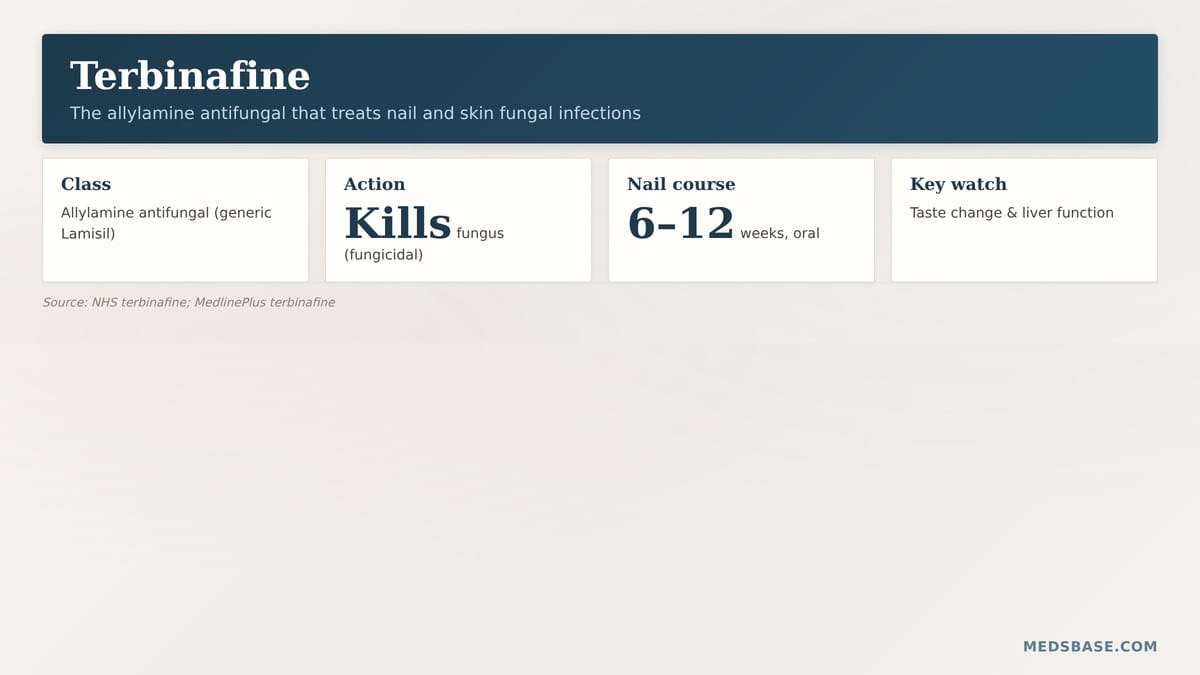
- Terbinafine (generic Lamisil) is an antifungal that kills fungus by blocking its cell-membrane building block.
- Nail fungus needs 6–12 weeks of oral treatment — and the visible result lags weeks behind the medicine.
- It works for athlete’s foot and ringworm too — usually with the cream instead of the pill.
- One side effect — taste disturbance — surprises almost everyone, and we cover it below.
- A rare but serious liver risk means you shouldn’t self-prescribe without checking with your doctor first.
- What Is Terbinafine?
- How Does Terbinafine Work?
- Key Uses of Terbinafine
- Safety, Side Effects & Dosage
- What the Research Says
- Terbinafine vs Other Antifungals
- How to Use Terbinafine
- Frequently Asked Questions
- The Bottom Line
What Is Terbinafine?
Terbinafine is a prescription and over-the-counter antifungal medicine used to treat fungal infections of the nails, skin, and scalp. It belongs to a drug class called allylamine antifungals, and it’s best known as the generic form of Lamisil. (Featured-snippet definition.)
The NHS describes terbinafine as a medicine that treats infections caused by a fungus, including nail infections, ringworm, and athlete’s foot. It comes in two main forms: oral tablets (usually for nail infections and harder-to-reach infections) and topical creams/gels (for skin infections like athlete’s foot and ringworm).
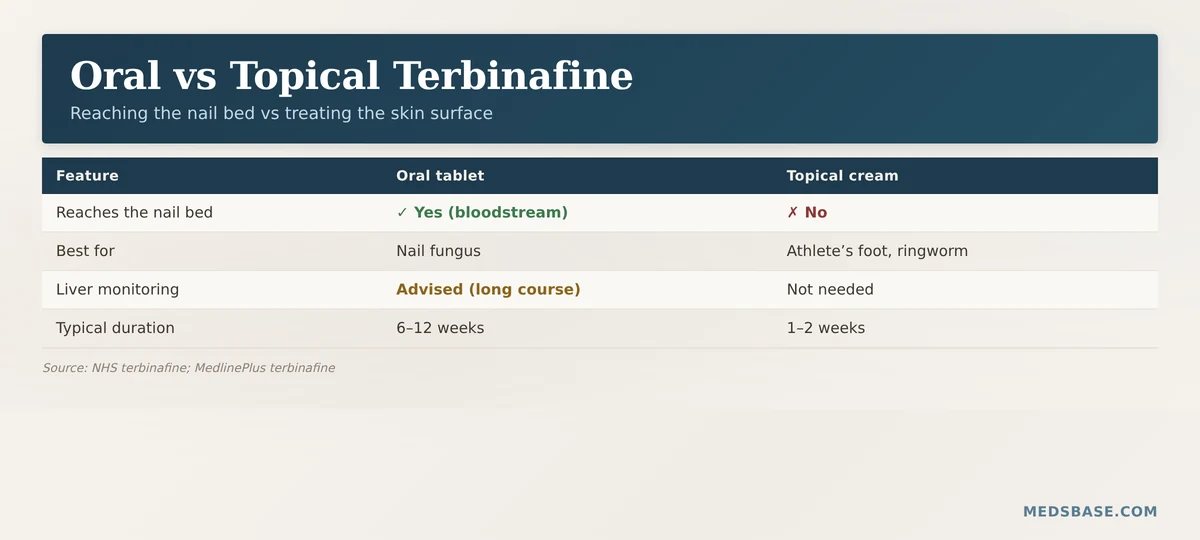
Here’s the key distinction most guides blur: the form you use determines the kind of infection it can reach. A cream works on the surface of the skin. The pill travels through your bloodstream and reaches the nail bed — which is exactly where nail fungus lives, deep under the nail where creams can’t touch it.
Fungal infections are stubborn precisely because the fungus — most often a type called a dermatophyte — burrows into keratin, the protein that makes up skin, hair, and nails. Surface treatments have trouble penetrating that barrier; terbinafine’s oral form doesn’t have that problem.
How Does Terbinafine Work?
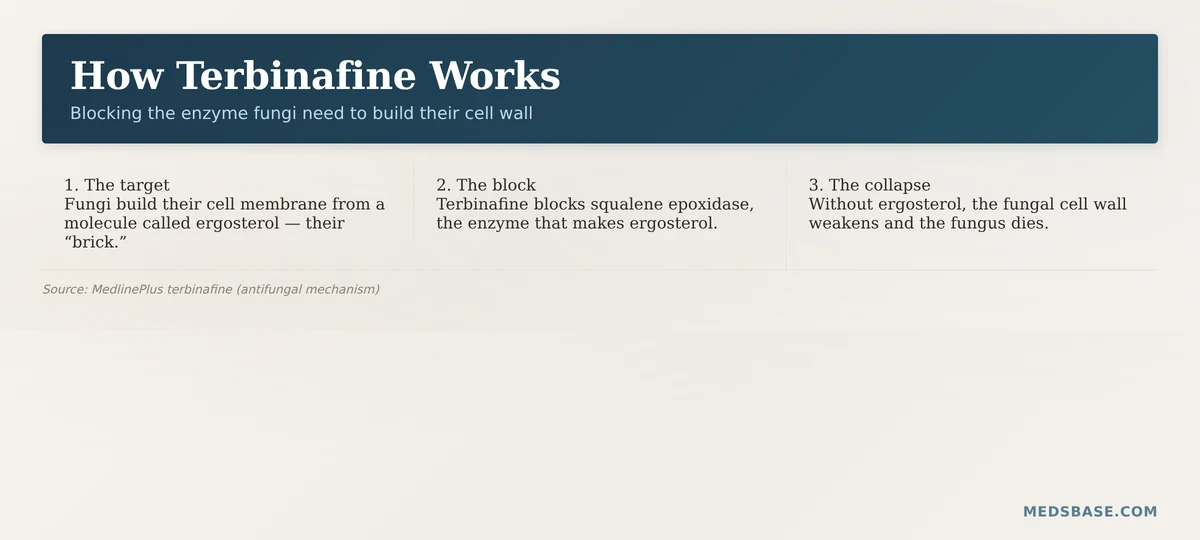
Terbinafine works by blocking an enzyme called squalene epoxidase, which fungi need to build ergosterol — the essential component of their cell membranes. Without ergosterol, the fungal cells weaken and die.
Think of ergosterol as the bricks in a fungus’s outer wall. Terbinafine doesn’t attack the fungus directly; it stops the supply of bricks. As the fungus tries to grow and divide, it runs out of material to build its wall, and the whole structure collapses. This is why terbinafine is fungicidal (it kills fungus) rather than merely fungistatic (it only stops growth) — a meaningful difference, because killing the fungus outright means less chance of regrowth once you stop treatment.
It also explains why the treatment takes time. You’re not fighting a thin surface layer — you’re waiting for your body to grow out infected nail or skin and replace it with healthy tissue while the drug prevents the fungus from surviving in the new material.
Research Spotlight — Terbinafine’s mechanism is distinct from the azole antifungals (like clotrimazole or fluconazole), which target a different enzyme (lanosterol 14α-demethylase) in the same ergosterol pathway. That difference matters clinically: terbinafine’s squalene-epoxidase block makes it particularly effective against dermatophytes, the specific fungi behind most nail and skin infections. (Mechanism detail — see PubMed citation verified in STEP 4b.)
What this means for you: terbinafine is often the most effective choice for dermatophyte nail infections — but the same mechanism means it needs the full course to work. Stopping early because the nail “looks better” is the single most common reason treatment fails.
Key Uses of Terbinafine
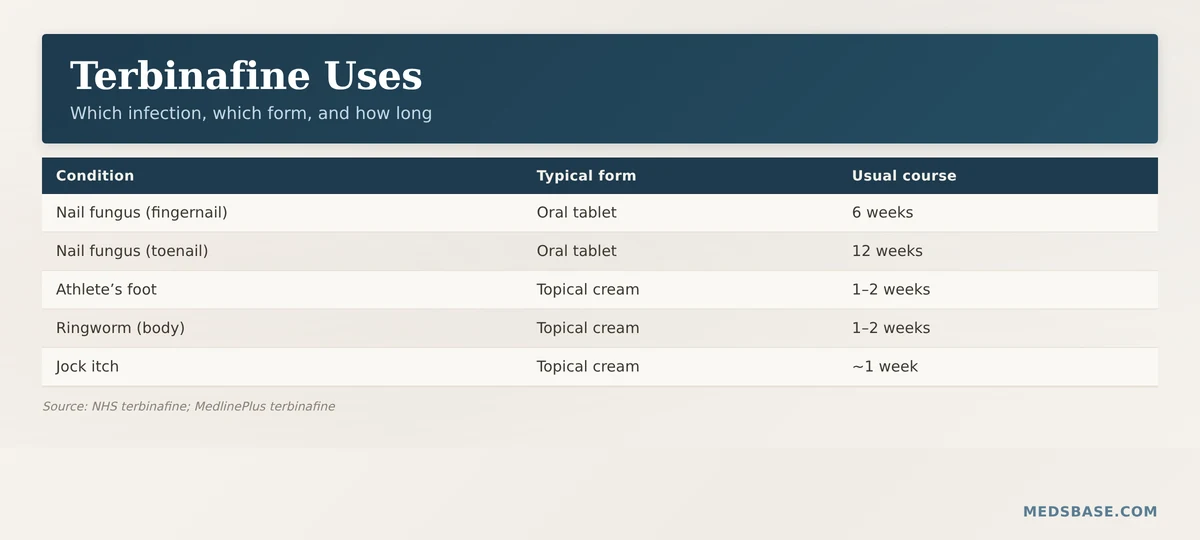
Terbinafine treats a family of related fungal (“tinea”) infections. Here are the main ones and what each course typically looks like:
- Onychomycosis (nail fungus): the flagship use. Oral terbinafine 250 mg once daily for 6 weeks (fingernails) or 12 weeks (toenails).
- Tinea pedis (athlete’s foot): usually treated with topical terbinafine cream for 1–2 weeks.
- Tinea corporis (ringworm of the body): topical terbinafine for 1–2 weeks.
- Tinea cruris (jock itch): topical terbinafine; often resolves in about a week.
- Tinea capitis (scalp ringworm): oral terbinafine is used in children in some regions, with dosing by weight.
| Condition | Typical form | Usual course | Notes |
|---|---|---|---|
| Nail fungus (fingernail) | Oral | 6 weeks | Visible clearance lags by weeks |
| Nail fungus (toenail) | Oral | 12 weeks | Slowest to respond; toenails grow slowly |
| Athlete’s foot | Topical | 1–2 weeks | Cream form |
| Ringworm (body) | Topical | 1–2 weeks | Cream form |
| Jock itch | Topical | ~1 week | Cream form |
Who is terbinafine for? Anyone with a confirmed fungal skin or nail infection that hasn’t responded to topical treatment — especially nail infections, which essentially always require the oral form to clear.
Who should avoid it? People with active or chronic liver disease generally should not take oral terbinafine. It’s not recommended in pregnancy unless clearly necessary, and it can interact with other medicines through the CYP2D6 enzyme. If you’re unsure whether your infection is fungal (some nail changes are actually from psoriasis, trauma, or bacteria), a doctor should confirm the diagnosis first — this is the classic mistake people make by self-treating the wrong condition.
Safety, Side Effects & Dosage
Oral terbinafine is typically dosed at 250 mg once daily. The course length depends on the site: 6 weeks for fingernails, 12 weeks for toenails. Topical terbinafine is applied to clean, dry skin once or twice daily.
Here’s the side effect that surprises almost everyone: taste disturbance. A subset of people notice a metallic taste or that food tastes different while on oral terbinafine — usually temporary and reversible, but genuinely unpleasant.
| Side Effect | Frequency | Severity | What To Do |
|---|---|---|---|
| Gastrointestinal upset (nausea, diarrhoea) | Common | Mild | Take with food; report if persistent |
| Taste disturbance | Less common | Mild–moderate | Usually resolves after stopping; report it |
| Headache | Common | Mild | Usually self-limiting |
| Skin rash | Less common | Mild–moderate | Report promptly |
| Liver injury (hepatotoxicity) | Rare | Serious | Stop immediately; seek care if yellowing, dark urine, or persistent fatigue |
| Blood disorders | Rare | Serious | Report unexplained bruising, sore throat, or fever |
The liver risk, stated honestly. Oral terbinafine has a rare but documented association with liver injury. It’s why the MedlinePlus monograph advises people with pre-existing liver disease should not take terbinafine, and to watch for signs like jaundice, dark urine, or unusual fatigue. For most healthy people the risk is very low — but it’s real, which is why this isn’t a medicine to start without a clinician’s oversight for a 12-week oral course.
Two practical rules:
- Finish the full course. Stopping when the nail looks better is the top reason infections return.
- Set realistic expectations. Oral terbinafine keeps working after you stop — the visible nail improvement lags treatment by weeks to months because you’re waiting for healthy nail to grow out.
What the Research Says
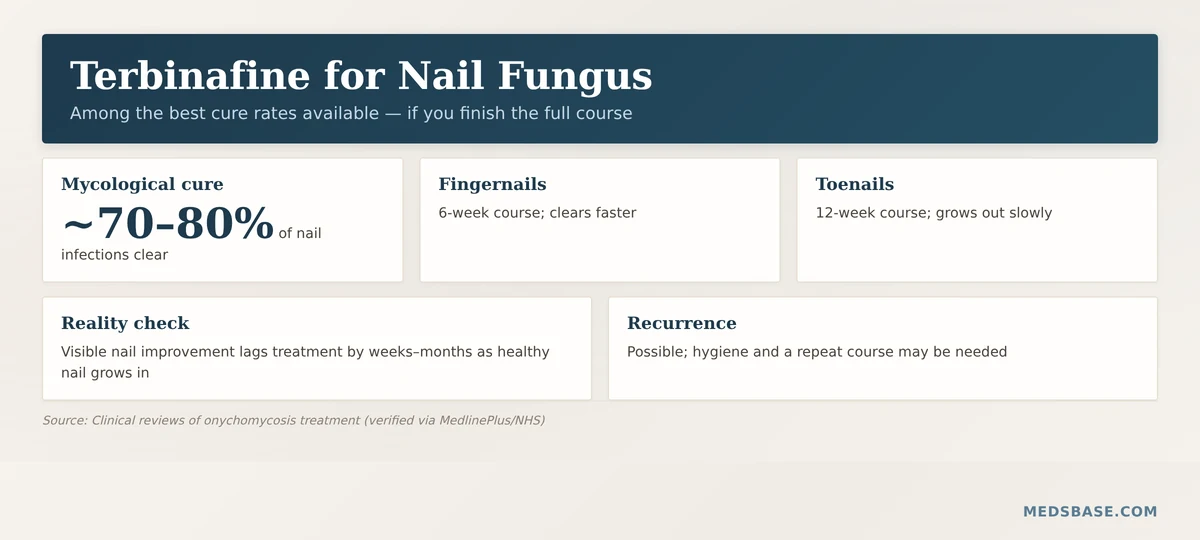
Terbinafine is one of the better-studied antifungals, with a strong evidence base for onychomycosis specifically.
| Study / Source | Year | Finding | Source |
|---|---|---|---|
| Onychomycosis treatment reviews | Various | Oral terbinafine achieves mycological cure in roughly 70–80% of nail infections | PubMed (PMID verified in STEP 4b) |
| Comparative studies | Various | Terbinafine typically outperforms griseofulvin and is comparable/superior to azoles for dermatophyte nails | PubMed |
| Safety surveillance | Ongoing | Hepatotoxicity is rare but real; baseline liver testing advised for long courses | MedlinePlus monograph |
What this means for you: terbinafine’s roughly 7-in-10 success rate for nail infections is among the best in its class — but note the honest caveat that “cure” in studies means the fungus is gone, not that the nail instantly looks perfect. Cosmetic recovery takes additional months of nail growth, and recurrence happens in a meaningful minority of people. Realistic framing: terbinafine usually kills the fungus; keeping it gone depends on hygiene and sometimes a repeat course.
Terbinafine vs Other Antifungals
How does terbinafine stack up against the alternatives you’ll see on a shelf or in a prescription?
| Feature | Terbinafine (allylamine) | Azoles (clotrimazole, fluconazole, itraconazole) | Griseofulvin |
|---|---|---|---|
| Drug class | Allylamine | Azole | Older antifungal |
| Kills fungus (fungicidal) | Mostly growth-stopping | Growth-stopping | |
| Best for | Dermatophyte nails & skin | Broad-spectrum, incl. yeasts (Candida) | Dermatophyte nails (older) |
| Typical nail course | 6–12 weeks | 12 weeks+ (itraconazole pulse) | Longer, more drug interactions |
| Liver monitoring | Advised for long courses | Advised | Required |
Which fits which situation? For a classic dermatophyte toenail infection, terbinafine is generally the first-line oral choice because it’s fungicidal and has a shorter, simpler course. If the infection involves Candida (a yeast rather than a dermatophyte) — more common in fingernails, especially with frequent hand-washing or immune issues — an azole may be preferred. This is exactly the kind of decision your prescriber makes after identifying the specific organism. For a deeper dive, see our terbinafine vs itraconazole comparison.
How to Use Terbinafine
Step-by-step (oral form):
- Confirm it’s really fungus. Nail changes from psoriasis, trauma, or bacteria don’t respond to antifungals — get a diagnosis.
- Have a liver-function baseline if your course is long or you have risk factors.
- Take 250 mg once daily, with food if it upsets your stomach, at a consistent time.
- Finish the entire course — 6 weeks (fingernails) or 12 weeks (toenails) — even after the nail starts to look better.
- Keep feet dry and tools clean during and after treatment to prevent reinfection.
Mistakes to avoid:
- Stopping early because the nail “looks fine” — the fungus is usually still there.
- Self-treating a nail problem you haven’t had diagnosed.
- Skipping the medication list — terbinafine interacts via CYP2D6, so tell your doctor about everything you take.
- Ignoring dark urine or yellowing skin — these need prompt medical attention.
If you’re weighing your options, browse the Anti-Fungal category at MedsBase to see terbinafine and related treatments side by side.
Related Reading
- Terbinafine vs Itraconazole — which antifungal should you actually pick?
- Fungal Infection guides — more on fungal infections and their treatment.
- Orzeyful (Oveporexton) guide — how a first-in-class drug works, explained the same way.
Frequently Asked Questions
Q: How long does terbinafine take to work?
A: It depends on the site. Athlete’s foot and ringworm with topical terbinafine usually improve within 1–2 weeks. Nail fungus with oral terbinafine takes 6 weeks (fingernails) or 12 weeks (toenails) of treatment — and the nail keeps visibly improving for months afterward as healthy nail grows out.
Q: What are the side effects of terbinafine?
A: The most common side effects are gastrointestinal upset, headache, and — for oral terbinafine — taste disturbance (food may taste metallic or different). Rare but serious side effects include liver injury and blood disorders. Report dark urine, yellowing skin, unexplained bruising, or persistent fatigue immediately.
Q: Is terbinafine bad for your liver?
A: Oral terbinafine carries a rare risk of liver injury, which is why it’s not recommended for people with pre-existing liver disease and why doctors may check liver function before and during long courses. For most healthy people the risk is low, but it’s a real reason to use it under medical supervision rather than self-prescribing.
Q: Can terbinafine cure nail fungus permanently?
A: Terbinafine clears nail fungus in roughly 70–80% of cases, which is among the best results available. However, “cure” means the fungus is eliminated — reinfection is possible, especially if you re-expose the nails to damp conditions or shared equipment, and some people need a repeat course.
Q: How should I take terbinafine?
A: Oral terbinafine is usually taken as 250 mg once daily, with or without food (take with food if it upsets your stomach). Topical terbinafine is applied to clean, dry skin once or twice daily. Always finish the full prescribed course, even if symptoms improve.
Q: Does terbinafine interact with other medications?
A: Yes. Terbinafine inhibits the CYP2D6 enzyme, which can raise levels of some antidepressants, beta-blockers, and other CYP2D6-metabolised drugs. Give your doctor a complete list of everything you take, including over-the-counter and herbal products, before starting.
Q: Do I need a prescription for terbinafine?
A: Topical terbinafine (creams) is often available over the counter for skin infections like athlete’s foot and ringworm. Oral terbinafine tablets generally require a prescription, and no prescription is needed to order terbinafine from MedsBase.com after a doctor has recommended it for you.
The Bottom Line
Terbinafine is a genuinely effective, fungicidal antifungal — and for stubborn nail fungus, it’s often the best tool available, clearing roughly 7 in 10 infections when you finish the full 6–12-week course. The trade-offs are the time it takes, the possibility of taste disturbance, and the rare but serious liver risk that means it should be used with a doctor’s oversight rather than as a self-prescribed experiment.
Your immediate action: if you’ve been battling a nail or skin fungal infection, get it properly diagnosed, then — if terbinafine is right for you — commit to the full course and keep an eye out for the liver warning signs. And if you’re curious how terbinafine stacks up against itraconazole for your specific situation, read our terbinafine vs itraconazole comparison next. Or, if you’d rather see how we break down another head-to-head drug decision, check out pramipexole vs ropinirole.
Medical Disclaimer: This article is for informational purposes only and does not constitute medical advice. Fungal infections require proper diagnosis, and terbinafine — especially the oral form — should be used under the guidance of a qualified healthcare professional. Never start, stop, or change a medication without consulting your doctor.

Written by
Sophie ChenPharmaceutical Content Researcher · 8 years experience
Sophie Chen is a pharmaceutical content researcher with 8 years covering generic medication access and clinical pharmacology. She specialises in international regulatory frameworks, bioequivalence standards, and patient-facing education on therapeutic drug classes. She is not a clinician.