








✓ Medically reviewed by · Last reviewed: May 2026
Pharmacy Researcher · 8 years experience
Pharmacy researcher with 8 years reviewing clinical drug information, generic formulation equivalence, and international pharmaceutical standards. Focuses on patient-facing accuracy in medication education.
bisphosphonates for osteoporosis — Bisphosphonates for Osteoporosis: 7 Essential Facts & Safety Guide. Read on for an evidence-backed guide covering everything you need to know.
You have just been told your bones are thinning, and the first medicine your doctor mentioned has a name you can barely pronounce — and, if you googled it, a side-effect list long enough to make you want to skip treatment entirely. Take a breath. Bisphosphonates for osteoporosis are the most widely used first-line treatment in the world, they have decades of evidence behind them, and most of what you have read about them online is either outdated or missing the context that makes the risk feel proportionate.
By the end of this guide you will know exactly what bisphosphonates for osteoporosis do, why the way you take them matters more than almost any other medicine you will ever be prescribed, how long they take to work, and how to weigh the jaw side effect everyone worries about against the very real risk of a broken hip. You will also know when a bisphosphonate is the right choice — and when another option might serve you better.
Key Takeaways
- Bisphosphonates for osteoporosis work by slowing down bone breakdown, which lets your body’s natural bone-building keep up — but they are not a quick fix, and the payoff is measured in years, not weeks
- The three dosing rules — empty stomach, plain water only, stay upright for 30 minutes — are not fussy suggestions; they are what stop the drug from damaging your food pipe
- The jaw side effect (osteonecrosis of the jaw) is real but rare, and it is far more common with high-dose intravenous treatment for cancer than with the tablets used for osteoporosis
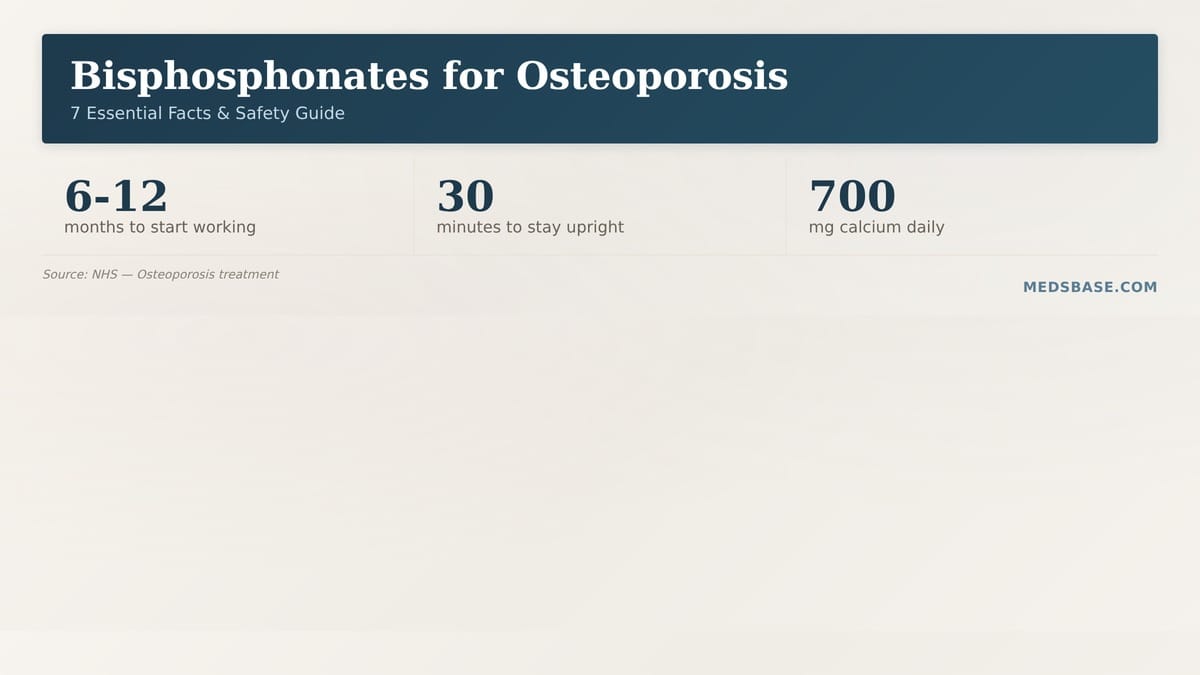
- They usually take 6 to 12 months to start working, and treatment may continue for 5 years or more
- Calcium and vitamin D are the quiet co-stars — a bisphosphonate cannot build bone without the raw materials
- What Are Bisphosphonates for Osteoporosis?
- How Do Bisphosphonates for Osteoporosis Work?
- Who Should Take Bisphosphonates for Osteoporosis?
- How to Take Bisphosphonates for Osteoporosis Correctly
- Safety: Side Effects of Bisphosphonates for Osteoporosis
- Bisphosphonates for Osteoporosis vs Other Treatments
- Calcium, Vitamin D & Everyday Bone Care
- Related Reading
- Frequently Asked Questions
- The Bottom Line
What Are Bisphosphonates for Osteoporosis?
Bisphosphonates for osteoporosis are a class of medicines that slow the rate at which your body breaks down bone. The NHS explains that this maintains bone density and reduces your risk of a broken bone. They are usually the first treatment a doctor reaches for when osteoporosis — or high-risk osteopenia — is diagnosed.
The class includes several familiar drugs. The NHS lists alendronic acid, ibandronic acid, risedronate, and zoledronic acid. Alendronic acid (also known as alendronate) is the most commonly prescribed, and MedlinePlus describes it as being in a class called bisphosphonates that works by preventing bone breakdown and increasing bone density. Some are taken as a tablet, some as a liquid, and some as an injection.
To understand why these medicines matter, you need to understand osteoporosis itself. The NHS defines osteoporosis as a condition that weakens bones, making them fragile and more likely to break, and notes it often goes undiagnosed until a fall or sudden impact causes a fracture. The most common injuries are a broken wrist, a broken hip, and broken spinal bones.
Bisphosphonates for osteoporosis do not rebuild bone the way an anabolic steroid builds muscle. They tip the balance — your body is always breaking down old bone and laying down new bone, and in osteoporosis the breakdown side is winning. These medicines slow the breakdown side so the building side can catch up.
How Do Bisphosphonates for Osteoporosis Work?
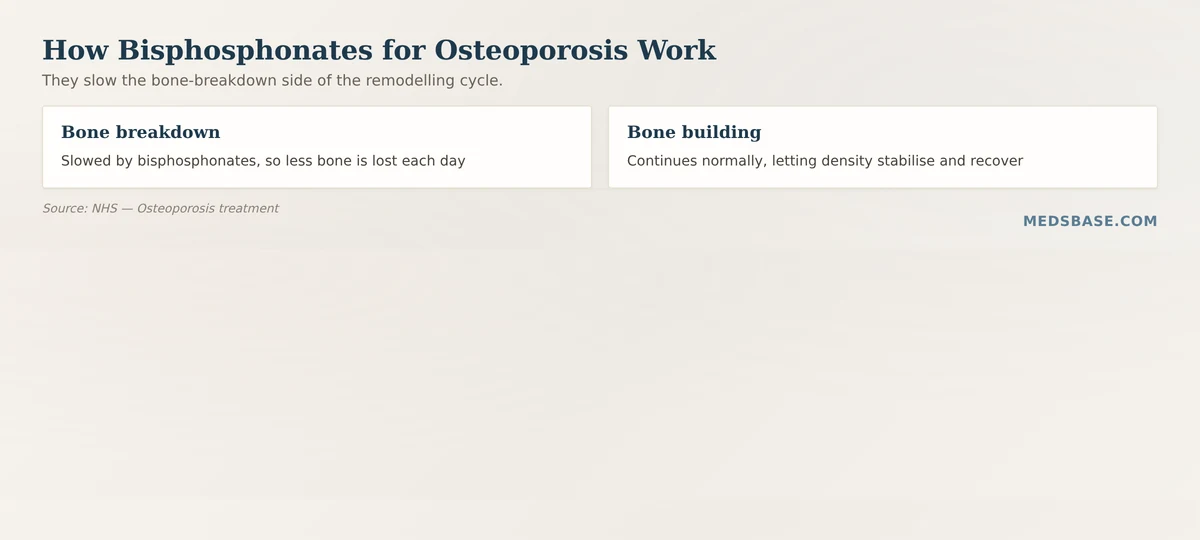
Bone is not the static scaffold it looks like. It is living tissue that constantly remodels itself: cells called osteoclasts break down old bone, while cells called osteoblasts build new bone. In youth these two processes are in balance. After menopause — and with age — the breakdown side gradually outpaces the building side, and net bone is lost.
Bisphosphonates for osteoporosis work by suppressing the osteoclasts, the cells that break bone down. By slowing resorption, they allow bone density to stabilise and, over time, increase. The NHS puts it simply: bisphosphonates slow the rate that bone is broken down in your body, which maintains bone density and reduces your risk of a broken bone.
A useful analogy: think of your skeleton as a wall that is constantly being repaired. In osteoporosis, the demolition crew is working faster than the bricklayers. Bisphosphonates for osteoporosis are not extra bricklayers — they are a work order telling the demolition crew to slow down, which lets the existing bricklayers finally make progress.
Clinical insight: One of the most common misunderstandings pharmacists hear is that bisphosphonates for osteoporosis “don’t seem to do anything.” Patients take a tablet once a week and feel no different, so they wonder whether it is working. The drugs are invisible by design — you cannot feel bone density improving, which is why repeat DEXA scans are the real measure, not how you feel day to day.
Who Should Take Bisphosphonates for Osteoporosis?
Bisphosphonates for osteoporosis are not for everyone with a slightly low bone-density reading, and the decision is genuinely individual. The NHS is clear that treatment depends on your age, sex, fracture risk, and previous injury history.
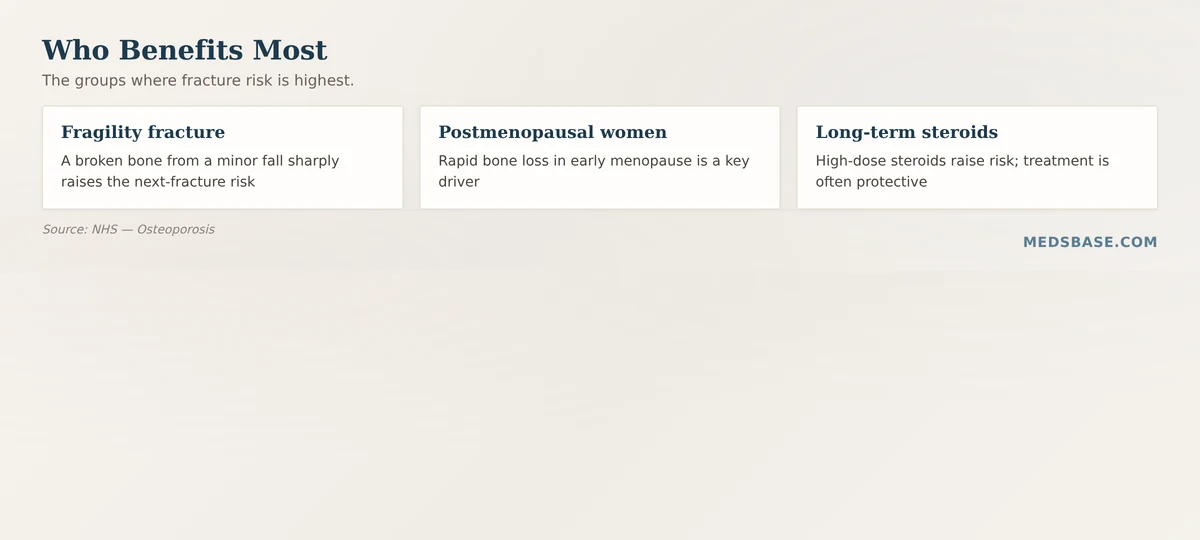
The people who benefit most include those who have already broken a bone from a minor bump or fall — a “fragility fracture” — because a first fracture sharply raises the risk of a second. Postmenopausal women with a T-score below -2.5 are also prime candidates, since rapid bone loss in the first years after menopause is the single biggest driver of osteoporosis.
Another key group is people taking long-term steroids. The NHS lists taking high-dose steroid tablets for more than three months as a major risk factor, and these patients are often prescribed a bisphosphonate protectively, even before bone loss shows up on a scan.
- For: anyone with a diagnosed fragility fracture; postmenopausal women with osteoporosis on a bone-density scan; people on long-term steroids; those whose fracture risk assessment (such as FRAX) comes back high.
- For: people who can commit to the dosing routine — the drug is only effective (and only safe) if taken correctly.
- Avoid / hold off: people who cannot sit or stand upright for 30 minutes; anyone with certain food-pipe (oesophageal) problems, low blood calcium, or who cannot follow the empty-stomach rules. MedlinePlus notes your doctor may tell you not to take alendronate in these situations.
- Always: discuss with your doctor — this is a long-term medicine, and the right call depends on your individual risk profile.
If a bisphosphonate is the right fit for you, the next step is getting the medicine and the routine right. MedsBase stocks alendronate (Osteofos) — and, as with all MedsBase products, no prescription is needed to order it, though a conversation with your doctor about whether it is appropriate for you remains essential.
How to Take Bisphosphonates for Osteoporosis Correctly
The way you take bisphosphonates for osteoporosis is genuinely more important than the dose. These medicines are poorly absorbed and mildly irritating to the food pipe, so the entire routine exists to maximise absorption while protecting your oesophagus.
The MedlinePlus alendronate page spells out the rules in detail, and they apply to the oral bisphosphonates generally:
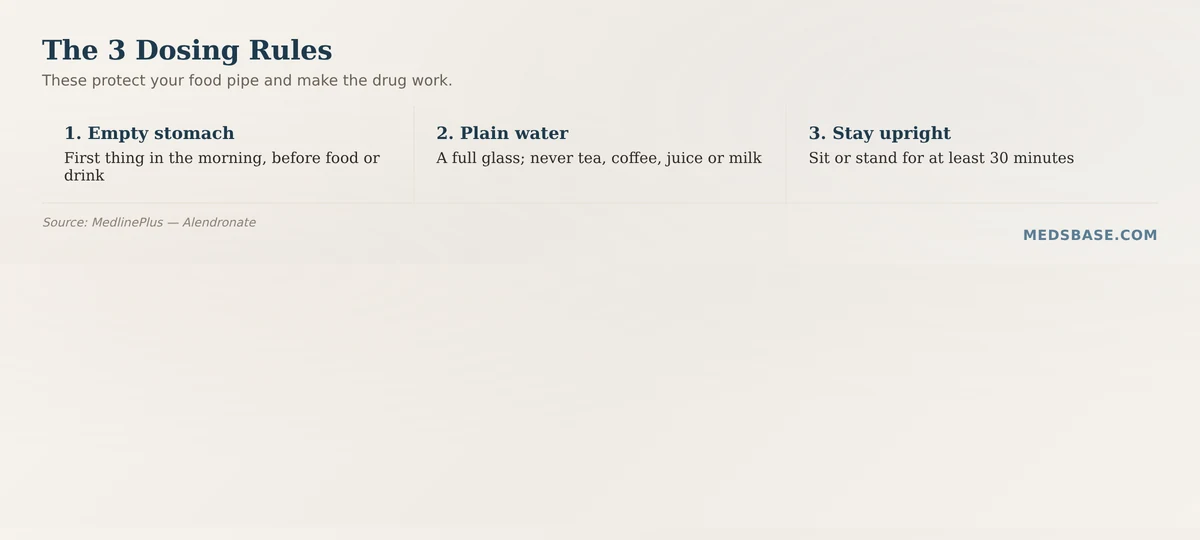
- Take it first thing in the morning, on a completely empty stomach. Before you eat or drink anything, and never at bedtime.
- Swallow the tablet whole with a full glass of plain water. Six to eight ounces, and only plain water — never tea, coffee, juice, milk, mineral water, or sparkling water.
- Stay upright for at least 30 minutes. Sit or stand; do not lie down, and do not eat, drink, or take any other medicine, vitamin, or antacid until at least 30 minutes have passed.
The NHS adds that you may need to wait between 30 minutes and 2 hours before eating or drinking anything else, depending on the specific medicine. Check your own product’s instructions.
- Wake up and take the tablet immediately, before breakfast or coffee
- Swallow it whole with a full glass of plain water
- Stay sitting or standing for 30 minutes — do not lie back down
- Do not eat, drink, or take other tablets or supplements in that window
- Then carry on with your normal day and breakfast
Mistakes to avoid:
- Taking it with coffee or juice, which interferes with absorption
- Lying back down after taking it, which lets the tablet sit against the food pipe
- Crushing or chewing the tablet, which can cause mouth or throat sores
- Taking calcium at the same time — calcium binds the drug and blocks absorption
Getting this routine wrong does not just make bisphosphonates for osteoporosis less effective; MedlinePlus warns that taking them incorrectly can damage the oesophagus or cause mouth sores. This is a rare medicine where the “how” is genuinely non-negotiable.
Safety: Side Effects of Bisphosphonates for Osteoporosis
The side-effect conversation is where most people get scared unnecessarily, so let us separate the common from the rare and keep both in proportion.
The most common side effects are mild and digestive. The NHS lists irritation to the food pipe, swallowing problems, and stomach pain as the main ones. MedlinePlus adds nausea, stomach pain, constipation, diarrhoea, gas, and bloating as possible mild effects. Most of these can be minimised by following the dosing rules above.
The two side effects that generate the most anxiety are osteonecrosis of the jaw (ONJ) and atypical thigh fractures — and both deserve honest context.
| Side effect | Frequency | Severity | What to do |
|---|---|---|---|
| Food pipe irritation, stomach pain | Common (with incorrect dosing) | Mild–moderate | Follow the dosing rules; report persistent pain |
| Nausea, constipation, bloating | Common | Mild | Usually settles; report if severe |
| Osteonecrosis of the jaw (ONJ) | Rare with tablets; more common with high-dose IV cancer treatment | Serious | Dental check-up before starting; report jaw pain, loose teeth |
| Atypical thigh fracture | Rare | Serious | Report dull thigh or groin pain |
| Severe bone, muscle or joint pain | Uncommon | Moderate | Report to your doctor |
The NHS is explicit that osteonecrosis of the jaw is rare and “most frequently with high-dose intravenous bisphosphonate treatment for cancer and not for osteoporosis.” MedlinePlus advises a dental check-up before starting treatment, and to keep up good mouth care while taking the medicine. If you need dental surgery, tell your dentist you are taking a bisphosphonate.
Here is the proportionality that often gets lost: a hip fracture in an older adult carries a serious risk of disability and death. The risk of ONJ from tablet bisphosphonates for osteoporosis, by contrast, is on the order of a few cases per tens of thousands of patient-years. Both are real; one is far more common. Your doctor weighs exactly this when deciding that the medicine is worth it for you.
Bisphosphonates for Osteoporosis vs Other Treatments
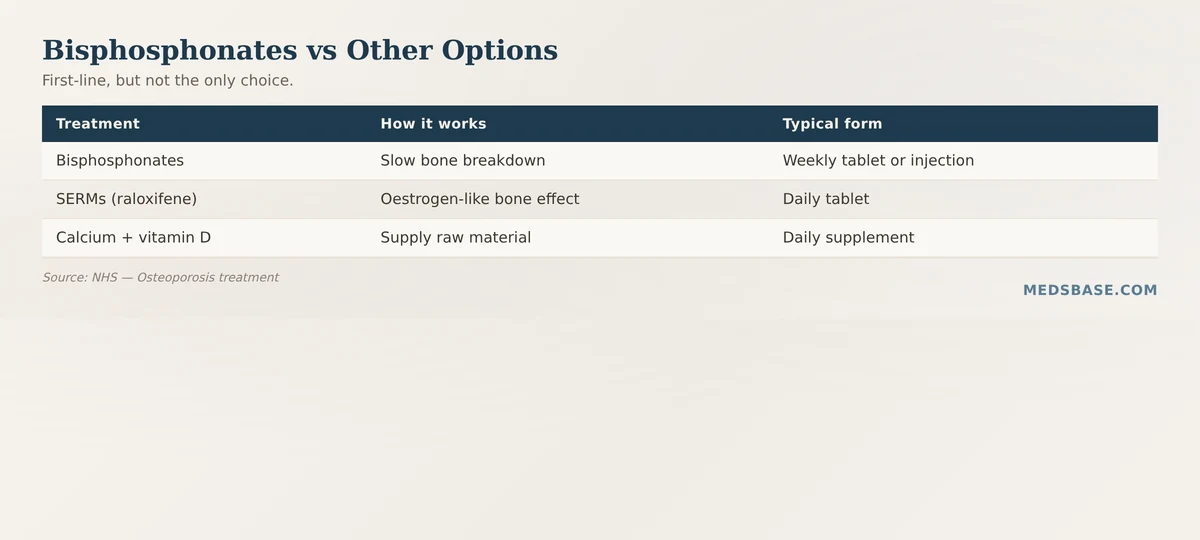
Bisphosphonates for osteoporosis are first-line, but they are not the only option, and they are not always the best one. The NHS treatment guide lays out the full menu.
| Treatment | How it works | Typical form | Notes |
|---|---|---|---|
| Bisphosphonates | Slow bone breakdown | Weekly tablet or injection | First-line; 6–12 months to work |
| SERMs (raloxifene) | Oestrogen-like effect on bone | Daily tablet | Postmenopausal women only; may reduce spine fracture |
| Parathyroid hormone (teriparatide) | Stimulates new bone | Daily injection | For very low density; builds bone |
| Biologicals (denosumab, romosozumab) | Slow breakdown + speed building | Injection monthly/quarterly | For severe disease or intolerance |
| Calcium + vitamin D | Supply raw material | Daily supplement | Supportive, not a standalone treatment |
The choice usually comes down to this: bisphosphonates for osteoporosis are the default because they are well-studied, effective, convenient, and inexpensive. Raloxifene is a reasonable alternative for postmenopausal women who want an oestrogen-like bone effect without bisphosphonates, though it can cause hot flushes and leg cramps and carries a small increased risk of blood clots. Parathyroid hormone and the biologicals are reserved for more severe cases or when other treatments fail.
If a non-bisphosphonate option appeals to you, MedsBase stocks raloxifene (Raloxiheal) — again, no prescription needed to order, but the choice should be made with your doctor. The key is that “which medicine” is a decision, not a default, and your fracture risk is the deciding factor.
Calcium, Vitamin D & Everyday Bone Care
Bisphosphonates for osteoporosis cannot do their job alone, because they need calcium and vitamin D as raw materials. The NHS recommends around 700 milligrams of calcium a day for most healthy adults — more if you have osteoporosis — and 10 micrograms of vitamin D a day for all adults.
Vitamin D matters because it helps your body absorb calcium. Without enough vitamin D, you can swallow all the calcium in the world and your bones will still not benefit. The timing also matters: take calcium and vitamin D at a different time from your bisphosphonate, because calcium taken together can block the drug’s absorption.
Beyond medication, the NHS prevention advice is refreshingly concrete: regular weight-bearing exercise, eating calcium- and vitamin D-rich foods, quitting smoking, and cutting back on alcohol. These are not afterthoughts — they are part of the same treatment plan as the tablet.
If you need to top up your calcium and vitamin D intake, MedsBase stocks a calcium and vitamin D supplement (Cipcal). Think of it as giving your bones the building blocks the medicine is trying to protect.
Frequently Asked Questions
Q: What are bisphosphonates?
A: Bisphosphonates are a class of medicines that slow the rate at which your body breaks down bone. The NHS explains they maintain bone density and reduce fracture risk, and lists alendronic acid, ibandronic acid, risedronate, and zoledronic acid as the main examples.
Q: How do you take alendronate correctly?
A: Take it first thing in the morning on a completely empty stomach, swallow it whole with a full glass of plain water, and stay sitting or standing upright for at least 30 minutes. MedlinePlus stresses never to take it with tea, coffee, juice, milk, or mineral water, and never to lie down during that first 30 minutes.
Q: What are the side effects of bisphosphonates?
A: The most common are mild and digestive — food pipe irritation, swallowing problems, and stomach pain, according to the NHS. Rarer but more serious effects include osteonecrosis of the jaw and atypical thigh fractures; the NHS notes the jaw problem is mostly linked to high-dose intravenous cancer treatment rather than osteoporosis tablets.
Q: How long do bisphosphonates take to work?
A: The NHS says bisphosphonates usually take 6 to 12 months to work, and you may need to take them for 5 years or longer. Because you cannot feel bone density improving, repeat DEXA scans — not how you feel — are how progress is measured.
Q: Can bisphosphonates cause jaw problems?
A: Yes, but rarely. Osteonecrosis of the jaw can occur, especially with dental surgery during treatment. MedlinePlus recommends a dental check-up before starting and good mouth care throughout. The risk is far lower with tablets for osteoporosis than with high-dose intravenous treatment for cancer.
Q: What is the difference between osteopenia and osteoporosis?
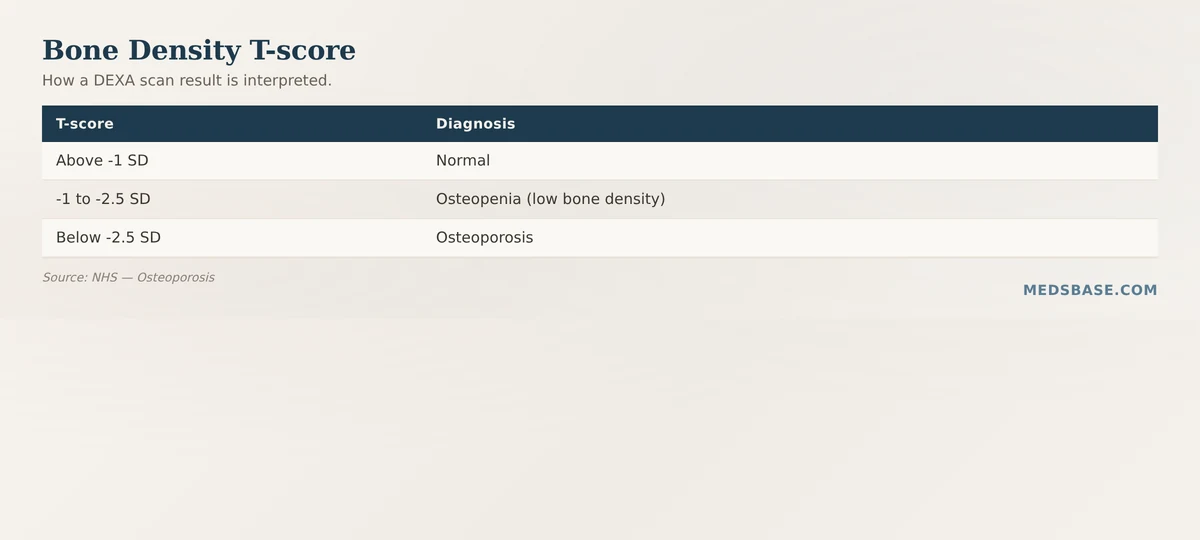
A: Both mean lower-than-average bone density. The NHS uses a T-score: above -1 is normal, between -1 and -2.5 is osteopenia (low density), and below -2.5 is osteoporosis. Osteopenia is the earlier stage and does not always progress to osteoporosis.
Q: Do I need calcium and vitamin D with bisphosphonates?
A: Yes, in most cases. The NHS recommends around 700 mg of calcium and 10 micrograms of vitamin D daily, and advises taking them at a different time from the bisphosphonate so they do not block its absorption.
The Bottom Line
Bisphosphonates for osteoporosis are the first-line treatment for a reason: they are effective, well-studied, convenient, and inexpensive. For most people with a fragility fracture or an osteoporotic bone-density reading, the benefit of reducing future fractures comfortably outweighs the small risk of the rare side effects — provided the medicine is taken correctly.
The honest bottom line is that the “correctly” part is where most people slip, and it is also where most of the scary stories come from. Take it on an empty stomach, with plain water, and stay upright for 30 minutes, and you have already neutralised the most common problems.
Your immediate action is simple: if you have been prescribed bisphosphonates for osteoporosis, write down the three dosing rules and stick them where you will see them in the morning. And if you are weighing your options, browse alendronate (Osteofos) at MedsBase or compare it with raloxifene. Wondering how bone health fits with the rest of your picture? Read our guide to continuous ketone monitoring for the other half of metabolic health.

Written by
Sophie ChenPharmaceutical Content Researcher · 8 years experience
Sophie Chen is a pharmaceutical content researcher with 8 years covering generic medication access and clinical pharmacology. She specialises in international regulatory frameworks, bioequivalence standards, and patient-facing education on therapeutic drug classes. She is not a clinician.