








✓ Medically reviewed by · Last reviewed: May 2026
Pharmacy Researcher · 8 years experience
Pharmacy researcher with 8 years reviewing clinical drug information, generic formulation equivalence, and international pharmaceutical standards. Focuses on patient-facing accuracy in medication education.
You find a half-used bottle of amoxicillin at the back of the cabinet, the date on the label slipped past months ago, and your throat is starting to feel raw again. So does amoxicillin expire, and does that faded date mean the pills are now useless — or dangerous? The honest answer is more nuanced than the panic-or-shrug takes you usually run into. Yes, amoxicillin expires, and the date is real. But an expiration date is a manufacturer’s promise of full potency up to that day under proper storage, not the exact minute a tablet flips from medicine to poison. That distinction matters, and it shifts depending on the form in your hand. A sealed tablet behaves very differently from the pink liquid a pharmacist mixed up for a child’s ear infection. By the end of this guide you’ll know what the date really guarantees, which form to worry about most, what the research actually shows, and the one situation where reaching for leftovers is the wrong move — even when the drug is technically still strong.
- Yes, amoxicillin expires — but the label date is a potency guarantee, not a hard safety cliff.
- Sealed tablets and capsules are the sturdiest form; testing has found many solid drugs holding potency for years past label under ideal storage.
- Reconstituted (mixed) liquid amoxicillin is the real weak link — refrigerate it and discard it after about 14 days.
- Sub-potent antibiotics can under-treat an infection and feed antibiotic resistance, so “still strong-ish” isn’t automatically “safe to use.”
- Storage decides almost everything: heat, humidity, and light in bathrooms and hot cars speed up breakdown.
- The safest move is to skip self-treating a new infection with leftovers and get the right drug at the right dose.
Does Amoxicillin Expire? The Straight Answer
Every box of amoxicillin carries a printed expiration date because regulators require it, and because the manufacturer has tested how long the product reliably holds its strength. Up to that date, stored the way the label says, you can trust the tablet or capsule to deliver the labeled dose.
Past the date, you move into a grey zone rather than falling off a cliff. A sealed tablet does not suddenly become toxic at midnight on the expiry date. What actually happens is slower and quieter: the active ingredient can gradually lose strength, and how fast that happens depends heavily on how the medicine was stored. That is the nuance most quick answers skip — and it is exactly the part that decides whether your leftover bottle is merely weaker or genuinely a bad idea to use.
There is one honest exception worth flagging right away, because it is the most common real-world scenario: the pink liquid amoxicillin a pharmacist mixes on the spot. That form is far less stable than dry tablets, and its useful life is measured in days, not months. We’ll come back to it in detail.
What an Expiration Date Actually Means
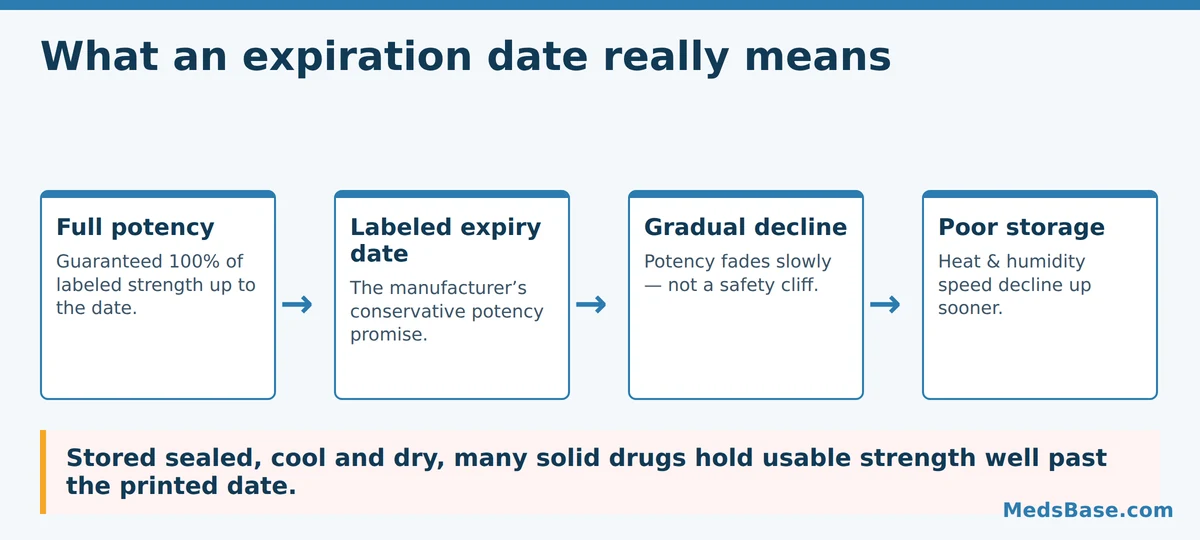
Think of an expiration date less like a “use-by” warning on milk and more like a warranty. It is the last day the manufacturer will vouch that the medicine holds its full labeled strength, quality, and purity — provided you stored it under the labeled conditions. The FDA describes the expiration date as the period during which the product is known to remain stable, meaning it keeps its strength, quality, and purity when stored correctly. FDA — Expiration Dates: Questions and Answers
That word “stored correctly” is doing a lot of heavy lifting. Manufacturers set the date based on stability testing in controlled conditions. A bottle that lived in a warm, humid bathroom has not had those controlled conditions, so its real-world potency could fade faster than the date suggests. A bottle that sat sealed in a cool, dark drawer may hold up better than the date implies. The date is a conservative promise, not a precise stopwatch.
Here is the part that surprises people. When drugs do lose potency, tablets and capsules tend to lose it slowly, and long-term testing has repeatedly found solid oral medicines holding usable strength well beyond their printed dates under good storage.
So why do expiration dates look so cautious next to that finding? Two reasons. First, manufacturers can only guarantee what they have formally tested, and long shelf-life studies are expensive, so dates are set conservatively. Second — and this is the antibiotic-specific twist — potency loss carries a different weight for an antibiotic than for, say, a mild headache tablet. Being “mostly potent” is fine for some drugs. For an antibiotic that has to fully clear an infection, “mostly” can be a problem, and that is where the story gets more careful.
Amoxicillin Shelf Life by Form: Tablets, Capsules & Liquid
Not all amoxicillin ages the same way. The single most important factor in whether your leftover is usable is the form it comes in. Getting this right answers most of what people mean when they ask does amoxicillin expire in a way that matters.
Sealed Tablets and Capsules
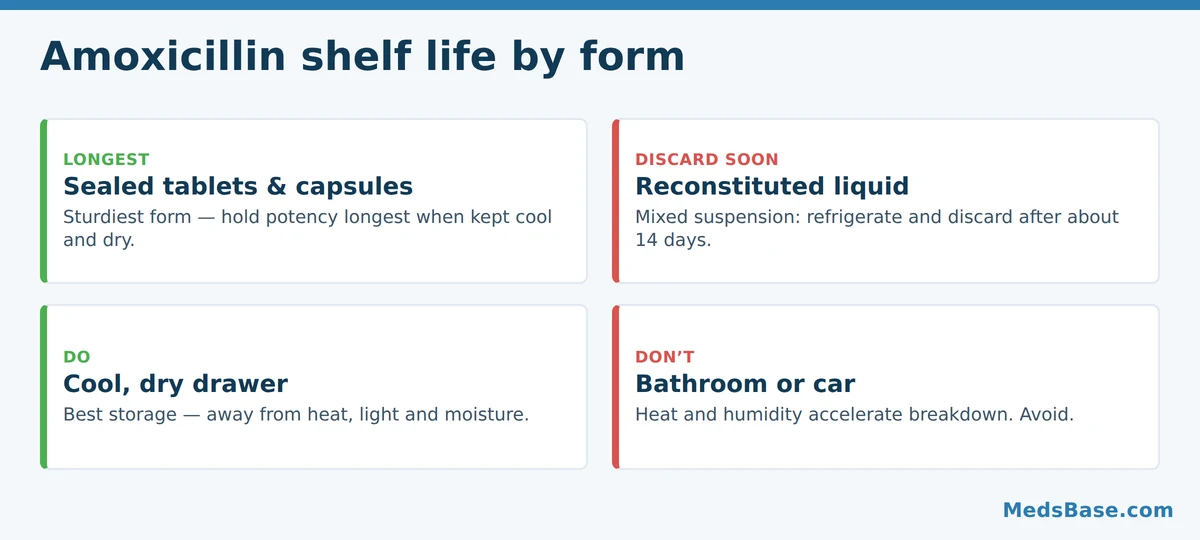
Dry solid forms are the durable ones. Kept sealed in their original packaging, in a cool and dry spot, amoxicillin tablets and capsules are the least likely to degrade quickly, and they generally stay close to labeled strength up to the printed date — often with some conservative margin built in. This is the form the long-expiry research above is most reassuring about. It is not a green light to use years-old tablets for an infection, but it does explain why a tablet a month or two past date, stored well, is a very different object from spoiled liquid.
Reconstituted (Mixed) Liquid Suspension — the Key One
This is the caveat that actually decides most real cases. Amoxicillin oral suspension arrives as a dry powder, and the pharmacist adds water to “reconstitute” it right before you take it home. The moment water is added, the clock speeds up dramatically. The NIH’s MedlinePlus amoxicillin monograph is explicit: the liquid should preferably be kept in the refrigerator, should not be frozen, and any unused liquid medication should be disposed of after 14 days. MedlinePlus — Amoxicillin
Depending on the specific product and your pharmacy’s label, that discard window is commonly stated as roughly 7 to 14 days. The rule is simple: follow the date your pharmacist writes on the bottle, and when in doubt, throw it out. Mixed liquid that has been sitting at room temperature for weeks is the classic “expired amoxicillin” you should not be tempted by — not because it is dramatically dangerous, but because it may be well below the strength needed to do its job.
How Storage Changes the Timeline
Storage is the accelerator pedal. Heat, humidity, and light all speed up chemical breakdown. That is why the two worst places to keep any medicine are the two most popular: the bathroom cabinet (steamy, warm) and the car (temperature swings, sometimes brutal heat). MedlinePlus specifically advises storing amoxicillin tablets and capsules away from excess heat and moisture — and notes, pointedly, not in the bathroom. A cool, dry drawer or a closet shelf is a far better home.
- Reasonable to consider (with a pharmacist’s nod): a sealed, well-stored tablet slightly past date, for a minor situation where you’d confirm the plan with a professional first.
- Should avoid leftovers entirely: anyone treating a new, undiagnosed, or potentially serious infection; children (dosing is weight-based and precise); people with a penicillin allergy; pregnant or breastfeeding readers; and anyone with a suspected UTI, strep throat, dental abscess, or chest infection who needs the right antibiotic confirmed, not a guess.
If your leftover is the mixed liquid and it is past its discard date, the decision is easy: bin it and get a fresh, correctly dosed supply. Ordering fresh amoxicillin such as Moxicip means you start with a full-strength, in-date product — and MedsBase supplies it with no prescription needed, so you’re not stuck rationing an old bottle out of convenience.
Is It Safe to Take Expired Amoxicillin? Side Effects & Risks
Now to resolve the open loop from the intro: the one situation where using leftovers is the wrong move even if the drug is technically still strong. It is this — treating an infection you haven’t had properly assessed. The danger there isn’t usually the tablet’s chemistry; it’s the decision to self-treat with the wrong drug, the wrong dose, or for the wrong bug.
Here’s how the common scenarios actually break down:
| Scenario | Potency risk | Safety risk | What to do |
|---|---|---|---|
| Sealed tablets a few months past date, stored cool & dry | Low to moderate | Low | Confirm the plan with a pharmacist; don’t rely on it for a serious infection |
| Sealed tablets years past date | Higher and unpredictable | Low to moderate | Discard; do not use to treat an infection |
| Reconstituted liquid past its ~14-day window | High, and fast | Moderate (spoilage, under-dosing) | Discard — no exceptions worth the gamble |
| Any expired antibiotic for a new or undiagnosed infection | Variable | Under-treatment resistance | Get a fresh, correctly chosen course |
The standout risk with antibiotics specifically is incomplete treatment. A weakened antibiotic may knock the infection back without fully clearing it. The hardier bacteria survive, adapt, and can return tougher to treat. The FDA puts it plainly: sub-potent antibiotics can fail to treat infections, which can lead to more serious illness and antibiotic resistance. FDA — Don’t Be Tempted to Use Expired Medicines That is why “still 90% potent” is genuinely not the same as “fine to treat my infection with.”
What about the fear that expired amoxicillin becomes toxic? For amoxicillin specifically, that is largely a myth — the realistic downside is under-treatment, not poisoning. The famous cautionary tale involves a different antibiotic: decades ago, degraded tetracycline in an old formulation was linked to a reversible kidney problem (a Fanconi-type syndrome). Manufacturers reformulated tetracycline afterward, and this has never been an established problem with amoxicillin. The reason it is worth mentioning at all is honesty: it shows that a degraded antibiotic can, in rare historical cases, cause harm beyond simply not working — which is one more reason not to treat “expired but probably strong enough” as automatically safe.
What Does the Research Say About Expired Medications?
The evidence base is more reassuring about potency than most people expect, and appropriately cautious about using expired drugs for real infections. Both things are true at once.
| Study / Source | Year | Finding (qualifying language kept) | Source |
|---|---|---|---|
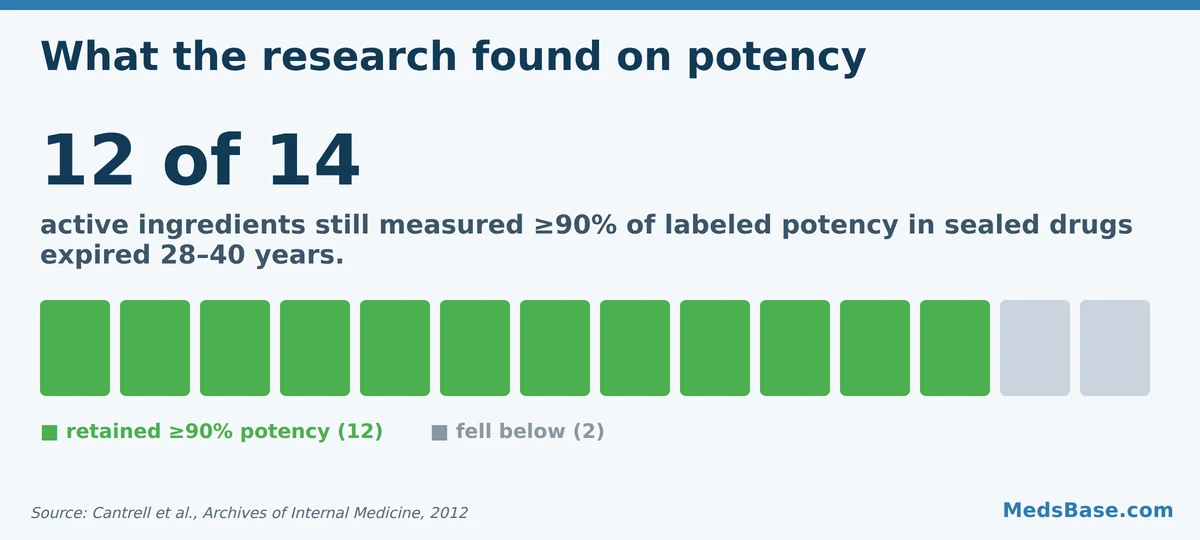
| Cantrell et al., Archives of Internal Medicine | 2012 | 12 of 14 active ingredients retained ≥90% of labeled potency in medications stored sealed and expired 28–40 years | PubMed |
| FDA — Expiration Dates: Q&A | Current | An expiration date reflects the period a product is known to remain stable (strength, quality, purity) under labeled storage; a degraded drug may be sub-potent | FDA |
| FDA — Don’t Be Tempted to Use Expired Medicines | Current | Sub-potent antibiotics can fail to treat infections, contributing to resistance; store medicine in a cool, dry place | FDA |
| MedlinePlus — Amoxicillin monograph | Current | Discard unused liquid amoxicillin after 14 days; store tablets away from heat and moisture, not in the bathroom | MedlinePlus |
A few honest limits on that potency research. It looked at solid forms in unopened, well-controlled storage — not mixed liquids, not a bottle that spent a summer in a glovebox. It measured whether the active ingredient was still present, which is not the same as proving the pill would successfully treat a specific infection at that reduced level. And regulators still advise against relying on expired medicine for anything that matters.
What this means for you: a sealed, well-stored tablet is unlikely to have turned into something harmful just because a date passed — but that is a reason to relax about accidental use, not a strategy for treating illness. For an actual infection, the strength margin and the “is this even the right antibiotic” question both point the same way.
Expired Amoxicillin vs a Fresh Course: Which Is the Right Call?
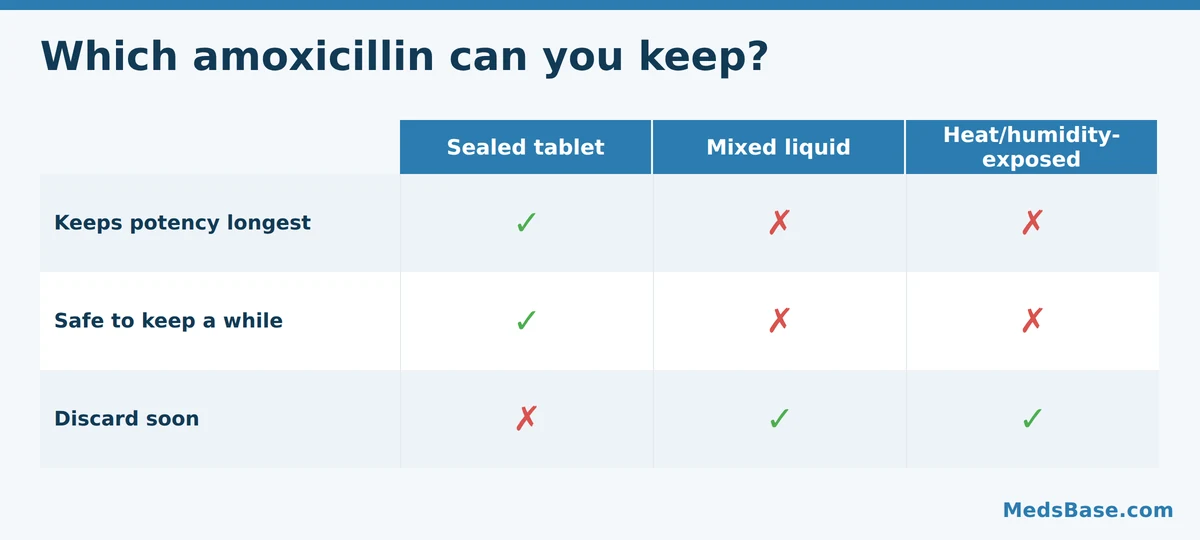
When you strip away the chemistry, the decision usually comes down to a simple comparison. The question isn’t only “is the pill still strong?” — it’s “am I giving this infection the correct drug, at a guaranteed dose, for the full course?”
| Factor | Leftover / expired amoxicillin | A fresh, correct course |
|---|---|---|
| Potency certainty | Uncertain — depends on age, form, storage | Guaranteed to the label |
| Right drug for this infection | Unknown — leftovers rarely match the current bug | Chosen for the confirmed indication |
| Full-length course available | Usually not — leftovers are partial | Yes, a complete course |
| Resistance risk | Higher (under-dosing, wrong target) | Lower |
| Best call | Avoid for treating infections | Preferred |
The verdict is not complicated. If you are actually unwell and considering an antibiotic, a fresh, correctly chosen course wins on every line that matters. Leftovers are almost always partial (you were supposed to finish the last course), they may be the wrong antibiotic for what you have now, and their strength is a question mark. None of that is worth gambling an infection on. If you’ve decided you need amoxicillin and want to understand your options for getting a fresh, full course, this walkthrough on ordering antibiotics online covers how it works — including that no prescription is needed to order from MedsBase.
How to Store Amoxicillin and Handle Expiry — Practical Steps
Good storage is what turns “technically expired” into “still fine up to the date” — and bad storage is what quietly ruins a bottle long before its date. A few habits protect your medicine and your money.
- Keep it sealed in the original packaging until you’re ready to use it. The packaging is part of the stability plan.
- Store tablets and capsules cool and dry — a bedroom drawer or a closet shelf. The FDA’s advice is straightforward: a cool, dry place, not a warm humid one.
- Refrigerate reconstituted liquid, don’t freeze it, and write the “discard by” date on the bottle so you’re not guessing later.
- Keep everything away from light, heat, and humidity — which rules out the bathroom cabinet and the car.
- Read the label before every dose, checking both the printed expiry and, for liquid, the reconstitution/discard date.
- Dispose of expired or leftover antibiotics responsibly, ideally through a pharmacy take-back program rather than pouring them down the sink.
- Storing medicine in the bathroom “medicine cabinet” — the humidity and heat are exactly what degrade it.
- Leaving a bottle in a hot car or on a sunny windowsill.
- Keeping mixed liquid amoxicillin “just in case” past its 14-day window.
- Saving leftover antibiotics to self-treat the next infection.
- Assuming “expired” always means “toxic” — the more realistic risk is that it’s too weak to fully work.
If you live somewhere hot or you’re travelling, storage gets harder and matters more; our guide to storing medications in hot weather has specifics. And if your leftovers are past their useful life, replacing them with an in-date supply from the antibiotics range is simpler and safer than rationing an old bottle — no prescription needed to order.
Frequently Asked Questions
Q: Can I take amoxicillin one year after the expiration date?
A: For a sealed, well-stored tablet or capsule, a year past date usually means some potency margin has narrowed rather than the drug becoming dangerous — but that doesn’t make it a smart way to treat an infection. The bigger issues are that its strength is no longer guaranteed and that leftovers may not be the right antibiotic for your current illness. Check with a pharmacist, and for an active infection, choose a fresh, correctly dosed course instead.
Q: Does amoxicillin expire if it’s still sealed?
A: Yes. Sealing slows degradation and helps the drug hold potency up to (and often a bit beyond) the date, but the expiration date still applies. Sealed, cool, dry storage is the best case for solid tablets and capsules; it does not make the date meaningless.
Q: How long does reconstituted (liquid) amoxicillin last?
A: Not long. Once mixed, amoxicillin suspension should be refrigerated and discarded after about 14 days (some labels say 7 to 14 — follow the date your pharmacist writes on the bottle). The dry powder lasts far longer than the mixed liquid, which is why it’s only reconstituted when you’re ready to use it.
Q: What happens if you take expired amoxicillin?
A: Most often, not much dramatic — but the real risk is that a weakened antibiotic under-treats the infection, letting bacteria survive and potentially become harder to treat. For amoxicillin specifically, becoming “toxic” is largely a myth; incomplete treatment and resistance are the genuine concerns.
Q: Can expired amoxicillin make you sick?
A: Expired amoxicillin is unlikely to poison you, but it can leave you sicker for longer if it fails to clear an infection at full strength. If you develop an unexpected reaction after taking any medicine, expired or not, stop and seek medical advice.
Q: Does liquid amoxicillin expire faster than tablets?
A: Much faster. Reconstituted liquid is measured in days (around 14), while sealed tablets and capsules are measured in months to years up to their label date. Water and refrigeration life make the suspension the shortest-lived form by far.
Q: How should I store amoxicillin so it lasts?
A: Keep tablets and capsules sealed in a cool, dry place away from heat, light, and moisture — not the bathroom or a hot car. Refrigerate reconstituted liquid, don’t freeze it, and note the discard date. Good storage is the single biggest lever on real-world shelf life.
Q: How do I safely dispose of expired amoxicillin?
A: The preferred route is a pharmacy or community drug take-back program, where old medicines are collected and disposed of safely. Avoid flushing unless the label specifically instructs it, and don’t leave old antibiotics where children or pets could reach them.
The Bottom Line: Does Amoxicillin Expire?
So, does amoxicillin expire? Yes — but the label date is a manufacturer’s potency guarantee under proper storage, not the exact moment the drug becomes unsafe. Sealed tablets and capsules are sturdy and can hold usable strength up to (and often beyond) their date when stored cool and dry, while reconstituted liquid is the genuine short-timer that belongs in the bin after about 14 days. The catch that outranks the chemistry: an under-strength or mismatched antibiotic can under-treat an infection and feed resistance, so leftovers are the wrong tool for treating a new illness.
Your immediate action: check the form and the date on the bottle in your hand right now. If it’s mixed liquid past its window, or you’re facing an infection that needs the right antibiotic, don’t ration old stock — start fresh. You can browse in-date options in the antibiotics range, with no prescription needed to order. And when you’re deciding what to keep versus toss, these next reads help: how to store medications in hot weather and does birth control expire?

Written by
Sophie ChenPharmaceutical Content Researcher · 8 years experience
Sophie Chen is a pharmaceutical content researcher with 8 years covering generic medication access and clinical pharmacology. She specialises in international regulatory frameworks, bioequivalence standards, and patient-facing education on therapeutic drug classes. She is not a clinician.