








✓ Medically reviewed by · Last reviewed: May 2026
Pharmacy Researcher · 8 years experience
Pharmacy researcher with 8 years reviewing clinical drug information, generic formulation equivalence, and international pharmaceutical standards. Focuses on patient-facing accuracy in medication education.
It’s a bright July morning, and within ten minutes of stepping outside you’re sneezing, your eyes are streaming, and your head feels stuffed with cotton wool. You took an antihistamine — so why isn’t it working? If that sounds like your summer, you’re about to learn why the order of your treatment matters as much as the treatment itself.
This guide walks you through exactly how to treat seasonal allergies using a simple, evidence-based relief ladder: what to try first, when to step up, the single option that beats antihistamines for a blocked nose, and the mistakes that keep people miserable all season. No hype — just the sequence that actually works.
Two things surprise most people here: one treatment most of us reach for last should often come first, and one symptom quietly tells you it’s time to see a doctor. Both are coming up.
- Seasonal allergies (allergic rhinitis) aren’t an infection — they’re your immune system overreacting to pollen, so the goal is to calm the reaction, not “kill a bug.”
- The smartest approach is a ladder: avoidance first, then antihistamines, then a step most people skip too long.
- For a blocked, congested nose, intranasal corticosteroid sprays generally outperform oral antihistamines — a fact worth knowing before you buy anything.
- Timing beats power: starting treatment before peak pollen days works better than chasing symptoms after they hit.
- There’s no cure for seasonal allergies — but with the right ladder, most people get most of their life back.
What Are Seasonal Allergies?
Unlike a cold, seasonal allergies aren’t caused by a virus and can’t be “caught.” They’re an immune misfire. Your body mistakes harmless pollen for a threat and mounts a defence you don’t need.
That distinction matters for how you treat seasonal allergies. Antibiotics do nothing (there’s no infection). Instead, every effective treatment works by either reducing your exposure to the trigger or dampening the histamine reaction it sets off.
According to MedlinePlus, allergic rhinitis is extremely common, and its hallmark is the cluster of nasal and eye symptoms that track with the pollen calendar. Tree pollen tends to peak in spring, grasses in early summer, and weeds like ragweed in late summer and autumn — which is why your “allergy season” may look nothing like your neighbour’s.
Knowing your trigger season is more useful than it sounds. If you sneeze every April, tree pollen is the likely culprit; a July flare points to grasses; a late-August-into-autumn misery usually means ragweed. Once you can predict your window, you can start treatment before it opens — and as you’ll see, that head start is one of the biggest levers you have. It also helps distinguish seasonal allergies from year-round (“perennial”) triggers like dust mites, pet dander or mould, which don’t follow the pollen calendar and sometimes need a different plan.
One more distinction worth making early: allergies versus a summer cold. Both cause a runny nose and sneezing. But allergies typically bring itchy eyes, nose and throat (colds rarely itch), produce clear rather than thick discolored mucus, and last as long as you’re exposed to the trigger rather than resolving in a week to ten days. If your “cold” itches and drags on through pollen season, it’s probably allergies.
Here’s the mechanism in plain terms.
How Does Pollen Trigger Seasonal Allergies?
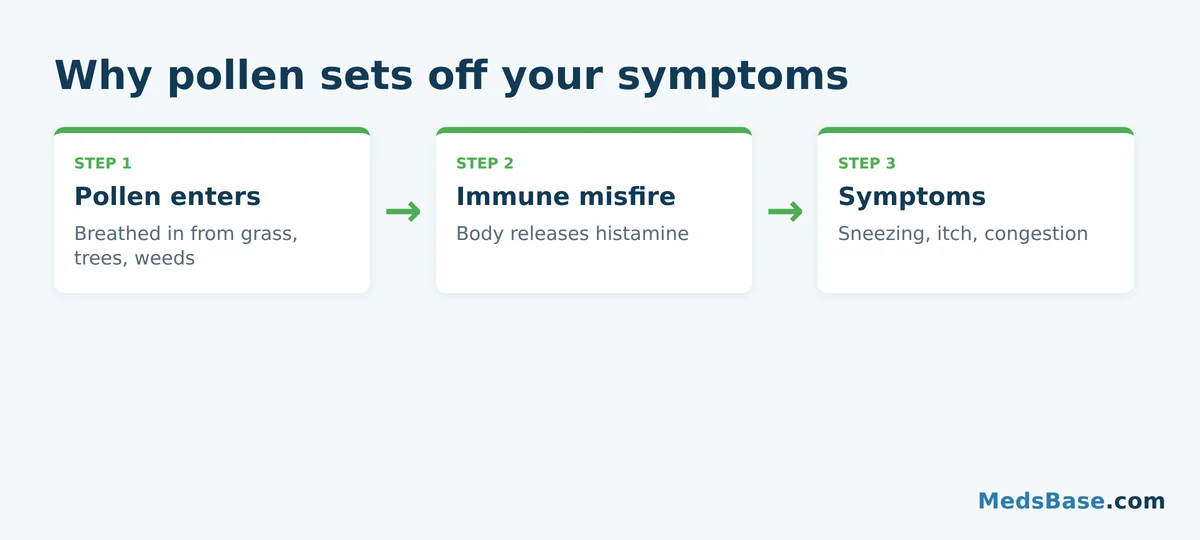
Picture your immune system as an overzealous security guard. Pollen is a harmless visitor — but the guard has wrongly flagged it as an intruder.
The first time you’re exposed, your body makes antibodies primed to recognise that pollen. On every later exposure, those antibodies signal specialised cells to release histamine and other chemicals. Histamine is what actually produces the misery: it makes blood vessels leak (congestion), nerve endings itch (sneezing, itchy eyes), and glands pour out mucus (runny nose).
This is why antihistamines are a first-line tool — they block histamine from docking onto its receptors, cutting the sneeze-itch-drip cycle. But histamine isn’t the whole story. Ongoing exposure also drives inflammation in the nasal lining, and that inflammation is what most stubbornly blocks your nose. Antihistamines barely touch it, which is your first clue about why one drawer of the medicine cabinet works better than another.
So a good plan tackles both the histamine spikes and the underlying inflammation. That’s exactly what the relief ladder does.
How to Treat Seasonal Allergies: The Relief Ladder
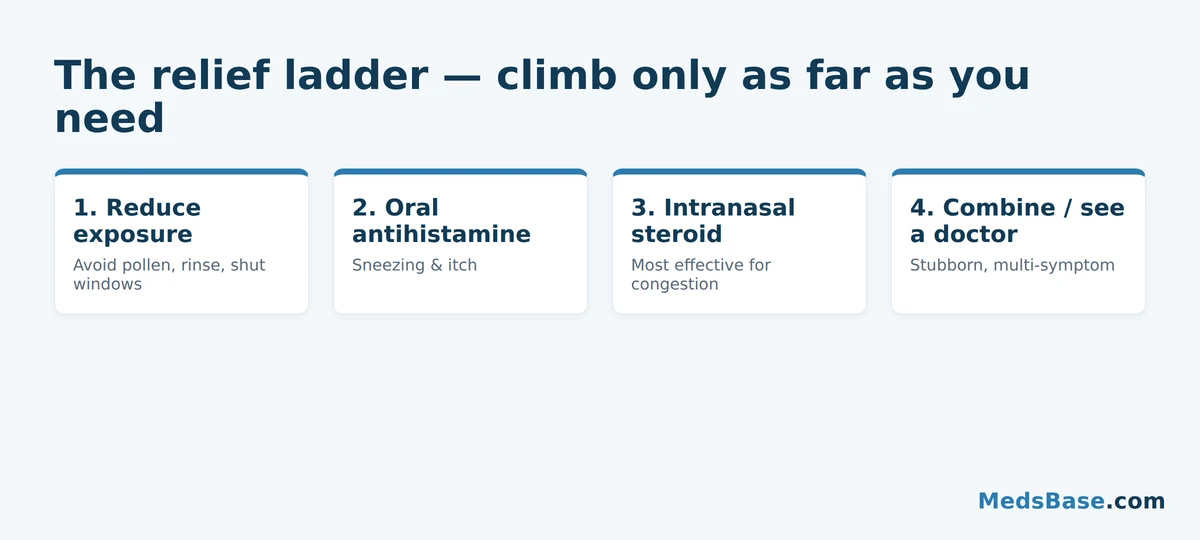
Think of treatment as a ladder. Start on the bottom rung; climb only as high as you need. Most people can control seasonal allergies within the first three rungs.
Rung 1 — Reduce your exposure
Every symptom you prevent is one you don’t have to medicate. The NHS suggests practical steps: keep windows shut on high-pollen days, shower and change clothes after being outside, wear wraparound sunglasses, and dab a little petroleum jelly around your nostrils to trap pollen. Check your local pollen forecast and plan outdoor time for lower-count periods (often after rain).
Rung 2 — Add a non-drowsy oral antihistamine
If avoidance isn’t enough, a daily second-generation antihistamine (cetirizine, loratadine, fexofenadine or levocetirizine) is the classic next step. These block histamine and are far less sedating than older options. They’re excellent for sneezing, itch and runny nose. MedsBase stocks several, including cetirizine (Okacet) — and you can browse the full hay fever and allergy range to compare.
Not sure which tablet to choose? That’s a real decision with real trade-offs — our Zyrtec vs Claritin guide breaks down speed versus drowsiness so you can match the pill to your day.
Rung 3 — Step up to an intranasal corticosteroid
This is the rung people skip too long. For a blocked, congested nose — and for all-round control — a steroid nasal spray is often more effective than any tablet. It needs a few days of consistent use to reach full effect, so start early and keep going. Some products combine a nasal antihistamine with a steroid for faster, broader relief, such as this azelastine-plus-fluticasone spray.
Two things make or break this rung. The first is patience — because these sprays reduce inflammation gradually, judging them after a single day is like judging a fitness plan after one gym session. Give it a week of daily use before deciding it isn’t working. The second is technique: a spray that runs straight down your throat isn’t reaching the tissue that needs it. Point the nozzle slightly outward, toward the wall of each nostril, and breathe in gently rather than sniffing hard. Done right, this one habit does more for congestion than any tablet on the shelf.
Rung 4 — Combine, target, or see a doctor
Still struggling? A clinician may combine an oral antihistamine with a nasal steroid, add specific eye drops for itchy, watery eyes (browse allergy eye-care options), or discuss longer-term options like immunotherapy. That’s the signal-symptom we promised: when correctly used pharmacy treatments stop working, that’s your cue to escalate to a professional — not to just double the dose.
Seasonal Allergy Treatments: Side Effects & Cautions
Every effective treatment has trade-offs. Knowing them keeps you comfortable and safe.
| Treatment | Common side effects | Frequency | What to do |
|---|---|---|---|
| Second-gen antihistamines | Mild drowsiness (more with some), dry mouth | Occasional | Take at night if drowsy; switch molecule if it bothers you |
| Intranasal corticosteroids | Nasal dryness, mild nosebleeds, throat irritation | Occasional | Aim the spray outward (away from the septum); pause a day if bleeding |
| Decongestant sprays (e.g. oxymetazoline) | Rebound congestion if overused | Common with >3–5 days’ use | Use only for short bursts; never as a daily fix |
| Oral decongestants | Raised blood pressure, insomnia, jitteriness | Variable | Avoid with hypertension/heart issues without advice |
| Antihistamine eye drops | Brief stinging | Occasional | Usually settles quickly |
Two cautions deserve emphasis. First, decongestant nasal sprays are a trap — used beyond a few days they cause rebound congestion that feels worse than the allergy. Second, “non-drowsy” isn’t identical across antihistamines; some make more people sleepy than others, which is exactly the difference our comparison covers below.
What the Evidence Says About How to Treat Seasonal Allergies
If you read only one research paragraph, read this one.
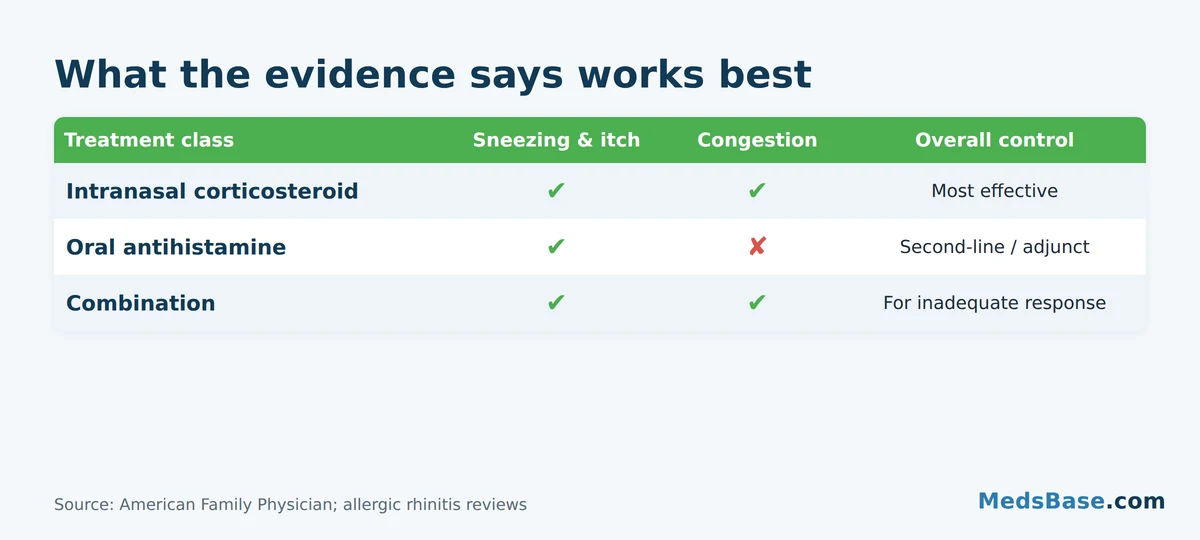
Multiple reviews of allergic-rhinitis treatment reach the same conclusion: intranasal corticosteroids are the most effective single therapy and are recommended first-line for mild-to-moderate and moderate-to-severe disease. As American Family Physician puts it, “intranasal corticosteroids are the mainstay of treatment,” and “many studies have demonstrated that nasal corticosteroids are more effective than oral and intranasal antihistamines.”
| Treatment class | Best at | Weaker at | Evidence position |
|---|---|---|---|
| Intranasal corticosteroid | Congestion + all nasal/eye symptoms | Slower to start | First-line, most effective |
| Oral antihistamine (2nd gen) | Sneezing, itch, runny nose; fast, “as needed” | Congestion | Effective, second-line/adjunct |
| Combination (spray + tablet) | Stubborn, multi-symptom cases | More steps | For inadequate single-agent response |
That single insight — nasal steroid for congestion, antihistamine for itch — puts you ahead of most people fumbling through the pharmacy aisle.
Antihistamine vs Nasal Steroid vs Combination
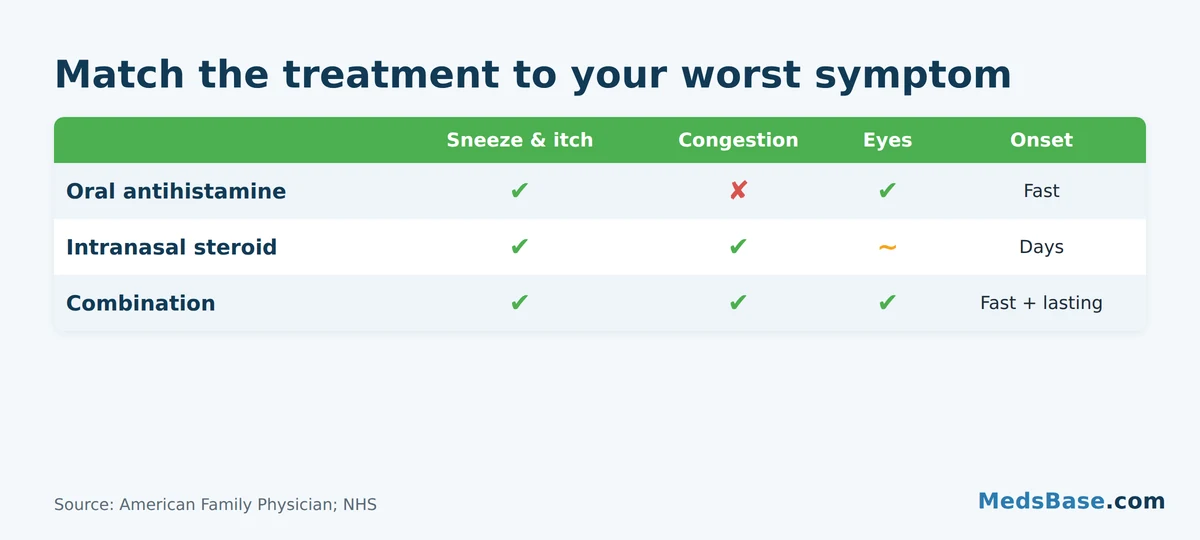
Here’s the side-by-side that turns the evidence into a choice.
| Oral antihistamine | Intranasal steroid | Combination | |
|---|---|---|---|
| Sneezing & itch | Strong | Good | Strongest |
| Congestion | Weak | Strong | Strong |
| Itchy, watery eyes | Good (esp. with eye drops) | Moderate | Good |
| Onset | Fast (hours) | Slower (days to full effect) | Fast + sustained |
| Best for | Mild, intermittent, itch-dominant | Congestion, daily control | Stubborn, multi-symptom |
Which fits which situation? Occasional, itch-heavy days on a picnic weekend? A fast antihistamine is perfect. Daily congestion through ragweed season? Anchor on a nasal steroid. Miserable on both fronts? Combine them — that’s what clinicians do. There’s no prize for suffering on a single tablet when your symptoms have outgrown it.
What Doesn’t Work: Seasonal Allergy Myths
Half of getting relief is not wasting time and money on things that don’t help. A few popular “remedies” don’t hold up.
“Local honey builds immunity to pollen.” It’s a lovely idea — eat local honey, expose yourself to local pollen, get desensitised. Unfortunately the pollen that triggers hay fever comes from wind-pollinated grasses, trees and weeds, while honey mostly contains pollen from flowers that bees visit. Controlled studies haven’t found a reliable benefit. Honey is a nice tea sweetener, not an allergy treatment.
“Antihistamines fix a blocked nose.” As covered above, oral antihistamines are weak against congestion. If your nose is stuffy, reaching for a stronger antihistamine is the wrong lever — you need an anti-inflammatory nasal spray.
“Decongestant sprays are fine for the whole season.” They work brilliantly for two or three days, then betray you. Used longer, oxymetazoline-type sprays cause rebound congestion that’s often worse than the allergy itself. Reserve them for short, specific bursts.
“Vitamin C, quercetin or a ‘natural’ supplement will fix it.” Evidence for supplements is weak and inconsistent. Some people find saline rinses and physical pollen-avoidance genuinely helpful — those are worth doing — but no supplement replaces a nasal steroid for moderate symptoms.
“If one antihistamine doesn’t work, none will.” Not true. People respond differently to different molecules. If cetirizine leaves you foggy or loratadine feels too weak, switching is reasonable — the Zyrtec vs Claritin comparison explains how they differ.
The theme across every myth is the same: match the mechanism to the symptom. Once you do, the guesswork — and most of the wasted spending — disappears.
How to Treat Seasonal Allergies Day to Day — Practical Guidance
The right products only work if you use them well. These habits separate real relief from wasted money.
- Start early. Begin treatment a week or two before your usual season, especially for nasal steroids — they build up over days.
- Be consistent with sprays. A steroid spray used “only when blocked” underperforms. Daily through the season is how it works.
- Nail your spray technique. Tilt slightly forward, aim the nozzle toward the outer wall of each nostril (not the septum), and breathe gently — don’t sniff hard.
- Layer by symptom, not by panic. Add the nasal steroid for congestion, the antihistamine for itch, eye drops for eyes. Don’t stack three decongestants.
- Rinse the pollen out. A daily saline rinse physically flushes allergens and is a genuinely useful, drug-free add-on.
Mistakes to avoid: relying on decongestant sprays for more than a few days, expecting a steroid spray to work in an hour, stopping the moment you feel better (symptoms return within the season), and ignoring itchy eyes because “the tablet should cover it” — often it doesn’t fully.
- Zyrtec vs Claritin: which antihistamine wins for you — today’s companion guide on speed vs drowsiness.
- Browse hay fever & allergy treatments — compare tablets, sprays and drops in one place.
- Allergy eye-care and drops — for the itchy, watery-eye half of the problem.
Frequently Asked Questions
Q: How do you get rid of seasonal allergies fast?
A: For fast relief of sneezing and itch, a second-generation oral antihistamine works within a few hours. For a blocked nose, nothing is truly instant — a steroid nasal spray is the most effective option but needs a few days of consistent use. Combining the two, plus reducing pollen exposure, gives the quickest all-round improvement. There’s no overnight cure, only faster control.
Q: What is the best treatment for seasonal allergies?
A: There’s no single “best” — it depends on your dominant symptom. Reviews consistently rank intranasal corticosteroid sprays as the most effective single treatment, especially for congestion. Oral antihistamines are excellent for sneezing and itch. Many people do best combining a daily nasal steroid with an antihistamine as needed.
Q: Do steroid nasal sprays work better than antihistamines?
A: For overall control and congestion, yes — multiple studies find intranasal corticosteroids more effective than oral or nasal antihistamines. The trade-off is speed: sprays take days to reach full effect, while antihistamines act in hours. That’s why a combination often makes sense.
Q: How can I reduce pollen exposure at home?
A: Keep windows closed on high-pollen days, shower and change clothes after being outdoors, use wraparound sunglasses, dry laundry indoors during peak season, and consider a HEPA air filter. A dab of petroleum jelly around the nostrils can trap pollen before you breathe it in. Small habits add up to noticeably fewer symptoms.
Q: When should I see a doctor for seasonal allergies?
A: See a clinician if pharmacy treatments stop controlling your symptoms, if symptoms are year-round rather than seasonal, if you have wheezing or breathing difficulty, or if allergies are wrecking your sleep or daily function. A doctor can prescribe stronger options or discuss immunotherapy for long-term relief.
Q: Are seasonal allergies curable?
A: No — there’s currently no cure for seasonal allergies, and you can’t fully prevent them. But with the right ladder of avoidance, antihistamines and nasal steroids, most people control their symptoms so well that allergies stop running their summer. Immunotherapy can reduce sensitivity over years for some people.
Q: How do I know if it’s allergies or a cold?
A: Allergies usually cause itching (eyes, nose, throat), produce clear mucus, and persist as long as you’re exposed to the trigger. Colds tend not to itch, often bring thicker or discoloured mucus and sometimes a mild fever, and resolve within about a week to ten days. If your symptoms itch and drag on through pollen season, allergies are the likely cause — and allergy treatments, not cold remedies, are what will help.
Q: Can children take seasonal allergy medicines?
A: Many antihistamines and some nasal sprays have child-appropriate versions, but doses and suitable products differ by age, and not every adult product is safe for kids. Always check the age guidance on the specific product or ask a pharmacist. For young children, or if symptoms are severe, a quick chat with a doctor or pharmacist is the safest route before starting anything.
The Bottom Line: How to Treat Seasonal Allergies
Here’s the verdict. Learning how to treat seasonal allergies isn’t about finding one magic pill — it’s about climbing a ladder in the right order: reduce exposure, add a non-drowsy antihistamine for itch and sneeze, and reach for an intranasal steroid for congestion and daily control. Match the tool to your worst symptom, start early, and be consistent.
Your one immediate action: identify your dominant symptom right now — itch or congestion — and pick the matching rung. That single decision fixes most people’s “why isn’t my medicine working?” frustration.
Two natural next reads: if you’re stuck choosing a tablet, Zyrtec vs Claritin settles the speed-versus-drowsiness question; and to see your options in one place, browse the hay fever and allergy range.

Written by
Sophie ChenPharmaceutical Content Researcher · 8 years experience
Sophie Chen is a pharmaceutical content researcher with 8 years covering generic medication access and clinical pharmacology. She specialises in international regulatory frameworks, bioequivalence standards, and patient-facing education on therapeutic drug classes. She is not a clinician.