








✓ Medically reviewed by · Last reviewed: May 2026
Pharmacy Researcher · 8 years experience
Pharmacy researcher with 8 years reviewing clinical drug information, generic formulation equivalence, and international pharmaceutical standards. Focuses on patient-facing accuracy in medication education.
If you have ever picked up an Ozempic pen and wondered whether you were about to inject insulin, you are far from alone. The question “is Ozempic insulin” is one of the most-searched diabetes questions on the internet, and the confusion is understandable: both come in pen injectors, both live in the fridge, and both lower blood sugar. But they are not the same medicine, and treating them as interchangeable can lead to real dosing mistakes.
Here is what you will learn: exactly what Ozempic is, how semaglutide works compared with insulin, why the two get mixed up, what the head-to-head research shows, and whether you can safely use them together. One difference between the two surprises almost everyone who switches — we will get to it in the safety section.
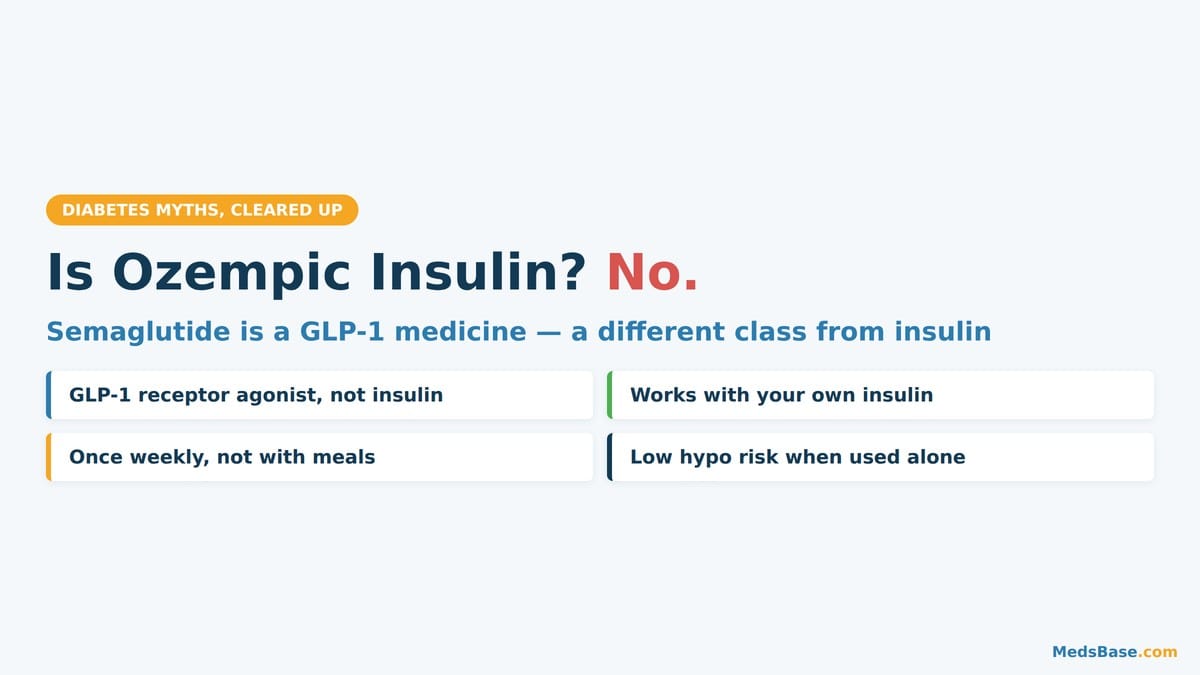
The short version, if you only remember one thing: is Ozempic insulin? No. Now let us unpack why the answer is a confident no, and why the difference changes how the medicine is dosed, who it suits, and how safe it is.
- Ozempic is not insulin — it is a GLP-1 receptor agonist, an entirely different class of diabetes medicine.
- Insulin replaces a hormone your body lacks; semaglutide nudges your own pancreas — but only when your glucose is elevated, which changes everything about the risk.
- On its own, Ozempic rarely causes dangerous low blood sugar — yet one common combination flips that safety picture, and we flag it below.
- In a head-to-head trial, semaglutide beat insulin glargine on both blood sugar and weight — the numbers are in the research chart.
- Yes, you can take Ozempic and insulin together — many people do, under medical guidance.
- Ozempic is a brand of semaglutide; the same molecule is available as a generic, which we will point you to.
What Is Ozempic? (And Is Ozempic Insulin?)
Ozempic is a brand name for semaglutide, a once-weekly injectable medicine approved for type 2 diabetes. It belongs to a class called GLP-1 receptor agonists — it mimics a natural gut hormone your body already makes. So when you ask “is Ozempic insulin,” the accurate answer is a clear no: it is a hormone mimic, not the hormone insulin. Any honest answer to is Ozempic insulin has to start with that class distinction.
Insulin, by contrast, is the hormone that moves sugar out of your bloodstream and into your cells. People with type 1 diabetes make almost none of it, and many people with long-standing type 2 diabetes eventually make too little. Injected insulin replaces what the body cannot produce. Semaglutide does something quite different, as you will see next.
The mix-up matters because the two medicines are dosed, timed, and adjusted in completely different ways. Insulin is often taken several times a day and titrated against meals and readings. Ozempic is a single weekly injection with a slow, fixed step-up schedule. Confusing one for the other is not a small error — it is a different treatment philosophy entirely.
MedsBase stocks semaglutide, the same molecule sold under the Ozempic brand, produced by WHO-GMP-certified manufacturers. That means the confusion around “is Ozempic insulin” is worth clearing up before anyone starts treatment.
How Does Ozempic Work?
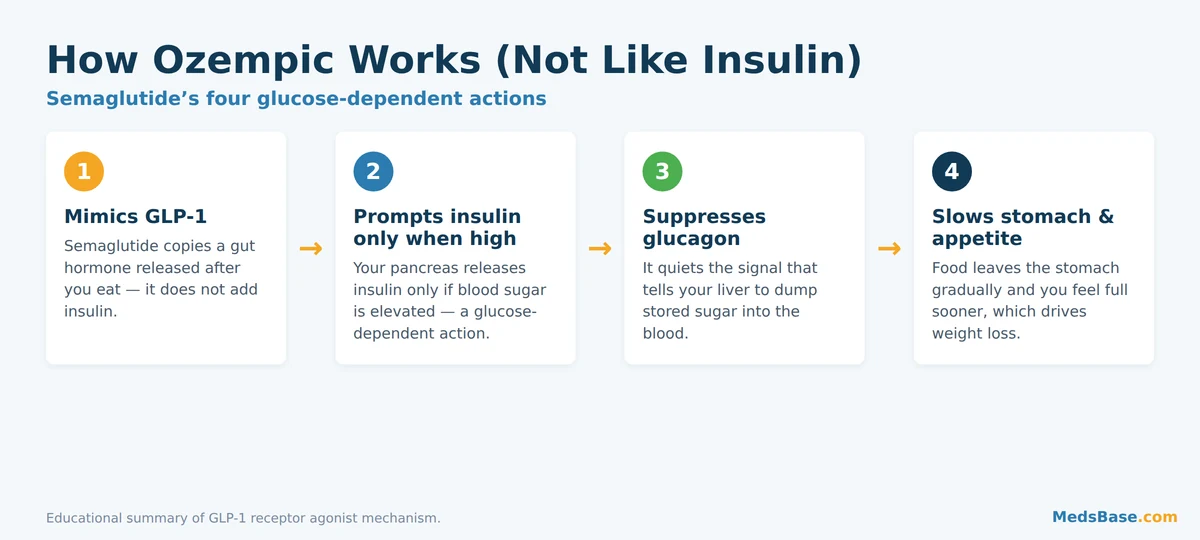
To understand why Ozempic is not insulin, it helps to know how does Ozempic work at the cellular level. Ozempic works by copying GLP-1 (glucagon-like peptide-1), a hormone your intestine releases after you eat. That single action sets off a chain of effects that lower blood sugar and reduce appetite — without directly forcing glucose into cells the way injected insulin does. This GLP-1 mechanism of action is the biological reason semaglutide sits in its own class. Put simply, the Ozempic mechanism of action is to amplify a natural signal, not to substitute for a missing hormone the way injected insulin does.
Think of insulin as a delivery truck that hauls sugar out of the blood no matter what. Semaglutide is more like a smart dispatcher: it tells your pancreas to send insulin only when blood sugar is actually high, tells your liver to stop dumping extra sugar, and tells your stomach to empty more slowly so you feel full sooner. When your sugar is normal, the dispatcher stays quiet.
This “glucose-dependent” behaviour is the heart of why semaglutide behaves so differently from insulin. Because it only prompts insulin release when it is needed, semaglutide used alone carries a low risk of hypoglycaemia. It also has four main jobs working at once:
- Prompts glucose-dependent insulin release — your pancreas responds only when sugar is elevated.
- Suppresses glucagon — the hormone that tells your liver to release stored sugar.
- Slows gastric emptying — food leaves your stomach more gradually, blunting post-meal spikes.
- Acts on appetite centres in the brain — you feel satisfied on less food, which drives weight loss.
Why People Confuse Ozempic With Insulin
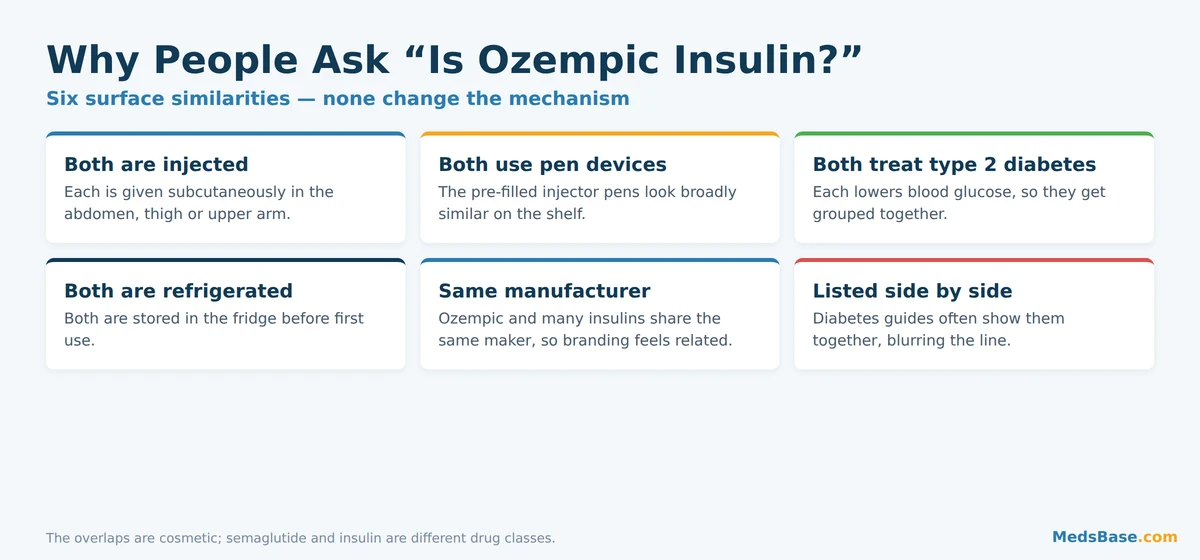
If the science says no, why does the question “is Ozempic insulin” keep resurfacing? The belief that Ozempic is a kind of insulin comes from surface similarities, not from how the drugs actually behave. Both are injected under the skin, both treat type 2 diabetes, both affect blood sugar, and both are made by Novo Nordisk. On a pharmacy shelf they can look like cousins. Under the hood, they are not.
Here is where it gets interesting: the two medicines even interact with insulin from opposite directions. Injected insulin is the hormone. Semaglutide only encourages your own insulin — and only at the right moment. That distinction is the single most important thing to understand when you ask whether Ozempic is insulin.
Six reasons the mix-up happens so often:
- Both come in pre-filled pen injectors that look broadly similar.
- Both are typically stored in the refrigerator before first use.
- Both are prescribed for type 2 diabetes and lower blood glucose.
- Both are injected subcutaneously — usually in the abdomen, thigh, or upper arm.
- Both are made by the same manufacturer, so the branding feels related.
- Diabetes education online often lists them side by side, blurring the line.
None of those overlaps changes the core fact, and none of them turns the answer to is Ozempic insulin into a yes. A GLP-1 receptor agonist and insulin are separate tools that a clinician may use alone or together, depending on how much natural insulin your body still produces.
Ozempic vs Insulin: The Key Differences
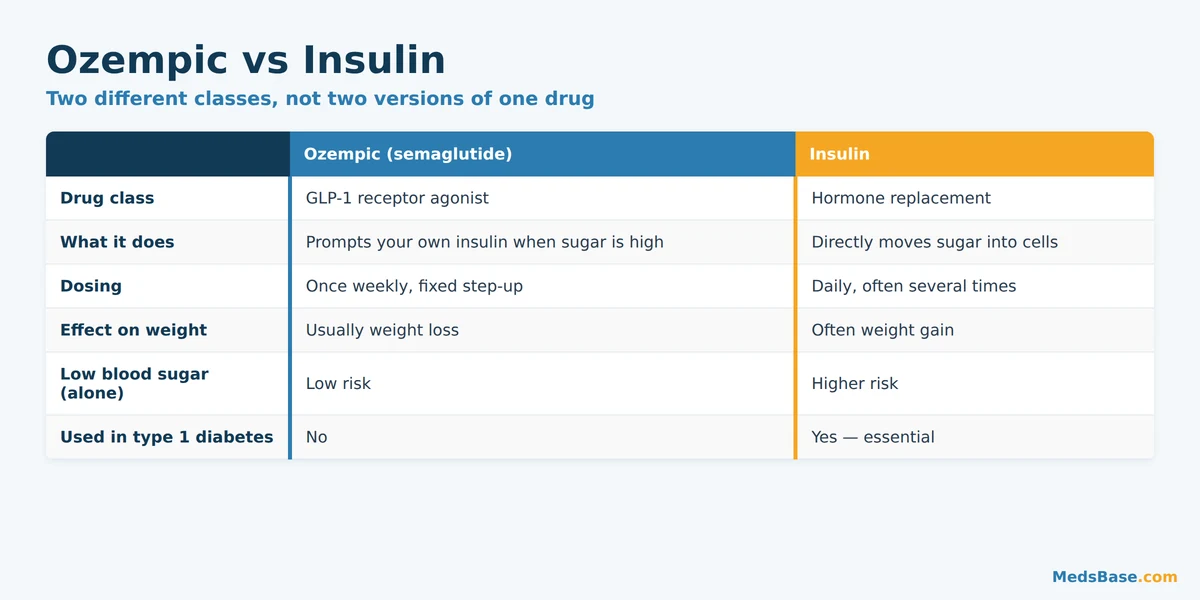
Comparing Ozempic vs insulin side by side makes the distinction obvious, and it retires the question of is Ozempic insulin for good. They differ in drug class, mechanism, dosing frequency, effect on weight, and the risk of low blood sugar. The table below lays out where semaglutide and insulin part ways — the differences that matter most for anyone weighing their options.
| Feature | Ozempic (semaglutide) | Insulin |
|---|---|---|
| Drug class | GLP-1 receptor agonist (hormone mimic) | Hormone replacement |
| What it does | Prompts your own insulin when sugar is high; slows appetite | Directly moves sugar from blood into cells |
| Dosing | Once weekly, fixed step-up schedule | Daily, often multiple times, adjusted to meals |
| Effect on weight | Usually weight loss | Often weight gain |
| Low blood sugar risk (alone) | Low | Higher — a defining risk of insulin |
| Used in type 1 diabetes? | No (type 2, and off-label weight use) | Yes — essential for type 1 |
| Heart-protection evidence | Yes, in high-risk type 2 diabetes | Not the same class effect |
Which one fits which situation? If your body still makes some insulin but your sugar and weight are creeping up, a GLP-1 medicine like semaglutide often does more, with less hypoglycaemia. If your pancreas produces little or no insulin — as in type 1 diabetes, or advanced type 2 — insulin is not optional; it is life-sustaining. Many people land somewhere in between and use both. For a deeper class comparison, see our guide to how Ozempic stacks up against metformin, another first-line diabetes drug.
What Type of Diabetes Is Ozempic For?
Ozempic is approved for type 2 diabetes, and the same molecule (in higher-dose brands) is used for weight management. It is not a treatment for type 1 diabetes. That single fact answers a lot of the “is Ozempic insulin” confusion, because insulin and semaglutide are used in genuinely different patient groups.
In type 1 diabetes, the immune system destroys the cells that make insulin, so the body produces almost none. Ozempic cannot help there in the way insulin does, because semaglutide works by nudging a pancreas that still functions. If there is no insulin-making capacity to nudge, the GLP-1 signal has little to act on. This is exactly why Ozempic for type 2 diabetes makes sense, while type 1 diabetes still requires injected insulin for survival.
In type 2 diabetes, the picture is different: the pancreas usually still makes insulin, but the body resists it and output slowly declines. Here, semaglutide can do a lot — improving how the body uses its own insulin, curbing appetite, and lowering HbA1c. Some people even reduce their insulin dose after starting it. But does Ozempic replace insulin entirely? For some with type 2 diabetes, partly; for people with type 1, no. That decision belongs to a clinician who knows how much insulin your pancreas still produces.
There is also a growing off-label use for weight loss in people without diabetes, which further muddies the public picture and keeps the question is Ozempic insulin trending across search engines. Using semaglutide for weight does not make it insulin either — the mechanism is the same GLP-1 action, just applied to a different goal. If weight is your focus, our guide to Ozempic and weight-loss alternatives covers the options honestly.
Safety Profile, Side Effects & Dosage
The safety picture is another place where the answer to is Ozempic insulin has real consequences. Semaglutide is generally well tolerated, but its side-effect pattern is distinct from insulin’s. The most common issues are gastrointestinal — nausea, especially in the first weeks as the dose steps up. The surprise we promised: used on its own, Ozempic rarely causes the dangerous low blood sugar that people fear from diabetes medicines. That is the opposite of insulin, where hypoglycaemia is the headline risk.
Ozempic is titrated slowly on purpose. Most people start at 0.25 mg once weekly for four weeks — a “starter” dose meant only to reduce nausea, not to control blood sugar — then move to 0.5 mg, and later to 1 mg or 2 mg if needed. Never skip ahead. The table below summarises the common and serious effects.
| Side Effect | Frequency | Severity | What To Do |
|---|---|---|---|
| Nausea | Common | Mild–moderate | Eat smaller, low-fat meals; usually eases in weeks |
| Diarrhoea or constipation | Common | Mild | Stay hydrated; tell your clinician if persistent |
| Vomiting | Common | Mild–moderate | Slow the dose step-up with your prescriber |
| Low blood sugar (alone) | Uncommon | Usually mild | Higher risk if combined with insulin or sulfonylureas |
| Gallstones | Uncommon | Moderate | Seek care for severe upper-right belly pain |
| Pancreatitis | Rare | Serious | Stop and seek urgent care for severe, persistent belly pain |
When to see your doctor: Seek urgent care for severe abdominal pain that radiates to the back, signs of an allergic reaction, or symptoms of low blood sugar (shakiness, sweating, confusion) — especially if you also use insulin. Semaglutide carries a boxed warning about a risk of thyroid C-cell tumours seen in rodents; it is not recommended if you or your family have a history of medullary thyroid cancer or MEN 2.
What Does the Research Say?
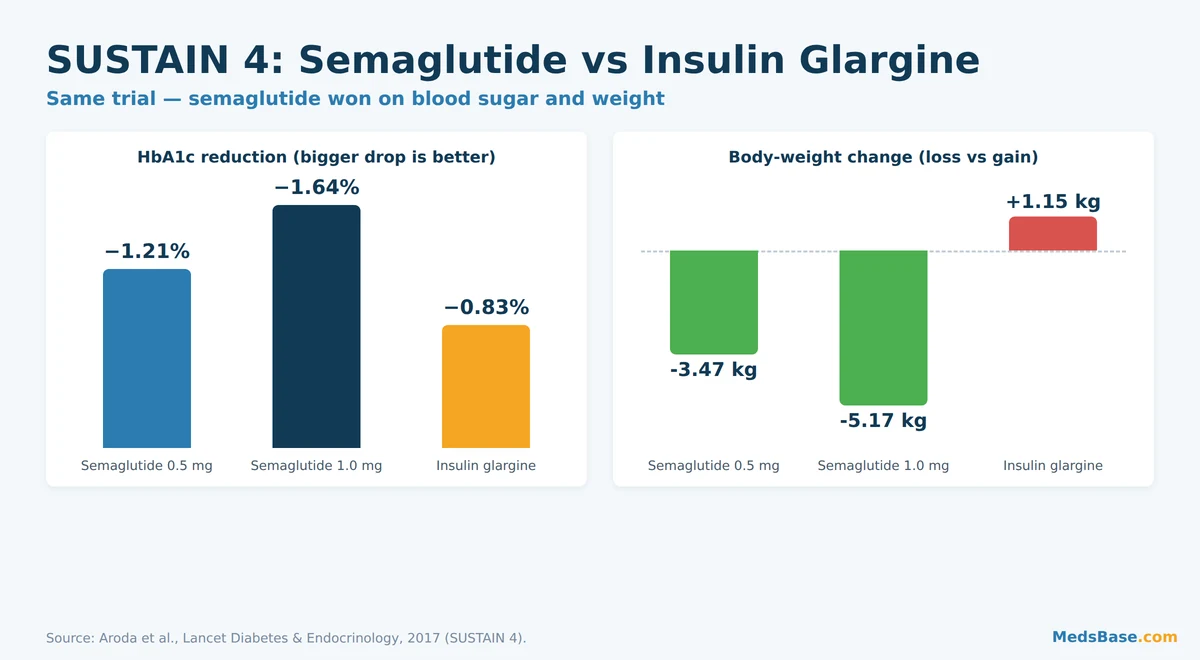
The strongest evidence on whether Ozempic is insulin comes from trials that put the two against each other. In the SUSTAIN clinical programme, semaglutide was tested head-to-head with insulin glargine — and the results show two different drugs, not two versions of one. If Ozempic were simply another insulin, a trial pitting it against insulin glargine would make no sense.
In SUSTAIN 4, adults with type 2 diabetes who added semaglutide lowered their HbA1c more than those who added insulin glargine, and — the striking part — they lost weight while the insulin group gained it. Research consistently suggests GLP-1 medicines and insulin pull weight in opposite directions.
| Study | Year | Finding | Source |
|---|---|---|---|
| SUSTAIN 4 (Aroda et al.) | 2017 | Semaglutide cut HbA1c more than insulin glargine and produced weight loss vs weight gain | Lancet Diab Endo |
| SUSTAIN 5 (Rodbard et al.) | 2018 | Semaglutide added to basal insulin improved control — the two work together | J Clin Endo Metab |
| SUSTAIN 6 (Marso et al.) | 2016 | 26% reduction in major cardiovascular events vs placebo | N Engl J Med |
| MedlinePlus drug monograph | Current | Classifies semaglutide as an incretin mimetic — explicitly not insulin | MedlinePlus |
What this means for you: the trial data settle the question of is Ozempic insulin more firmly than any label can. If a medicine both lowers HbA1c more than insulin and reverses the weight trend that insulin often causes, it clearly is not a form of insulin. It is a separate class doing a separate job — one reason clinicians increasingly reach for GLP-1 therapy earlier.
Can You Take Ozempic and Insulin Together?
Yes — and the fact that you can is itself proof that is Ozempic insulin has to be answered “no.” You cannot meaningfully stack a drug on top of itself. Because Ozempic and insulin work through different pathways, a clinician may prescribe both: insulin to cover what the pancreas no longer makes, and semaglutide to improve control, curb appetite, and offset insulin-related weight gain. The SUSTAIN 5 trial studied taking Ozempic and insulin together in exactly this way.
There is one important caveat, and it is the flip side of Ozempic’s low-hypo reputation. Combining semaglutide with insulin (or with sulfonylurea pills) raises the risk of low blood sugar, because now you have a direct glucose-lowering agent in the mix. That is why doctors often reduce the insulin dose when adding a GLP-1 medicine, and watch readings closely at first.
- Good candidates: people with type 2 diabetes on basal insulin who still have high HbA1c or unwanted weight gain.
- Be cautious: anyone prone to hypoglycaemia, or on high insulin doses — the combination needs close monitoring and usually an insulin dose cut.
- Not a swap for insulin in type 1 diabetes: semaglutide does not replace the insulin a type 1 body cannot make.
Consider Maria, 58, an illustrative example: on basal insulin, her sugar was acceptable but she had gained weight and disliked frequent injections. Her clinician added weekly semaglutide, trimmed her insulin dose, and over months she lost weight and steadied her readings. If you take insulin, browse our rapid-acting insulin options at MedsBase and discuss any combination with your prescriber first.
How to Use Ozempic — Practical Guidance
Once you accept that the answer to is Ozempic insulin is no, the practical routine falls into place. Using Ozempic correctly is straightforward once you separate it from insulin routines. It is a once-weekly injection — not a with-every-meal medicine — and the dose climbs on a fixed schedule rather than being adjusted against each blood-sugar reading. Getting the rhythm right is what keeps side effects low.
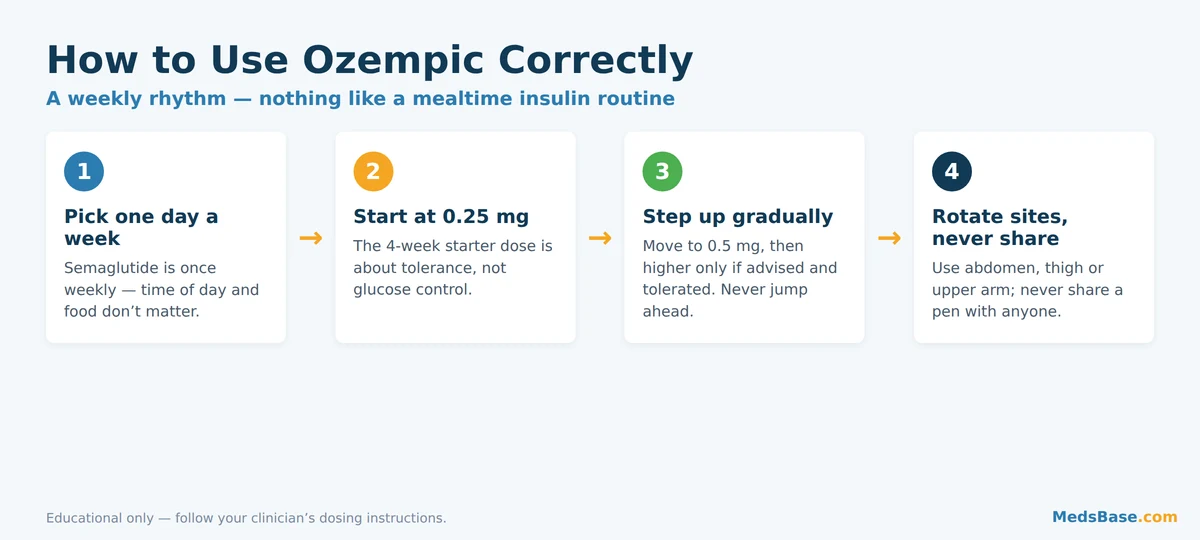
Pharmacists commonly see two mistakes: people expecting fast results and stopping early, or people trying to jump to a higher dose to speed up weight loss. Both backfire. Here is the correct sequence:
- Pick one day a week and stick to it — semaglutide’s long action means the exact time of day does not matter, with or without food.
- Start low at 0.25 mg for four weeks. This starter dose is about tolerance, not glucose control.
- Step up gradually to 0.5 mg, then higher only if your clinician advises and you are tolerating it.
- Rotate injection sites — abdomen, thigh, or upper arm — and never share a pen.
Mistakes to avoid: do not double up if you miss a dose by more than five days; do not treat the starter dose as ineffective and quit; and do not assume it works like mealtime insulin. If you want the exact click-by-click schedule, our Ozempic dosage chart breaks it down. Curious what happens if you pause treatment? Read what happens when you stop taking Ozempic.
- GLP-1 weight-loss injections: the complete guide — how this whole drug class works.
- Ozempic nausea: why it happens and how to settle it — manage the most common side effect.
- Insulin resistance explained — the process behind type 2 diabetes.
Frequently Asked Questions
Q: Is Ozempic insulin or a different kind of drug?
A: No. Ozempic (semaglutide) is a GLP-1 receptor agonist, not insulin. Insulin is a hormone your body makes to move sugar into cells; when you inject insulin, you are replacing that hormone. Semaglutide instead mimics a gut hormone that prompts your own pancreas to release insulin only when blood sugar is high. They are separate drug classes with different dosing, effects, and risks, even though both treat type 2 diabetes.
Q: Does Ozempic contain insulin?
A: No, Ozempic contains no insulin at all. Its active ingredient is semaglutide, a synthetic version of the GLP-1 hormone. There is no insulin molecule in the pen. This is why so many people are surprised to learn the answer to “is Ozempic insulin” is a firm no — the medicine works with your body’s own insulin supply rather than adding more from outside.
Q: Can you take Ozempic and insulin at the same time?
A: Yes, and it is a common, evidence-backed combination. Because they work differently, a clinician may prescribe both — insulin for direct glucose control and semaglutide for added control, appetite reduction, and weight benefit. The main caution is that combining them raises the risk of low blood sugar, so your insulin dose is often lowered and your readings watched closely at first.
Q: Does Ozempic lower blood sugar like insulin?
A: It lowers blood sugar, but by a different route. Insulin directly pushes glucose into cells. Semaglutide prompts your pancreas to release insulin only when sugar is elevated, suppresses the liver’s sugar output, and slows digestion. Because its action is glucose-dependent, Ozempic used on its own rarely causes the dangerous lows that insulin can — one of the biggest practical differences between the two.
Q: Is Ozempic safer than insulin?
A: Neither is universally “safer” — they suit different situations. Ozempic carries a lower risk of hypoglycaemia and tends to reduce weight, which many people prefer. But insulin is irreplaceable when the body makes too little of its own, such as in type 1 diabetes. Ozempic has its own cautions, including nausea and rare pancreatitis. The safest choice is the one matched to your specific diabetes by a clinician.
Q: Will Ozempic replace my insulin?
A: Not necessarily, and not in everyone. Whether does Ozempic replace insulin depends on your diabetes type: some people with type 2 diabetes reduce or stop insulin after adding semaglutide, but that is a medical decision based on how much insulin their pancreas still makes. People with type 1 diabetes cannot replace insulin with Ozempic — their bodies produce essentially none, and semaglutide only works alongside a functioning insulin supply. Never stop insulin on your own.
Q: Is semaglutide the same as Ozempic?
A: Semaglutide is the active ingredient; Ozempic is one brand name for it. The same molecule appears in other brands and in generic semaglutide. So when you compare “is Ozempic insulin” against “is semaglutide insulin,” the answer is identical: no in both cases. Asking is semaglutide insulin gets the same reply because semaglutide is the drug inside every Ozempic pen. Choosing a generic can lower cost while delivering the same GLP-1 medicine, which is why many people look for semaglutide directly.
Q: Why do people think Ozempic is insulin?
A: Mostly because of surface resemblance. Both are injectable pens, both treat type 2 diabetes, both are refrigerated, and both are made by the same company. Diabetes information often lists them together, which blurs the line further. But the mechanisms are unrelated: one replaces a hormone, the other mimics a different hormone to coax your own insulin at the right moment.
The Bottom Line
So, is Ozempic insulin? No. Ozempic is semaglutide, a GLP-1 receptor agonist that works with your body’s own insulin rather than replacing it — a genuinely different class of diabetes medicine, with different dosing, a lower risk of low blood sugar when used alone, and a tendency to reduce weight instead of adding it. As a treatment, Ozempic for type 2 diabetes leans on a pancreas that still functions, whereas insulin remains essential for people whose bodies cannot make enough of their own — and the two can be safely combined under medical guidance.
Your one immediate action: if you are still unsure whether is Ozempic insulin applies to your own prescription, check the drug class printed on the box or ask your pharmacist — it takes thirty seconds and prevents dosing errors. If you and your clinician decide semaglutide is right for you, MedsBase stocks generic semaglutide from WHO-GMP-certified manufacturers.
Wondering how this class compares across brands and formats? Read our complete guide to GLP-1 injections. Weighing semaglutide against another common first-line drug? See Ozempic vs metformin for the full comparison.

Written by
Sophie ChenPharmaceutical Content Researcher · 8 years experience
Sophie Chen is a pharmaceutical content researcher with 8 years covering generic medication access and clinical pharmacology. She specialises in international regulatory frameworks, bioequivalence standards, and patient-facing education on therapeutic drug classes. She is not a clinician.