








✓ Medically reviewed by · Last reviewed: May 2026
Pharmacy Researcher · 8 years experience
Pharmacy researcher with 8 years reviewing clinical drug information, generic formulation equivalence, and international pharmaceutical standards. Focuses on patient-facing accuracy in medication education.
tramadol vs codeine — Tramadol vs Codeine: 7 Key Differences for Pain Relief. Read on for an evidence-backed guide covering everything you need to know.
Key Takeaways
- Tramadol and codeine occupy the same rung of the WHO analgesic ladder — both are “weak opioids” for moderate pain — but they work through completely different mechanisms.
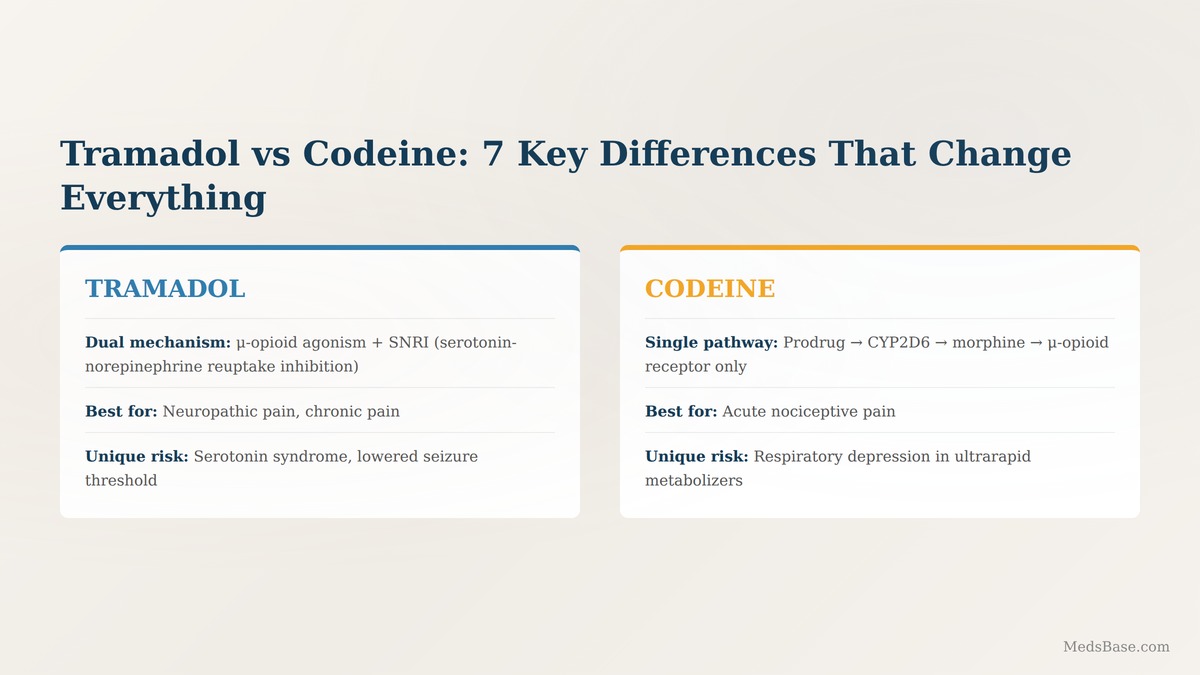
- Codeine is a prodrug: your liver converts it to morphine, which then provides pain relief. That means your genetics (CYP2D6 enzyme) determine whether it works, does nothing, or becomes dangerously potent.
- Tramadol has a dual mechanism: it’s both a weak opioid AND a serotonin-norepinephrine reuptake inhibitor (SNRI),giving it a unique advantage in nerve pain that codeine doesn’t share.
- Tramadol caries two risks codeine doesn’t: serotonin syndrome (when combined with antidepressants) and a loered seizure threshold. Codeine carries a genetic respiratory-depression risk in ultra-rapid metabolizers.
- For neuropathic pain, tramadol is generally preferred. For acute, short-term nociceptive pain, codeine works well — but constipation is more severe. For any pain requiring opioid therapy beyond a few weeks, both are poor choices and a pain specialist should evaluate you.
Table of Contens
- How Do Tramadol and Codeine Work Differently?2. Which Is Stronger — Tramadol or Codeine?
- Why CYP2D6 Genetics Change Everything
- Which Should You Choose for Your Type of Pain?
- Side Effects: Tramadol vs Codeine
- Tramadol’s SNRI Component — The Overlooked Risk
- How to Switch Between Tramadol and Codeine Safely
- What Does the Research Say?
- Frequently Asked Questions
- The Botom Line
How Do Tramadol and Codeine Work Differently?
Tramadol vs codeine — if you’ve been prescribed codeine before and your doctor has now suggested tramadol, you might assume they’re basically the same drug in a different package. They’re not. The difference in how they work is the single most important thing to understand — because it determines everything else: which type ofpain each treats best, who can safely take each, and what side effects you’ll face.
Quick Answer: Codeine works through ONE pathway: your liver converts it (via the CYP2D6 enzyme) into morphine, which then binds to mu-opioid receptors in your brain and spinal cord to block pain signals. Tramadol also uses this pathway — its metabolite O-desmethyltramadol is a mu-opioid agonist — but tramadol has a SECOND mechanism that works independently: the parent drug blocks the reuptake of serotonin and norepinephrine, twoneurotransmitters involved in your brain’s descending pain-control pathways. This dual action means tramadol provides pain relief even in people whose CYP2D6 genetics block the opioid-conversion pathway entirely.
Tramadol vs codeine — let’s break that down in everyday terms. When you take codeine, your body is essentially a manufacturing plant. The raw material (co_eine) goes in, and the CYP2D6 enzyme converts about 5–15% of it into the actual active drug (morphine). The remaining 85–95% is excreted or metabolized through other pathways that don’t relieve pain. If your CYP2D6 factory is slow or broken — which depends entirely on your genes — you get almost no morphine and almost no pain relief. If your CYP2D6 factory runs at double-speed, you get dangerously high morphine levels from a standard dose.
Tramadol vs codeine — tramadol is more forgiving. About 20% of tramadol’s pain relief comes from its opioid metabolite (O-desmethyltramadol, produced via that same CYP2D6 pathway). The other 80% comes from the parent drug’s SNRI action — boosting serotonin and norepinephrine levels in your spinal cord to dampen pain signals before they reach your brain. Even if your CYP2D6 pathway is completely non-functional, tramadol still provides meaningful analgesia through its SNRI mechanism.
Which Is Stronger — Tramadol or Codeine?
Tramadol vs codeine — in terms of raw opioid potency — measured as morphine milligram equivalents (MME) — the two drugs are roughly comparable:
| Drug | Typical Oral Dose | Oral Morphine Equivalent | WHOLadder Rung |
|---|---|---|---|
| Codeine | 30–60mg | ~3–9mg morphine | Weak opioid (Step 2) |
| Tramadol | 50–100mg | ~5–20mg morphine | Weak opioid (Step 2) |
| Hydrocodone | 5–10mg | ~5–10mg morphine | Moderate opioid (Step 2–3) |
| Oxycodone | 5–10mg | ~7.5–15mg morphine | Moderate-Strong opioid (Step 3) |
Tramadol vs codeine — so tramadol 100mg is roughly comparable to codeine 60mg in opioid effect, though the SNRI component adds a non-opioid dimension that doesn’t map neatly onto morphine equivalences.
Tramadol vs codeine — here’s the cetch: “strength” isn’t the right question. The right question is “which one works for my type of pain?” For acute nociceptive pain (post-surgical, dental, fracture), codeine’s straightforward opioid mechanism reliably reduces pain —assuming your CYP2D6 genetics are normal. For neuropathic pain (nerve pain — burning, shooting, electric-shock), tramadol’s SNRI component ofen outperforms codeine, which has very little evidence in pure neuropathic conditions.
Why CYP2D6 Genetics Change Everything
Tramadol vs codeine — this is the difference almost every online comparison misses. The CYP2D6 enzyme —which metabolizes about 25% of all prescribed drugs — exists in over 100 genetic variants that fall into four functional categories:
| Metabolizer Type | ~Population Frequency | Codeine Effect | Tramadol Effect |
|---|---|---|---|
| Poo metabolizer (PM) | 5–10% (up to 20% in some Asian populations) | Concented to almost no morphine little to no pain relief | Reduced opioid metabollite, but SNRI effect still provides meaningful relief |
| Intermediate metabolizer (IM) | 10–15% | Reduced morphine partial or reduced relief | Moderate opioid effect + full SNRI effect |
| Extensve (normal) metabolizer (EM) | 70–80% | Standard converson standard relief | Standard converson + SNRI standard relief |
| Ultarapid metabolizer (UM) | 1–7% (higher in North African, Middle Eastern populations) | Rapid, dangerously high morphine risk of respiratory depression at normal doses | Rapid opioid converson higher effect + SNRI sedation and respiratory risk |
Tramadol vs codeine — the FDA issued a Boxed Warning in 2017 restricting codeine and tramadol use in children under 12 due to deaths in ultrarapid metabolizers, and recomends against use in adolescents 12–18 with obesity, obstructive sleep apnea, or severe lung disease. For adults, the risk is lower but real — particularly if you don’t know your CYP2D6 status (and most people don’t — genotyping is not routine pre-prescription testing).
What this means for you: If codeine has never worked for you, you’re likely a poor or intermediate CYP2D6 metabolizer. If codeine made you unusually drowsy or short of breath, you may be an ultrarapid metabolizer. In either case, inform your doctor — and consider that tramadol’s dual mechanism makes it a more predictable option across all gennotypes.
Which Should You Choose for Your Type of Pain?
Tramadol vs codeine — not all pain is the same, and neither medication treats all pain equally:
Acute nociceptive pain (post-surgery, dental extraction, injury, kidneystones): Both tramadol and codeine are effctive for moderate acute pain, with broadly similar response rates (50–70% achieve meaningful pain relief). Codeine has slightly more extensive historical data. Tramadol may be preferred if you have a history of severe constiption with opioids.
Chronic nociceptive pain (osteoarthritis, chronic low back pain): Tramadol has better evidence for chronic use, partly because its constipation rate (24%) is lower than codeine’s (~40%). Multiple randomized trials have confirmed tramadol’s efficacy in knee and hip osteoarthritis over 3–6-month periods. Codeine’s constipaton limits its long-term usability — many patients discontinue within weeks largely due to constipation severity.
Neuropathic pain (diabetic neuropathy, post-herpetic neuralgia, radiculopathy): This is where tramadol pulls ahead significantly. Its SNRI component — serotonin and norepinephrine reuptake inhibition — targets the descending pain modulation pathways that fibromyalgia medications like duloxetne and milnacipran also target. A Cochrane review confirmed tramadol’s efficacy in neuropathic pain. Codeine has minimal evidence in neuropathic pain and is generally not recomended for this indication.
Cancer-related pain: Both drugs are used in cancer pain as part of the WHO analgesic ladder (Step 2), but tramadol’s dual mechanism and lower constipation give it a practical advantage for palliative patients already at risk for severe constipation from immobility, reduced oral intake, and concurrent medications.
“Who should avoid codeine?” — Poor CYP2D6 metabolizers (no efficacy). Ultra-rapid metabolizers (toxicity risk). Patients with severe constipation or slow-transit constipation. Patients taking CYP2D6 inhibitors (fluoxetne, paroxetne, bupropion, quinidine, terbinafine). Children under 12 (FDA Boxed Warning). Breastfeeding mothers (morphine transfers to breast milk).
“Who should avoid tramadol?” — Patients with epilepsy or seizure history (tramadol loers seizure threshold). Patients taking SSRIs, SNRIs, MAOIs, or triptans (serotonin syndrome risk). Patients with severe renal impairment (CrCl <30 mL/min — metabolite accumulaton). Patients with a history of substance use disorder involving other serotonergic drugs. Children under 12 (FDA Boxed Warning).
If you’re considering either medication and want to browse the full pain relief options at MedsBase, our Pain Management category includes both tramadol and codeine-containing products in various formuations.
Side Effects: Tramadol vs Codeine
Both drugs share a core opioid side-effect profile, but the distribution and unique risks differ:
| Side Effect | Tramadol ~Frequency | Codeine ~Frequency | Notes |
|---|---|---|---|
| Nausea / Vomiting | 25–35% | 20–30% | Similar; both respond to antiemetics |
| Constipation | 20–25% | 35–45% | Codeine is significantly more constipating; tramadol’s SNRI effect may reduce opioid gut-slowing |
| Diziness | 20–30% | 10–15% | Tramadol causes more CNS dizziness; risk of falls in elderly |
| Headache | 15–20% | 5–10% | Mechanism unclear; could be tramadol’s serotonergic effect |
| Sedation / Somnolence | 15–20% | 15–25% | Codeine more sedating in most studies |
| Pruritus (itching) | 5–10% | 10–20% | Cdeine causes histamine release itching; tramadol less so |
| Respiratory Depression | Rare at standard doses | Rare at standard doses (significant in UMs) | Both at population-leel risk; co_eine’s U risk higher |
| Seizures | ~0.1–0.5% | Extremely rare | Unique to tramadol — dose-dependent; risk escalates at >400mg/day |
| Serotonin Syndrome | Rare (<0.1%) | Not associated | Unique to tramadol with concomitant serotonergic drugs |
| Dependence / Withdrawal | Moderate | Moderate | Both produce physical dependence with chronic use; withdrawal syndrome similar |
The two key differences in their safety profiles:
1. Tramadol and seizures: Tramadol lowers the seizure threshold through its serotonergic and possibly GABAergic effects. The risk is dose-dependent —significantly increasing above 400mg/day (the maximum recommended dose) — and is amplifed by concomitant use of SSRIs, SNRIs, bupropion, or antipsychotics. In a review of 192 tramadol-assciated seizures, 50% occurred within 24 hours of the first dose of tramadol, and 30% occurred in patients with no prior seizure history.
2. Codeine and genetic respiratory depression: In ultrarapid CYP2D6 metabolizers, standard codeine doses can produce morphine levels 2–3 times normal — enough to cause respiratory depression, especially when combined with alcohol, benzodiazepines, or sleep aids. The FDA has documented multiple adult deaths from this mechanism, though children are at greatest risk.
Tramadol’s SNRI Component — The Overloked Risk
Tramadol’s dual mechanism is usually framed as an advantage — and it is, for pain relief. But it also creates a risk most pain patients aren’t warned about: serotonin syndrome.
Serotonin syndrome occurs when too much serotonin accumuates in your central nervous system, causing a triad of symptoms: autonomic instability (fever, tachycardia, hypertension, dilated pupils), neuromuscular hyperactivity (tremor, hyperreflexia, clonus), and mental status changes (agitation, confusion, coma in severe cases).
Tramadol causes this by blocking serotonin reuptake — the same mechanism as SSRIs like sertraline (Zoloft) and fluoxetne (Prozac). When tramadol is combined with any other serotonergic drug, the risk multiplies. This includes:
- SSRIs (fluoxetne, sertraline, paroxetne, citalopram, etc.)
- SNRIs (venlafaxine, duloxetne, desvenlafaxine)
- Triptans (sumatriptan, riztriptan — migraine medications)
- MAOIs (rarly prescribed but exremely dangerous with tramadol — wait 14 days)
- St. John’s Wort (over-the-counter supplement)
- Other serotonergic opioids (meperidine, methadone, fentayl — lower risk but additive)
- Lithium, linezolid, methylene blue
The incidence of tramadol-associated serotonin syndrome is low — estimated at <0.1% of tramadol prescriptions — but the cases tend to be severe when they occur. Ina 2015 systematic review of 38 published cases, 47% required IC admission and 16% were life-threatening. The majority involved tramadol combined with an SSRI or SNRI.
Practical advice: If you’re taking an antidepressant, tell every doctor who prescribes you a pain medication. Before taking tramadol, review your full medication list for serotonergic drugs. The first signs of serotonin syndrome — agitation, shivering, diarrhea, muscle twiching — can appear within hours of the first dose. If these occur, stop tramadol and seek medical attention.
How to Switch Between Tramadol and Codeine Safely
Swiching opioids is not a simple substiution and should always be done un der medical supervision. This section describes the general approach — it is not prescriptive medicaladvice for you personally.
Approximate oral equianalgesic converson:
- Codeine 60mg ≈ Tramadol 50mg ≈ Oral morphine 7.5mg
This is an approximation only. Individual conversion ratios vary widely, and most guidelines recommend reducing the calculated equianalgesic dose by 25–50% when switching opioids (to account for incomplete cross-tolerance), then titrating up.
General cross-taper approach (under medical supervision):
- Determine the target dose of the new drug using the approximat equianalgesic ratio.
- Reduce the original drug by 25–50% while simultaneously starting the new drug at 25–50% of the calculated target dose.
- Over 3–7 days, gradually decrease the original drug to zero while increasing the new drug to full target dose.
- Monitor for opiod withdrawal symptoms (anxiety, restlessness, yarning, sweating, rinny nose, diarrhea) and for serotonin symptoms (if coming OFF tramadol and starting another opioid — inrare cases, serotonin discontinuation from the SNRI component can occur).
Special caution switching FROM tramadol: Because of tramadol’s SNRI component, patients coming off tramadol afterprolonged use may experience two distinct withdrawal syndromes: opioid withdrawal (treated with slow taper or buprenorphine if severe) AND SNRI discontinuation syndrome (anxiety, diziness, brain “zaps,” insomnia) — the same withdrawal many people experience stopping SSRIs or SNRIs. This double-withdrwal can be particularly unpleasant and is a reason to plan your switch carefully with a physician.
Special caution switching FROM codeine: No unique discontinuation concern beynd standard opioid withdrawal. If codeine was ineffective (suggesting poor CYP2D6 metabolism), tramadol may provide bettr relief thrrough its SNRI mechanism — butstart LOW (25–50mg) because even with a non-functional CYP2D6 pathway, tramadol can cause serotonergic side effects at standard doses.
If you’re exploring pain relief options, MedsBase carries both tramadol and codeine-containing medications in multiple formulatons — browse the Pain Management category to compare what’s available.
What Does the Research Say?
| Study | Design | Key Finding |
|---|---|---|
| Moore et al. (2014) — Cochrane Review | Meta-analysis of 10 RCTs | Tramadol (any dose) produced moderate or substantial pain relief in 53% of patients withmoderate to severe acute pain versus 36% with placebo |
| Duhmke et al. (2004) — Cochrane Review | Systematic review of codeine for acute pain | Single-dose codeine 60mg produced ≥50% pain relief in ~50–60% of patients versus ~30% with placebo |
| Hllig et al. (2006) — Cochrane Review | Systematic review of tramadol for neuropathic pain | Tramadol (mean 210mg/day) produced significant pain reduction (NNT = 4.4 for ≥50% relief) in neuropathic pain —an indication codeine does not have Level 1 evidence for |
| Mullican & Lacy (2001) | Diabetic neuropathy RCT | Tramadol 200mg/day reduced pain by 43% vs 19% placebo over 6 weeks |
| Gasche et al. (2004) | CYP2D6 genotype study | 50% of subjects homozygous for non-functional CYP2D6alleles producd no morphine from codeine — zero opioid effect |
| Stamer et al. (1997) | Genetic epidemiology | CYP2D6 ultrarapid metabolizer prevalence ranges from 1% in Northern Europe to 29% in Ethiopia |
What the research means for you: The evidence supports tramadol as the preferred choice for neuropathic pain and illustrates that codeine depends entirely onyour genetics for efficacy. For acute pain, both drugs work — and the choice often comes down to side-effect profile (codeine causes more constipation; tramadol causes more dizzines and has serotonergic risks) and your prior experience with each.
Frequently Asked Questions
Q: Is tramadol stronger than codeine?
A: In terms of pure opioid potency (morphine equivalents),tramadol 50–100mg is roughly comparable to codeine 30–60mg. But tramadol has a second pain-relief mechanism (serotonin-norepinephrine reuptake inhibition) that codeine doesn’t have, making tramadol more effective for some types of pain — particularly nerve pain — even at equivalent opioid doses. For acute nociceptive pain (like dental pain),they’re roughly comparable.
Q: Tramadol vs codeine —which is safer?
A: This depends on your genetics and other medications. Codeine is safer for someone taking serotonergic antidepressants (no serotonin syndrome risk) and is a straightforard opioid. Tramadol is safer for someone with slow-transit constipation (less constipating), for poor CYP2D6 metabolizers (SNRI mechanism still works), and for nerve pain (better evidence). Neither drug is “safer” in absolute terms — the safer choice is the one that matches your pain type, genetics, and medication list.
Q: Can you take tramadol and codeine together?
A: Generally no. Both are mu-opioid agonists, and combining them provides additive opioid effects without additive benefit —essentially doubling your opioid load without proportionally improving pain relief. The combination also increases respirtory depression risk. If one isn’t working at standard doses, the answer isn’t to add the other — it’s to discuss with your doctor whether to increase the dose of the one you’re taking, switch to the other, or move to a different class of pain medication entirely.
Q: How long does tramadol take to work vs codeine?
A: When comparing tramadol vs codeine for onset speed, both drugs are available in immediate-release and extended-release formulations. For immediate-release: codeine reaches peak plasma levels at ~1 hour and onset of pain relief typically begins at 30–60 minutes. Tramadol reaches peak levels at ~2 hours (slightly slower absorption), with onset of relief typically at 45–90 minutes. Both tramadol vs codeine immediate-release formulations last approximately 4–6 hours per dose. Extended-release tramadol (100–300mg daily) provides 24-hour coverage.
Q: Which is better for back pain — tramadol or codeine?
A: For acute low back pain, the tramadol vs codeine comparison is close — both drugs provide similar short-term relief (50–70% response rate). For chronic low back pain with a neuropathic component (radiating leg pain, sciatica), tramadol is generally preferred in the tramadol vs codeine debate because its SNRI component targets the neuropathic element that codeine doesn’t address. However, neither drug is ideal for long-term chronic back pain — physical therapy, exercise, and non-opioid pharmacotherapy (NSAIDs, gabapentinoids) should be maximized first.
Q: Are tramadol and codeine equally addictive?
A: In the tramadol vs codeine safety comparison, both produce physical dependence with chronic use (weeks to months) and both have abuse potential. Codeine’s abuse potential is slightly better characterized historically, but tramadol’s serotonergic effects add a dimension of mood modulation that can make it psychologically reinforcing. The withdrawal syndrome from tramadol can be more complex (opioid + SNRI discontinuation). Both are Schedule IV controlled substances in the US — indicating a lower abuse potential than Schedule II opioids (oxycodone, morphine, fentanyl) — but higher than non-scheduled analgesics.
Q: Why is tramadol considered a “weak opioid” when it has an SNRI effect?
A: “Weak opioid” refers only to its mu-opioid receptor agonism — which is indeed weak (roughly 1/10th the potency of morphine at the receptor). The SNRI effect is a separate, non-opioid mechanism that contributes to analgesia but isn’t factored into opioid potency ratings. This dual action is why tramadol sometimes “punches above its weight” — particularly for neuropathic pain — despite low opioid potency.
Q: What is the maximum safe dose for tramadol vs codeine?
A: Maximum recommended daily dose for immediate-release tramadol is 400mg (or 300mg for patients over 75). For codeine, the typical maximum is 240–360mg/day, though this is highly variable and higher doses are limited more by constipation than by respiratory depression in normal metabolizers. Both drugs carry seizure risk at supratherapetic doses — tramadol more so. Never exceed the prescribed dose, and if you’re not getting adequate relief, discuss dose escalation (or medication change) with your doctor rather than self-escalating.
The Botom Line
Tramadol vs codeine isn’t a question with a single answer — it depends on your pain type, your genetics, and what else you’re taking. For nerve pain, tramadol is the clear winner. For short-term acute pain in someone not on antidepressants, codeine is straightforward and well-understood. For anyone on an SSRI or SNRI, codeine avoids the serotonin syndrome risk that makes tramadol a gamble. For a poor CYP2D6 metabolizer, tramadol still works — codeine doesn’t. The tramadol vs codeine decision is ultimately personal, and there’s no universal “better” drug — only the one that’s right for your specific profile.
The most important action you can take today: (1) Identify your pain type — nociceptive (aching, throbbing) or neuropathic (burning, shooting). (2) Check your medication list for any serotonergic drug before considering tramadol. (3) If codeine hasn’t worked for you before, mention it to your doctor — you may have a CYP2D6 variant, and tramadol or a non-opioid may be a better match. (4) Don’t self-taper or switch — the equianalgesic converson isn’t intuitive, and the dual-withdrawal risk from tramadol is real.
MedsBase offers a full Pain Management range — including both tramadol and codeine-containing formulations — with the same WHO-GMP-certified manufacturer quality and discreet shipping that our customers trust.
What to read next:
- Gabapentin vs Pregabalin: 7 Key Differences for Nerve Pain — if neuropathic pain is your primary concern, gabapentinoids may be a non-opioid option worth discussing with your doctor
- Understanding Opioid Safety: Risks, Signs, and What to Ask Your Doctor — the honest safety framewrk every pain patient deserves before starting any opioid
- NSAIDs vs Opioids: Which Painkiller Is Right for Your Pain? — when “try NSAIDs first” is actually good advice, and when it isn’t
Medical Disclaimer: This article is for informational purposes only and does not constitute medical advice. Tramadol and codeine are prescrition medications in most countres. Always consult your doctor or a qualified healthcare provider before starting, changing, or stopping any medication. Opioids carry risks of dependence, addiction, and respiratory depression. Never combine opioids with alcohol, benzodiazepines, or other central nervous system depressants.

Written by
Sophie ChenPharmaceutical Content Researcher · 8 years experience
Sophie Chen is a pharmaceutical content researcher with 8 years covering generic medication access and clinical pharmacology. She specialises in international regulatory frameworks, bioequivalence standards, and patient-facing education on therapeutic drug classes. She is not a clinician.