








✓ Medically reviewed by · Last reviewed: May 2026
Pharmacy Researcher · 8 years experience
Pharmacy researcher with 8 years reviewing clinical drug information, generic formulation equivalence, and international pharmaceutical standards. Focuses on patient-facing accuracy in medication education.
antidepressant discontinuation syndrome — Antidepressant Discontinuation Syndrome: 7 Proven Safe Tapering Strategies. Read on for an evidence-backed guide covering everything you need to know.

Key Takeaways
- Antidepressant discontinuation syndrome is real and common — a major 2019 meta-analysis published in Addictive Behaviors found that 56% of people who stop antidepressants experience withdrawal symptoms, and nearly half of those rate their symptoms as severe.
- Brain zaps are not in your head — they are a well-documented neurological phenomenon. Doctors who dismiss them are behind the evidence.
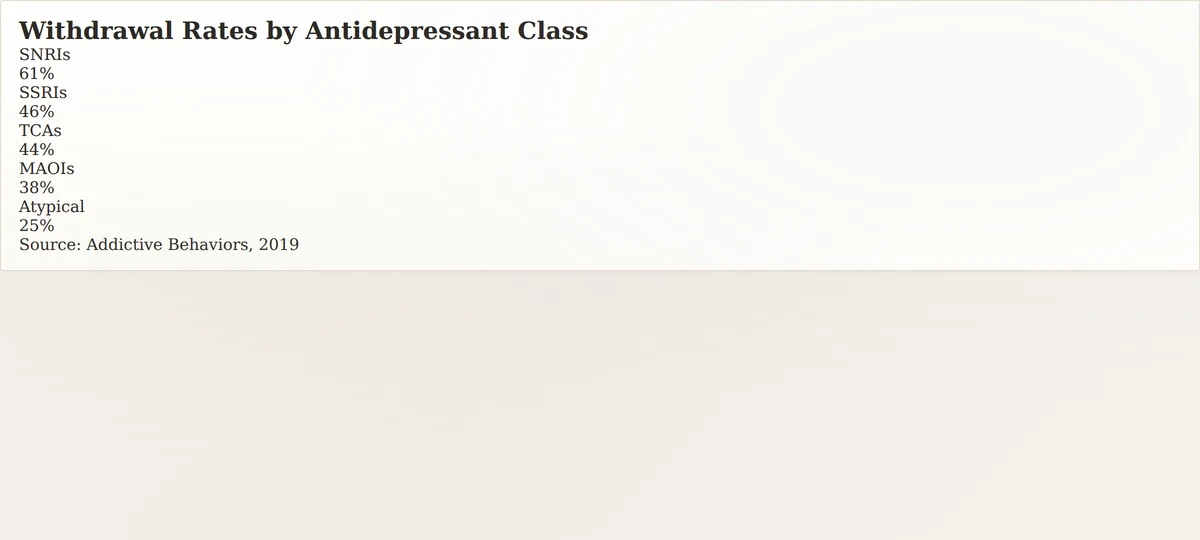
- SNRIs like venlafaxine carry the highest withdrawal risk — up to 61% of users experience discontinuation symptoms, which can last weeks to months.
- Cold-turkey cessation is never recommended — it can trigger severe and prolonged withdrawal. Tapering is the only safe approach.
- “Hyperbolic tapering” works better than linear tapering — because the brain’s response to dose reduction follows a hyperbolic curve, not a straight line.
- The symptom nobody mentions: sensory hypersensitivity — sounds feel too loud, lights feel too bright, and emotions feel unmanageably raw. It has a name and a mechanism.
- Fluoxetine is the easiest to discontinue — its long half-life provides a natural self-taper. Switching to fluoxetine before tapering is sometimes the best strategy.
- What Is Antidepressant Discontinuation Syndrome?
- What Does Antidepressant Withdrawal Feel Like?
- How Different Antidepressants Compare for Withdrawal Risk
- What Does the Research Say?
- 7 Proven Tapering Strategies That Actually Work
- What to Do If Withdrawal Symptoms Are Severe
- Related Reading
- Frequently Asked Questions
- The Bottom Line
You decide it is time to come off your antidepressant. You have been stable for a year. You have done the therapy. You feel ready.
You skip one dose. Then two. Within three days, something feels wrong. Not just “a little off” — fundamentally wrong. Your head buzzes when you move your eyes. You feel electric zaps shooting through your brain. Every sound is too loud. You cry at a commercial for insurance. Someone tells you it is “all in your head” or that your depression is returning.
It is not your depression, and it is not in your head — or rather, it is in your head in a very specific, physiological way. What you are experiencing is antidepressant discontinuation syndrome, and research shows it happens to more than half of people who stop these medications. The difference between a terrible experience and a manageable one almost always comes down to one factor: the tapering strategy.
By the end of this article, you will know exactly which antidepressant classes carry the highest risk, what the symptoms mean (including the one almost nobody warns you about), and seven evidence-based tapering methods — with class-specific recommendations — that make the difference between suffering through withdrawal and stopping safely.
What Is Antidepressant Discontinuation Syndrome?
Quick Answer: Antidepressant discontinuation syndrome is a cluster of physical and psychological symptoms that occur when antidepressant medication is reduced or stopped abruptly after regular use. Unlike addiction (where there is craving and loss of control), discontinuation syndrome is a physiological adaptation response — the brain has adjusted to the presence of the medication and needs time to readjust to its absence. The syndrome is distinct from both addiction and depression relapse, though it is frequently misdiagnosed as the latter.
The term itself matters. For decades, doctors used “antidepressant withdrawal” or even — inaccurately — “antidepressant addiction.” The correct clinical term is “discontinuation syndrome” because the underlying mechanism is different from substance withdrawal. In addiction, the brain’s reward pathways are hijacked, producing drug-seeking behaviour. In discontinuation syndrome, the brain’s serotonin (and sometimes norepinephrine) receptor populations, which downregulated to adapt to higher neurotransmitter levels, suddenly find themselves with too few neurotransmitters to bind to. The symptoms are the brain scrambling to upregulate receptors — a process that takes time.
The syndrome was formally recognised in the 1990s, following the widespread adoption of SSRIs. A 2019 meta-analysis published in Addictive Behaviors found that 56.4% of people who discontinue antidepressants experience withdrawal symptoms, with 46% of those rating symptoms as severe. The analysis also found that longer duration of use does not reliably predict who will experience withdrawal — some people on antidepressants for just 6–8 weeks develop significant symptoms, while others on them for years do not.
What Does Antidepressant Withdrawal Feel Like?
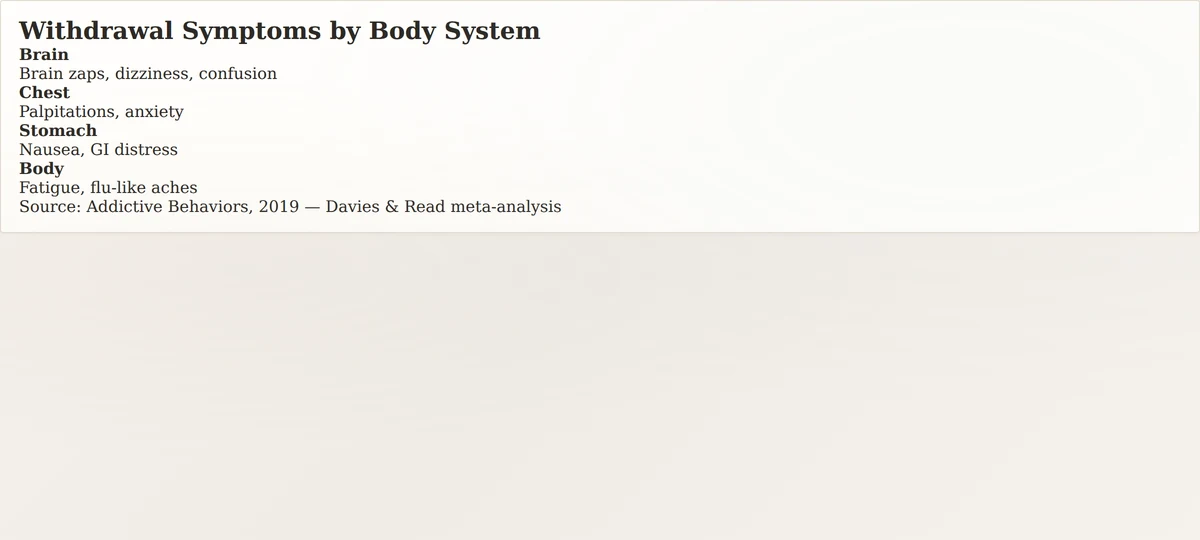
Here is where it gets interesting. The “classic” withdrawal symptoms — dizziness, nausea, headache — are well known. But there is a whole category of sensory and emotional symptoms that catch people completely off guard, and understanding them is the first step to managing them.
The FINISH Mnemonic (and What It Misses)
Medical students learn the “FINISH” mnemonic for SSRI discontinuation: Flu-like symptoms, Insomnia, Nausea, Imbalance (dizziness/vertigo), Sensory disturbances, Hyperarousal (anxiety/agitation). This captures the basics, but it misses the symptom that patients consistently describe as the most distressing.
Brain Zaps — The Symptom Nobody Warns You About (Including Your Doctor)
Brain zaps — also called “brain shivers,” “electrical shocks,” or “cranial zaps” — are sudden, brief sensations that feel like an electric jolt passing through the brain. They are often triggered by lateral eye movement or head turning. They are not dangerous, but they are deeply unsettling and can persist for weeks or months.
What causes them? The leading hypothesis involves serotonin’s role in modulating sensory processing. When serotonin levels drop rapidly during discontinuation, the brain’s sensory gating mechanism — which normally filters out irrelevant neural noise — becomes temporarily impaired. Lateral eye movements trigger signals that, without adequate serotonin modulation, are perceived as electrical sensations.
The practical implication: if you experience brain zaps during tapering, you are tapering too fast.
Sensory Hypersensitivity
Less well-known but equally real: sounds feel painfully loud (hyperacusis), lights seem unbearably bright (photophobia), and emotional stimuli that you normally handle easily — a sad song, a minor criticism — feel overwhelming. This is the brain’s sensory filtering network temporarily offline. It is not weakness. It is neurochemistry.
The Emotional Roller Coaster
Crying spells that come out of nowhere. Irritability that feels completely disproportionate to the trigger. A sense of being emotionally “raw” or unguarded. These are not signs that your depression is returning — at least not yet. They are direct effects of serotonin receptor readjustment. The distinction matters because the response is different: for withdrawal, the treatment is slowing the taper; for relapse, the treatment might be restarting the medication.
Timeline: How Long Does It Last?
| Medication Class | Typical Onset | Peak Severity | Typical Duration | Can Last |
|---|---|---|---|---|
| SSRIs (paroxetine, sertraline) | 1–3 days | 4–7 days | 1–3 weeks | Up to several months |
| SNRIs (venlafaxine, duloxetine) | 12–24 hours | 2–5 days | 2–6 weeks | Up to 1 year (rare) |
| TCAs (amitriptyline, nortriptyline) | 1–2 days | 3–7 days | 1–2 weeks | Several weeks |
| MAOIs (phenelzine, tranylcypromine) | 1–3 days | 5–10 days | 2–4 weeks | Months (rare) |
| Atypical (mirtazapine, bupropion) | 1–3 days | 3–7 days | 1–2 weeks | Several weeks |
How Different Antidepressants Compare for Withdrawal Risk
The single biggest predictor of withdrawal severity is the drug’s elimination half-life — how quickly it leaves the body. Shorter half-lives produce steeper drops in brain serotonin levels, triggering more intense discontinuation symptoms.
High-Risk Medications
Venlafaxine (Effexor): Half-life of just 5 hours (active metabolite 11 hours). This is the antidepressant most consistently associated with severe withdrawal. Missing even a single dose can trigger symptoms in many users. Specific studies have documented withdrawal rates exceeding 60%.
Paroxetine (Paxil): Half-life of 21 hours (but with high inter-individual variability). Paroxetine also has anticholinergic effects, meaning additional withdrawal symptoms like rebound sweating and GI distress. It is consistently ranked among the hardest-to-stop antidepressants.
Duloxetine (Cymbalta): Half-life of 12 hours. As an SNRI, it carries both serotonergic and noradrenergic withdrawal effects. Reports of severe withdrawal with duloxetine are common.
Medium-Risk Medications
Sertraline (Zoloft): Half-life of 26 hours. Withdrawal is common but typically less severe than paroxetine or venlafaxine. MedsBase stocks several sertraline formulations — [browse sertraline options]().
Escitalopram (Lexapro): Half-life of 27–32 hours. Withdrawal risk is moderate. Many patients can taper over 4–8 weeks with manageable symptoms.
Citalopram (Celexa): Half-life of 35 hours. Similar risk profile to escitalopram.
Mirtazapine (Remeron): Different mechanism (noradrenergic and specific serotonergic antidepressant — NaSSA). Half-life of 20–40 hours. Withdrawal risk is moderate but includes distinct symptoms like rebound insomnia and nausea.
Low-Risk Medications
Fluoxetine (Prozac): Half-life of 4–6 days for the parent drug and up to 16 days for its active metabolite, norfluoxetine. This exceptionally long half-life means fluoxetine effectively self-tapers over weeks after the last dose. Withdrawal rates are the lowest of any SSRI — approximately 5–15% vs 40–60% for paroxetine. This is why switching to fluoxetine before tapering is sometimes the best strategy for patients on high-risk medications.
Bupropion (Wellbutrin): Primarily dopaminergic and noradrenergic, not serotonergic. Half-life of 21 hours. Withdrawal is generally mild and lacks the classic SSRI brain zaps.
What Does the Research Say?
| Study | Year | Finding | Source |
|---|---|---|---|
| Davies & Read — Addictive Behaviors meta-analysis | 2019 | 56% of antidepressant users experience withdrawal; 46% of those rate it as severe; SNRIs have highest rates (61%) | Lancet Psychiatry |
| Haddad — SSRI discontinuation review | 2000 | Seminal review establishing discontinuation syndrome as a distinct clinical entity; proposed the FINISH diagnostic mnemonic | J Clin Psychiatry |
| Horowitz & Taylor — hyperbolic tapering | 2019 | Demonstrated that SSRI receptor occupancy follows a hyperbolic curve, meaning linear dose reductions produce disproportionately large receptor effects at low doses; proposed hyperbolic tapering | Lancet Psychiatry |
| Fava et al. — venlafaxine withdrawal | 2000 | Specific documentation of venlafaxine’s pronounced withdrawal syndrome; established need for extended tapering | J Clin Psychopharmacology |
| Royal College of Psychiatrists — official stopping guidance | 2020 (updated) | Official UK clinical guidance recommending gradual dose reduction over weeks to months; acknowledges prolonged withdrawal in some patients | RCPsych |
What this means for you: The evidence is clear that (1) discontinuation syndrome is common, (2) severity varies by drug, and (3) gradual tapering — especially hyperbolic tapering — is the only evidence-based prevention strategy. If your doctor has never mentioned tapering or suggested you can “just stop,” they are working from outdated information.
7 Proven Tapering Strategies That Actually Work
1. Hyperbolic Tapering (The Gold Standard)
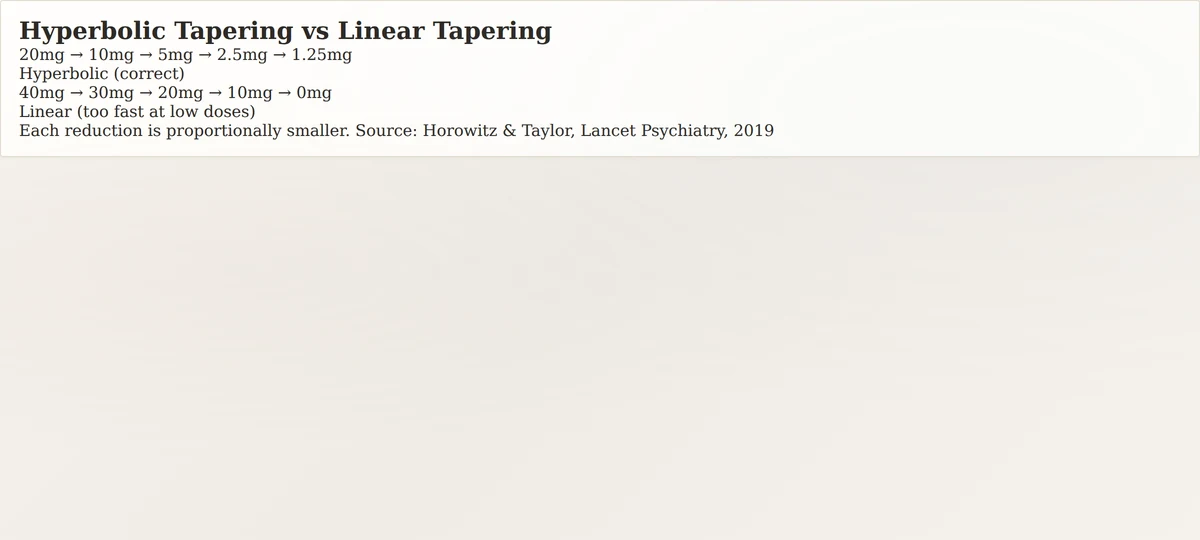
Here is the problem with linear tapering: cutting from 20 mg to 10 mg (a 50% reduction) does not produce a 50% reduction in serotonin transporter occupancy. Because the receptor-occupancy curve is hyperbolic — steep at low doses, flat at higher doses — a linear dose reduction produces a disproportionately large effect on brain serotonin levels at the lower end of the dose range.
This is why so many people do fine going from 40 mg to 20 mg but crash when going from 10 mg to 5 mg. Hyperbolic tapering solves this: each reduction is a fixed proportion of the current dose, not a fixed mg amount. For example: 20 mg 10 mg 5 mg 2.5 mg 1.25 mg stop. Each step is 50% of the previous dose, and each step should be held for at least 2–4 weeks (longer if symptoms emerge).
For practical implementation, this often requires liquid formulations or compounding to achieve the small doses needed at the tail end of the taper.
2. The Fluoxetine Bridge
For people on high-risk medications (venlafaxine, paroxetine, duloxetine), one of the most effective strategies is to switch to fluoxetine first, then taper off fluoxetine. Because fluoxetine’s half-life is so long (4–16 days), it naturally self-tapers over several weeks after the last dose, dramatically reducing withdrawal severity.
The bridge typically works like this: cross-titrate from the high-risk medication to an equivalent dose of fluoxetine over 1–2 weeks, stabilise on fluoxetine for 2–4 weeks, then stop fluoxetine. Many patients report minimal or no withdrawal symptoms with this approach. This is a decision to make with your prescriber, but it is a well-supported strategy with decades of clinical experience.
3. Extended-Linear Tapering
If hyperbolic tapering or a fluoxetine bridge are not available, a very slow linear taper — reducing by the smallest available tablet increment every 4–6 weeks — is better than faster approaches. For someone on sertraline 100 mg, this might look like: 100 75 50 37.5 25 12.5 stop, with 4 weeks minimum at each step.
The key word is “minimum.” If withdrawal symptoms emerge at any step, hold at that dose until you have been symptom-free for at least 2 weeks before the next reduction. There is no prize for tapering fast. There is only suffering from doing it too quickly.
4. Every-Other-Day Dosing (For Fluoxetine Only)
Because of fluoxetine’s long half-life, every-other-day dosing can work for this medication specifically — and essentially only this one. Taking fluoxetine 20 mg every other day produces average blood levels roughly equivalent to 10 mg daily. For any other antidepressant, every-other-day dosing produces the very plasma-level peaks and troughs that drive withdrawal symptoms. Do not use this strategy with venlafaxine, paroxetine, or any SNRI.
5. Liquid Formulation Micro-Tapering
Many antidepressants are available as oral solutions (liquid), which allows for much smaller dose adjustments than splitting tablets. For the final stages of a taper — going from 5 mg to 2.5 mg to 1.25 mg to 0.625 mg — liquid is often the only practical way to achieve these doses without compounding.
If your medication’s liquid formulation is not available or not covered by insurance, compounding pharmacies can prepare custom low-dose capsules or liquids. This costs more but can make the difference between a smooth taper and a failed one.
6. Symptom-Targeted Support
While tapering, certain adjunctive strategies can reduce specific withdrawal symptoms:
- Brain zaps and dizziness: Some evidence suggests omega-3 fatty acids (EPA/DHA) and magnesium may reduce neurological symptoms, though controlled trials are limited. Antihistamines like diphenhydramine have been used anecdotally for brain zaps but come with their own side effects.
- Insomnia: Melatonin (1–3 mg at bedtime), good sleep hygiene, and temporary use of sedating antihistamines (under medical guidance) can help. Avoid benzodiazepines or Z-drugs — they create a new discontinuation problem.
- Nausea: Ginger, small frequent meals, and avoiding an empty stomach can help. Ondansetron (prescription) is effective for severe nausea.
- Emotional lability: Knowing it is withdrawal, not relapse, is itself therapeutic. Brief supportive therapy or increased session frequency during the taper provides external grounding.
7. Psychological and Lifestyle Support
The tapering period is not just pharmacological — it is a psychological and physiological transition. Three things that meaningfully improve outcomes:
Exercise: Regular aerobic exercise (even 20–30 minutes of walking) increases brain-derived neurotrophic factor (BDNF), which supports neuroplasticity during the brain’s readjustment period. It also provides natural mood elevation and anxiety reduction.
Sleep protection: Tapering disrupts sleep architecture. Prioritise sleep with consistent bedtimes, reduced evening screen exposure, and a wind-down routine. If insomnia persists more than 2 weeks at any taper step, hold the dose until sleep stabilises.
Social support: Tell one trusted person what you are doing. Having someone who knows you are tapering — and who can reality-check whether your emotional state is withdrawal-related — is surprisingly protective against misinterpreting withdrawal as relapse.
What to Do If Withdrawal Symptoms Are Severe
If withdrawal symptoms become unmanageable despite slow tapering, you have options:
- Return to the last tolerated dose — not the original full dose. If you were stable at 20 mg and crashed at 10 mg, go back to 15 mg (or 20 mg), not 50 mg. Stabilise there for 4+ weeks, then attempt a smaller reduction next time (e.g., 20 17.5 15).
- Consider the fluoxetine bridge — especially if you are on venlafaxine or paroxetine and tapering has failed multiple times.
- Consult a specialist — a psychiatrist with specific expertise in psychopharmacology has options (liquid formulations, compounding, augmentation strategies) that a general practitioner may not be aware of.
- Know that it ends — even in rare cases where withdrawal persists for months, it does resolve. The brain’s plasticity means it eventually recalibrates. This is not a permanent state.
Related Reading
- Diabetes and Menopause: 7 Surprising Ways Blood Sugar Affects Symptoms — SSRIs are sometimes prescribed for menopause-related hot flashes. Our guide covers when this makes sense and when it doesn’t.
- ACE Inhibitors vs ARBs: Which Blood Pressure Medication Is Right for You? — Many people on antidepressants also manage hypertension. Understanding your options matters.
- [MedsBase Mental Health Options]() — Browse our full catalogue of mental health medications, including sertraline, escitalopram, fluoxetine, and more.
Frequently Asked Questions
Q: How long does antidepressant withdrawal last?
A: It depends on the medication and tapering speed, but typically 1–3 weeks for SSRIs tapered over 4–8 weeks, and 2–6 weeks for SNRIs. With cold-turkey cessation or very fast tapers, symptoms can persist for months (protracted withdrawal). The Addictive Behaviors meta-analysis found duration varies widely by individual and medication — there is no one-size-fits-all timeline.
Q: What are brain zaps from antidepressants?
A: Brain zaps are brief, electric-shock-like sensations in the head, often triggered by eye or head movement, that occur during antidepressant dose reduction or cessation. They are caused by temporary impairment of the brain’s sensory gating mechanism due to rapidly dropping serotonin levels. They are not dangerous but indicate the taper is too fast.
Q: Can you stop antidepressants cold turkey?
A: No, cold-turkey cessation is never recommended. Abruptly stopping antidepressants — especially short-half-life drugs like venlafaxine and paroxetine — can trigger severe, prolonged withdrawal. Always taper under medical supervision.
Q: How to taper off venlafaxine safely?
A: Venlafaxine requires the most careful tapering of any commonly prescribed antidepressant due to its 5-hour half-life. Recommended approaches: (1) hyperbolic tapering to the smallest possible dose over months, (2) switching to fluoxetine first and tapering fluoxetine (the “fluoxetine bridge”), or (3) using venlafaxine’s extended-release formulation to create smaller incremental dose reductions. Never every-other-day dose with venlafaxine.
Q: What does antidepressant withdrawal feel like?
A: Withdrawal typically includes dizziness, vertigo, brain zaps (electrical sensations in the head), nausea, fatigue, flu-like body aches, insomnia, vivid dreams or nightmares, crying spells, irritability, sensory hypersensitivity (sounds too loud, lights too bright), and a sense of being emotionally “raw.” The specific mix varies by individual and medication.
Q: Is antidepressant withdrawal the same as relapse?
A: No. Withdrawal symptoms typically begin within 1–3 days of dose reduction (faster with short-half-life drugs), peak within the first week, and include physical symptoms (dizziness, brain zaps, nausea) that are not typical of depression relapse. Depression relapse typically takes weeks to develop and does not include brain zaps, dizziness, or sensory disturbances. If you have physical symptoms, it is withdrawal. If symptoms are purely emotional and develop gradually over 4+ weeks, it may be relapse.
Q: How does bupropion withdrawal compare to SSRI withdrawal?
A: Bupropion (Wellbutrin) withdrawal is generally milder than SSRI or SNRI withdrawal. Because bupropion primarily affects dopamine and norepinephrine — not serotonin — it does not cause brain zaps or most serotonergic withdrawal symptoms. Common bupropion withdrawal effects include fatigue, low energy, increased appetite, and mild mood changes. These are typically manageable with a slow taper over 2–4 weeks.
Q: Can I use over-the-counter supplements to help with withdrawal?
A: Some people find omega-3 fatty acids, magnesium, and melatonin helpful for specific symptoms (neurological sensations, sleep), but no supplement has strong clinical evidence for preventing or treating discontinuation syndrome. The most evidence-based intervention remains slow tapering. Supplements should be discussed with your prescriber, as some can interact with residual medication levels.
The Bottom Line
Antidepressant discontinuation syndrome is real, common, and — crucially — preventable. The difference between a traumatic withdrawal experience and a manageable one is almost entirely determined by the tapering strategy. Slow down the taper, respect the hyperbolic dose-response curve, and give your brain the weeks (or months) it needs to readjust.
Your immediate action step: If you are considering stopping an antidepressant, open the conversation with your prescriber using the word “taper.” Ask specifically about a hyperbolic taper or a fluoxetine bridge. If your prescriber dismisses withdrawal concerns or suggests you can stop in under a week, seek a second opinion — the evidence is on your side.
Understanding how medications interact is key to managing your overall health. If menopause symptoms are part of your picture, our guide on diabetes and menopause covers the surprising hormonal connections that affect treatment decisions. And if you are managing multiple prescriptions — as many people on antidepressants do — our comparison of ACE inhibitors vs ARBs walks through the blood pressure medication landscape clearly.
Medical Disclaimer: This article is for informational purposes only and does not constitute medical advice. Never stop, change, or taper any medication without direct supervision from your prescribing healthcare provider. Antidepressant discontinuation should always be managed under medical guidance.

Written by
Sophie ChenPharmaceutical Content Researcher · 8 years experience
Sophie Chen is a pharmaceutical content researcher with 8 years covering generic medication access and clinical pharmacology. She specialises in international regulatory frameworks, bioequivalence standards, and patient-facing education on therapeutic drug classes. She is not a clinician.