








✓ Medically reviewed by · Last reviewed: May 2026
Pharmacy Researcher · 8 years experience
Pharmacy researcher with 8 years reviewing clinical drug information, generic formulation equivalence, and international pharmaceutical standards. Focuses on patient-facing accuracy in medication education.
Apixaban vs rivaroxaban: the short answer. Both are direct Factor Xa inhibitor blood thinners that prevent strokes in atrial fibrillation and treat blood clots. They work through the same target, yet they differ in ways that matter every single day — dosing frequency, food requirements, kidney clearance, and real-world bleeding risk. For most people, the weight of observational evidence tilts toward apixaban on safety, while rivaroxaban wins on once-daily convenience. Your best choice depends on your kidney function, age, weight, bleeding history, and lifestyle.
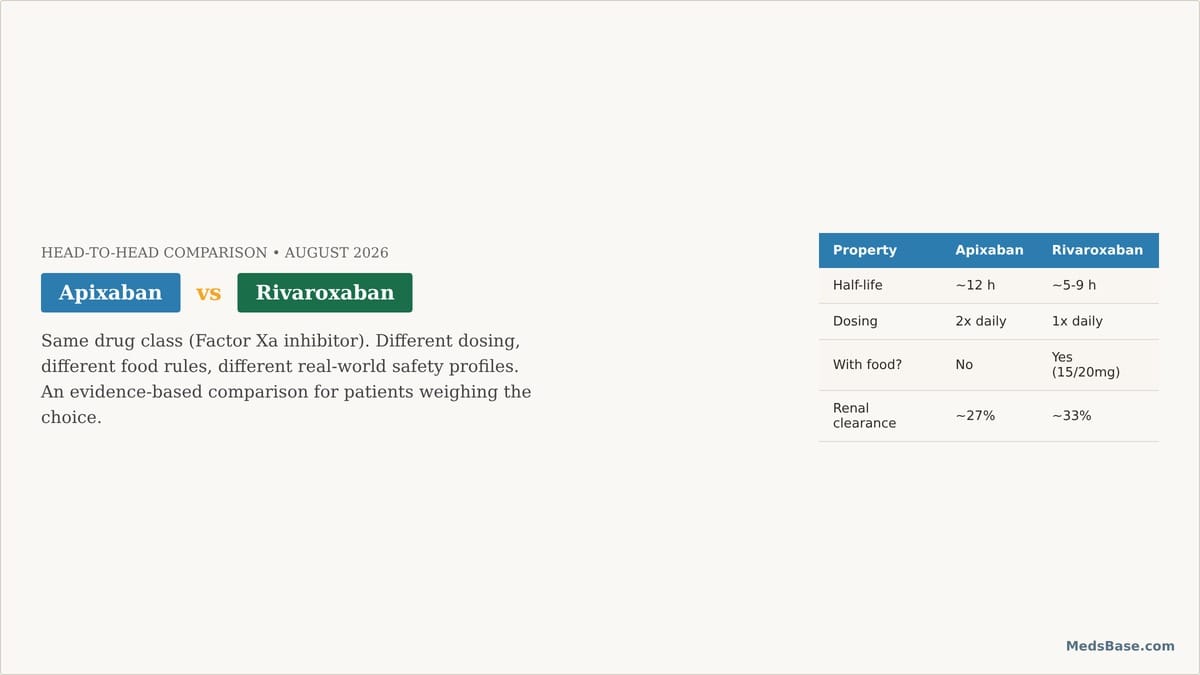
Choosing between apixaban vs rivaroxaban is one of the most common decisions in modern blood-thinner therapy — and for good reason. Both drugs replaced warfarin as the go-to oral anticoagulants for millions of people, yet they are far from interchangeable. In this guide, you will learn exactly how these two Factor Xa inhibitors compare across the details that actually affect you: bleeding risk, dosing schedules, food interactions, kidney function, and cost.
Atrial fibrillation — the irregular heartbeat these drugs most often protect against — affects tens of millions of people worldwide and raises the risk of stroke roughly fivefold. That is why getting the apixaban vs rivaroxaban decision right matters: the wrong choice for your profile can mean either a preventable stroke or an avoidable bleed.
Key Takeaways
- Both are Factor Xa inhibitor DOACs — however, apixaban is taken twice daily while rivaroxaban is taken once daily, and this single difference ripples through missed-dose risk and everyday convenience.
- Real-world safety data tilts toward apixaban. Large observational studies consistently link apixaban with lower rates of major and gastrointestinal bleeding than rivaroxaban, with similar stroke-prevention efficacy.
- Kidney function changes the calculus. Because apixaban clears less through the kidneys than rivaroxaban, apixaban is generally preferred in moderate kidney impairment — although both require dose adjustments as kidney function declines.
- Food matters for one of them. Rivaroxaban’s 15 mg and 20 mg doses must be taken with food, whereas apixaban can be taken with or without food.
- Neither needs routine blood monitoring like warfarin, which is why both feel easier to live with — but they are not interchangeable, and switching requires a doctor’s guidance.
What Are Apixaban and Rivaroxaban?
Apixaban and rivaroxaban belong to a class of medications called direct oral anticoagulants (DOACs), sometimes referred to as NOACs. Specifically, they are both direct Factor Xa inhibitors. That means they block a specific enzyme — Factor Xa — that sits near the end of the blood-clotting cascade. By turning this enzyme off, the drugs slow the chain reaction that forms harmful clots inside blood vessels.
Apixaban is sold under the brand name Eliquis. It was approved by regulators in 2012 and is used to lower stroke risk in people with atrial fibrillation, to treat deep vein thrombosis (DVT) and pulmonary embolism (PE), and to prevent blood clots after hip or knee replacement surgery.
Rivaroxaban is sold under the brand name Xarelto. Approved in 2011, it treats the same core conditions: stroke prevention in atrial fibrillation, DVT and PE treatment, and clot prevention after surgery. In addition, rivaroxaban carries an indication for reducing the risk of major cardiovascular events in people with chronic coronary or peripheral artery disease — a use apixaban does not share.
On the surface, the apixaban vs rivaroxaban comparison looks almost too close to call. Both are oral pills, both work on Factor Xa, and both avoid the frequent blood tests that made warfarin cumbersome. Consequently, many people assume the two are effectively identical. In practice, however, their pharmacokinetic profiles — how quickly the body absorbs, distributes, and clears each drug — diverge in clinically meaningful ways.
Part of why these two became so popular is what they left behind. Warfarin, the standard for decades, required regular finger-prick blood tests, strict diet rules around vitamin K, and constant dose fiddling. The DOACs swept away most of that friction, which is why the apixaban vs rivaroxaban question — rather than “warfarin or not?” — now dominates prescribing conversations.
Both drugs are also available as generic medicines in addition to their brand-name forms, which has helped lower out-of-pocket costs in many regions. Even so, pricing and availability vary by country and insurance plan, so the affordability side of the apixaban vs rivaroxaban decision often comes down to what your specific formulary happens to cover.
Apixaban vs Rivaroxaban — How They Work
To understand the apixaban vs rivaroxaban comparison, it helps to understand what Factor Xa actually does. When you bleed, your body launches a cascade of clotting proteins — a kind of domino chain with two starting paths, the intrinsic and extrinsic pathways, that meet at a common junction. At that junction sits Factor Xa, which converts prothrombin into thrombin. Thrombin, in turn, converts fibrinogen into fibrin — the fibrous mesh that plugs a wound.
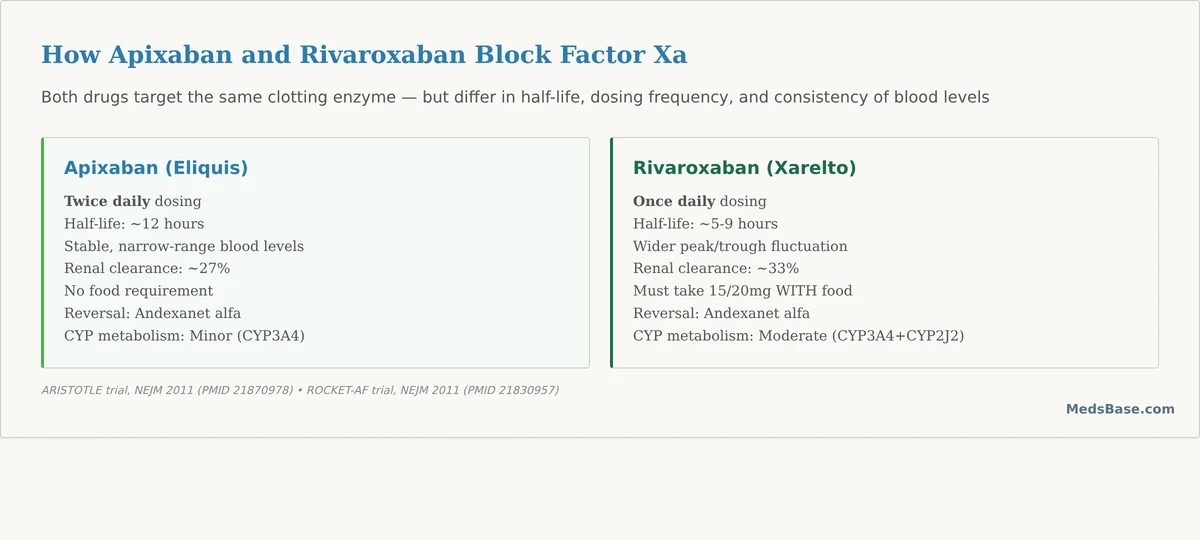
Both apixaban and rivaroxaban attach directly to Factor Xa and prevent it from doing its job. The result is a gentler, more predictable anticoagulant effect than warfarin, which interferes with several vitamin K-dependent clotting factors at once. Because the DOACs act so specifically, they require no routine blood monitoring and have fewer food and drug interactions overall.
However, the two drugs reach their target differently. Apixaban has a half-life of roughly 12 hours, which is why it is dosed twice daily. Rivaroxaban has a shorter, more variable half-life — around 5 to 9 hours in younger people and up to 13 hours in older adults — yet its effects still permit once-daily dosing for most indications.
Equally important is how each drug is cleared. Apixaban is eliminated roughly 27% through the kidneys, meaning the kidneys handle only about a quarter of the drug. Rivaroxaban, by contrast, is cleared about 36% through the kidneys. This difference explains why kidney function weighs more heavily on rivaroxaban dosing decisions — a theme we will return to shortly.
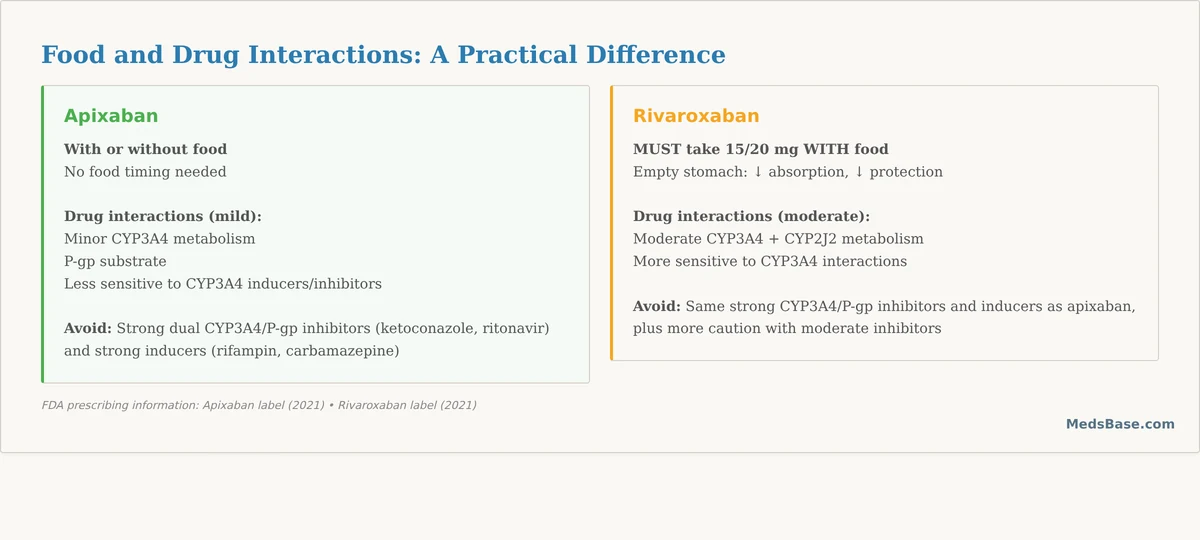
Both drugs are also metabolized in part by the liver enzyme CYP3A4 and are substrates of the transporter protein P-glycoprotein. That shared pathway means certain strong enzyme inhibitors or inducers — some antifungals, some HIV medicines, and certain anti-seizure drugs — can raise or lower blood levels of either drug. In practice, the apixaban vs rivaroxaban interaction profiles are similar, but the specific drug combinations that cause trouble can differ, which is why your full medication list belongs in the conversation.
Apixaban vs Rivaroxaban — 7 Key Differences
The apixaban vs rivaroxaban decision usually comes down to seven practical differences. Here they are, ranked roughly by how much they affect daily life.
- Dosing frequency. Apixaban is taken twice daily, roughly every 12 hours. Rivaroxaban is taken once daily. For people who struggle to remember a second dose, rivaroxaban’s once-daily schedule is a genuine advantage — and one of the most common reasons people request it.
- Food requirement. Rivaroxaban’s 15 mg and 20 mg doses must be taken with food — ideally the main meal — because absorption drops significantly on an empty stomach. Apixaban can be taken with or without food, which makes it more forgiving for irregular eaters.
- Kidney clearance. Roughly 27% of apixaban is renally cleared versus about 36% of rivaroxaban. This makes apixaban the more common choice in moderate kidney impairment, where rivaroxaban’s dependence on the kidneys becomes a liability.
- Real-world bleeding risk. Large observational studies, including a 2021 JAMA analysis of more than half a million people, found higher rates of major and gastrointestinal bleeding with rivaroxaban than with apixaban.
- Half-life and steady-state. Apixaban’s ~12-hour half-life means consistent blood levels with twice-daily dosing. Rivaroxaban’s shorter half-life means levels dip between once-daily doses, so the timing of your dose relative to a missed one matters more.
- Dose-reduction criteria. Apixaban’s dose is halved when at least two of three criteria are met — age 80 or older, weight 60 kg or less, or serum creatinine of 1.5 mg/dL or higher. Rivaroxaban’s dose is reduced based on kidney function alone.
- Extra indications. Rivaroxaban is also approved to reduce cardiovascular risk in chronic coronary and peripheral artery disease, a use apixaban does not have — a decisive factor if you are treating more than one condition.
Notice a pattern: none of these differences make one drug universally “better.” Instead, each tilts the apixaban vs rivaroxaban scale toward a specific patient profile — which is precisely why your doctor’s input matters before you commit to either one.
Apixaban vs Rivaroxaban — Bleeding Risk & Safety
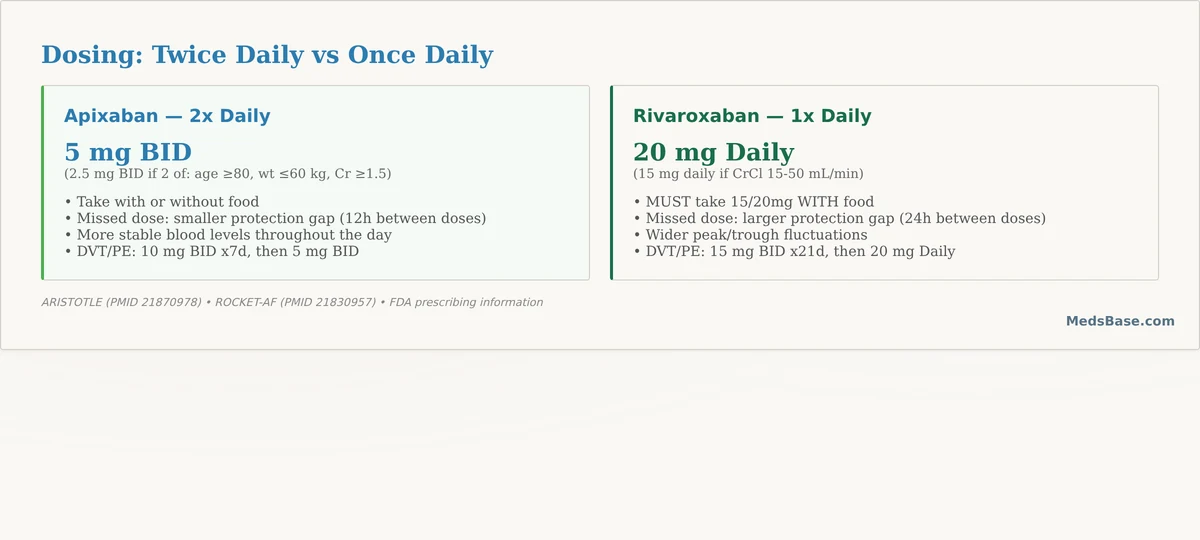
Bleeding is the most serious side effect of any blood thinner, so safety dominates the apixaban vs rivaroxaban conversation. Both drugs lower the risk of stroke but raise the risk of bleeding; the question is how much, and where.
In their landmark trials, both drugs reduced the most feared bleeding event — intracranial hemorrhage, or bleeding inside the brain — by roughly half compared with warfarin. The ARISTOTLE trial found apixaban reduced major bleeding versus warfarin, while the ROCKET-AF trial found rivaroxaban produced similar overall major bleeding to warfarin but fewer fatal and intracranial bleeds.
Where the two diverge most is in gastrointestinal (GI) bleeding. Real-world evidence consistently shows higher GI bleeding rates with rivaroxaban than with apixaban. This matters because GI bleeding — often from the stomach or lower bowel — is one of the more common serious bleeds in anticoagulated patients.
| Bleeding Outcome | Apixaban (Eliquis) | Rivaroxaban (Xarelto) |
|---|---|---|
| Major bleeding vs warfarin | Lower | Similar |
| Gastrointestinal bleeding | Lower | Higher |
| Intracranial hemorrhage | Much lower than warfarin | Much lower than warfarin |
| Fatal bleeding | Lower than warfarin | Lower than warfarin |
Your personal bleeding risk depends on more than the drug you choose. Age over 75, a prior stomach bleed or ulcer, kidney or liver disease, and the use of NSAIDs (like ibuprofen) or antiplatelet drugs (like aspirin or clopidogrel) all stack additional risk. Because these factors can outweigh the drug-to-drug differences, the safest version of the apixaban vs rivaroxaban decision is one that weighs your whole profile, not just the brand names.
Beyond bleeding, both drugs share a similar, generally mild side-effect profile. Nausea, bruising, mild anemia, and fatigue can occur. Neither drug carries the hair loss, skin necrosis, or dietary restrictions famously associated with warfarin. Importantly, both drugs are considerably safer than warfarin when it comes to brain bleeding — one of the strongest reasons DOACs became first-line therapy.
It is also worth knowing that a specific reversal agent, andexanet alfa, can partially reverse the effect of both apixaban and rivaroxaban in an emergency. The fact that a reversal option exists does not make these drugs risk-free, but it does reduce one of the historical fears around anticoagulants — the sense that a major bleed would be impossible to stop.
Finally, certain people should avoid both drugs altogether. These include people with mechanical heart valves, those with severe liver disease, and most pregnant women. If you fall into one of these groups, the apixaban vs rivaroxaban question is likely moot, and a different anticoagulation strategy will be recommended instead.
Apixaban vs Rivaroxaban — Dosing Schedules Compared
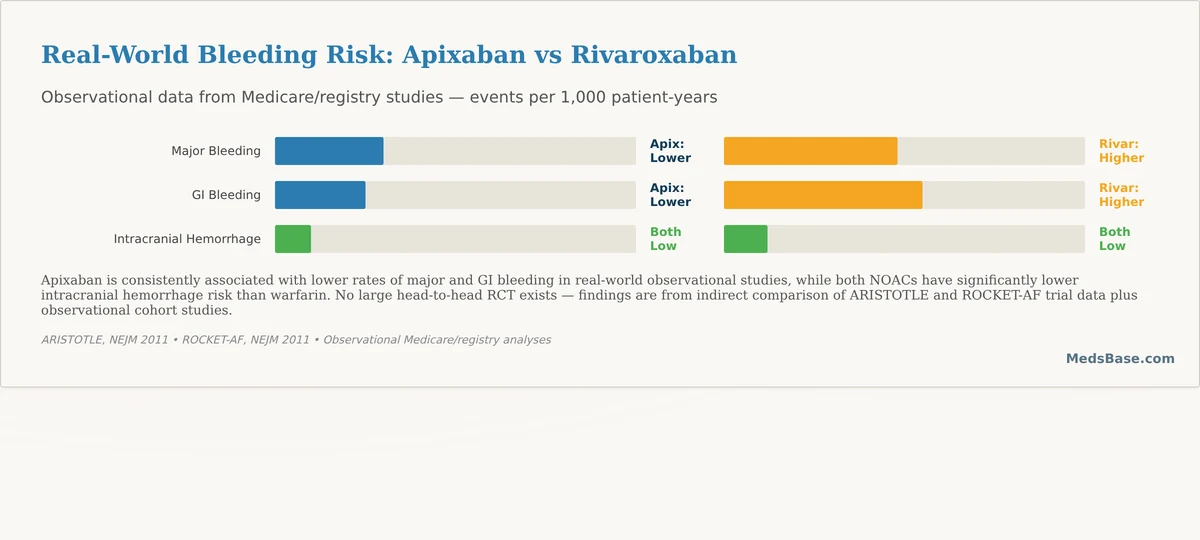
If you have ever forgotten a pill, the apixaban vs rivaroxaban dosing comparison will feel personal. Rivaroxaban’s once-daily convenience is balanced against apixaban’s more forgiving absorption and steadier blood levels.
| Dosing Factor | Apixaban (Eliquis) | Rivaroxaban (Xarelto) |
|---|---|---|
| Typical dose (AF) | 5 mg twice daily | 20 mg once daily |
| Dose reduction | 2.5 mg twice daily if 2 of 3 criteria met | 15 mg once daily if kidney function reduced |
| Food | With or without food | 15/20 mg must be taken with food |
| Half-life | ~12 hours | ~5 to 13 hours |
| Renal clearance | ~27% | ~36% |
The food rule is the most commonly overlooked detail in the apixaban vs rivaroxaban discussion. If rivaroxaban’s 20 mg dose is taken on an empty stomach, its absorption can fall by roughly a third, potentially leaving you under-anticoagulated. Taking it with the main evening meal is a simple but critical habit.
Apixaban’s twice-daily dosing is a double-edged sword. On one hand, forgetting a dose matters less because blood levels stay steadier. On the other hand, you must remember to take it twice a day — a real hurdle for some. Your preference here is a legitimate factor in choosing between apixaban and rivaroxaban.
Missed-dose handling also differs in spirit. With once-daily rivaroxaban, a forgotten dose can leave a longer stretch with little drug on board. With twice-daily apixaban, a missed dose is usually caught sooner. In both cases, the rule of thumb is to take the missed dose as soon as you remember — unless it is almost time for the next dose, in which case you skip it and never double up. Always confirm the exact instruction with your doctor or pharmacist.
Special populations get special rules. Older adults, people with low body weight, and those with reduced kidney or liver function may all need dose adjustments. Consequently, the “typical” doses in the table are only a starting point — the correct dose for you is the one your clinician calculates from your bloodwork and history.
What the Research Says — Apixaban vs Rivaroxaban
No large head-to-head randomized trial has directly compared apixaban and rivaroxaban against each other. Instead, the evidence for the apixaban vs rivaroxaban question comes from two landmark warfarin-controlled trials plus a growing body of high-quality real-world studies.
| Study | Design | Key Finding |
|---|---|---|
| ARISTOTLE (2011) | RCT: apixaban vs warfarin (n=18,201) | Apixaban superior for stroke prevention, with less major bleeding and lower mortality. |
| ROCKET-AF (2011) | RCT: rivaroxaban vs warfarin (n=14,264) | Rivaroxaban non-inferior for stroke prevention, with less intracranial and fatal bleeding. |
| Ray et al. (JAMA, 2021) | Real-world Medicare cohort (n≈581,000) | Rivaroxaban associated with more major ischemic and hemorrhagic events than apixaban, driven by bleeding. |
| Fralick et al. (Ann Intern Med, 2020) | Routine-practice cohort (n≈39,000) | Similar stroke prevention; apixaban linked to lower GI bleeding in several analyses. |
| Ray et al. (JAMA, 2024) | Drug-interaction cohort | Combining diltiazem with either drug raised serious bleeding risk — a reminder that interactions matter. |
Read together, these studies tell a consistent story. For stroke prevention, apixaban and rivaroxaban perform similarly. For bleeding — especially GI bleeding — apixaban tends to come out ahead. Consequently, the apixaban vs rivaroxaban safety edge has quietly shifted prescribing patterns in apixaban’s favor over the past several years.
It is worth noting that observational studies carry inherent limitations. They are not randomized, so differences between patient groups could partly explain the results. Even so, the consistency of the finding across multiple large datasets makes it hard to dismiss.
A definitive head-to-head randomized trial is unlikely to arrive anytime soon. Such a study would need tens of thousands of participants and years of follow-up to detect small differences in already-rare outcomes, and neither manufacturer has an incentive to fund it. As a result, the apixaban vs rivaroxaban comparison will keep leaning on the observational evidence above — which, while imperfect, is unusually large and consistent.
How to Choose — Apixaban vs Rivaroxaban Decision Guide
There is no single correct answer to the apixaban vs rivaroxaban question. The right drug depends on your individual profile. Use the following guide as a starting point for a conversation with your doctor.
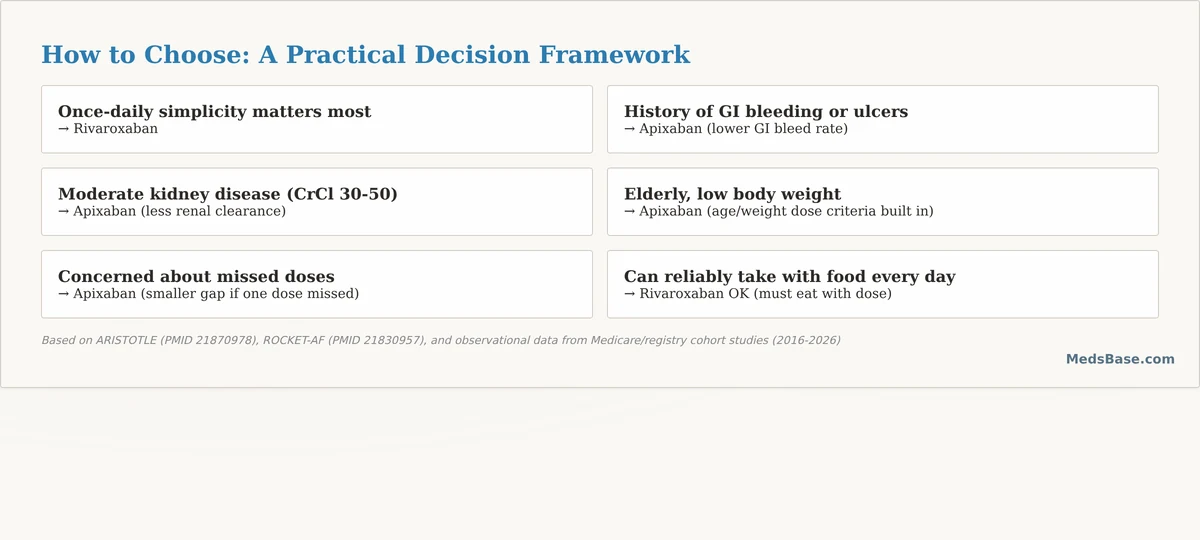
- Choose apixaban if you have moderate kidney impairment, a history of GI bleeding or ulcers, or you value the flexibility to take your pill with or without food.
- Choose rivaroxaban if you struggle to remember a twice-daily routine, you need the extra cardiovascular indications, or your doctor confirms your kidney function is stable.
- Consider cost and coverage. Brand-name prices and insurance formularies vary, so affordability can legitimately decide between apixaban and rivaroxaban.
- Never switch on your own. Transitioning between anticoagulants requires a specific protocol — usually stopping one and starting the next at the time the next dose would have been due — without overlapping.
Think of it as three buckets. The first is safety, where apixaban generally leads on GI bleeding. The second is convenience, where rivaroxaban’s once-daily dosing shines. The third is your specific body — your kidneys, weight, age, and other medicines — which can override everything else. A sound apixaban vs rivaroxaban decision weighs all three rather than fixating on any single headline.
Finally, keep in mind that “no routine monitoring” does not mean “no monitoring ever.” Most clinicians still check kidney and liver function, along with a blood count, roughly once a year while you are on either drug. These simple checks help catch the slow decline in kidney function that can quietly shift the ideal apixaban vs rivaroxaban dose over time.
Remember that neither drug requires routine blood monitoring, which is why both feel dramatically easier than warfarin. Furthermore, both are available without a prescription through MedsBase.com, sourced from WHO-GMP-certified manufacturers. Still, anticoagulants are serious medicines, and you should coordinate any start, switch, or stop with your doctor — and keep up with the periodic kidney and liver function checks your clinician schedules.
If you are managing related conditions, you may also want to review our guide to high blood pressure management, our article on blood thinners and cognitive decline, and our pain relief medication overview.
Frequently Asked Questions
Which is better, apixaban or rivaroxaban?
For most patients, real-world evidence suggests apixaban holds a modest safety advantage — lower rates of major and gastrointestinal bleeding with similar stroke-prevention efficacy. However, there is no head-to-head randomized trial, and rivaroxaban’s once-daily dosing remains genuinely attractive for many. “Better” depends on your bleeding risk, kidney function, age, weight, and lifestyle.
Is apixaban safer than rivaroxaban?
In large observational studies, yes — apixaban is consistently linked to lower major and GI bleeding than rivaroxaban, with similar or lower stroke risk. The difference matters most for people with GI bleeding risk factors. Both drugs are far safer than warfarin when it comes to brain bleeding, but observational data should be read as a tendency rather than a definitive ranking.
Can apixaban and rivaroxaban be taken together?
No — absolutely not. Both are anticoagulants acting through the same Factor Xa mechanism. Taking them together stacks the anticoagulant effect and dramatically raises the risk of serious, potentially fatal bleeding. If a switch is needed, follow a doctor-provided transition protocol precisely rather than overlapping the two drugs.
What is the difference between Eliquis and Xarelto?
Eliquis is the brand name for apixaban, and Xarelto is the brand name for rivaroxaban. The key differences: apixaban is dosed twice daily and taken with or without food, while rivaroxaban is once daily and its 15/20 mg doses require food. Apixaban also shows lower real-world bleeding and less renal clearance, whereas rivaroxaban offers once-daily convenience.
Does apixaban have fewer side effects than rivaroxaban?
The side-effect profiles are similar — both can cause bleeding, bruising, nausea, and anemia. The most meaningful difference is bleeding risk, where observational data favors apixaban. Neither drug is associated with the hair loss, skin necrosis, or frequent monitoring issues sometimes seen with warfarin.
Do I need to take rivaroxaban with food?
Yes — rivaroxaban’s 15 mg and 20 mg doses must be taken with food, ideally the main evening meal for the once-daily dose. On an empty stomach, absorption drops sharply, which can leave you under-anticoagulated. Apixaban, in contrast, can be taken with or without food.
Are apixaban and rivaroxaban available without a prescription?
Through MedsBase.com, both apixaban and rivaroxaban are available without a prescription, sourced from WHO-GMP-certified manufacturers. That said, anticoagulants are serious medications, and you should always coordinate with your doctor before starting, switching, or stopping any blood thinner.
Can I switch from apixaban to rivaroxaban or vice versa?
Yes, switching is possible and sometimes done for cost, side effects, or convenience. However, it must be done correctly — typically by stopping the first drug and starting the second at the time the next dose would have been due, without overlapping. Never attempt to switch anticoagulants on your own, as errors can leave you unprotected or over-anticoagulated during the transition.
The Bottom Line
The apixaban vs rivaroxaban decision is genuinely close, but it is not a coin flip. Both are excellent Factor Xa inhibitors that beat warfarin on convenience and brain-bleeding safety. The differences that matter are concrete: apixaban is taken twice daily with or without food and tends to produce less GI bleeding, while rivaroxaban is taken once daily with food and carries extra cardiovascular indications.
In short, if safety and flexibility are your priority, apixaban is often the preferred choice. If once-daily simplicity is your priority, rivaroxaban has a clear edge. Because the right answer depends on your kidneys, your bleeding history, and your daily routine, the smartest move is to discuss the apixaban vs rivaroxaban choice with your doctor — and to keep that conversation grounded in the evidence above.
Medical Disclaimer: This article is for educational purposes only and does not constitute medical advice. Always consult a qualified healthcare professional before starting, stopping, or changing any medication, including blood thinners such as apixaban or rivaroxaban.

Written by
Sophie ChenPharmaceutical Content Researcher · 8 years experience
Sophie Chen is a pharmaceutical content researcher with 8 years covering generic medication access and clinical pharmacology. She specialises in international regulatory frameworks, bioequivalence standards, and patient-facing education on therapeutic drug classes. She is not a clinician.