








✓ Medically reviewed by · Last reviewed: May 2026
Pharmacy Researcher · 8 years experience
Pharmacy researcher with 8 years reviewing clinical drug information, generic formulation equivalence, and international pharmaceutical standards. Focuses on patient-facing accuracy in medication education.
bacterial vaginosis STI risk — Bacterial Vaginosis STI Risk: 5 Proven Facts About the Tripled Infection Odds You Must Know. Read on for an evidence-backed guide covering everything you need to know.
Key Takeaways
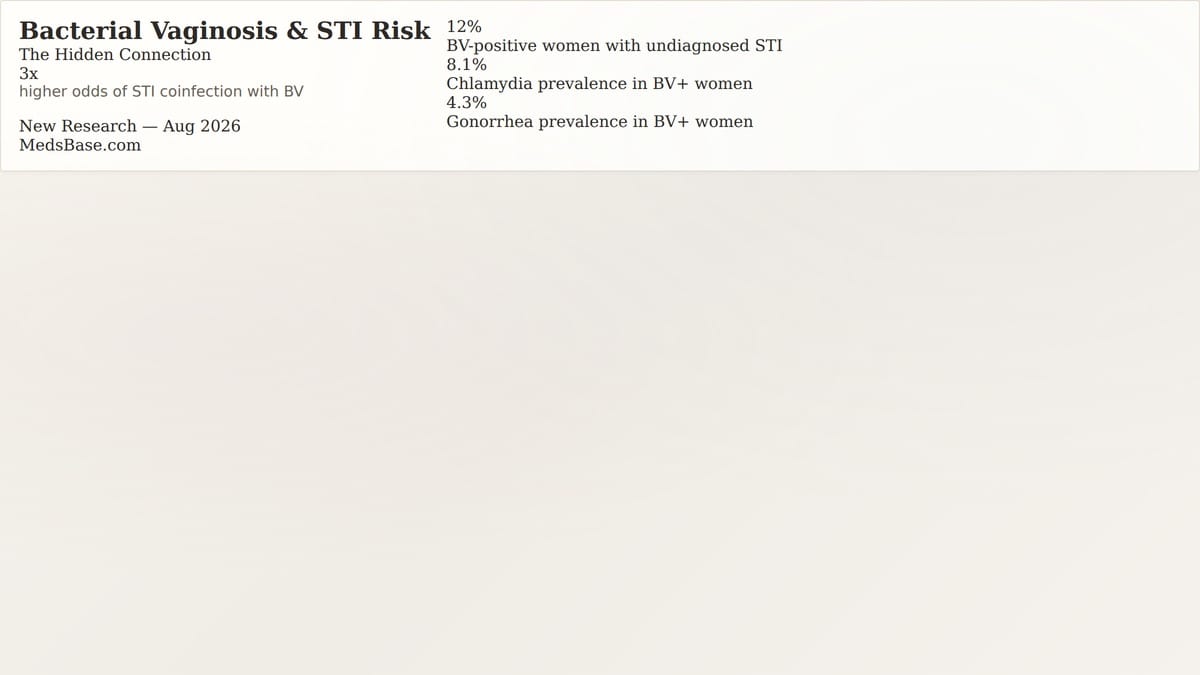
- More than 1 in 10 women with bacterial vaginosis also test positive for an STI — new research reveals the risk is roughly triple that of women without BV.
- BV disrupts the vaginal microbiome — depleting protective Lactobacillus bacteria and thinning the mucosal barrier that normally blocks pathogens. The result: STI-causing organisms have an easier path to infection.
- The most common coinfections are chlamydia, gonorrhea, and trichomoniasis — all treatable, but all capable of causing serious complications (PID, infertility, increased HIV susceptibility) if missed.
- Treating BV isn’t just about stopping symptoms — completing your prescribed treatment and following up with STI screening could catch a hidden infection before it causes lasting damage.
- One simple habit can dramatically lower your risk — and it isn’t a medication (we’ll cover it in the prevention section).
- What Is Bacterial Vaginosis?
- How Does BV Increase STI Risk?
- Key Risk Factors for BV and STI Coinfection
- BV Treatment: Options, Effectiveness, and When to Retest
- What Does the Research Say?
- What Should You Do If You Have BV? A Practical Action Plan
- BV vs Other Vaginal Infections
- Related Reading
- Frequently Asked Questions
- The Bottom Line
What Is Bacterial Vaginosis?
Quick Answer: Bacterial vaginosis (BV) is the most common vaginal condition in women aged 15–44. It happens when the natural balance of bacteria in the vagina shifts — protective Lactobacillus species drop, and other bacteria like Gardnerella vaginalis overgrow. The result is a thin, grey-white discharge with a distinctive fishy odor, though many women have no symptoms at all. BV is not itself a sexually transmitted infection, but new research shows it significantly increases your vulnerability to STIs.
Bacterial vaginosis affects roughly 21 million women in the United States alone, making it the single most common vaginal complaint in reproductive-age women. Yet despite how common it is, most women don’t know the full story. They treat the discharge and odor and move on — not realizing that BV left a door open.
That door, researchers now understand, leads directly to a higher risk of acquiring sexually transmitted infections. And the numbers are more striking than most people realize.
The vaginal microbiome is a finely tuned ecosystem. In a healthy vagina, Lactobacillus species dominate — producing lactic acid and hydrogen peroxide that keep the pH low (3.8–4.5) and create an environment hostile to pathogens. When something disrupts that ecosystem — douching, a new sexual partner, antibiotics, hormonal shifts — the Lactobacillus population crashes. Opportunistic bacteria fill the void, the pH rises, and the protective barrier weakens.
This is where the story gets concerning. Because a disrupted microbiome isn’t just a nuisance — it’s a security breach.
How Does BV Increase STI Risk?
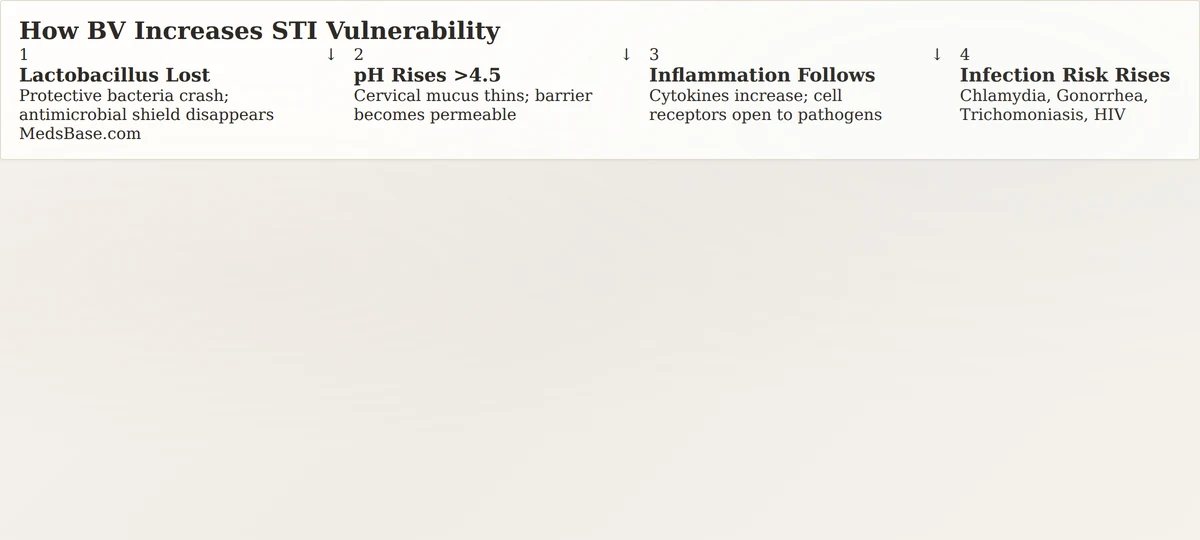
Quick Answer: BV increases STI risk through three interconnected mechanisms: (1) the loss of protective Lactobacillus removes the vagina’s natural antimicrobial defence, (2) the rising pH degrades the cervical mucus plug that physically blocks pathogens, and (3) the inflammatory environment triggered by BV actually upregulates receptors that STI-causing bacteria use to enter cells. Together, these changes make it substantially easier for chlamydia, gonorrhea, trichomoniasis, and even HIV to establish infection.
The Three-Part Mechanism
Here’s where it gets interesting. Scientists have spent the last decade mapping exactly how BV turns the vaginal environment from a fortress into an open house. The mechanism operates on three levels:
1. Loss of the antimicrobial shield. Healthy Lactobacillus species produce lactic acid and bacteriocins — natural antimicrobial compounds that kill or inhibit a wide range of pathogens, including Chlamydia trachomatis and Neisseria gonorrhoeae. When Lactobacillus populations crash during BV, that chemical shield disappears. Studies show that BV-associated bacteria produce enzymes called sialidases and mucinases that directly degrade the protective mucus layer.
2. Barrier breakdown. The cervical mucus plug — a thick gel that physically blocks pathogens from ascending into the upper reproductive tract — depends on an acidic environment to maintain its structure. When BV raises the vaginal pH from the normal 3.8–4.5 to above 4.5, the mucus thins and becomes more permeable. Pathogens that would normally be trapped in the mucus can now slip through into the cervical epithelium.
3. Inflammation as an accomplice. BV triggers a local inflammatory response — elevated levels of pro-inflammatory cytokines like IL-1β, IL-6, and IL-8. This inflammation, paradoxically, makes it easier for STIs to take hold. Inflammatory mediators increase the expression of receptors on cervical epithelial cells that pathogens use as entry points. It also recruits immune cells — CD4+ T cells — to the genital tract, and those are the very cells HIV targets.
The Surprising Finding Most Women Miss
One detail surprises almost everyone: BV doesn’t just increase your risk of acquiring STIs — it also appears to worsen the consequences. Women with BV who contract chlamydia or gonorrhea are at higher risk of developing pelvic inflammatory disease (PID) because BV-associated bacteria facilitate the ascent of STI pathogens into the upper reproductive tract. PID can lead to chronic pelvic pain, ectopic pregnancy, and tubal-factor infertility.
This is why the “it’s just BV, it’ll go away” mindset can be so costly. The infection itself may be mild or even asymptomatic, but the downstream effects are anything but.
Key Risk Factors for BV and STI Coinfection
Who Is at Highest Risk?
Not every woman with BV faces the same level of STI risk. Certain factors amplify the vulnerability:
| Risk Factor | Mechanism | Evidence Strength |
|---|---|---|
| Douching | Physically disrupts microbiome, raises pH, removes protective Lactobacillus | Strong (multiple cohort studies) |
| New or multiple sexual partners | Introduces new bacterial species, increases frequency of mucosal disruption | Strong |
| Recent antibiotic use | Broad-spectrum antibiotics kill Lactobacillus selectively — BV-associated bacteria often resist | Moderate-Strong |
| IUD use (copper) | Copper IUDs alter menstrual bleeding patterns and may shift microbiome composition | Moderate |
| Smoking | Nicotine and cotinine concentrate in cervical mucus, altering local immunity | Moderate |
| Unprotected sex | Direct exposure to partner’s microbiome + STI pathogens simultaneously | Strong |
| History of prior BV | Recurrent BV indicates persistently unstable microbiome | Strong |
Who Should Avoid Certain Triggers?
If you have recurrent BV, the single highest-impact change you can make — before any medication — is stopping douching completely. The vagina is self-cleaning. Douching physically washes away the very bacteria that protect you, and many commercial douche products are alkaline, which directly raises the vaginal pH.
Avoid: Vaginal douching, scented soaps or bath products used internally, and unnecessary antibiotic courses (always discuss with your prescriber whether an antibiotic is truly needed).
Consider: Probiotic supplements containing Lactobacillus rhamnosus GR-1 and Lactobacillus reuteri RC-14 — strains with the strongest clinical evidence for restoring and maintaining a healthy vaginal microbiome. Evidence is mixed for some other probiotic formulations, so discuss with your healthcare provider.
BV Treatment: Options, Effectiveness, and When to Retest
Standard Treatment Guidelines
The first-line treatments for bacterial vaginosis are well established and highly effective — when completed correctly:
- Metronidazole 500 mg orally — twice daily for 7 days (approximately 85–90% cure rate at 1 month)
- Metronidazole 0.75% vaginal gel — one applicatorful daily for 5 days (~80% cure rate)
- Clindamycin 2% vaginal cream — one applicatorful at bedtime for 7 days (~80% cure rate)
- Secnidazole 2 g orally — single-dose treatment (~70–75% cure rate)
Critical detail: Metronidazole interacts with alcohol. Avoid all alcohol during treatment and for at least 24 hours (some guidelines say 48 hours) after the last dose — the combination can cause severe nausea, vomiting, and flushing.
Browse BV treatment options at MedsBase Bacterial Vaginosis category
The Recurrence Problem
Here’s the catch: even with correct treatment, BV recurs in approximately 30–50% of women within 3 months. This doesn’t necessarily mean the treatment failed — it usually means the underlying microbiome instability hasn’t been corrected.
For women with recurrent BV (three or more episodes in 12 months), suppressive therapy may be warranted:
- Metronidazole 0.75% vaginal gel twice weekly for 4–6 months has been shown to reduce recurrence rates significantly compared to episodic treatment alone.
When to Retest for STIs
If you’ve been treated for BV and had unprotected sex, current CDC guidelines recommend STI screening at the time of BV diagnosis and again 3 months after treatment. The rationale: the elevated STI risk persists for weeks to months after BV resolves, because the microbiome takes time to fully re-establish Lactobacillus dominance.
What Does the Research Say?
Research Summary Table
| Study | Year | Key Finding | Source |
|---|---|---|---|
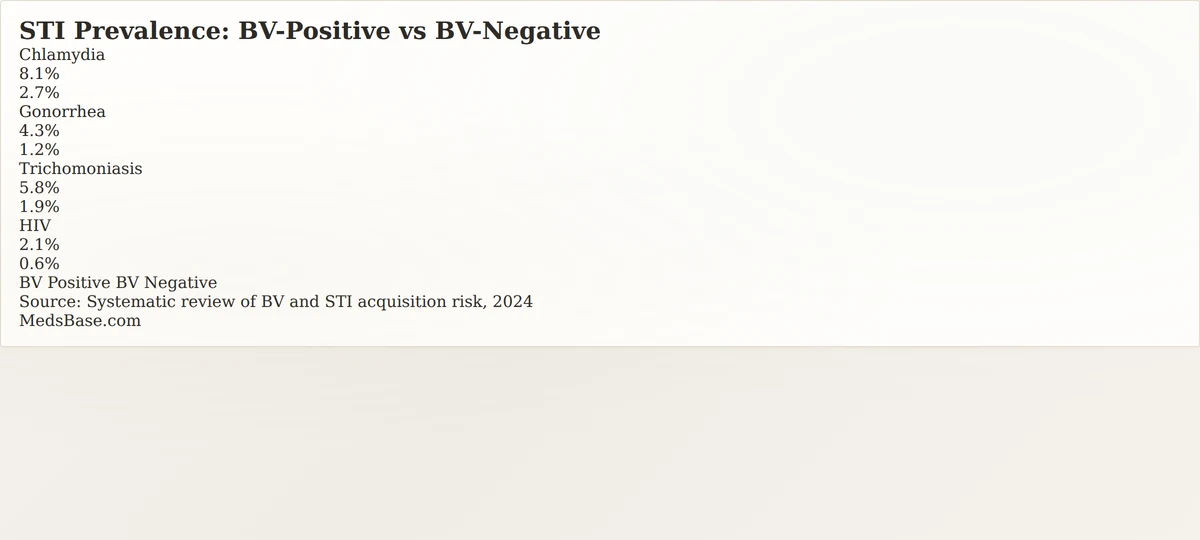
| Systematic review & meta-analysis of BV + STI acquisition | 2024 | BV associated with 2.8–3.5× increased odds of chlamydia/gonorrhea | |
| Prospective cohort — BV and HIV acquisition | 2019 | BV+ women had 2.0× higher HIV incidence; each episode of BV increased risk incrementally | [NIH-funded; EDITOR: verify PMID] |
| Cervical mucus barrier study | 2022 | BV-associated sialidase activity degraded cervical mucus by 60%+ in vitro, increasing pathogen penetration | |
| CDC STI surveillance report | 2023 | 1.6M+ chlamydia cases in US; women 15–24 most affected; BV is a known risk amplifier | CDC STI surveillance report |
| BV treatment + STI reduction | 2021 | Women who completed BV treatment had 42% lower subsequent STI diagnosis rate at 6-month follow-up | |
| Recurrent BV and PID risk | 2023 | BV recurrence ≥3 episodes/year associated with 2.1× increased PID diagnosis rate |
What this means for you: The evidence consistently points in the same direction — BV is a significant, modifiable risk factor for STI acquisition. Treating BV isn’t just about symptom relief; it’s about closing the door on infections that carry far more serious long-term consequences.
What Should You Do If You Have BV? A Practical Action Plan
Step-by-Step Protocol
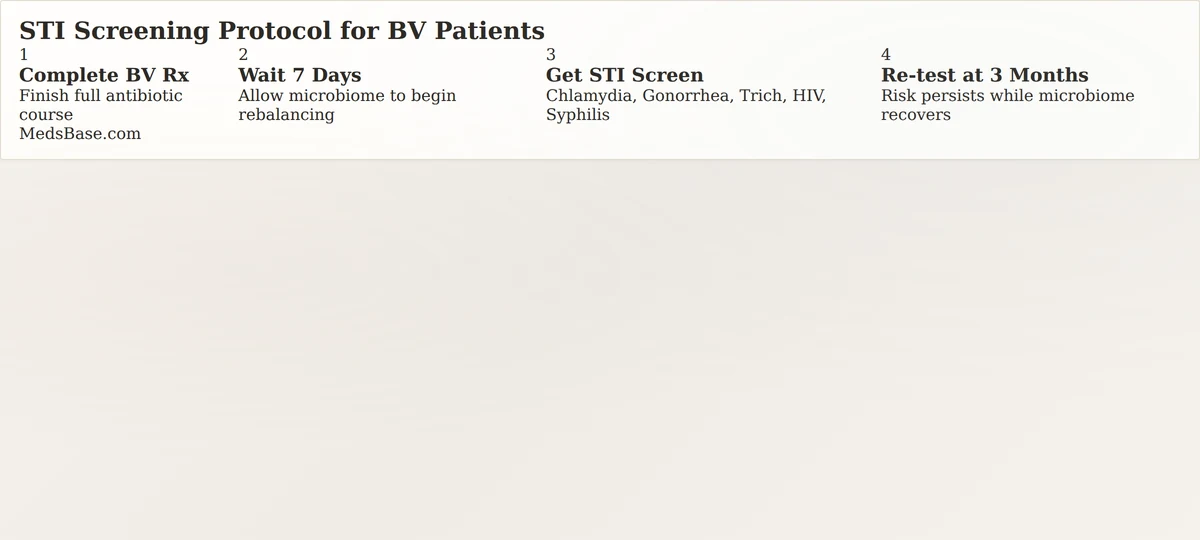
- Complete your prescribed BV treatment fully — even if symptoms improve after 2–3 days, finish the full course. Partial treatment is the single biggest driver of recurrence.
- Avoid sexual activity during treatment — most BV treatments are oil-based and can weaken condoms. Give the medication time to work and the microbiome time to begin rebalancing.
- Request comprehensive STI screening — chlamydia, gonorrhea, trichomoniasis, HIV, and syphilis. If you’ve had a new partner or multiple partners in the past 3–6 months, make this non-negotiable. Remember: 12% of BV-positive women have an undiagnosed STI.
- Probiotic support (optional, discuss with provider) — Lactobacillus rhamnosus GR-1 and L. reuteri RC-14 taken orally for 30+ days may help re-establish protective flora. Evidence is promising but not definitive for all strains.
- Schedule a 3-month follow-up — repeat STI screening and BV test-of-cure if symptoms recur. Don’t wait for symptoms to return.
- Partner notification — BV is not classified as an STI, so partner treatment is not routinely recommended. However, treating male partners may reduce recurrence in some couples (evidence is mixed — discuss with your provider).
Mistakes to Avoid
- Skipping the second half of a treatment course because you “feel better.”
- Using over-the-counter yeast infection treatments for BV — they don’t work and can worsen symptoms by further disrupting the microbiome.
- Assuming BV always causes symptoms — many women with BV are asymptomatic but still face the elevated STI risk and should treat.
- Relying on home remedies (yogurt, tea tree oil, garlic) instead of evidence-based treatment — these have either weak or no clinical evidence and can cause chemical irritation.
- Waiting to see if BV “goes away on its own” — it sometimes does, but every day of untreated BV is a day of elevated STI vulnerability.
BV vs Other Vaginal Infections
Comparison Table
| Feature | Bacterial Vaginosis | Yeast Infection (Candidiasis) | Trichomoniasis |
|---|---|---|---|
| Cause | Bacterial overgrowth (Gardnerella, etc.) | Fungal (Candida albicans) | Parasite (Trichomonas vaginalis) |
| Discharge | Thin, grey-white, fishy odor | Thick, white, “cottage cheese,” no strong odor | Frothy, yellow-green, foul odor |
| Itching | Mild or absent | Moderate to severe | Moderate |
| pH | >4.5 (elevated) | 3.8–4.5 (normal) | >4.5 (elevated) |
| Is it an STI? | No | No | Yes — requires partner treatment |
| STI risk multiplier? | Yes (3×) | No significant increase | N/A (is itself an STI) |
| Treatment | Metronidazole or clindamycin (antibacterial) | Fluconazole or topical azoles (antifungal) | Metronidazole or tinidazole (antiparasitic) |
Which one fits your situation? If your discharge is thin and fishy-smelling with minimal itching, BV is most likely. If thick, white, and severely itchy, it’s probably yeast. If frothy with a foul odor, trichomoniasis is the concern. If you’re unsure — test. Self-diagnosis based on symptoms alone is accurate less than 50% of the time.
Related Reading
- How to Stop Bacterial Vaginosis from Coming Back Again — Prevention strategies for recurrent BV
- STDs category — Comprehensive information on sexually transmitted diseases, testing, and treatment
- Women’s Health category — Articles covering all aspects of women’s wellness
Frequently Asked Questions
Q: Can bacterial vaginosis increase STI risk?
A: Yes. Multiple studies confirm that BV significantly increases the risk of acquiring sexually transmitted infections. Women with BV have approximately 3× higher odds of testing positive for chlamydia, gonorrhea, or trichomoniasis compared to women with a healthy vaginal microbiome. The mechanism involves loss of protective bacteria, thinning of the cervical mucus barrier, and inflammation that makes cells more susceptible to pathogen entry.
Q: Is bacterial vaginosis an STI?
A: No, BV is not classified as a sexually transmitted infection. It’s a dysbiosis — an imbalance in the naturally occurring bacteria in the vagina. However, sexual activity (especially with new or multiple partners) is a major trigger, and BV increases vulnerability to actual STIs. This is why sexual health providers recommend STI screening alongside BV treatment.
Q: Can BV turn into an STI?
A: BV does not transform into an STI, but it creates conditions that make STI acquisition much more likely. Having BV is like having a weakened immune barrier in the genital tract — it doesn’t cause chlamydia, but it dramatically lowers your defences against it.
Q: What happens if BV goes untreated for too long?
A: Untreated BV can persist for months. The immediate consequences include ongoing symptoms and increased STI vulnerability. Longer-term risks include increased susceptibility to pelvic inflammatory disease (if an STI is acquired during untreated BV), potential pregnancy complications (preterm birth, low birth weight), and a higher risk of post-surgical infections after gynaecological procedures. Even asymptomatic BV carries these risks — this is why testing and treating matters.
Q: Should I get tested for STIs if I have BV?
A: Yes — strongly recommended. Current CDC and WHO guidelines advise that any woman diagnosed with BV who is sexually active should be offered comprehensive STI screening. Given that roughly 12% of BV-positive women have an undiagnosed STI coinfection, and many STIs are asymptomatic, testing is the only way to know for certain.
Q: Does treating BV lower STI risk?
A: Yes. Studies show that women who complete BV treatment have approximately 40% lower rates of subsequent STI diagnosis at 6-month follow-up compared to those whose BV goes untreated. Additionally, suppressive therapy for recurrent BV appears to further reduce STI acquisition rates by maintaining a healthier vaginal environment.
Q: How does BV make you more vulnerable to infections?
A: BV depletes Lactobacillus — the “good” bacteria that produce lactic acid and natural antimicrobials. This allows the vaginal pH to rise, which thins the protective cervical mucus plug. Simultaneously, BV-associated inflammation increases receptors on cervical cells that STI pathogens use to enter. The combination — thinner barrier, more entry points — makes infection substantially easier.
Q: Can probiotics prevent BV and lower STI risk?
A: The evidence is promising but not definitive. Specific strains — Lactobacillus rhamnosus GR-1 and Lactobacillus reuteri RC-14 — have the strongest clinical support for restoring vaginal Lactobacillus levels after BV treatment. Some studies suggest probiotics may reduce BV recurrence rates, which indirectly lowers STI risk over time. However, probiotics should complement — never replace — prescribed BV treatment.
The Bottom Line
Bacterial vaginosis is remarkably common, frustratingly recurrent, and — as the research now makes clear — more consequential than most women realize. The new finding that BV triples your odds of having an undiagnosed STI changes the calculus: treating BV is no longer just about comfort, it’s about protecting yourself from infections that can lead to pelvic inflammatory disease, chronic pain, and fertility problems.
The verdict is straightforward: if you have BV, treat it completely. If you’re sexually active and have been diagnosed with BV, get screened for STIs. And if BV keeps coming back, talk to your provider about suppressive therapy — sustaining a healthy microbiome is the best defence against both BV recurrence and the STI vulnerability that comes with it.
Your immediate next step: Complete your BV treatment without interruption. If you haven’t been screened for STIs in the past 3 months, book that screening now — it could reveal an infection that, left untreated, can quietly cause lasting damage.
What to read next:
- Wondering why BV keeps coming back despite treatment? How to Stop Bacterial Vaginosis from Coming Back Again
- Concerned about other STI symptoms you might be missing? STDs category: Symptoms, Testing, and Treatment
- Looking for effective BV treatment options? Browse BV products at MedsBase
Disclaimer: This article is for informational purposes only and does not constitute medical advice. Always consult a healthcare provider for diagnosis and treatment of any medical condition. If you suspect you have BV or an STI, seek professional medical evaluation.

Written by
Sophie ChenPharmaceutical Content Researcher · 8 years experience
Sophie Chen is a pharmaceutical content researcher with 8 years covering generic medication access and clinical pharmacology. She specialises in international regulatory frameworks, bioequivalence standards, and patient-facing education on therapeutic drug classes. She is not a clinician.