








✓ Medically reviewed by · Last reviewed: May 2026
Pharmacy Researcher · 8 years experience
Pharmacy researcher with 8 years reviewing clinical drug information, generic formulation equivalence, and international pharmaceutical standards. Focuses on patient-facing accuracy in medication education.
fluconazole — Fluconazole — practical guide to uses, dosage, and safety. Read on for an evidence-backed guide covering everything you need to know.
Picture this: you’ve been dealing with an uncomfortable itch or a sore, white-coated mouth for days, and your doctor or pharmacist hands you a single tablet and says “this should clear it up.” If you’re like most people, you’re relieved — and then immediately curious. What exactly is this pill, how does one tablet knock out an infection, and why do some people need it for weeks instead of days? That pill is almost certainly fluconazole.
By the end of this guide, you’ll know exactly what fluconazole treats, how it works, how the dose differs from one infection to the next, and the side effects worth watching for. One of those side effects — a change most people don’t connect to the medication — is the thing to keep an eye on, and we’ll get to it in the safety section.
Key Takeaways
- Fluconazole is an azole antifungal that treats thrush, vaginal yeast infections, and other fungal infections.
- Many vaginal yeast infections clear with a single 150 mg dose — but other infections need weeks.
- It works by weakening the fungal cell wall, not by killing bacteria — so it won’t work on a bacterial infection.
- It’s usually well tolerated, but it can interact with a long list of medicines and stress the liver.
- Finish the full course even if you feel better — stopping early is how infections come back.
- What Is Fluconazole?
- What Does Fluconazole Treat?
- How Does Fluconazole Work?
- Safety, Side Effects & Dosage
- What the Research & Guidelines Say
- Fluconazole vs Topical Antifungals
- How to Take Fluconazole
- Frequently Asked Questions
- The Bottom Line
What Is Fluconazole?
Fluconazole is a prescription antifungal medicine used to treat fungal infections — including yeast infections of the vagina, mouth, throat, and esophagus, as well as certain internal infections and meningitis caused by fungus. It belongs to a class of medicines called triazole antifungals. (Featured-snippet definition.)
The NHS lists fluconazole’s brand names as Azocan, Diflucan, and Canesten Thrush Oral Capsules, and describes it simply as a medicine for thrush and other fungal infections. The MedlinePlus monograph adds the important detail that fluconazole is also used to prevent yeast infections in people at high risk — for example, patients receiving chemotherapy or radiation therapy before a bone marrow transplant.
The word “fungal” matters here, and it’s worth being precise about. Fluconazole targets fungi — a completely different type of organism from bacteria or viruses. That means it won’t help a bacterial infection like strep throat or a urinary tract infection, and it won’t touch a cold or flu virus. It’s a targeted tool for a specific problem, and understanding that saves you from taking the wrong medicine for the wrong bug.
What this means for you: if a doctor prescribed fluconazole, they’ve judged that your symptoms are most likely caused by yeast or another fungus. If you’ve bought it hoping it will clear up “whatever’s wrong,” that’s a signal to confirm the diagnosis first.
What Does Fluconazole Treat?
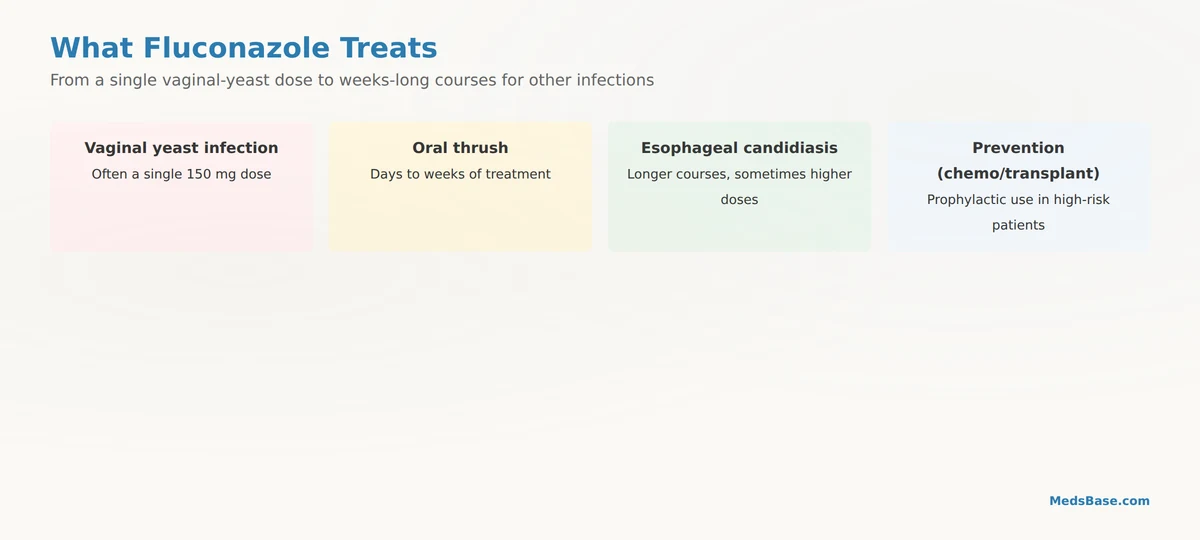
Fluconazole is remarkably versatile because yeast infections can crop up in many places. The most common uses:
| Infection | What it is | Typical fluconazole approach |
|---|---|---|
| Vaginal yeast infection (thrush) | Itching, irritation, and a thick white discharge | Often a single 150 mg oral dose |
| Oral thrush | White patches in the mouth or on the tongue | A course of treatment, often days to weeks |
| Esophageal candidiasis | Thrush that spreads to the swallowing tube | Longer courses, sometimes at higher doses |
| Skin and nail fungal infections | Red, itchy, scaly rashes or thickened nails | Varies; sometimes off-label or specialist-led |
| Fungal meningitis | Infection of the membranes around the brain/spine | Specialist treatment, often intravenous or high-dose |
| Prevention (chemo/transplant) | Protecting high-risk patients | Taken preventively during treatment |
Oral thrush and vaginal thrush are the everyday uses. MedlinePlus describes candidiasis as an infection with Candida — a yeast that lives harmlessly in most people until something (like antibiotics or a weakened immune system) lets it multiply. Thrush in the mouth shows up as white patches; a vaginal yeast infection shows up as the classic cottage-cheese-like discharge the NHS describes along with itching and soreness.
Who is fluconazole for? Adults with a diagnosed yeast or fungal infection — especially vaginal thrush, oral thrush, or esophageal candidiasis — and, under specialist care, people needing antifungal protection during cancer treatment or transplant.
Who should avoid it? People with an allergy to fluconazole or other azole antifungals (like itraconazole, ketoconazole, or voriconazole); people with liver disease or a history of abnormal heart rhythm (prolonged QT); and anyone whose other medicines interact with fluconazole — which is a surprisingly long list. Fluconazole is also generally not recommended in the first trimester of pregnancy.
How Does Fluconazole Work?
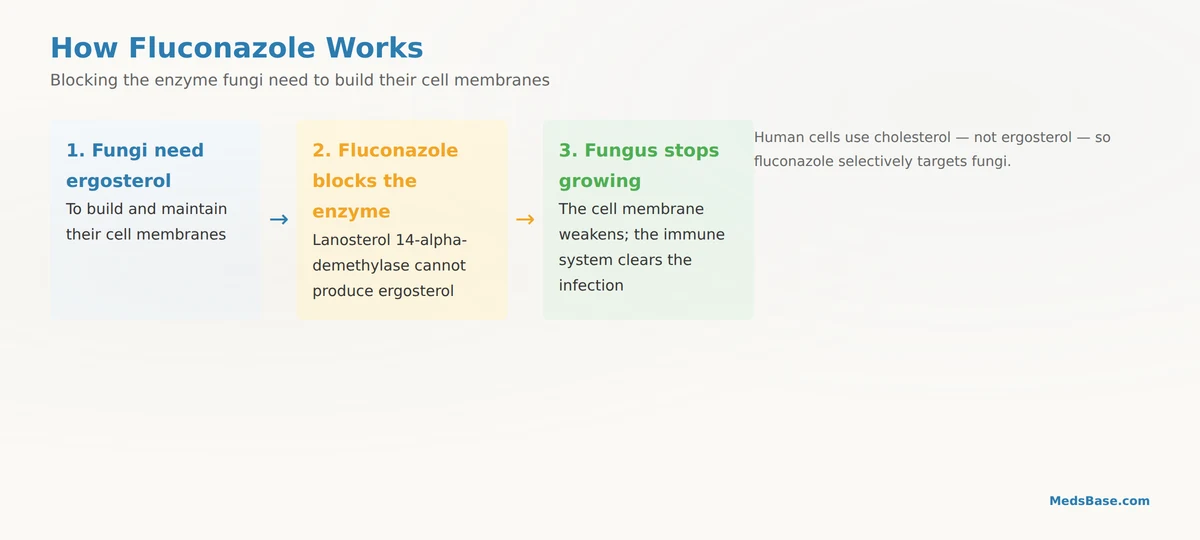
Fluconazole works by blocking the enzyme fungi need to build their cell membranes, weakening the fungus so it stops growing and multiplying — without harming human cells.
Here’s the plain-English version. Every living cell needs a wall, and fungal cells build theirs partly out of a molecule called ergosterol. Fluconazole blocks the enzyme (a cytochrome P450 enzyme called lanosterol 14-alpha-demethylase) that produces ergosterol. Without ergosterol, the fungal cell membrane becomes leaky and unstable, and the fungus can’t grow or reproduce.
The clever part is the selectivity. Human cells use cholesterol, not ergosterol, for their membranes — so fluconazole can knock out the fungus while leaving your own cells largely alone. That’s the whole trick of the azole antifungals, and why they’re so widely used.
Research Spotlight — Fluconazole belongs to the “azole” family because of the chemical structure shared by fluconazole, itraconazole, ketoconazole, and voriconazole. That shared structure also explains a shared warning: because azoles affect certain liver enzymes, they interact with many other drugs. Fluconazole is among the most-used azoles precisely because it’s well absorbed by mouth and reaches high levels in tissues, which is why one tablet can be enough for some infections.
What this means for you: because fluconazole stops the fungus from growing rather than “zapping” it instantly, your immune system still does part of the job. That’s why you may keep improving for a few days after your last dose — and why finishing the course matters.
Safety, Side Effects and Dosage
Fluconazole is generally well tolerated, and many people take a single dose with no noticeable side effects at all. But it’s not side-effect-free, and one of them is easy to miss. The MedlinePlus monograph lists the common side effects and the serious ones separately:
| Side Effect | Frequency | Severity | What To Do |
|---|---|---|---|
| Headache | Common | Mild | Usually passes; report if persistent |
| Stomach pain or heartburn | Common | Mild | Take with or after food |
| Diarrhea | Common | Mild | Stay hydrated; report if severe |
| Dizziness | Common | Mild | Avoid driving until you know how it affects you |
| Change in sense of taste | Common | Mild | Usually temporary; note it |
| Liver injury | Rare | Severe | Dark urine, yellowing skin/eyes, upper-right stomach pain = call a doctor |
| Severe skin reaction / rash | Rare | Severe | Blistering or peeling skin = emergency |
| Seizures | Rare | Severe | Emergency |
Here’s where it gets interesting: the side effect most people don’t connect to fluconazole is the change in taste. It’s listed right alongside headache and diarrhea as a common, mild effect, but because nobody associates a taste change with an antifungal pill, patients often miss it — or assume the medicine isn’t working. It’s harmless and temporary in most cases, but it’s worth knowing about so it doesn’t alarm you.
Two safety rules that matter:
- Tell your doctor about every medicine you take. Fluconazole interacts with a long list — including blood thinners like warfarin, certain statins, some heart-rhythm drugs, and even some NSAIDs. The interaction can push the other drug’s levels dangerously high.
- Watch your liver. The serious warning signs are dark urine, yellowing of the skin or eyes, flu-like symptoms, loss of appetite, or pain in the upper-right part of your stomach. These are rare, but they’re the ones to act on immediately.
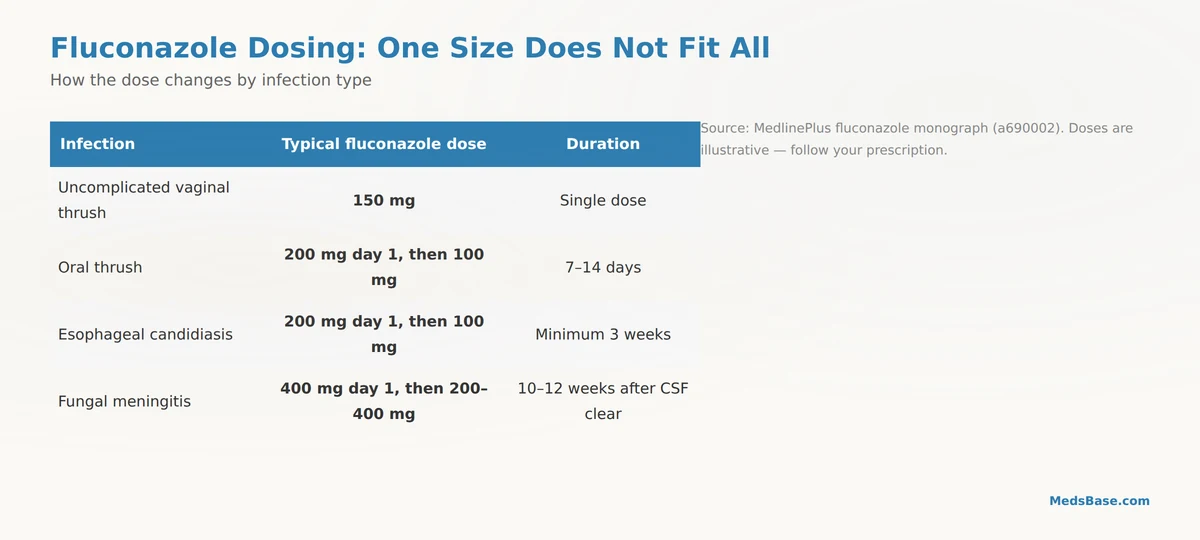
Dosage varies more than people expect. A single 150 mg dose is standard for an uncomplicated vaginal yeast infection. Oral thrush and esophageal candidiasis generally need longer courses. The exact dose and duration depend on the infection, its severity, and how you respond — which is why the “just take one and see” approach doesn’t generalize to every fungal infection.
What the Research & Guidelines Say
Fluconazole isn’t experimental — it’s a decades-old, guideline-endorsed workhorse. Here’s the evidence context:
| Source | Year | Key point |
|---|---|---|
| MedlinePlus (AHFS) monograph | 2018 (monograph) | Documents approved uses, dosing, and the full safety/precaution list |
| NHS medicines guidance | ongoing | Confirms brand names and the “treats thrush and other fungal infections” scope |
| CDC candidiasis guidance | ongoing | Recognizes azoles as first-line for many candidiasis presentations |
What this means for you: the value of fluconazole is well established, but its effectiveness depends on using the right dose for the right organism and completing the course. The single most common reason a yeast infection “keeps coming back” is stopping treatment too soon or treating the wrong thing.
Fluconazole vs Topical Antifungals
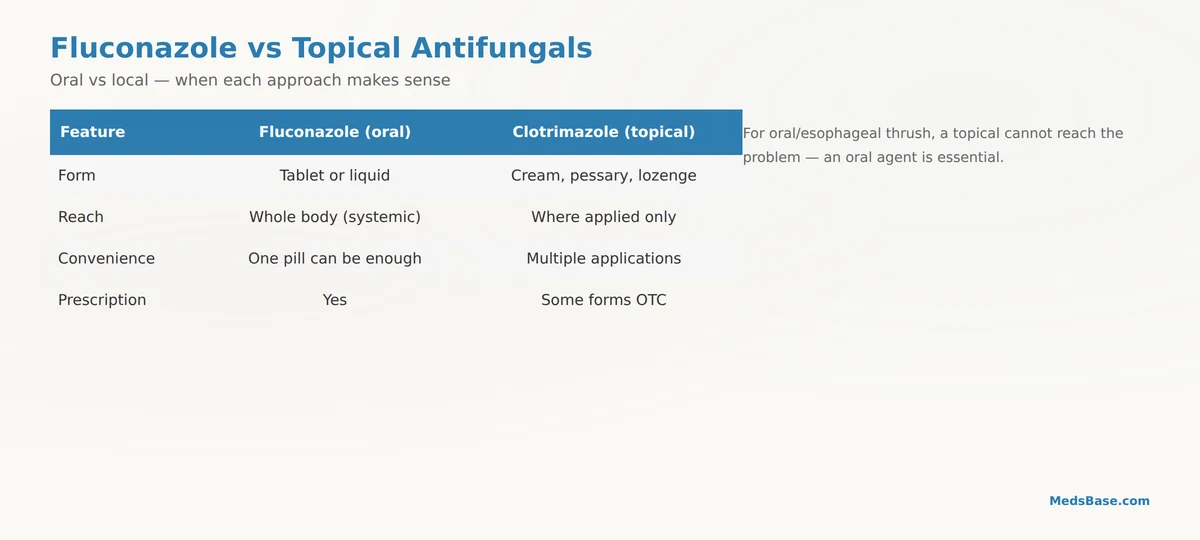
Fluconazole isn’t the only option. For surface infections, topical azoles like clotrimazole are often used — and the two fill different roles:
| Feature | Fluconazole (oral) | Clotrimazole (topical) |
|---|---|---|
| Form | Tablet or liquid, by mouth | Cream, pessary, or lozenge |
| Reach | Whole body (systemic) | Only where it’s applied |
| Common for | Vaginal thrush (single dose), oral/esophageal thrush, prevention | Skin thrush, some vaginal thrush, athlete’s foot |
| Convenience | One pill can be enough | Needs repeated application |
| Prescription | Yes | Some forms over-the-counter |
Which fits which situation? For a straightforward vaginal yeast infection, either can work, and the choice often comes down to preference — some people like the one-and-done oral tablet, others prefer a cream. For oral or esophageal thrush, or for infections deep in the body, a topical can’t reach the problem and an oral agent like fluconazole is the natural choice. Your doctor or pharmacist is the best judge of which suits your specific infection.
How to Take Fluconazole
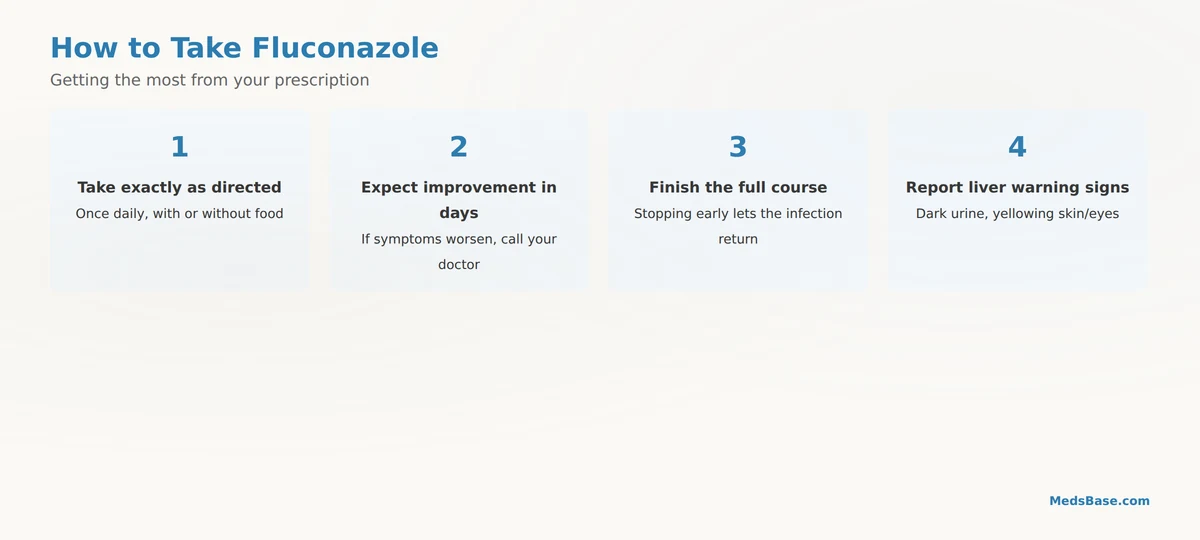
Getting the most out of fluconazole is mostly about consistency and patience:
- Take it exactly as directed. Fluconazole is usually taken once a day, with or without food. Your doctor may tell you to take a double dose on the first day — that’s intentional, to get drug levels up quickly.
- Expect to feel better within days. You should start improving in the first few days. If symptoms don’t improve — or get worse — call your doctor.
- Finish the full course. Even if you feel better, stopping early is the most common way the infection comes back.
- Shake the liquid well if you’re taking the suspension form, and store it correctly (dispose of unused liquid after 14 days).
- Report anything serious. Dark urine, yellowing skin or eyes, a spreading rash, or seizures mean you should seek help promptly.
Mistakes to avoid:
- Assuming it works on bacteria. Fluconazole is antifungal only — it won’t treat strep, a UTI, or a cold.
- Stopping when you feel better. Finish the prescribed course.
- Mixing with alcohol without checking. Alcohol itself can stress the liver; ask your pharmacist what’s safe for you.
- Hiding other medicines. The interaction list is long — disclose everything, including supplements.
Related Reading
- Fungal Infection articles — more on treating fungal and yeast conditions.
- Aspirin for Gum Disease — a practical guide to another everyday medication, written today.
- Sertraline vs Fluoxetine — how two similar drugs compare, written today.
Frequently Asked Questions
Q: What is fluconazole used for?
A: Fluconazole treats fungal and yeast infections, including vaginal yeast infections, oral thrush, esophageal candidiasis, certain skin and nail infections, and fungal meningitis. It’s also used to prevent yeast infections in high-risk patients undergoing chemotherapy or a bone marrow transplant.
Q: How long does fluconazole take to work?
A: Most people start to feel better within the first few days. A single 150 mg dose often clears an uncomplicated vaginal yeast infection, while oral or esophageal thrush may take longer. Finish the full course even after symptoms improve.
Q: How do you take fluconazole?
A: Fluconazole is taken by mouth as a tablet or liquid, usually once a day, with or without food. For a vaginal yeast infection it’s often a single 150 mg dose. Your doctor may direct a double dose on the first day for some infections.
Q: What are the side effects of fluconazole?
A: Common side effects include headache, stomach pain, diarrhea, dizziness, and a change in the sense of taste. Serious but rare effects include liver injury (dark urine, yellowing skin), severe skin reactions, and seizures — these need immediate medical attention.
Q: Can you drink alcohol with fluconazole?
A: There’s no direct interaction between alcohol and fluconazole, but both can affect the liver, and alcohol may worsen side effects like dizziness and stomach upset. It’s safest to ask your pharmacist, and to limit alcohol during treatment.
Q: Does fluconazole treat thrush?
A: Yes. Fluconazole is a standard treatment for oral thrush and vaginal thrush. It’s also used for esophageal candidiasis, a form of thrush that spreads to the swallowing tube, and to help prevent thrush in people with weakened immune systems.
Q: Is fluconazole an antibiotic?
A: No. Fluconazole is an antifungal, not an antibiotic. Antibiotics treat bacterial infections, while fluconazole treats fungal (yeast) infections. In fact, taking antibiotics is a common trigger for yeast infections, because antibiotics can disrupt the balance that normally keeps yeast in check.
The Bottom Line
Fluconazole is a safe, well-established, and remarkably convenient antifungal — for the right infection. For a straightforward vaginal yeast infection, it can be a single-tablet fix. For oral or esophageal thrush, it’s a cornerstone treatment. What it can’t do is treat bacteria, viruses, or a problem that isn’t fungal at all.
The balanced verdict: if a professional has diagnosed a fungal infection and prescribed fluconazole, the immediate action is simple — take it exactly as directed, finish the course, and report any liver warning signs or spreading rash. If you’re considering it without a diagnosis, pause and get the diagnosis first; using the wrong medicine is how infections linger.
Wondering how another everyday medication stacks up? Read our aspirin for gum disease guide for the same evidence-first walkthrough. Or, if you’d rather see two drugs compared directly, our sertraline vs fluoxetine breakdown does exactly that.
Medical Disclaimer: This article is for informational purposes only and does not constitute medical advice. Fungal infections require diagnosis and treatment by a qualified healthcare professional. Never start, stop, or change a medication without consulting your doctor or pharmacist.

Written by
Sophie ChenPharmaceutical Content Researcher · 8 years experience
Sophie Chen is a pharmaceutical content researcher with 8 years covering generic medication access and clinical pharmacology. She specialises in international regulatory frameworks, bioequivalence standards, and patient-facing education on therapeutic drug classes. She is not a clinician.