








✓ Medically reviewed by · Last reviewed: May 2026
Pharmacy Researcher · 8 years experience
Pharmacy researcher with 8 years reviewing clinical drug information, generic formulation equivalence, and international pharmaceutical standards. Focuses on patient-facing accuracy in medication education.
Roughly 1 in 30 adults will meet the criteria for binge-eating disorder at some point in their lives — making it the most common eating disorder in the United States, more common than anorexia and bulimia combined. So when a major 2026 review suggested that the same medicines behind the weight-loss boom might quiet binge eating too, headlines moved fast. The science deserves a slower read.
This guide gives you the honest version of the GLP-1 for binge eating story: what the new evidence found, how these drugs might work on the brain’s “food noise,” who they could help, and — just as importantly — what they are not approved to do. By the end you’ll be able to tell a real signal from a hopeful headline.
One detail surprises almost everyone who reads the study closely, and it changes how you should interpret the results — we’ll get to it in the research section.
- A 2026 meta-analysis of 25 trials and ~8,000 adults linked GLP-1 drugs to lower binge-eating severity — but the effect is best described as moderate, not a cure.
- GLP-1 for binge eating is off-label: no GLP-1 drug is FDA-approved for binge-eating disorder (the only approved medicine for that is a stimulant, lisdexamfetamine).
- The likely mechanism runs through two systems at once — appetite and reward — which may be why some people describe “food noise” going quiet.
- The evidence is mostly short-term, and most trials studied people with obesity, not people formally diagnosed with binge-eating disorder — a gap that matters.
- Therapy (CBT-E) remains first-line. Medication, where used, is an add-on decided with a clinician — never a DIY fix.
What Is GLP-1 for Binge Eating?
Let’s define both halves of the phrase.
Binge-eating disorder (BED) is a recognised mental-health condition. It means recurring episodes of eating unusually large amounts of food, quickly, with a distressing sense of loss of control — and, unlike bulimia, without regular purging or compensatory behaviour. According to MedlinePlus, it is the most common eating disorder in the U.S. People often eat when not hungry, eat in secret, and feel guilt or shame afterward.
GLP-1 receptor agonists are a class of medicines that mimic a natural gut hormone, glucagon-like peptide-1. They slow stomach emptying, improve blood-sugar control, and reduce appetite. That last effect is why they became famous for weight loss.
So the “GLP-1 for binge eating” question is really this: if these drugs turn down appetite and hunger signals, can they also turn down the compulsive pull toward a binge? That’s the idea the 2026 research put to the test.
Here’s where it gets interesting — because appetite and compulsion aren’t the same brain circuit.
How GLP-1 Drugs May Quiet a Binge
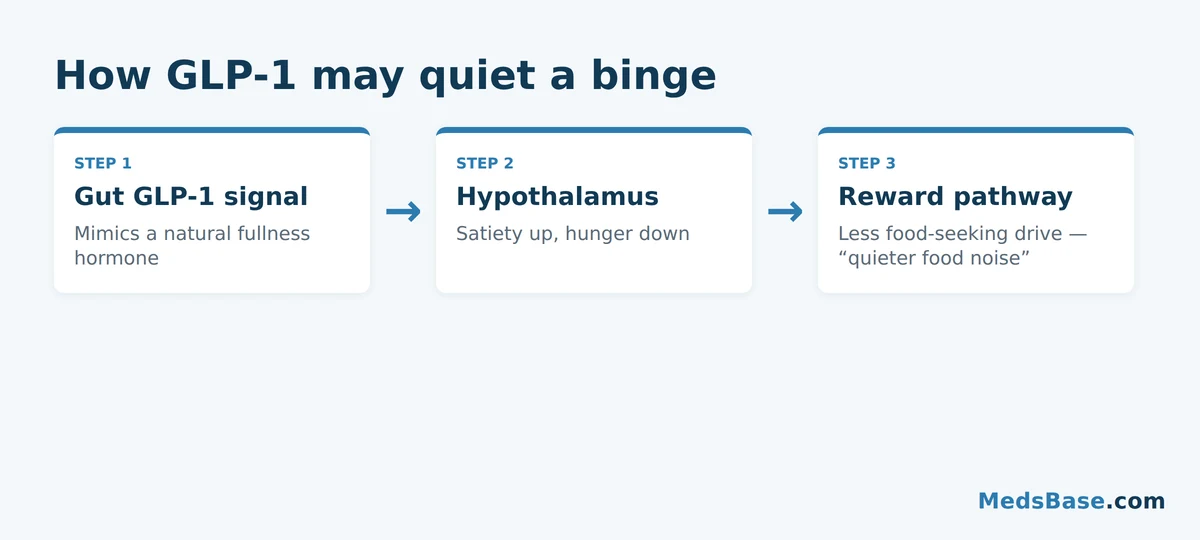
To understand why researchers even suspected a benefit, picture two separate systems in the brain that both influence eating.
The first is the hunger–fullness system, run largely by the hypothalamus. Think of it as the fuel gauge: it tells you when the tank is low and when it’s full. GLP-1 receptor agonists push this gauge toward “full” — activating satiety-promoting signals and dialing down hunger-stimulating ones.
The second is the reward system, the mesolimbic dopamine pathway. Think of it as the “want it anyway” circuit — the one that lights up at the sight of a favourite dessert even after a full meal. In binge eating, this reward drive can override the fuel gauge.
Here’s the intriguing part. A 2025 neurobiological review in the International Journal of Molecular Sciences describes how GLP-1 receptor agonists appear to act on both systems: they promote satiety in the hypothalamus and “suppress operant behaviours for palatable food,” blunting the reward-driven pull in areas like the nucleus accumbens and ventral tegmental area (review).
Many people on these drugs describe the experience in one phrase: the food noise gets quieter. The constant background chatter about the next snack fades. If loss-of-control eating is partly a reward-circuit problem, a drug that touches that circuit is at least a plausible candidate.
Why does this matter for treatment? Because binge eating has never fit neatly into the “just eat less” box. If part of the problem is a biological drive rather than a willpower failure, then a medicine that dampens that drive is worth studying seriously — which is exactly what the 2026 evidence set out to do.
Plausible mechanism, though, is not proof of benefit. For that, we need trials — and this is where the story got its 2026 update. If you’re weighing the molecule behind these headlines, you can browse semaglutide options to see what MedsBase stocks, then bring specifics to your clinician.
Key Uses: Where GLP-1 Actually Fits In
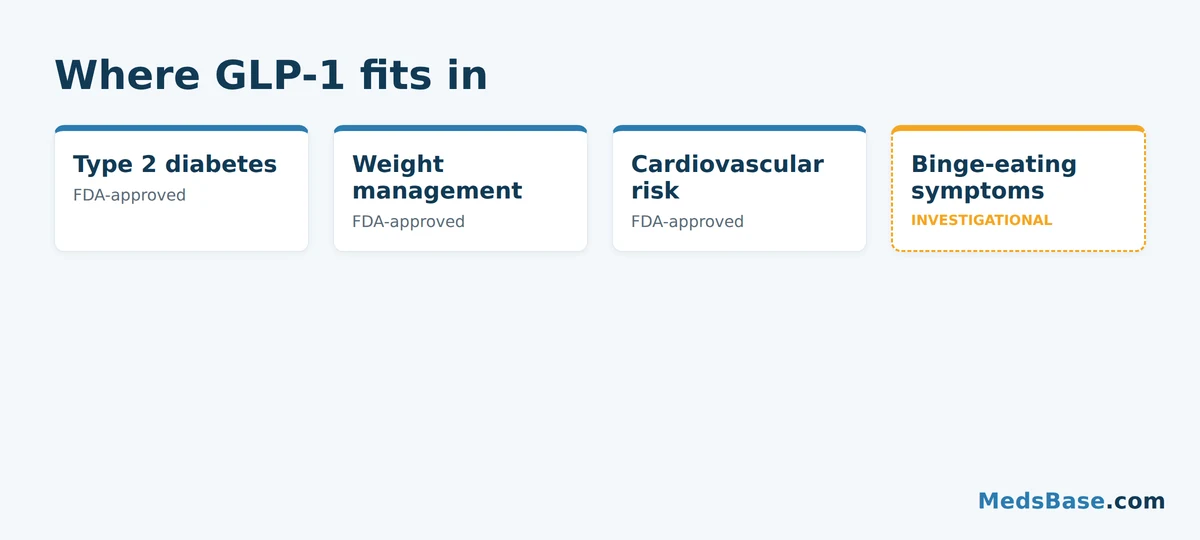
It’s worth being precise about what GLP-1 drugs are for versus where binge eating fits in.
Approved uses (what the label actually says)
Per MedlinePlus, semaglutide is FDA-approved to help control blood sugar in type 2 diabetes, to reduce cardiovascular risk in certain adults, to assist weight management in people with obesity or overweight plus a weight-related condition, and for a couple of other metabolic indications.
The investigational use
Binge-eating symptoms are not on that list. When a clinician uses a GLP-1 drug hoping to reduce binge eating, that is off-label — a legal, common practice, but one that means the evidence bar is on the doctor and patient, not a regulator.
Where it may genuinely help
- Binge eating that travels with obesity. Most of the trial evidence comes from adults with obesity, where reduced binge frequency and weight loss can move together.
- “Food noise” that sabotages other treatment. Some people find the quieter appetite makes therapy skills easier to practise.
- Loss-of-control eating on questionnaires. Trials consistently show improvements in loss-of-control and emotional-eating scores.
The honest takeaway: GLP-1 for binge eating is a maybe, for a specific person, decided with a clinician — not a universal answer.
GLP-1 for Binge Eating: Safety Profile, Side Effects & Dosage
The safety story here is mostly the familiar GLP-1 side-effect profile, plus one behavioural caution unique to eating disorders.
| Side effect / concern | Frequency | Severity | What to do |
|---|---|---|---|
| Nausea, vomiting | Very common early on | Usually mild, fades | Start low, eat smaller meals, tell your prescriber if persistent |
| Constipation or diarrhoea | Common | Mild–moderate | Fluids, fibre, movement; review if severe |
| Reflux / feeling too full | Common | Mild | Smaller portions; a genuine problem if it triggers restriction |
| Gallbladder problems | Uncommon | Can be serious | Seek care for severe right-upper-abdominal pain |
| Pancreatitis | Rare | Serious | Stop and seek urgent care for severe, persistent abdominal pain |
| Tipping into restriction | Variable | Serious in at-risk people | Specialist monitoring; watch for skipped meals, not just fewer binges |
On dosage, there is no binge-eating-specific dose, because there is no approved binge-eating indication. In trials and practice, clinicians use the standard diabetes/obesity titration — starting low and increasing slowly to limit nausea. That slow ramp is not red tape; it’s how you stay on the medicine long enough to benefit.
Resolving the open loop from the top: the surprising detail in the safety picture is that the same appetite-suppressing effect that reduces bingeing can, in someone prone to restriction, quietly worsen an eating disorder. Fewer binges is not automatically “better eating.” That’s why supervision matters, and why “GLP-1 for binge eating” is never a self-prescription.
No prescription is needed to order from MedsBase.com, but that makes a candid conversation with a doctor or pharmacist more important, not less — especially when the goal touches eating behaviour and mental health.
What Does the Research Say About GLP-1 for Binge Eating?
This is the section the headlines came from — so let’s read it carefully.
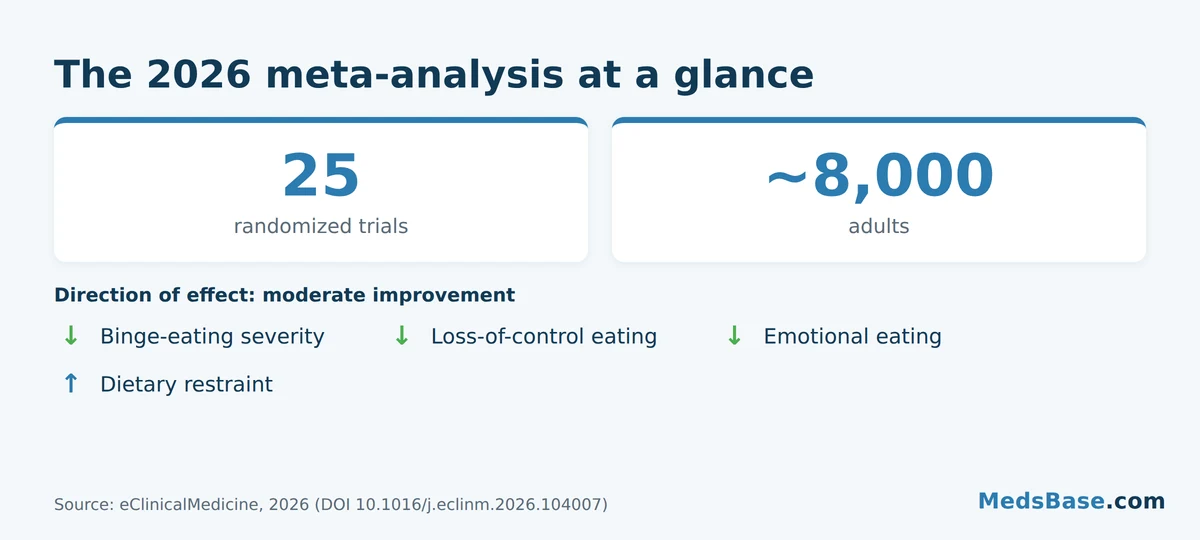
In 2026, a systematic review and meta-analysis published in eClinicalMedicine (part of the Lancet family) pooled the randomized-trial evidence on GLP-1 receptor agonists and binge-eating-related outcomes. It gathered 25 randomized controlled trials covering roughly 8,000 adults — most with obesity or overweight, and about two-thirds women (study).
| Outcome measured | Direction with GLP-1 | Confidence |
|---|---|---|
| Binge-eating severity | Improved (reduced) | Moderate |
| Loss-of-control eating | Improved (reduced) | Moderate |
| Disinhibited / uncontrolled eating | Improved (reduced) | Moderate |
| Emotional eating | Improved (reduced) | Lower — fewer studies |
| Cognitive / dietary restraint | Increased | Lower — fewer studies |
| Long-term durability | Unknown | Not established |
The authors summarised the overall picture as a moderate improvement in binge-eating-related symptoms. That’s a genuine, encouraging signal.
Now the surprising detail we promised. Of those 25 trials, only a small handful actually enrolled people diagnosed with binge-eating disorder. Most measured eating behaviours in people recruited for obesity — not BED as a formal diagnosis. So the strongest claim the data support is “GLP-1 drugs reduce binge-type eating behaviours in adults with obesity,” which is not the same as “GLP-1 drugs treat binge-eating disorder.” The reviewers also flagged a high risk of bias in several trials and a lack of long-term follow-up.
There’s helpful context in where some of this evidence came from. Several of the pooled trials were the large STEP semaglutide studies, designed to test weight loss — not binge eating. Researchers looked at the eating-behaviour questionnaires those trials collected and found consistent improvements in loss-of-control and emotional-eating scores. That’s genuinely useful, but notice the direction of travel: the binge-eating signal was often a secondary finding inside weight-loss research, not the main event of a trial built to treat binge-eating disorder. It’s supportive evidence, not confirmatory evidence.
This is why careful clinicians describe the current state as “promising and worth watching” rather than “proven.” The biology makes sense, the questionnaire data point the right way, and yet the specific, long-term, BED-focused trials that would settle the question mostly haven’t been run. Honest uncertainty here isn’t a weakness of the research — it’s the most accurate summary of it.
GLP-1 vs Therapy vs the Approved Medication
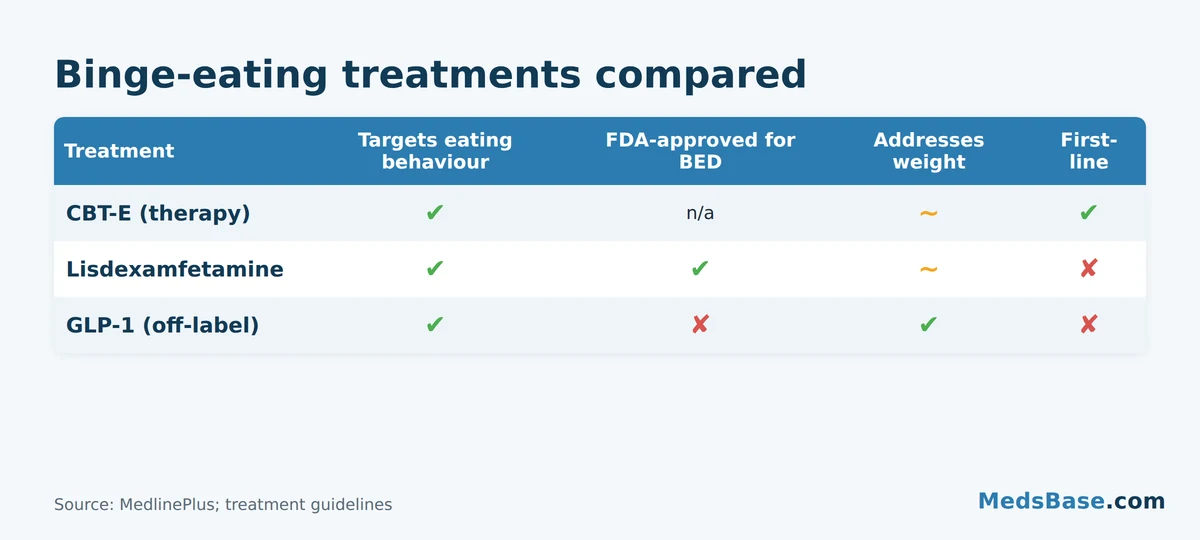
If reducing binge eating is the goal, GLP-1 is one option among several — and not the first-line one.
| Treatment | Targets eating behaviour | FDA-approved for BED | Also addresses weight | Typical position |
|---|---|---|---|---|
| CBT-E (enhanced cognitive behavioural therapy) | Yes — directly | N/A — first-line therapy (FDA approves drugs, not therapy) | Indirectly | First-line |
| Lisdexamfetamine | Yes | Yes — the only approved BED drug | Modestly | Approved medication option |
| GLP-1 receptor agonists | Yes (off-label) | No | Yes — strongly | Investigational add-on |
| SSRIs (e.g. some antidepressants) | Sometimes | No (used off-label) | No | Adjunct for mood/urges |
Which fits which situation? If binge eating is the core problem, therapy (CBT-E) is the evidence-backed starting point and belongs in almost every plan. If a medication is added, lisdexamfetamine is the only one actually approved for BED. A GLP-1 becomes most logical when binge-type eating and obesity co-exist and a clinician judges the metabolic benefits worth it — treating two problems with one tool. For the full landscape of weight-focused options, see our weight-loss medication guides.
The point isn’t that GLP-1 loses. It’s that “best” depends on what you’re actually treating.
A useful way to hold all this together: therapy treats the disorder; medication treats a target. CBT-E works on the thoughts, triggers and behaviours that keep binge eating going — the thing itself. Lisdexamfetamine and GLP-1 drugs each aim at a narrower target (impulse/urge, or appetite and reward). That’s why medication tends to work best alongside therapy rather than instead of it. If you take only one idea from this comparison, let it be that pairing beats picking.
It’s also worth being clear-eyed about cost and access. GLP-1 drugs are expensive and, for binge eating specifically, unlikely to be covered by insurance since it’s an off-label use. Therapy has its own access hurdles — waitlists, cost, finding a CBT-E-trained clinician. Neither is a frictionless option, and a realistic plan accounts for those practicalities, not just the pharmacology.
Using a GLP-1 Sensibly — Practical Guidance
If you and a clinician decide a GLP-1 is worth trying, a few practical rules make it safer and more useful.
- Get the diagnosis clear first. Binge eating, grazing, and restriction-driven rebound eating are different problems. The right treatment depends on which one you have.
- Pair it with therapy, don’t replace it. Medication may quiet the urge; skills keep it quiet. The two together beat either alone for most people.
- Titrate slowly. Follow the standard low-to-high dose ramp to limit nausea and stay on treatment.
- **Watch the quality of eating, not just the quantity.** Fewer binges but skipped meals is a warning sign, not a win.
- Plan for “then what?” Appetite effects can fade if the drug stops. Understanding what happens when you stop taking a GLP-1 helps you avoid a rebound.
Common mistakes to avoid: treating the drug as a moral fix (“if I just had willpower”), stopping abruptly, ignoring mood changes, or using it to eat as little as possible. That last one is how a binge problem can morph into a restriction problem.
- Oral GLP-1 pill options explained — for needle-averse readers weighing the newer tablets.
- Protecting muscle while losing weight on a GLP-1 — because rapid appetite drop affects more than fat.
- What happens when you stop a GLP-1 — planning the exit from day one.
Frequently Asked Questions
Q: Can GLP-1 drugs help binge-eating disorder?
A: Research suggests they can reduce binge-eating symptoms — severity, loss-of-control eating, and emotional eating — especially in adults with obesity. A 2026 meta-analysis of 25 trials found a moderate improvement. But most of that evidence came from people studied for obesity, not people formally diagnosed with binge-eating disorder, and it’s mostly short-term. Helpful signal, not settled proof.
Q: Is semaglutide approved for binge eating?
A: No. Semaglutide is approved for type 2 diabetes, weight management, cardiovascular risk reduction, and a few other metabolic uses — not binge-eating disorder. Any use aimed at binge eating is off-label and should be supervised by a clinician who knows your history.
Q: What medication is actually approved for binge-eating disorder?
A: Lisdexamfetamine is the only medication FDA-approved specifically for moderate-to-severe binge-eating disorder in adults. Psychotherapy, particularly enhanced cognitive behavioural therapy (CBT-E), is considered first-line overall. A GLP-1 would be an off-label addition, not a replacement for either.
Q: Does GLP-1 stop “food noise”?
A: Many people report that the intrusive, constant thoughts about food quiet down on a GLP-1. Researchers think this reflects the drug’s action on the brain’s reward pathway, not just appetite. The effect varies a lot between individuals, and it isn’t guaranteed.
Q: Is GLP-1 safe if I have a history of an eating disorder?
A: Caution is essential. If your history includes anorexia or restrictive eating, the appetite-suppressing effect can be harmful and may worsen restriction. These drugs should only be considered under specialist supervision in anyone with a current or past eating disorder — never self-started.
Q: Will the benefit last if I stop the drug?
A: The current evidence is short-term, so long-term durability is genuinely unknown. Appetite and eating effects can rebound after stopping, which is one reason therapy skills — which you keep — are so central to a durable plan.
Q: Is GLP-1 the same as a stimulant appetite suppressant for binge eating?
A: No. Older appetite suppressants and the approved BED stimulant, lisdexamfetamine, work mainly through different brain chemistry (largely dopamine and noradrenaline). GLP-1 drugs mimic a gut hormone and act on satiety and reward pathways in a distinct way. They also carry different side-effect profiles — GLP-1s are more likely to cause nausea and digestive effects than the jitteriness or raised heart rate associated with stimulants.
Q: Should I ask my doctor about a GLP-1 specifically for binge eating?
A: It’s a fair question to raise, especially if binge eating and weight are entangled for you. Frame it as a conversation, not a request for a specific drug: describe your eating patterns, ask whether therapy should anchor your plan, and ask whether your overall health makes a GLP-1 a reasonable addition. A good clinician will weigh the off-label evidence against your personal history rather than say yes or no reflexively.
The Bottom Line on GLP-1 for Binge Eating
Here’s the balanced verdict: GLP-1 for binge eating is a promising, still-investigational option — not an approved treatment and not a cure. The 2026 evidence shows a moderate reduction in binge-type eating, most convincingly in people who also have obesity, and most of it is short-term. The mechanism is plausible, the signal is real, and the limits are just as real.
Your one immediate action: if loss-of-control eating is affecting your life, book a conversation with a doctor or pharmacist and ask two questions — “should therapy be part of my plan?” and “does my history make a GLP-1 reasonable or risky for me?” That single step does more than any headline.
Still mapping your options? Two natural next reads: what happens when you stop taking a GLP-1, and our broader weight-loss medication guides if weight and eating are tangled together for you.

Written by
Sophie ChenPharmaceutical Content Researcher · 8 years experience
Sophie Chen is a pharmaceutical content researcher with 8 years covering generic medication access and clinical pharmacology. She specialises in international regulatory frameworks, bioequivalence standards, and patient-facing education on therapeutic drug classes. She is not a clinician.