








✓ Medically reviewed by · Last reviewed: May 2026
Pharmacy Researcher · 8 years experience
Pharmacy researcher with 8 years reviewing clinical drug information, generic formulation equivalence, and international pharmaceutical standards. Focuses on patient-facing accuracy in medication education.
If your fungal acne has ignored months of face washes, antibiotics and spot creams, there is a good reason: it may not be acne at all. Those small, itchy, same-size bumps on your forehead, chest or back are often Malassezia folliculitis — a yeast problem wearing an acne costume. Treat it like an ordinary breakout and it digs in. Treat the yeast, and it can fade within weeks.
Below you will learn exactly how to tell this condition apart from regular breakouts, why your current routine might be feeding it, and the evidence-backed steps that actually clear it. One of the signs surprises almost everyone — we will get to it in the symptoms section. By the end, you will know what to try first and when to bring in a professional.
Key takeaways
- It is a yeast infection of the follicles, not a bacterial acne — so acne antibiotics often make it worse, not better.
- The bumps are usually uniform, itchy, and comedone-free (no blackheads) — a combination regular acne rarely shows.
- It favours the forehead, hairline, chest, upper back and shoulders, and flares with heat, sweat and occlusion.
- Studies suggest it is often misdiagnosed for months before the right treatment starts — the detail is in the research section.
- Antifungals — topical ketoconazole, selenium sulfide, or an oral course for stubborn cases — are the fix that finally works.
What Is Fungal Acne?
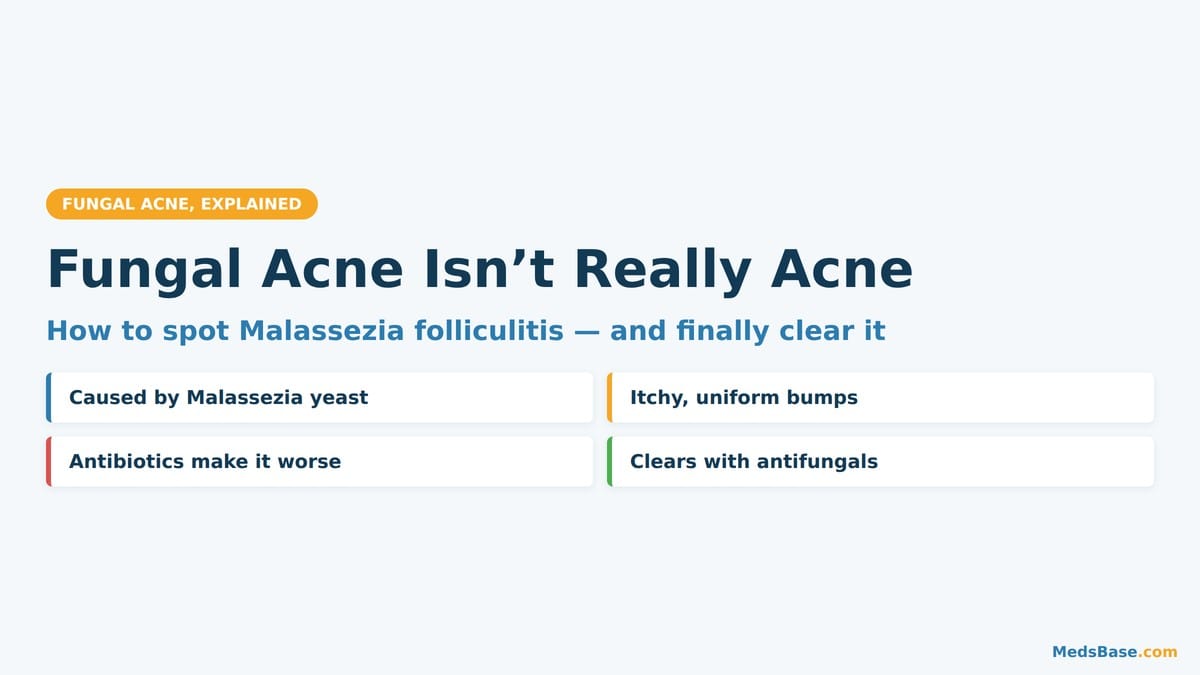
Fungal acne is an overgrowth of Malassezia yeast inside hair follicles, producing small, itchy, uniform papules and pustules. Its medical name is Malassezia folliculitis (older texts call it Pityrosporum folliculitis). Despite the nickname, it is a fungal follicle infection — not the bacterial, oil-driven condition we call acne vulgaris.
The confusion is understandable. The two look almost identical from across the room: clusters of little raised bumps, some with white heads. But the biology underneath is completely different, and that difference decides which treatment works. Reach for the wrong one and you can chase the problem for a year.
Malassezia is a normal resident of human skin. Nearly everyone carries it, mostly harmlessly, feeding on the oils your follicles produce. The trouble starts only when that quiet colonisation tips into overgrowth and the follicles become inflamed. In other words, the yeast was always there; something changed to let it multiply.
That is why the condition clusters in oil-rich, sweat-prone zones and why it so often lands on younger adults, athletes, and people in hot, humid climates. It is common, under-recognised, and very treatable once correctly identified — the whole reason getting the diagnosis right matters so much.
How Does Fungal Acne Develop?
Fungal acne develops when everyday Malassezia yeast overgrows inside hair follicles and triggers inflammation. Think of your skin as a garden where the yeast is a normal weed kept in check. Change the conditions — more warmth, more moisture, more oil, or fewer competing bacteria — and the weed takes over a flowerbed.
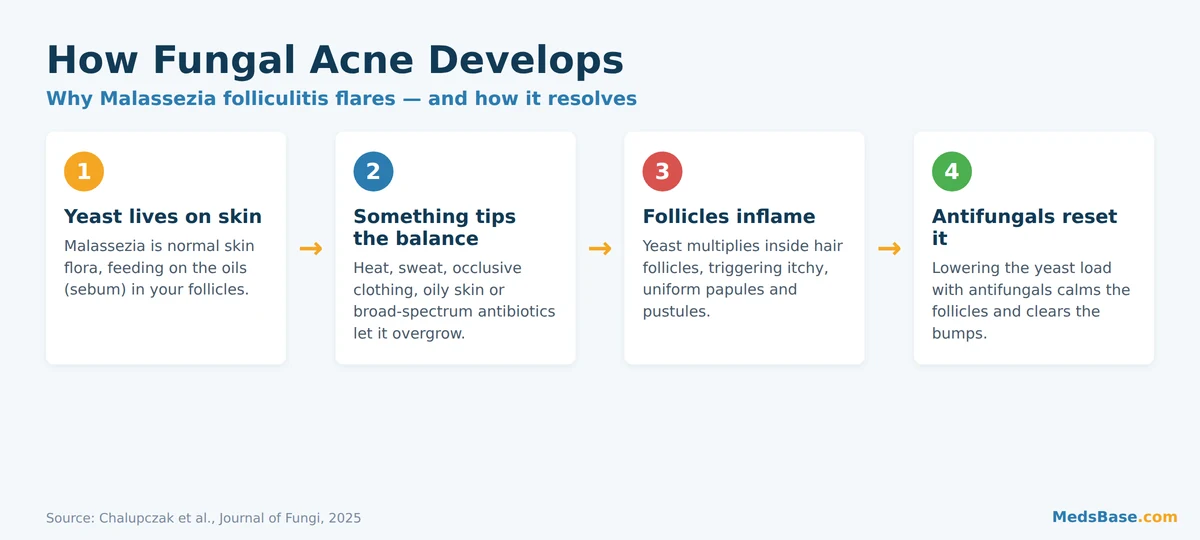
Several everyday triggers push the balance toward overgrowth. Heat and sweat create the warm, moist microclimate the yeast loves. Occlusive clothing, heavy sunscreens and thick moisturisers trap that moisture against the skin. Naturally oily skin gives the yeast more fuel. And here is the twist that catches so many people out: broad-spectrum antibiotics can trigger it by wiping out the bacteria that normally keep Malassezia in check.
Once the yeast multiplies, it irritates the follicle lining and provokes the immune response you see as red, sometimes pus-topped bumps. Fatty acids released as the yeast breaks down sebum add to the inflammation. The result feels like acne but behaves like an infection — which is precisely how you should treat it.
The encouraging part is that the same lever that lets the yeast flare also calms it. Lower the load with an antifungal, keep the skin cool and dry, and the follicles settle. That is the logic behind every effective plan you will read below.
Fungal Acne Symptoms: 7 Signs It Isn’t Regular Acne
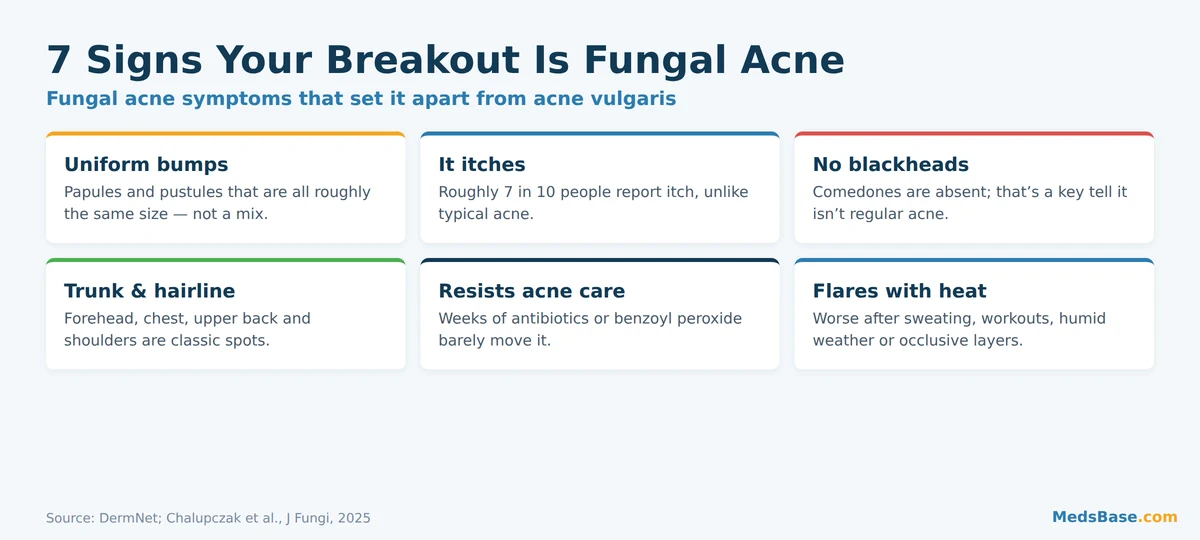
Fungal acne symptoms overlap with ordinary acne, but a handful of tells reliably separate them. No single sign is proof on its own; the pattern is what matters. If you recognise several of the following, a yeast cause becomes far more likely than a bacterial one.
1. The bumps are all the same size
The eruption is monomorphic — the papules and pustules look uniform, like someone stamped the same tiny bump dozens of times. Regular acne is polymorphic: a jumble of blackheads, whiteheads, papules and the occasional cyst, all different sizes and stages.
2. It itches
Here is the sign that surprises almost everyone: these breakouts frequently itch, while ordinary acne usually does not. Reported itch rates vary by study, but roughly seven in ten patients notice it. If your rash is nagging you to scratch, take that seriously.
3. There are no blackheads or whiteheads
Comedones — blackheads and whiteheads — are the signature of acne vulgaris. Malassezia folliculitis typically has none. If you look closely and see uniform inflamed bumps but not a single blackhead, that absence is a strong clue.
4. It shows up on the trunk and hairline
While it can appear on the face, the condition loves the forehead and hairline, chest, upper back and shoulders — the oily, sweaty zones. Breakouts that cluster along the hairline or across the upper back deserve a second look.
5. Your acne routine isn’t working
Weeks or months of benzoyl peroxide, salicylic acid or oral antibiotics with little to show for it is a classic tell. If anything, some people feel their skin worsened on antibiotics. Treatment resistance is itself a diagnostic hint.
6. It flares with heat and sweat
Notice a pattern after workouts, hot weather, long flights or sitting in sweaty gym clothes? Yeast-driven bumps track with warmth, humidity and occlusion far more tightly than typical acne does.
7. It often follows antibiotics or steroids
A new crop of uniform, itchy bumps after a course of broad-spectrum antibiotics — or oral or inhaled steroids — points toward yeast overgrowth taking advantage of a disturbed skin balance.
Who is most likely to get it?
- People with naturally oily skin or living in hot, humid climates.
- Athletes and gym-goers who sweat heavily and stay in damp clothing.
- Anyone recently on broad-spectrum antibiotics or corticosteroids.
- People whose “acne” has resisted standard treatment for months.
Less likely: classic facial breakouts full of blackheads and whiteheads, with no itch — that pattern points to ordinary acne, and our guide to the best acne treatments is the better starting point.
One important caveat: itchy, scaly or ring-shaped patches are not always what they seem. Skin conditions mimic each other constantly — our explainer on why a red circle on your skin might not be ringworm is a useful reminder that self-diagnosis has limits.
Fungal Acne vs Acne: The Comparison Table
The fastest way to sort fungal acne from acne vulgaris is to line the two up feature by feature. They can coexist, and only a clinician can confirm the diagnosis, but this side-by-side captures the differences that matter most for choosing treatment.
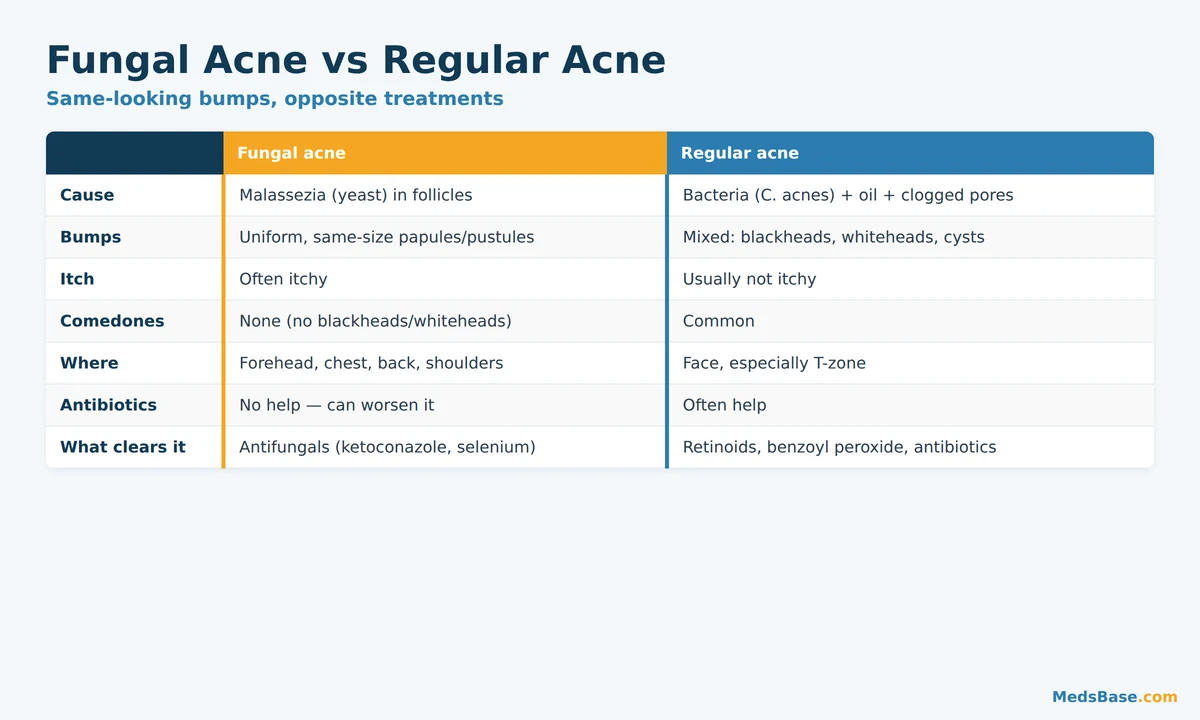
| Feature | Fungal acne (Malassezia folliculitis) | Regular acne (acne vulgaris) |
|---|---|---|
| Root cause | Yeast overgrowth in follicles | Bacteria, excess oil, clogged pores |
| Bump pattern | Uniform, same-size bumps | Mixed sizes and types |
| Blackheads/whiteheads | Absent | Common |
| Itch | Often itchy | Usually not itchy |
| Typical location | Forehead, chest, back, shoulders | Face, especially the T-zone |
| Response to antibiotics | None — can worsen | Often improves |
| What clears it | Antifungals (ketoconazole, selenium sulfide) | Retinoids, benzoyl peroxide, antibiotics |
Which situation fits you? If your bumps are itchy, uniform, comedone-free and clustered on the trunk or hairline — especially after antibiotics or heavy sweating — the fungal picture fits, and an antifungal is the logical first move. If you have blackheads, whiteheads and painful cysts mostly on the face with no itch, ordinary acne is more likely. When both patterns show up together, a clinician can help you treat the fungal component without abandoning your acne care.
Fungal Acne Treatment: Safety Profile, Side Effects & Dosage
Fungal acne treatment centres on antifungals in three tiers: medicated washes, topical creams, and — for stubborn or widespread cases — a short oral course guided by a clinician. Most people start with washes and creams, which have a reassuring safety profile when used as directed. The table below summarises what to expect from the common options.
| Side effect | Frequency | Severity | What to do |
|---|---|---|---|
| Local stinging or burning (topicals) | Common | Mild | Usually settles; reduce frequency if persistent |
| Dryness, redness or peeling | Common | Mild | Add a light, non-oily moisturiser |
| Change in hair texture (medicated shampoo) | Uncommon | Mild | Rinse thoroughly; space out use |
| Contact dermatitis / allergic reaction | Uncommon | Moderate | Stop use; seek advice if rash spreads |
| Nausea, headache (oral antifungals) | Uncommon | Mild–moderate | Take with food; tell your prescriber |
| Liver-enzyme changes / interactions (oral) | Rare | Serious | Clinician-supervised only; report symptoms promptly |
Topical ketoconazole (typically a 2% cream or shampoo) is a mainstay of treatment. Creams are usually applied once or twice daily to affected areas; medicated shampoos are used as a body wash, lathered and left on for a few minutes before rinsing. You can review the full drug information for topical ketoconazole on MedlinePlus.
Selenium sulfide and zinc pyrithione washes are practical, low-cost options that reduce yeast load across large areas like the chest and back. Oral antifungals such as itraconazole or fluconazole are reserved for extensive or recalcitrant cases and are used under medical supervision because they carry interaction and liver considerations that topical products do not.
What Does the Research Say About Fungal Acne?
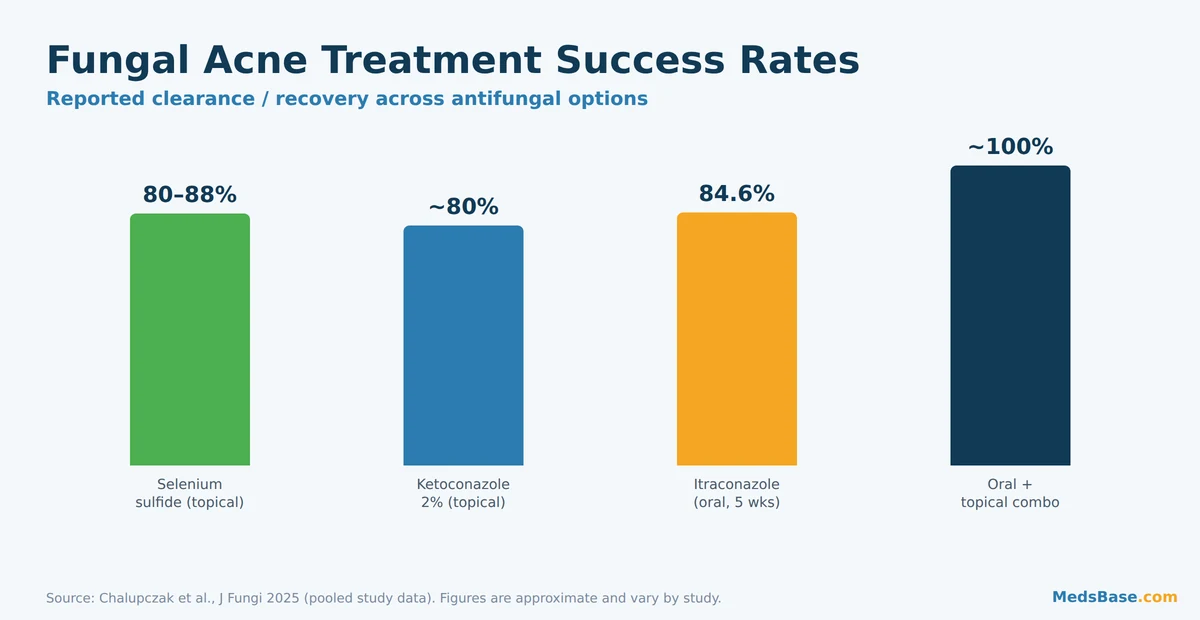
The evidence on fungal acne is consistent on two points: it is widely misdiagnosed, and it responds well to antifungals. Much of the literature is case series and retrospective reviews rather than large randomised trials, so treat the numbers as indicative rather than definitive. Still, the direction of travel is clear.
| Study / source | Year | Finding | Source |
|---|---|---|---|
| Chalupczak et al., Journal of Fungi | 2025 | In one cohort, 75% had been treated unsuccessfully for acne first; selenium disulfide gave ~80–88% recovery, itraconazole ~85% mycological cure at 5 weeks. | PMC review |
| Malgotra et al., Cureus | 2021 | Case that failed clindamycin, antibiotics and isotretinoin resolved ~90% on oral itraconazole plus a topical antifungal. | PMC case report |
| Position statement on diagnosis & treatment | 2023 | Recommends confirming with KOH microscopy or Wood’s lamp and using antifungals rather than antibacterials. | PubMed |
| DermNet clinical reference | Ongoing | Describes monomorphic, itchy follicular papules and recommends topical then oral antifungals; relapse is common. | DermNet |
What this means for you: the studies line up with what patients report — antifungals work when antibiotics did not, and the earlier you switch, the sooner you improve. They also flag a real-world catch: relapse is common, so a light maintenance routine matters as much as the initial clear-up. If you want the broader landscape of options, our overview of the best antifungal treatments puts these agents in context.
How to Get Rid of Fungal Acne: Practical Guidance
Getting rid of fungal acne is mostly about switching strategy: stop feeding the yeast, start treating it, and hold the line so it does not return. Here is a straightforward, evidence-aligned routine to discuss with a healthcare provider — especially if the breakout is widespread or persistent.
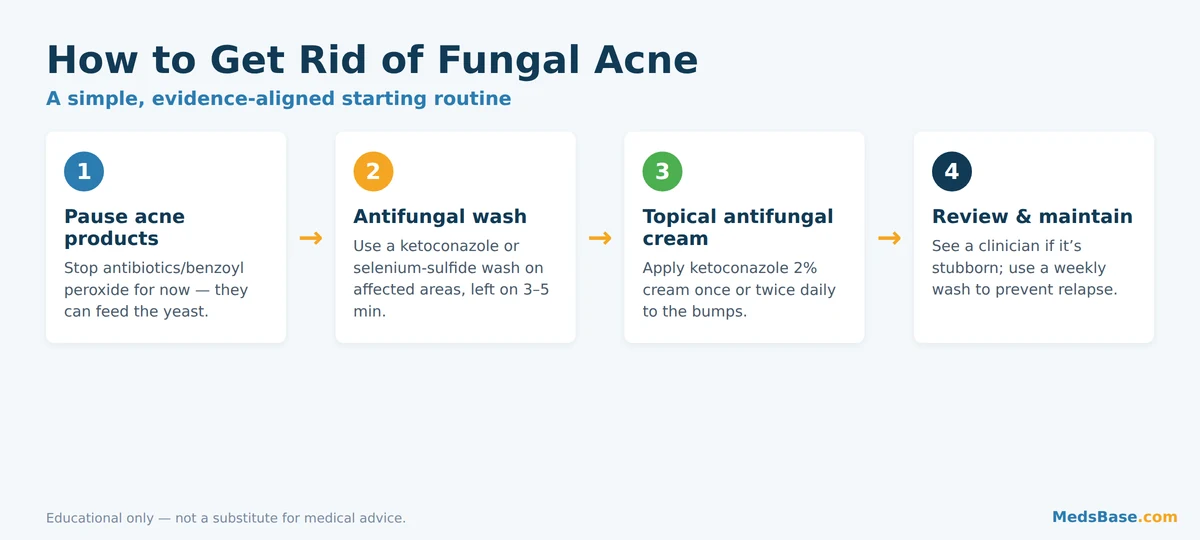
- Pause the acne products. Stop oral antibiotics and, temporarily, heavy acne actives while you test the fungal theory. Antibiotics in particular can prolong the problem by disturbing the skin’s bacterial balance.
- Start an antifungal wash. Use a ketoconazole or selenium sulfide wash on affected areas — lather, leave it on for three to five minutes, then rinse. Doing this in the shower a few times a week makes chest and back coverage easy. Browse options in our Anti-Fungal category, including a selenium sulfide wash.
- Add a topical antifungal cream. Apply ketoconazole 2% cream once or twice daily to the bumps for a few weeks. Give it time — topical creams often take around four weeks to show their full effect.
- Review, then maintain. If it is not improving after a few weeks, or it is severe, see a clinician who may recommend a short oral antifungal course. Once clear, a weekly antifungal wash helps prevent relapse.
Common mistakes to avoid:
- Piling on more acne treatment. Extra benzoyl peroxide or a new antibiotic will not touch yeast — and antibiotics can make things worse.
- Heavy, occlusive moisturisers and oils. Many facial oils and rich creams contain fatty acids Malassezia can feed on. Favour lighter, non-comedogenic formulas while you treat it.
- Staying in sweaty clothes. Shower and change promptly after workouts; damp fabric is a greenhouse for yeast.
- Quitting too soon. Bumps can linger even as the infection clears. Follow the full course and keep a maintenance wash going.
Yeast folliculitis and true acne can also overlap, and clearing the yeast sometimes reveals lingering acne underneath. If congestion and blackheads remain, a gentle exfoliating acid can help — our piece on whether salicylic acid can treat acne covers where it fits. And if dark marks are left behind after the bumps fade, our guide to post-inflammatory hyperpigmentation explains how to fade them safely.
How to Stop Fungal Acne Coming Back
Clearing the bumps is only half the job. Because Malassezia is a permanent skin resident, it can regroup the moment conditions favour it again — which is why the literature repeatedly flags relapse as the main long-term challenge. A little prevention keeps a one-time clear-up from turning into a seasonal cycle.
Keep a maintenance wash in rotation. Many people do well using an antifungal or selenium-sulfide wash once or twice a week on the chest, back and hairline even after the skin looks clear. Think of it the way you would anti-dandruff shampoo: occasional use keeps the yeast population low rather than letting it rebuild to the tipping point.
Manage the microclimate. The single biggest environmental lever is heat and moisture. Shower soon after exercise, swap out of sweaty or damp clothing quickly, and choose breathable fabrics in hot weather. If you use rich sunscreens or heavy body lotions, switch to lighter, non-comedogenic formulas on prone areas — the fatty acids in some emollients can feed the yeast.
Be strategic with antibiotics. You cannot always avoid a needed antibiotic course, but if you are prone to flares, it is worth telling your clinician — some people benefit from a short preventive antifungal wash alongside broad-spectrum antibiotics. The goal is to protect the bacterial balance that normally keeps Malassezia in check.
A simple maintenance rhythm
- Weekly: antifungal or selenium-sulfide wash on prone areas, left on a few minutes.
- Daily: shower promptly after sweating; lighter, non-comedogenic skincare.
- As needed: restart the full treatment routine at the first sign of returning itch or uniform bumps — catching it early keeps flares small.
Related reading
- Best Antifungal Treatments: 10 Evidence-Backed Picks — where ketoconazole and selenium sit among the options.
- Best Acne Treatments — if your breakout turns out to be ordinary acne after all.
- The Red Circle on Your Skin Might Not Be Ringworm — another look-alike worth ruling out.
Frequently Asked Questions
Q: What does fungal acne look like?
A: Fungal acne looks like clusters of small, uniform, red or skin-coloured bumps, sometimes with tiny pus heads, that are often itchy. Unlike ordinary acne, the bumps are all roughly the same size and there are no blackheads or whiteheads. It commonly appears on the forehead and hairline, chest, upper back and shoulders rather than deep in the facial T-zone.
Q: How do you get rid of fungal acne fast?
A: The fastest route is to stop feeding the yeast and start an antifungal. Pause oral antibiotics and heavy acne actives, use a ketoconazole or selenium sulfide wash on the area, and apply a topical antifungal cream once or twice daily. Keep skin cool and dry. Many people notice improvement within a couple of weeks, though topical creams can take around four weeks for full effect.
Q: Does fungal acne go away on its own?
A: It sometimes settles if a trigger is removed — for example, once a course of antibiotics ends or the weather cools. More often, though, it persists or recurs until you treat the yeast directly with an antifungal. Because relapse is common even after successful treatment, a light maintenance routine such as a weekly antifungal wash is usually the difference between a lasting clear-up and a recurring problem.
Q: Can ketoconazole treat fungal acne?
A: Yes. Topical ketoconazole — as a 2% cream or a medicated shampoo used as a body wash — is a standard treatment for fungal acne and works by reducing the Malassezia yeast load. It is generally well tolerated, with mild local irritation the most common side effect. Oral ketoconazole tablets are a different matter and are now restricted because of liver risk, so treatment relies on the topical forms.
Q: What triggers fungal acne?
A: Common triggers include heat, humidity and heavy sweating; occlusive clothing, thick moisturisers and oily skin; and anything that disturbs the skin’s microbial balance, especially broad-spectrum antibiotics and corticosteroids. Because the yeast is a normal skin resident, the condition is really a story of overgrowth — the trigger tips a quiet colonisation into an inflamed one.
Q: Is fungal acne contagious?
A: Not in the everyday sense. Malassezia yeast already lives on almost everyone’s skin, so you do not “catch” it from someone else the way you might a cold. It reflects a change in your own skin environment that let the resident yeast overgrow, which is why treatment focuses on your triggers and yeast load rather than on avoiding other people.
Q: How is it different from acne vulgaris?
A: The key difference is the cause: fungal acne comes from yeast in the follicles, while acne vulgaris comes from bacteria, oil and clogged pores. That drives everything else — the yeast form is itchy, uniform and comedone-free and resists antibiotics, whereas ordinary acne is a mix of blackheads, whiteheads and cysts that often improves with them. The two can coexist, which is one reason a professional diagnosis helps.
Q: When should I see a doctor about it?
A: See a clinician if the bumps are widespread, painful, or have not improved after a few weeks of topical antifungal treatment, or if you are unsure of the diagnosis at all. A professional can confirm it with a simple skin test and, when needed, prescribe a short oral antifungal course. Always seek advice before starting oral antifungals, as they interact with several common medications.
The Bottom Line
Fungal acne is one of dermatology’s great impersonators — it looks like acne, sits where acne sits, but answers to a completely different treatment. If your bumps are itchy, uniform, blackhead-free and stubborn against every acne product you have tried, the yeast explanation deserves a serious look. Switching to an antifungal, keeping skin cool and dry, and holding a light maintenance routine is what finally turns the corner for most people.
Your one immediate step: stop reaching for stronger acne products and try an antifungal wash on the affected area for two to three weeks. If the yeast was the culprit, you should see the difference — and if not, you will have a clearer answer to bring to a professional. When you are ready to choose a product, our Anti-Fungal range is a practical place to compare options.
Still weighing whether your breakout is fungal or bacterial? Read our guide to the best acne treatments to rule acne in or out. And if look-alike rashes are on your mind, see why a red circle on your skin might not be ringworm.

Written by
Sophie ChenPharmaceutical Content Researcher · 8 years experience
Sophie Chen is a pharmaceutical content researcher with 8 years covering generic medication access and clinical pharmacology. She specialises in international regulatory frameworks, bioequivalence standards, and patient-facing education on therapeutic drug classes. She is not a clinician.