








✓ Medically reviewed by · Last reviewed: May 2026
Pharmacy Researcher · 8 years experience
Pharmacy researcher with 8 years reviewing clinical drug information, generic formulation equivalence, and international pharmaceutical standards. Focuses on patient-facing accuracy in medication education.
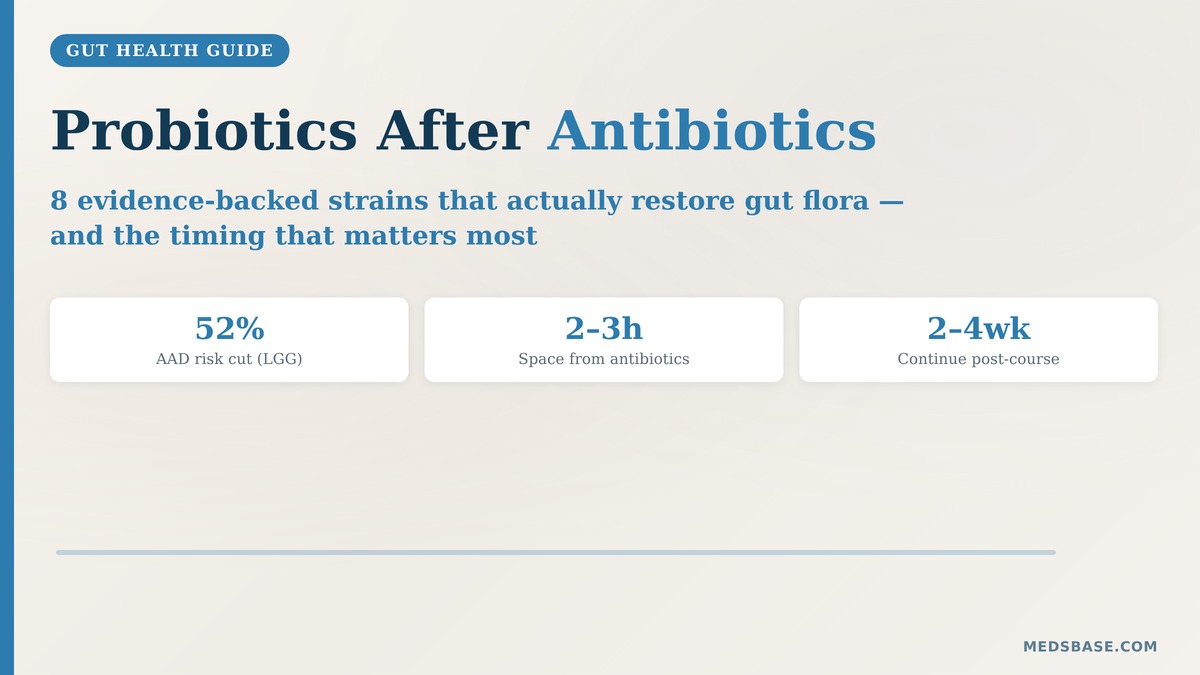
probiotics after antibiotics — Probiotics After Antibiotics — Which Strains Actually Work (and When to Take Them). Read on for an evidence-backed guide covering everything you need to know.
You’ve just finished a 7-day course of amoxicillin for a sinus infection. The infection is gone, but your stomach feels like a war zone — bloating, unpredictable bowels, and a general sense that something is “off” down there.
You’re not imagining things. A single course of broad-spectrum antibiotics can reduce gut microbiome diversity by up to 30%, and recovery without intervention can take months. But taking the right probiotics after antibiotics can cut that recovery time dramatically — if you choose the right ones.
Here’s what you’ll learn: which 8 probiotic strains have actual research behind them for post-antibiotic recovery, the exact timing protocol (during vs after is the wrong debate), how long you need to take them, and the prebiotic foods that help probiotics actually work.
Key Takeaways
- Most generic probiotics won’t survive the antibiotic environment — but there are two specific strains that consistently outperform the rest in clinical trials
- The “during or after” debate misses the point: the real question is about timing, and the answer changes depending on the strain
- Antibiotic-associated diarrhea affects up to 30% of patients — and one specific strain cuts that risk nearly in half
- Gut recovery isn’t instant — research shows it takes at least 2-4 weeks even with the best probiotics, and one thing can easily undo your progress
- Prebiotic foods work like fertilizer for probiotics — without them, you’re planting seeds in depleted soil
- Immunocompromised patients get a different set of rules entirely — what’s safe for most people isn’t safe for everyone
- What Do Probiotics Do After Antibiotics?
- When to Take Probiotics: During or After Antibiotics?
- Which Probiotic Strains Actually Work After Antibiotics?
- How Long Should You Take Probiotics After Antibiotics?
- How Long Does Gut Recovery Take After Antibiotics?
- Probiotic Foods vs Supplements: Which Is Better?
- What the Research Says About Probiotics After Antibiotics
- Frequently Asked Questions
- The Bottom Line
What Do Probiotics Do After Antibiotics? — Probiotics after antibiotics Explained
Quick Answer: Probiotics after antibiotics help replenish the beneficial gut bacteria that antibiotics wipe out. They compete with harmful bacteria (like C. difficile) for space and nutrients, produce compounds that support the gut lining, and accelerate the restoration of microbiome diversity. The right strains can reduce antibiotic-associated diarrhea risk by up to 52%.
Antibiotics work by killing or inhibiting bacteria — but they’re indiscriminate. Broad-spectrum antibiotics like amoxicillin-clavulanate, clindamycin, and fluoroquinolones wipe out beneficial gut bacteria alongside the pathogens causing your infection. The result: a depleted gut ecosystem where opportunistic bacteria can take over.
Probiotics after antibiotics act like a reseeding crew after a forest fire. They don’t instantly regrow the forest (that takes weeks), but they establish beneficial species that create the conditions for recovery, prevent weeds (pathogens) from taking over, and accelerate the return of biodiversity.
The mechanism of probiotics after antibiotics is three-fold:
- Competitive exclusion: Probiotic bacteria occupy the same ecological niches that pathogens (especially C. difficile) would colonize, preventing infection.
- Metabolic support: Probiotics produce short-chain fatty acids (SCFAs) like butyrate that nourish colon cells and strengthen the gut barrier.
- Immune modulation: Certain strains signal the immune system to mount a measured response rather than an inflammatory overreaction — important for reducing post-antibiotic gut inflammation.
Without probiotics, gut recovery from antibiotics can take 1-3 months for healthy adults — and longer for older adults or those on multiple antibiotic courses.
When to Take Probiotics: During or After Antibiotics?
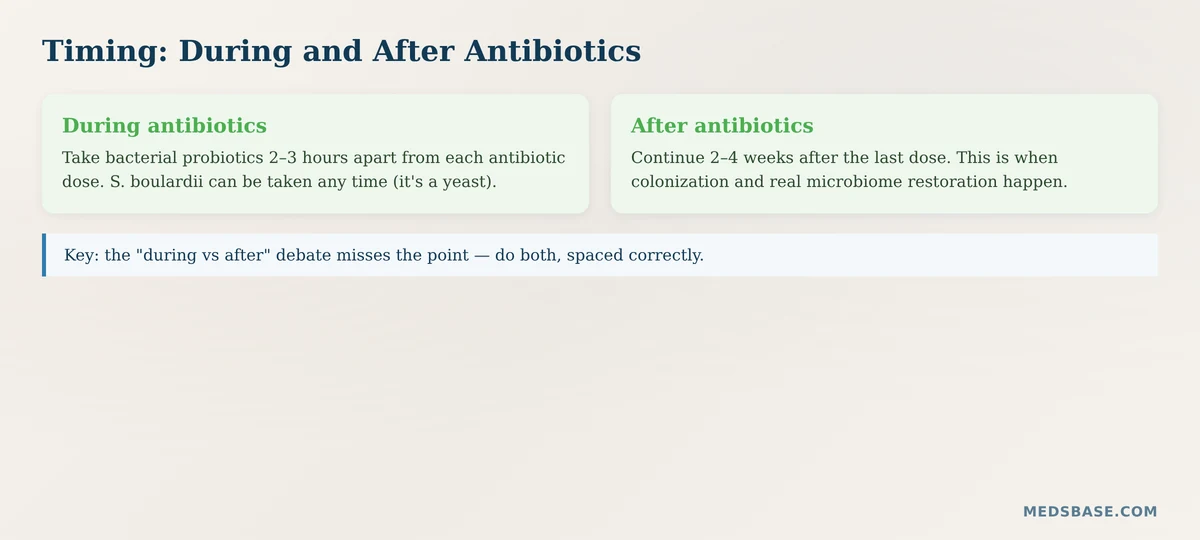
Quick Answer: You can take probiotics during AND after antibiotics — but timing matters. When taking them concurrently, space the probiotic at least 2-3 hours apart from the antibiotic dose. Continue for 2-4 weeks after finishing the antibiotic course. Saccharomyces boulardii can be taken simultaneously with antibiotics because it’s a yeast, not a bacterium, so antibiotics don’t kill it.
Here’s where it gets interesting. The old advice was “wait until after antibiotics because the antibiotic will kill the probiotic.” That’s partially true for bacterial probiotics taken at the same time as antibiotics. But it oversimplifies the picture.
The current evidence-based approach for probiotics after antibiotics breaks down into two phases:
During antibiotics: Start probiotics on day 1 of your antibiotic course. Take them at least 2-3 hours apart from the antibiotic (e.g., antibiotic at 8am and 8pm; probiotic at 11am and 3pm). The goal during antibiotics isn’t full colonization — it’s maintaining enough beneficial bacteria to prevent C. difficile overgrowth and reduce diarrhea severity.
After antibiotics: Continue probiotics for 2-4 weeks after your last antibiotic dose. This is the critical window. During these weeks, the antibiotic has cleared, so probiotic bacteria can colonize without being killed. This is when meaningful microbiome restoration happens.
But there’s a catch when taking probiotics after antibiotics: the most-studied probiotic for antibiotic-associated diarrhea — Saccharomyces boulardii — is a yeast, not a bacterium. Antibiotics can’t kill it. You can take S. boulardii at the same time as any antibiotic with no timing gap needed. This is why many experts recommend S. boulardii as the first-line probiotic during antibiotic treatment, switching to or adding bacterial strains afterward.
Timing summary for probiotics after antibiotics:
- S. boulardii (yeast): Any time — even simultaneously with antibiotics
- Bacterial probiotics: 2-3 hours after antibiotics, then continue 2-4 weeks post-course
- Multi-strain blends: Space 2-3 hours from antibiotics during treatment; can take any time after the course ends
Which Probiotic Strains Actually Work After Antibiotics?
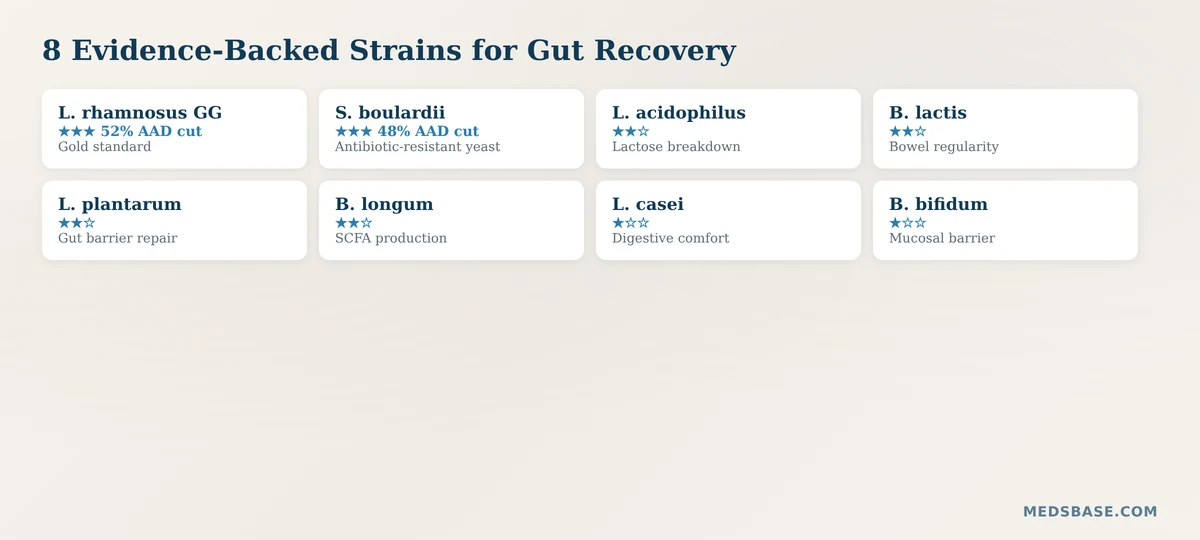
Not all probiotics are created equal — and the label on most drugstore probiotics bears little relationship to what the research actually supports. Here are the 8 strains with the strongest evidence for post-antibiotic recovery:
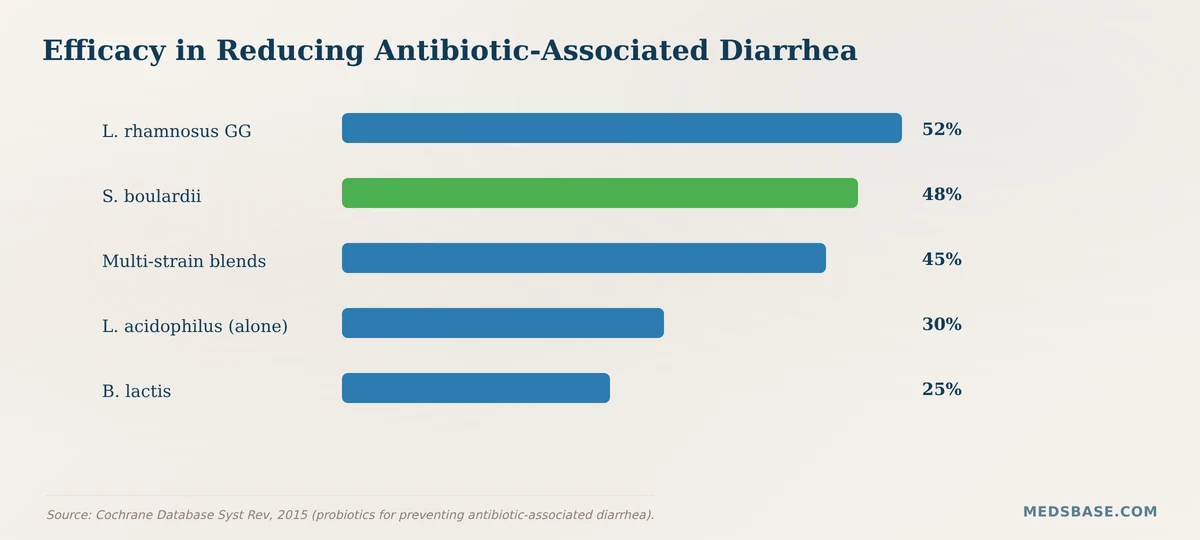
1. Lactobacillus rhamnosus GG (LGG) — The gold standard. A Cochrane systematic review found LGG reduced antibiotic-associated diarrhea (AAD) risk by 52%. It survives stomach acid, adheres well to intestinal walls, and has been studied in more than 800 clinical trials. Dose: 10-20 billion CFU daily.
2. Saccharomyces boulardii — The unique one. Being a yeast, S. boulardii is completely antibiotic-resistant — you can take it any time. Research in the World Journal of Gastroenterology found it reduced AAD risk by ~48%. It’s especially effective at preventing C. difficile infection. Dose: 250-500mg (5-10 billion CFU) twice daily.
3. Lactobacillus acidophilus — One of the most common yogurt probiotics, L. acidophilus helps break down lactose and produces lactic acid that inhibits pathogens. Evidence for AAD prevention is moderate but consistent. Works best in combination with other strains. Dose: 10-20 billion CFU daily.
4. Bifidobacterium lactis — Strong evidence for improving bowel regularity and reducing bloating. Often paired with L. acidophilus in commercial blends. A randomized controlled trial found B. lactis combined with LGG significantly reduced AAD duration. Dose: 10 billion CFU daily.
5. Lactobacillus plantarum — Notable for its ability to survive the entire GI tract and reduce intestinal permeability (“leaky gut”). Particularly useful after broad-spectrum antibiotics that damage the gut lining. Found in fermented foods like kimchi and sauerkraut. Dose: 10 billion CFU daily.
6. Bifidobacterium longum — Important for breaking down complex carbohydrates and producing SCFAs. Levels drop significantly after clindamycin and amoxicillin. Supplementing after antibiotics helps restore SCFA production faster. Dose: 5-10 billion CFU daily.
7. Lactobacillus casei — Modest evidence for reducing AAD, but strong data for improving overall digestive comfort. Often included in multi-strain blends. Dose: 10 billion CFU daily.
8. Bifidobacterium bifidum — Helps maintain the mucosal barrier of the large intestine. Less direct evidence for AAD prevention than LGG or S. boulardii, but complementary role in overall microbiome restoration. Dose: 5-10 billion CFU daily.
The most effective approach for probiotics after antibiotics is to combine strains for probiotics after antibiotics: a product containing L. rhamnosus GG + S. boulardii as the core, with 2-4 additional strains for broader coverage. Single-strain products work, but multi-strain blends more closely mimic the natural microbiome diversity you’re trying to restore.
How Long Should You Take Probiotics After Antibiotics?
The research on probiotics after antibiotics points to a minimum of 2-4 weeks of probiotics after antibiotics — but the exact duration depends on your antibiotic course length and your baseline gut health.
Short antibiotic course (3-7 days, e.g., amoxicillin, nitrofurantoin):
- Take probiotics during treatment (spaced 2-3 hours from antibiotic dose)
- Continue for 2 weeks after last dose
- Most healthy adults return to near-normal gut function in this window
Medium antibiotic course (7-14 days, e.g., doxycycline, ciprofloxacin):
- Take probiotics during treatment
- Continue for 3-4 weeks after last dose
- Consider adding prebiotic fiber in week 2 to feed the new probiotic bacteria
Long or multiple antibiotic courses (14+ days, or back-to-back courses):
- S. boulardii during treatment (antibiotic-resistant)
- Multi-strain bacterial blend started on day 1 (spaced from doses)
- Continue for 4-8 weeks after last dose
- Gut recovery takes proportionally longer — be patient
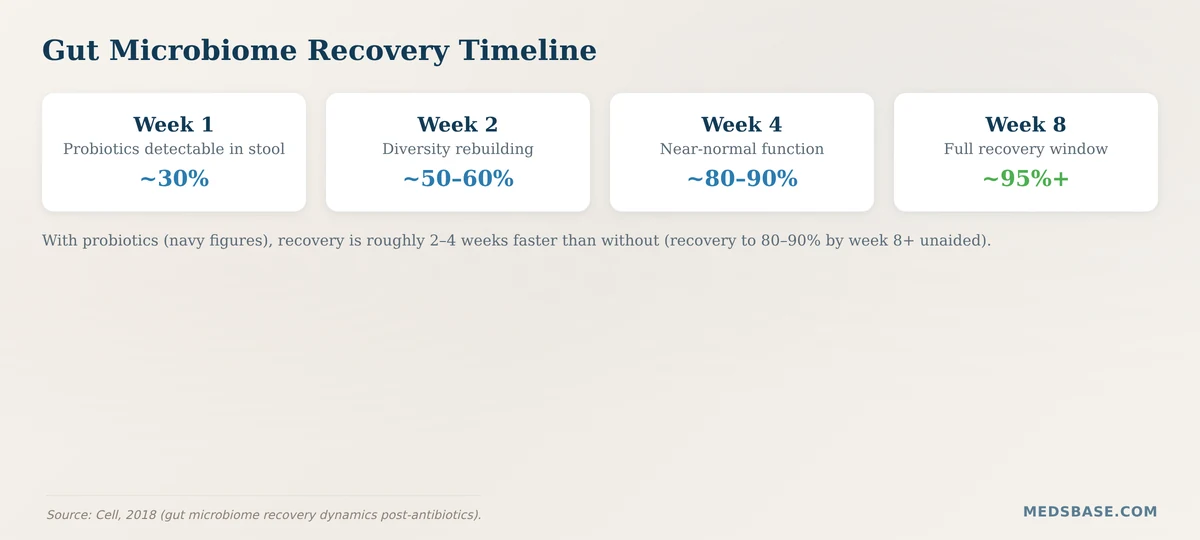
A 2018 study in Cell showed that gut microbiome diversity typically returns to near-baseline by week 4 with probiotic support, compared to week 8+ without. But some bacterial families remain depleted for up to 6 months after certain antibiotics (especially clindamycin and fluoroquinolones) — which is why probiotic maintenance, not just acute treatment, matters.
One reality check that’s rarely discussed: probiotics after antibiotics help, but they don’t fully prevent microbiome disruption. Even with the best probiotics, a broad-spectrum antibiotic course will reduce your gut diversity. The goal of probiotics isn’t to prevent any impact — it’s to accelerate recovery and prevent complications like C. difficile.
How Long Does Gut Recovery Take After Antibiotics?
The honest answer: probiotics after antibiotics help, but gut recovery takes longer than most people think.
Even with optimal probiotic support, the gut microbiome doesn’t bounce back in a week. Here’s the realistic timeline based on the 2018 Cell study:
| Timeline | What’s Happening | With Probiotics | Without Probiotics |
|---|---|---|---|
| Day 0 | Last antibiotic dose | Gut diversity severely depleted | Same |
| Week 1 | Initial repopulation | Probiotics detectable in stool; SCFA production begins | Slow endogenous recovery begins |
| Week 2 | Diversity rebuilding | ~50-60% of baseline diversity restored | ~30-40% restored |
| Week 4 | Near-normal function | ~80-90% diversity restored; normal bowel function | ~60-70% restored; residual bloating common |
| Week 8 | Full recovery window | ~95%+ diversity | ~80-85% diversity; some strains still depleted |
| Month 6 | Long-term normalization | Most individuals fully recovered | Most individuals recovered; some strain gaps persist |
The takeaway: probiotics after antibiotics accelerate recovery by roughly 2-4 weeks. That’s meaningful — it’s 2-4 fewer weeks of bloating, irregular bowels, and discomfort. But probiotics aren’t magic. Full gut restoration is a biological process that takes time regardless of supplementation.
Probiotic Foods vs Supplements: Which Is Better?
Both have a role — but they serve different purposes in the post-antibiotic context.
Probiotic foods (yogurt, kefir, kimchi, sauerkraut, kombucha, miso):
- Pros: Affordable, naturally contain prebiotic fiber alongside probiotics, contribute to long-term dietary patterns
- Cons: Unknown CFU counts, limited strain diversity, most commercial yogurts use only L. acidophilus and B. lactis
- Best for: Long-term gut maintenance, dietary integration, people who just finished a short antibiotic course
Probiotic supplements (capsules, powders):
- Pros: Known CFU counts (typically 10-50 billion per dose), specific documented strains, can include S. boulardii and LGG (rarely found in foods), tested for viability
- Cons: Cost ($15-40/month), variable quality between brands, some strains die in transit without refrigeration
- Best for: Active antibiotic recovery, known GI conditions, preventing or treating AAD, anyone on medium-to-long antibiotic courses
The optimal strategy: supplements during and for 2-4 weeks after antibiotics (targeted, high-dose recovery), then transition to probiotic-rich foods for long-term maintenance. Food alone is unlikely to provide the CFU counts or specific strains needed for active post-antibiotic recovery.
One more thing: prebiotic fiber matters as much as the probiotics themselves. Prebiotics are indigestible fibers that feed probiotic bacteria — without them, you’re planting seeds in depleted soil. Good sources: garlic, onions, leeks, asparagus, bananas, oats, and Jerusalem artichokes. Start introducing these in week 2 of your probiotic regimen.
What the Research Says About Probiotics After Antibiotics
| Study | Year | Finding | Source |
|---|---|---|---|
| Cochrane AAD review | 2015 | Probiotics reduced AAD risk by 52% (LGG) to 48% (S. boulardii); NNT = 9 | Cochrane Database |
| LGG RCT | 2013 | LGG + B. lactis reduced AAD duration by 1.5 days vs placebo | Am J Gastroenterol |
| S. boulardii efficacy | 2014 | S. boulardii reduced AAD risk by 48% and C. diff infection risk significantly | World J Gastroenterol |
| Gut recovery timeline | 2018 | Microbiome recovery to 80-90% diversity by week 4 with probiotics vs week 8 without | Cell |
| NHS guidance | Ongoing | Recommends spacing probiotics 2-3 hours from antibiotics; evidence strongest for preventing AAD | NHS |
What this means for you about probiotics after antibiotics: Probiotics after antibiotics are one of the most evidence-supported supplement interventions in gastroenterology. The Cochrane review — the highest standard of medical evidence — confirms they work. But the benefit is specific: you need the right strains (LGG, S. boulardii), the right timing (2-3 hours apart during treatment, 2-4 weeks after), and realistic expectations (faster recovery, not instant recovery).
Frequently Asked Questions
Q: Should I take probiotics during or after antibiotics?
A: Both. Start probiotics on day 1 of your antibiotic course, spacing bacterial strains 2-3 hours apart from each antibiotic dose. S. boulardii can be taken simultaneously (it’s antibiotic-resistant). After finishing antibiotics, continue probiotics for 2-4 weeks.
Q: How long after antibiotics should I take probiotics?
A: Start taking probiotics after antibiotics the same day your antibiotic course ends — don’t wait a day. Continue for 2-4 weeks minimum. If you were on a long antibiotic course (14+ days), continue for 4-8 weeks.
Q: Which probiotic is best after antibiotics?
A: The strongest evidence supports Lactobacillus rhamnosus GG (LGG) and Saccharomyces boulardii as first-line probiotics after antibiotics. A multi-strain product combining LGG, S. boulardii, L. acidophilus, and B. lactis provides the broadest coverage.
Q: Do probiotics really help after antibiotics?
A: Yes. A Cochrane review of 23 randomized trials found that probiotics reduce the risk of antibiotic-associated diarrhea by approximately 50%. The benefit is strongest for preventing C. difficile infection and reducing diarrhea severity.
Q: Can I take probiotics at the same time as antibiotics?
A: For bacterial probiotics, space them 2-3 hours apart from antibiotics. For S. boulardii (a yeast probiotic), yes — you can take it at the same time because antibiotics don’t affect yeast.
Q: How long does it take to restore gut bacteria after antibiotics?
A: With probiotics, meaningful recovery begins at week 1 and reaches ~80-90% of baseline by week 4. Without probiotics, recovery may take 8+ weeks. Some bacterial families remain depleted for up to 6 months after certain antibiotics.
Q: Are probiotics safe for everyone after antibiotics?
A: Probiotics after antibiotics are safe for most healthy adults. However, people who are severely immunocompromised, have central venous catheters, or have short bowel syndrome should consult their doctor — there are rare cases of probiotic-related bloodstream infections in these populations. Infants and the elderly may benefit but should also consult a healthcare provider.
Q: What foods should I eat with probiotics after antibiotics?
A: Prebiotic-rich foods that feed probiotics: garlic, onions, leeks, asparagus, bananas, oats, and Jerusalem artichokes. Fermented foods like yogurt, kefir, and kimchi provide both probiotics and prebiotics. Avoid excessive sugar and processed foods, which can feed pathogenic bacteria during the recovery window.
The Bottom Line
Probiotics after antibiotics are one of the few supplement interventions with genuine, high-quality evidence behind them. They reduce diarrhea risk by roughly half, accelerate microbiome recovery by 2-4 weeks, and make the post-antibiotic period significantly more comfortable.
The key is choosing the right probiotics after antibiotics: L. rhamnosus GG and S. boulardii as your core, a multi-strain blend for breadth, taken 2-3 hours apart from antibiotics during treatment, and continued for 2-4 weeks after.
If you’re about to start antibiotics, pick up a quality probiotic at the same time — don’t wait until you feel bad. If you’ve already finished your course, start today. Your gut will thank you.
Browse MedsBase’s antibiotic products at competitive prices, and check our selection of general health supplements including probiotics for post-antibiotic recovery. For more on specific antibiotics, read our complete doxycycline guide and amoxicillin vs doxycycline comparison. Wondering about medication effects on your body? Read our guide to the finasteride shedding phase.
Disclaimer: This article is for informational purposes only and does not constitute medical advice. Probiotics are supplements, not medications. Consult your doctor before starting any new supplement, especially if you are immunocompromised, pregnant, or taking other medications.

Written by
Sophie ChenPharmaceutical Content Researcher · 8 years experience
Sophie Chen is a pharmaceutical content researcher with 8 years covering generic medication access and clinical pharmacology. She specialises in international regulatory frameworks, bioequivalence standards, and patient-facing education on therapeutic drug classes. She is not a clinician.