








✓ Medically reviewed by · Last reviewed: May 2026
Pharmacy Researcher · 8 years experience
Pharmacy researcher with 8 years reviewing clinical drug information, generic formulation equivalence, and international pharmaceutical standards. Focuses on patient-facing accuracy in medication education.
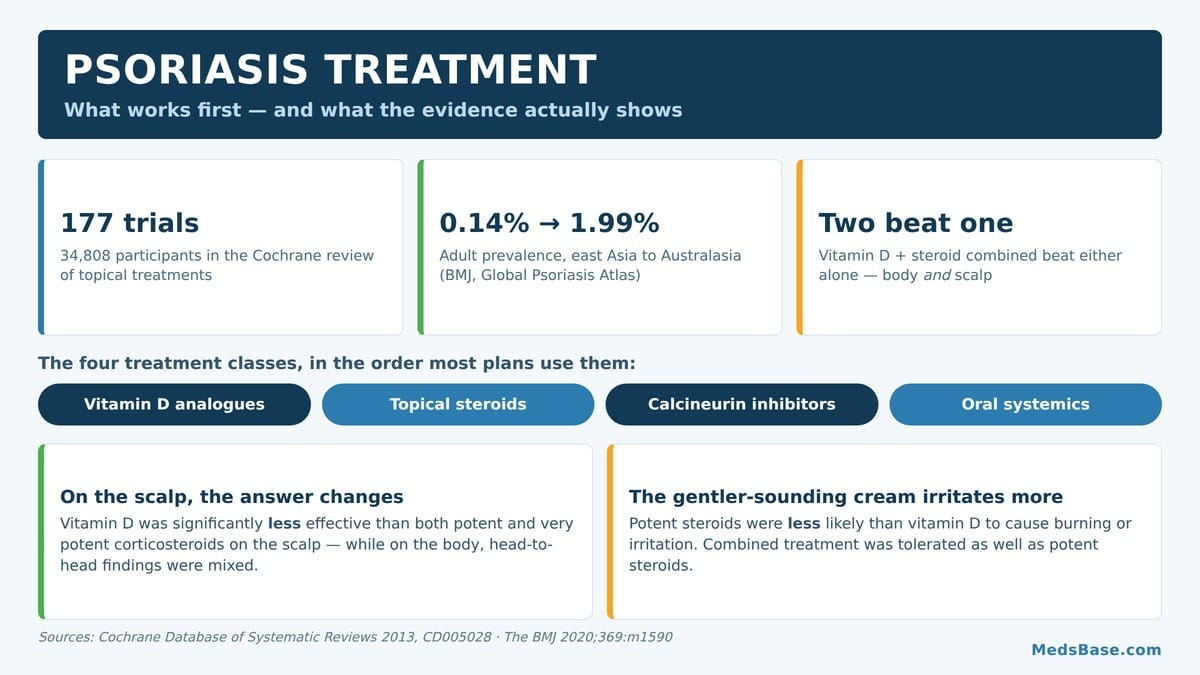
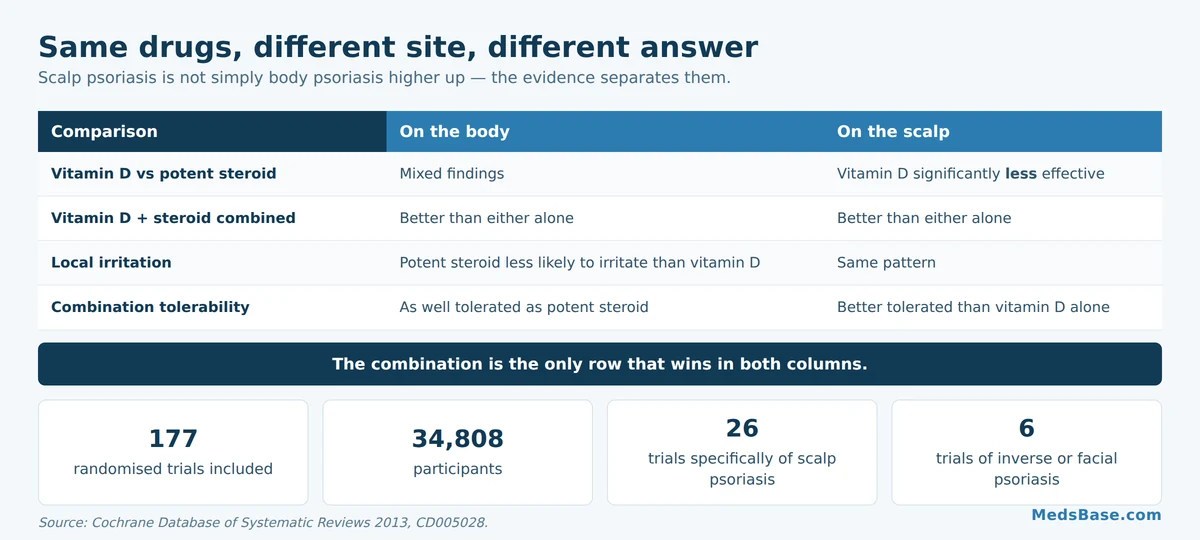
Quick Answer — Psoriasis treatment usually starts with creams, not tablets. Most people begin with a vitamin D analogue, a topical corticosteroid, or the two combined in one product. A Cochrane review of 177 trials found the combination outperformed either ingredient used alone, on both the body and the scalp.
Here is a number that reframes the whole condition: psoriasis is roughly fourteen times more common in some parts of the world than others, ranging from 0.14% of adults in east Asia to 1.99% in Australasia, according to Global Psoriasis Atlas data published in The BMJ. That gap tells you something important. This is not a condition you caused by eating the wrong thing, and finding the right psoriasis treatment is not a test of willpower.
By the end of this guide you will know which treatments have the strongest evidence behind them, which ones work on your scalp but not your elbows, and the honest side-effect price of each. You will also know the one combination that the research supports more clearly than almost anything else in this field — and why so few articles mention it.
One warning up front: there is a treatment that works brilliantly for six weeks and then stops being a good idea. We will get to it in the safety section, because knowing when to stop matters as much as knowing what to start.
- Two creams beat one — and the trial evidence behind that is 177 studies deep, not one small paper.
- Your scalp is a different problem. One popular treatment is significantly less effective there than on your body, and almost nobody tells you.
- Potency has a ceiling. The strongest steroids work best — but there is a specific reason you cannot simply keep using them.
- Psoriasis is immune-driven, not hygiene-driven. That single fact changes which treatments can realistically work.
- It cannot be cured — but “controlled” is a genuinely achievable target, and the research says most people reach it with topicals alone.
- One widely available class is steroid-free and exists specifically for the places steroids should not go. Details in the options section.
- What Is Psoriasis?
- How Does Psoriasis Treatment Work?
- The Main Psoriasis Treatment Options
- Psoriasis Treatment Safety: Side Effects and Duration
- What Does the Research Say About Psoriasis Treatment?
- Psoriasis Treatment vs the Alternatives
- How to Use Psoriasis Treatment Properly
- Frequently Asked Questions
- The Bottom Line
What Is Psoriasis?
Psoriasis is a long-term skin condition in which an overactive immune system makes skin cells multiply far too quickly, producing raised patches covered in silvery-white scale. Plaque psoriasis is the most common form. It cannot be cured, but it can usually be controlled, and symptoms typically come and go in flare-ups rather than staying constant.
That definition does a lot of work, so let us unpack the part most people get wrong. The NIH’s arthritis and skin institute describes psoriasis as a disease in which “the immune system becomes overactive, causing skin cells to multiply too quickly.” Your skin is not dirty, dry or damaged in the ordinary sense. It is receiving a signal to rebuild itself far faster than it should.
That is why moisturiser alone never fixes psoriasis — it is treating the result, not the cause.
The same source lists what can set it off: infections, particularly streptococcal and HIV infections, and certain medicines including some drugs used for heart disease, malaria and mental health conditions. Stress and skin injuries are named as common triggers worth managing. If your flare-ups seem to follow a sore throat or a stressful month, you are not imagining a pattern.
Psoriasis also travels with other conditions. NIAMS names psoriatic arthritis, cardiovascular events such as heart attacks and strokes, and mental health problems including low self-esteem, anxiety and depression. That last one deserves saying plainly: if this condition is affecting your mood, that is a recognised part of the disease, not a personal failing.
How Does Psoriasis Treatment Work?
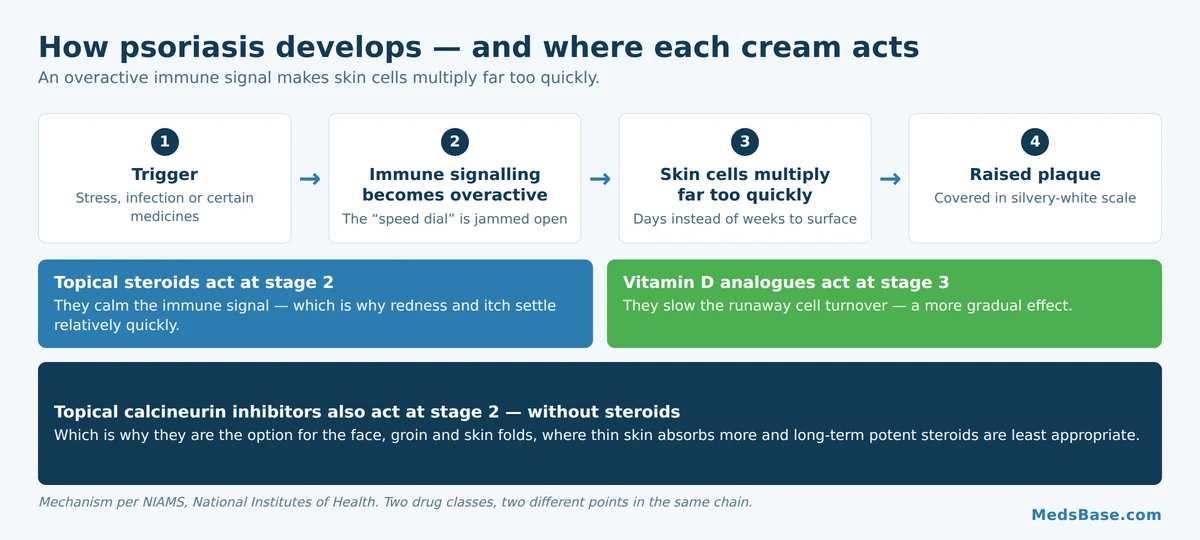
Think of your skin as a production line that normally runs at a steady pace. In psoriasis, an immune signal jams the speed dial wide open. Cells that should take weeks to reach the surface arrive in days, pile up, and form a plaque.
Effective psoriasis treatment intervenes at one of two points on that line — and this is the key to everything that follows. Nearly every topical option you will be offered belongs to one of the two groups below.
Topical corticosteroids act on the signal. They dampen the immune activity driving the overproduction, which is why they calm redness and itch relatively quickly. Vitamin D analogues act on the production line itself, slowing how fast skin cells multiply and encouraging them to mature normally. They work more gradually.
Two mechanisms. Two different points in the same chain. Here is where it gets interesting: because they do different jobs, using them together is not simply “double the cream” — it is closing off the problem from two directions at once. That is the mechanistic reason behind the strongest single finding in this whole field, which we will quantify shortly.
A third topical class works differently again. Topical calcineurin inhibitors such as tacrolimus suppress the immune signal without being steroids at all, which matters enormously for certain body sites. More on why in the options section.
The Main Psoriasis Treatment Options
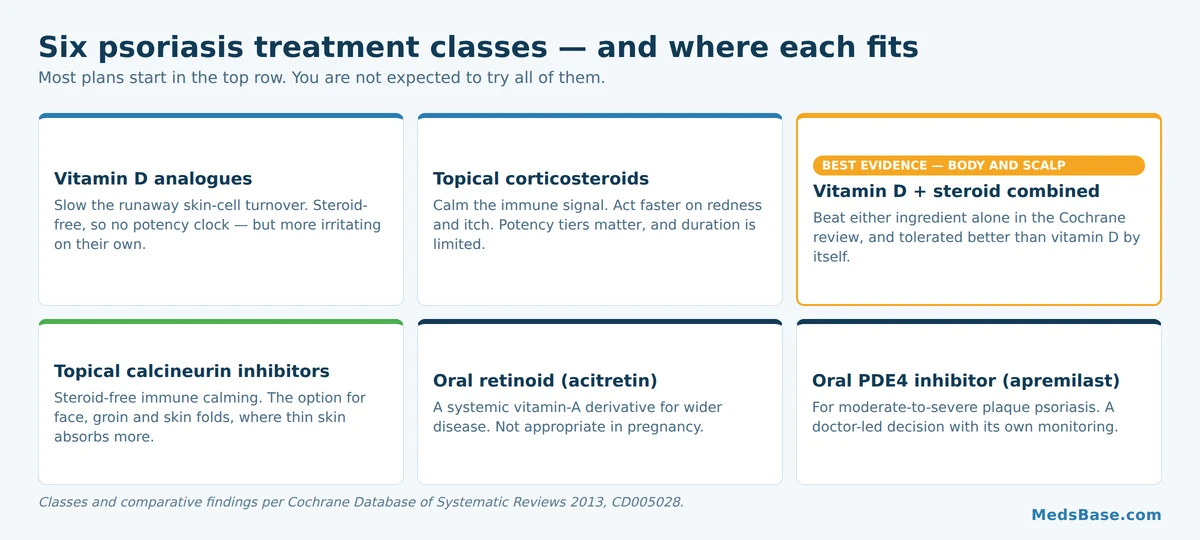
Most psoriasis treatment plans work through these in roughly this order. You are not expected to try all of them.
1. Vitamin D analogues
These slow down the runaway skin-cell turnover. In the Cochrane data, most vitamin D analogues used on the body were significantly more effective than placebo. They are steroid-free, which means no potency clock — an important practical advantage for a condition that lasts years.
The trade-off is honest: they can burn or irritate, and on the scalp they underperform badly compared with steroids.
2. Topical corticosteroids
The workhorses. They come in potency tiers, and the tier genuinely matters — very potent steroids produced roughly double the benefit of merely potent ones in the pooled trial data. They also act faster than vitamin D analogues on redness and itch.
The catch is that steroid potency cannot be used indefinitely, which the safety section covers in full.
3. Vitamin D analogue and corticosteroid combined
The best-supported option in the topical evidence, for the mechanistic reason explained above. If you have tried one cream and found it only half-worked, this is the specific conversation worth having with a pharmacist or doctor.
4. Topical calcineurin inhibitors
Steroid-free immune-calming ointments such as tacrolimus. Their value is site-specific: facial and flexural psoriasis — the folds at the groin, under the breasts, behind the knees — is exactly where long-term potent steroids are least appropriate, because the skin there is thin and absorbs more.
5. Oral treatments
When topicals genuinely are not enough, oral options include acitretin, a vitamin-A-derived retinoid, and apremilast, a PDE4 inhibitor for moderate-to-severe plaque psoriasis. These are systemic medicines with meaningfully different monitoring requirements, and they are a doctor-led decision rather than a self-directed one.
- Have plaques covering a limited area of your body
- Have tried a single cream that partly worked and then stalled
- Want to control flare-ups without systemic medication
- Have scalp involvement — provided you pick the right agent for that site
- Are pregnant, planning pregnancy, or breastfeeding — acitretin in particular is not appropriate, and this is not a grey area
- Have psoriasis over most of your body, where topicals become impractical
- Have joint pain alongside skin symptoms — that may be psoriatic arthritis and needs assessing properly
- Have thin or broken skin at the treatment site
- Have an active infection in the area
An illustrative example — not a real patient. Take Marcus, 38, with stubborn plaques on both elbows and a patch behind one ear. He was given a vitamin D cream, used it faithfully for three weeks, saw a modest improvement on his elbows and nothing at all behind his ear, and concluded the treatment had failed. Two things were happening. The elbow response was real but slow, because that is how vitamin D analogues behave. The lack of response behind his ear was predictable, because that site sits closer to scalp-type skin, where the trial evidence says vitamin D underperforms against steroids. His problem was never the product — it was one product being asked to cover two different sites on two different timelines.
If you have identified which class fits your situation, you can browse the eczema and psoriasis treatments MedsBase stocks — the range covers topical steroids across three potency tiers, steroid-free calcineurin inhibitors, and oral options. No prescription is needed to order from MedsBase.com.
Psoriasis Treatment Safety: Side Effects and Duration
Time to close the loop from the introduction. The psoriasis treatment that works brilliantly and then stops being a good idea is the potent topical corticosteroid — and the reason is skin thinning.
| Side effect | Frequency | Severity | What to do |
|---|---|---|---|
| Burning or stinging on application (vitamin D analogues) | Common | Mild | Often settles; combination products were tolerated significantly better than vitamin D alone |
| Local irritation, redness at site | Common | Mild | Review the agent — potent steroids were less likely to irritate than vitamin D analogues |
| Skin thinning with prolonged potent steroid use | Uncommon in trials, but poorly measured | Moderate — can be lasting | Use in defined courses, not indefinitely; switch sites or classes as advised |
| Rebound flare after stopping a strong steroid abruptly | Reported | Moderate | Taper rather than stop dead; ask about a maintenance plan |
| Sensitivity when treating face, groin or skin folds | Site-dependent | Moderate | This is the classic indication for a steroid-free option |
| Systemic effects from oral retinoids or PDE4 inhibitors | Varies by drug | Moderate to serious | Doctor-supervised; acitretin is contraindicated in pregnancy |
Two honest caveats about that table. First, the Cochrane authors were candid that only 25 of 177 trials assessed skin atrophy at all, few cases were detected, and the trials “reported insufficient information to determine whether assessment methods were robust.” They add that clinical measurements of atrophy are insensitive and detect only the most severe cases. In plain terms: the trials probably undercounted this, so the caution is based on clinical practice rather than a precise trial number.
Second — and this is the part worth internalising — the irritation ranking is the opposite of what most people assume. The “gentler-sounding” vitamin D cream is the more irritating one on its own. Potent steroids were less likely than vitamin D to cause burning or irritation, on both body and scalp.
What Does the Research Say About Psoriasis Treatment?
| Study | Year | Finding | Source |
|---|---|---|---|
| Cochrane review of topical treatments (177 RCTs, 34,808 participants) | 2013 | Combined vitamin D + corticosteroid performed significantly better than either alone, on body and scalp | PMID 23543539 |
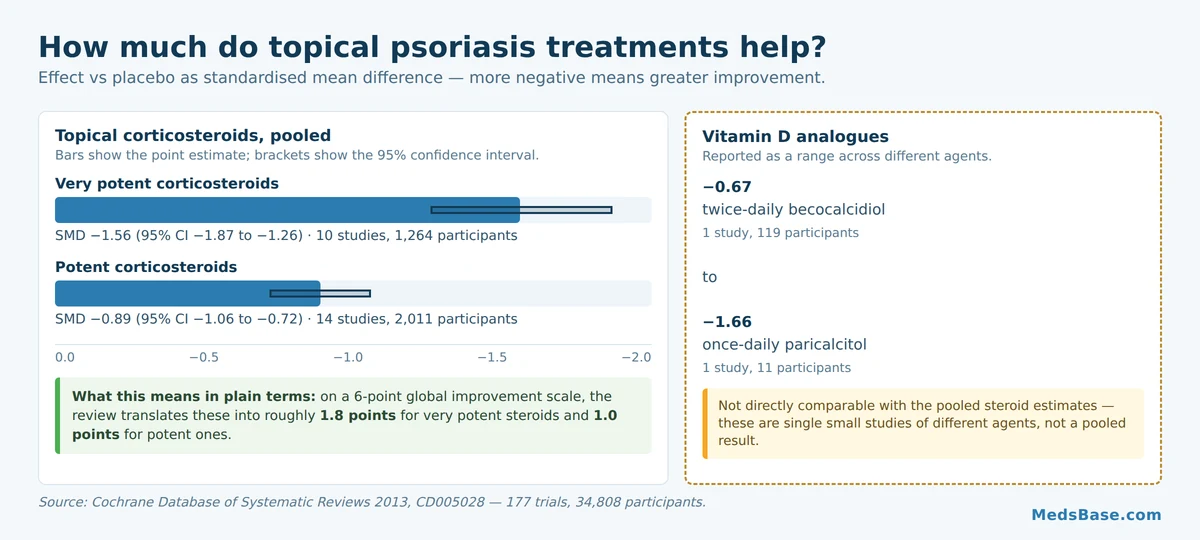
| Same review — corticosteroid potency | 2013 | Potent steroids SMD −0.89 (95% CI −1.06 to −0.72; 14 studies, 2,011 participants); very potent −1.56 (95% CI −1.87 to −1.26; 10 studies, 1,264 participants) | PMID 23543539 |
| Same review — scalp psoriasis | 2013 | On the scalp, vitamin D was significantly less effective than both potent and very potent corticosteroids | PMID 23543539 |
| Global Psoriasis Atlas, The BMJ | 2020 | Adult prevalence 0.14% (east Asia) to 1.99% (Australasia); 81% of countries lack epidemiological data | PMID 32467098 |
What this means for you: on a 6-point global improvement scale, the Cochrane authors translate those effect sizes into roughly 1.0 points of improvement for potent steroids and 1.8 points for very potent ones. That is a real, felt difference — not a statistical curiosity. But it also explains why potency is not a free upgrade: the stronger the agent, the more carefully the duration needs managing.
A note on how fresh this evidence is. The completed Cochrane review dates from 2013, and its authors flagged that trials found in their final 2012 searches would be folded into the next update. That update is now happening — an updated Cochrane network meta-analysis is under way, registered in March 2026, aiming to rank topical treatments directly against each other. It has not reported results yet, so nothing in this article comes from it. When it lands, the ranking between individual agents may sharpen. The core combination finding has been stable across two decades of trials.
Where the evidence is genuinely weaker, it is worth saying so: head-to-head comparisons of vitamin D against potent steroids on the body had mixed findings, and results against dithranol were mixed too. The scalp picture is clear; the body picture is not.
Psoriasis Treatment vs the Alternatives
| Approach | Best for | Evidence strength | Main limitation |
|---|---|---|---|
| Vitamin D + steroid combined | Most plaque psoriasis, body or scalp | Strongest in the topical evidence | Still a daily routine, not a one-off |
| Potent topical steroid alone | Fast control of an active flare | Strong vs placebo | Duration-limited; rebound risk |
| Vitamin D analogue alone | Long-term maintenance, steroid-free | Significant vs placebo on the body | Underperforms on scalp; more irritating |
| Calcineurin inhibitor (steroid-free) | Face, groin, skin folds | Site-specific | Not a first choice for thick body plaques |
| Oral systemic (acitretin, apremilast) | Moderate-to-severe or widespread disease | Established for their indications | Systemic effects; monitoring; pregnancy restrictions |
| Moisturiser alone | Supporting any of the above | Adjunct only | Does not address the immune driver |
Which one fits which situation? If your plaques sit on elbows, knees, trunk or scalp and cover a limited area, the combination product is the evidence-led starting point. If your problem is specifically facial or in skin folds, the steroid-free calcineurin route is the one designed for that. If topicals have genuinely failed across a wide area, that is the point at which an oral option becomes a reasonable conversation — not before.
One more distinction worth drawing, because it sends people down the wrong path for months: psoriasis is regularly mistaken for eczema. They look superficially similar and are treated differently. If you are not certain which you are dealing with, our full guide to the seven types of eczema lays out the differences in appearance and distribution.
How to Use Psoriasis Treatment Properly
So what does this mean for you day to day? Most of the failure cases pharmacists see are not treatment failures — they are application failures.
- Match the agent to the site before anything else. Body, scalp, face and folds are four different problems. Using your body cream on your face is the single most common error.
- Apply to the plaque, not the whole limb. Topicals are dosed for affected skin.
- Give it a fair trial. Vitamin D analogues in particular work gradually. Judging one after four days tells you nothing.
- Do not stop a potent steroid abruptly after a long course. Ask about tapering or a maintenance schedule to reduce rebound risk.
- Keep moisturising alongside treatment, not instead of it. It supports the skin barrier while the active ingredient does the real work.
- Track your triggers. Infections, stress and skin injury are documented triggers. A rough note on your phone beats memory.
- Escalate on a timeline, not on frustration. If a properly used topical has not helped in the timeframe your clinician set, that is information — bring it back rather than layering on more product.
Mistakes to avoid: using a potent steroid on the face or groin; stopping at the first sign of improvement so the plaque returns within a fortnight; assuming a scalp product and a body product are interchangeable; expecting a cure rather than control; and quietly stacking three products at once so that when something works, you have no idea which one it was.
If you want to see what is available across these classes, you can browse the eczema and psoriasis treatments MedsBase stocks — including tacrolimus ointment for the sites where steroids are a poor fit. Worldwide Shipping is available.
- How to fade the marks psoriasis and eczema leave behind — the question that comes after the plaque clears
- The seven types of eczema, and how to tell them apart — for anyone still unsure which condition they have
- The wider skin care range — barrier support and adjunct care
Frequently Asked Questions
Q: What is the best treatment for psoriasis?
A: For most people with plaque psoriasis, the best-evidenced starting point is a vitamin D analogue combined with a topical corticosteroid. The Cochrane review of 177 trials found that combination worked significantly better than either ingredient alone, on both the body and the scalp — and it was tolerated better than vitamin D used by itself. “Best” still depends on where your plaques are, which is why site matters more than brand.
Q: Can psoriasis be cured permanently?
A: No. The NHS states plainly that psoriasis “cannot be cured, but there are treatments to help manage your symptoms.” What is realistic is control: long stretches with clear or nearly clear skin, punctuated by flare-ups that you have a plan for. Anyone promising a permanent cure is selling something the evidence does not support.
Q: How long does psoriasis treatment take to work?
A: It depends on which psoriasis treatment class you are using. Topical corticosteroids act on the immune signal and tend to reduce redness and itch relatively quickly. Vitamin D analogues work on skin-cell turnover and are noticeably more gradual — judging them after a few days is the most common reason people abandon a treatment that would have worked. Follow the timeframe your clinician or the product guidance sets.
Q: What is the strongest cream for psoriasis?
A: Very potent topical corticosteroids produced the largest effect in the Cochrane data — a standardised mean difference of −1.56, against −0.89 for merely potent steroids, or roughly 1.8 versus 1.0 points on a 6-point improvement scale. But strongest is not automatically best. Potency comes with duration limits and site restrictions, and it should never be applied to the face or skin folds by default.
Q: Is psoriasis an autoimmune disease?
A: It is immune-driven. NIAMS describes it as a chronic disease in which the immune system becomes overactive, causing skin cells to multiply too quickly. That is why treatments which calm immune signalling or slow cell turnover work, and why washing, scrubbing or drying the skin does not.
Q: What triggers psoriasis flare-ups?
A: NIAMS names infections — particularly streptococcal and HIV infections — and certain medicines, including some used for heart disease, malaria and mental health conditions. Stress and skin injuries are also identified as common triggers worth managing. Triggers are individual, so a simple log of flares against events is genuinely useful.
Q: Can I use my psoriasis cream on my face?
A: Not if it is a potent steroid, unless a clinician has specifically told you to. Facial and flexural skin is thinner and absorbs more, which raises the risk of thinning and other local effects. This is exactly the situation steroid-free topical calcineurin inhibitors were developed for.
Q: Does psoriasis affect anything besides skin?
A: It can. NIAMS lists psoriatic arthritis, cardiovascular events such as heart attacks and strokes, and mental health problems including low self-esteem, anxiety and depression among the associated risks. If you have joint pain alongside skin symptoms, mention both together — they are often assessed separately when they should not be.
The Bottom Line
Effective psoriasis treatment is less about finding one perfect product and more about matching the right class to the right site, then giving it a fair run. The evidence points somewhere specific and slightly unglamorous: for most plaque psoriasis, a vitamin D analogue combined with a topical corticosteroid outperforms either one alone — and it is easier to tolerate than vitamin D by itself.
The honest verdict: this condition is controllable, not curable, and most people get there with creams rather than tablets. Where the evidence is soft — head-to-head comparisons on the body, long-term skin-thinning rates — this article has said so rather than papering over it.
One thing to do today: work out which site your worst plaques are on, and check that the product you are using is actually intended for that site. Scalp, body, face and folds are four different answers, and a mismatch there wastes more treatment time than any other single mistake.
Still deciding what to try? You can browse the eczema and psoriasis treatments MedsBase stocks — all sourced from WHO-GMP-certified manufacturers, with no prescription needed to order.
Wondering whether it is actually psoriasis at all? Read the seven types of eczema and how to tell them apart. Cleared the plaque but left with marks? Read how to fade the scars psoriasis and eczema leave behind.
Medical disclaimer: This article is for general information and is not medical advice. Psoriasis varies enormously between individuals, and treatment choices depend on where your plaques are, how much skin is involved, your other health conditions and any medicines you already take. Always consult a doctor or pharmacist before starting, stopping or combining treatments — particularly with oral medicines, during pregnancy or when treating a child.

Written by
Sophie ChenPharmaceutical Content Researcher · 8 years experience
Sophie Chen is a pharmaceutical content researcher with 8 years covering generic medication access and clinical pharmacology. She specialises in international regulatory frameworks, bioequivalence standards, and patient-facing education on therapeutic drug classes. She is not a clinician.