








✓ Medically reviewed by · Last reviewed: May 2026
Pharmacy Researcher · 8 years experience
Pharmacy researcher with 8 years reviewing clinical drug information, generic formulation equivalence, and international pharmaceutical standards. Focuses on patient-facing accuracy in medication education.
Most people grab whichever antihistamine is on sale and assume Zyrtec vs Claritin is a coin toss — same job, same result, pick the cheaper box. The clinical data says otherwise. These two are more different than their near-identical marketing suggests, and choosing the wrong one can leave you either still sniffling or unexpectedly drowsy at your desk.
By the end of this guide you’ll know exactly which one fits your day: which works faster, which is genuinely non-drowsy, which is better for stubborn symptoms, and when a third option beats both. We’ll settle it with real numbers, not vibes.
Here’s the twist that trips people up: the “non-drowsy” reputation both drugs share is only half true — and the exception has a name. We’ll get to it in the drowsiness section.
- Zyrtec is cetirizine; Claritin is loratadine — both are second-generation antihistamines, but they behave differently.
- Speed: cetirizine tends to start working a little faster (about 60 minutes vs 75 in one clinical study).
- Drowsiness: loratadine is the genuinely non-drowsy one; cetirizine is the well-known exception that makes more people sleepy.
- Strength: for tougher symptoms, cetirizine often edges ahead — the trade-off for its mild sedation.
- There’s no universal winner: the right pick depends on whether you value speed and strength or zero drowsiness.
Zyrtec vs Claritin: What’s the Difference?
Both drugs do the same core job — block histamine, the chemical behind sneezing, itching, runny nose and hives. Both last about 24 hours, so you take one tablet a day. Both are available as inexpensive generics.
So why does the choice matter? Because the small differences land exactly where daily life happens: how fast you get relief, and whether you feel foggy afterward. If you’re comparing the two generics directly, MedsBase stocks cetirizine as Okacet and loratadine as Loratin — same molecules as the brand names, without the brand markup.
Understanding why they differ starts with a peek at how they reach histamine’s receptors.
How Does Each Antihistamine Work?
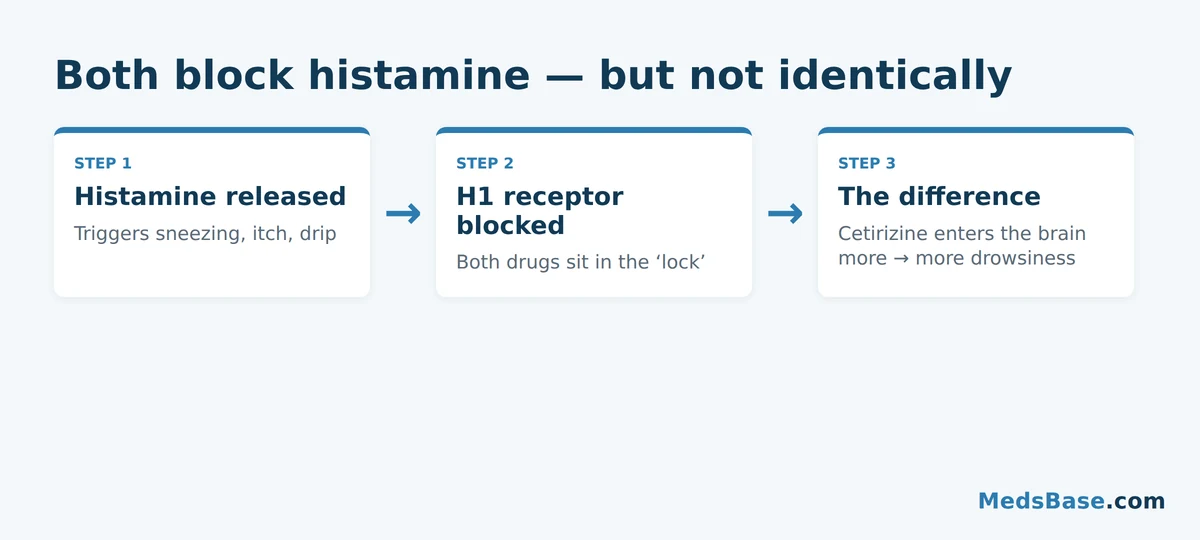
Imagine histamine as a key, and the H1 receptor on your cells as a lock. When histamine turns the lock, you get the sneeze-itch-drip cascade. Both cetirizine and loratadine are “decoy keys” — they sit in the lock without turning it, so histamine can’t get in. That’s the antihistamine effect.
The difference is where else the decoy key travels. Older, first-generation antihistamines crossed easily into the brain, which is why they knocked people out. Second-generation drugs like cetirizine and loratadine were designed to stay out of the brain — hence “non-drowsy.”
But the design isn’t identical. Loratadine is very good at staying out of the brain, so it rarely causes sedation. Cetirizine crosses into the brain slightly more than loratadine does. That small difference is exactly why cetirizine tends to be a touch more effective and a touch more sedating. One property drives both.
So the trade-off is baked into the chemistry: cetirizine’s slight brain penetration buys you strength and speed, at the cost of a higher chance of drowsiness. Keep that lever in mind — it explains almost every practical difference below.
There’s a second layer worth understanding. Both drugs are “long-acting,” meaning a single dose keeps blocking histamine for roughly a full day. But blocking histamine is only part of allergy control. Histamine drives the immediate symptoms — the sneeze, the itch, the sudden runny nose. It does far less for the slow-building congestion that comes from swollen, inflamed nasal tissue. That’s why even the best antihistamine can leave your nose feeling blocked while your sneezing disappears. Neither Zyrtec nor Claritin was ever designed to be a decongestant, and expecting one to clear a stuffy nose is the single most common reason people conclude “this medicine doesn’t work.” It works — just not on that symptom.
One more practical nuance: because both are taken once daily and build steady levels in your system, they reward consistency. An antihistamine taken sporadically, only on your worst days, never reaches its full protective effect. Think of it less like a painkiller you grab when it hurts and more like a daily shield you keep up through your allergy season.
The 6 Key Differences That Matter
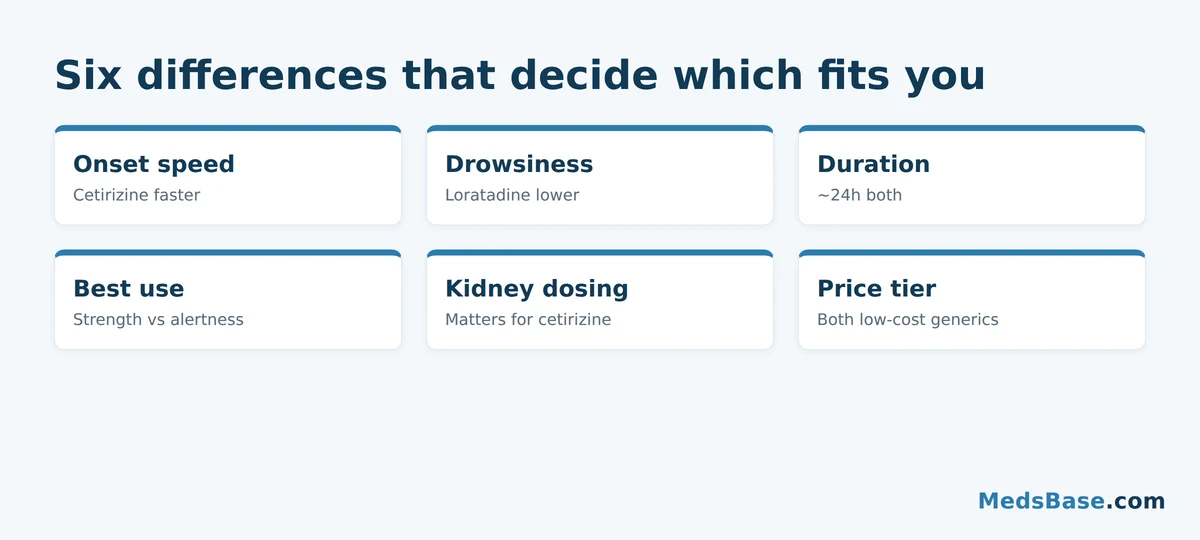
Here are the differences that actually change your choice.
1. Onset speed
Cetirizine tends to kick in a little faster — roughly an hour — while loratadine takes somewhat longer to reach full effect. If you want relief soon, that edge matters.
2. Drowsiness
Loratadine is the more reliably non-drowsy option. Cetirizine causes sedation in a meaningful minority of users — more than loratadine, though still far less than older antihistamines. In practice, this doesn’t mean cetirizine will make you sleepy — many people take it with no drowsiness at all. It means the odds are higher than with loratadine. If you’ve never tried either, a reasonable approach is to test loratadine first (lower sedation risk) and only switch to cetirizine if you need more symptom control. And if cetirizine does make you drowsy, that isn’t a reason to abandon it — simply moving your dose to bedtime often solves the problem entirely while keeping cetirizine’s extra strength.
3. Strength for tough days
For intense sneezing, itch or hives, cetirizine often provides slightly stronger relief. Many people keep it for their worst flare days.
4. Duration
Both last about 24 hours with once-daily dosing, so neither wins here — convenience is a tie.
5. Kidney considerations
Cetirizine is cleared largely by the kidneys, so people with significant kidney impairment may need a lower dose or a different choice. Worth a pharmacist check if that applies to you.
6. When to consider a cousin
If loratadine is too weak but cetirizine makes you sleepy, levocetirizine (Xyzal) — a refined version of cetirizine — or fexofenadine may thread the needle. More on that in the alternatives.
Zyrtec and Claritin: Side Effects & Who Should Be Careful
Both are among the best-tolerated allergy medicines, but “well tolerated” isn’t “side-effect free.”
| Side effect / concern | Cetirizine (Zyrtec) | Loratadine (Claritin) | What to do |
|---|---|---|---|
| Drowsiness | More likely | Less likely | Take at night if it affects you; consider switching |
| Dry mouth | Occasional | Occasional | Sip water; usually mild |
| Headache | Occasional | Occasional | Usually settles |
| Kidney-related dose need | More relevant | Less relevant | Ask a pharmacist if kidney disease |
| Rebound itch on stopping cetirizine | Reported with long daily use | Rare | Taper or switch if severe itch on stopping |
A few honest cautions. If you drive for work or operate machinery, loratadine’s lower sedation risk may matter more than cetirizine’s slight speed edge. In pregnancy or breastfeeding, don’t self-select — ask a clinician which antihistamine is preferred. For children, doses and suitable formulations differ, so check age-appropriate products.
No prescription is needed to order either antihistamine from MedsBase.com — but that freedom makes a 30-second pharmacist question (especially about kidney health, pregnancy or other medicines) a smart move, not a hurdle.
Speed and Drowsiness: What the Data Shows
This is the section that turns opinion into evidence.
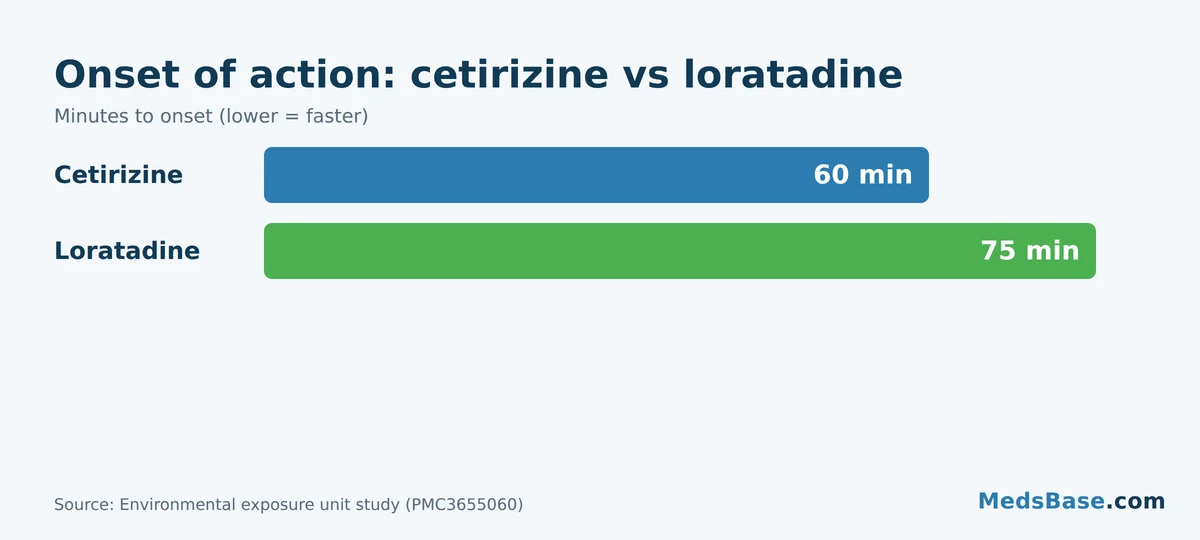
On speed, a controlled environmental-exposure-unit study — where volunteers are exposed to pollen and timed for relief — measured onset of action at about 60 minutes for cetirizine and 75 minutes for loratadine (study). Cetirizine’s roughly 15-minute head start is modest but real.
On drowsiness, the direction is equally consistent. MedlinePlus warns plainly that “[cetirizine] may make you drowsy” and advises caution with driving until you know how it affects you (MedlinePlus). Loratadine, by contrast, lists drowsiness only as an uncommon effect and is generally taken as the non-sedating standard.
| Measure | Cetirizine (Zyrtec) | Loratadine (Claritin) |
|---|---|---|
| Onset of action (EEU study) | ~60 minutes | ~75 minutes |
| Sedation risk | Higher (the class exception) | Lower (reliably non-drowsy) |
| Relative symptom strength | Slightly stronger | Slightly gentler |
| Dosing | Once daily | Once daily |
Zyrtec vs Claritin: Side by Side
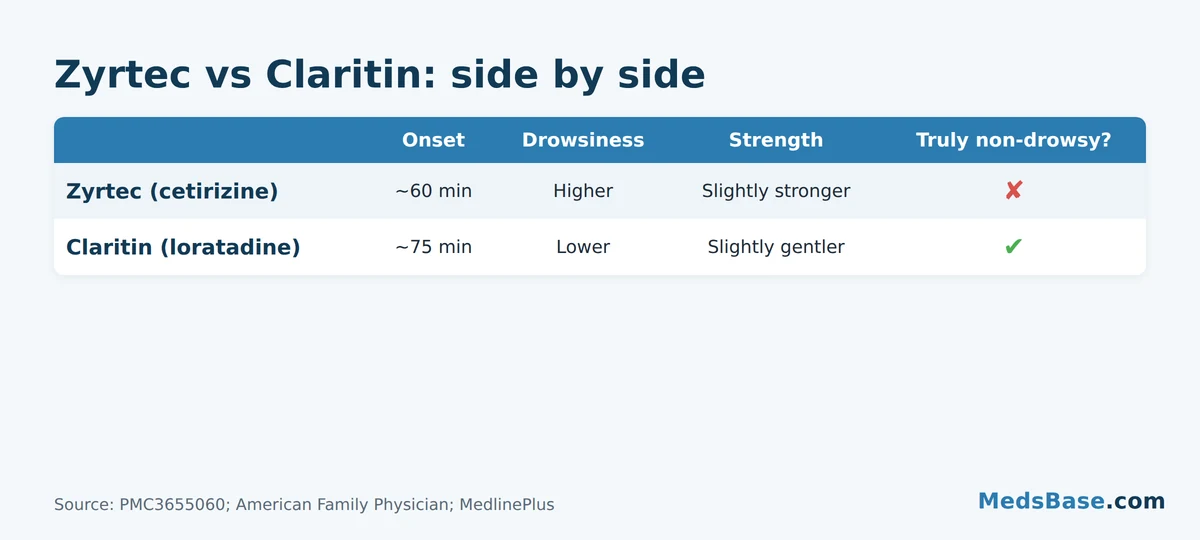
Everything above, distilled into one grid.
| Zyrtec (cetirizine) | Claritin (loratadine) | |
|---|---|---|
| Onset | Faster (~60 min) | Slower (~75 min) |
| Drowsiness | More likely | Less likely |
| Strength for tough symptoms | Slightly stronger | Slightly gentler |
| Truly non-drowsy? | Not fully — the exception | Yes, for most people |
| Kidney dose adjustment | Sometimes needed | Rarely needed |
| Best for | Fast, strong relief; night-time dosing | Daytime alertness; sensitive to sedation |
Which fits which situation? Choose cetirizine (Zyrtec/Okacet) when symptoms are stubborn and you can dose at night, or when speed matters most. Choose loratadine (Claritin/Loratin) when you must stay alert, drive, or simply hate feeling foggy. Still torn, or finding neither is quite right? Browse the wider hay fever and allergy range — fexofenadine (Allegra) and levocetirizine (Xyzal) each occupy a useful middle ground.
Beyond Zyrtec and Claritin: Your Other Options
The Zyrtec vs Claritin debate is really just the two most famous members of a bigger family. If neither fits perfectly, three near neighbours are worth knowing.
Fexofenadine (Allegra) — the alert one
Fexofenadine is arguably the least sedating second-generation antihistamine of all — it barely crosses into the brain. That makes it a strong pick if loratadine isn’t quite controlling your symptoms but cetirizine’s drowsiness rules it out. One quirk: fruit juices (orange, apple, grapefruit) can reduce its absorption, so take it with water. It’s fast-acting and a favourite for people who need both strength and a clear head.
Levocetirizine (Xyzal) — refined cetirizine
Cetirizine is actually a mix of two mirror-image molecules; only one does most of the antihistamine work. Levocetirizine (Xyzal) is that active half, isolated. The idea is similar strength to cetirizine at a lower dose, potentially with a touch less drowsiness for some people — though it can still cause sedation. It’s a sensible “step” if cetirizine works but feels a little heavy.
When no tablet is the answer
Here’s the honest limit of this entire comparison: all oral antihistamines are relatively weak against a blocked, congested nose. If your dominant symptom is stuffiness rather than sneezing and itch, switching between Zyrtec and Claritin is rearranging deck chairs. The more effective move is adding a steroid nasal spray, which targets the underlying inflammation antihistamines can’t reach. Our companion guide walks through exactly when to make that jump.
What about hives, itch and other uses?
Both cetirizine and loratadine are licensed not only for hay fever but for chronic hives (urticaria) and general allergic itch. For persistent hives, clinicians often favour cetirizine or levocetirizine for their slightly stronger antihistamine punch, and sometimes use higher-than-hay-fever doses under supervision. For everyday itch from mild allergic reactions, either works well. The same speed-versus-drowsiness trade-off applies: cetirizine tends to calm intense itch faster, loratadine keeps you clear-headed.
How to Use Zyrtec vs Claritin Properly
The right tablet still needs the right habits.
- Take it once daily, consistently. Both work best as a steady daily dose during your allergy season, not only after symptoms spike. Per MedlinePlus, loratadine is taken once a day with or without food; cetirizine is the same.
- Time cetirizine to your schedule. If cetirizine makes you drowsy, take it in the evening so any sedation happens while you sleep.
- Don’t double up randomly. Taking Zyrtec and Claritin together isn’t a standard strategy and mostly adds side effects, not benefit — ask a pharmacist before combining antihistamines.
- Give it a fair trial. Judge a tablet over several days of consistent use, not one dose.
- Pair with the right partner. Antihistamines are weak against nasal congestion; if a blocked nose is your main problem, a steroid nasal spray does more — which is exactly the ladder we lay out in the companion guide below.
Mistakes to avoid: switching brands daily “to see which is better” (give each a few days), assuming cetirizine can’t cause drowsiness because it’s “non-drowsy,” and using either tablet to fight congestion it was never strong at.
Zyrtec vs Claritin: A 3-Question Decision Guide
Still can’t decide? Answer these three questions and the choice usually makes itself.
1. Will you be driving, working, or studying while it’s active? If yes, lean loratadine (Claritin) — its lower sedation risk protects your focus. If you’re home, or you can take it before bed, cetirizine’s drowsiness matters less.
2. How stubborn are your symptoms? For mild, occasional sneezing and itch, either works and loratadine’s clean profile wins. For intense, hard-to-shift itch or hives, cetirizine (Zyrtec) often brings faster, firmer relief.
**3. Is your worst symptom a blocked nose?** If so, stop comparing tablets — the honest answer is that neither will fully fix congestion. Add a steroid nasal spray instead, and use whichever antihistamine you prefer for the sneeze-and-itch layer.
Notice that only questions 1 and 2 actually separate Zyrtec from Claritin. Question 3 is the trap most shoppers fall into: reaching for a different antihistamine when the symptom needed a different drug class entirely. Get those three answers straight and you’ll rarely buy the wrong box again.
For anyone whose allergies span sneezing, itch and congestion — which is most people at the season’s peak — the smartest setup is often a daily nasal steroid as the anchor, plus your preferred antihistamine on the worst days. That layered approach beats endlessly swapping tablets, and it’s exactly the ladder our companion guide lays out step by step.
- How to treat seasonal allergies: the full relief ladder — today’s companion guide, from avoidance to nasal sprays.
- Cetirizine (Okacet) and loratadine (Loratin) — compare the two generics directly.
- Levocetirizine (Xyzal) — the refined cetirizine, if you want strength with less sedation.
Frequently Asked Questions
Q: Is Zyrtec or Claritin better for allergies?
A: Neither is universally better — they suit different priorities. Zyrtec (cetirizine) works slightly faster and is a bit stronger for tough symptoms, but is more likely to cause drowsiness. Claritin (loratadine) is the more reliably non-drowsy option, at a marginally slower onset. Pick based on whether speed and strength or all-day alertness matters more to you.
Q: Which works faster, Zyrtec or Claritin?
A: Zyrtec (cetirizine) tends to work a little faster. In a controlled clinical study, cetirizine reached its onset of action at about 60 minutes versus about 75 minutes for loratadine. The difference is modest — roughly 15 minutes — but real if you want relief sooner.
Q: Does Zyrtec make you more drowsy than Claritin?
A: Yes, on average. Both are second-generation “non-drowsy” antihistamines, but cetirizine is the well-known exception that causes sedation in more people than loratadine does. It’s still far less sedating than older antihistamines. If drowsiness is a dealbreaker, loratadine is usually the safer choice.
Q: Can I take Zyrtec and Claritin together?
A: It’s not a standard approach. Taking two antihistamines from the same class together mostly increases side effects rather than relief. If one isn’t controlling your symptoms, it’s better to switch, add a different type of treatment like a nasal steroid, or ask a pharmacist — not stack the two.
Q: Is cetirizine stronger than loratadine?
A: Some studies suggest cetirizine produces slightly greater symptom relief, especially for intense itch and hives. That extra strength comes from the same property that makes it a bit more sedating — it reaches its targets slightly more readily. For many people the difference is small; for tough symptoms it can be noticeable.
Q: What if neither Zyrtec nor Claritin works well for me?
A: If loratadine feels too weak but cetirizine makes you sleepy, consider levocetirizine (a refined form of cetirizine) or fexofenadine, which is fast and very low-sedation. Persistent congestion often needs a steroid nasal spray rather than any tablet. If symptoms still won’t settle, see a clinician about combination treatment or immunotherapy.
Q: Does it matter what time of day I take Zyrtec or Claritin?
A: For loratadine, timing rarely matters much since it seldom causes drowsiness — take it whenever you’ll remember. For cetirizine, if you’re prone to its sedating effect, taking it in the evening means any grogginess happens overnight rather than during your day. Otherwise, both provide about 24 hours of cover, so the most important thing is simply taking it at the same time each day for steady protection.
Q: Are the generic versions (Okacet, Loratin) as good as the brands?
A: Yes. Okacet contains the same cetirizine as Zyrtec, and Loratin contains the same loratadine as Claritin, at the same strengths. Generic antihistamines must meet the same quality and bioequivalence standards as the brand-name originals — you’re paying for the molecule, not the box. Choosing a generic is one of the simplest ways to cut the cost of allergy season without changing what you actually take.
The Bottom Line: Zyrtec vs Claritin
Here’s the verdict on Zyrtec vs Claritin: there’s no single winner, only a better match for you. Cetirizine (Zyrtec) is the faster, slightly stronger option — with a real chance of drowsiness that makes evening dosing smart. Loratadine (Claritin) is the dependable non-drowsy choice for anyone who has to stay sharp. Same price tier, different personalities.
Your one immediate action: decide your top priority in a word — “fast” or “focused.” If it’s fast, reach for cetirizine; if it’s focused, choose loratadine. That’s the whole decision, made in five seconds.
Two natural next reads: if a blocked nose is your real enemy, tablets aren’t the answer — see how to treat seasonal allergies for the full relief ladder; and to compare the exact generics, view cetirizine (Okacet) and loratadine (Loratin) side by side.

Written by
Sophie ChenPharmaceutical Content Researcher · 8 years experience
Sophie Chen is a pharmaceutical content researcher with 8 years covering generic medication access and clinical pharmacology. She specialises in international regulatory frameworks, bioequivalence standards, and patient-facing education on therapeutic drug classes. She is not a clinician.