








✓ Medically reviewed by · Last reviewed: May 2026
Pharmacy Researcher · 8 years experience
Pharmacy researcher with 8 years reviewing clinical drug information, generic formulation equivalence, and international pharmaceutical standards. Focuses on patient-facing accuracy in medication education.
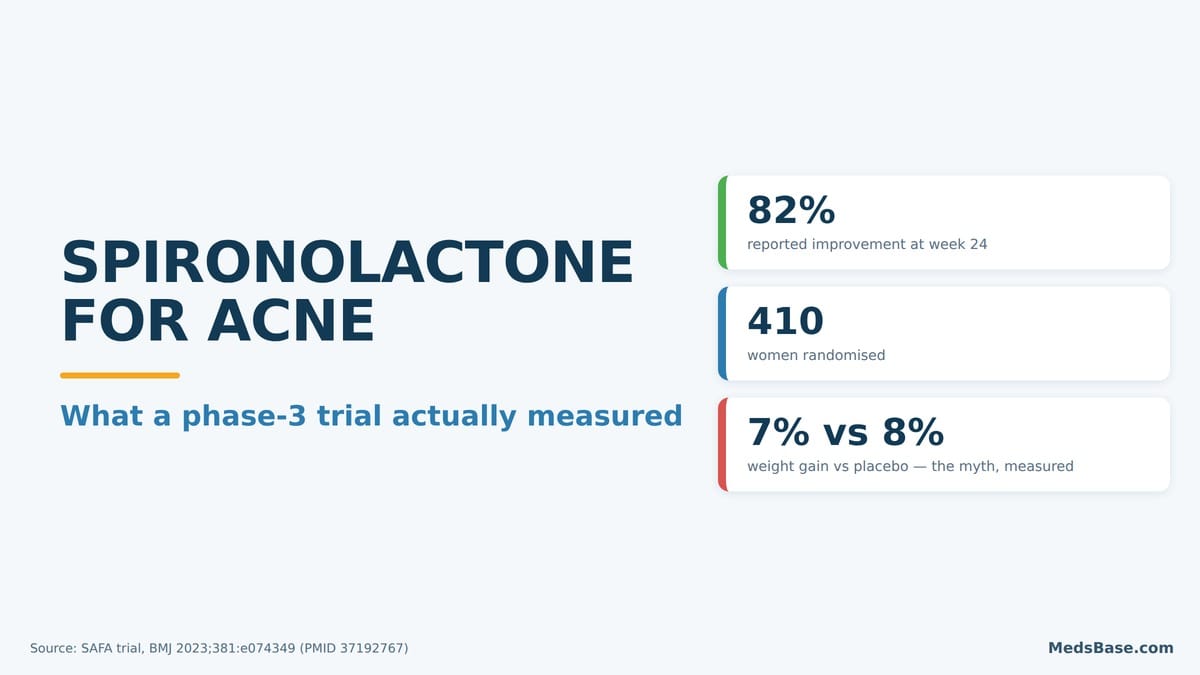
Most people believe spironolactone for acne makes you gain weight. The strongest research on the drug says otherwise: in a placebo-controlled trial of 410 women, weight gain was reported by 7% of the women taking spironolactone and 8% of the women taking a dummy tablet. The rumour is real. The effect, at acne doses, was not.
That comparison tells you something about this whole subject. Almost everything circulating about the drug comes from women describing their own experience rather than from studies that compared it against nothing. Some of it holds up. Some collapses the moment a placebo group exists.
So this article does what the marketing pages do not. It reports the actual trial numbers, says where the evidence is thin, and gives you the comparison against isotretinoin you were probably looking for. You will also find out why the trial’s week-12 and week-24 results tell two different stories — and why that gap is the most practical thing here.
One promise up front: there is a straight answer on blood tests, and it is not the answer most sites give you.
- Spironolactone for acne is used off-label almost everywhere — the FDA-approved label does not mention acne once. That is not a red flag, but you deserve to know it.
- In the SAFA trial, 82% of women reported improvement by week 24 versus 63% on placebo — but at week 12 the difference was small enough to be unconvincing. Timing changes the verdict.
- Weight gain and irregular periods were no commoner than placebo. Headache was. The side-effect profile is not the one the internet describes.
- Routine potassium blood tests may be unnecessary in healthy young women — there is published evidence on exactly this population, with limits you should know.
- It is maintenance therapy, not a course. Stop the tablet and the benefit fades. Isotretinoin is the option that behaves differently.
What spironolactone actually is
Spironolactone is an old blood-pressure and heart-failure tablet that turned out to block androgen receptors as a side activity. Dermatologists borrowed it for that side activity. Used for skin, it lowers the hormonal signal that drives your oil glands, which is why it helps the acne pattern that sits along your jawline and chin.
Why it is still off-label
Here is a fact you can check yourself. Search the FDA-approved label on DailyMed for the word “acne” and you get zero hits. The approved indications are heart failure, high blood pressure, fluid retention in liver disease or nephrotic syndrome, and primary hyperaldosteronism. Acne is not among them.
So every time a clinician uses spironolactone for acne, they are prescribing outside the licensed indications. That is ordinary medical practice — a large share of dermatology runs this way — and both US and European acne guidelines already recognise a role for the drug in women. But pages that quietly skip the detail do you a disservice, because off-label status is exactly why the monitoring advice online is so inconsistent. The label’s instructions were written for heart-failure patients, not for a healthy 28-year-old with jawline spots. Hold that thought; section four resolves it.
What this page is not about. Two adjacent questions are answered elsewhere on this site. If you saw the drug mentioned for thinning hair, that is a different indication with different dosing logic — read why the same drug is used for hair thinning in women. If you already take a combined oral contraceptive and want to know whether it should be clearing your skin alone, start with whether the combined pill clears acne on its own. This page stays on one job: the anti-androgen, for acne.
How it works on acne
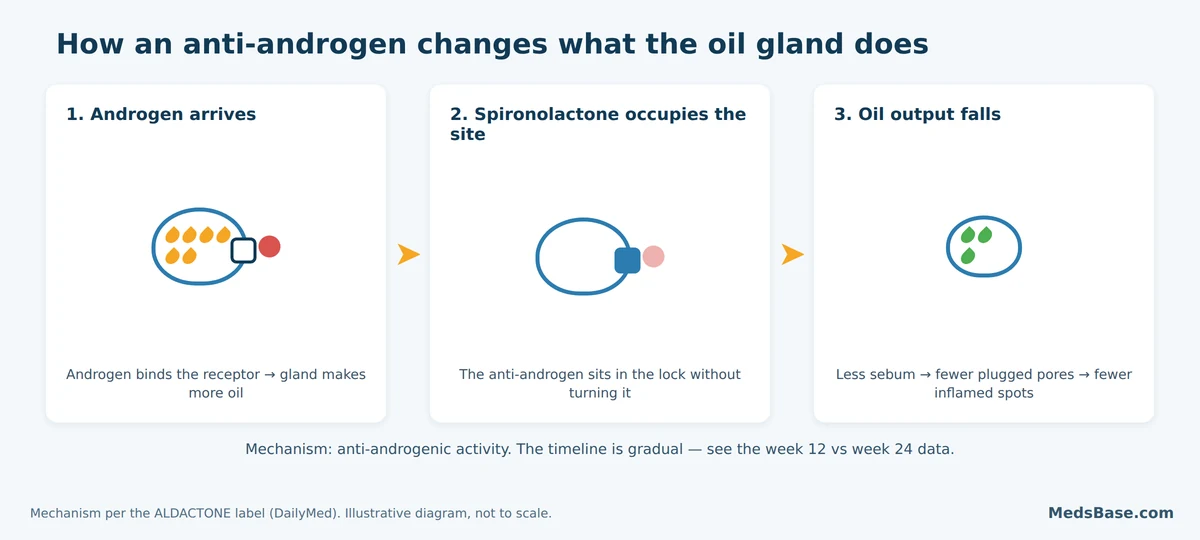
Your oil glands carry receptors that respond to androgens — testosterone and its more potent relative. When an androgen docks into one, the gland is instructed to produce more sebum. More sebum means more plugged pores, more food for the bacteria living in them, and more of the deep, tender bumps that take a fortnight to settle.
Picture the receptor as a lock on the side of the gland. Androgens are the key that turns it. Spironolactone is a key cut to the same shape that slides in and simply sits there, occupying the space without turning anything. The FDA label calls this the drug’s anti-androgenic properties — the same property that makes the pregnancy warning non-negotiable.
Two consequences follow, and both matter to you.
First, it is slow. You are not switching off inflammation; you are turning down a production line. Glands already loaded with oil have to empty, existing lesions have to heal, and new ones have to stop forming. That takes months.
Second, it does not fix your hormones. Your androgen levels are not the target — the receptor is. That is why the benefit is not permanent. Remove the blocking key and the original key works again.
One honest caveat. The mechanism above is well established, but nobody has shown that measured androgen levels predict who responds. Response tracks the pattern of the acne better than any blood test does — which is what the next section is about.
Who spironolactone for acne works best for
Jawline acne and the hormonal pattern
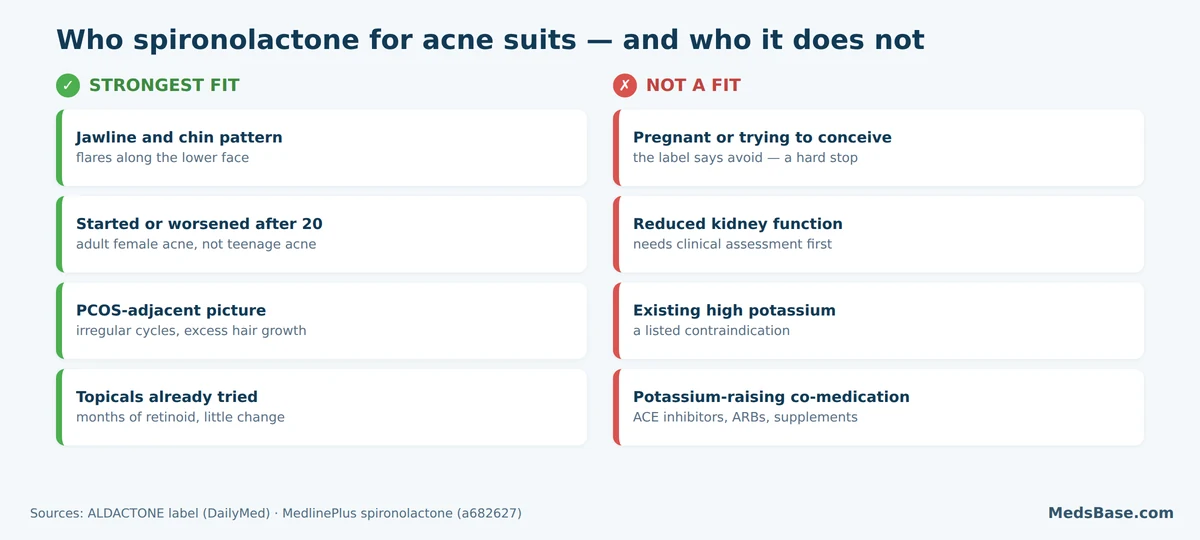
If you drew a line from ear to chin along your jaw and your worst spots sat on it, that is the distribution most associated with an androgen-driven picture. The lesions tend to be deep and tender rather than surface whiteheads, they often arrive on a monthly rhythm, and they clear more slowly than the spots you had at sixteen. This is the pattern that responds best.
Adult female acne that started after 20
Teenage acne and adult female acne are not the same problem wearing different clothes. Acne that appears or worsens in your twenties and thirties, in someone who had clear skin as a teenager, behaves and responds differently. The SAFA trial’s average participant was 29 — exactly the population the strongest evidence covers.
PCOS-adjacent presentations
Irregular cycles, excess hair growth in a male pattern, or a diagnosis of polycystic ovary syndrome all raise the likelihood that androgens are involved in your skin, which makes an anti-androgen a mechanistically sensible choice. Note that the drug treats the skin, not the syndrome — the wider condition needs its own conversation with a clinician.
Acne that has shrugged off topicals
Pharmacists commonly see the same sequence: benzoyl peroxide, then a topical retinoid, then months of patient application, then a face that looks broadly the same. If you have genuinely used a retinoid nightly for twelve weeks and the deep jawline lesions kept coming, that is information, not failure. It suggests the problem sits upstream of the pore surface — which is where an oral anti-androgen acts.
Take Priya, 28 — an illustrative example, not a real patient. Clear skin until 24. Now four to six deep bumps along the jaw every month, worse the week before her period, unchanged after five months of a nightly retinoid. Pattern, age, timing and treatment history all point the same way, and she is the archetype the SAFA evidence was generated in. If that reads like your own history, you can see what oral spironolactone options look like — but read the next section first, because the timeline is the part people get wrong.
Dosing, timeline and side effects
Spironolactone dosage: what the trials actually used
The SAFA protocol is the clearest published guide, because it is what was tested rather than what is customary. Participants took 50 mg daily to week six, then increased to 100 mg daily through week 24. More than 95% tolerated the increase and reached the higher dose. Tablets are commonly available as 25 mg, 50 mg and 100 mg.
Starting low and stepping up is not caution theatre — it is how the tolerability in that data was achieved. Note also that the increase came at six weeks, before anyone expected the skin to have changed, so early impatience is built into the schedule rather than a sign of failure.
Spironolactone side effects measured against a placebo
This is where a placebo group earns its keep. In SAFA, 64% of women on spironolactone reported at least one adverse reaction versus 51% on placebo — a real difference, driven mainly by headache and dizziness. But most individual complaints occurred at similar rates in both groups, which means most were not caused by the drug.
| Side effect | Frequency (spironolactone vs placebo, SAFA) | Severity | What to do |
|---|---|---|---|
| Headache | 20% vs 12% (p=0.02) | Mild, usually settles | The one clearly linked to the drug. Take with food, keep fluids up; raise it if it persists past a few weeks. |
| Increased urination | 31% vs 25% | Nuisance, not dangerous | Expected — it is a diuretic. Take your dose in the morning, not at bedtime. |
| Breast tenderness | 20% vs 18% | Mild | Reported almost as often on placebo. Mention it if it becomes painful rather than tender. |
| Dizziness or light-headedness | 19% vs 12% | Mild | Stand up slowly for the first fortnight. Persistent dizziness warrants a blood-pressure check. |
| Breast enlargement | 15% vs 12% | Mild | No significant difference from placebo here. Worth reporting if it is marked. |
| Reduced libido | 8% vs 5% | Variable | Not significantly different from placebo, but real for some. Worth naming rather than tolerating silently. |
| Weight gain | 7% vs 8% | — | Reported slightly less often on the drug than on placebo. No action needed. |
| Irregular periods (weeks 12–24) | 32% vs 35% | — | Also no commoner than placebo, which contradicts the usual warning. Higher doses may differ. |
| Serious adverse reactions | None identified | — | None related to study medication were reported over 24 weeks. |
There is the resolution of the opening promise. The weight-gain fear that dominates every comment thread was measured directly, against a placebo, in 410 women — and it did not appear. Neither did the menstrual disruption the drug is routinely blamed for, at these doses. Headache did. That is a very different risk conversation from the one you have probably been having with yourself.
One wider caution belongs here. MedlinePlus drug information for spironolactone opens by warning that the drug has caused tumours in laboratory animals and advising you discuss risks and benefits with a doctor. That finding comes from high-dose rat studies and sits in the non-clinical toxicology section of the current FDA label rather than in a boxed warning — but it is a real part of the record, and you should weigh it rather than have it hidden from you.
The potassium monitoring question, answered
The open loop from section one closes here. Spironolactone raises potassium; that is not in dispute. The label instructs that serum potassium be checked within one week of starting and regularly after. What most pages fail to tell you is that the instruction was written for people treated for heart failure, cirrhosis and hypertension — often elderly, often with impaired kidneys, often already on other drugs that raise potassium.
Healthy young women with acne are a different population, and somebody measured it. A retrospective study of 974 healthy young women taking spironolactone for acne, published in JAMA Dermatology, found 13 abnormal potassium readings across 1,802 measurements — a rate of 0.72%. The background rate in a comparison group of 1,165 young women was 0.76%. The readings were no more frequent than they would have been without the drug. When 6 of the 13 were retested they came back normal, suggesting some were laboratory noise. The authors concluded that routine monitoring is unnecessary in this population.
What the research says about spironolactone for acne
| Study | Year | Finding | Source |
|---|---|---|---|
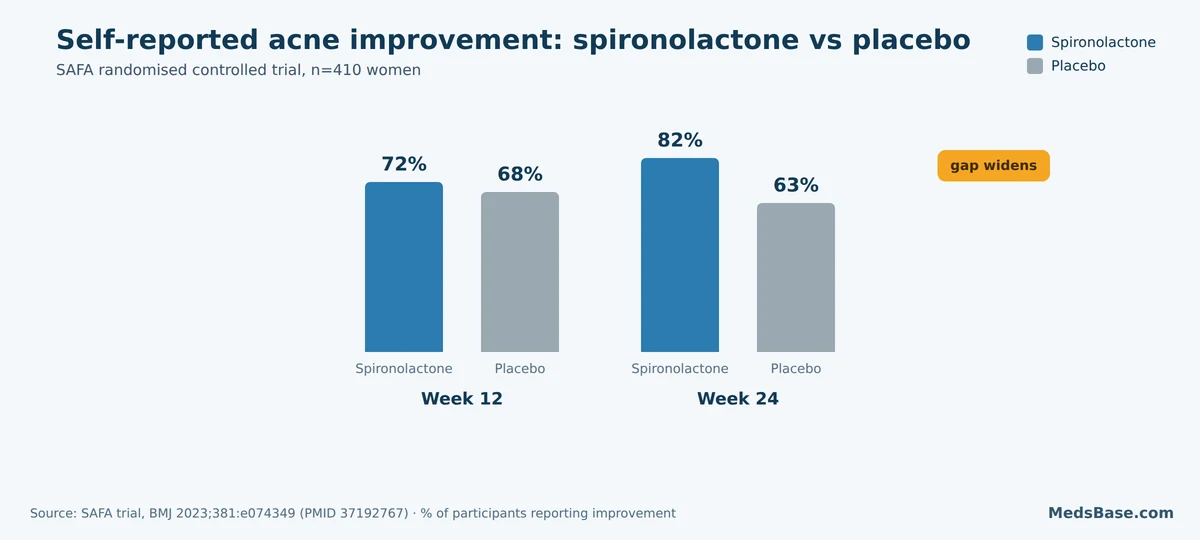
| SAFA — pragmatic phase-3 double-blind RCT, 410 women, England and Wales | 2023 | Investigator-rated treatment success at week 12: 19% on spironolactone vs 6% on placebo (odds ratio 5.18, 95% CI 2.18–12.28). Self-reported improvement: 72% vs 68% at week 12 (not significant) and 82% vs 63% at week 24 (OR 2.72, 95% CI 1.50–4.93). No serious adverse reactions. | BMJ 2023, PMID 37192767 |
| Systematic review and meta-analysis with trial sequential analysis, 563 patients across 5 randomised placebo-controlled trials | 2025 | Objective acne improvement roughly sixfold higher with spironolactone (OR 6.59, 95% CI 3.50–12.43, I²=0%). Menstrual irregularity (OR 1.09) and breast enlargement (OR 1.37) not significantly increased. Trial sequential analysis indicated the required sample size had been reached. | J Cosmet Dermatol 2025, PMID 40823723 |
| Retrospective analysis of potassium monitoring in 974 healthy young women on spironolactone for acne | 2015 | Hyperkalaemia rate 0.72% vs a 0.76% background rate in 1,165 comparison women. Authors concluded routine potassium monitoring is unnecessary in this population. | JAMA Dermatol 2015, PMID 25796182 |
| FDA-approved product label (ALDACTONE), revised 11/2025 | 2025 | Acne is not a licensed indication. Contraindicated in hyperkalaemia, Addison’s disease and with concomitant eplerenone. Pregnancy section advises avoiding the drug in pregnancy because of the risk to a male fetus. | DailyMed, NIH/NLM |
What this means for you. Look again at the two SAFA timepoints, because this is the promised payoff. At week 12, 72% of women on the drug felt improved — and so did 68% on a sugar pill. That is close to nothing. By week 24 it was 82% against 63%. The drug did not suddenly start working; the placebo group simply stopped catching up. Judge this treatment at three months and you will probably conclude it did nothing. The evidence says the decision point is six months. That reframe is worth more to you than any dosing chart.
Two honesty notes. Investigator-rated success at week 12 was only 19%, meaning four out of five women were not close to clear at that point even on the drug. And the 2025 meta-analysis found strong agreement between trials on objectively rated improvement (I²=0%) but wide disagreement on patient-rated improvement (I²=85%, pooled result not statistically significant). The gap between what a doctor scores and what a woman sees in her own mirror is not fully explained, so anyone describing a settled, uniform effect is overselling it. Those authors nonetheless argued the evidence is now strong enough that acne should be promoted from off-label use to a formally recommended option — a position, not a fact, but a well-supported one.
Spironolactone for acne vs the alternatives
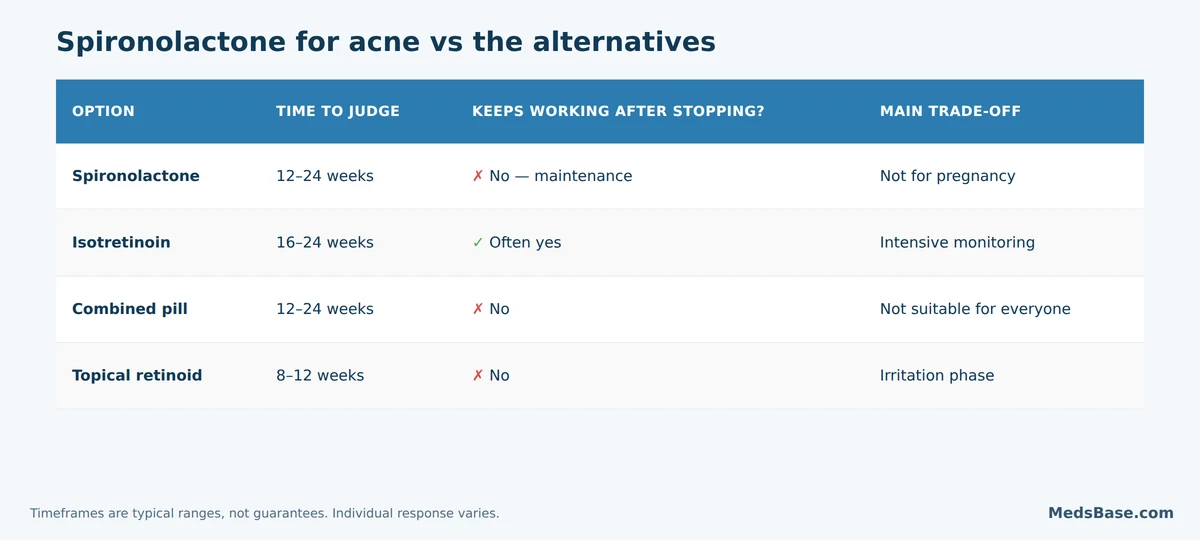
Nobody writes this comparison plainly, so here it is.
| Option | How it works | Time to judge it | Keeps working after you stop? | Main trade-off |
|---|---|---|---|---|
| Spironolactone | Blocks androgen receptors, reducing oil production | 12–24 weeks | No — benefit fades; this is maintenance | Cannot be used in pregnancy; needs an honest 6-month commitment |
| Isotretinoin | Shrinks oil glands and alters skin cell turnover | 16–24 weeks for a full course | Often yes — many people stay clear long after finishing | Far more intensive: strict pregnancy prevention, dryness, mood monitoring, regular review |
| Combined oral contraceptive | Raises the protein that binds free testosterone | 12–24 weeks | No | Not suitable for everyone; a separate decision with its own risk profile |
| Topical retinoid | Normalises how pore linings shed | 8–12 weeks | No | An irritation phase most people underestimate; limited effect on deep jawline lesions |
| Oral antibiotic | Reduces bacteria and inflammation | 6–12 weeks | No | Not intended for long-term use; contributes to antibiotic resistance |
Spironolactone for acne vs isotretinoin: the honest decision path
These two options are not competing on effectiveness. They are competing on what kind of commitment you want.
Isotretinoin is a defined course with an endpoint. You take it for a set period, it is demanding while you do, and a substantial proportion of people stay clear afterwards without further treatment. It requires strict contraception and regular monitoring, and it is the appropriate choice for severe, scarring or nodular acne.
Spironolactone is the opposite shape. It is easier day to day, has no course length, and stops working when you stop it. That makes it a good fit for persistent moderate acne you expect to manage over years rather than defeat in one campaign.
So the decision path is short:
- Scarring, nodular or severe acne, and you want a shot at a durable end? Isotretinoin is the conversation to have. If you are unsure how that differs from the cream with a similar name, read how isotretinoin and tretinoin differ before you decide anything.
- Moderate, jawline-pattern, cyclical acne, and daily simplicity matters more than a finish line? Spironolactone for acne fits that brief better.
- Already on the combined pill with partial improvement? Adding an anti-androgen is a recognised next step rather than a duplicate — but it is a conversation to have with a clinician, because the two act on the same hormonal axis by different routes.
- Might you be pregnant in the next year? Neither of these two is the right starting point. That conversation needs a clinician and a topical-first plan.
How to use it — practical guidance
- Check your own contraindication list first. Pregnancy, breastfeeding or trying to conceive, kidney impairment, a known raised potassium, or any potassium-raising medicine — including ACE inhibitors, angiotensin-receptor blockers, potassium-sparing diuretics and potassium supplements. If any apply, ask a doctor or pharmacist before you start, not after.
- Start low. The tested schedule is 50 mg daily for the first six weeks. Beginning at the top dose buys you side effects, not speed.
- Take it in the morning. It is a mild diuretic. Evening doses buy you night-time trips to the bathroom for no clinical benefit.
- Step up at around six weeks if you are tolerating it, to 100 mg daily. In the trial, over 95% of women managed this.
- Keep using your topical. SAFA participants continued topical treatment throughout, so the evidence describes a combination, not a replacement. If you want to see what oral spironolactone options look like alongside what you already use, check what forms and strengths are available before you commit to a routine.
- Photograph your face on day one. Same light, same angle, once a fortnight. Gradual improvement is nearly invisible in a mirror and obvious in a photo sequence.
- Diarise a six-month review, not a six-week one. Put the date in your phone now.
- Use reliable contraception throughout if there is any chance of pregnancy. This is the one non-negotiable.
- Quitting at week 8. The trial’s own week-12 data barely beat placebo. You are abandoning it before the evidence says to look.
- Expecting your hormone levels to change. They do not. The receptor is blocked; the hormones carry on.
- Assuming a purge means it is working. Unlike topical retinoids, there is no established purging phase here. New deep lesions in month three are worth mentioning, not enduring.
- Treating it as a course. Stop and the benefit recedes over the following months. Plan for maintenance from day one, or choose a different option.
- Ignoring a potassium-raising co-medication because “young women don’t need testing”. The reassuring data came from women who had none. You may not be in that group.
- Skipping contraception because the drug is “just for skin”. The anti-androgen effect does not know why you are taking it.
Related reading
- How isotretinoin and tretinoin differ — the two most-confused names in acne treatment, and why the choice between them is not a matter of strength.
- Whether the combined pill clears acne on its own — if you are already taking one and your skin has only partly settled, start here.
- Why the same drug is used for hair thinning in women — the sibling indication, with its own dosing logic and evidence base.
Frequently asked questions
Q: How long does spironolactone for acne take to work?
A: Plan on judging it at six months, not three. In the SAFA trial, self-reported improvement at week 12 was 72% on the drug versus 68% on placebo — barely a difference. By week 24 it was 82% versus 63%. Investigator-rated success at week 12 reached only 19%. Some women notice fewer new deep lesions by week 8, but the evidence-based review point is month six.
Q: Does spironolactone cause weight gain?
A: At acne doses, the placebo-controlled evidence says no. In SAFA, weight gain was reported by 7% of women on spironolactone and 8% on placebo — slightly less common on the drug. What you may notice early is fluid shifting, because it is a mild diuretic, which can make the scale move in either direction for a week or two before settling. The persistent-weight-gain reputation is not supported by the trial data.
Q: Do you need blood tests or potassium monitoring on spironolactone?
A: Possibly not, if you are otherwise healthy. A retrospective study of 974 healthy young women taking it for acne found abnormal potassium in 0.72% of measurements against a 0.76% background rate, and its authors concluded routine monitoring is unnecessary in that group. But it excluded women with kidney or cardiovascular disease or potassium-raising medication, and the label still advises checking. If you have any kidney history, take an ACE inhibitor or ARB, or do not know your baseline, ask a clinician about one test before starting.
Q: Can you take spironolactone if you are pregnant or trying to conceive?
A: No — this is the firmest limit on the drug. The FDA-approved label advises avoiding spironolactone in pregnancy because its anti-androgenic action carries a potential risk to a male fetus, with rat studies showing feminisation of male fetuses after exposure in the womb. If you are pregnant, breastfeeding or actively trying to conceive, this is not the right treatment, and you should discuss alternatives with a doctor or pharmacist. Use reliable contraception the whole time you take it.
Q: Should you choose spironolactone for acne or isotretinoin?
A: It depends on the shape of commitment you want rather than on which is stronger. Isotretinoin is a demanding fixed course that often keeps working after you finish, and it is the right answer for severe, nodular or scarring acne. Spironolactone is gentler day to day but is maintenance therapy with no endpoint — better suited to persistent moderate jawline acne you expect to manage for years. Discuss which fits your acne and your plans with a clinician.
Q: What happens if you stop taking spironolactone?
A: The benefit fades. You are blocking a receptor, not resetting your hormones, so once the drug clears, androgens reach those receptors again and oil production climbs back toward where it started. Most women see gradual return of breakouts over the following months rather than an overnight rebound. This is the single most important difference from isotretinoin, and the reason to decide up front whether you are willing to take a daily tablet indefinitely.
Q: Does it help hormonal hair thinning at the same time?
A: The same drug is used for female pattern hair loss, and some women are treated for both at once — but it is a genuinely separate indication, with its own dosing logic, its own evidence base and a much longer timeline before anything is visible. Do not assume an acne dose will address hair. We cover that indication properly in a dedicated article rather than as a footnote here.
Q: Is spironolactone safe to take for years?
A: The honest answer is that the high-quality randomised evidence runs to 24 weeks, so long-term use is supported by clinical experience and observational data rather than by trials. No serious adverse reactions related to study medication were reported in SAFA. Against that, the FDA label reports tumours in high-dose animal studies, which MedlinePlus surfaces as an important warning. Long-term use is common and generally considered reasonable, but it deserves a periodic review with a clinician rather than an indefinite repeat.
The bottom line on spironolactone for acne
Spironolactone for acne is neither the breakthrough the telehealth funnels imply nor the hormonal gamble the comment sections warn about. It is an old, cheap, off-label tablet with one large randomised trial and a 2025 meta-analysis behind it, a genuine effect that becomes convincing around the six-month mark, a side-effect profile that turned out to be milder than its reputation once a placebo group was involved, and one absolute limit around pregnancy. Its real cost is not risk — it is open-endedness. Stop taking it and the benefit goes with it.
If the pattern in §3 described your face, the single most useful thing you can do today costs nothing: photograph your jawline in consistent light and write “review this” in your calendar for six months from now. That baseline is what turns a vague sense of “I don’t think it’s working” into an actual decision. Then talk to a doctor or pharmacist about whether an anti-androgen suits your kidney function, your medication list and your plans for the next year — and if you want to see the whole field first, compare the topical treatments worth pairing with it, since the trial evidence describes spironolactone used alongside a topical rather than instead of one. Generic spironolactone from WHO-GMP-certified manufacturers contains the same molecule studied in SAFA.
Two questions readers usually ask next: if the choice between the oral and the topical retinoid is what is really holding you up, how isotretinoin and tretinoin differ settles it in a few minutes. And if a medication has changed something cosmetic about you and you want the same kind of straight answer, why GLP-1 medicines can trigger hair shedding applies the same evidence-first treatment to a different complaint.

Written by
Sophie ChenPharmaceutical Content Researcher · 8 years experience
Sophie Chen is a pharmaceutical content researcher with 8 years covering generic medication access and clinical pharmacology. She specialises in international regulatory frameworks, bioequivalence standards, and patient-facing education on therapeutic drug classes. She is not a clinician.