








✓ Medically reviewed by · Last reviewed: May 2026
Pharmacy Researcher · 8 years experience
Pharmacy researcher with 8 years reviewing clinical drug information, generic formulation equivalence, and international pharmaceutical standards. Focuses on patient-facing accuracy in medication education.
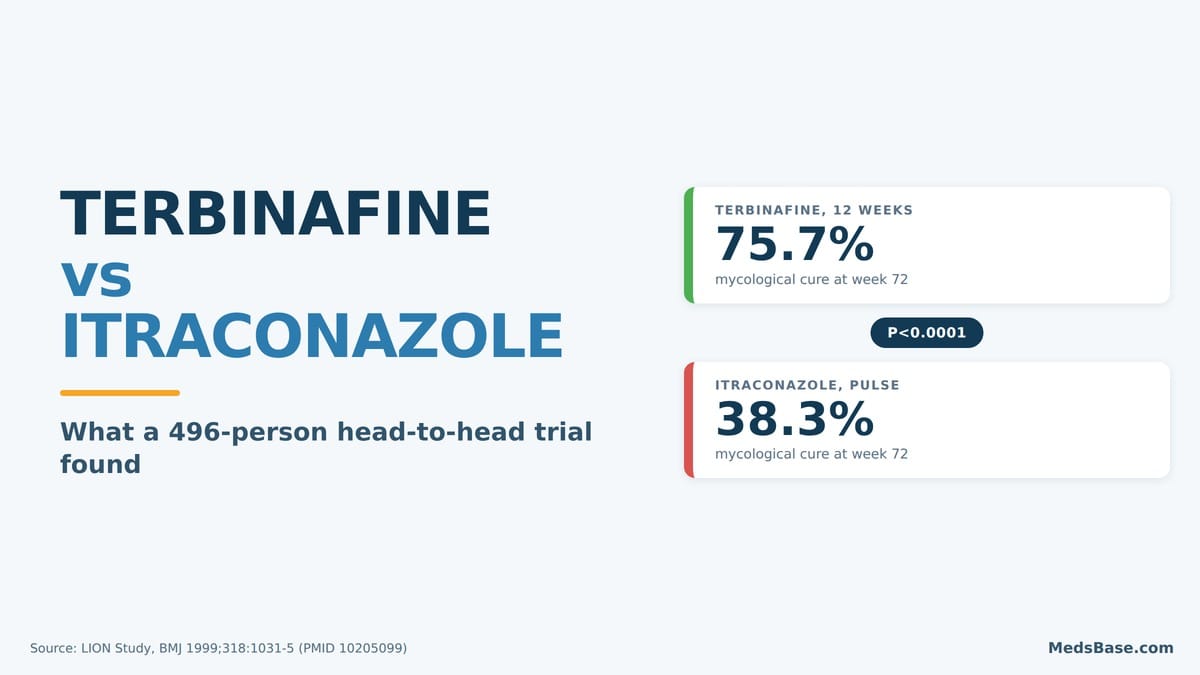
You have had the same thick, yellow-brown toenail for two years. You have painted a lacquer on it for months, watched nothing happen, and finally been offered a choice between two tablets with names you cannot pronounce. So you did what everyone does: you searched terbinafine vs itraconazole and got ten pages of “both are effective options — consult your doctor.”
That is not an answer. And in this case there genuinely is one, because these two drugs were put head to head in a proper double-blind randomised trial and the result was not close.
By the end of this you will know the cure rates from that trial, what happened when the same patients were tracked for five more years, the two absolute hard stops that decide the choice for some people before efficacy ever enters the room, and why your nail can still look terrible months after a successful course. That last one causes more unnecessary panic than any side effect.
- In the head-to-head trial, terbinafine cured 75.7% and itraconazole 38.3% — and the number that matters most was measured at week 72, not week 12.
- Five years on, the gap had not closed. It had widened.
- Two hard stops decide terbinafine vs itraconazole for many people before efficacy does: one drug is off the table with liver disease, the other with heart failure — and if you take a statin, that choice may already be made.
- The itraconazole “pulse” regimen everyone quotes online is approved for fingernails only in the US. For toenails the labelled course is different.
- Your nail will still look wrong when the tablets stop. That is expected, and there is a reason rooted in millimetres per month.
- Before either drug: nearly half of abnormal-looking nails are not fungal at all — which makes testing the first real step in any nail fungus treatment.
Terbinafine vs itraconazole: the short answer
That is the honest summary. The rest of this article is the reasoning behind it, plus the circumstances that flip it for you.
First, a boundary worth drawing, because it saves you a wasted decision. This article is about oral antifungal treatment of toenail onychomycosis caused by dermatophytes — the slow, thick, crumbling nail you have been hiding in a sock. It is a different problem from a yeast infection, where the comparison you want is how an oral azole compares with a topical one for yeast infections. Different organism, different drugs, different decision. If your complaint is itching rather than a deformed nail, that guide is the one for you.
Now, the thing almost every page skips. Before you commit to either of these nail fungus tablets for three months, your diagnosis needs confirming with a nail clipping. This is not bureaucratic caution: according to the StatPearls reference text on onychomycosis, nearly half of abnormal nails are nonfungal. Nail psoriasis, old trauma, lichen planus and simple age can all produce a thick discoloured nail that looks exactly like yours. Treat one of those with an antifungal and you achieve nothing except three months of exposure to a drug you never needed.
If you take one thing from this section: get your nail tested before you start any nail fungus treatment.
That single step is also what makes the terbinafine vs itraconazole choice answerable at all, because the organism your clipping grows is the single biggest factor in which of the two will work for you.
How each drug works, and why one kills while the other stalls
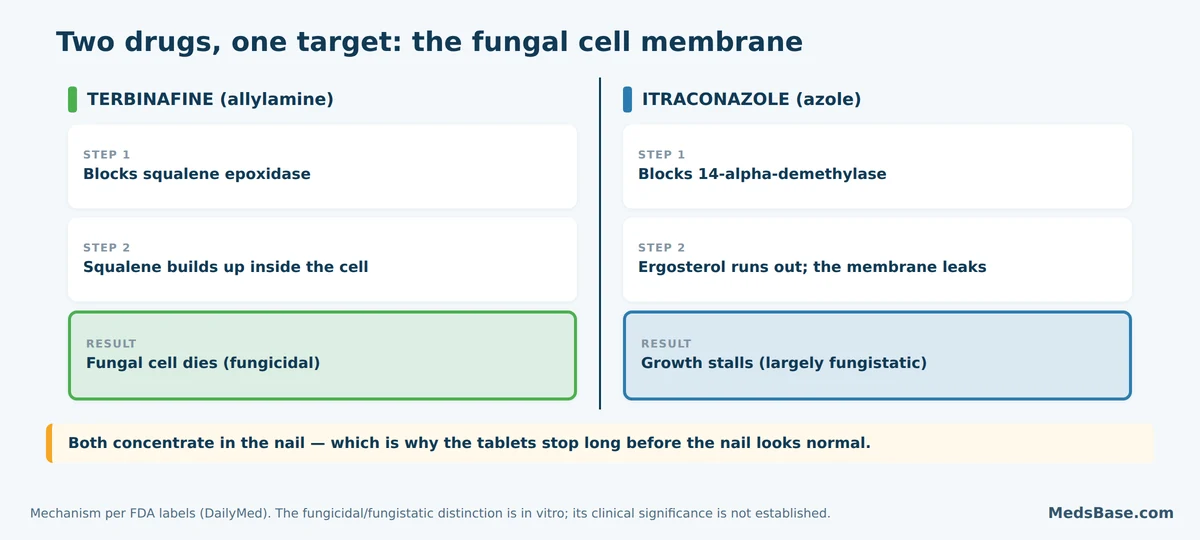
Both drugs attack the same structure — the fungal cell membrane — but at different points on the assembly line, and that difference has a consequence for you.
Picture the fungus living under your nail building its own cell wall from a kit. The critical component is ergosterol, the fungal equivalent of the cholesterol in your own cell membranes. Remove it and the membrane stops working.
Terbinafine is an allylamine. It blocks an enzyme called squalene epoxidase very early in that assembly line. Two things follow: ergosterol production stops, and the unused raw material — squalene — piles up inside the cell to toxic levels. It is a factory shutdown plus a warehouse overflow. In laboratory conditions this combination is fungicidal, meaning it kills the organism rather than merely holding it still.
Itraconazole is a triazole. It blocks a later enzyme, 14-alpha-demethylase. Ergosterol still runs out and the membrane still fails, but there is no toxic build-up behind the blockage. The effect is largely fungistatic — growth stalls, and the immune system and the growing nail have to finish the job.
One honest caveat, because the label insists on it: terbinafine’s own prescribing information notes that “the clinical significance of in vitro data is unknown.” So do not treat “fungicidal beats fungistatic” as your explanation for the trial results. It is a plausible mechanism, not a proven one. The trial numbers stand on their own.
That is the open loop closed early, because it prevents a specific and common mistake: stopping a working treatment at week 10 because “it isn’t doing anything.” At week 10 you should not expect to see much. You are watching a nail, not a rash.
Who each drug actually suits
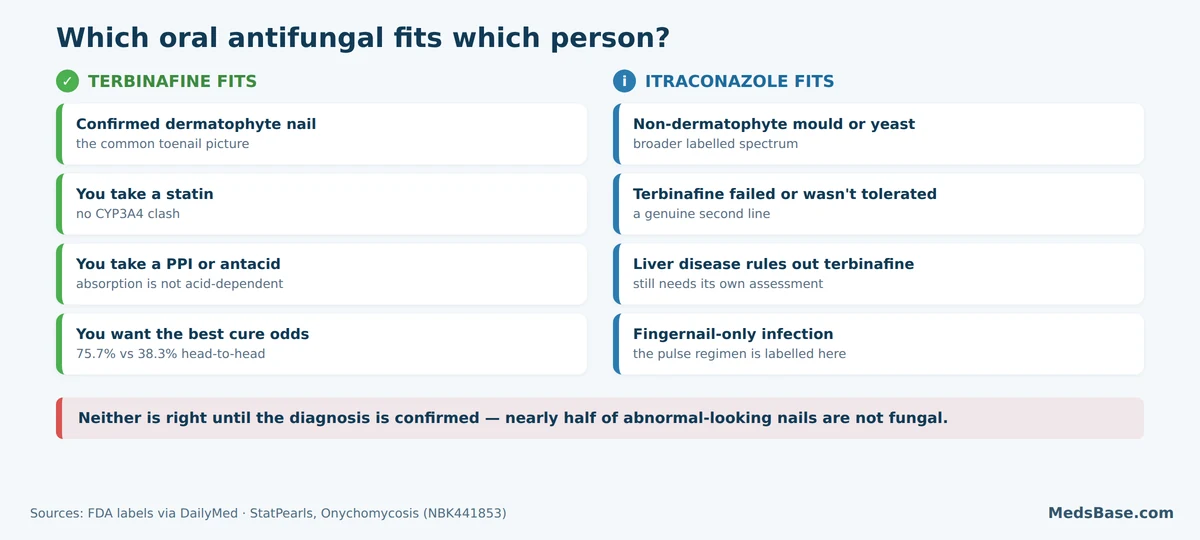
That last sentence is the part competitors leave out, so let us make it concrete for you.
When terbinafine is the straightforward choice
The FDA-approved label for terbinafine tablets indicates it for onychomycosis of the toenail or fingernail due to dermatophytes, with proven clinical activity against Trichophyton rubrum and Trichophyton mentagrophytes — between them, the overwhelming majority of the fungal nail infection cases you are likely to have.
Two practical advantages rarely get mentioned, and both are about your daily life rather than the laboratory. Terbinafine tablets can be taken with or without food — food changes absorption by less than 20%, so you do not have to plan your day around the dose. And terbinafine does not depend on your stomach acid, which matters enormously if you take a proton pump inhibitor for reflux. Neither point sounds dramatic. Both quietly decide your outcome, because a drug you absorb unreliably is a drug that fails you.
Once the choice is made, the tablet form most people are actually offered is terbinafine 250 mg, taken once daily. No prescription is needed to order it from MedsBase.com.
When the fungal nail infection is not what you assumed
There is a scenario worth naming, because it may be yours. Take Miriam, 61, illustrative rather than real: three toenails affected, a clipping that grows a non-dermatophyte mould, and a nail that shrugged off a full terbinafine course. That is not treatment failure in the usual sense. That is the wrong drug for the organism, and it is precisely where itraconazole’s broader labelled spectrum earns its place. Without a culture nobody would have known — which is the argument for testing your nail first, made a second way.
If you have already completed one oral antifungal course and seen nothing, this is the question to raise before you accept that treatment “does not work” for you. It may simply not have been the right drug for what is actually growing in your nail.
Terbinafine side effects, itraconazole side effects, and the two hard stops
Here is where the comparison stops being about cure rates and starts being about you specifically.
Both drugs are, for most people, well tolerated across a 12-week course. In the head-to-head trial there were no differences in the number or type of adverse events between the terbinafine and itraconazole groups, and a Cochrane review of 48 randomised trials likewise found no difference in adverse-event risk between terbinafine and the azoles (RR 1.00, 95% CI 0.86 to 1.17).
So when you compare terbinafine side effects against itraconazole side effects, the difference is not about how often something goes wrong. It is about who must not take which drug at all — and you may already be in one of those groups without knowing it.
| Side effect (terbinafine) | Frequency (vs placebo) | Severity | What to do |
|---|---|---|---|
| Headache | 12.9% vs 9.5% | Mild | Usually settles; ordinary pain relief is fine |
| Rash | 5.6% vs 2.2% | Mild–moderate | Report it; stop and seek advice if blistering or peeling |
| Diarrhoea | 5.6% vs 2.9% | Mild | Take with food; report if persistent |
| Liver enzyme rise (≥2× normal) | 3.3% vs 1.4% | Needs monitoring | Detected by the blood tests you should already be having |
| Taste disturbance or loss | 2.8% vs 0.7% | Can be serious | Report promptly — the label says to discontinue |
Two of those rows deserve more than a table cell, because they change what you should actually watch for.
Taste disturbance is the one terbinafine side effect people are not warned about properly. The label states it can be severe enough to cause reduced food intake, weight loss, anxiety and depressive symptoms, and that it “may be prolonged (greater than one year), or may be permanent.” It will affect fewer than 3 in 100 of you. But if your food starts tasting of cardboard, that is a same-week phone call, not a wait-and-see.
The liver rule is a real rule. Terbinafine’s label warns that liver failure — sometimes leading to transplant or death — has occurred, requires pretreatment serum transaminases before your first tablet, and makes chronic or active liver disease an outright contraindication. Read in isolation that is alarming. In context it is rarer than it sounds: the NIH LiverTox database puts clinically apparent liver injury at roughly 1 in 2,500 to 1 in 25,000 people exposed, usually appearing within the first six weeks. That pretreatment blood test exists precisely to find out whether you are one of the people at risk before you start.
What does the research say about terbinafine vs itraconazole?
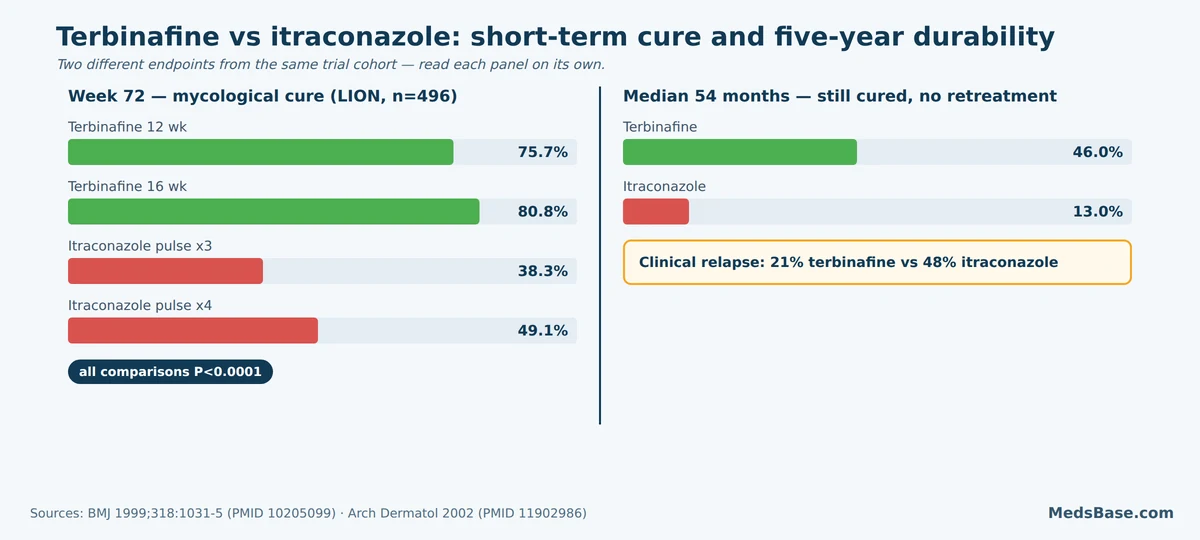
| Study | Year | Finding | Source |
|---|---|---|---|
| LION Study, 496 patients, 35 centres | 1999 | Mycological cure at week 72: 75.7% (terbinafine 12 wk) and 80.8% (16 wk) vs 38.3% and 49.1% (itraconazole pulse ×3 and ×4). All comparisons P<0.0001. No difference in adverse events. | BMJ 1999;318:1031–5 (PMID 10205099) |
| LION 5-year blinded follow-up | 2002 | At median 54 months, mycological cure without retreatment: 46% terbinafine vs 13% itraconazole (P<0.001). Clinical relapse 21% vs 48%. | Arch Dermatol 2002 (PMID 11902986) |
| Cochrane review, 48 RCTs, 10,200 participants | 2017 | Terbinafine probably more effective than azoles for clinical cure (RR 0.82, 95% CI 0.72–0.95) and mycological cure (RR 0.77, 95% CI 0.68–0.88). Moderate-quality evidence. No difference in adverse events. | Cochrane Database Syst Rev (PMID 28707751) |
| Network meta-analysis, 26 RCTs, 8,136 patients | 2020 | Continuous terbinafine 250 mg and continuous itraconazole 200 mg both significantly beat topical treatments. Pulse regimens of either drug did not differ significantly from topicals. | Br J Dermatol 2020 (PMID 31120134) |
What this means for you: the evidence points one direction, and it does so across three different study designs run decades apart. That consistency should reassure you more than any single percentage does.
But read the second and fourth rows carefully, because they carry the nuance the headline hides — and the nuance is what stops you overestimating your odds.
A double-blind randomised trial put them directly against each other using intermittent itraconazole — 400 mg a day for one week in four. The 2020 network meta-analysis later found that pulse regimens of either drug performed no better than topical treatments, while continuous dosing of either drug clearly did. So part of LION’s margin may reflect continuous-versus-pulse dosing rather than terbinafine-versus-itraconazole as molecules. Anyone telling you the trial proves terbinafine is intrinsically twice as good is overreading it.
That said, the direction survives every way of cutting it. Cochrane compared terbinafine against azoles broadly and still favoured terbinafine. And the researchers who followed the same patients for five years found the separation had grown, not shrunk.
One more honesty note. Cochrane found only low-quality evidence on recurrence and no clear difference between terbinafine and azoles there (RR 1.11, 95% CI 0.68–1.79). The striking 21%-versus-48% relapse figures come from the LION follow-up specifically. Treat them as strong evidence from one excellent study, not as settled fact.
Terbinafine vs itraconazole vs the alternatives
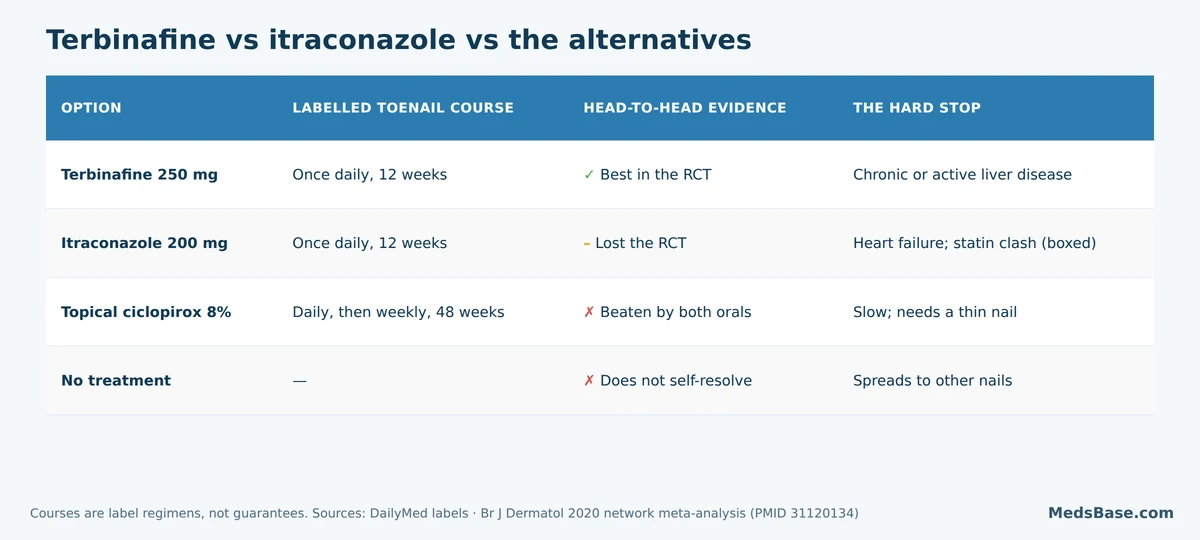
Oral tablets are not your only route, and for some nails they are not the right one. Before you settle the terbinafine vs itraconazole question, it is worth knowing what else is on the table.
| Option | Labelled toenail course | Evidence position | The hard stop |
|---|---|---|---|
| Terbinafine 250 mg | Once daily, 12 weeks | Best performer in the head-to-head trial and Cochrane | Chronic or active liver disease |
| Itraconazole 200 mg | Once daily, 12 consecutive weeks | Effective; lost the head-to-head | Heart failure (boxed); statin and CYP3A4 clashes |
| Topical ciclopirox 8% | Daily week 1, tapering to weekly, up to 48 weeks | Beaten by both continuous orals in the network meta-analysis | Slow; struggles with thick nails or matrix involvement |
| No treatment | — | Onychomycosis does not resolve on its own | Tends to spread to neighbouring nails |
Which one fits your situation? If your diagnosis is confirmed dermatophyte, your liver is healthy and you want the best odds, terbinafine is the evidence-led answer for you. If you have heart failure or take simvastatin, itraconazole is effectively off your table and the choice makes itself. If your organism is a non-dermatophyte mould, itraconazole’s broader spectrum is the reason it exists in this conversation at all. And if only the outer edge of one thin nail is involved — or you cannot take an oral antifungal at all — a topical lacquer works differently and suits a different nail, trading a much longer course for the absence of systemic risk.
One correction worth making loudly, because the internet has this backwards and it may already have misled you: the itraconazole “pulse” regimen — 200 mg twice daily for one week, three weeks off — is approved on the US label for fingernails only, and as two pulses, not three. For your toenails, the labelled regimen is 200 mg once daily for 12 consecutive weeks. If you have read otherwise, you have read a description of what the LION trial studied, not what the label approves.
How to actually get a cure — practical guidance
- Get your nail clipped and tested first. Almost half of abnormal nails are not fungal. Culture or PCR also identifies the organism, which is exactly what decides terbinafine vs itraconazole for you.
- Have your baseline blood test. Terbinafine’s label requires pretreatment serum transaminases. If you are offered the tablets without one, ask why.
- Take the full course. Terbinafine 250 mg once daily for 12 weeks (toenails) or 6 weeks (fingernails). Itraconazole for toenails is 200 mg once daily for 12 consecutive weeks — with food.
- Get the food and acid rules right. Terbinafine: with or without food. Itraconazole: immediately after a full meal, and be aware that PPIs, H2-blockers and antacids reduce its absorption. Getting this wrong quietly halves your chance of a cure.
- Then wait — properly. At roughly 1 mm of growth a month, your toenail takes 12–18 months to replace itself. Judge your result at a year, not at week 12.
- Reduce your reinfection risk. Treat athlete’s foot on your skin at the same time, rotate and dry your footwear, and do not share nail clippers.
- Know what a relapse means. In the LION follow-up, of the patients re-treated with terbinafine, 88% achieved mycological cure — so if yours comes back, that is not the end of the road.
Mistakes to avoid: stopping early because your nail looks unchanged (it will); taking itraconazole on an empty stomach or alongside a PPI; continuing your statin through an itraconazole course; ignoring a change in your sense of taste; and treating a nail nobody ever tested. Recurrence is common whichever drug you choose — reported ranges run from 5% to 50% — so your goal is a cure you maintain, not a cure you assume is permanent.
- How an oral azole compares with a topical one for yeast infections — the same head-to-head treatment for a different organism.
- Fungal acne is a different organism with a different fix — why antifungal logic changes completely on skin.
- The hormone-driven acne decision, laid out the same way — another comparison built on trial data rather than opinion.
Frequently asked questions
Q: Which is better, terbinafine or itraconazole?
A: For ordinary dermatophyte toenail fungus, terbinafine. The head-to-head LION trial found mycological cure in 75.7% of terbinafine patients versus 38.3% on intermittent itraconazole at 72 weeks, and a Cochrane review of 48 trials agreed that terbinafine is probably more effective than azoles. Itraconazole remains the better choice when the organism is not a dermatophyte, or when terbinafine is unsuitable.
Q: How long does it take to cure toenail fungus?
A: Longer than the tablets last. Treatment is 12 weeks, but toenails grow about 1 mm a month, so the damaged nail needs 12–18 months to grow out and be trimmed away. Itraconazole’s own label records a mean time to overall success of about 10 months. Judge success at a year, not when the packet finishes.
Q: Does terbinafine damage your liver?
A: Rarely, but the risk is real enough that monitoring is mandatory. The label warns liver failure has occurred and requires blood tests before starting and periodically during treatment. The NIH LiverTox database estimates clinically apparent liver injury at roughly 1 in 2,500 to 1 in 25,000 people exposed, usually within the first six weeks. Terbinafine is contraindicated if you have chronic or active liver disease.
Q: Can you take itraconazole with statins?
A: Not with simvastatin or lovastatin — both are contraindicated during itraconazole treatment and for two weeks afterwards. Itraconazole is a potent CYP3A4 inhibitor, so it lets these statins build up in your body and raises your risk of muscle injury. Among the itraconazole side effects that matter most, this interaction is the one that most often decides terbinafine vs itraconazole in older adults. Always show your full medicine list to whoever prescribes for you.
Q: Why does my nail still look bad after treatment?
A: Because the drug clears the fungus from your nail bed, but it cannot repair nail that has already grown out damaged. That damaged plate has to grow off the end of your toe at about 1 mm a month. If your nail still looks poor at week 12, that is normal and expected — not evidence your treatment failed.
Q: What is the success rate of terbinafine for toenail fungus?
A: In the LION trial, 75.7% achieved mycological cure with a 12-week course and 80.8% with 16 weeks, measured at week 72. Pooled meta-analytic estimates put terbinafine near 76%, itraconazole pulse dosing near 63% and fluconazole near 48%. Remember what you are being promised: “mycological cure” means the fungus is gone, while a cosmetically perfect nail is a slower and less certain outcome.
Q: Is terbinafine vs itraconazole a different question for fingernails?
A: Somewhat. Your fingernails grow faster, so courses are shorter and you see results sooner — terbinafine is 6 weeks for fingernails versus 12 for toenails. The US itraconazole label approves its pulse regimen specifically for fingernail infection. The underlying efficacy ranking does not change.
Q: Which nail fungus tablets can I get without a prescription?
A: No prescription is needed to order either of these nail fungus tablets from MedsBase.com. That said, this is one of the genuinely rare situations where your pre-treatment work matters as much as the tablet itself: a confirmed diagnosis from a nail clipping and a baseline liver blood test are what make a 12-week course worth your time at all. Bring both to your decision.
The bottom line on terbinafine vs itraconazole
For the common case — a confirmed dermatophyte toenail onychomycosis in someone with a healthy liver and no interacting medicines — the evidence on terbinafine vs itraconazole points clearly at terbinafine. It cured roughly twice as many people in the only large head-to-head trial, held that lead at five years, and carries no CYP3A4 interaction burden. Itraconazole is not a bad drug; it is a drug with a narrower window of people it suits, a broader antifungal spectrum when you need one, and a boxed warning that removes it entirely if you have any history of heart failure.
Be appropriately sceptical of the size of that gap. Part of it reflects pulse-versus-continuous dosing rather than the molecules themselves, and the relapse figures rest on a single follow-up study that Cochrane’s broader analysis does not fully corroborate. The direction is robust. The exact multiple is not, so do not build your expectations on “twice as good”.
Your one immediate action: get your nail clipped and tested before anything else. Nearly half of nails like yours are not fungal, and no comparison of antifungals will help you if you are in that half.
Once you have a confirmed diagnosis and a plan, you can browse the antifungal options and see what a full nail fungus treatment course actually involves.
Two questions readers usually ask next: why rapid weight loss can trigger shedding, if you have noticed hair and nail changes together — they share more mechanisms than you would expect; and how an oral azole compares with a topical one for yeast infections, if part of your problem turns out to be yeast rather than a dermatophyte.

Written by
Sophie ChenPharmaceutical Content Researcher · 8 years experience
Sophie Chen is a pharmaceutical content researcher with 8 years covering generic medication access and clinical pharmacology. She specialises in international regulatory frameworks, bioequivalence standards, and patient-facing education on therapeutic drug classes. She is not a clinician.