








✓ Medically reviewed by · Last reviewed: May 2026
Pharmacy Researcher · 8 years experience
Pharmacy researcher with 8 years reviewing clinical drug information, generic formulation equivalence, and international pharmaceutical standards. Focuses on patient-facing accuracy in medication education.
It is 3 a.m. and your big toe has woken you up. The joint is hot, swollen and so tender that the weight of a bedsheet is unbearable. You have not injured it. You want two things right now: something that works within hours, and reassurance that this will end. That is what proper gout attack treatment delivers — and most articles bury it under cherry juice and purine charts you cannot act on tonight.
By the end of this guide you will know which three drug classes actually stop a flare, how fast each should work, and the counter-intuitive rule about dosing that trips up almost everyone. There is also one common, well-meaning mistake that reliably makes attacks worse — it comes up in the mistakes section, and it is probably not what you would guess.
- Three drug classes stop a flare, and which one suits you depends less on the gout than on your kidneys, stomach and other medications.
- Timing beats dosing — starting early matters more than taking more.
- The high-dose colchicine approach many people reach for gives no extra pain relief and far more side effects. The numbers are stark.
- There is a common instinct during a flare that makes future attacks more likely, not less. It’s in the mistakes section.
- Stopping flares and preventing them are two different treatments — and confusing them is why some people flare for years.
What Is a Gout Attack?
A gout attack is a sudden episode of intense joint inflammation caused by needle-shaped urate crystals forming inside the joint. It usually strikes one joint at a time, most often the base of the big toe, and it arrives fast — typically overnight, reaching peak severity within hours. The joint becomes hot, swollen and red, and the pain is out of proportion to anything you did to it.
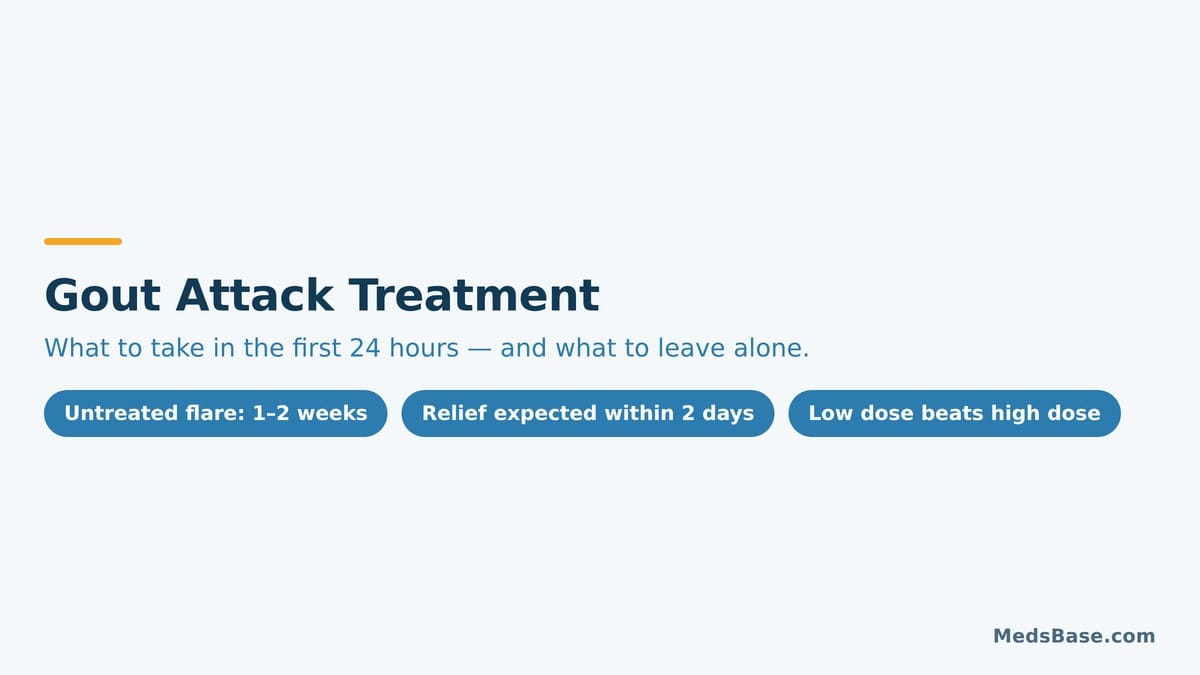
The NHS guidance on gout describes the classic picture as sudden severe pain in a joint — usually the big toe, though it can be others — with hot, swollen, red skin over it. Crucially, it also gives you the timeline you want at 3 a.m.: an attack usually lasts one to two weeks if left untreated.
That number is the honest starting point. Gout attacks end on their own. Treatment is not about whether you recover — it is about how much of that one-to-two-week window you spend in serious pain. Effective treatment compresses it substantially.
The single most useful thing to know is that speed matters more than strength. Treatment started in the first 24 hours works better than the same treatment started on day three, regardless of which of the three options you use. If you have had gout before and recognise the onset, that recognition is worth more than any drug choice.
Here is where it gets interesting: the pain you feel is not the crystals scratching the joint. It is your own immune system reacting to them. That single fact explains why every effective flare treatment is an anti-inflammatory of some kind — and why lowering your uric acid in the middle of an attack does nothing to help right now.
Why Gout Attacks Happen
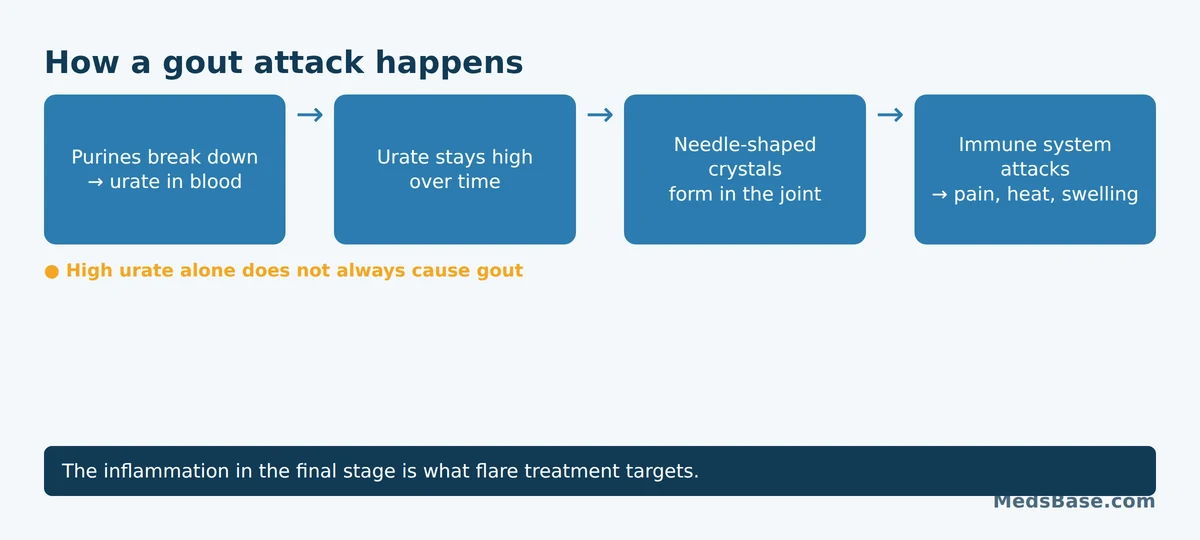
Picture urate as sugar stirred into tea. Below a certain concentration it stays dissolved and invisible. Push past that point and it starts to come out of solution as crystals. Your joints, particularly the cooler ones furthest from your heart, are where those crystals settle — which is why the big toe is gout’s favourite address.
According to NIAMS at the National Institutes of Health, gout happens when urate builds up and forms needle-shaped crystals in the joints. Urate itself comes from purines, compounds found both in your own body tissues and in foods. When purines break down, urate is the by-product.
But here is the nuance that consumer articles routinely flatten: not everyone with high urate levels develops gout. Many people carry elevated urate for years with no symptoms at all — a state called hyperuricaemia. High urate is necessary for gout but not sufficient. Something has to tip crystals into forming, and that trigger is not fully predictable.
That medication list deserves a moment, because it is actionable. If you take a diuretic (“water tablet”) for blood pressure and you have recurrent gout, that combination is worth raising with your doctor — there are other blood pressure medications that do not push urate up the same way. Do not stop anything on your own; a controlled swap is a conversation, not a decision to make at 3 a.m.
So what does this mean for you? Treat the flare tonight, but do not stop there. Recurrent attacks are a signal, and treating each one in isolation is how people end up with a decade of gout.
Gout Attack Treatment: What to Take
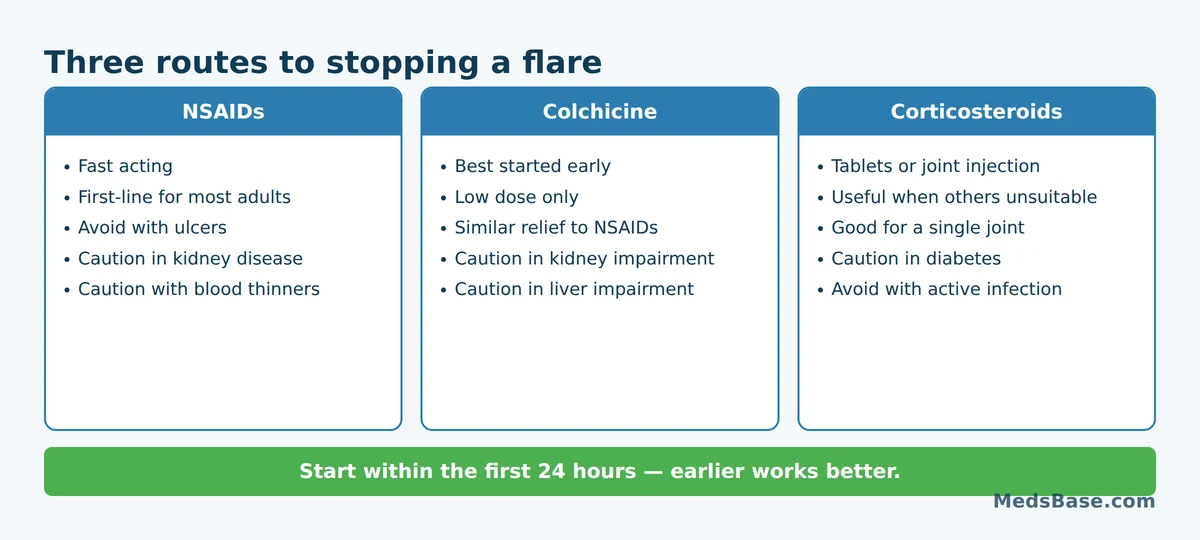
Three drug classes stop an acute flare. All three work by suppressing the inflammatory response, and the choice between them depends mostly on your other health conditions rather than on the gout itself.
| Option | How fast | Best suited to | Be cautious if |
|---|---|---|---|
| NSAIDs (indomethacin, ibuprofen, naproxen) | Hours; clear improvement expected within about 2 days | Most healthy adults; the NHS names an NSAID such as ibuprofen as the usual first step | Kidney disease, stomach ulcers, heart failure, taking blood thinners |
| Colchicine | Best within the first 12–24 hours of onset | People who cannot take NSAIDs; those who recognise a flare early | Significant kidney or liver impairment; certain interacting medicines |
| Corticosteroids (tablets or joint injection) | Hours to a day | People unsuitable for both of the above; single-joint flares suit an injection | Poorly controlled diabetes, active infection |
The NHS position is straightforward: an NSAID such as ibuprofen is the usual first step, and if that does not work, steroids as tablets or an injection are the next move. Colchicine sits alongside as the alternative for people who cannot take NSAIDs, and it is most effective when started early.
MedsBase carries the medicines in all three of these categories in its gout treatment range, including indomethacin and colchicine, and no prescription is needed to order. What no online range can do is tell you which one your kidneys and stomach can tolerate — that is the part worth a conversation with a doctor or pharmacist, ideally before your next flare rather than during it.
Gout Attack Treatment Safety, Side Effects and Dosing
Now for the counter-intuitive dosing rule, and it is worth the paragraph.
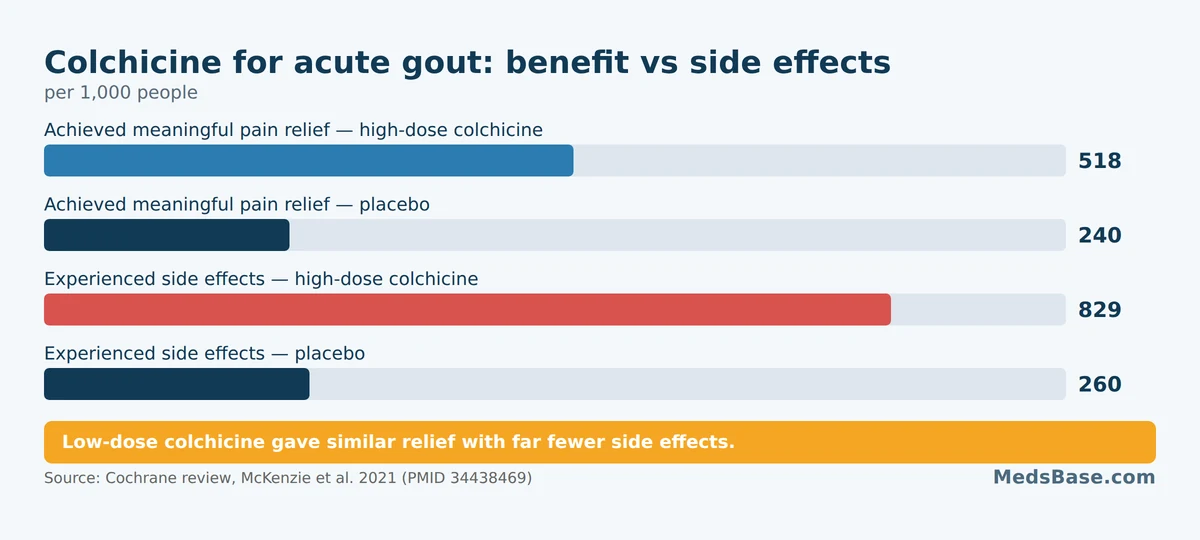
For decades, colchicine was given at high doses until either the pain stopped or the patient developed severe diarrhoea — often whichever came first. That approach has been abandoned, and the evidence for abandoning it is unusually clear. Low-dose colchicine gives comparable pain relief to high-dose, with dramatically fewer side effects. More is not better here. More is just worse.
A Cochrane review of colchicine for acute gout found little or no difference in treatment success between low-dose and high-dose regimens, while high-dose produced substantially more adverse events. The practical translation: taking extra tablets to chase faster relief buys you nausea, vomiting and diarrhoea without buying you less joint pain.
| Treatment | Common side effects | Severity | What to do |
|---|---|---|---|
| Colchicine | Diarrhoea, nausea, abdominal cramps | Usually mild but dose-dependent | Stay at the low-dose regimen; stop and seek advice if diarrhoea is severe |
| NSAIDs | Stomach irritation, indigestion, fluid retention | Mild to moderate; serious with ulcers or kidney disease | Take with food; avoid if you have ulcer or kidney history without advice |
| Corticosteroids (short course) | Raised blood sugar, mood changes, sleep disturbance | Usually short-lived | Monitor glucose if diabetic; keep courses short |
| Any of the above, in kidney impairment | Accumulation and toxicity | Potentially serious | Dose adjustment is essential — get advice before starting |
If colchicine is the route that suits you, MedsBase stocks it as Goutnil from WHO-GMP-certified manufacturers. Take the low-dose approach the evidence supports rather than the older “dose until it hurts” method, and confirm the regimen with a pharmacist if you have any kidney or liver impairment — that is where colchicine dosing genuinely changes.
What Does the Research Say About Gout Attack Treatment?
| Source | Year | Finding | Reference |
|---|---|---|---|
| Cochrane systematic review, colchicine for acute gout | 2021 | Low-dose colchicine gave similar treatment success to high-dose with significantly fewer adverse events; benefit versus placebo supported by low-quality evidence. High-dose caused side effects in roughly 829 per 1,000 people versus 260 per 1,000 on placebo. | PMID 34438469 |
| ACR guideline for the management of gout (42 recommendations) | 2020 | Allopurinol strongly recommended as preferred first-line urate-lowering therapy; treat-to-target serum urate below 6 mg/dL; start low (allopurinol ≤100 mg/day); give anti-inflammatory prophylaxis for at least 3–6 months when starting urate-lowering therapy. | PMID 32391934 |
| NHS clinical guidance | Current | An untreated attack usually lasts 1–2 weeks; treatment should show improvement within about 2 days; NSAIDs first, steroids if those do not work. | NHS |
What this means for you: the acute evidence is thinner than you might expect — the colchicine trials are small and the review rates the certainty as low. That is worth saying plainly rather than papering over. What the evidence does support confidently is the direction: treat early, treat with an anti-inflammatory, and do not escalate colchicine dosing in search of faster relief. The stronger, higher-certainty evidence sits on the prevention side, where the target is a serum urate below 6 mg/dL.
Gout Attack Treatment vs Long-Term Prevention
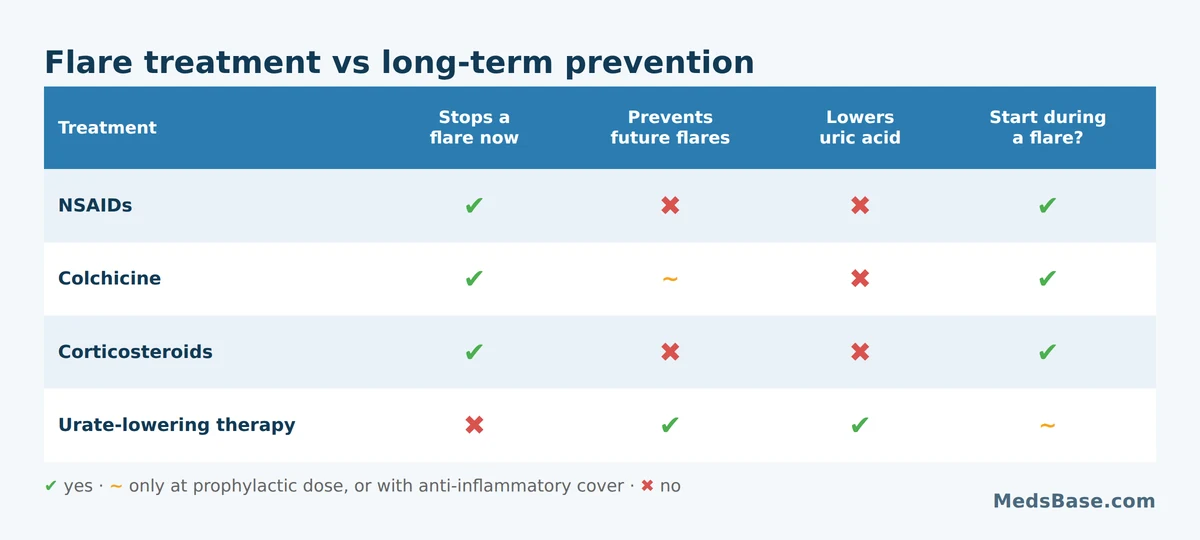
This is where a lot of people lose years. Flare treatment and prevention are different medicines doing different jobs, and taking one does not accomplish the other.
| Stops a flare now | Prevents future flares | Lowers uric acid | Start during a flare? | |
|---|---|---|---|---|
| NSAIDs | Yes | No | No | Yes |
| Colchicine | Yes | Yes, at prophylactic dose | No | Yes |
| Corticosteroids | Yes | No | No | Yes |
| Urate-lowering therapy (allopurinol, febuxostat) | No | Yes — the only option that does | Yes | Only with anti-inflammatory cover |
Which fits which situation? If you get an occasional flare — say one every few years — treating each episode may be entirely reasonable. If you are having frequent attacks, have visible urate deposits (tophi), or have joint damage on imaging, the ACR guideline is clear that urate-lowering therapy is the intervention that changes your trajectory. Anti-inflammatories manage episodes; only urate-lowering therapy addresses the cause.
The choice of which urate-lowering drug is a genuine decision with an evidence conflict behind it, and it deserves its own discussion — our guide to allopurinol vs febuxostat covers what two large trials found and why they disagreed.
How to Manage a Gout Attack — Practical Guidance
- Start treatment as early as you can. Within the first 24 hours of onset is the target. If you have flared before and recognise the feeling, act on that recognition.
- Pick the option that suits your other conditions. NSAIDs for most; colchicine if NSAIDs are unsuitable and you have caught it early; corticosteroids if neither fits.
- Use the low dose of colchicine, not the high one. The evidence is clear that extra doses add side effects without adding relief.
- Rest and elevate the joint. The NHS advises resting and raising the limb, and keeping bedclothes off the joint — that last tip sounds trivial until you have needed it.
- Apply ice for up to 20 minutes at a time. Wrap it; do not put ice directly on skin.
- Drink plenty of water. It will not end the flare, but dehydration works against you.
- Expect improvement within about two days. If there is none, or if you develop a fever, get assessed — a joint infection can look very similar.
- Stopping your allopurinol or febuxostat because a flare started. This is the well-meaning mistake, and it is the wrong move. Any sudden change in urate levels — up or down — can prolong or trigger flares. If you are already established on urate-lowering therapy, keep taking it through the attack and treat the flare separately.
- Starting urate-lowering therapy in the middle of a flare without cover. MedlinePlus’s allopurinol page notes that allopurinol may increase the number of gout attacks during the first few months, and that a medicine such as colchicine is often given alongside to prevent them. The ACR guideline recommends that anti-inflammatory prophylaxis for at least 3–6 months.
- Chasing relief with extra colchicine. Covered above — it buys side effects, not comfort.
- Treating your fifth flare exactly like your first. Recurrent attacks are the signal to have the prevention conversation.
- Assuming diet alone will fix it. Diet influences urate modestly. For most people with recurrent gout it is not enough on its own, and framing it as a willpower problem is both inaccurate and unkind.
- Ignoring a fever or multiple hot joints. That combination needs assessment, not self-treatment.
- Allopurinol vs febuxostat — the long-term decision, and the trial conflict behind it.
- Semaglutide for fatty liver — another condition that travels with metabolic syndrome, which is the company gout usually keeps.
- Best blood pressure medications — relevant if a diuretic may be feeding your flares.
Frequently Asked Questions
Q: How do you stop a gout attack fast?
A: Start an anti-inflammatory within the first 24 hours — an NSAID such as indomethacin or ibuprofen, low-dose colchicine, or a corticosteroid if neither suits you. Speed of starting matters more than the dose you take. Rest and elevate the joint, apply ice for up to 20 minutes at a time, and keep bedclothes off it. You should see clear improvement within about two days; if you do not, get assessed.
Q: How long does a gout attack last?
A: An untreated attack usually lasts one to two weeks according to NHS guidance, with the worst pain in the first day or two. Effective treatment does not change the underlying process but substantially shortens the painful window. If a flare drags well beyond two weeks, or the joint stays swollen after the pain settles, that is worth reviewing — it may point to ongoing crystal deposits rather than a simple flare.
Q: Should I take colchicine or ibuprofen for gout?
A: For most healthy adults an NSAID such as ibuprofen is the usual first step, and it works whether or not you catch the flare early. Colchicine is the better choice if NSAIDs are unsuitable — for example with stomach ulcers or if you take blood thinners — but it works best when started in the first 12 to 24 hours. Both need caution in kidney impairment. The deciding factor is usually your other health conditions, not the gout itself.
Q: Should I stop allopurinol during a gout attack?
A: No — if you are already established on it, keep taking it. This is one of the most common mistakes in gout care. Sudden shifts in uric acid levels in either direction can prolong or provoke flares, so stopping mid-attack tends to make things worse rather than better. Treat the flare with an anti-inflammatory alongside your usual urate-lowering medicine, and discuss any dose change with your doctor once the attack has settled.
Q: What triggers a gout flare?
A: Anything that shifts urate levels or promotes crystal formation. NIAMS lists alcohol, sugar-sweetened drinks, purine-rich diets, obesity, metabolic syndrome, chronic kidney disease, high blood pressure, increasing age and menopause among the contributors, along with medications including diuretics, low-dose aspirin, large amounts of niacin and cyclosporine. Dehydration and sudden changes in urate-lowering treatment are common practical triggers too. Many people never identify a single culprit.
Q: Can you walk on a foot with gout?
A: You can, but during an acute flare it is usually agonising and it does not help. Rest and elevation are part of standard self-care precisely because pressure on the joint worsens the pain. Once the flare settles, normal movement is fine and staying active supports the weight and metabolic factors that drive gout in the first place. If you must be on your feet, loose footwear that does not press on the joint makes a real difference.
Q: Do I need a prescription to order gout medication from MedsBase?
A: No — no prescription is needed to order from MedsBase.com, and our gout medicines come from WHO-GMP-certified manufacturers. The genuinely important caveat is medical rather than administrative: colchicine and NSAIDs both need dose adjustment or avoidance in kidney impairment, and a first suspected attack should be assessed by a clinician because joint infection can look very similar. Knowing which option is safe for you is worth a conversation before your next flare.
Q: Does cherry juice or diet really help gout?
A: Diet has a real but modest effect on urate levels, and it is not a substitute for treatment during a flare — nothing you eat will settle an acute attack. Reducing alcohol and sugar-sweetened drinks is genuinely worthwhile because both raise urate. But for someone with frequent attacks, diet alone rarely gets serum urate below the 6 mg/dL target that guidelines recommend. Treat diet as a helpful contributor, not the plan.
The Bottom Line
Effective gout attack treatment comes down to three things: start early, pick the anti-inflammatory that fits your other health conditions, and resist the urge to escalate the dose. An NSAID, low-dose colchicine or a corticosteroid will all shorten a flare that would otherwise run one to two weeks, and you should see improvement within about two days.
The balanced verdict is that acute treatment is well established but modestly evidenced, while the stronger evidence sits on the prevention side. If you are flaring repeatedly, treating each episode is managing a symptom of a problem you have not yet addressed. And if you are already on a urate-lowering medicine, keep taking it through the attack — stopping is the instinct that costs people the most.
The one thing to do next: if this is your second or later flare, book the conversation about urate-lowering therapy and ask for your serum urate number. The guideline target is below 6 mg/dL, and knowing where you actually sit turns gout from a recurring ambush into something with a plan attached.
Wondering which long-term tablet is the right one, and why one of them carries a safety warning the other does not? Read our guide to allopurinol vs febuxostat. Curious why gout so often shows up alongside weight and liver problems? Semaglutide for fatty liver covers the metabolic condition that keeps gout company.

Written by
Sophie ChenPharmaceutical Content Researcher · 8 years experience
Sophie Chen is a pharmaceutical content researcher with 8 years covering generic medication access and clinical pharmacology. She specialises in international regulatory frameworks, bioequivalence standards, and patient-facing education on therapeutic drug classes. She is not a clinician.