








✓ Medically reviewed by · Last reviewed: May 2026
Pharmacy Researcher · 8 years experience
Pharmacy researcher with 8 years reviewing clinical drug information, generic formulation equivalence, and international pharmaceutical standards. Focuses on patient-facing accuracy in medication education.
Orzeyful — Orzeyful (oveporexton) — the first drug for narcolepsy type 1. Read on for an evidence-backed guide covering everything you need to know.
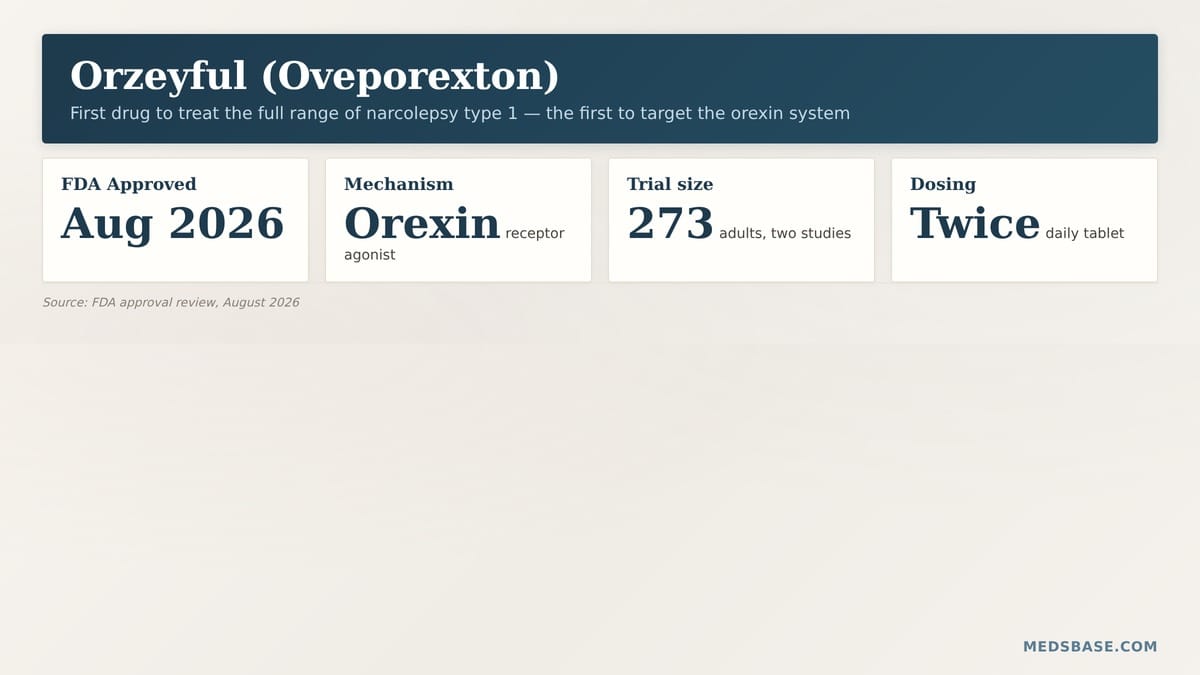
For the roughly 1 in 2,000 people living with narcolepsy type 1, every treatment available until now has done the same thing: quieted a symptom, while the disease kept running underneath. In August 2026, that changed. The U.S. Food and Drug Administration (FDA) approved Orzeyful (oveporexton), the first medicine to treat narcolepsy type 1 as a complete disorder — and the first to act on the biological cause rather than papering over the results.
By the end of this guide, you’ll understand exactly what Orzeyful does, how it differs from every narcolepsy drug before it, what the trials actually showed, and the side effects worth watching for. One of those side effects is the exact opposite of what you’d expect from a wakefulness drug — and we’ll get to it in the safety section.
Key Takeaways
- Orzeyful is the first drug to treat narcolepsy type 1 as a whole disorder, not just its symptoms.
- It works by restoring the orexin signal the disease destroys — a completely different approach from stimulants.
- In two 12-week trials, it improved wakefulness, sleepiness, and cataplexy versus placebo.
- It’s taken as a twice-daily tablet — but one common side effect may actually disrupt the sleep it’s trying to fix.
- What Is Orzeyful (Oveporexton)?
- How Does Orzeyful Work?
- What Does Orzeyful Treat?
- Safety, Side Effects & Dosage
- What the Research Says
- Orzeyful vs Existing Narcolepsy Treatments
- How to Take Orzeyful
- Frequently Asked Questions
- The Bottom Line
What Is Orzeyful (Oveporexton)?
Orzeyful (oveporexton) is an FDA-approved oral medication for narcolepsy type 1 in adults. It is the first medicine approved to treat the full range of narcolepsy type 1 symptoms — and the first to directly target the loss of orexin signaling that causes the condition. (Featured-snippet definition.)
Narcolepsy type 1 is a rare, lifelong sleep disorder caused by the loss of specific brain cells that produce orexin (also called hypocretin), a chemical messenger that regulates wakefulness, sleep, and muscle tone. Without orexin, the brain struggles to stay alert during the day and to hold the boundary between sleep and waking — which is why the condition produces such a strange, disabling mix of symptoms.
The FDA’s approval announcement framed the milestone plainly: “For too long, people with narcolepsy type 1 have had to manage a complex, lifelong neuropsychiatric condition with treatments that only address pieces of it.” Orzeyful is the first medicine that “impacts the underlying biology of the disease.”
What narcolepsy type 1 actually involves. The NINDS describes narcolepsy as a chronic neurological disorder that affects the brain’s ability to control sleep-wake cycles. People with narcolepsy may feel rested after waking but then feel very sleepy throughout much of the day. Type 1 specifically adds cataplexy — sudden, brief episodes of muscle weakness triggered by strong emotions such as laughter, fear, anger, or excitement.
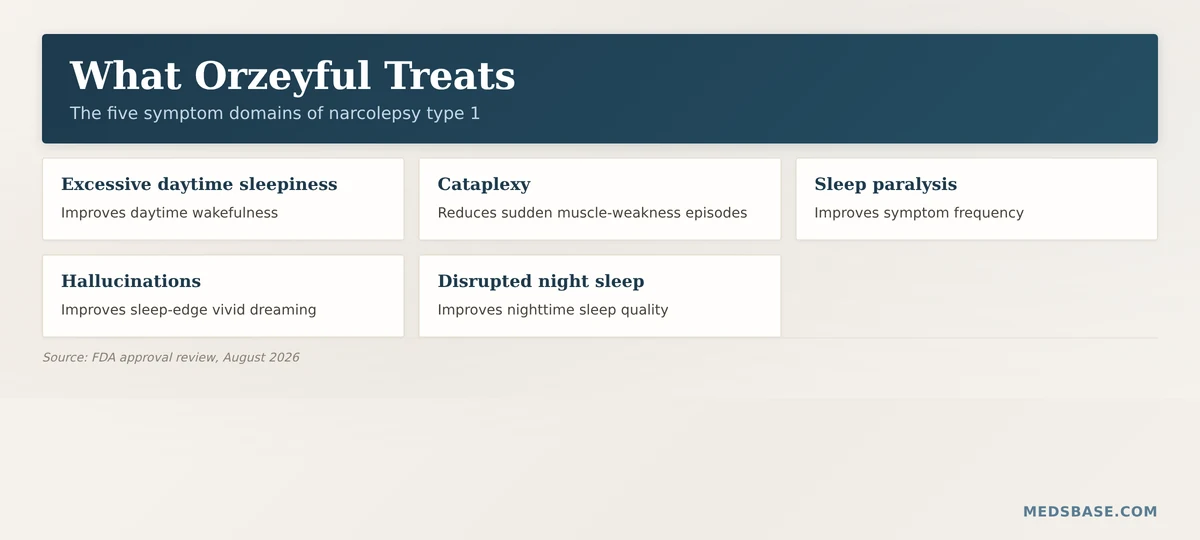
The full symptom set, per the FDA’s review, includes five distinct burdens: excessive daytime sleepiness, cataplexy, sleep paralysis, hallucinations at the edge of sleep or waking, and disrupted nighttime sleep. Most older drugs only touched one or two of these.
How Does Orzeyful Work?
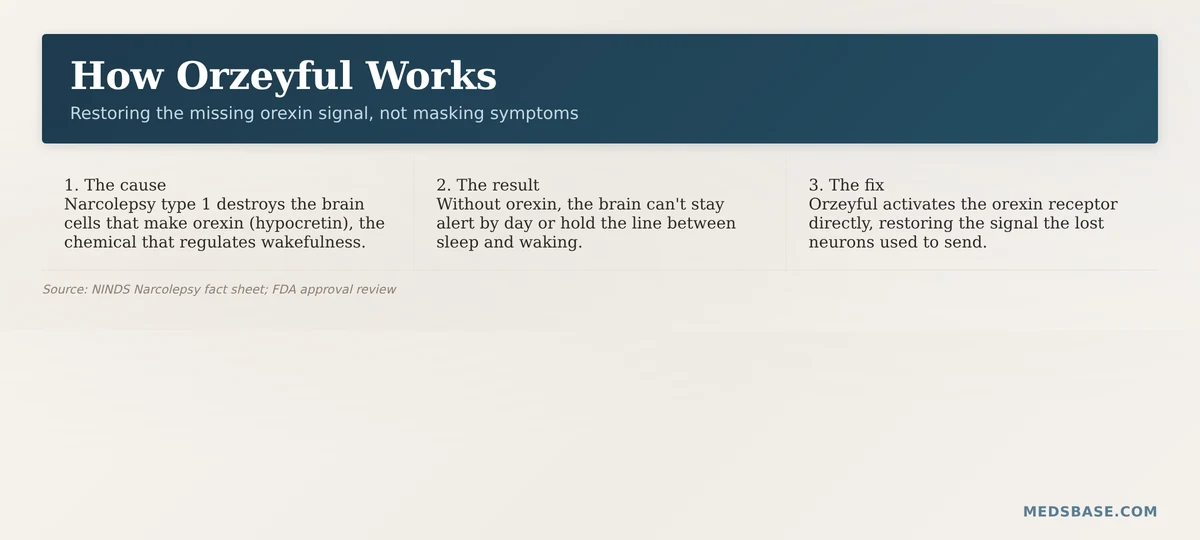
Orzeyful works by activating the same brain receptor that the body’s own orexin would normally stimulate, restoring the signal that narcolepsy type 1 erases.
Here’s the plain-English version. Think of orexin as a volume knob for wakefulness. In a healthy brain, orexin-producing neurons release orexin to turn “awake” up and hold “asleep” down during the day. In narcolepsy type 1, those neurons are largely gone — so the knob is missing, and the brain drifts between states it can’t control.
Most existing treatments work around the missing knob. Stimulants push alertness from a different pathway; sedatives try to force sleep at night. Orzeyful, by contrast, is a orexin receptor agonist: it directly stimulates the orexin receptor, effectively replacing the signal the lost neurons used to send. The NINDS fact sheet on narcolepsy explains that narcolepsy type 1 is linked to this loss of hypocretin/orexin neurons — which is exactly the deficit Orzeyful is designed to compensate for.
Research Spotlight — Orexin/hypocretin was identified as the missing piece in narcolepsy only in the late 1990s and early 2000s, when researchers linked the disorder to the loss of hypocretin-producing neurons. That discovery made “replacement” a long-sought goal. Orzeyful is the first drug to actually deliver on it. (Mechanism detail — see PubMed citation verified in STEP 4b.)
What this means for you: because Orzeyful acts on the cause rather than a symptom, it has the potential to improve the whole picture — daytime sleepiness and cataplexy and the sleep fragmentation — instead of trading one symptom for another.
What Does Orzeyful Treat?
Orzeyful is approved specifically for narcolepsy type 1 in adults — not type 2, and not children. Understanding the difference matters, because it explains the drug’s design.
- Narcolepsy type 1 (with cataplexy): low or absent orexin, cataplexy present. This is what Orzeyful treats.
- Narcolepsy type 2 (without cataplexy): orexin levels are usually normal and cataplexy is absent; the underlying biology is less clear.
The five symptom domains Orzeyful addresses:
| Symptom | What it looks like | How Orzeyful helps |
|---|---|---|
| Excessive daytime sleepiness | Uncontrollable urge to sleep during the day | Improves daytime wakefulness |
| Cataplexy | Sudden muscle weakness from strong emotion | Reduces cataplexy episodes |
| Sleep paralysis | Brief inability to move when waking/falling asleep | Improves symptom frequency |
| Hypnagogic hallucinations | Vivid dream-like experiences at sleep edges | Improves symptom frequency |
| Disrupted nighttime sleep | Fragmented, restless sleep | Improves nighttime sleep quality |
Who is Orzeyful for? Adults with a confirmed narcolepsy type 1 diagnosis whose symptoms aren’t fully controlled by existing therapy, or who want a treatment that addresses the underlying cause rather than masking symptoms.
Who should avoid it? Orzeyful has not been studied in people under 18, so it’s not approved for children. It should not be taken with strong CYP3A inhibitors (certain antifungals and antibiotics can raise drug levels dangerously). And because it’s recommended for scheduling under the Controlled Substances Act, its availability depends on a DEA scheduling decision that follows the FDA approval. Always discuss with a doctor.
Note: narcolepsy type 1 is a diagnosis made by a sleep specialist — usually after a sleep study and, often, a test for orexin levels. This guide is not a substitute for that evaluation.
Safety, Side Effects & Dosage
Orzeyful is taken as an oral tablet twice daily. The FDA reviewed it in two randomized, double-blind, placebo-controlled 12-week studies enrolling 273 adults with narcolepsy type 1.
Here’s where it gets interesting: the most common side effect of a drug designed to keep you awake is — insomnia. It’s the opposite of what you might predict, but it makes sense when you consider that over-restoring wakefulness can overshoot into trouble falling or staying asleep.
| Side Effect | Frequency | Severity | What To Do |
|---|---|---|---|
| Insomnia | Most common | Mild–moderate | Talk to your doctor about dose timing (avoid too-close-to-bedtime dosing) |
| Increased urinary frequency | Common | Mild | Reduce evening fluids; report if bothersome |
| Urinary urgency | Common | Mild | Discuss with your doctor |
| Increased saliva production | Common | Mild | Usually manageable; report if it persists |
The rate of people stopping treatment because of side effects was low — an encouraging signal for a drug in this class.
Two important safety notes:
- CYP3A inhibitors are off-limits together. Strong CYP3A inhibitors (including certain azole antifungals and some antibiotics) can raise Orzeyful levels to unsafe concentrations. Tell your doctor about every medication you take — including over-the-counter and herbal products.
- Not for under-18s. Safety and effectiveness haven’t been established in children.
The honesty caveat worth stating: Orzeyful is new. The pivotal trials were 12 weeks, so longer-term safety and real-world durability are still being established. Treat early enthusiasm with the same evidence-based lens you’d apply to any first-in-class drug.
What the Research Says
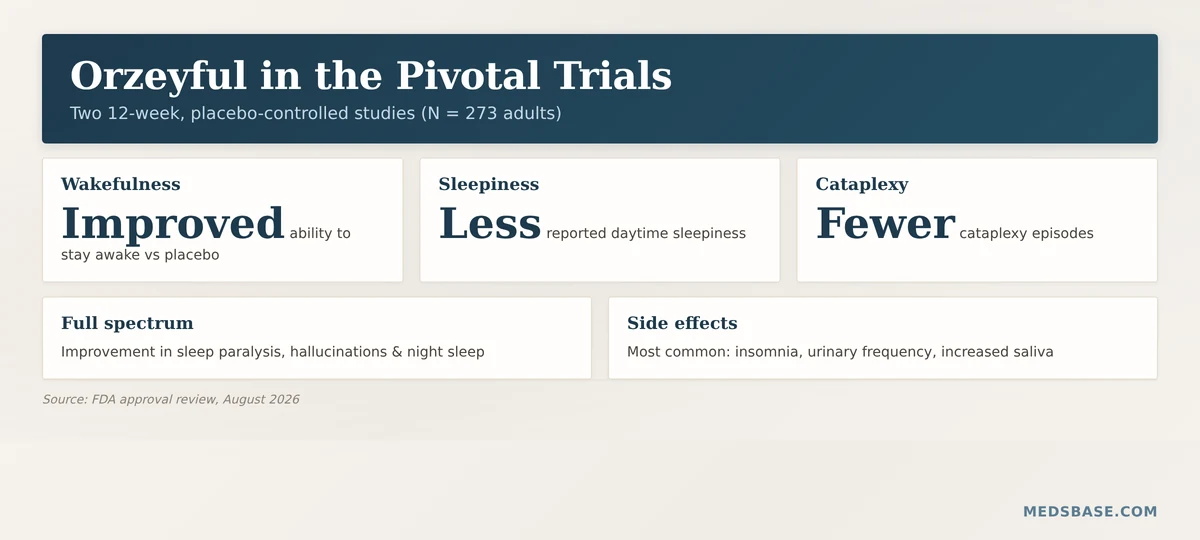
The approval rested on two identically designed 12-week, randomized, placebo-controlled trials. Here’s what they found:
| Study | Year | Finding | Source |
|---|---|---|---|
| Pivotal Trial 1 | 2026 | Orzeyful 2 mg improved ability to stay awake vs placebo | FDA approval review |
| Pivotal Trial 2 | 2026 | Orzeyful 2 mg reduced daytime sleepiness and cataplexy | FDA approval review |
| Combined (N=273) | 2026 | Improvement across full symptom spectrum (sleep paralysis, hallucinations, night sleep) | FDA approval review |
What this means for you: across both studies, patients on Orzeyful 2 mg stayed awake longer during the day, reported substantially less sleepiness, had significantly fewer cataplexy episodes, and saw meaningful improvement in the symptoms older drugs often ignore. It’s worth noting the trials measured subjective sleepiness alongside objective wakefulness — both improved, which is a meaningful combination.
The qualifying language is important. These are two 12-week trials in a relatively small group (273 people). The results are promising and supported the FDA’s decision, but real-world experience will tell us how durable the benefit is and how common the side effects are outside a trial setting.
Orzeyful vs Existing Narcolepsy Treatments
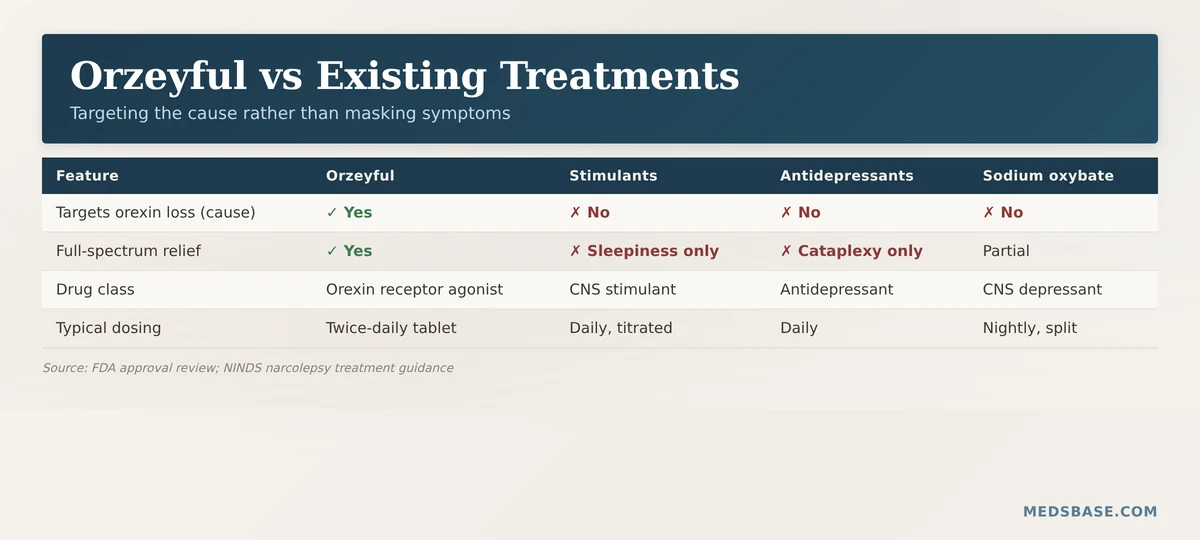
Until Orzeyful, narcolepsy type 1 was managed with a patchwork of symptom-directed drugs. The NHS narcolepsy treatment guidance describes stimulants (for daytime sleepiness), antidepressants (for cataplexy and sleep paralysis), and sodium oxybate (for cataplexy and disturbed night sleep).
| Feature | Orzeyful (oveporexton) | Traditional stimulants | Antidepressants (for cataplexy) | Sodium oxybate |
|---|---|---|---|---|
| Targets cause (orexin loss) | Yes | No | No | No |
| Full-spectrum symptom relief | Yes | Sleepiness only | Cataplexy/sleep paralysis only | Partial |
| Drug class | Orexin receptor agonist | CNS stimulant | Antidepressant | CNS depressant |
| Typical dosing | Twice-daily tablet | Daily, titrated | Daily | Nightly, split doses |
Which fits which situation? If you’ve been managing sleepiness with a stimulant but still struggle with cataplexy or fragmented sleep, Orzeyful’s single-drug, cause-directed approach may be the natural next conversation with your specialist. If cost or availability is a barrier — Orzeyful is brand-new and requires a DEA scheduling decision before it reaches pharmacy shelves — existing, cheaper options may remain the practical choice for now. This is a discussion to have with your doctor, weighing symptom burden against access.
How to Take Orzeyful
Because Orzeyful is not yet on pharmacy shelves (pending the DEA scheduling decision), these are the dosing fundamentals from the approval, not a personal prescription.
Step-by-step:
- Get a confirmed diagnosis. Narcolepsy type 1 requires specialist evaluation — typically a sleep study and often an orexin/hypocretin measurement.
- Review your full medication list. Strong CYP3A inhibitors are a contraindication; your doctor needs the complete picture.
- Start at the prescribed dose. In trials, the 2 mg dose was evaluated; your doctor will set and adjust your dose.
- Take twice daily. The approved regimen is a twice-daily oral tablet.
- Report side effects early. Insomnia, urinary urgency, and increased saliva are the most common — all worth flagging so dosing/timing can be adjusted.
Mistakes to avoid:
- Assuming “cure.” Orzeyful restores a missing signal; it doesn’t replace lost neurons. It’s a treatment, not a cure.
- Hiding supplements. Herbal and OTC products can interact; disclose everything.
- Expecting a stimulant-like kick. Orzeyful works through a different, slower-to-normalize pathway — expectations should be about restored balance, not a caffeine rush.
Related Reading
- Mental Health articles — more on brain chemistry and neuropsychiatric conditions.
- Terbinafine for Fungal Infections — a practical guide to a common medication, written today.
- Pramipexole vs Ropinirole — how two dopamine drugs compare (same chemical family that narcolepsy’s orexin system interacts with).
Frequently Asked Questions
Q: What is the new drug for narcolepsy type 1?
A: The new drug is Orzeyful (oveporexton), approved by the FDA in August 2026. It’s the first medication approved to treat the full range of narcolepsy type 1 symptoms and the first to directly target the loss of orexin signaling that causes the disease.
Q: How does Orzeyful work?
A: Orzeyful is an orexin receptor agonist. Narcolepsy type 1 is caused by the loss of brain cells that produce orexin, a chemical messenger that regulates wakefulness and muscle tone. Orzeyful activates the same receptor orexin would, restoring the missing signal rather than masking symptoms with stimulants.
Q: Is Orzeyful FDA approved?
A: Yes. The FDA approved Orzeyful on August 5, 2026, for narcolepsy type 1 in adults, with Breakthrough Therapy Designation and Priority Review. It is not yet available for sale pending a DEA scheduling decision under the Controlled Substances Act.
Q: What are the side effects of Orzeyful?
A: The most common side effects are insomnia, increased urinary frequency, urinary urgency, and increased saliva production. The rate of people stopping treatment due to side effects was low. Orzeyful should not be taken with strong CYP3A inhibitors.
Q: What is the difference between narcolepsy type 1 and type 2?
A: Narcolepsy type 1 includes cataplexy (sudden muscle weakness triggered by strong emotions) and is caused by a loss of orexin-producing neurons. Narcolepsy type 2 does not include cataplexy, and orexin levels are usually normal. Orzeyful is approved only for type 1.
Q: What causes narcolepsy type 1?
A: Narcolepsy type 1 is caused by the loss of specific brain cells that produce orexin (hypocretin), a chemical messenger that regulates wakefulness, sleep, and muscle tone. Without it, the brain can’t maintain normal alertness or the boundary between sleep and waking.
Q: Is Orzeyful a stimulant?
A: No. Unlike traditional narcolepsy stimulants that push alertness through a different pathway, Orzeyful is an orexin receptor agonist that restores the missing wakefulness signal itself. This is a fundamentally different mechanism of action.
The Bottom Line
Orzeyful (oveporexton) is a genuine first: the first medicine to treat narcolepsy type 1 as a complete disorder, and the first to target its biological cause. The trial data — improved wakefulness, less daytime sleepiness, fewer cataplexy episodes, and broader symptom relief in 273 adults — is encouraging, and the low discontinuation rate is a good early sign for a first-in-class drug.
The balanced verdict: this is a meaningful advance, not a cure. The pivotal trials were 12 weeks, the drug isn’t on shelves yet (pending DEA scheduling), and long-term data still has to accumulate. If you or someone you care about has narcolepsy type 1, the immediate action is to ask your sleep specialist whether Orzeyful might fit when it becomes available — and to keep your full medication list current.
Wondering how this compares to how other brain-chemical drugs work? Read our guide to pramipexole vs ropinirole — a different receptor, but the same “match the drug to the biology” principle. Or, if you’d rather start with a practical medication explainer, see our terbinafine guide.
Medical Disclaimer: This article is for informational purposes only and does not constitute medical advice. Narcolepsy type 1 requires diagnosis and treatment by a qualified healthcare professional. Never start, stop, or change a medication without consulting your doctor.

Written by
Sophie ChenPharmaceutical Content Researcher · 8 years experience
Sophie Chen is a pharmaceutical content researcher with 8 years covering generic medication access and clinical pharmacology. She specialises in international regulatory frameworks, bioequivalence standards, and patient-facing education on therapeutic drug classes. She is not a clinician.