








✓ Medically reviewed by · Last reviewed: May 2026
Pharmacy Researcher · 8 years experience
Pharmacy researcher with 8 years reviewing clinical drug information, generic formulation equivalence, and international pharmaceutical standards. Focuses on patient-facing accuracy in medication education.
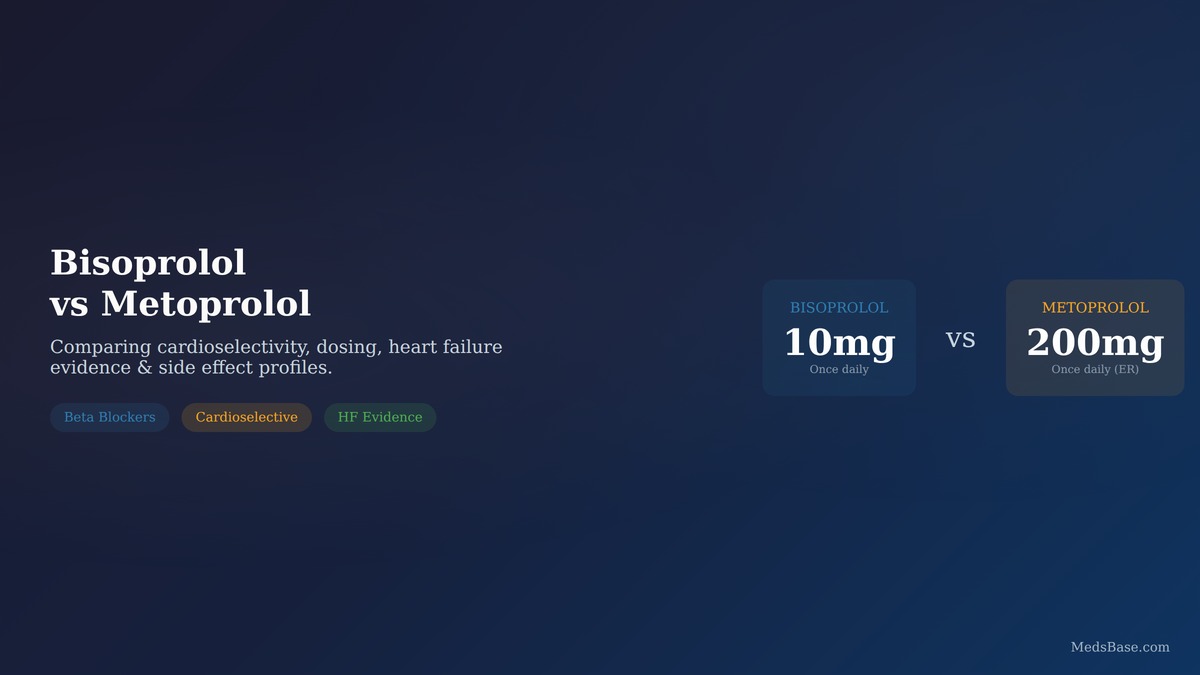
bisoprolol vs metoprolol — Bisoprolol vs Metoprolol: 7 Key Differences & Which Beta Blocker Is Right for You. Read on for an evidence-backed guide covering everything you need to know.
Key Takeaways
- Both bisoprolol and metoprolol are cardioselective beta-1 blockers — but bisoprolol has the highest beta-1 selectivity in the class, meaning less risk of lung-related side effects at therapeutic doses.
- Both have landmark clinical trial evidence for reducing mortality in heart failure: CIBIS-II (bisoprolol) and MERIT-HF (metoprolol succinate) each showed a 34% reduction in all-cause mortality.
- The most practical daily difference: bisoprolol is always once-daily. Metoprolol comes in two forms — metoprolol tartrate (usually twice-daily) and metoprolol succinate (once-daily extended release). Getting the wrong formulation is a common prescribing error.
- For hypertension alone, either is effective — the choice often comes down to tolerability, cost, and whether once-daily dosing matters to you.
- Neither is “stronger” — potency is not the relevant comparison. The two drugs have different pharmacokinetics and different selectivity profiles, and the right choice depends on your specific condition and how you tolerate each one.
- What Are Bisoprolol and Metoprolol?
- How Do Bisoprolol and Metoprolol Work?
- Bisoprolol vs Metoprolol: 7 Key Differences
- Dosing: Bisoprolol vs Metoprolol
- Safety & Side Effects
- What Does the Research Say?
- Bisoprolol vs Metoprolol vs Other Beta Blockers
- How to Take Beta Blockers Safely
- Related Reading
- Frequently Asked Questions
- The Bottom Line
What Are Bisoprolol and Metoprolol?
Bisoprolol vs metoprolol — bisoprolol and metoprolol are two of the most widely prescribed beta blockers in the world. They belong to the same drug class — beta-adrenergic receptor antagonists — and share the same core mechanism: blocking the effects of adrenaline and noradrenaline on the heart. Both are classified as cardioselective beta blockers, meaning they preferentially target beta-1 receptors found in the heart rather than beta-2 receptors found in the lungs and blood vessels.
Despite these similarities, a bisoprolol vs metoprolol comparison reveals clinically meaningful differences. They are not interchangeable at equivalent doses. Their pharmacokinetics differ — bisoprolol has a longer half-life and is always taken once daily, while metoprolol exists in two formulations with different dosing schedules. Their selectivity profiles differ — bisoprolol has the highest beta-1 selectivity of any beta blocker. And while both have proven mortality benefit in heart failure, those benefits were demonstrated in separate landmark trials with different patient populations.
Bisoprolol vs metoprolol — for someone newly prescribed either medication, the question “why this one and not the other?” is entirely reasonable. The answer almost always involves a combination of indication (heart failure vs hypertension vs angina vs arrhythmia), tolerability history, coexisting conditions (especially lung disease), and practical considerations like dosing convenience.
How Do Bisoprolol and Metoprolol Work?
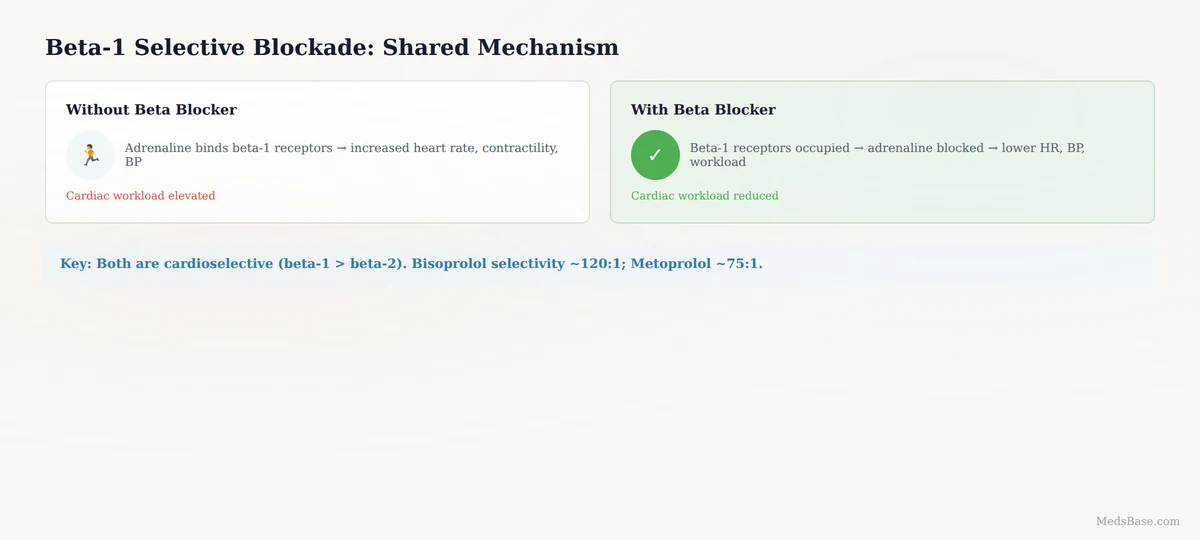
Bisoprolol vs metoprolol — both bisoprolol and metoprolol work through the same basic mechanism: they block beta-1 adrenergic receptors on heart muscle cells.
Bisoprolol vs metoprolol — here is what that means in plain terms. Your sympathetic nervous system — the “fight or flight” branch — releases adrenaline and noradrenaline. These hormones bind to beta-1 receptors on your heart, telling it to beat faster, pump harder, and release renin (which raises blood pressure through the RAAS system). This is useful if a lion is chasing you. It is less useful if you are sitting at your desk with hypertension or living with a weakened heart muscle.
Bisoprolol vs metoprolol — beta blockers step in and occupy those beta-1 receptors without activating them. They are like a key that fits into the lock but does not turn it — while the real key (adrenaline) is blocked from entering. The result: slower heart rate, reduced contractility, lower blood pressure, and reduced cardiac workload.
The cardioselectivity distinction is what separates bisoprolol and metoprolol from older beta blockers like propranolol. Non-cardioselective beta blockers block both beta-1 (heart) and beta-2 (lung) receptors. Blocking beta-2 receptors in the airways can cause bronchoconstriction — dangerous for people with asthma or COPD. Cardioselective beta blockers preferentially target beta-1 receptors, making them safer for patients with respiratory conditions, especially at lower doses.
Bisoprolol vs metoprolol — among cardioselective beta blockers, bisoprolol has the highest beta-1-to-beta-2 selectivity ratio — approximately 120:1, compared to metoprolol’s approximately 75:1. In practice, this means that at therapeutic doses, bisoprolol is slightly less likely to cause bronchospasm or cold extremities, though both are generally well-tolerated in patients without significant lung disease.
Bisoprolol vs Metoprolol: 7 Key Differences
1. Cardioselectivity. Bisoprolol has the highest beta-1 selectivity in the entire beta blocker class (~120:1 ratio of beta-1 to beta-2 blockade). Metoprolol is also cardioselective but has a lower selectivity ratio (~75:1). The clinical significance: at equivalent doses, bisoprolol is marginally less likely to cause bronchial side effects — relevant for patients with mild asthma or COPD, though neither should be used in uncontrolled asthma.
2. Half-life and dosing frequency. Bisoprolol has a long half-life of 10–12 hours and is always taken once daily. Metoprolol tartrate has a short half-life of 3–7 hours and must be taken twice daily for consistent beta blockade. Metoprolol succinate (extended-release) has effective 24-hour coverage and is taken once daily. This formulation distinction is one of the most common sources of confusion — and prescribing errors — in beta blocker therapy.
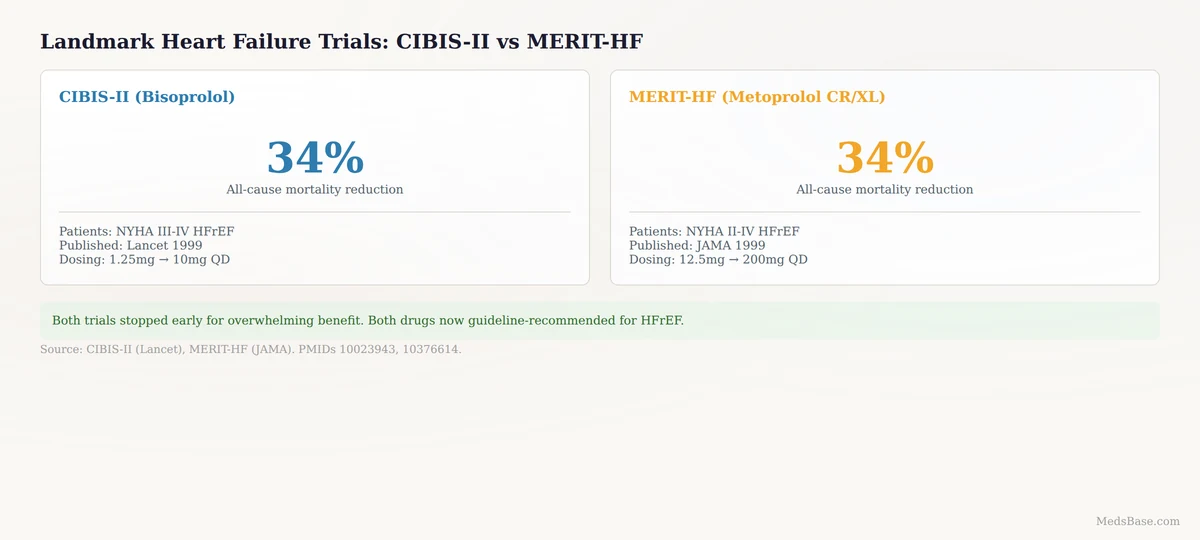
3. Heart failure trial evidence. Both have landmark mortality trials: CIBIS-II for bisoprolol (34% all-cause mortality reduction in NYHA Class III–IV heart failure) and MERIT-HF for metoprolol succinate (34% all-cause mortality reduction in NYHA Class II–IV). The trials used different patient populations and study designs, but the headline mortality benefit is remarkably similar. Neither trial used the tartrate formulation of metoprolol — an important prescribing distinction.
4. Metabolism and drug interactions. Bisoprolol is metabolised equally by the liver and kidneys (50/50), giving it a dual-clearance safety advantage — if one organ system is impaired, the other can compensate. Metoprolol is metabolised primarily by the liver via the CYP2D6 enzyme, making it susceptible to drug interactions with CYP2D6 inhibitors (fluoxetine, paroxetine, bupropion, terbinafine) and to genetic variations in CYP2D6 activity.
5. Lipophilicity and CNS penetration. Metoprolol is more lipophilic (fat-soluble) than bisoprolol, meaning it crosses the blood-brain barrier more readily. This can contribute to CNS side effects like vivid dreams, sleep disturbance, and fatigue — reported more frequently with metoprolol than with bisoprolol in post-marketing surveillance. The clinical relevance varies significantly by individual.
6. Available strengths and formulations. Bisoprolol is available in 1.25mg, 2.5mg, 5mg, and 10mg tablets. Metoprolol tartrate comes in 25mg, 50mg, and 100mg tablets (usually divided twice daily). Metoprolol succinate (extended-release) comes in 25mg, 50mg, 100mg, and 200mg tablets. The strength numbers are not directly comparable — 5mg of bisoprolol is roughly equivalent to 50mg of metoprolol tartrate in terms of beta-blocking effect.
7. Cost and generic availability. Both are available as generics and are generally inexpensive. Pricing varies by region, formulation, and pharmacy. In most markets, metoprolol tartrate is the cheapest beta blocker option due to its high prescribing volume. Metoprolol succinate and bisoprolol are typically comparable in price. The difference for most patients is measured in a few dollars per month.
Dosing: Bisoprolol vs Metoprolol
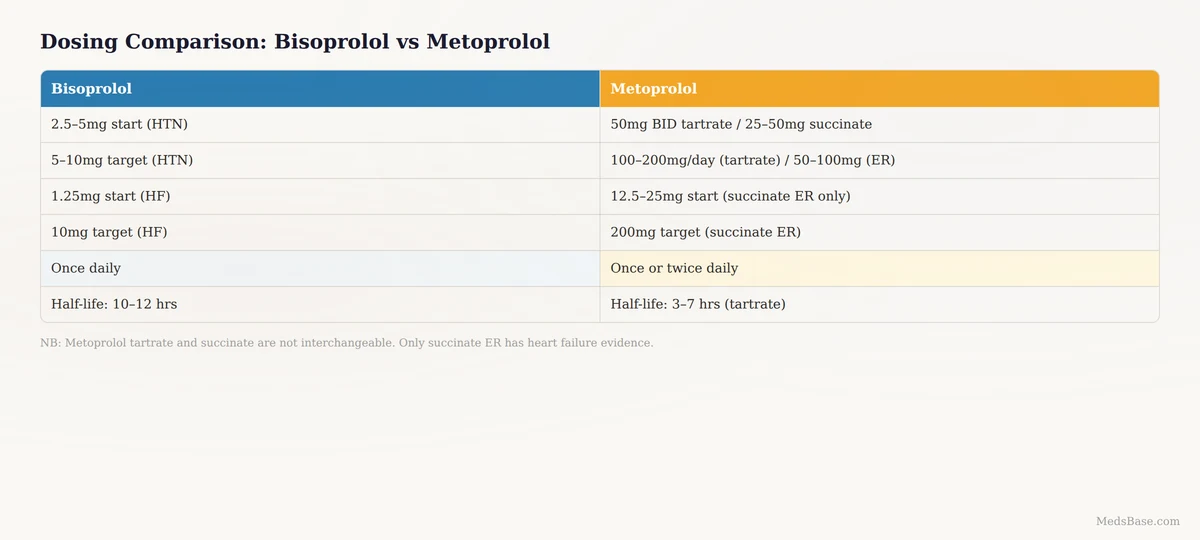
The dosing comparison is where the bisoprolol vs metoprolol distinction becomes most concrete:
| Parameter | Bisoprolol | Metoprolol Tartrate | Metoprolol Succinate (ER) |
|---|---|---|---|
| Starting dose — hypertension | 2.5–5mg once daily | 50mg twice daily (25mg BID if elderly) | 25–50mg once daily |
| Target dose — hypertension | 5–10mg once daily | 100–200mg/day in divided doses | 50–100mg once daily |
| Starting dose — heart failure | 1.25mg once daily | Not indicated for HF | 12.5–25mg once daily |
| Target dose — heart failure | 10mg once daily | Not indicated for HF | 200mg once daily |
| Dosing frequency | Once daily | Twice daily (BID) | Once daily |
| Maximum dose | 20mg/day | 400mg/day in divided doses | 400mg/day |
| Available strengths | 1.25, 2.5, 5, 10mg | 25, 50, 100mg | 25, 50, 100, 200mg |
| Renal dose adjustment | CrCl <20: max 10mg/day | None required | None required |
| Hepatic dose adjustment | Severe impairment: max 10mg/day | Reduce dose in severe impairment | Reduce dose in severe impairment |
Bisoprolol vs metoprolol — the critical point: metoprolol tartrate and metoprolol succinate are not interchangeable on a milligram-for-milligram or dose-for-dose basis. Tartrate requires twice-daily dosing to maintain beta blockade. Succinate provides 24-hour coverage with once-daily dosing. If you are prescribed metoprolol and the label does not specify which formulation, ask — because the dosing frequency and available strengths are completely different.
Bisoprolol vs metoprolol — for heart failure specifically, only bisoprolol and metoprolol succinate have clinical trial evidence. Metoprolol tartrate is not recommended for heart failure. The heart failure dosing protocol differs from hypertension dosing — you start at a very low dose and titrate upward slowly (doubling every 2–4 weeks as tolerated) to the target dose used in the landmark trials.
Safety & Side Effects
Both medications share the side effect profile common to beta blockers, but the severity and frequency of individual side effects differ somewhat between bisoprolol and metoprolol:
| Side Effect | Bisoprolol | Metoprolol | Clinical Note |
|---|---|---|---|
| Fatigue / tiredness | Common (10–15%) | Common (10–20%) | Often improves after 2–4 weeks |
| Bradycardia (slow heart rate) | Dose-dependent | Dose-dependent | Target resting HR 55–70 bpm |
| Dizziness / lightheadedness | Common (5–10%) | Common (5–10%) | More likely during dose titration |
| Cold hands and feet | Less common (3–5%) | Common (5–10%) | Due to peripheral vasoconstriction; bisoprolol’s higher selectivity may reduce this |
| Sleep disturbance / vivid dreams | Uncommon (2–5%) | More common (5–10%) | Metoprolol crosses blood-brain barrier more readily |
| Shortness of breath (bronchospasm) | Uncommon at therapeutic doses | Uncommon at therapeutic doses | Both are cardioselective; risk increases at high doses |
| Erectile dysfunction | Reported (3–5%) | Reported (3–5%) | Mechanism not fully understood; may be partly due to reduced cardiac output |
| Weight gain | Uncommon (1–3%) | Uncommon (1–3%) | Typically modest (1–2 kg); may relate to reduced metabolic rate |
| Depression | Rare; association debated | Rare; association debated | No consistent causal evidence in large studies |
Important safety points for both medications:
- Never stop either medication abruptly — this can cause rebound tachycardia, hypertension, and in patients with coronary artery disease, an increased risk of heart attack or unstable angina. Taper over 1–2 weeks under medical supervision.
- Both can mask the symptoms of hypoglycaemia (low blood sugar) in people with diabetes — particularly the tremors and palpitations that normally serve as warning signs. Sweating is not masked by beta blockers and remains a useful hypoglycaemia indicator.
- In patients with pheochromocytoma (a rare adrenal tumour), beta blockers must only be used after adequate alpha blockade — otherwise, unopposed alpha-adrenergic activity can cause a hypertensive crisis.
What Does the Research Say?
The evidence base for both bisoprolol and metoprolol in heart failure is among the strongest in cardiovascular medicine:
| Study | Drug | Year | Key Finding | Source |
|---|---|---|---|---|
| CIBIS-II | Bisoprolol | 1999 | 34% reduction in all-cause mortality in NYHA III–IV HFrEF | Lancet |
| MERIT-HF | Metoprolol succinate CR/XL | 1999 | 34% reduction in all-cause mortality in NYHA II–IV HFrEF | JAMA |
| COMET | Carvedilol vs metoprolol tartrate | 2003 | Carvedilol superior to metoprolol tartrate (NOT succinate) for mortality in HF | Lancet |
| Bisoprolol vs metoprolol in HTN | Both | 2015 meta-analysis | Comparable BP-lowering efficacy; bisoprolol slightly greater HR reduction at equivalent doses | J Hypertens |
| Beta blocker tolerability meta-analysis | All beta blockers | 2020 | No significant difference in discontinuation rates between bisoprolol and metoprolol succinate | Cochrane |
| Beta blockers in HFrEF — contemporary review | All evidence-based BBs | 2025 | Bisoprolol, metoprolol succinate, and carvedilol remain the three guideline-recommended beta blockers | Circulation |
What this means for you: The evidence for mortality reduction in heart failure is comparable — both bisoprolol and metoprolol succinate reduce the risk of death by approximately 34% in systolic heart failure. For hypertension alone, both are effective at lowering blood pressure, with bisoprolol providing slightly greater heart rate reduction at equivalent doses. The choice between them is rarely about efficacy and almost always about tolerability, dosing convenience, coexisting conditions, and prescriber familiarity.
Bisoprolol vs Metoprolol vs Other Beta Blockers
Beta blockers are not a monolithic class, and understanding where bisoprolol and metoprolol fit in the broader landscape clarifies why a prescriber might choose one over another — or over a different beta blocker entirely.
Bisoprolol vs metoprolol vs carvedilol: Carvedilol is a non-cardioselective beta blocker that also blocks alpha-1 receptors, giving it additional vasodilatory effects. It has heart failure mortality evidence (COPERNICUS trial) and is one of the three guideline-recommended beta blockers for heart failure alongside bisoprolol and metoprolol succinate. Carvedilol tends to lower blood pressure more than either, but its non-selectivity makes it less suitable for patients with asthma. It must be taken twice daily.
Bisoprolol vs metoprolol vs atenolol: Atenolol is cardioselective and was once widely prescribed, but it has fallen out of favour because it lacks heart failure mortality evidence and multiple studies have suggested it is inferior to other antihypertensives for preventing cardiovascular events. It is still used for angina and arrhythmias but is no longer a first-line recommendation for uncomplicated hypertension in most guidelines.
Bisoprolol vs metoprolol vs nebivolol: Nebivolol is the most cardioselective beta blocker available and has the unique property of stimulating nitric oxide release, which causes vasodilation. It has not been tested in a heart failure mortality trial but has good tolerability data. It is an option for hypertension but is less commonly prescribed than bisoprolol or metoprolol.
The broader point: for heart failure with reduced ejection fraction (HFrEF), the evidence supports three beta blockers — bisoprolol, metoprolol succinate, and carvedilol. Switching among these three is less important than reaching the target dose of whichever one a patient tolerates best.
How to Take Beta Blockers Safely
If you have been prescribed bisoprolol or metoprolol, these practical guidelines will help you get the most benefit with the fewest problems:
1. Take it at the same time each day. Consistency maintains steady blood levels. For bisoprolol or metoprolol succinate, morning dosing is standard. For metoprolol tartrate, take your doses approximately 12 hours apart.
2. Do not skip doses or stop suddenly. Abrupt beta blocker withdrawal can trigger rebound hypertension, tachycardia, and in patients with coronary artery disease, acute coronary events. If you need to stop, your doctor will taper the dose over 1–2 weeks.
3. Monitor your heart rate. A resting heart rate of 55–70 beats per minute is a typical target range. If your heart rate consistently drops below 50 bpm or you feel lightheaded, dizzy, or unusually fatigued, contact your prescriber — the dose may need adjustment.
4. Be aware of masking hypoglycaemia. If you have diabetes, beta blockers can blunt the tremors and palpitations that normally warn you of low blood sugar. Sweating is unaffected and remains a reliable hypoglycaemia signal. Monitor your blood glucose more closely during dose changes.
5. Report new or worsening shortness of breath. Although bisoprolol and metoprolol are cardioselective, selectivity is dose-dependent — at higher doses, beta-2 blockade in the lungs can become clinically relevant, especially in patients with underlying asthma or COPD.
6. Discuss all other medications. Metoprolol specifically interacts with several commonly prescribed drugs via CYP2D6: fluoxetine, paroxetine, bupropion, terbinafine, and duloxetine can all increase metoprolol levels. Bisoprolol has fewer CYP450 interactions due to its balanced renal/hepatic clearance.
Related Reading
- Beta Blockers vs Calcium Channel Blockers: Which Blood Pressure Medication Is Right for You?
- Blood Pressure Medication Adherence: A Practical Guide
- ACE Inhibitors vs ARBs: Key Differences & Which One to Choose
- Intensive Blood Pressure Control Cuts Dementia Risk by 15%
Frequently Asked Questions
Q: Which is better, bisoprolol or metoprolol?
A: Neither is universally “better.” Both reduce mortality by 34% in heart failure in landmark trials. For hypertension, both lower blood pressure comparably. The choice depends on individual factors: bisoprolol offers simpler once-daily dosing for everyone and slightly higher cardioselectivity. Metoprolol succinate is also once-daily and is the formulation with heart failure evidence (not metoprolol tartrate). Your doctor will choose based on your specific condition, how you tolerate the medication, coexisting conditions, and cost considerations.
Q: Is bisoprolol stronger than metoprolol?
A: “Stronger” is misleading terminology for beta blockers. Bisoprolol is more potent on a per-milligram basis — 5mg of bisoprolol provides roughly equivalent beta blockade to 50mg of metoprolol tartrate. But potency does not mean superiority. Both drugs can be dose-titrated to achieve the desired therapeutic effect (target heart rate, blood pressure reduction). The relevant comparisons are selectivity, dosing convenience, side effect profile, and trial evidence — not potency.
Q: Can I switch from metoprolol to bisoprolol or vice versa?
A: Yes, but only under medical supervision. Switching between beta blockers requires dose conversion (they are not 1:1 equivalent) and a transition period during which your response is monitored. Common reasons for switching include side effects (fatigue, vivid dreams, cold extremities on metoprolol), desire for simpler once-daily dosing (switching from metoprolol tartrate to bisoprolol), or availability issues. Your doctor will calculate the equivalent starting dose and may titrate upward from there.
Q: What is the difference between metoprolol tartrate and metoprolol succinate?
A: Metoprolol tartrate is immediate-release, has a short half-life (3–7 hours), and must be taken twice daily. It is approved for hypertension and angina. Metoprolol succinate is extended-release, provides 24-hour coverage, is taken once daily, and is the formulation with heart failure mortality evidence. They are NOT interchangeable. If your prescription just says “metoprolol,” confirm which formulation your doctor intended.
Q: Does bisoprolol cause fewer side effects than metoprolol?
A: The side effect profiles overlap significantly, but there are two areas where bisoprolol may have an advantage: (1) CNS side effects like vivid dreams and sleep disturbance appear less common with bisoprolol because it is less lipophilic and crosses the blood-brain barrier less readily; (2) cold extremities may be less common due to bisoprolol’s higher beta-1 selectivity, which means less beta-2-mediated peripheral vasoconstriction. That said, individual responses vary widely — some patients tolerate one much better than the other for reasons that are not fully predictable.
Q: Which beta blocker is best for heart failure?
A: Three beta blockers have guideline-recommended status for heart failure with reduced ejection fraction (HFrEF): bisoprolol (CIBIS-II trial), metoprolol succinate (MERIT-HF trial), and carvedilol (COPERNICUS trial). All three reduced all-cause mortality by approximately 34–35% in their respective trials. The most important factor is not which one you take — it is reaching the target dose that was used in the clinical trial. Many patients are under-dosed on beta blockers for heart failure. The best beta blocker is the one you tolerate at the target dose.
Q: Can I take bisoprolol or metoprolol if I have asthma?
A: Cardioselective beta blockers like bisoprolol and metoprolol are considered safer than non-selective beta blockers for patients with mild, stable asthma, but they are not risk-free. At low-to-moderate doses, beta-1 selectivity generally spares beta-2 receptors in the airways. At higher doses, selectivity can be lost, and bronchospasm becomes a risk. If you have asthma and need a beta blocker, your doctor will likely start at the lowest possible dose, monitor pulmonary function, and have you report any increase in wheezing or shortness of breath. Uncontrolled or severe asthma remains a relative contraindication.
Q: How long do bisoprolol and metoprolol take to work?
A: Both begin lowering heart rate and blood pressure within hours of the first dose. However, the full therapeutic benefit — particularly the mortality reduction in heart failure — takes weeks to months of sustained treatment. This is not a medication where you feel a dramatic difference on day one. The benefits are measured in long-term outcomes: fewer hospitalisations, slower disease progression, and extended survival. Patience with the slow dose-titration process (up-titrating every 2–4 weeks in heart failure) is essential.
The Bottom Line
The bisoprolol vs metoprolol comparison is not a contest with a single winner. Both are effective, evidence-backed cardioselective beta blockers with proven mortality benefit in heart failure. The differences that matter — dosing frequency, selectivity ratio, metabolic pathway, CNS penetration — are clinically relevant but not decisive for most patients.
If you have been prescribed one and are tolerating it well, there is rarely a reason to switch. If you are struggling with side effects (vivid dreams and fatigue on metoprolol; or simply the inconvenience of twice-daily metoprolol tartrate), a conversation with your doctor about switching to the alternative is reasonable and common. If you are newly diagnosed with hypertension or heart failure and your doctor is choosing between them, the decision will likely turn on dosing simplicity, your other medications, any history of lung disease, and local prescribing patterns.
Your immediate action: Check your prescription. If it says “metoprolol” without specifying tartrate or succinate, ask your doctor or pharmacist which formulation you are taking and whether it is being dosed correctly for your condition. This single clarification prevents one of the most common prescribing errors in cardiovascular medicine.
What to read next:
- Wondering how beta blockers compare to other blood pressure medication classes? Read our beta blockers vs calcium channel blockers guide.
- Looking for practical tips on staying consistent with your medication? Our blood pressure medication adherence guide covers what actually works.
Medical Disclaimer: This article is for informational purposes only and does not constitute medical advice. Beta blockers are prescription medications that require individual assessment and ongoing monitoring. Never start, stop, or change the dose of a beta blocker without consulting your doctor. Abrupt discontinuation can be dangerous.

Written by
Sophie ChenPharmaceutical Content Researcher · 8 years experience
Sophie Chen is a pharmaceutical content researcher with 8 years covering generic medication access and clinical pharmacology. She specialises in international regulatory frameworks, bioequivalence standards, and patient-facing education on therapeutic drug classes. She is not a clinician.