








✓ Medically reviewed by · Last reviewed: May 2026
Pharmacy Researcher · 8 years experience
Pharmacy researcher with 8 years reviewing clinical drug information, generic formulation equivalence, and international pharmaceutical standards. Focuses on patient-facing accuracy in medication education.
compounding pharmacy safety — Compounding Pharmacy Safety. Read on for an evidence-backed guide covering everything you need to know.
Hero Intro
In the fall of 2012, 64 people died and more than 750 fell ill across 20 US states — all from contaminated steroid injections produced by a single compounding pharmacy. The New England Compounding Center had shipped vials of methylprednisolone acetate contaminated with fungal organisms, injecting them directly into patients’ spinal fluid. It remains the deadliest pharmacy-safety failure in American history.
The tragedy reshaped US compounding regulation. Yet more than a decade later, compounding pharmacy safety is back in the headlines — this time driven by the GLP-1 medication boom and a surge in demand for lower-cost compounded semaglutide and tirzepatide. Understanding compounding pharmacy safety is no longer a niche concern for rare-disease patients — it is relevant to millions of people considering weight loss and hormone therapy treatments.
By the end of this guide, you will know exactly how to check whether a compounding pharmacy meets safety standards, the one question that instantly separates reputable facilities from risky ones, and a simple 30-second online search that could protect you from contaminated medication.
Here is a number that might surprise you: there are approximately 7,500 compounding pharmacies in the United States — and not all of them are held to the same standard. We will explain the difference.
Key Takeaways
- Compounding pharmacy safety depends on which regulatory tier the facility operates under — 503A (state-regulated, individual prescriptions) versus 503B (FDA-registered, cGMP standards, larger batches)
- Not all compounded medications are created equal — compounded semaglutide often uses salt forms (sodium or acetate) that are NOT the same as FDA-approved semaglutide base
- You can verify a compounding pharmacy’s legitimacy in about 30 seconds using your state’s board of pharmacy website and the FDA’s 503B registry
- The single most important question to ask: “What form of the active ingredient do you use, and can you provide a certificate of analysis?”
- Legitimate compounding pharmacies welcome questions about their processes — evasiveness is the biggest red flag
- Compounded medications are never FDA-approved as finished products — this is a fundamental distinction many consumers misunderstand
- What Is Compounding Pharmacy Safety?
- How Is Compounding Regulated?
- The Risks: What Can Go Wrong With Compounded Medications
- Compounding Pharmacy Safety: 6 Red Flags You Must Never Ignore
- What Does the Research & Regulatory History Say?
- How to Verify a Compounding Pharmacy in 8 Steps
- Compounded vs FDA-Approved Medications: The Real Differences
- Frequently Asked Questions
- The Bottom Line
What Is Compounding Pharmacy Safety?
Quick Answer: Compounding pharmacy safety refers to the regulatory standards, facility practices, and quality controls that ensure compounded medications — custom-mixed drugs prepared for individual patients — are sterile, accurately dosed, free from contamination, and made with verified active pharmaceutical ingredients. When these standards fail, the consequences range from ineffective treatment to life-threatening infections.
Drug compounding is the centuries-old practice of a pharmacist preparing a customised medication for a specific patient. Unlike mass-manufactured drugs that come in standard doses and forms, compounded medications are mixed to order — perhaps because a patient needs a liquid version of a pill they cannot swallow, a dye-free formulation due to allergy, or a specific dose not commercially available.
This is a legitimate and essential part of pharmacy practice. Neonatal intensive care units rely on compounded medications for premature infants who need micro-doses. Dermatologists prescribe compounded creams with custom ingredient combinations. Allergy specialists depend on compounded allergen extracts for immunotherapy.
But compounding pharmacy safety becomes a concern when the line blurs between legitimate patient-specific compounding and what is essentially unregulated small-scale drug manufacturing. This is precisely what happened with the GLP-1 medication surge. When semaglutide and tirzepatide were in shortage, compounding pharmacies began producing their own versions — often using salt forms of the active ingredient that had never been tested in humans, shipped in multi-dose vials with unknown sterility and stability profiles.
The fundamental tension in compounding pharmacy safety is this: compounding serves a genuine medical need, but it operates with less regulatory oversight than FDA-approved drug manufacturing. Knowing where to draw the line — and how to check which side of it your pharmacy falls on — is what this guide will teach you.
How Is Compounding Regulated? — Compounding pharmacy safety Explained
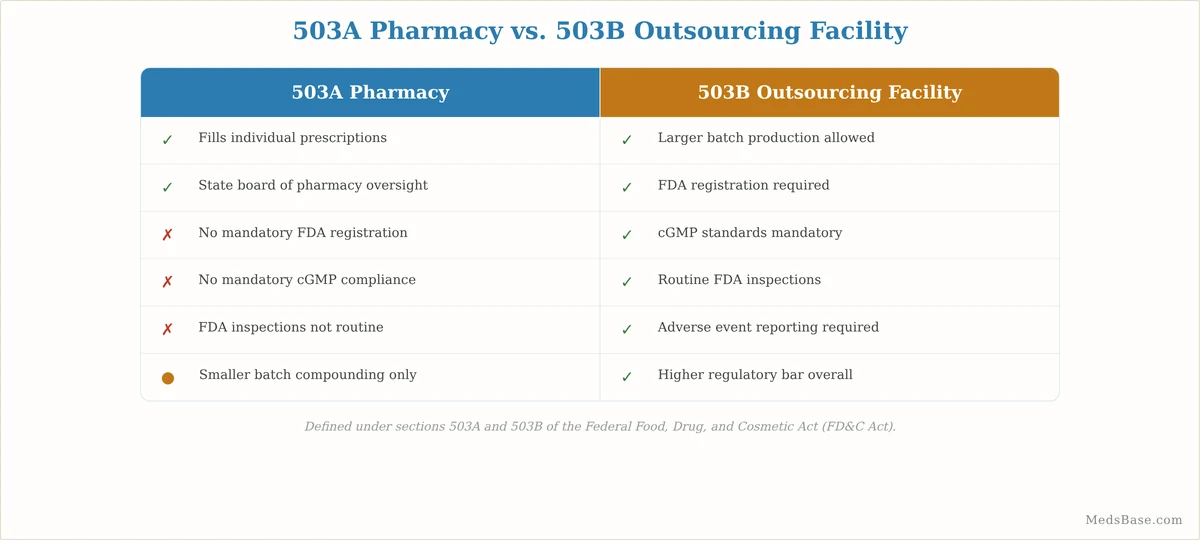
Research Spotlight: The regulatory framework for compounding in the United States changed fundamentally after the 2012 NECC outbreak. The Drug Quality and Security Act (DQSA), signed into law in 2013, created a two-tier system: traditional 503A compounding pharmacies (regulated primarily by state boards of pharmacy) and 503B outsourcing facilities (registered with the FDA and held to current Good Manufacturing Practice standards). Understanding this distinction is the single most important concept in compounding pharmacy safety.
Think of it like this: the 2012 NECC tragedy revealed a regulatory gap. Traditional compounding pharmacies compounded for individual patients — that was always the model. But some pharmacies, like NECC, were operating as small-scale drug manufacturers: producing large batches of sterile injectables and shipping them across state lines. They fell into a regulatory grey zone — too large for traditional state pharmacy oversight, but not subject to FDA drug-manufacturing rules.
The DQSA closed that gap by creating the 503B category. Here is how the two tiers compare:
503A — Traditional Compounding Pharmacies:
- Compound medications for individual patients with a valid prescription
- Regulated primarily by state boards of pharmacy
- Follow USP compounding standards (USP <795> for non-sterile, USP <797> for sterile)
- Are NOT registered with the FDA
- Are NOT required to follow cGMP (current Good Manufacturing Practice)
- Cannot compound drugs that appear on an FDA “do not compound” list
- Limited batch sizes — cannot mass-produce
503B — Outsourcing Facilities:
- Can compound larger batches for healthcare facilities (hospitals, clinics)
- Must register with the FDA and are subject to FDA inspection
- Must follow cGMP standards — the same quality standards as pharmaceutical manufacturers
- Must report adverse events to the FDA
- Must label products with “This is a compounded drug” and a list of active ingredients
- Are subject to FDA’s risk-based inspection schedule
Here is the practical takeaway for compounding pharmacy safety: if your medication comes from a 503B outsourcing facility, it was made under FDA oversight with manufacturer-level quality standards. If it comes from a traditional 503A pharmacy, the quality standards depend entirely on your state board of pharmacy and the individual pharmacy’s practices — which vary considerably.
The FDA maintains a public registry of 503B outsourcing facilities that you can check in seconds.
The Risks: What Can Go Wrong With Compounded Medications
Compounding pharmacy safety matters because when compounding goes wrong, it goes catastrophically wrong. Here are the main categories of risk:
Contamination
This is the most feared failure mode. If a sterile compounding area is not properly maintained — wrong air pressure, inadequate filtration, improper gowning, contaminated raw materials — bacteria or fungi can enter the product. When that product is injected (as with the NECC steroids, or as with compounded GLP-1 injectables), the contamination bypasses the body’s external defences and can cause meningitis, bloodstream infections, or abscesses. The CDC documented the 2012 NECC fungal meningitis outbreak as the worst pharmacy-safety event in US history: 64 deaths, 753 cases across 20 states.
Incorrect Active Ingredient Form
This is the compounding pharmacy safety issue most relevant to today’s GLP-1 market. FDA-approved semaglutide exists as the “base” form. Some compounding pharmacies use semaglutide sodium or semaglutide acetate — salt forms — because the base form is patent-protected or difficult to source. These salt forms have different pharmacokinetics. The FDA has explicitly stated that it “is not aware of any basis for compounding using these salt forms that would meet the requirements for compounding” and has issued multiple warning letters. Taking semaglutide sodium instead of semaglutide base is not the same medication — and there is zero published clinical trial data on its safety or efficacy in humans.
Dosing Inaccuracy
Compounded products are not subject to the same batch-testing requirements as manufactured drugs. A study published in JAMA in 2017 found that among compounded levothyroxine samples, potency ranged from 73% to 124% of the labelled dose. For a medication with a narrow therapeutic window, that range is the difference between ineffective treatment and toxicity.
Stability and Sterility Failure
FDA-approved injectable medications must demonstrate sterility and stability throughout their labelled shelf life. Compounded injectables may not have been tested for how long they remain sterile after the vial is first punctured — a critical question for multi-dose vials used over weeks or months. If a compounded semaglutide vial is designed for four weekly doses but loses sterility after two weeks, the patient is injecting contaminated product without knowing it.
Compounding Pharmacy Safety: 6 Red Flags You Must Never Ignore
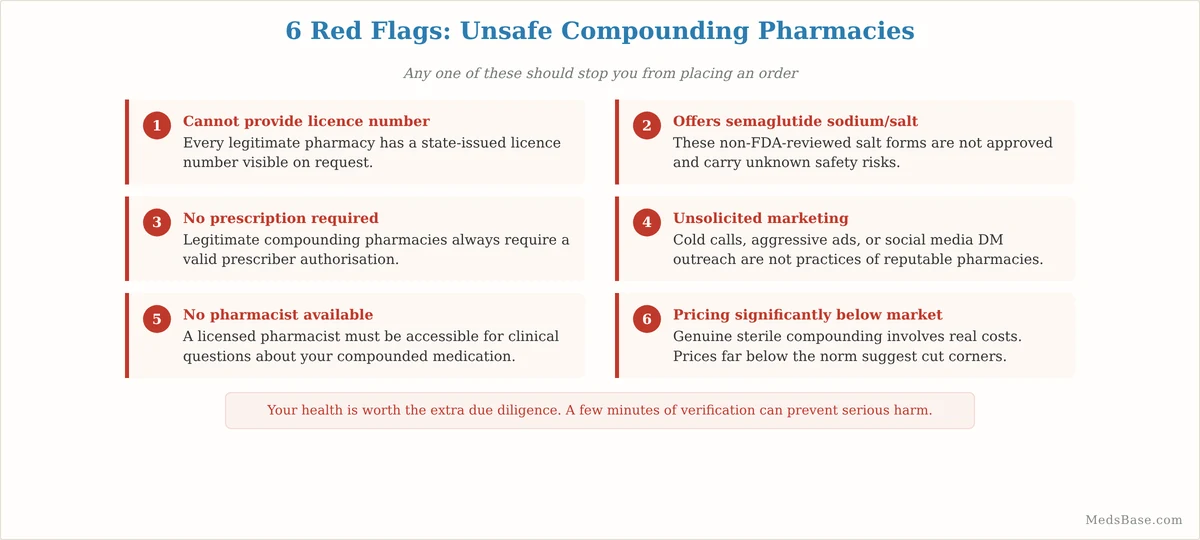
Quick Answer: Any compounding pharmacy that cannot immediately provide its state license number, cannot explain what form of the active ingredient it uses, or promotes compounded drugs through social media and unsolicited ads — especially with “no prescription needed” messaging — is a compounding pharmacy safety risk. Walk away.
1. They cannot — or will not — provide their state pharmacy license number.
Every legitimate pharmacy in the United States holds a license from its state board of pharmacy. Ask for the license number. Then verify it on your state’s board of pharmacy website. Many state boards maintain online license lookup tools that take less than a minute to use. If the pharmacy hesitates, makes excuses, or provides a number that does not check out, stop immediately. Compounding pharmacy safety starts with licensure — no license means no legitimate operation.
2. They offer semaglutide sodium or semaglutide acetate as their active ingredient.
FDA-approved semaglutide is the base form. The salt forms — sodium and acetate — are not FDA-approved, have not undergone human clinical trials, and have been the subject of multiple FDA warning letters. If a compounding pharmacy is offering compounded semaglutide and cannot tell you what form of the API (active pharmaceutical ingredient) they use, or if they use a salt form, this is a clear compounding pharmacy safety red flag. The FDA has stated that these salt forms do not meet compounding requirements under federal law.
3. They do not require a prescription.
Compounded medications are, by definition, prepared for an individual patient based on a valid prescription from a licensed prescriber — this is a core requirement under both 503A and 503B pathways. Any pharmacy offering compounded medications without requiring a prescription is operating outside the law and outside any meaningful quality-control framework. This is not a “convenience” — it is a fundamental compounding pharmacy safety violation.
4. They market compounded drugs aggressively, especially through social media.
Legitimate compounding pharmacies grow through relationships with prescribers, not through Instagram ads. Weight-loss clinics and telehealth platforms marketing “compounded semaglutide at a fraction of the cost” through social media and targeted ads should be approached with extreme caution. Many of these operations are marketing fronts that source from the cheapest compounding facility available — with little regard for compounding pharmacy safety or ingredient quality.
5. No pharmacist is available to answer your questions.
Ethical compounding is pharmacist-led. If you call and a sales representative — not a pharmacist — answers your technical questions about sterility testing, ingredient sourcing, or beyond-use dating, that is a problem. Pharmacists have a professional and legal obligation to counsel patients. If the pharmacy seems structured to prevent you from speaking to one, compounding pharmacy safety is not their priority.
6. The pricing is dramatically below market.
Quality active pharmaceutical ingredients cost money. Maintaining a sterile compounding environment costs money. Batch testing costs money. If compounded semaglutide is being offered at $75 per month when the average legitimate compounding price is $200–400 per month, something is being cut — and it is almost certainly quality, sterility, or ingredient authenticity. In compounding pharmacy safety, you generally get what you pay for.
What Does the Research & Regulatory History Say?
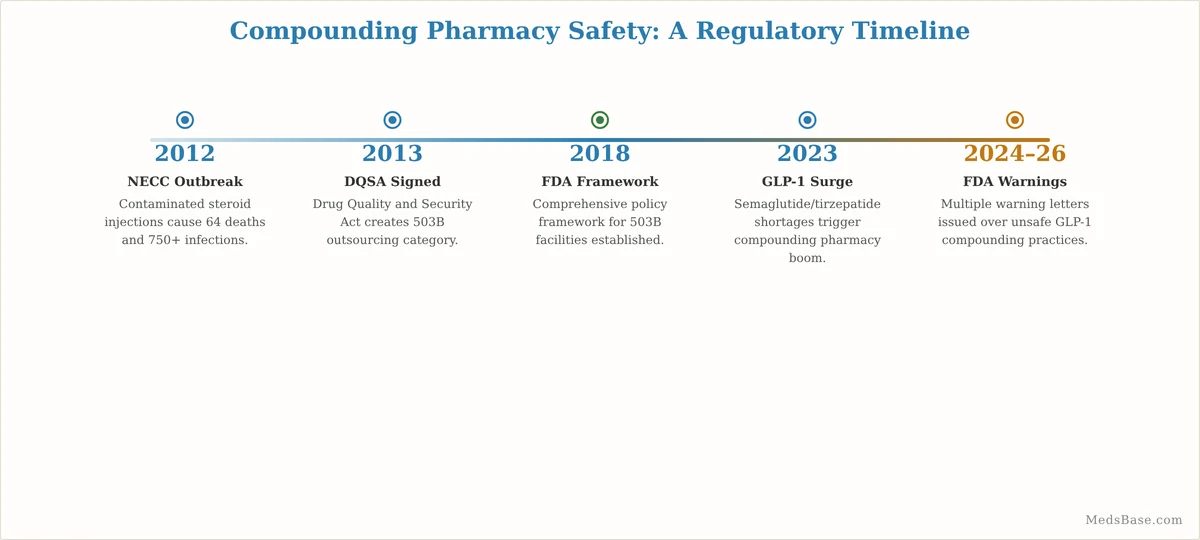
| Event / Source | Year | Key Finding | Source |
|---|---|---|---|
| NECC fungal meningitis outbreak | 2012 | 64 deaths, 753 cases — contaminated methylprednisolone acetate injections from a single compounding pharmacy | CDC |
| Drug Quality and Security Act | 2013 | Created the two-tier 503A/503B system, closing the regulatory gap exploited by NECC | US Congress |
| FDA compounding policy framework | 2018 | Established risk-based enforcement priorities for human drug compounding | FDA |
| JAMA levothyroxine potency study | 2017 | Compounded levothyroxine potency ranged 73–124% of labelled dose — dosing accuracy concern | JAMA |
| GLP-1 compounding surge begins | 2023 | Semaglutide/tirzepatide shortages triggered a wave of compounding for weight loss | — |
| FDA warning: semaglutide salt forms | 2024–2026 | Multiple FDA warning letters and safety alerts about semaglutide sodium/acetate compounding | FDA |
| WebMD compounding safety special report | Sep 2026 | Ongoing cases of infections linked to compounded amino acid injections | WebMD |
The pattern is clear: every major compounding pharmacy safety crisis has been followed by regulatory reform, and then by a new category of medications driving compounding demand faster than oversight can keep up. The NECC outbreak led to the DQSA. The GLP-1 surge is now testing whether the system built after 2012 is sufficient for 2026’s compounding landscape. The FDA’s warning letters about semaglutide salt forms suggest it is struggling.
How to Verify a Compounding Pharmacy in 8 Steps
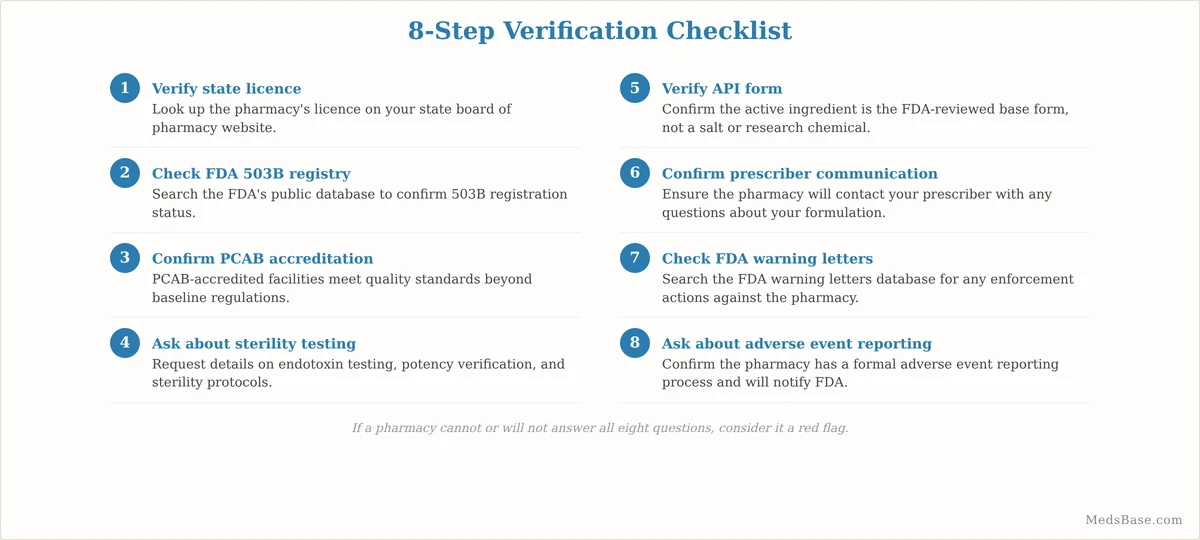
Quick Answer: You can perform a basic compounding pharmacy safety verification in about 5 minutes. Start with your state’s board of pharmacy license lookup, check the FDA 503B registry if applicable, and confirm PCAB accreditation. If the pharmacy checks all three boxes, you are dealing with a facility that takes safety seriously.
Step 1: Verify the state pharmacy license. Go to your state’s board of pharmacy website (search “[your state] board of pharmacy license lookup”). Enter the pharmacy’s name or license number. Confirm that the license is active and in good standing. Some state boards also list disciplinary actions — check for those.
Step 2: Check FDA 503B registration (if applicable). If the pharmacy claims to be a 503B outsourcing facility, verify it on the FDA’s public registry. This list is searchable and updated regularly. A facility that claims 503B status but does not appear on this list is misrepresenting itself — a major compounding pharmacy safety red flag.
Step 3: Look for PCAB accreditation. The Pharmacy Compounding Accreditation Board (PCAB) offers voluntary accreditation that goes beyond state licensing requirements. PCAB-accredited pharmacies have demonstrated compliance with USP compounding standards through an external audit. While not mandatory, PCAB accreditation is a strong positive signal for compounding pharmacy safety. Check at pcab.org.
Step 4: Ask about sterility testing protocols. If you are receiving an injectable compounded medication, ask: “Do you perform sterility testing on each batch? What method do you use? Can I see a summary of your sterility test results?” A legitimate compounding pharmacy will have a clear answer — typically USP <71> sterility testing with a 14-day incubation. Vague or dismissive answers are concerning.
Step 5: Confirm the API form. Ask explicitly: “What form of the active ingredient do you use — base, salt, or ester? Can you provide a certificate of analysis from your API supplier?” For GLP-1 medications, the correct answer is the base form (semaglutide base, tirzepatide base), sourced from an FDA-registered API manufacturer. Salt forms (sodium, acetate) or inability to produce a certificate of analysis are deal-breakers.
Step 6: Verify prescriber communication protocol. Ask: “Do you communicate directly with my prescriber about this prescription? Can you send documentation to my doctor?” A compounding pharmacy that operates without prescriber communication is either operating illegally or operating dangerously — and compounding pharmacy safety requires two-way clinical communication.
Step 7: Check the FDA warning letter database. Search the FDA’s warning letter database for the pharmacy name. Warning letters are public and indicate the FDA found significant violations during an inspection. A pharmacy with unresolved FDA warning letters should be avoided. Search at fda.gov/inspections-compliance-enforcement-and-criminal-investigations/compliance-actions-and-activities/warning-letters.
Step 8: Ask about adverse event reporting. Ask: “What is your process if a patient reports an adverse reaction to a compounded medication? Do you report adverse events to the FDA?” 503B facilities are required to report adverse events; 503A pharmacies are encouraged to. A pharmacy that has no adverse event reporting process at all is not operating with adequate compounding pharmacy safety protocols.
Compounded vs FDA-Approved Medications: The Real Differences
| Aspect | FDA-Approved Drug | Compounded Medication |
|---|---|---|
| FDA approval required | Yes — undergoes clinical trials (Phase 1–3) | No — compounded drugs are NOT FDA-approved as finished products |
| Manufacturing standards | cGMP (current Good Manufacturing Practice) | Variable — cGMP only for 503B facilities; 503A follows USP standards |
| Batch testing | Required — potency, purity, sterility, stability | Variable — 503B must test; 503A standards depend on state requirements |
| Active ingredient | FDA-reviewed for safety and efficacy | Must use FDA-registered API source but finished product is not reviewed |
| Labelling | Standardised prescribing information | Variable — must list active ingredients but may lack full safety information |
| Adverse event reporting | Mandatory, systematic | Mandatory for 503B; voluntary for 503A |
| Sterility assurance | Validated processes; stability-tested | Dependent on individual pharmacy practices |
| Cost | Typically higher (brand pricing) | Typically lower (but with quality trade-offs) |
Which is right for you? FDA-approved medications are always the first choice when they meet your clinical needs — they offer guaranteed quality, proven efficacy, and systematic safety monitoring. Compounded medications are appropriate when an FDA-approved option does not exist in the form, dose, or formulation you need — but only when sourced from a verified, properly regulated facility following every compounding pharmacy safety standard. If you are considering compounded GLP-1 medications specifically to save money, read our microdosing GLP-1 medications guide — there may be safer alternatives using standard FDA-approved products at lower doses.
Related Reading
Frequently Asked Questions
Q: How do I know if a compounding pharmacy is safe?
A: A: Start with three quick verifications: check the pharmacy’s state license on your state board of pharmacy website, confirm FDA 503B registration if the pharmacy claims outsourcing-facility status, and look for PCAB accreditation. Then ask the pharmacy directly about their sterility testing protocol and what form of the active ingredient they use. A safe compounding pharmacy will answer all of these questions clearly and without hesitation. If any answer is vague, dismissive, or unavailable, treat it as a compounding pharmacy safety concern.
Q: What is the difference between 503A and 503B compounding pharmacies?
A: A: 503A pharmacies compound for individual patients with a prescription and are regulated primarily by state boards of pharmacy. They follow USP standards but not cGMP. 503B outsourcing facilities can compound larger batches for healthcare facilities, must register with the FDA, are subject to FDA inspection, and must follow cGMP — the same quality standards as pharmaceutical manufacturers. For injectable medications in particular, 503B facilities offer a higher level of compounding pharmacy safety assurance.
Q: Are compounded medications FDA-approved?
A: A: No — this is a critical distinction. The FDA does not approve compounded medications as finished products. The active pharmaceutical ingredients (APIs) used in compounding must come from FDA-registered facilities, but the compounded finished product itself has not been reviewed for safety, efficacy, or quality by the FDA. This means the sterility, potency, and stability of a compounded medication depend entirely on the individual pharmacy’s practices — which is why compounding pharmacy safety verification is entirely on you as the consumer.
Q: What are the risks of compounded drugs?
A: A: The three main risks are contamination (bacteria or fungi in the product — particularly dangerous for injectables), incorrect active ingredient (using salt forms or unverified APIs that differ from the approved medication), and dosing inaccuracy (too little or too much active ingredient). A 2017 JAMA study found that compounded levothyroxine potency varied from 73% to 124% of the labelled dose. For medications with narrow therapeutic windows, this range can mean the difference between therapeutic failure and toxicity.
Q: How to check if a compounding pharmacy is licensed?
A: A: Every state board of pharmacy maintains a public license lookup tool — search “[your state] board of pharmacy license verification.” Enter the pharmacy’s name or license number. The search takes about 30 seconds and tells you whether the license is active, when it expires, and whether any disciplinary actions exist. Some states also integrate with the National Association of Boards of Pharmacy (NABP) e-Profile system for cross-state verification. This is the simplest and most important step in compounding pharmacy safety.
Q: What happened with the New England Compounding Center?
A: A: In 2012, the New England Compounding Center (NECC) in Framingham, Massachusetts, shipped approximately 17,000 vials of contaminated methylprednisolone acetate — a steroid injection — to 23 states. The vials were contaminated with fungal organisms (primarily Exserohilum rostratum) during the compounding process due to inadequate sterility practices. The result: 753 cases of fungal meningitis and other infections, and 64 deaths. The NECC tragedy led directly to the Drug Quality and Security Act of 2013, which created the 503B outsourcing facility category and fundamentally restructured compounding pharmacy safety regulation in the United States.
Q: Can I trust online compounding pharmacies?
A: A: Exercise extreme caution. Many online “pharmacies” offering compounded medications — especially GLP-1 drugs at dramatically discounted prices — are marketing operations, not pharmacies themselves. They may source from unknown compounding facilities, may not verify prescriptions properly, and may use the cheapest available ingredients rather than quality-verified APIs. The minimum verification: confirm the actual compounding facility’s name and address, then run it through your state board of pharmacy license lookup and the FDA 503B registry. If an online provider refuses to disclose which pharmacy compounds their products, do not use them.
Q: Should I ever use a compounded GLP-1 medication?
A: A: The safest path is to use FDA-approved GLP-1 products — Wegovy, Mounjaro, Zepbound, Ozempic — at doses prescribed by your doctor. Compounded GLP-1 medications introduce compounding pharmacy safety risks that FDA-approved products eliminate. However, if cost or shortage makes approved products inaccessible, and you and your doctor decide compounded medication is your only option, verify the compounding pharmacy against every step in this guide — with special attention to the active ingredient form (must be base, never sodium or acetate salt) and sterility testing for injectable products. Our guide on microdosing FDA-approved GLP-1 medications describes a potentially safer alternative that stays within the approved-product ecosystem.
The Bottom Line
Compounding pharmacy safety is not something the system will guarantee for you — it is something you must verify for yourself. The regulatory framework has improved dramatically since the NECC tragedy, but the GLP-1 compounding boom has opened new gaps that the FDA is still struggling to close.
The good news: with about 5 minutes and an internet connection, you can check the three things that matter most — state licensure, FDA 503B registration (if applicable), and PCAB accreditation. A pharmacy that clears all three is almost certainly operating with legitimate compounding pharmacy safety standards. A pharmacy that cannot clear even one is not worth the risk.
Your immediate action: if you are currently using or considering a compounded medication, pull up your state’s board of pharmacy website right now and verify the pharmacy’s license. It takes 30 seconds. If it checks out, great — now ask about the API form. If it does not, stop taking the medication and contact your doctor.
What to read next:
- Microdosing GLP-1 Medications: A Safer Alternative to Compounded Products?
- What to Do If Your Medication Is Recalled: A Step-by-Step Guide
Medical Disclaimer: This article is for informational purposes only and does not constitute medical or legal advice. Always consult your prescribing doctor before starting, stopping, or changing any medication — including compounded medications. If you suspect a compounded medication has caused harm, report it to your doctor immediately and to the FDA’s MedWatch programme at fda.gov/safety/medwatch. Never purchase compounded medications from a pharmacy that does not require a valid prescription or cannot provide verifiable state licensure.

Written by
Sophie ChenPharmaceutical Content Researcher · 8 years experience
Sophie Chen is a pharmaceutical content researcher with 8 years covering generic medication access and clinical pharmacology. She specialises in international regulatory frameworks, bioequivalence standards, and patient-facing education on therapeutic drug classes. She is not a clinician.