








✓ Medically reviewed by · Last reviewed: May 2026
Pharmacy Researcher · 8 years experience
Pharmacy researcher with 8 years reviewing clinical drug information, generic formulation equivalence, and international pharmaceutical standards. Focuses on patient-facing accuracy in medication education.
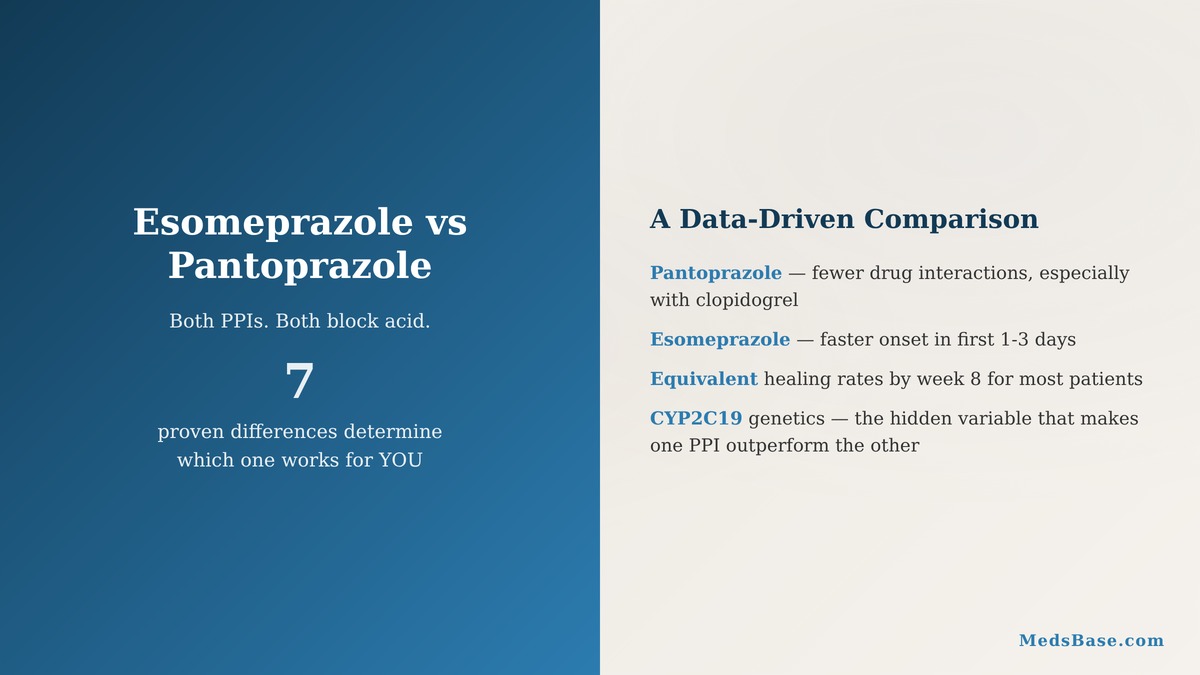
esomeprazole vs pantoprazole — Esomeprazole vs Pantoprazole — 7 Proven Differences to Choose the Right PPI. Read on for an evidence-backed guide covering everything you need to know.
Key Takeaways
- Esomeprazole and pantoprazole are both proton pump inhibitors (PPIs), but they differ in three clinically significant ways: metabolism, drug interaction profile, and how quickly they reach full acid suppression
- Pantoprazole has fewer drug-drug interactions — and the difference matters most if you take clopidogrel, an anti-seizure medication, or methotrexate
- Esomeprazole achieves faster and slightly more complete acid control in the first few days of treatment, which may matter for acute symptom relief
- The CYP2C19 genetic pathway is the hidden variable — if you are a “rapid metaboliser,” esomeprazole may clear too fast to work well; pantoprazole bypasses this issue
- In head-to-head studies, the two are equally effective for GERD healing by week 8 — meaning short-term differences exist, but long-term outcomes are comparable for most patients
Search “esomeprazole vs pantoprazole” and you will find pages telling you they are basically interchangeable — “both are PPIs, both reduce stomach acid, pick whichever your insurance covers.” That advice is not wrong for most people, but it misses the differences that matter for the people they actually matter for: those taking clopidogrel after a stent, those with a genetic variation in CYP2C19 liver enzymes, and those who have already tried one PPI without results and are wondering whether to try the other. This esomeprazole vs pantoprazole comparison is built for those readers — the ones for whom the choice actually makes a difference.
Here is the honest starting point: for the average person with uncomplicated GERD and no interacting medications, esomeprazole and pantoprazole produce equivalent healing rates at 8 weeks. The evidence is consistent on that. But the differences — in how they are metabolised, which other drugs they interact with, and how quickly they kick in — are real, measurable, and clinically relevant for specific patient profiles.
By the end of this comparison, you will know exactly which of these two PPIs fits your situation — or whether neither one is the right answer and you should consider a different approach entirely. A proper esomeprazole vs pantoprazole assessment is not about declaring a universal winner — it is about matching the drug to your body, your other medications, and your specific acid reflux pattern.
But there is a catch: one of the most important differences involves a genetic variation that affects roughly 20% of people — and most doctors never test for it before prescribing. We will cover what that means for your esomeprazole vs pantoprazole decision.
Esomeprazole vs Pantoprazole — What’s the Difference?
Quick Answer: Esomeprazole (Nexium) and pantoprazole (Protonix) are both proton pump inhibitors that irreversibly block the stomach’s acid-producing pumps, but they differ in metabolism pathway, drug interaction profile, and speed of onset. Esomeprazole is metabolised primarily by CYP2C19 (a liver enzyme with significant genetic variation), reaches peak acid suppression faster, and has more drug interactions. Pantoprazole is metabolised by CYP2C19 plus sulfation (an alternative pathway), has fewer drug interactions, and is often preferred in hospital settings and for patients on multiple medications.
Both were developed as improvements over omeprazole — the original PPI. Esomeprazole is the S-isomer of omeprazole (a purified single-enantiomer version), which gives it a more predictable pharmacokinetic profile than its parent drug. Pantoprazole was developed with a different chemical structure that makes it less reactive at neutral pH, theoretically improving its stability and reducing the risk of acid degradation before it reaches the parietal cells.
In clinical practice, the choice between esomeprazole vs pantoprazole often comes down to three patient-specific factors: (1) whether the patient takes clopidogrel or other CYP2C19-metabolised drugs, (2) whether rapid symptom relief is a priority, and (3) whether the patient has tried one already and needs to switch. We will walk through each.
How Do PPIs Work, and Why Does It Matter for This Comparison?
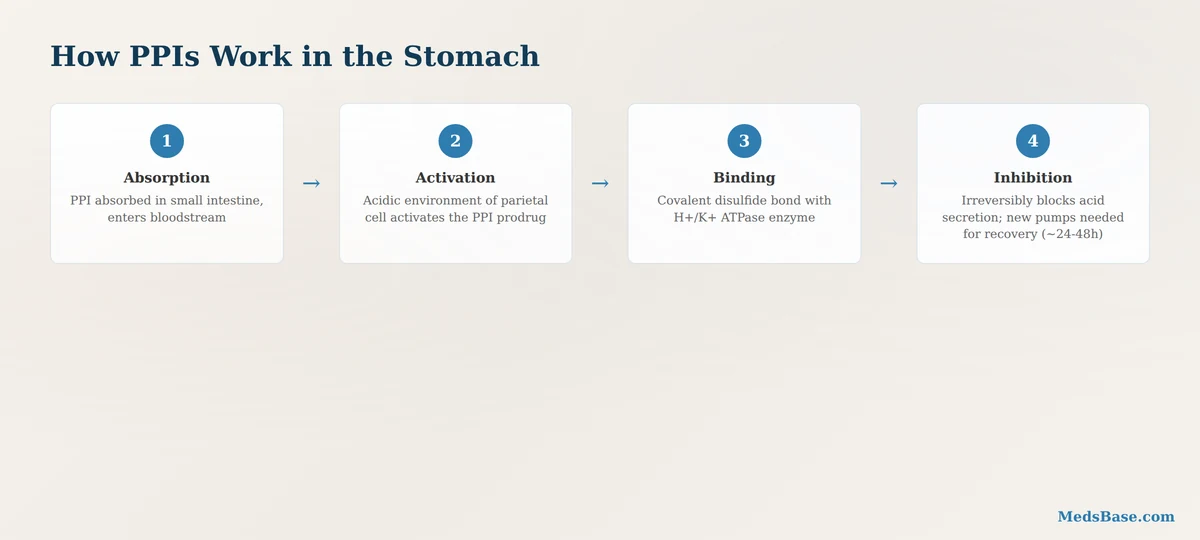
Proton pump inhibitors share a mechanism — they all bind irreversibly to the H+/K+ ATPase enzyme (the “proton pump”) on gastric parietal cells, shutting down acid secretion at the final common pathway. But the how, the speed, and the metabolism differ — and those differences are what make the esomeprazole vs pantoprazole question clinically relevant rather than purely academic.
Think of the parietal cell as a factory with thousands of tiny pumps continuously pushing acid into the stomach. A PPI molecule absorbed into the bloodstream travels to these pumps and forms a covalent bond — a permanent “lock” — that disables each pump for its entire lifespan. New pumps must be manufactured (roughly 24–48 hours) before acid secretion can resume, which is why PPIs taken once daily provide 24-hour acid suppression and why it takes 3–5 days to reach full effect.
The differences between esomeprazole and pantoprazole emerge at two points: (1) how quickly and completely they disable those pumps in the first 24–72 hours (onset), and (2) how the liver processes and eliminates them (metabolism), which determines drug interaction risk and how long the drug stays active.
Esomeprazole metabolism by the numbers: Primarily CYP2C19 (roughly 73%), with CYP3A4 contributing about 27%. About 20% of people carry genetic variants that make them “rapid metabolisers” — their CYP2C19 enzymes clear the drug so fast that standard doses produce suboptimal acid suppression. Another 3–5% are “poor metabolisers” — their CYP2C19 is practically non-functional, drug levels run high, and they get more acid suppression from standard doses (which sounds good but raises long-term safety questions).
Pantoprazole metabolism: Also uses CYP2C19, but has a secondary pathway — sulfation by SULT enzymes — that CYP2C19 rapid metabolisers can use to maintain therapeutic levels. This makes pantoprazole dosing more predictable across genetic backgrounds.
This is why “which PPI is best” has no universal answer — it depends on your genes, your other medications, and what you need the PPI to do.
The 7 Evidence-Based Differences Between Esomeprazole and Pantoprazole
The esomeprazole vs pantoprazole decision rests on seven measurable differences. Some affect nearly everyone who takes these medications; others matter only for specific patient profiles. Understanding which of these differences applies to your situation is what turns this esomeprazole vs pantoprazole comparison from an academic exercise into a practical choice.
1. Onset of Action — Esomeprazole Acts Faster
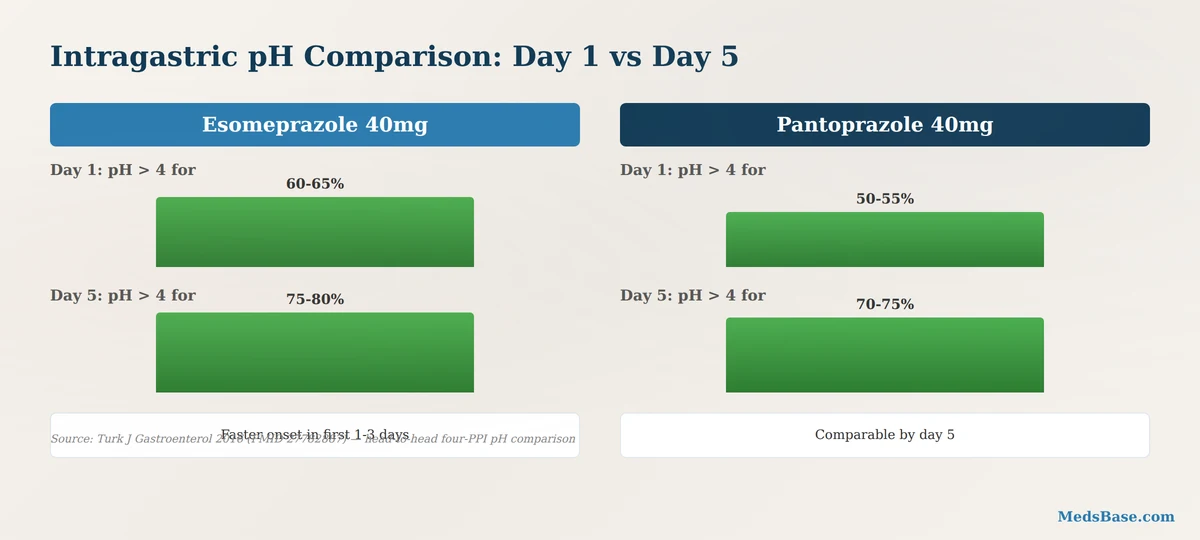
In head-to-head intragastric pH monitoring studies, esomeprazole 40 mg achieves a higher percentage of time with intragastric pH above 4 (the threshold for mucosal healing) within the first 24 hours compared to pantoprazole 40 mg. A 2016 Turkish Journal of Gastroenterology study that directly compared four PPIs — esomeprazole 40 mg, pantoprazole 40 mg, rabeprazole 20 mg, and lansoprazole 30 mg — found that esomeprazole produced the highest mean 24-hour intragastric pH and the greatest percentage of time above pH 4 on day 1 (PMID 27782887).
This matters for patients with severe erosive esophagitis or breakthrough nighttime symptoms who need rapid acid control. If you are in pain and want the fastest relief, esomeprazole has the edge in the first 48–72 hours.
Edge: Esomeprazole
2. Drug Interaction Profile — Pantoprazole Has Fewer Interactions
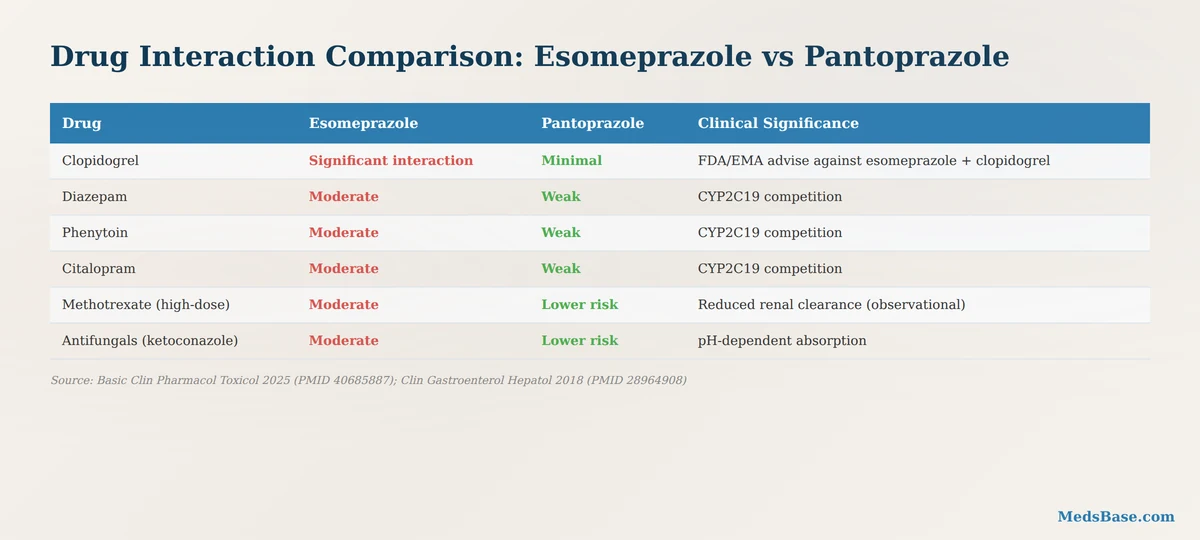
This is arguably the most clinically significant difference, and the reason pantoprazole is often preferred in hospitalised patients on multiple medications. The key interaction is with clopidogrel (Plavix) — the antiplatelet drug taken by millions to prevent stent thrombosis after coronary interventions.
Clopidogrel is a prodrug that must be activated by — you guessed it — CYP2C19. Esomeprazole competes for the same enzyme and can reduce clopidogrel activation. A 2025 systematic review and meta-analysis in Basic & Clinical Pharmacology & Toxicology confirmed that the clinical significance of this interaction remains debated, but regulatory agencies including the FDA and EMA have advised against the combination of clopidogrel with omeprazole or esomeprazole specifically. Pantoprazole, because of its partial reliance on sulfation, has a weak or negligible effect on clopidogrel activation (PMID 40685887).
Other CYP2C19-metabolised drugs affected more by esomeprazole than pantoprazole include diazepam, phenytoin, and citalopram (moderate interaction). Methotrexate (high-dose, used in oncology and rheumatology) — PPIs reduce its renal clearance, and pantoprazole may have a slightly lower risk than esomeprazole based on observational data, though the evidence is not definitive.
If you are taking clopidogrel or multiple CYP2C19-metabolised medications, pantoprazole is the safer choice.
Edge: Pantoprazole
3. CYP2C19 Genetic Variation — Pantoprazole Is More Predictable
The CYP2C19 genetic variation is not theoretical — it is well-characterised and clinically relevant. In populations of European and African ancestry, approximately 20–25% of people carry at least one “rapid metaboliser” allele (CYP2C1917). In East Asian populations, the “poor metaboliser” phenotype (CYP2C192 or *3) is more common, at approximately 15–25%.
For esomeprazole, rapid metabolisers clear the drug faster and may not achieve adequate acid suppression on standard 40 mg doses. Poor metabolisers have elevated drug exposure, which improves efficacy but may increase long-term risks. Pantoprazole, because it has the sulfation backup pathway, shows less inter-individual variability — which means the standard 40 mg dose is more likely to work predictably regardless of genetics.
Most doctors do not test for CYP2C19 before prescribing a PPI. If you know you have failed one PPI (especially esomeprazole) and genetics are unknown, pantoprazole is a reasonable next choice precisely because it is less affected by this variable.
Edge: Pantoprazole (for consistency)
4. Acid Suppression at Steady State — Roughly Equivalent by Day 5
While esomeprazole wins on day 1, the gap narrows substantially by day 5 of daily dosing. A 2018 landmark review in Clinical Gastroenterology and Hepatology on PPI interchangeability based on relative potency found that at steady state (day 5 and beyond), esomeprazole 40 mg and pantoprazole 40 mg produce comparable 24-hour intragastric pH profiles, with esomeprazole having a modest edge in mean pH (0.2–0.3 pH units) that is unlikely to be clinically meaningful for most patients (PMID 28964908).
For GERD healing, both achieve equivalent rates at 8 weeks — roughly 85–92% healing for Los Angeles grades A and B esophagitis. For grade C/D (severe erosive esophagitis), some data suggest esomeprazole may be marginally superior, but the evidence is mixed.
Edge: Tie (at steady state for most patients)
5. FDA-Approved Indications — Slightly Different
Esomeprazole carries a broader set of FDA-approved indications: GERD (healing and maintenance), erosive esophagitis, H. pylori eradication (in combination with antibiotics), and risk reduction of NSAID-associated gastric ulcers. Pantoprazole is approved for GERD (short-term healing), erosive esophagitis (healing and maintenance), and pathological hypersecretory conditions (Zollinger-Ellison syndrome).
Importantly, pantoprazole is not specifically FDA-approved for NSAID ulcer prophylaxis (esomeprazole is), though it is used off-label for this purpose routinely in clinical practice.
Edge: Esomeprazole (broader labeled indications)
6. Formulation and Administration — IV Availability
Both are available as oral delayed-release tablets. Pantoprazole is also widely available as an IV formulation, which is why it is the go-to PPI in hospital intensive care units for stress ulcer prophylaxis. Esomeprazole has an IV formulation too but it is less commonly stocked. For oral use, both are generally taken once daily, 30–60 minutes before the first meal of the day. Neither should be crushed or chewed (enteric coating protects the drug from stomach acid).
Edge: Pantoprazole (IV availability and hospital preference)
7. Cost and Availability — Pantoprazole Is Generally Less Expensive
Both are available as generics in the US and internationally. On average, generic pantoprazole is slightly less expensive than generic esomeprazole, though the difference is typically modest ($5–15 per month at retail). Both are available through MedsBase without requiring a prescription.
Edge: Pantoprazole (generally lower cost)
Safety Profile — Side Effects, Interactions, and Long-Term Concerns
The side effect profiles of esomeprazole and pantoprazole are broadly similar — both are well-tolerated in short-term use. But they are not identical, and the esomeprazole vs pantoprazole safety comparison is most relevant when evaluating drug interactions, since the direct side effect experience (headache, diarrhea, nausea) is nearly indistinguishable between the two.
| Side Effect | Esomeprazole | Pantoprazole | Notes |
|---|---|---|---|
| Headache | Common (7%) | Common (6%) | Usually mild and transient |
| Diarrhea | Moderate (4%) | Moderate (3%) | If persistent >2 weeks, evaluate for C. difficile |
| Nausea | Moderate (3%) | Moderate (2%) | Taking with food may help |
| Abdominal pain | Moderate (2–3%) | Moderate (2%) | Usually resolves within first week |
| Hypomagnesemia | Rare with long-term use | Rare with long-term use | Risk increases after 1+ years; PPI class effect |
| Vitamin B12 deficiency | Rare with long-term use | Rare with long-term use | PPI class effect; consider monitoring after 2 years |
| Increased risk of C. difficile infection | Small absolute increase | Small absolute increase | PPI class effect; relevant in hospitalised or antibiotic-exposed patients |
| Acute interstitial nephritis | Very rare | Very rare | Hypersensitivity reaction; discontinue immediately if suspected |
Long-term PPI safety concerns apply to both esomeprazole and pantoprazole roughly equally, since they are class effects: increased risk of enteric infections (C. difficile, possibly small intestinal bacterial overgrowth), nutrient malabsorption (magnesium, B12, possibly calcium with fracture association), and a possible association with chronic kidney disease (observational data — causation not established). These risks are small in absolute terms and must be weighed against the benefits of acid suppression, which for severe GERD or Barrett’s esophagus can be substantial.
The interaction question — who should choose pantoprazole over esomeprazole:
- You take clopidogrel pantoprazole
- You take multiple CYP2C19-metabolised drugs (phenytoin, diazepam, citalopram) pantoprazole
- You are on high-dose methotrexate discuss with your doctor; pantoprazole may be preferred
- You are in hospital or starting multiple new medications pantoprazole (fewer interactions to track)
The onset question — who should choose esomeprazole over pantoprazole:
- You have severe, painful GERD and want the fastest possible relief esomeprazole
- You need NSAID ulcer prophylaxis esomeprazole (FDA-approved for this indication)
- You are being treated for H. pylori esomeprazole is part of well-studied triple-therapy regimens
- You have severe erosive esophagitis (LA grade C/D) esomeprazole (marginally better data)
What the Research Says
| Study | Year | Finding | Source |
|---|---|---|---|
| PPI interchangeability based on relative potency — review | 2018 | Esomeprazole 40 mg and pantoprazole 40 mg produce comparable intragastric pH at steady state (day 5+); esomeprazole has 0.2–0.3 pH unit advantage that is unlikely to be clinically meaningful for most patients | Clin Gastroenterol Hepatol (PMID 28964908) |
| Head-to-head pH comparison of 4 PPIs | 2016 | Esomeprazole 40 mg achieved the highest mean 24h intragastric pH and greatest time above pH 4 on day 1; pantoprazole was comparable by day 5 | Turk J Gastroenterol (PMID 27782887) |
| Clopidogrel-PPI interaction — systematic review and meta-analysis | 2025 | Regulatory agencies advise against combining clopidogrel with omeprazole or esomeprazole; pantoprazole interaction is weak or negligible | Basic Clin Pharmacol Toxicol (PMID 40685887) |
| PPI safety in preterm infants — Cochrane review | 2025 | No direct esomeprazole vs pantoprazole comparison in this population; overall PPI safety profile confirmed in special populations | Cochrane Database Syst Rev (PMID 40066936) |
What this means for you: The research supports a simple rule of thumb for the esomeprazole vs pantoprazole question. If drug interactions are your primary concern — especially clopidogrel — pantoprazole is the clear winner. If onset speed matters most — you are in pain and need relief now — esomeprazole has a measurable (though modest) advantage. For everyone else, at the standard 40 mg once-daily dose, the two drugs are close enough that factors like cost, availability, and how you personally respond become the real deciding variables in the esomeprazole vs pantoprazole decision.
Esomeprazole vs Pantoprazole vs Other Acid Reflux Treatments
| Treatment | Mechanism | Onset | Duration of Action | Best For | Key Limitation |
|---|---|---|---|---|---|
| Esomeprazole 40 mg | PPI — irreversible H+/K+ ATPase inhibition | 1–3 days to peak | 24 hours | Rapid relief needed, NSAID prophylaxis, H. pylori triple therapy | CYP2C19 interactions, genetic variability |
| Pantoprazole 40 mg | PPI — irreversible H+/K+ ATPase inhibition | 3–5 days to peak | 24 hours | Patients on multiple medications, clopidogrel users, hospital settings | Slightly slower onset |
| Omeprazole 20 mg | PPI — older racemic mixture | 2–4 days to peak | 24 hours | Cost-sensitive patients | Higher CYP2C19 interaction risk than pantoprazole |
| Famotidine 20-40 mg | H2 receptor antagonist | Within 1 hour | 10–12 hours | Mild/intermittent symptoms, nighttime acid breakthrough | Tachyphylaxis (tolerance develops) |
| Voquezna (vonoprazan) 10-20 mg | Potassium-competitive acid blocker (PCAB) | Within hours | 24 hours | Severe GERD, PPI-resistant symptoms | Newer drug, less long-term data |
Q: Which one fits which situation?
A: – If you are reading this because your current PPI is not working well enough: switch to the other one (esomeprazole pantoprazole or vice versa) AND ensure you are taking it correctly — 30–60 minutes before food, not with other medications that need stomach acid for absorption – If you have tried both PPIs without adequate results: consider Voquezna (vonoprazan), a PCAB with a different mechanism — read our Voquezna vs Pantoprazole comparison – If you are deciding between esomeprazole and omeprazole specifically: read our esomeprazole vs omeprazole guide
How to Choose and Switch — Practical Steps
Step 1 — Identify what you are trying to solve. Are you switching because your current PPI is not controlling symptoms? Because of side effects? Because you started clopidogrel or another interacting medication? Each reason points to a different solution. Switching from esomeprazole to pantoprazole because of clopidogrel interaction is a strong medical reason. Switching because you read that pantoprazole has fewer interactions “in general” when you are not on any interacting drugs — that difference is unlikely to produce a noticeably different outcome.
Step 2 — Take it correctly before blaming the drug. The single most common reason a PPI fails is incorrect timing. PPIs only disable pumps that are actively secreting acid. Take them 30–60 minutes before the first meal of the day — not with the meal, not after. If you are taking them at bedtime, you are getting roughly half the acid suppression of morning dosing. If you have been on pantoprazole for 3 weeks with no improvement, verify your timing before you conclude the drug does not work.
Step 3 — Switch directly. You do not need to taper between PPIs — they all work on the same target. Finish your current PPI, and start the new one the following morning at the standard dose. There is no washout period needed.
Step 4 — Give the new PPI at least 2–4 weeks. Even esomeprazole’s faster onset does not mean “instant relief within an hour.” PPIs take days to reach full acid suppression because existing pumps must be replaced by newly manufactured ones. Do not judge effectiveness before 2 weeks of daily use.
Step 5 — If both PPIs fail, escalate the investigation. Persistent GERD symptoms on full-dose PPI therapy for 8+ weeks warrant an endoscopy to rule out eosinophilic esophagitis, esophageal stricture, or other non-acid causes of symptoms. You may need a 24-hour pH-impedance study to determine whether acid is actually the problem.
Mistakes to avoid:
- Taking a PPI with food — the meal stimulates acid secretion, and the PPI arrives too late to block those pumps
- Stopping abruptly and experiencing “acid rebound” — if you need to stop, taper over 1–2 weeks or use an H2 blocker (famotidine) as a bridge
- Stacking PPIs (taking esomeprazole AND pantoprazole) — this does not improve acid suppression and increases side effect risk
- Assuming that because one PPI did not work, no PPI will work — the CYP2C19 variable means a different PPI may genuinely perform better
- Using PPIs indefinitely without reconsideration — guidelines recommend the lowest effective dose for the shortest necessary duration; annual review is appropriate for long-term users
Related Reading
- Esomeprazole vs Omeprazole: 7 Proven Differences to Know — the other esomeprazole comparison readers commonly search for
- Voquezna vs Pantoprazole: PCAB vs PPI — Which Should You Choose? — the next-generation acid blocker comparison
- PPI vs H2 Blockers for GERD: A Complete Guide — the broader class comparison
Frequently Asked Questions About Esomeprazole vs Pantoprazole
Q: Is esomeprazole better than pantoprazole?
A: Not universally. Esomeprazole achieves faster acid suppression in the first 1–3 days and has slightly higher peak potency, making it preferable when rapid symptom relief is the priority. Pantoprazole has fewer drug interactions (especially with clopidogrel), more predictable metabolism across genetic backgrounds, and is equally effective by day 5 of dosing. For the average patient with uncomplicated GERD and no drug interactions, neither is clearly “better” — the choice depends on your specific circumstances.
Q: Which is stronger, esomeprazole or pantoprazole?
A: At standard doses (esomeprazole 40 mg vs pantoprazole 40 mg), esomeprazole is slightly more potent — it achieves approximately 0.2–0.3 pH units higher mean 24-hour intragastric pH and a few percentage points more time above pH 4 at steady state. However, this small difference is unlikely to translate into a noticeably different clinical experience for most patients. The relative potency tables published in clinical guidelines consider esomeprazole 40 mg roughly equivalent to pantoprazole 40 mg in clinical effect.
Q: Can I switch from pantoprazole to esomeprazole?
A: Yes, you can switch directly. There is no need to taper off one PPI before starting the other — they work on the same target (the proton pump) and have the same mechanism (irreversible inhibition). Stop pantoprazole one day, and start esomeprazole the next morning at the standard dose of 40 mg, 30–60 minutes before breakfast. Allow 2–4 weeks to assess the response before deciding whether the switch was effective.
Q: What are the side effects of esomeprazole vs pantoprazole?
A: In the direct esomeprazole vs pantoprazole side effect comparison, the profiles are very similar. Both can cause headache (~6–7%), diarrhea (~3–4%), nausea (~2–3%), and abdominal pain (~2%). Long-term concerns (hypomagnesemia, B12 deficiency, possible kidney effects, C. difficile infection risk) apply to both drugs as PPI class effects. The difference in the esomeprazole vs pantoprazole safety comparison is primarily in drug interactions, not direct side effects — pantoprazole has measurably fewer CYP2C19-based drug interactions.
Q: Does pantoprazole interact with fewer drugs than esomeprazole?
A: Yes, and this is the strongest reason to choose pantoprazole over esomeprazole for specific patients. Because pantoprazole is metabolised partly by sulfation (an alternative pathway to CYP2C19), it has a weaker interaction with CYP2C19-dependent drugs. The most clinically important example is clopidogrel: pantoprazole has a negligible effect on clopidogrel activation, while esomeprazole meaningfully inhibits it. Pantoprazole also interacts less with diazepam, phenytoin, and citalopram.
Q: Which PPI works fastest for GERD?
A: In the esomeprazole vs pantoprazole speed comparison, esomeprazole works fastest in the first 1–3 days. A direct head-to-head intragastric pH study of four PPIs found that esomeprazole 40 mg achieved the highest percentage of time with pH above 4 on day 1 of treatment, outperforming pantoprazole, lansoprazole, and rabeprazole. By day 5, the differences had largely equalised — which is why this esomeprazole vs pantoprazole distinction matters most for acute symptom relief, not chronic maintenance.
Q: Is esomeprazole available over the counter?
A: In the United States, esomeprazole (Nexium 24HR) is available OTC at 20 mg — half the standard prescription dose of 40 mg. Pantoprazole is prescription-only in the US. MedsBase offers both esomeprazole and pantoprazole without requiring a prescription at their full therapeutic doses.
Q: Can I take esomeprazole or pantoprazole long-term?
A: Long-term use of any PPI should be periodically reassessed — current guidelines recommend using the lowest effective dose for the shortest necessary duration. In the esomeprazole vs pantoprazole question, long-term safety is a class effect — meaning both drugs carry similar risks with prolonged use. For conditions like severe erosive esophagitis or Barrett’s esophagus, the benefits of long-term PPI use likely outweigh the small absolute increases in risks. For patients using PPIs for mild GERD symptoms indefinitely without reassessment, deprescribing or switching to on-demand H2 blocker therapy is reasonable to discuss with your doctor at your next visit.
The Bottom Line
The esomeprazole vs pantoprazole decision is not about which drug is universally superior — it is about which matches your specific clinical profile. Here is the verdict:
If you take clopidogrel, phenytoin, or multiple CYP2C19-metabolised medications, pantoprazole is the clear choice — the interaction difference is real, documented, and clinically meaningful.
If you need the fastest possible acid suppression for severe erosive esophagitis or breakthrough pain, esomeprazole has the edge in the first 48–72 hours, though the advantage fades by day 5.
If you are not in either of those categories, the differences between esomeprazole vs pantoprazole are small enough that cost, availability, and — most importantly — which one your body responds to become the deciding factors. The standard recommendation: try one, take it correctly (30–60 minutes before food), assess at 4 weeks, and switch if results are inadequate.
Your immediate action: if you are currently on a PPI that is not working well enough, verify you are taking it correctly — the single most common cause of PPI failure is incorrect timing, not the wrong drug. If timing is correct and symptoms persist, book a follow-up with your doctor to discuss switching to the other PPI or escalating the investigation with endoscopy.
Browse MedsBase’s Acid Reflux category for esomeprazole, pantoprazole, and other treatment options — no prescription needed.
For a deeper comparison of PPI classes and alternatives, read our PPI vs H2 blockers guide. And if you are curious about how the newest acid blocker stacks up, our Voquezna vs Pantoprazole comparison covers the PCAB alternative in full detail.
Medical Disclaimer: This article is for informational purposes only and does not constitute medical advice. Never stop or change a prescribed medication without consulting your prescribing physician. PPIs should be used at the lowest effective dose for the shortest necessary duration. Always seek the guidance of a qualified healthcare professional regarding medication decisions.

Written by
Sophie ChenPharmaceutical Content Researcher · 8 years experience
Sophie Chen is a pharmaceutical content researcher with 8 years covering generic medication access and clinical pharmacology. She specialises in international regulatory frameworks, bioequivalence standards, and patient-facing education on therapeutic drug classes. She is not a clinician.