








✓ Medically reviewed by · Last reviewed: May 2026
Pharmacy Researcher · 8 years experience
Pharmacy researcher with 8 years reviewing clinical drug information, generic formulation equivalence, and international pharmaceutical standards. Focuses on patient-facing accuracy in medication education.
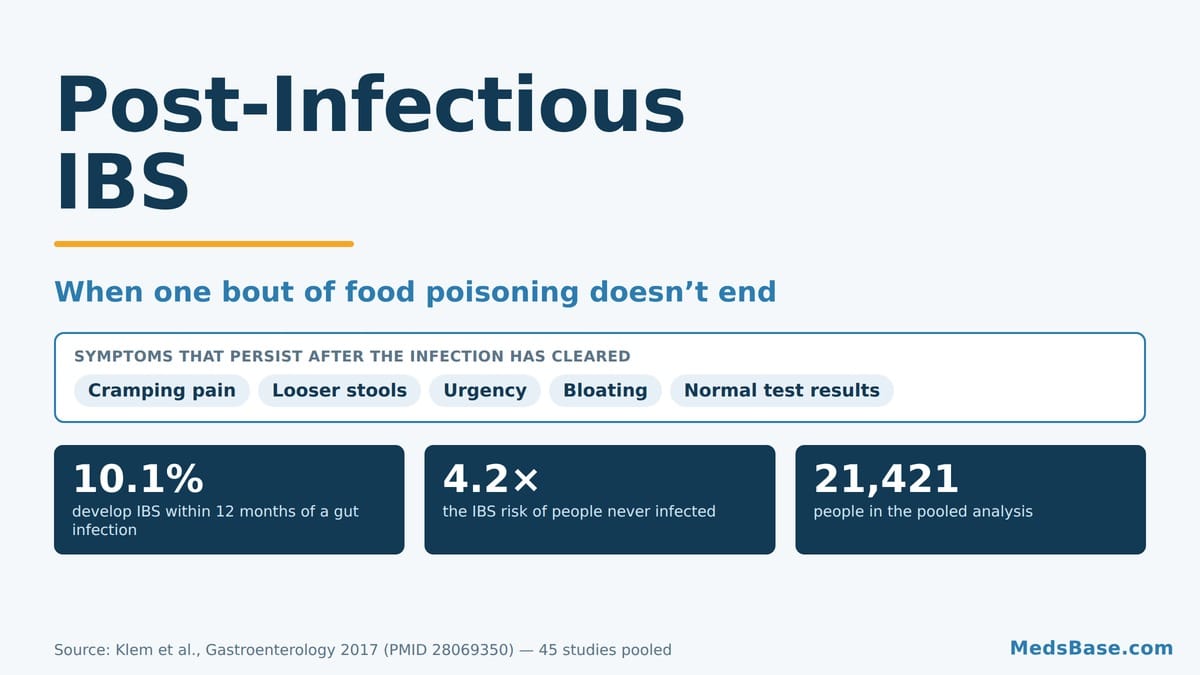
You got food poisoning in March. It was grim for four days, then it passed, and everyone told you that was that. It is now August, and your gut still behaves like a stranger’s — cramping after meals it used to tolerate, urgent one week and stubbornly slow the next, bloated by four in the afternoon. Your blood tests are normal. Your stool tests are clear. And somewhere along the way the conversation quietly shifted from “let’s find out what’s wrong” to “these things happen.”
What you probably have is post-infectious IBS, and there is nothing vague about it. It has a defined onset, a measured incidence, a well-described mechanism and a recovery curve that runs in years rather than weeks. By the end of this article you will know how likely your infection was to cause it, which pathogens carry the highest risk, what genuinely helps, and the exact phrase to use at your next appointment.
There is also one group of infections that carries a risk roughly three times higher than the rest — and it is not the one most people would guess. That comes in the research section.
- Roughly 1 in 10 people develop IBS within a year of a gut infection — and the risk stays elevated well beyond that first year.
- One infection multiplies IBS risk more than fourfold, which is why “it’s just a coincidence” is rarely the right explanation.
- The pathogen matters far more than most people are told, and one category is a dramatic outlier.
- Antibiotics given during the original infection are themselves an independent risk factor — a genuinely uncomfortable finding.
- Most people do recover. The honest timeline is the part nobody says out loud, and it is in the FAQ.
- What Is Post-Infectious IBS?
- How Post-Infectious IBS Develops
- Who Actually Gets It — The Measured Risk Factors
- Symptoms, Timeline and the Red Flags
- What the Research Says
- Post-Infectious IBS vs Other Causes of Lingering Gut Symptoms
- How to Manage Post-Infectious IBS
- Frequently Asked Questions
- The Bottom Line
What Is Post-Infectious IBS?
The defining feature is the datable start. Ordinary IBS usually creeps in; people struggle to say when it began. Post-infectious IBS has a before and an after, and patients can almost always name the week. That single detail is diagnostically useful, and it is the reason this article insists you write the date down.
The other defining feature is what the tests show: nothing. The infection has gone. Inflammatory markers are normal. Stool cultures are clear. To a clinician glancing at a results screen, you look well — which is precisely why so many people with this condition come away feeling disbelieved.
You are not describing a mystery. You are describing a recognised sequel to infection that has been pooled, measured and published in mainstream gastroenterology journals for two decades.
How Post-Infectious IBS Develops
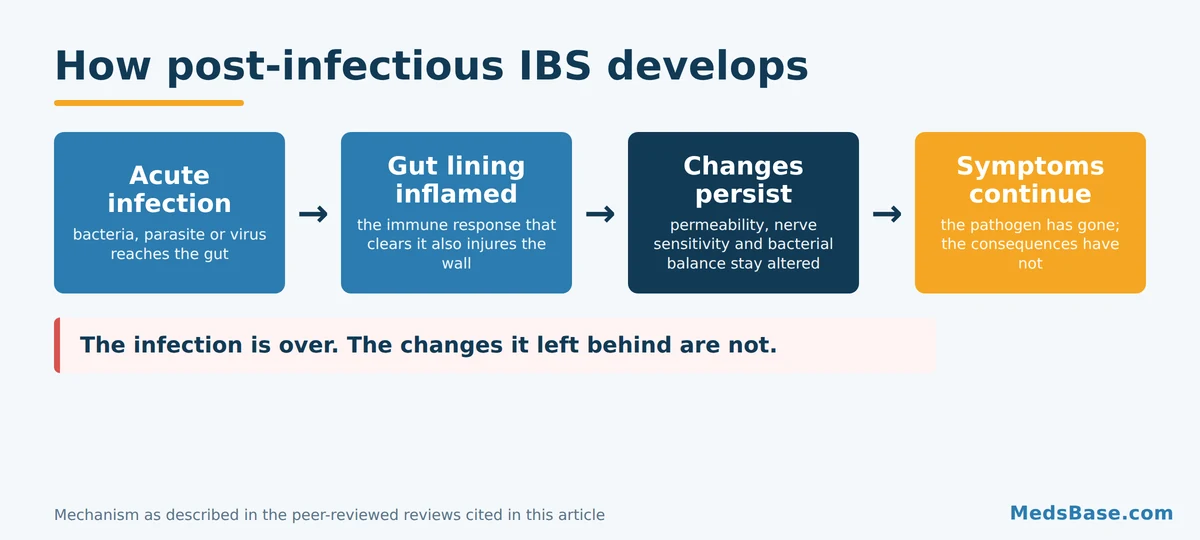
Think of a gut infection like a small kitchen fire. The fire brigade arrives, the flames go out, and the fire is genuinely over. But the smoke damage, the water on the floor and the warped door frame are all still there, and none of them will show up on a “is there a fire?” test.
That is roughly what an episode of infectious gastroenteritis does to a gut lining. The immune response that clears the pathogen also inflames the bowel wall. In most people everything resets within weeks. In a minority, some of the changes outlast the infection: the lining stays subtly more permeable, the nerve endings in the gut wall stay more reactive, and the population of bacteria living there does not return to its previous balance. The pathogen is gone. Its consequences are not.
That mismatch is the whole condition. Your symptoms are real, your tests are normal, and both facts are true at the same time.
Here’s what this means for you: if your symptoms began after an infection and have not settled, you are not an outlier and you are not imagining a connection. You are inside a well-described minority.
Who Actually Gets It — The Measured Risk Factors
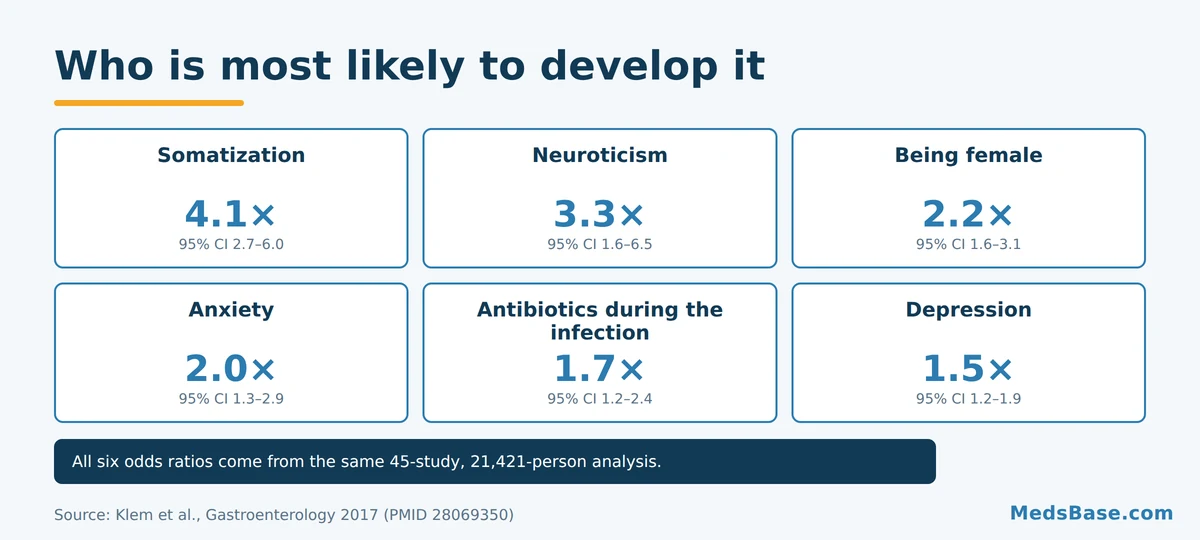
A Mayo Clinic meta-analysis of 45 studies, covering 21,421 people who had infectious enteritis and followed them for between three months and ten years, produced the numbers this whole subject rests on.
The headline figures:
- 10.1% of people had IBS 12 months after infectious enteritis (95% confidence interval 7.2–14.1).
- 14.5% had IBS more than 12 months afterwards (95% CI 7.7–25.5).
- Risk of IBS was 4.2 times higher in people who had an infection in the past 12 months than in those who had not (95% CI 3.1–5.7).
- Beyond 12 months, risk was still 2.3 times higher (95% CI 1.8–3.0).
That fourfold figure is the number worth carrying into an appointment. It is the difference between “these things happen” and “this is a recognised consequence with an effect size.”
The same analysis measured who is most affected, and the pattern is more interesting than folklore suggests:
| Risk factor | Odds ratio | 95% CI |
|---|---|---|
| Somatization | 4.1 | 2.7–6.0 |
| Neuroticism | 3.3 | 1.6–6.5 |
| Being female | 2.2 | 1.6–3.1 |
| Anxiety | 2.0 | 1.3–2.9 |
| Antibiotic exposure during the infection | 1.7 | 1.2–2.4 |
| Depression | 1.5 | 1.2–1.9 |
Severity of the original illness also raised risk — the sicker the acute episode, the higher the chance of a lasting sequel.
The antibiotic finding deserves a straight answer, because it is easy to misread. It does not mean antibiotics caused your IBS, and it is emphatically not a reason to refuse an antibiotic you clinically need. Part of the association is almost certainly that sicker people get antibiotics, and severity is itself a risk factor. But the disruption an antibiotic causes to gut bacteria is a plausible contributor too, and the honest position is that both explanations are probably operating. If you have been taking an antibiotic and separately seen it named in a recall headline, our explainer on what a nitrosamine impurity recall actually means covers that entirely separate question.
Symptoms, Timeline and the Red Flags
Post-infectious IBS most often follows the diarrhoea-predominant pattern, though mixed and constipation-predominant forms occur. Here is what to expect, and — more importantly — what should send you back to a doctor rather than to an article.
| Symptom | How typical | What it usually means | What to do |
|---|---|---|---|
| Cramping abdominal pain, often eased by passing stool | Very common — the core feature | Heightened gut nerve sensitivity | Track which foods and times cluster with it |
| Looser, more frequent stools than before the infection | Very common | Altered transit and absorption | Note the change from your baseline, not a textbook one |
| Urgency, especially after meals | Common | Exaggerated gastrocolic reflex | Plan around it; it usually eases over months |
| Bloating and distension through the day | Common | Gas handling and motility changes | Worth a food-and-symptom diary |
| Fatigue and low mood | Common | Both a consequence and a risk factor | Raise it explicitly — it is treatable and it matters |
| Blood in the stool | Not typical | Needs assessment | See a doctor promptly |
| Fever, night sweats, unintended weight loss | Not typical | Needs assessment | See a doctor promptly |
| Symptoms that began after age 50 with no clear trigger | Not typical | Needs assessment | See a doctor promptly |
Those last three rows are the ones that matter most. Post-infectious IBS does not cause bleeding, fever or weight loss. If you have any of them, the working diagnosis should change, and the NIDDK’s overview of IBS is clear that IBS remains a diagnosis made after ruling out conditions that look similar.
The timeline, honestly. Symptoms typically declare themselves within the first few months after the infection rather than immediately, which is exactly why so many people never connect the two events. Improvement is measured in months to years, not weeks, and a substantial proportion of people do resolve without any specific treatment. What the pooled data will not give you is a personal prognosis, and anyone offering you one is guessing.
What the Research Says About Post-Infectious IBS
| Study | Year | Design | Key finding |
|---|---|---|---|
| Mayo Clinic pooled analysis | 2017 | 45 studies, 21,421 people with enteritis | 10.1% had IBS at 12 months; risk 4.2× higher than uninfected |
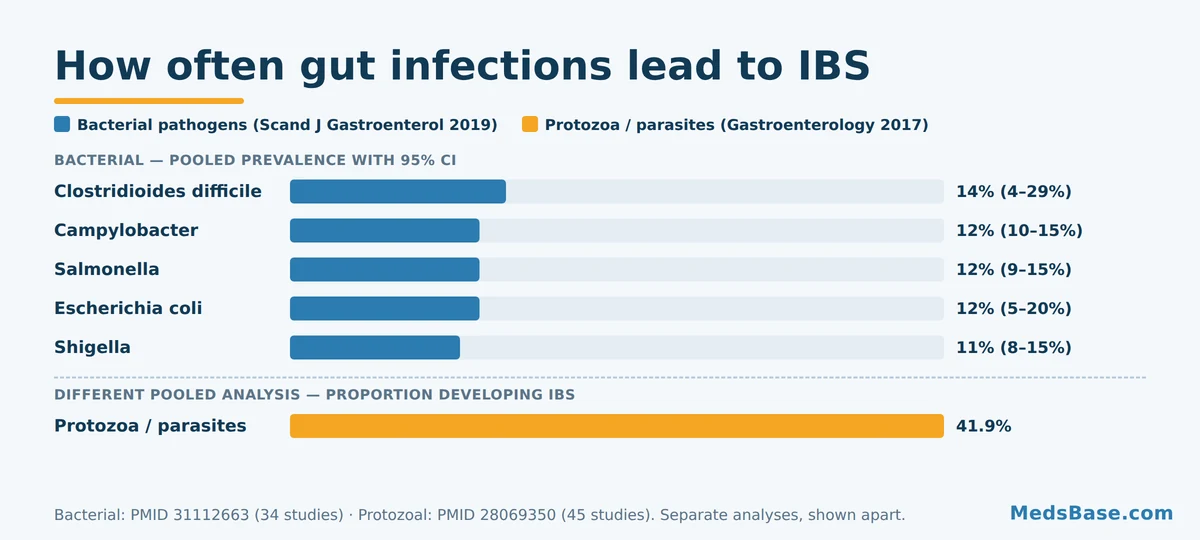
| Same analysis, by organism type | 2017 | Subgroup by pathogen class | 41.9% after protozoal or parasitic enteritis vs 13.8% after bacterial |
| Pathogen-specific review | 2019 | 34 studies pooled by organism | Campylobacter 12%, Salmonella 12%, Shigella 11%, C. difficile 14%, E. coli 12% |
| Travellers’ diarrhoea meta-analysis | 2015 | 6 studies | Relative risk 3.35 (95% CI 2.22–5.05); incidence 5.4% vs 1.4% in unaffected travellers |
Here is the open loop from the introduction, closed. The category carrying the highest risk is not a famous bacterium. In the Mayo analysis, 41.9% of people whose enteritis was caused by protozoa or parasites went on to develop IBS, against 13.8% after bacterial infection. That is roughly a threefold difference, and it is the single most under-communicated fact in this entire subject. If your illness followed contaminated water, a parasitic infection such as giardiasis, or a long unexplained bout of diarrhoea abroad, your risk sits in a very different bracket from someone who had a weekend of food poisoning from a bacterial source.
A 2019 review that separated the pathogens confirms how tightly the bacterial figures cluster — every common organism landing between 11% and 14% — and is candid that the evidence for viral and parasitic causes is much thinner, with few studies available. Its pooled odds ratio for developing IBS after gastroenteritis from any pathogen was 4.9 (95% CI 3.9–6.1), which lines up closely with the Mayo estimate from an independent set of studies. Two separate teams, two separate methods, near-identical answers — that is what a durable finding looks like.
For travellers specifically, a meta-analysis of travellers’ diarrhoea outcomes pooled six studies and found a relative risk of 3.35 (95% CI 2.22–5.05), with post-infectious IBS occurring in 5.4% of people who had travellers’ diarrhoea versus 1.4% of those who did not. Notably, the risk estimate was higher when travellers self-reported their illness (RR 3.90) than when it was laboratory-confirmed (RR 2.42) — a reminder that some of the effect in self-reported studies reflects how people remember and classify their own illness. If that is how your symptoms started, our guide to how travellers’ diarrhoea is treated in the first place covers the acute stage this condition follows on from.
What this means for you: the numbers are consistent enough across independent analyses that you can take them to an appointment with confidence. Where the evidence is genuinely weak — viral causes, parasitic causes, and anything resembling a personal prognosis — this article says so rather than inventing precision.
Post-Infectious IBS vs Other Causes of Lingering Gut Symptoms
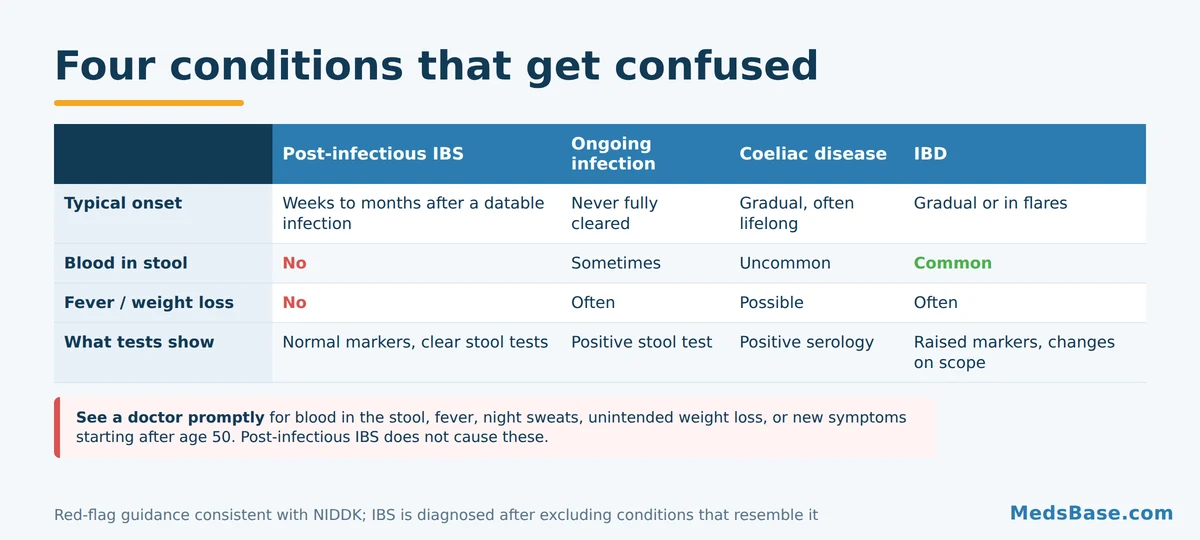
Several conditions produce months of unsettled bowels after an infection, and they separate more cleanly than you might expect.
| Post-infectious IBS | Ongoing or relapsed infection | Coeliac disease | Inflammatory bowel disease | |
|---|---|---|---|---|
| Typical onset | Weeks to months after a datable infection | Symptoms never fully cleared | Gradual, often lifelong pattern | Gradual or in flares |
| Blood in stool | No | Sometimes | Uncommon | Common |
| Fever or weight loss | No | Often | Possible | Often |
| What testing shows | Normal inflammatory markers, clear stool tests | Positive stool test | Positive coeliac serology | Raised inflammatory markers, changes on scope |
| Usual course | Improves over months to years | Resolves when treated | Improves on a gluten-free diet | Chronic, needs specialist care |
Which one fits which situation? If your infection is documented, your symptoms started after it, your tests are clean and you have none of the red flags, post-infectious IBS is the most probable explanation and the reasonable next step is symptom management with review. If your stool tests were never repeated after the acute illness, ask for that first — a persisting or relapsed infection is a treatable miss and worth excluding. If there is blood, fever or weight loss, this article stops being the relevant one; that combination needs assessment, not management.
How to Manage Post-Infectious IBS
There is no treatment that targets the post-infectious mechanism itself. What exists — and it is genuinely useful — is treatment aimed at the dominant symptom, layered onto time.
- Date the infection and write it down. The month, the likely source, whether it was confirmed by a test, and whether you were given antibiotics. This turns a vague complaint into a clinical history and changes the conversation.
- Get the red flags excluded once, properly. Bleeding, fever, weight loss, or onset after 50 all warrant assessment before anyone settles on a functional diagnosis.
- Treat the dominant symptom rather than “IBS” in general. Cramping pain calls for a different approach than urgency, which calls for a different approach again than bloating.
- Re-assess at around six months. This condition tends to improve. If yours has not moved at all, that is itself useful information and a reason to revisit the diagnosis.
For the cramping-pain pattern, which is the most common presentation here, antispasmodics are the usual first line. A 2022 systematic review of mebeverine pooled 22 studies including 19 randomised trials and found six reporting a significant reduction in abdominal pain, alongside improvements in bowel habit, distension and stool consistency — while noting honestly that three studies showed no improvement, and that adverse events were rare and mostly indistinguishable from IBS symptoms themselves. That is a modest, real, non-miraculous evidence base, and it is described here as exactly that. It is worth adding that several of the review’s authors declare consultancy or speaker relationships with pharmaceutical companies, which is disclosed in the paper and worth knowing when you read it.
If that pattern matches yours, Colospa is mebeverine 135 mg, and our detailed mebeverine dosing guide covers how it is taken and who should avoid it. For a broader view of what else exists across the symptom spectrum, see the full range of IBS and IBD treatment options. No prescription is needed to order from MedsBase, but which class suits your symptom pattern is genuinely a conversation worth having with a pharmacist or doctor — this is one of those conditions where the right choice depends almost entirely on which symptom dominates.
- Eliminating foods one at a time for months. Post-infectious IBS symptoms fluctuate on their own, so single-food trials generate false conclusions and a shrinking diet.
- Repeating stool tests over and over. Once cleared properly, repeat testing rarely adds anything and delays useful treatment.
- Treating urgency with an antispasmodic and expecting it to fix bloating. Different symptoms, different targets.
- Assuming no improvement at three months means no improvement ever. The recovery curve for this condition is genuinely slow.
- Not mentioning low mood or anxiety. Both are measured risk factors and both are treatable — leaving them out of the conversation removes a lever.
One thing clinicians notice repeatedly: patients arrive apologising for wasting an appointment, having already decided their symptoms are not serious enough to mention. The single most useful sentence you can open with is the plain history — “I had a confirmed gut infection in March and my bowels have not been the same since.” That sentence, on its own, reframes the entire consultation.
- How travellers’ diarrhoea is treated in the first place — the acute illness this condition follows.
- The full range of IBS and IBD treatment options — what exists beyond antispasmodics.
- Our detailed mebeverine dosing guide — practical dosing and cautions.
Frequently Asked Questions
Q: How long does post-infectious IBS last?
A: Longer than most people are told, but it does tend to improve. Pooled data show 10.1% of people still meeting IBS criteria at 12 months after infectious enteritis and 14.5% beyond 12 months, with risk remaining roughly 2.3 times higher than the uninfected population even after the first year. Recovery is measured in months to years rather than weeks. A substantial proportion of people resolve without specific treatment, but nobody can give you a reliable personal timeline.
Q: Can food poisoning cause IBS?
A: Yes, and the association is well quantified rather than theoretical. A meta-analysis of 45 studies covering 21,421 people with infectious enteritis found IBS risk was 4.2 times higher in the year following the infection than in people who had not been infected. Roughly 1 in 10 developed IBS within 12 months. Most people who get food poisoning do not, so it is a real risk rather than an expected outcome.
Q: Does the type of infection matter?
A: Substantially. Pooled figures for common bacteria cluster tightly: Campylobacter 12%, Salmonella 12%, Shigella 11%, C. difficile 14%, E. coli 12%. Protozoal and parasitic infections are the striking outlier, with 41.9% going on to develop IBS versus 13.8% after bacterial infection. Evidence for viral causes is thinner, though norovirus is generally reported to leave less behind.
Q: Why are my tests normal if something is wrong?
A: Because the tests are looking for the infection, and the infection has gone. What persists after post-infectious IBS develops are changes in gut permeability, nerve sensitivity and bacterial balance — none of which appear on standard stool cultures or inflammatory markers. Normal results genuinely rule out several serious conditions, which is valuable. They do not rule out this one, because there is no positive test for it.
Q: Does post-infectious IBS go away on its own?
A: Often, yes, though slowly. The prevalence data show numbers falling over time in most cohorts, and many people recover without any targeted treatment. That is not a reason to wait passively — symptom-directed treatment can make the intervening months considerably more liveable, and a proper red-flag assessment early on is worth doing regardless of how the condition eventually resolves.
Q: Did the antibiotics I was given cause this?
A: Antibiotic exposure during the infection is an independent risk factor, with an odds ratio of 1.7 (95% CI 1.2–2.4) in the pooled analysis. But this is an association, not a demonstrated cause, and part of it reflects that people who are sicker receive antibiotics while severity is itself a risk factor. It is not a reason to decline an antibiotic you clinically need. It is a reason to ask whether one is genuinely indicated.
Q: What triggers symptoms after a stomach bug has cleared?
A: Most people identify meals, particularly larger or higher-fat ones, as the strongest trigger, reflecting an exaggerated post-meal gut reflex. Stress and poor sleep commonly amplify symptoms, which is consistent with anxiety and depression appearing as measured risk factors. Specific food triggers vary so much between individuals that a symptom diary tends to be more useful than any standard exclusion list.
Q: Is post-infectious IBS permanent?
A: For most people, no. It is best understood as a slow-resolving condition rather than a permanent one, with prevalence in follow-up studies declining over time. A minority do have long-lasting symptoms, and the honest answer is that current evidence cannot predict which group any individual falls into. If symptoms have not shifted at all after roughly six months, that is a reasonable point to revisit the diagnosis with a clinician.
The Bottom Line on Post-Infectious IBS
If your gut has not been right since a specific infection, you are not describing a coincidence and you are not being dramatic. Post-infectious IBS is a measured, published, mainstream diagnosis: about one in ten people develop it within a year of infectious gastroenteritis, the risk is more than four times that of people who were never infected, and it runs far higher again after protozoal or parasitic illness. The tests are normal because the tests are looking for something that has already gone.
The balanced verdict is this. There is no treatment that reverses the underlying change, symptom-directed treatment genuinely helps, most people improve over months to years, and a minority do not. Anyone promising you faster or more certain than that is going beyond the evidence.
Your immediate action: write down the month of your infection, whether it was confirmed by a test, and whether you were given antibiotics. Take those three facts to your next appointment and open with them.
Wondering how the acute illness that started all this should have been handled? Read our guide to how travellers’ diarrhoea is treated in the first place. And if cramping pain is your dominant symptom and you want to understand the options, the full range of IBS and IBD treatment options sets them out side by side.

Written by
Sophie ChenPharmaceutical Content Researcher · 8 years experience
Sophie Chen is a pharmaceutical content researcher with 8 years covering generic medication access and clinical pharmacology. She specialises in international regulatory frameworks, bioequivalence standards, and patient-facing education on therapeutic drug classes. She is not a clinician.