








✓ Medically reviewed by · Last reviewed: May 2026
Pharmacy Researcher · 8 years experience
Pharmacy researcher with 8 years reviewing clinical drug information, generic formulation equivalence, and international pharmaceutical standards. Focuses on patient-facing accuracy in medication education.
Most people believe high uric acid is a food problem, fixable with a strict enough diet. The research says otherwise: roughly two-thirds of the uric acid in your body is manufactured internally from the normal turnover of your own cells, not delivered by your dinner. That single fact explains why so many people cut out shellfish and red meat for a year, feel virtuous, and still get a flare.
This guide covers how to lower uric acid with actual numbers attached — what each change is worth in mg/dL, what target you are aiming at and why, and the honest point at which food and willpower stop being enough. You will also get the one number most people never ask for, which does more to predict your next flare than any food diary.
There is a well-known dietary study in here whose headline finding is regularly quoted at four times its real strength. We will come to it, and to why the small print matters.
- About two-thirds of your uric acid is made internally — which caps what any diet can do before you start.
- There is a specific target number, and it is not “within the normal range” on your lab report. That distinction changes everything.
- The best randomised dietary evidence moved urate by roughly 0.35 mg/dL on average. Useful, and probably less than you were hoping.
- One popular food-based recommendation has far weaker evidence than its reputation — details in the food section.
- The single biggest non-drug lever is not a food at all, and most articles bury it.
What Uric Acid Is and Why It Matters
Uric acid is not a toxin or a sign you have done something wrong. It is a normal end product of purine metabolism, and it circulates in everyone’s blood. Purines come from two places: the food you eat, and the routine breakdown and renewal of your own cells. The second source is much larger.
Problems begin when the concentration rises past the point where uric acid stays dissolved. Above roughly 6.8 mg/dL, it starts to come out of solution and form needle-shaped monosodium urate crystals. Those crystals settle in joints — classically the base of the big toe, where the temperature is lowest and solubility is worst.
The crystals are the disease. The number is just what predicts them. That reframing is genuinely useful, because it explains why lowering your level slowly and keeping it low works, while a dramatic short-term diet before a blood test does nothing for the deposits already sitting in your joints.
Not everyone with a high level gets gout. Plenty of people have raised urate for years without a single attack, which is why treatment decisions are rarely made on a blood result alone. But once you have had a flare, the number becomes the thing that predicts whether you will have another — and if you are dealing with one right now, what actually stops an attack once it starts is a different job from what this article covers.
How Uric Acid Builds Up in the First Place
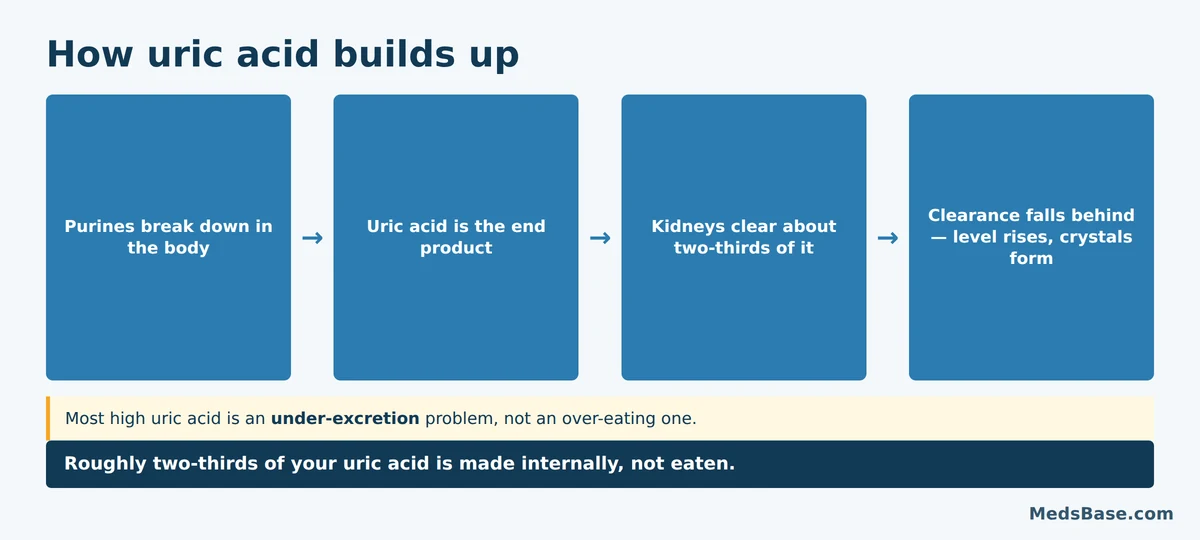
Two things can push your level up: making too much, or clearing too little. In most people it is the second.
Picture a sink with the tap running steadily. The tap is purine breakdown; the drain is your kidneys, which handle roughly two-thirds of uric acid clearance, with the gut managing most of the rest. If the drain narrows, the water rises even though nobody touched the tap.
That is what happens in the majority of people with high uric acid levels. Hyperuricemia is fundamentally an excretion problem in most cases. Kidney function, genetics affecting the urate transporters in your kidney tubules, some medications, insulin resistance and alcohol all narrow the drain.
This is also why the “you did this to yourself” framing around gout is both unkind and inaccurate. Gout has one of the strongest genetic components of any common rheumatic condition. Two people can eat identically and end up with very different serum urate levels because of inherited differences in how efficiently their kidneys handle it.
What this means for you: if your level is high, it is far more likely a plumbing issue than a punishment for your diet. That does not make diet irrelevant — it makes it one lever among several, with a size you can now estimate rather than guess at.
The Uric Acid Test Result You Are Actually Aiming For
Here is the detail that quietly derails a lot of people: on a uric acid test, your lab’s “normal range” and your treatment target are not the same thing.
Most laboratories report a reference range for uric acid that runs up to roughly 7.0 mg/dL for men and 6.0 for women, because that is the statistical spread of the population they sampled. But the American College of Rheumatology sets the target below 6 mg/dL for people with gout, as part of a treat-to-target strategy in which urate-lowering therapy is titrated against repeated blood tests rather than left at a fixed dose.
The reason is physical, not statistical. Urate stops reliably dissolving somewhere around 6.8 mg/dL. To dissolve crystals that have already formed, you need to sit clearly below that saturation point, not just inside a population average.
So a result of 6.9 mg/dL can be reported as “normal” by your lab and still be a level at which crystals continue to accumulate. If you have had gout and your report says normal, that is a question worth asking rather than a reassurance to accept.
| Where the number sits | What it usually means |
|---|---|
| Below 6.0 mg/dL | Target zone for people with gout; existing deposits can slowly dissolve |
| 6.0–6.8 mg/dL | Often reported “normal”; above target if you have had gout |
| Above 6.8 mg/dL | Above the saturation point; crystals can continue forming |
| Above 9.0 mg/dL | Substantially raised; flare risk is high and diet alone rarely closes this gap |
For people with more severe disease — visible tophi, frequent attacks — some guidance supports aiming lower still, closer to 5 mg/dL, to dissolve deposits faster. That is a conversation for whoever manages your care, and it depends on how much crystal burden you are carrying.
Now hold that target in mind, because the next section puts a number on what diet delivers against it.
How to Lower Uric Acid: The Eight Steps That Have Evidence
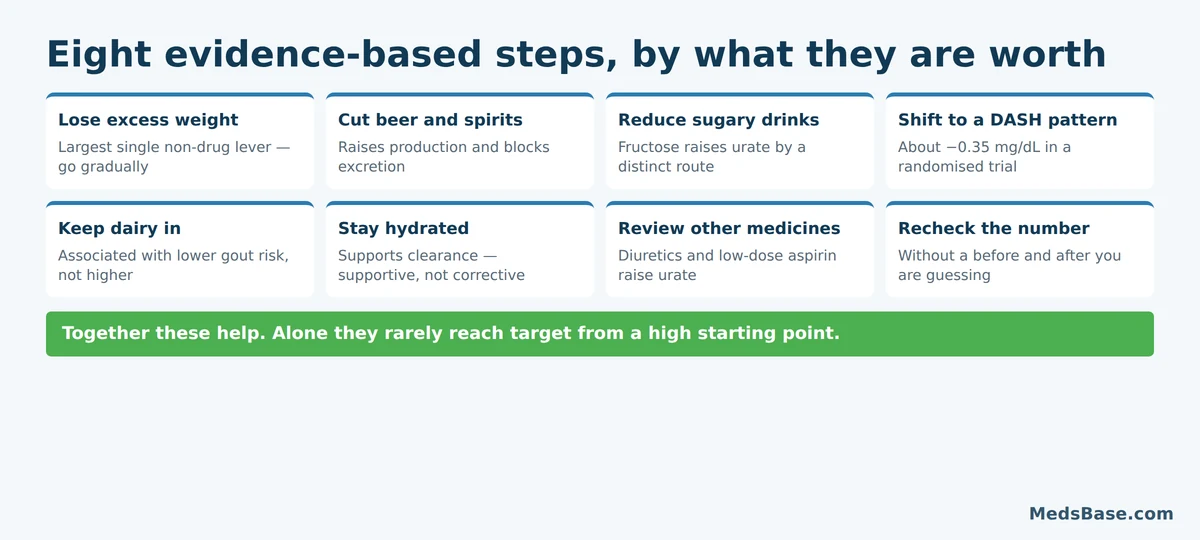
Here is how to lower uric acid in practice, ordered by how much each step is realistically worth — which is not the order most lists use.
- Lose excess weight, gradually. This is the largest non-drug lever and the one buried at position seven in most articles. Excess weight and insulin resistance both impair urate excretion. Losing weight steadily improves it. The catch matters: rapid weight loss or fasting temporarily raises urate, because tissue breakdown releases purines and ketones compete with urate for kidney excretion. Slow and steady genuinely beats fast here.
- Cut back on beer and spirits. Alcohol raises urate through two mechanisms at once — it increases production and reduces excretion. Beer adds a third, being purine-rich in its own right from the brewer’s yeast. This is one of the few dietary changes with a direct, fairly quick effect on the number.
- Reduce sugar-sweetened drinks. Fructose is the one dietary component that raises uric acid through a distinct metabolic route: metabolising it consumes ATP and generates purine breakdown products directly. Sugary soft drinks and fruit juices count; whole fruit behaves differently and does not need eliminating.
- Shift toward a DASH-style eating pattern. More vegetables, fruit, low-fat dairy and wholegrains; less red meat and less added sugar. This is the dietary pattern with the best randomised evidence behind it, quantified in the research section below.
- Keep dairy in your diet. Low-fat dairy is associated with lower gout risk, not higher — one of the few foods that appears actively protective. Cutting it out as part of a general “clean eating” push is a common own goal.
- Stay properly hydrated. Adequate fluid supports kidney clearance and reduces the concentration at which crystals form. This helps, but on its own it does not move a substantially raised level to target.
- Review your other medicines. Several common drugs raise urate — thiazide and loop diuretics most notably, plus low-dose aspirin and ciclosporin. Nobody should stop a prescribed medicine over this, but it is a genuinely useful thing to raise, because sometimes an equally effective alternative exists.
- Measure, don’t guess. Get the number rechecked after a few months of change. Without a before and after, you cannot tell whether what you are doing is working, and you may be relying on changes that are not delivering.
The honest summary of how to lower uric acid with this list: steps 1 through 7 combined will help most people, and will not, by themselves, take a level of 9 mg/dL to under 6. That is the realistic ceiling of gout prevention through lifestyle alone.
The Food Question, Answered Honestly
This resolves the first open loop — the recommendation quoted at four times its evidential strength is cherry consumption, and we will get there in a moment.
The best food-by-food data still comes from a study that followed 47,150 men for 12 years and recorded 730 new cases of gout. Comparing highest to lowest intake groups, it found a relative risk of 1.41 for meat and 1.51 for seafood — and 0.56 for dairy, meaning the highest dairy consumers had roughly half the gout risk of the lowest.
The finding that overturned decades of advice: purine-rich vegetables showed no association with increased gout risk at all. Neither did total protein intake.
| Food group | Effect on gout risk | What to actually do |
|---|---|---|
| Red meat | Higher risk (RR 1.41, highest vs lowest intake) | Reduce portion size and frequency; no need to eliminate |
| Seafood | Higher risk (RR 1.51) | Moderate; oily fish still has cardiovascular value worth weighing |
| Low-fat dairy | Lower risk (RR 0.56) | Keep it in — this one appears protective |
| Purine-rich vegetables | No increased risk found | Stop avoiding spinach, asparagus, mushrooms and beans |
| Beer and spirits | Higher risk | The most worthwhile drink-related change |
| Sugary drinks | Higher risk via fructose | Reduce; whole fruit is a different matter |
So: cherries. Cherry juice and cherry extract are recommended almost universally in consumer gout advice. The reality is that supportive evidence exists but is thin — small studies, often observational, with methodological limits — and it has not been established as a way to lower serum urate meaningfully. Cherries are a pleasant thing to eat and carry essentially no downside. Treating them as a substitute for reaching target is the mistake. Where evidence is this limited, saying so plainly is more useful than repeating the recommendation with confidence it has not earned.
Vitamin C deserves a similar note. Observational data linked higher intake with lower urate, but when tested in people who actually have gout, supplementation produced disappointing results. It is not a substitute for treatment.
What the Research Says About How to Lower Uric Acid
Now the number that anchors this whole article.
| Study | Year | Design | Finding |
|---|---|---|---|
| DASH-Sodium ancillary feeding study | 2016 | Randomised crossover, 103 adults, controlled feeding, weight held constant | DASH diet reduced serum uric acid by −0.35 mg/dL (95% CI −0.65, −0.05); −1.29 mg/dL (95% CI −2.50, −0.08) in the subgroup with baseline urate ≥7 mg/dL (n=8) |
| Health Professionals Follow-up Study | 2004 | Prospective cohort, 47,150 men, 12 years, 730 incident cases | Meat RR 1.41, seafood RR 1.51, dairy RR 0.56; purine-rich vegetables and total protein not associated |
| ACR gout management guideline | 2020 | Systematic evidence review and guideline | Treat-to-target serum urate <6 mg/dL with titrated urate-lowering therapy; dietary modification produces only small changes in serum urate |
The centrepiece is a randomised feeding trial — the strongest design available for a dietary question, because participants were actually fed the diets rather than asked to report what they ate, and body weight was deliberately held constant so the diet’s effect could be isolated from weight loss.
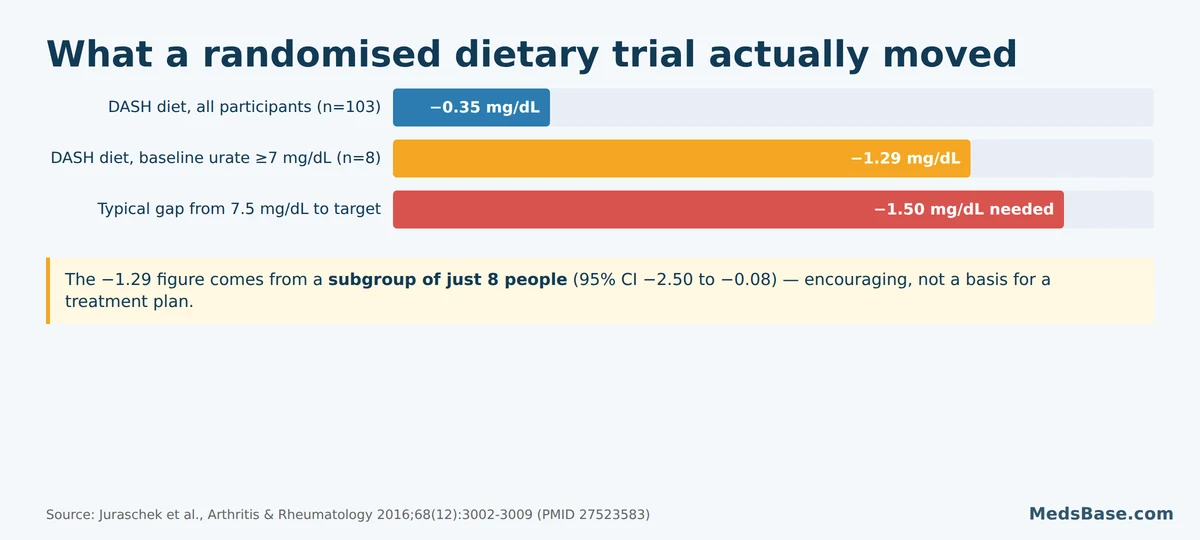
The DASH diet lowered serum uric acid by 0.35 mg/dL on average. That is a real, statistically significant effect from diet alone, and it is worth having.
Now the small print on the number you have probably seen quoted. In participants who started with a urate of 7 mg/dL or above, the reduction was 1.29 mg/dL — the figure that gets repeated as evidence that diet can do the heavy lifting. That subgroup contained eight people. The confidence interval ran from −2.50 to −0.08, which is another way of saying the true effect could be almost anything from substantial to barely detectable. It is a genuine and encouraging signal, and it is not a number to build a treatment plan on.
What this means for you: if your level is 7.5 mg/dL, excellent dietary work might reasonably get you to somewhere around 7.0, possibly a bit lower with weight loss on top. Target is under 6.0. You can see the size of the remaining gap.
That gap is not an argument against changing your diet. It is an argument for knowing what you are buying with the effort, so you are not blindsided when a year of discipline leaves you still above target and still having flares.
Diet Versus Medication — Which Fits Which Situation
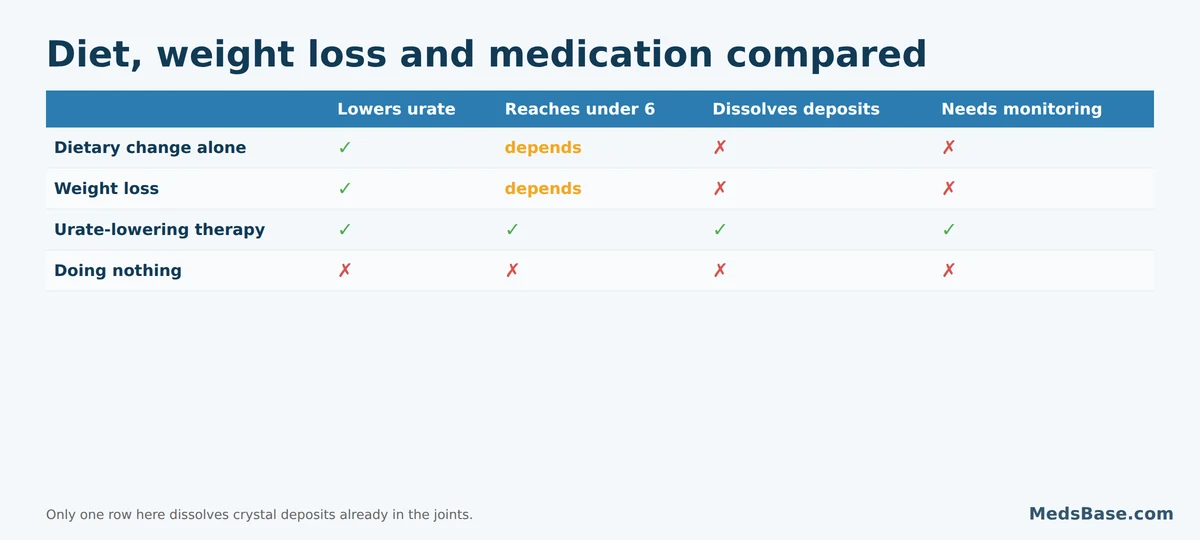
When people ask how to lower uric acid, this is the decision underneath the question. The choice is rarely either/or, but the situations genuinely differ.
| Diet and lifestyle alone | Urate-lowering therapy (plus diet) | |
|---|---|---|
| Typical urate reduction | Roughly 0.3–1.0 mg/dL | Enough to reach and hold under 6 mg/dL |
| Dissolves existing crystal deposits | Not reliably | Yes, gradually, when held below target |
| Requires blood monitoring | Recheck to confirm progress | Yes — dose is titrated against results |
| Best suited to | Mildly raised urate, no flares, no deposits | Recurrent flares, tophi, joint damage, or urate far above target |
Which one fits which situation? If your level is mildly raised, you have never had a flare, and you have no crystal deposits, diet and lifestyle are a reasonable first approach — with a recheck to see whether they worked. If you are having recurrent attacks, have visible tophi, or your uric acid levels sit well above target, the evidence supports urate-lowering therapy for gout prevention, and delaying it usually means more joint damage rather than more virtue.
Urate-lowering therapy works on the mechanism directly, either reducing production or increasing excretion. Allopurinol is the most widely used first-line option; MedlinePlus drug information for allopurinol covers how it is taken and what to watch for. It is a long-term medicine — stopping it lets urate climb straight back, which is why it is started with the intention of continuing. MedsBase stocks it as Hyloric (allopurinol), and no prescription is needed to order from MedsBase.com. If you do reach that decision point, how the two main urate-lowering drugs compare sets out the choice in detail.
One counterintuitive thing to expect: starting urate-lowering therapy can trigger a flare in the first weeks. As deposits begin dissolving, crystals shed into the joint space. It is a sign the treatment is working, not failing, and it is the single most common reason people abandon a medicine that was about to help them. Because of this, short-term preventive cover — commonly low-dose colchicine, stocked as Goutnil (colchicine) — is usually recommended alongside the first months of treatment. The NHS guidance on gout describes the same approach.
Practical Guidance: Building a Plan That Works
Knowing how to lower uric acid is only useful once it becomes a sequence. Here is a sensible order.
- Get a baseline uric acid test result, taken when you are not mid-flare. Urate can read misleadingly low during an acute attack, which is one of the more common ways people get falsely reassured.
- Write down your actual starting point and the gap to 6.0 mg/dL. This turns a vague goal into arithmetic and makes the next decisions obvious.
- Start with the two biggest levers: gradual weight loss if you carry excess weight, and reducing beer, spirits and sugary drinks.
- Fix the avoidable own goals: stop avoiding purine-rich vegetables, keep dairy in, and drink enough fluid.
- Ask about your other medicines at your next appointment — particularly if you take a diuretic.
- Recheck at three months. Compare against your baseline honestly.
- If you are still above target, treat that as information, not failure. It usually means the excretion bottleneck is the dominant factor, which is precisely the situation urate-lowering therapy is designed for.
Mistakes to avoid: treating “normal on the lab report” as “at target”; crash dieting or extended fasting; eliminating vegetables and dairy for no benefit; relying on cherry juice as a treatment; stopping urate-lowering therapy the moment the number improves; and abandoning a new medicine because it triggered a flare in the first month — that is the expected pattern, not a failure.
- What actually stops an attack once it starts — the acute playbook, which is a different job from prevention.
- How the two main urate-lowering drugs compare — for the decision point this article leads to.
- What the eye warnings on GLP-1 medicines really mean — relevant if weight loss is part of your plan and you are considering medication for it.
Frequently Asked Questions
Q: What foods lower uric acid quickly?
A: No single food lowers uric acid quickly. The dietary pattern with the best randomised evidence is DASH-style eating — more vegetables, fruit, low-fat dairy and wholegrains, less red meat and added sugar — which reduced serum uric acid by about 0.35 mg/dL on average in a controlled feeding trial. Low-fat dairy is the closest thing to a genuinely helpful food, being associated with roughly half the gout risk in the highest consumers. The fastest dietary lever is subtractive rather than additive: cutting beer, spirits and sugary drinks.
Q: How long does it take to lower uric acid?
A: Dietary and lifestyle changes show up on a blood test within weeks, but the effect is modest and worth rechecking at around three months. Urate-lowering medication works faster and further, often reaching target within weeks of finding the right dose. Dissolving crystal deposits already in your joints is much slower — months to years of staying below target, which is why treatment is continued rather than stopped once the number looks good.
Q: Can you lower uric acid without medication?
A: You can, and whether that is enough depends entirely on your starting point. Every approach to how to lower uric acid without a tablet works on the same handful of levers. Combined weight loss, alcohol reduction, cutting sugary drinks and a DASH-style diet realistically deliver somewhere in the region of 0.5 to 1.5 mg/dL for many people. If you start at 6.5 mg/dL that may reach target. If you start at 9 mg/dL it will not. Guidelines recommend urate-lowering therapy for recurrent flares, tophi or joint damage regardless of diet quality.
Q: What is a normal uric acid level?
A: Laboratory reference ranges typically run up to about 7.0 mg/dL for men and 6.0 for women, but that is a population average, not a treatment goal. For anyone with gout, the American College of Rheumatology target is below 6 mg/dL, because urate stops reliably dissolving at around 6.8. A result of 6.5 can therefore be flagged “normal” and still be a level at which crystals accumulate — worth clarifying with whoever ordered the test.
Q: Does drinking water lower uric acid?
A: Adequate hydration supports kidney clearance and reduces the concentration at which crystals form, so it genuinely helps — but the effect is supportive rather than corrective. Drinking more water will not bring a substantially raised level down to target on its own. It is most valuable as one component alongside the larger levers, and particularly worth attention if you have had urate kidney stones, where fluid intake has a more direct role.
Q: Do cherries lower uric acid?
A: The evidence is weaker than the recommendation’s popularity suggests. Some small and largely observational studies have reported fewer gout attacks with cherry intake, but this has not been established as a reliable way to lower serum urate, and the research has notable methodological limits. Cherries are harmless and pleasant, so there is no reason to avoid them. Relying on them instead of reaching your target number is where people come unstuck.
Q: Why did my gout get worse after starting treatment?
A: This is expected and usually temporary. As urate levels fall, existing crystal deposits begin to dissolve and can shed crystals into the joint space, triggering a flare. It signals that the medicine is working on the deposits, not that it has failed. This is why short-term preventive cover is commonly prescribed alongside the first months of urate-lowering therapy. Stopping the medicine at this point is the most common way people lose the benefit just as it starts.
Q: Should I avoid spinach, asparagus and beans?
A: No — this is one of the most persistent pieces of outdated advice. Purine-rich vegetables were tested directly in a 12-year study of 47,150 men and showed no association with increased gout risk. The purines in plant foods appear to behave differently from those in meat and seafood. Avoiding vegetables costs you nutritional quality for no measurable urate benefit, and it makes a DASH-style pattern — the approach with the best evidence — harder to follow.
The Bottom Line
The honest answer on how to lower uric acid is that diet and lifestyle are worth real effort and are frequently not sufficient on their own. Weight loss, less alcohol, fewer sugary drinks and a DASH-style pattern will move your number, probably by somewhere between half a point and a point and a half. Whether that is enough depends entirely on how far above 6 mg/dL you started.
The one action worth taking this week: find out your actual number, taken outside a flare, and write down the gap between it and 6.0 mg/dL. Every decision that follows — how hard to push on diet, whether to discuss medication, how long to give it — becomes straightforward once you can see the size of the gap. Guessing is what keeps people stuck.
If you have worked through this and concluded you are likely to need more than diet, that is a reasonable conclusion rather than a personal failure, and you can see the available options for Hyloric (allopurinol) before raising it with a clinician.
Wondering which urate-lowering medicine you would actually be offered? How the two main urate-lowering drugs compare walks through the choice. And if weight loss is part of your plan and you are weighing medication for that too, what the eye warnings on GLP-1 medicines really mean covers a safety question worth understanding before you start.

Written by
Sophie ChenPharmaceutical Content Researcher · 8 years experience
Sophie Chen is a pharmaceutical content researcher with 8 years covering generic medication access and clinical pharmacology. She specialises in international regulatory frameworks, bioequivalence standards, and patient-facing education on therapeutic drug classes. She is not a clinician.