








✓ Medically reviewed by · Last reviewed: May 2026
Pharmacy Researcher · 8 years experience
Pharmacy researcher with 8 years reviewing clinical drug information, generic formulation equivalence, and international pharmaceutical standards. Focuses on patient-facing accuracy in medication education.
You’re an hour into the ferry crossing when the horizon starts to tilt. Your mouth goes watery, a cold sweat prickles your neck, and you’d trade almost anything to make the boat stop moving. If you’ve ever been that person — green-faced on a coach, a flight, or the back seat of a mountain road — you already know that the right motion sickness medication can be the difference between a ruined day and barely noticing the motion at all.
By the end of this guide you’ll know which drug class actually prevents travel nausea, which one won’t leave you too drowsy to enjoy the destination, and the single timing mistake that makes people think their tablets “didn’t work.” There’s also one common assumption about the strongest option that turns out to be backwards — we’ll get to it in the comparison.
- Prevention beats rescue — most motion sickness medication works far better before symptoms start, not after.
- First-generation antihistamines are the everyday workhorses — with moderate-certainty evidence behind them.
- The scopolamine patch may protect more people — but it comes with a trade-off most travellers underestimate.
- One popular option is best for vertigo, not travel sickness — mixing them up wastes a dose.
- Drowsiness is the price of admission for several options — one choice keeps a clearer head.
- A few no-cost habits boost every tablet’s effect — skip them and even the best drug underperforms.
Table of Contents
- What is motion sickness — and why medication helps
- How motion sickness medication works
- Key uses & who should take it
- Safety, side effects & the drowsiness trade-off
- What the research says
- Motion sickness medication vs the alternatives
- How and when to take it — the timing that matters
- Frequently asked questions
- The bottom line
What Is Motion Sickness — and Why Medication Helps
Motion sickness is nausea, sweating and dizziness triggered when your inner ear senses movement your eyes don’t confirm — or vice versa. Your balance system and your vision send the brain conflicting reports, the brain reads the mismatch as a possible toxin, and it responds with the classic queasy cascade. Travel sickness tablets work by dampening that false alarm before it snowballs into vomiting.
That sensory-mismatch idea explains a lot. Reading in a moving car is a reliable trigger because your eyes lock onto a still page while your inner ear shouts “we’re moving.” Looking at the horizon helps because it lets your eyes and ears agree again. The NHS lists both the drug and non-drug tactics travellers can combine.
Here’s the first open loop worth planting: not everything sold for “dizziness” is a motion sickness medication. Some products are built for a completely different problem — the spinning, room-tilting sensation of vestibular vertigo — and taking one for a car trip is a classic mix-up. We’ll untangle that in the comparison section, because it changes which product you should reach for.
How Motion Sickness Medication Works
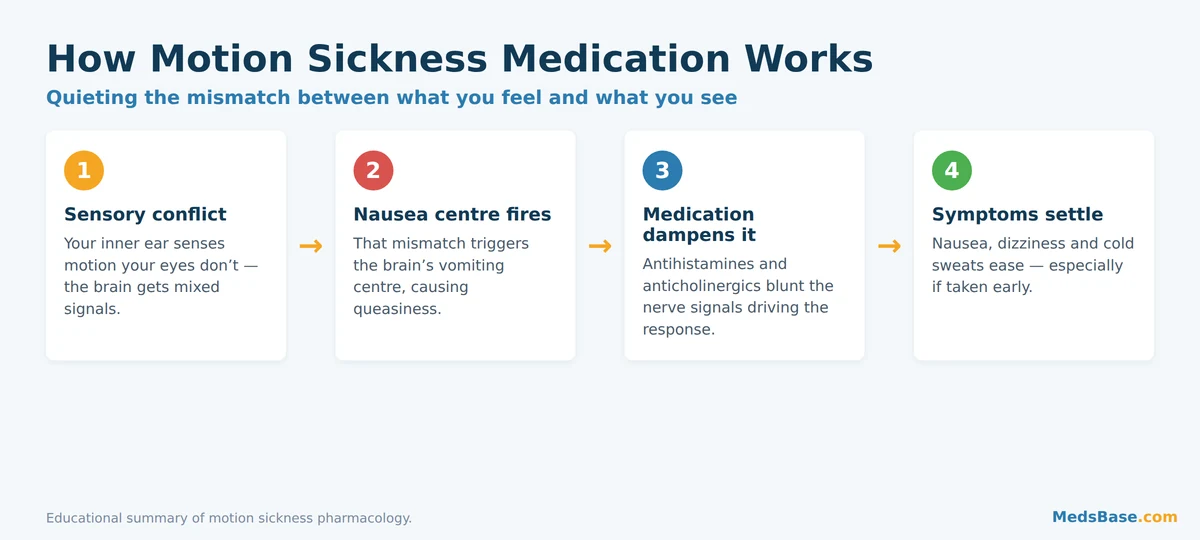
Most travel sickness drugs fall into two families, and they quiet the alarm in different ways.
First-generation antihistamines — promethazine, meclizine, cinnarizine, dimenhydrinate — block histamine and, importantly, cross into the brain, where they calm the vestibular signals feeding the nausea centre. Their brain penetration is exactly why they work and why they make you sleepy: the same door that lets them dampen the signal also causes drowsiness.
Anticholinergics — chiefly scopolamine (hyoscine) — block acetylcholine in the vestibular pathway. The transdermal scopolamine patch delivers a steady low dose through the skin for up to three days, which suits long crossings and cruises.
Betahistine sits in a third, separate lane — a histamine-like drug used mainly for inner-ear disorders such as Ménière’s, not classic travel sickness. Keep it in mind for the comparison; it’s the source of that common mix-up.
One line to remember: nearly every motion sickness medication works by muting a false alarm — so the earlier you mute it, the better it works.
Key Uses & Who Should Take It
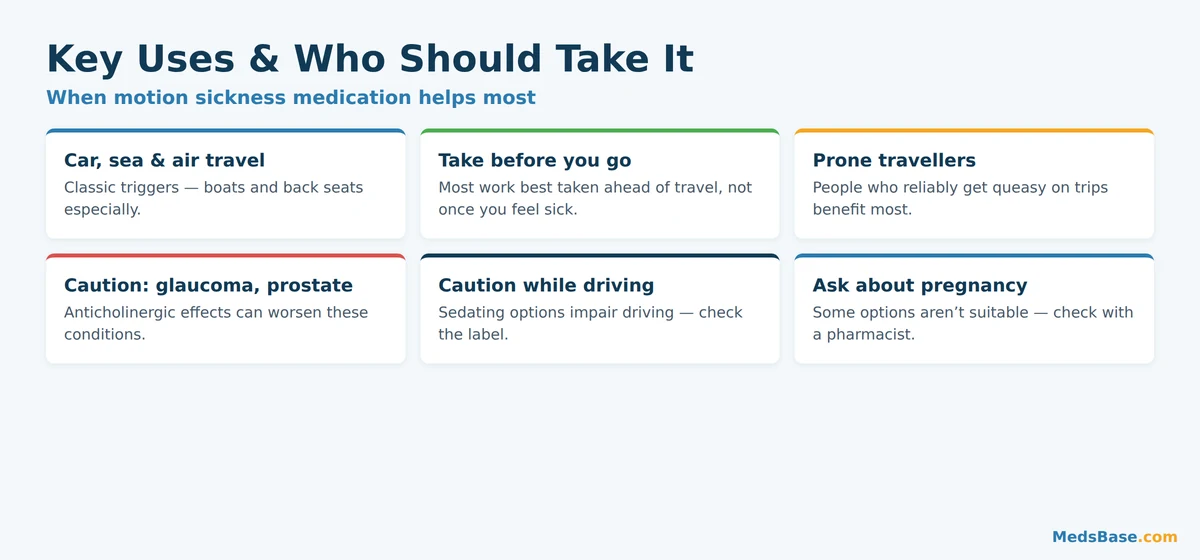
Travel sickness tablets earn their place any time motion and vision disagree:
Everyday situations
- Cars, coaches and winding roads — especially for back-seat passengers and readers.
- Boats, ferries and cruises — where the patch’s multi-day coverage shines.
- Flights — turbulence-prone routes or small aircraft.
- Rides and VR — theme parks and headsets trigger the same mismatch.
Who benefits most
- Children and teens, who are especially prone (with age-appropriate products and dosing only).
- Anyone with a history of travel nausea — if it happened before, prevent it this time.
- People facing a long, unavoidable journey where being sick isn’t just unpleasant but genuinely disruptive.
Before a big trip, it’s worth reading everything you need to pack your medicines safely — dosing across time zones and carrying documentation trips up more travellers than the motion itself.
Take Marcus, 34 — a purely illustrative example. Every summer ferry to visit family leaves him green within the hour, so he “toughs it out” and spends the crossing by the rail. This year he takes a lower-sedation antihistamine an hour before boarding, picks a mid-ship seat, and keeps his eyes on the horizon instead of his phone. He still notices the swell — no tablet erases it — but he arrives able to carry the bags instead of collapsing into the car. Marcus’s story isn’t a promise; it’s the ordinary, achievable difference the right routine makes.
Special situations: children, pregnancy and long cruises
A few travellers need a tailored approach rather than the default tablet.
- Children are more prone to motion sickness than adults, peaking roughly between ages 2 and 12. They need child-specific products and doses — never a fraction of an adult tablet — and benefit hugely from the non-drug habits below, since a distracted, horizon-watching child is a less nauseous one.
- Pregnancy changes the calculus. Some options are used in pregnancy under medical guidance, but this is firmly a “ask your doctor or pharmacist first” situation rather than a self-select one.
- Older adults are more sensitive to the confusion, constipation and fall risk that anticholinergic and sedating drugs can bring — a gentler option and a lower dose usually make sense.
- Multi-day cruises are the scenario where the scopolamine patch shines: steady coverage for up to about three days without re-dosing, so you’re not setting alarms at sea. Just start it ahead of departure and mind the dry mouth.
Safety, Side Effects & the Drowsiness Trade-Off
Now the trade-off we flagged. The very property that makes first-generation antihistamines effective — getting into the brain — is what makes them sedating. For an overnight ferry, that’s a feature. For a self-drive road trip where you’re behind the wheel, it’s a genuine hazard.
| Side effect | Frequency | Severity | What to do |
|---|---|---|---|
| Drowsiness / sedation | Common (antihistamines & scopolamine) | Mild–moderate | Never drive or operate machinery; let a non-driver take the sedating option |
| Dry mouth | Common (scopolamine) | Mild | Sip water, sugar-free gum |
| Blurred vision | Occasional (scopolamine) | Mild–moderate | Avoid if it affects driving; remove patch if severe |
| Constipation / urinary difficulty | Occasional | Mild | More likely in older adults; review if bothersome |
| Confusion / memory fog | Uncommon (worse in older adults) | Variable | Prefer lower-sedation options; stop and review |
A pharmacist’s practical note: the person who reacts worst is usually the driver who takes a sedating antihistamine “to be safe,” then fights heavy eyelids for three hours. If you’re the one driving, the safer plan is a lower-drowsiness choice — or letting a passenger carry the sedating option instead. The best motion sickness medication for you depends as much on your role in the journey as on the drug itself.
That resolves the safety loop: drowsiness isn’t a rare surprise, it’s a predictable price — and you can choose how much of it to pay.
What the Research Says
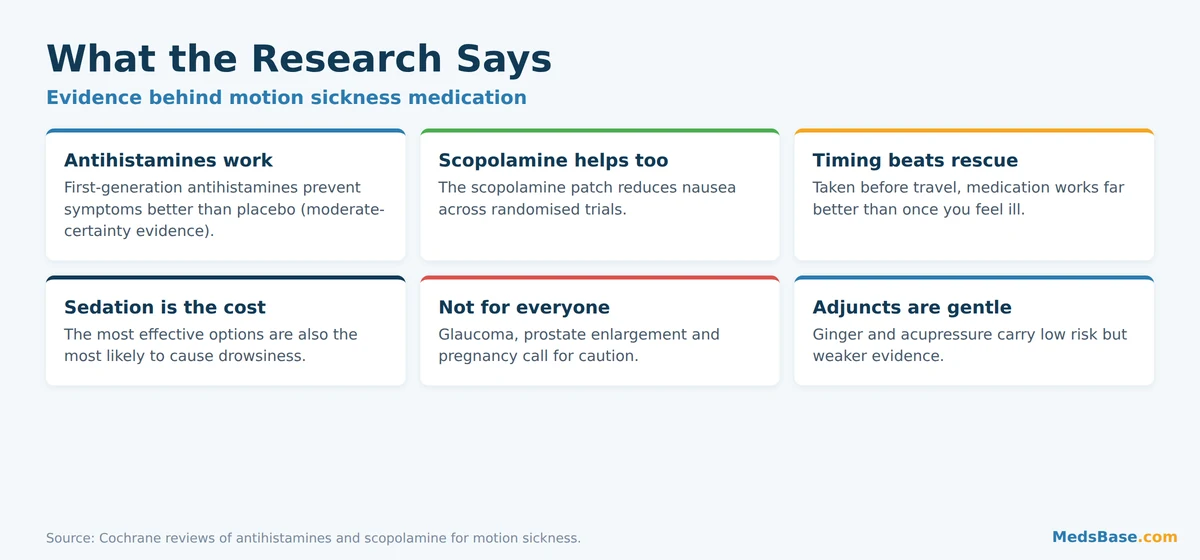
The evidence base here is reassuringly ordinary — no hype, just modest, real benefit.
| Evidence | Focus | Key finding | Source |
|---|---|---|---|
| Cochrane-linked antihistamine review | First-gen antihistamines | Better than placebo at preventing symptoms, moderate-certainty evidence; sedation more common than placebo | NIH/PMC |
| Cochrane scopolamine review | Scopolamine (hyoscine) | Reduced nausea vs placebo across randomised trials; anticholinergic effects noted | Cochrane |
| Comparative data | Scopolamine vs antihistamine | In some head-to-heads, the patch protected a larger share of people | Peer-reviewed |
According to the antihistamine evidence summarised by NIH/PMC, first-generation antihistamines prevent motion sickness for a meaningful minority more than placebo does — with drowsiness as the trade-off. The scopolamine evidence tells a similar story: a Cochrane review of randomised trials found the patch reduced nausea compared with placebo, though it didn’t abolish vomiting entirely and brought its own anticholinergic effects. In other words, both mainstays are real but modest — they tilt the odds, they don’t rewrite the rules of physics.
What this means for you: don’t expect a force field. These drugs shift the odds solidly in your favour, especially when paired with the timing and seating habits below — but no tablet makes a small boat in a swell feel like dry land. The travellers who are happiest with their medication are the ones who also did the free things: sat in the calmest spot, watched the horizon, skipped the phone, and dosed early. Set realistic expectations and stack the habits, and you won’t be disappointed.
Do the non-drug tactics actually help?
Yes — and they’re not just folk wisdom. Choosing the least-motion seat, fixing your gaze on a stable distant point, getting fresh air and eating lightly beforehand all reduce the sensory mismatch that starts the whole cascade. Evidence for acupressure wristbands and ginger is genuinely mixed — some people swear by them, trials are inconsistent — but both are low-risk and cheap enough to try alongside, not instead of, a proven medication. The one habit with the biggest payoff and zero cost is simply looking where you’re going.
Motion Sickness Medication vs the Alternatives
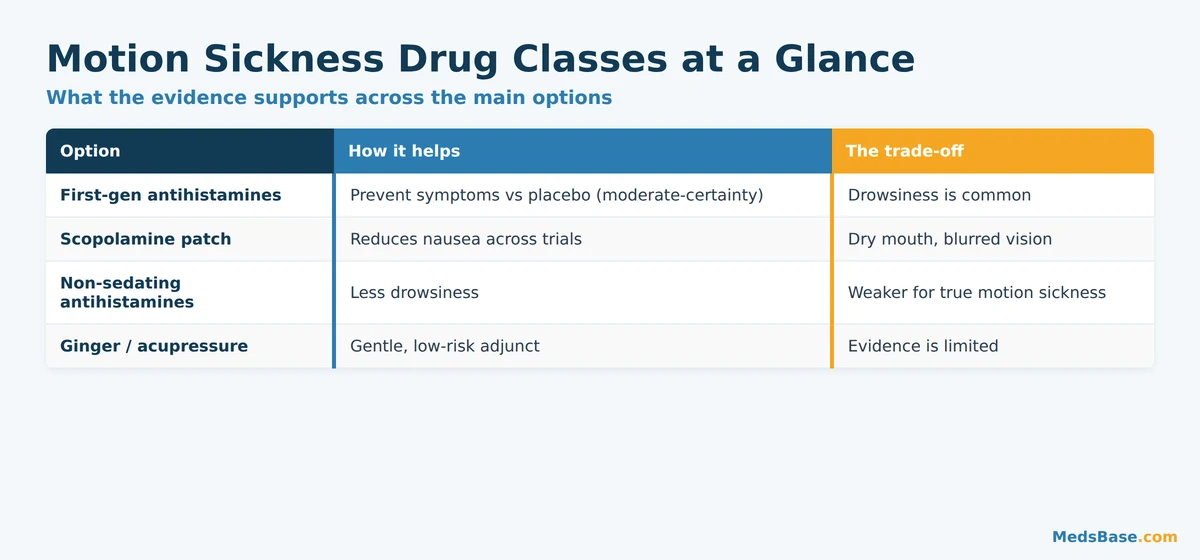
Here’s the backwards-seeming truth we promised. Ask most people which is “strongest” and they’ll guess the tablet they know. Yet in several comparisons, the scopolamine patch protected a larger proportion of travellers than a standard antihistamine dose — while the antihistamine meclizine tends to cause less memory fog than either scopolamine or promethazine. Strongest and gentlest aren’t the same drug.
| Option | Type | Drowsiness | Best for | Notes |
|---|---|---|---|---|
| Meclizine | Antihistamine | Lower | Day trips where you stay alert | Fewer cognitive effects; take ~1 hr before |
| Promethazine | Antihistamine | Higher | Severe cases, overnight travel | Effective but sedating; not for drivers |
| Cinnarizine | Antihistamine | Moderate | Boats, longer journeys | Popular for seasickness |
| Scopolamine patch | Anticholinergic | Moderate | Cruises, multi-day trips | Up to ~3 days’ cover; dry mouth, blurred vision |
| Betahistine | Histamine-like | Low | Vestibular vertigo, not travel sickness | Different problem — don’t use for a car trip |
Which fits which situation? Driving yourself on a day trip? A lower-sedation antihistamine like meclizine, sold as Diligan, keeps you clearer-headed — the MedlinePlus meclizine page covers dosing and its drowsiness profile. Facing a rough overnight ferry as a passenger? A stronger, more sedating antihistamine such as promethazine, sold as Avomine, may suit. On a multi-day cruise? The scopolamine patch’s steady release means no re-dosing — just mind the dry mouth and blurred vision.
And that mix-up we kept circling back to: if your “dizziness” is actually the room-spinning, off-balance sensation of vestibular vertigo — not travel-triggered nausea — then betahistine (sold as Vertin) targets that inner-ear problem instead. Unsure which you have? Our vertigo symptoms and treatment guide helps you tell them apart before you spend a dose on the wrong one.
Onset, duration and re-dosing — the details that decide comfort
Two travellers can take the “same” motion sickness medication and have very different journeys, because onset and duration vary by product. Oral antihistamines generally take hold within 30 to 60 minutes and last several hours, which is why a single well-timed dose covers most day trips. Longer or repeat journeys may need a second dose at the label’s stated interval — but stacking doses early to “make sure” mostly just doubles the drowsiness. The scopolamine patch is the opposite temperament: slow to start (apply it several hours ahead) but long to last, giving up to around three days of steady cover ideal for a cruise. Match the drug’s rhythm to your trip’s rhythm and you avoid both the “wore off halfway” and the “too sedated to enjoy it” traps.
Choosing in 30 seconds
If you want a fast rule of thumb: driving or need to stay sharp? Pick the lower-sedation antihistamine. Passenger on a rough, long journey? A stronger antihistamine is fair game. Multi-day boat trip? Consider the patch. Room genuinely spinning even when still? That’s a vertigo question, not a travel-sickness one — different aisle entirely. Whatever you choose, the dose only works if it’s on board before the motion starts.
How and When to Take It — the Timing That Matters
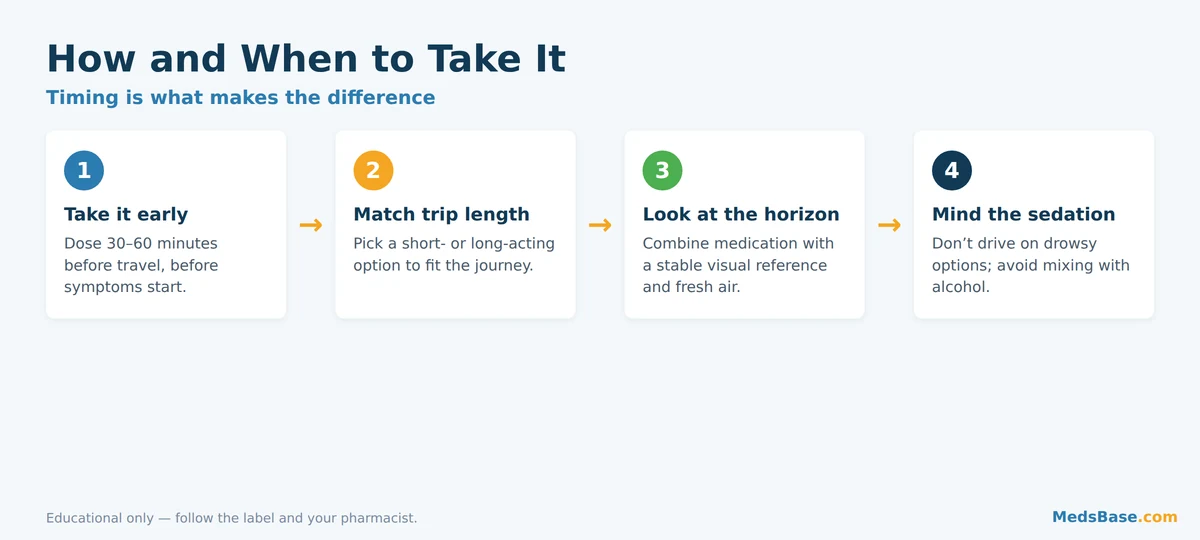
This is the section that fixes the “my tablets didn’t work” complaint. Nine times out of ten, they were taken too late.
- Dose ahead of time. Take most oral motion sickness medication 30–60 minutes before you travel. For the scopolamine patch, apply it several hours before departure per the label.
- Pick your seat. Front seat of a car, over the wing on a plane, mid-ship on a boat — the spots with the least motion.
- Give your eyes a truthful view. Look at the horizon or a fixed distant point. Don’t read, don’t stare at a phone.
- Get air and stay cool. Fresh air and avoiding strong smells reduce the trigger load.
- Re-dose only as the label allows. For long trips, follow the stated interval — don’t stack doses to “top up.”
Mistakes to avoid: waiting until you feel sick to take the first dose; driving after a sedating antihistamine; reading or scrolling to “distract yourself” (it makes the mismatch worse); and giving adult products or doses to children. If you’re stocking up before a trip, you can browse our full Vertigo & Motion Sickness range to compare formats in one place.
Frequently Asked Questions
Q: What is the best medication for motion sickness?
A: There’s no single winner — it depends on your role and trip length. For staying alert (especially if you’re driving), a lower-sedation antihistamine like meclizine is a strong pick. For severe cases or overnight travel as a passenger, promethazine works but sedates more. For multi-day cruises, the scopolamine patch offers steady, re-dose-free coverage.
Q: How long before travel should I take motion sickness tablets?
A: Most oral tablets work best taken about 30 to 60 minutes before you set off, because prevention beats rescue. The scopolamine patch should go on several hours ahead per its label. Taking a tablet only after nausea starts often disappoints, since a queasy stomach absorbs the drug poorly.
Q: Does motion sickness medication make you drowsy?
A: Often, yes. First-generation antihistamines and scopolamine can all cause drowsiness because they act in the brain. Meclizine tends to cause less cognitive fog than promethazine or scopolamine, but no sedating option is safe to combine with driving. Choose based on whether you need to stay alert.
Q: Can you take motion sickness medication with high blood pressure?
A: Usually, but check first. The concern is additive drowsiness with other medicines and, rarely, interactions. If you manage high blood pressure or take several drugs, ask a pharmacist to confirm your specific combination is fine before travelling — and never drive after a sedating dose.
Q: What helps motion sickness without medication?
A: Sit where there’s least motion (front of a car, over the wing, mid-ship), fix your eyes on the horizon, avoid reading or screens, get fresh air, and eat lightly beforehand. These habits genuinely reduce symptoms and make any medication you do take work better. Evidence for acupressure bands and ginger is mixed but low-risk to try.
Q: Is scopolamine or meclizine better?
A: Neither is universally better. In some studies the scopolamine patch protected a larger share of people, making it appealing for long trips; meclizine tends to cause less memory fog and is convenient for shorter journeys. The patch adds dry mouth and blurred vision; the tablet is simpler. Match the tool to the trip.
Q: Can children take motion sickness medication?
A: Some products are suitable for children, but only in child-specific formulations and doses — never an adult tablet split down. Children are actually more prone to motion sickness than adults. Check the label’s age guidance or ask a pharmacist, and pair the dose with the seating and horizon habits that help every traveller.
Q: Does motion sickness medication stop working if you use it often?
A: For occasional travel, tolerance isn’t usually a practical problem — these drugs are taken for a trip, not daily for months. What people often mistake for “it stopped working” is actually a timing or dose issue: taken too late, or a dose too low for a rough journey. If you travel very frequently and feel a product is fading, that’s a good prompt to review your options and technique with a pharmacist rather than simply doubling up.
Q: Is it safe to drink alcohol with motion sickness tablets?
A: It’s best avoided. Alcohol adds to the sedation from antihistamines and scopolamine, deepening drowsiness and impairing coordination — a poor combination on any journey, and a dangerous one if you might drive. If you want a drink on a long flight or cruise, a lower-sedation option and moderation are wiser, but the safest answer is to keep the two apart while the medication is active.
The Bottom Line
The best motion sickness medication is the one matched to your journey and your job on it. If you’re driving, favour a lower-sedation antihistamine and keep a clear head. If you’re a passenger facing a rough crossing, a stronger antihistamine or the scopolamine patch will serve you better. Whatever you choose, take it early, sit smart, and keep your eyes on the horizon — the drug and the habits together beat either one alone.
Your one immediate action: before your next trip, set a phone reminder to take your dose 30–60 minutes before departure. That single habit fixes the most common reason travel sickness tablets seem to “fail.”
Not sure you’ve picked the right fix? These are the natural next questions:
- Packing for a longer trip? Read our guide to traveling with medications so nothing gets held up at the border.
- Is it really travel sickness, or something more persistent? Learn to tell it apart in our vertigo symptoms and treatment guide.

Written by
Sophie ChenPharmaceutical Content Researcher · 8 years experience
Sophie Chen is a pharmaceutical content researcher with 8 years covering generic medication access and clinical pharmacology. She specialises in international regulatory frameworks, bioequivalence standards, and patient-facing education on therapeutic drug classes. She is not a clinician.