








✓ Medically reviewed by · Last reviewed: May 2026
Pharmacy Researcher · 8 years experience
Pharmacy researcher with 8 years reviewing clinical drug information, generic formulation equivalence, and international pharmaceutical standards. Focuses on patient-facing accuracy in medication education.
Xalatan eye drops are one of the world’s most widely used treatments for lowering the pressure inside the eye — the single most important step in protecting sight from glaucoma. Glaucoma is the leading cause of irreversible blindness, and because it steals vision silently from the edges inward, most people never notice it happening. That is exactly why a simple once-daily drop matters so much.
The active ingredient in Xalatan eye drops, latanoprost 0.005%, is a prostaglandin analogue that has anchored glaucoma care since the late 1990s. In this guide you will learn what Xalatan eye drops do, how to use them correctly, the side effects to expect (including the well-known changes to iris colour and eyelashes), what the research actually shows, and how they compare with other glaucoma eye drops. The goal is simple: help you use this proven medication safely and get the most from every drop.
Key Takeaways
- What they are: Xalatan eye drops contain latanoprost 0.005%, a prostaglandin F2α analogue that lowers intraocular pressure (IOP).
- What they treat: open-angle glaucoma and ocular hypertension — conditions where high eye pressure threatens the optic nerve.
- How much they lower pressure: roughly 28–31% from baseline, among the strongest single-drop reductions available.
- How to use them: one drop in the affected eye(s) once daily in the evening — more frequent dosing actually works less well.
- Signature side effects: gradual, often permanent brown darkening of the iris, plus longer, thicker, darker eyelashes.
- Monitoring matters: glaucoma is silent — keep up regular eye-pressure checks even when the drops feel like they are doing nothing.
What Are Xalatan Eye Drops? (Latanoprost Explained)
Xalatan eye drops are a branded form of latanoprost 0.005%, a prostaglandin analogue that lowers intraocular pressure by improving fluid drainage from the eye. Used once daily, they treat open-angle glaucoma and ocular hypertension, reducing eye pressure by roughly 28–31% to help protect the optic nerve from damage.
Xalatan is the original brand name for latanoprost, a topical medication supplied as a 0.005% (50 micrograms per millilitre) sterile ophthalmic solution. It belongs to a class called prostaglandin analogues — synthetic molecules that mimic prostaglandin F2α, a naturally occurring signalling compound in the body.
Latanoprost was first approved by the US FDA in 1996 and quickly became a first-line treatment for chronic glaucoma because it is effective, needs dosing only once a day, and has few effects outside the eye compared with older tablet and drop treatments. The molecule itself is a prodrug: it is inactive as supplied and is converted by enzymes in the cornea into “latanoprost acid,” the form that actually lowers pressure.
You may see the same medicine sold under several names, which causes understandable confusion. “Xalatan” is the original brand; “latanoprost” is the generic active ingredient; and various generic brands worldwide contain the identical 0.005% solution. Whatever the label on the bottle, the molecule — and the once-daily evening routine — is the same, which is why generic latanoprost is used interchangeably with the brand.
At MedsBase, Xalatan Eye Drop is sourced from a WHO-GMP-certified manufacturer and, like the brand, contains the same 0.005% latanoprost concentration. No prescription is needed to order, and every order is covered by our Reshipment Assurance Policy.
How Do Xalatan Eye Drops Work?
To understand the drops, it helps to understand the pressure. The eye continuously produces a clear fluid called aqueous humour. In a healthy eye, this fluid drains away at the same rate it is made, keeping internal pressure stable. In glaucoma, drainage falls behind production, pressure builds, and that pressure slowly damages the optic nerve — the cable that carries vision to the brain.
Because the damage is painless and starts at the edges of vision, most people do not notice it until sight is already lost, which is why glaucoma is often called “the silent thief of sight.” Lowering the pressure is the only proven way to slow that damage.
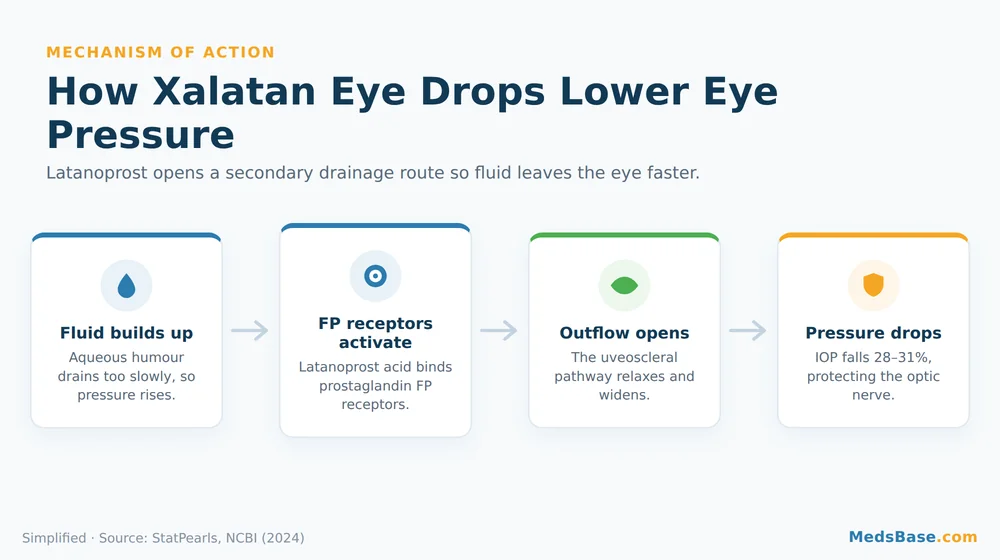
Latanoprost lowers pressure by opening up a secondary drainage route called the uveoscleral outflow pathway. Clinical pharmacology reviews describe how the drug binds prostaglandin FP receptors and remodels the tissue around this pathway, so more aqueous humour leaves the eye and pressure drops (StatPearls, NCBI). A measurable reduction usually begins about 3–4 hours after the first drop, with the maximum effect reached roughly 8–12 hours later — which is exactly why an evening dose gives its strongest pressure control overnight and into the following day.
What Do the Eye-Pressure Numbers Mean?
Eye pressure is measured in millimetres of mercury (mmHg). A typical healthy reading sits between 10 and 21 mmHg. Many people with glaucoma have pressures above that range, although damage can occasionally occur at “normal” pressures too — a form called normal-tension glaucoma.
Your eye-care professional sets a personal target pressure, often 20–30% below your starting reading, because lowering pressure is the one intervention proven to slow glaucoma. That is why the 28–31% reduction Xalatan eye drops deliver is so valuable: for many people, a single evening drop is enough to reach that target without adding a second medication.
Research Spotlight: Why Xalatan Can Change Your Eye Colour
Latanoprost increases the amount of brown pigment (melanin) in the coloured part of the eye. People with mixed-colour irises — blue-brown, green-brown or grey-brown — are the most likely to notice a gradual, permanent shift toward brown, usually over months of use. The change is cosmetic rather than harmful, but because it does not reverse when the drops are stopped, it is worth knowing about before you start — especially if you are treating only one eye, where a colour difference between the two eyes could become noticeable. The same pigment effect is what makes lashes grow longer and darker, an action harnessed cosmetically in bimatoprost products such as those covered in our Latisse vs Careprost comparison.
What Xalatan Eye Drops Treat: Key Uses
Xalatan eye drops are used to reduce elevated intraocular pressure in adults (and, in selected cases, children) with two main conditions:
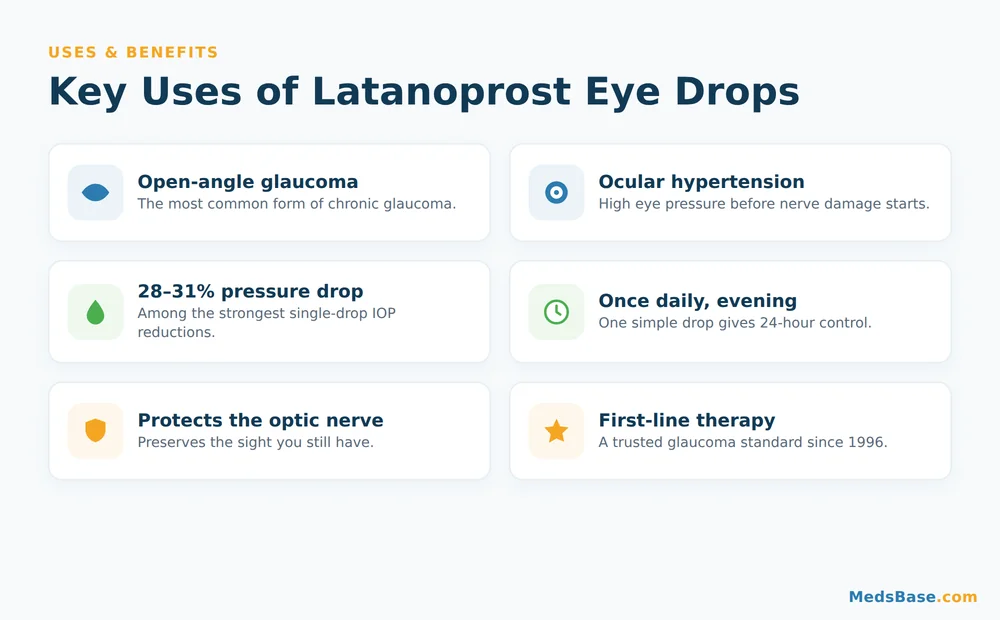
- Primary open-angle glaucoma (POAG) — the most common form, where the drainage angle is open but fluid still escapes too slowly.
- Ocular hypertension — raised eye pressure without (yet) any detectable optic-nerve damage, where treatment is used to prevent glaucoma from developing.
They are not a treatment for acute angle-closure glaucoma (a medical emergency) and do nothing to reverse vision that has already been lost. The goal of therapy is to protect the sight you still have by keeping pressure in a safe range for the long term — often for life. According to the MedlinePlus drug monograph, latanoprost is prescribed specifically to control this pressure rather than to cure the underlying condition.
Who Is This For?
- Adults with primary open-angle glaucoma who need reliable, long-term pressure control.
- People with ocular hypertension at risk of developing glaucoma.
- Anyone who wants the simplicity of a single evening drop rather than multiple daily doses.
- Patients starting first-line therapy, where a strong prostaglandin is usually tried before other classes.
- Not suitable as an emergency treatment for sudden, painful, red-eye angle-closure attacks — those need urgent in-person care.
Xalatan Eye Drops Dosage & How to Use Them
The dosing schedule for latanoprost is refreshingly simple, and simplicity is part of why it works so well — people find it easy to stick to. The table below sums up the standard regimen.
| Parameter | Recommendation |
|---|---|
| Standard dose | 1 drop in the affected eye(s) |
| Frequency | Once daily |
| Best time of day | Evening |
| Do not exceed | 1 drop per day — extra doses reduce, not increase, the effect |
| Concentration | 0.005% (50 µg/mL) |
How to put the drops in correctly:
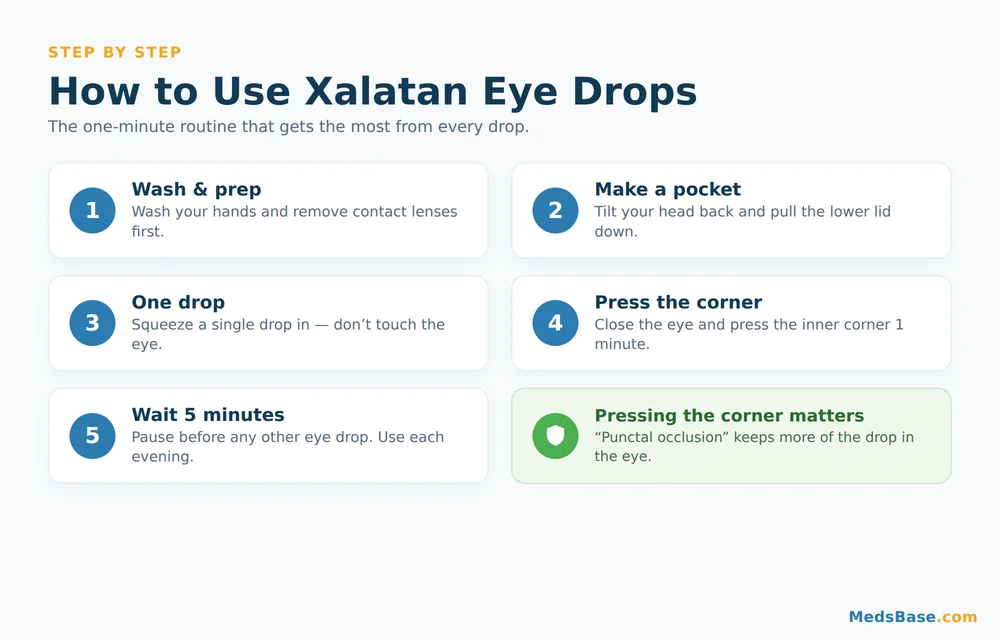
- Wash your hands and, if you wear them, take out your contact lenses.
- Tilt your head back and gently pull the lower eyelid down to make a small pocket.
- Squeeze one drop into the pocket without letting the bottle tip touch your eye or lashes.
- Close the eye softly and press a finger against the inner corner (next to the nose) for about a minute. This “punctal occlusion” stops the drop draining into your bloodstream and improves how much stays in the eye.
- Wait at least five minutes before using any other eye drop.
If you use more than one type of drop — a common situation in glaucoma — Xalatan should generally go in last, and you should never mix two prostaglandin analogues (such as latanoprost and bimatoprost) together, as this can paradoxically raise pressure. For a plain-language administration refresher, the UK’s NHS latanoprost guidance walks through the same steps. You can browse the full eye care range if you need a companion product.
Xalatan Eye Drops Side Effects & Safety Profile
Most side effects of latanoprost are local to the eye and mild. The table below groups the main ones by how often they occur and how serious they tend to be, so you know what is expected and what deserves prompt attention.
| Side effect | Frequency | Severity |
|---|---|---|
| Iris darkening (brown pigment) | Common | Mild — cosmetic, usually permanent |
| Longer, thicker, darker eyelashes | Common | Mild — cosmetic, reversible |
| Eye redness (conjunctival hyperaemia) | Common | Mild |
| Stinging, burning or grittiness on instillation | Common | Mild — brief |
| Blurred vision for a few minutes | Common | Mild — temporary |
| Darkening of the eyelid skin | Uncommon | Mild — often reversible |
| Dry eye, light sensitivity, eyelid crusting | Uncommon | Mild |
| Punctate keratitis (surface corneal spots) | Uncommon | Mild to moderate |
| Macular oedema (swelling at the back of the eye) | Rare | Serious — mainly after cataract surgery |
| Iritis / uveitis (inflammation inside the eye) | Rare | Serious — seek prompt care |
| Reactivation of herpes eye infection | Rare | Serious — seek prompt care |
Seek prompt eye-care advice if vision suddenly worsens, the eye becomes very painful, or you develop marked light sensitivity. These are uncommon, but they are the signs worth acting on quickly.
Who Should Take Extra Care First
- Contact lens wearers — the preservative benzalkonium chloride can be absorbed by soft lenses. Remove lenses before instilling and wait 15 minutes before putting them back in.
- People who have had cataract or other eye surgery, or who have a torn lens capsule — a slightly higher risk of macular oedema.
- Anyone with active eye inflammation or a history of herpes eye infection.
- People treating one eye only, who may prefer to accept the pressure benefit knowing the two eyes could differ in colour or lash length.
- Those who are pregnant, planning pregnancy, or breastfeeding — the pressure benefit should be weighed against limited safety data. Always consult your doctor before starting any new medication in these situations.
None of these are absolute barriers — they are simply situations where an informed conversation and, ideally, ongoing pressure monitoring make sense. Because glaucoma damage is painless and irreversible, the single most important thing any latanoprost user can do is keep up periodic eye-pressure and optic-nerve checks.
How to Reduce Xalatan Side Effects
A few habits noticeably cut the minor irritations. Pressing the inner corner of the eye for a minute after each drop (punctal occlusion) keeps more medication in the eye and less in the bloodstream, which reduces both stinging and any body-wide effects. Gently blotting stray liquid from the cheek and eyelid limits skin darkening. If daytime blurring bothers you, the evening schedule means most of it passes while you sleep. And treating both eyes when advised avoids a visible mismatch in iris colour or lash length. None of these habits change how well the drop lowers pressure — they simply make long-term use more comfortable.
What Does the Research Say About Latanoprost?
Latanoprost is not a new or lightly studied drug — it has decades of trial data behind it. Research consistently shows it is one of the most effective pressure-lowering drops available, which is why it remains a global first choice. The chart below summarises how it stacks up against other classes.
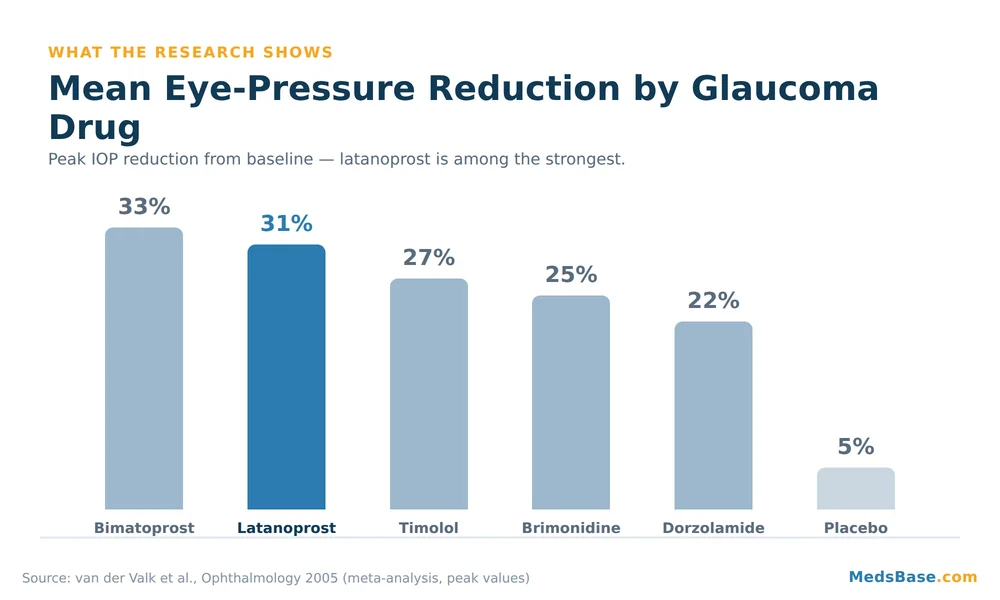
A landmark meta-analysis of randomised trials found that latanoprost lowered intraocular pressure by roughly 31% at peak — placing it among the most effective glaucoma medicines studied, alongside other prostaglandin analogues (van der Valk et al., Ophthalmology 2005). Early studies and later reviews also confirm the once-daily evening schedule delivers the best 24-hour control. The summary table gathers the key evidence.
| Study / source | Year | What it suggests | Source |
|---|---|---|---|
| van der Valk et al. meta-analysis | 2005 | Latanoprost cut IOP ~31% at peak — among the most effective drops. | Ophthalmology (PubMed) |
| StatPearls: Latanoprost | 2024 | Works by increasing uveoscleral outflow via prostaglandin FP receptors. | NCBI Bookshelf |
| NHS medicines guidance | Current | Once-daily evening dosing; iris and eyelash changes are recognised effects. | NHS |
| WHO vision burden data | Current | Glaucoma is a leading cause of irreversible vision loss worldwide. | World Health Organization |
Just as importantly, that benefit appears to hold up over time. Long-term follow-up studies indicate latanoprost keeps lowering pressure across years of continuous use, without the tolerance “drift” sometimes seen with older drops. This durability, combined with once-daily dosing, is a big reason Xalatan eye drops remain a global first choice decades after launch.
Research is summarised in plain language here; the qualifying words “suggests” and “indicates” are deliberate. Individual results vary, and only ongoing monitoring can confirm how well pressure is controlled in a given person.
Xalatan vs Other Glaucoma Eye Drops
Latanoprost is usually the first drop tried because it is potent, once-daily and well tolerated. When a single prostaglandin is not enough, other classes are added or switched in — beta-blockers, alpha-agonists or carbonic anhydrase inhibitors — sometimes as fixed-dose combinations. Here is how the main options compare.
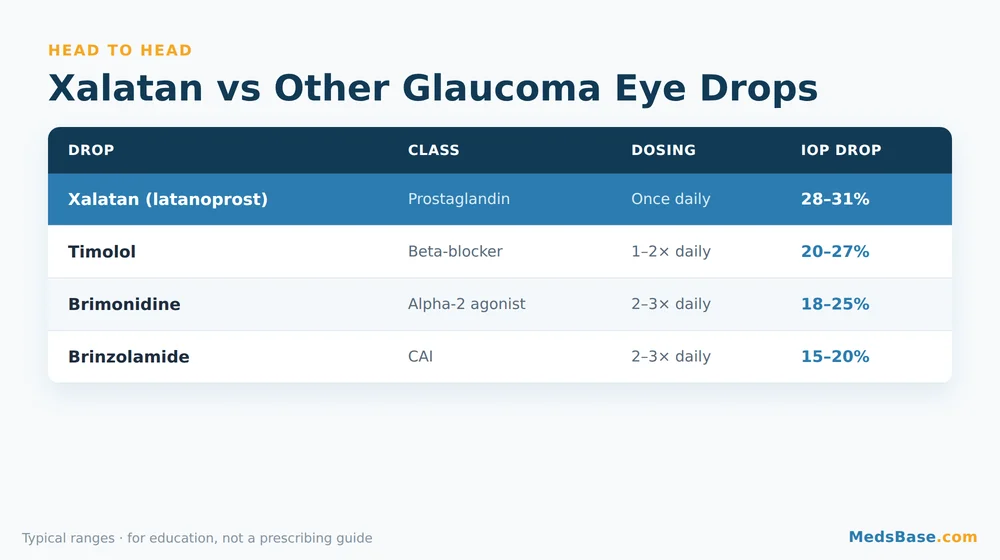
| Drop | Class | Typical dosing | Notes |
|---|---|---|---|
| Xalatan (latanoprost) | Prostaglandin analogue | Once daily (evening) | Strong ~28–31% IOP drop; iris/lash changes |
| Iotim (timolol) | Beta-blocker | Once or twice daily | Avoid in asthma/slow heart rate |
| Alphagan P (brimonidine) | Alpha-2 agonist | Two–three times daily | Can cause allergy, dry mouth, drowsiness |
| Azopt (brinzolamide) | Carbonic anhydrase inhibitor | Two–three times daily | Often added on; temporary blurring |
| Combigan (brimonidine/timolol) | Fixed combination | Twice daily | Two mechanisms in one bottle |
| Brimolol (brimonidine/timolol) | Fixed combination | Twice daily | Generic combination alternative |
For a fuller breakdown of which drop suits which situation, see our roundup of the best glaucoma eye drops. The key point: Xalatan eye drops earn their first-line status by pairing the strongest pressure drop with the simplest schedule.
Getting the Most from Latanoprost Eye Drops
Any glaucoma drop only works if it actually reaches the eye, every single day. A few simple habits help latanoprost eye drops do their job reliably.
Stick to the Evening Routine
Because the strongest pressure control comes overnight, tie your dose to an existing evening habit — brushing your teeth, for example. A phone alarm or a calendar tick can turn the drop into an automatic ritual. Skipping occasional doses quietly undermines the very protection you are treating for.
Combining Xalatan With Other Glaucoma Drops
If one drop is not enough, a second class is usually added rather than swapped in. When you use two drops, leave at least five minutes between them so the first is not washed out, and always put the prostaglandin in last. Never combine two prostaglandin analogues, as doubling up can paradoxically raise pressure instead of lowering it.
What to Expect Over the First Few Months
Early on you may notice mild stinging, brief blurring or a little redness; these usually settle within a few weeks. The cosmetic changes — subtle iris darkening and longer lashes — appear gradually over months, not days. Keep every follow-up appointment, because the only way to know Xalatan eye drops are working is a pressure check. You will not feel the difference yourself.
Storage, Missed Doses & Practical Tips
- Storage: keep unopened bottles refrigerated (2–8°C). Once opened, most latanoprost bottles can be kept at room temperature (below 25°C) and used within about four weeks — check the specific product leaflet.
- Missed a dose? Skip it and take the next dose at the usual evening time. Do not double up.
- One bottle, one month: a single bottle is designed to last roughly a month of once-daily use; replace it on schedule even if drops remain.
- Don’t stop suddenly on your own: because the drops treat a silent condition, stopping usually feels like nothing has changed while pressure quietly climbs again.
- Wipe away excess: gently blotting any liquid that runs onto the cheek can reduce darkening of the eyelid skin.
Frequently Asked Questions
How long do Xalatan eye drops take to work?
Pressure begins to fall within 3–4 hours of the first drop and reaches its maximum effect around 8–12 hours later. The full, stable pressure-lowering benefit of Xalatan eye drops is usually assessed after a few weeks of daily use, once your eye-care professional re-checks the reading.
Is the eye-colour change from latanoprost permanent?
Yes. Increased brown pigment in the iris does not fade after stopping the drops, although no further darkening occurs once treatment ends. The eyelash changes (length, thickness, colour), by contrast, gradually reverse over several months.
Can I use Xalatan in the morning instead of the evening?
Evening dosing is recommended because it delivers the strongest 24-hour pressure control. Consistency matters most, so if you genuinely cannot manage the evening, pick one fixed time and stick to it — but evening remains the preferred schedule.
Do I need a prescription to buy Xalatan eye drops?
At MedsBase, no prescription is needed to order Xalatan Eye Drop. That said, glaucoma is a lifelong, sight-threatening condition, so ongoing eye-pressure monitoring with an eye-care professional is strongly advised whether or not a prescription is involved.
Is generic latanoprost as good as branded Xalatan?
Generic latanoprost 0.005% contains the identical active ingredient at the identical concentration and is expected to lower pressure to the same degree. The MedsBase product is produced by a WHO-GMP-certified manufacturer to the same specification as the brand.
Can I wear contact lenses with Xalatan eye drops?
Take lenses out before applying the drop and wait at least 15 minutes before reinserting them, because the benzalkonium chloride preservative can be absorbed by soft lenses. This keeps both your lenses and your eyes comfortable.
What happens if I accidentally use two drops?
A single extra drop is unlikely to cause harm, but using latanoprost more than once a day actually reduces its pressure-lowering effect over time, so stick to one drop each evening.
What are the most common Xalatan side effects?
The most common Xalatan side effects are cosmetic and mild: gradual brown darkening of the iris, longer and darker eyelashes, and some eye redness or brief stinging when the drop goes in. Serious effects such as inner-eye inflammation are rare. Report any sudden pain or vision change to an eye-care professional promptly.
Does Xalatan work for everyone?
Most people respond well, but a minority are “non-responders” whose pressure barely shifts on a prostaglandin. If your target pressure is not reached after a few weeks, your eye-care professional may add or switch to another glaucoma drop. That is normal fine-tuning, not a failure.
Can Xalatan eye drops be used in both eyes?
Yes. When glaucoma or ocular hypertension affects both eyes, one drop is placed in each eye once daily. Treating both eyes also avoids the mismatched iris or eyelash appearance that can occur when only one eye is treated.
Medical Disclaimer
This article is for general educational purposes and is not a substitute for professional medical advice, diagnosis or treatment. Glaucoma is a serious, potentially sight-threatening condition that requires regular monitoring of eye pressure and the optic nerve. Always seek the guidance of a qualified eye-care professional about your specific situation, and do not disregard or delay professional advice because of something you have read here.
The Bottom Line
Xalatan eye drops remain a first-line glaucoma treatment for good reason: one evening drop of latanoprost 0.005% lowers eye pressure by roughly 28–31%, the schedule is easy to keep, and decades of research back it up. The trade-off is a small set of mostly cosmetic effects — chiefly the gradual iris and eyelash changes — that are worth understanding before you begin.
If you are managing open-angle glaucoma or ocular hypertension, consistency and monitoring are everything. Use the drop every evening, keep your pressure checks, and the medicine can quietly protect your vision for years. Ready to reorder? Xalatan Eye Drop (latanoprost 0.005%) is available at MedsBase from a WHO-GMP-certified manufacturer, with Worldwide Shipping and discreet packaging, backed by our Reshipment Assurance Policy on every order.

Written by
Sophie ChenPharmaceutical Content Researcher · 8 years experience
Sophie Chen is a pharmaceutical content researcher with 8 years covering generic medication access and clinical pharmacology. She specialises in international regulatory frameworks, bioequivalence standards, and patient-facing education on therapeutic drug classes. She is not a clinician.