








✓ Medically reviewed by · Last reviewed: May 2026
Pharmacy Researcher · 8 years experience
Pharmacy researcher with 8 years reviewing clinical drug information, generic formulation equivalence, and international pharmaceutical standards. Focuses on patient-facing accuracy in medication education.
Is generic Farxiga really the same drug as the brand-name tablet you may be paying several hundred dollars a month for — and if so, why is the price gap so large? Thousands of people quietly typed that question into search bars after the FDA approved the first generic versions of Farxiga (dapagliflozin) on April 7, 2026. It deserves a straight answer, not a press release.
By the end of this guide, you’ll know exactly what that approval does and doesn’t mean: how bioequivalence testing works, why “approved” and “on your pharmacy shelf” are two different events, the realistic cost picture, and how to choose between brand, generic dapagliflozin, or an alternative entirely. One detail buried in the generic’s label surprises almost everyone — we’ll get to it in the uses section. And if you take this tablet through a hot summer, a seasonal risk you’ve probably never heard of is waiting in the safety section.
Key Takeaways
- Approval is real, availability is rolling: the FDA approved the first generic Farxiga (dapagliflozin) tablets on April 7, 2026 — but approval and pharmacy availability are two different things.
- Bioequivalence is the standard: a generic must prove the same molecule, strength and blood levels — yet one part of the label can legally differ (explained below).
- Competition drives the savings: FDA data shows one generic maker tends to cut prices about 30%; five makers, nearly 85%. Timing is everything.
- The evidence is the same: dapagliflozin is backed by three landmark trials across diabetes, heart failure and kidney disease — exact numbers in the research table.
- Summer changes the risk math: heat raises one specific dapagliflozin risk most patients never hear about — covered in the safety section.
- Switching is simple, done right: five short pharmacist questions make the change far safer.
On this page
- What “first generic approval” really means
- How does dapagliflozin work?
- Is generic Farxiga the same medication?
- Key uses: who benefits?
- The real cost picture
- Safety, side effects & dosage
- What the research says
- Generic dapagliflozin vs the alternatives
- How to switch safely
- Frequently asked questions
- The bottom line
What Is Generic Farxiga — and What “First Generic Approval” Really Means
Generic Farxiga is dapagliflozin — the identical active ingredient found in brand-name Farxiga, manufactured by other companies under FDA-approved generic licences. The FDA approved the first generic dapagliflozin tablets on April 7, 2026, opening the door to lower-cost versions of one of the most widely used SGLT2 inhibitor medications.
On April 7, 2026, the FDA granted approval to multiple generic-drug applicants at once — you can read the FDA announcement of the first generic dapagliflozin approvals yourself. Each approved product appears in the FDA’s “Orange Book,” the official registry telling pharmacists which generics are substitutable for which brands.
Here’s the part most headlines skipped: an approval is a legal permission, not a stocked shelf. Between the FDA’s signature and your pharmacy counter sit manufacturing scale-up, wholesaler contracts and formulary updates that refresh only a few times a year. For many first generics, that means weeks to months before you can actually fill generic Farxiga anywhere. So if your pharmacy says “we don’t have that,” nothing is wrong — the pipeline simply hasn’t reached you. Ask your pharmacist to flag your file so you’re offered generic Farxiga the moment their wholesaler lists it.
Bottom line: generic Farxiga is real, FDA-approved, and arriving on a rolling schedule — one pharmacist conversation captures the savings earliest.
How Does Dapagliflozin Work?
Your kidneys are quietly obsessive recyclers. Every day they filter a large bag of sugar’s worth of glucose out of your blood — then, using a transporter protein called SGLT2, reabsorb almost all of it. In type 2 diabetes, where blood sugar is already too high, that recycling habit works against you.
Dapagliflozin — the molecule inside both brand-name Farxiga and generic Farxiga — blocks that SGLT2 transporter. Think of it as closing the recycling gate at a water-treatment plant: excess sugar drains out in your urine instead of returning to your blood. The result, in research settings, is lower glucose without pushing your pancreas to make more insulin.
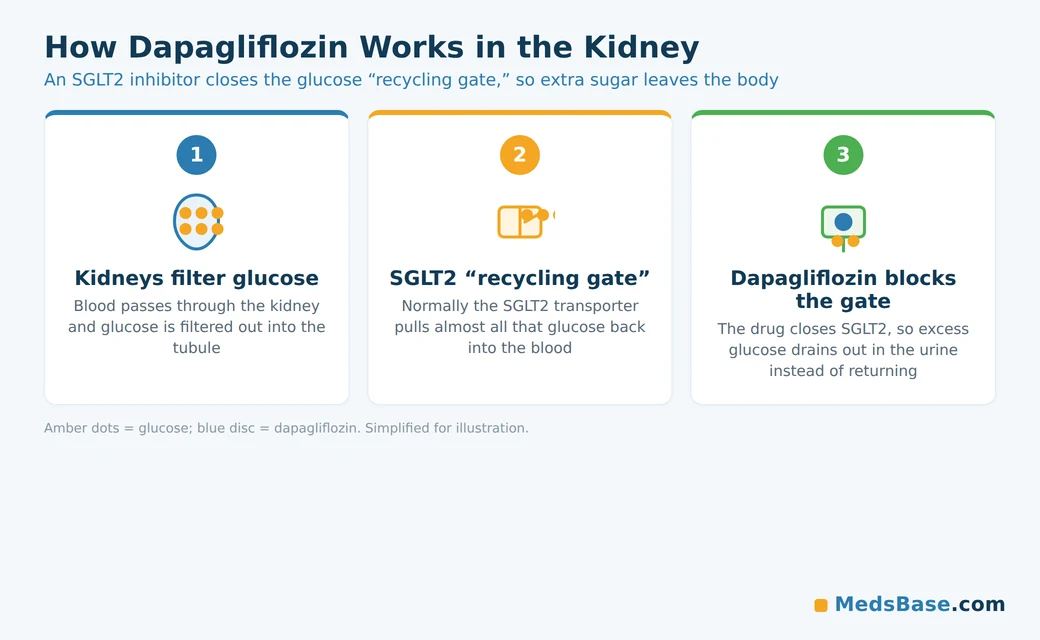
That single mechanism explains almost everything else about this drug:
- Lower blood sugar with low hypoglycemia risk on its own, because it doesn’t force insulin release.
- Modest weight change for many users — calories are literally leaving in urine.
- A mild diuretic effect and lower blood pressure, because sugar pulls water out with it.
- More bathroom trips and more genital yeast infections — the flip side of sugary urine, covered honestly in the safety section.
Here’s where it gets interesting. That “sugar drain” seemed to protect the heart and kidneys in ways beyond glucose control — which is why dapagliflozin’s story didn’t stop at diabetes.
Research Spotlight: A Diabetes Pill That Became Heart-Failure Therapy
In the landmark DAPA-HF trial (NEJM, 2019; 4,744 patients with heart failure and reduced ejection fraction), dapagliflozin cut the combined risk of worsening heart failure or cardiovascular death by roughly 26% versus placebo — strikingly, in patients with and without diabetes. That finding turned an SGLT2 inhibitor “diabetes pill” into mainstream heart-failure therapy.
Is Generic Farxiga Really the Same Medication?
This is the high-stakes question, so it deserves a serious answer.
To win approval, every generic Farxiga tablet had to demonstrate bioequivalence to the brand: the same active ingredient (dapagliflozin), the same strength, the same dosage form, and blood-level curves matching the brand’s within tight, pre-set statistical limits. Products that pass earn a therapeutic-equivalence rating in the Orange Book — which is precisely what allows your pharmacist to substitute them. The FDA’s position, stated plainly on the FDA’s Generic Drug Facts page, is that an approved generic is bioequivalent to the brand and carries the same label, with certain limited exceptions.
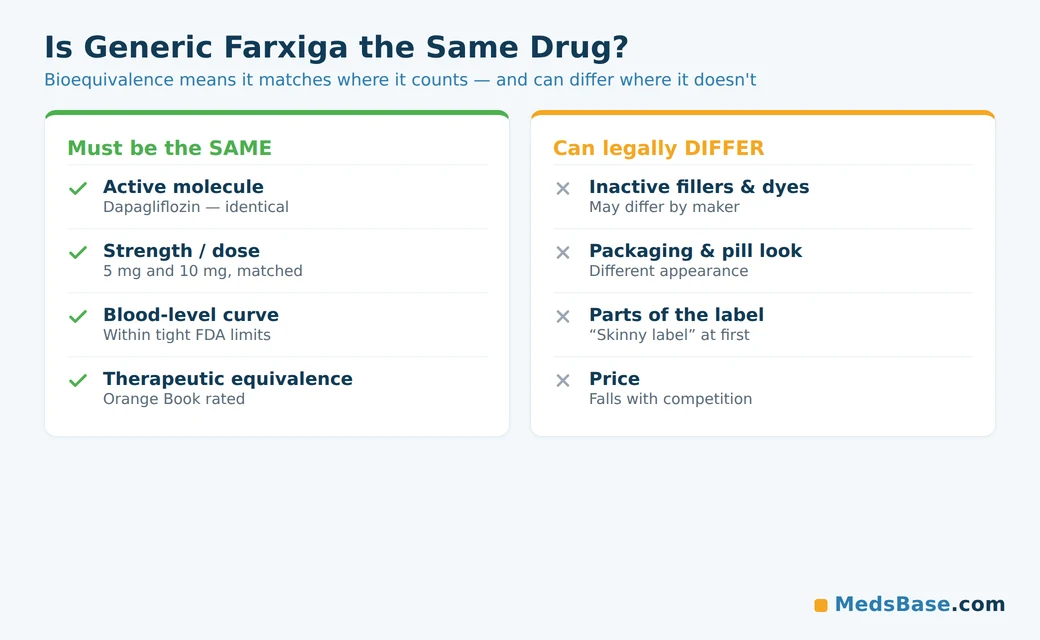
So what can differ? Two things:
- Inactive ingredients. Fillers, binders and dyes may vary between makers. Irrelevant for most people — but if you have a known sensitivity (a dye, lactose as filler), ask your pharmacist to check the specific generic’s ingredient list first.
- Parts of the label. More on this in the uses section — it’s the detail that surprises people.
What about the “generics are weaker” worry? The bioequivalence standard exists to prevent exactly that: a generic whose blood levels drifted below the brand’s would fail testing and never reach the Orange Book. Pharmacists field this concern daily, and their reassurance is simple — the same molecule at the same blood level cannot secretly underperform. Chemistry doesn’t know what the box looks like.
And the price gap that makes people suspicious? That’s a competition signal, not a quality signal. Per the FDA’s published figures, a single generic competitor tends to cut prices by about 30%, while five competing makers are associated with drops of nearly 85%. Cheap generic Farxiga isn’t cut-rate chemistry — it’s the same chemistry finally exposed to competition. Because multiple applicants were approved at once, pressure on Farxiga cost should build faster than for drugs with a lone first generic.
Bottom line: generic Farxiga must match brand-name Farxiga where it matters — molecule, dose, blood levels — and differs mainly in fillers, packaging and price.
Key Uses: Who Benefits From Dapagliflozin?
Dapagliflozin’s approved uses have grown well beyond blood sugar. Here’s who stands to gain — and, just as honestly, who shouldn’t take it.
Type 2 Diabetes: Glycemic Control Plus Heart Protection
The foundation indication: as an adjunct to diet and exercise, dapagliflozin improves glycemic control in adults with type 2 diabetes. Trial A1c reductions were modest but meaningful — often around half a percentage point or more, depending on baseline. For you, that can be the difference between adding another drug and staying put.
In people with type 2 diabetes plus established cardiovascular disease or risk factors, the DECLARE-TIMI 58 trial (NEJM, 2019; over 17,000 participants) found dapagliflozin cut hospitalisation for heart failure by roughly 27% relative to placebo — the specific benefit the FDA highlighted when approving generic Farxiga.
Heart Failure: Fewer Hospitalisations, With or Without Diabetes
Following DAPA-HF (see the Research Spotlight above), brand Farxiga’s label expanded to heart failure itself — including in people without diabetes. If your cardiologist suggested this tablet and you’ve never had a high blood sugar reading, that’s why.
Chronic Kidney Disease: Slowing the Decline
The DAPA-CKD trial (NEJM, 2020; 4,304 patients with chronic kidney disease, with and without diabetes) reported a roughly 39% relative reduction in a composite of major kidney decline, end-stage kidney disease, or kidney/cardiovascular death — strong enough that the trial was stopped early. Research suggests this is among the most consequential kidney-protection findings of the past decade.
Now, the label detail we promised. The first generic Farxiga approvals cover the type 2 diabetes–related indications — glycemic control, and cutting heart-failure hospitalisation risk in type 2 diabetes. Brand Farxiga’s newer indications (heart failure and chronic kidney disease without diabetes) may not appear on every generic’s label at first — a common, legal pattern called a “skinny label,” driven by patent timing, not any difference in the tablet. The molecule is identical either way; substitution rules vary by state and insurer. If you take dapagliflozin for your heart or kidneys, this is question one for your pharmacist — not a reason for alarm.
Who Is This For? / Who Should Avoid It?
Potentially a good fit (with your clinician’s guidance):
- Adults with type 2 diabetes needing better glycemic control, especially with cardiovascular risk
- People with heart failure, with or without diabetes
- People with chronic kidney disease at risk of progression
- Anyone paying brand prices who wants generic Farxiga’s identical molecule for less
Should generally avoid it — or needs a careful conversation first:
- People with type 1 diabetes or any history of diabetic ketoacidosis
- Anyone with a previous serious hypersensitivity reaction to dapagliflozin
- People on dialysis, or with severely reduced kidney function where the glucose-lowering benefit fades
- Pregnant or breastfeeding women
- Those prone to recurrent genital or urinary infections, or to dehydration (e.g. frail older adults on diuretics)
These lists are illustrative, not exhaustive — the right call is individual, made with a doctor or pharmacist who knows your history.
The Real Cost Picture: Brand Farxiga vs Generic Pricing
Let’s talk about the reason you’re probably here. Brand-name Farxiga’s US list price has sat in the several-hundred-dollars-a-month range before insurance — over a year, a sum that rivals a used car. What you personally pay varies enormously with coverage and discounts, so treat every number you see online (including ours) as a starting point, not a quote.
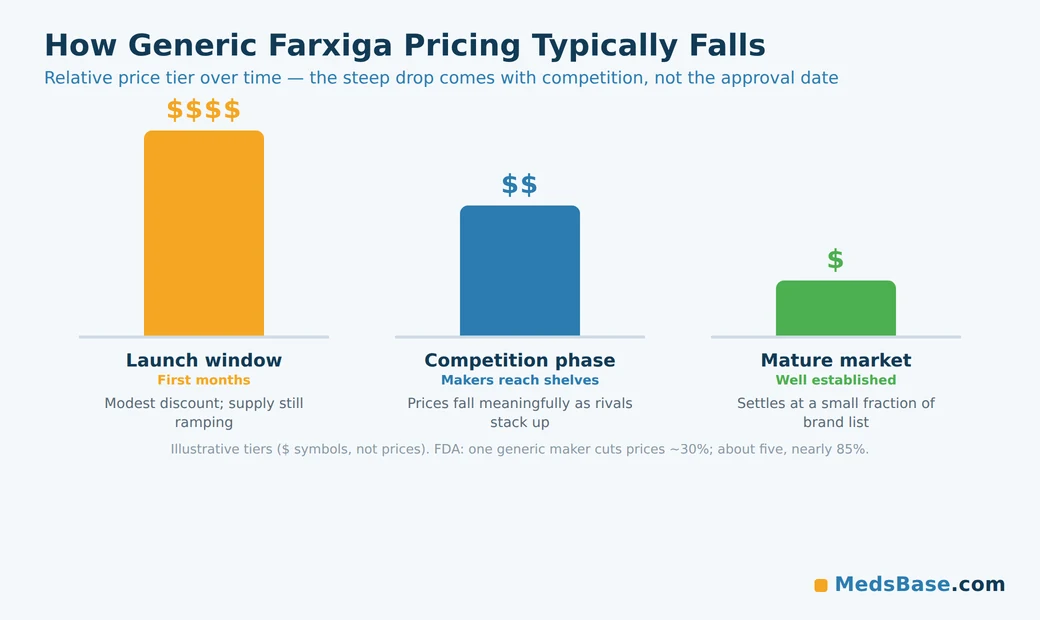
So what should you realistically expect generic Farxiga to cost? Three phases, based on how generic markets typically behave:
- Launch window (first months): modest discounts. Early generic Farxiga prices often sit just below brand while supply ramps up, and formularies may not list the generic yet.
- Competition phase: as the multiple approved makers reach shelves, prices fall meaningfully — remember the FDA’s ~30%-with-one, ~85%-with-five pattern.
- Mature market: generic dapagliflozin should eventually settle at a small fraction of brand list price, as older generics like metformin did. Prices vary by pharmacy, region and insurer at every stage.
Take Robert, 58 — illustrative, not a real patient. Type 2 diabetes, brand Farxiga 10 mg, high-deductible plan, paying full list price every January until his deductible resets. Even the launch-window discount on generic Farxiga matters to him immediately; by the competition phase, his out-of-pocket cost could fall by more than half. The point: when you switch matters less than deciding you will.
One thing US headlines rarely mention: dapagliflozin has been sold internationally for years as Forxiga — AstraZeneca’s own international brand of the identical molecule — at prices long sitting at a fraction of US brand list price. If you’re comparing every route to affordable dapagliflozin while US generic supply ramps up, you can see current Forxiga (dapagliflozin) options at MedsBase in both 5 mg and 10 mg strengths, with no prescription needed.
Bottom line: the question isn’t whether generic Farxiga will cost less — it’s how soon, and if you’ve positioned yourself to catch the drop.
Generic Farxiga Safety Profile, Side Effects & Dosage
Generic Farxiga carries the same prescribing information as the brand — same warnings, precautions and contraindications, per the FDA’s approval announcement. Here’s the honest picture, neither hidden nor dramatised.
| Side effect | Frequency | Severity | What to do |
|---|---|---|---|
| Genital yeast infections (mycotic) | Common — most-reported, especially in women | Usually mild–moderate | Good hygiene; standard antifungals work; see your clinician if it recurs |
| Urinary tract infections | Common | Mild–moderate; rarely serious | Hydrate; seek prompt care for fever, flank pain or feeling systemically unwell |
| Increased urination and thirst | Common, especially early | Mild | Dose in the morning; keep water handy; usually settles |
| Volume depletion (dizziness, low blood pressure) | Uncommon — risk rises with heat, diuretics, age | Moderate | Hydrate; stand up slowly; call your clinician if dizziness persists |
| Hypoglycemia | Mainly alongside insulin or sulfonylureas | Varies | Ask your prescriber whether companion doses need adjusting |
| Diabetic ketoacidosis (even with near-normal glucose) | Rare | Serious — emergency | Nausea, vomiting, abdominal pain, unusual fatigue despite normal readings → stop the tablet, seek urgent care |
| Fournier’s gangrene (necrotising perineal infection) | Very rare | Emergency | Immediate care for pain, swelling, redness or fever in the genital area |
Two rows deserve a plain-English word. Ketoacidosis on SGLT2 inhibitors can occur even when your glucose meter looks reassuring — that’s what makes it sneaky, and why clinicians often advise pausing dapagliflozin during serious illness, prolonged fasting or around surgery. Fournier’s gangrene sounds terrifying, and it is — but it’s genuinely very rare; it’s on the label so you act fast, not so you live in fear.
Summer Heat Advisory — the seasonal risk we flagged at the top
Dapagliflozin makes your kidneys excrete glucose, and glucose drags water out with it. In a heat wave, that built-in fluid loss stacks on top of sweating — a double drain that can tip into dizziness, low blood pressure or dehydration faster than you’d expect, especially if you’re older or on a diuretic. Through the hot months: drink water steadily rather than in catch-up gulps, go easy on alcohol, and treat new light-headedness as a signal to rest, rehydrate and call your clinician if it persists. Dapagliflozin isn’t the only summer-sensitive medicine in many cabinets — see our companion guide to which everyday medications raise your sun and heat risk.
Dosage basics. The usual adult dose is 10 mg once daily, morning, with or without food; a 5 mg strength is sometimes used when starting therapy or in situations your prescriber will judge. Generic Farxiga follows the same strengths and schedule as the brand. Missed a dose? Take it when you remember the same day — never double up the next morning.
What Does the Research Say About Dapagliflozin?
Skimmers, this table is for you — three landmark randomised trials, one per organ system:
| Study | Year | Population | Key finding | Source |
|---|---|---|---|---|
| DECLARE-TIMI 58 | 2019 | 17,160 adults with type 2 diabetes and cardiovascular disease or risk factors | Hospitalisation for heart failure reduced by ~27% (relative) vs placebo | PubMed record |
| DAPA-HF | 2019 | 4,744 adults with heart failure (reduced ejection fraction), with and without diabetes | Worsening heart failure or cardiovascular death reduced by ~26% (relative) | PubMed record |
| DAPA-CKD | 2020 | 4,304 adults with chronic kidney disease, with and without diabetes | Major kidney-decline composite reduced by ~39% (relative); trial stopped early for benefit | PubMed record |
Qualifying words matter: these are relative risk reductions against placebo, in trial populations that may differ from you — research describes groups, not guarantees for individuals.
What this means for you: every one of those trials tested the dapagliflozin molecule itself — exactly what generic Farxiga contains. The evidence behind the brand is, molecule for molecule, the evidence behind the generic. You aren’t switching to a less-studied drug; you’re switching to a less-marketed one.
Generic Dapagliflozin vs the Alternatives
But there’s a catch to any “just switch” advice: the best choice depends on which problem you’re solving. Here’s the honest field:
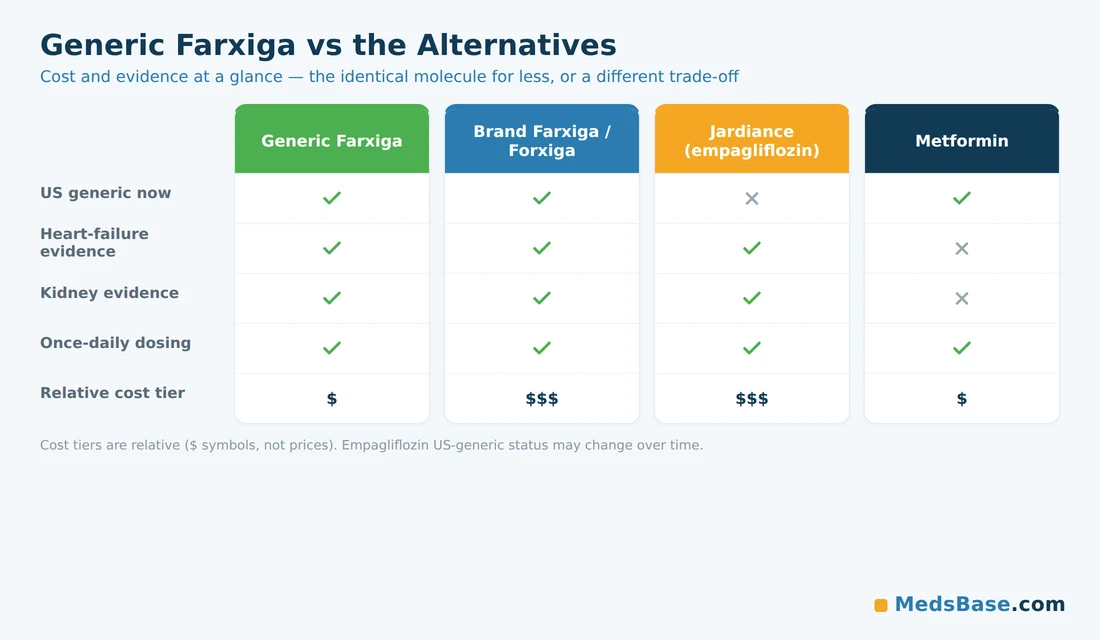
| Option | Active molecule | US generic status | Strongest evidence base | Typical fit |
|---|---|---|---|---|
| Generic Farxiga | Dapagliflozin | First generics FDA-approved April 2026; rolling out | Same trials as brand (DECLARE-TIMI 58, DAPA-HF, DAPA-CKD) | Anyone doing well on Farxiga who wants the identical molecule for less |
| Brand Farxiga / Forxiga | Dapagliflozin | Brand (Forxiga = international brand name) | As above | Insurer still favours brand, or you prefer one consistent manufacturer |
| Jardiance (empagliflozin) | Empagliflozin | No widely available FDA-approved US generic yet | Its own major heart and kidney outcome trials | A clinician prefers empagliflozin’s trial profile — differences are real but modest |
| Metformin-first pathway | Metformin | Generic for decades; very low cost | Longest track record in type 2 diabetes | First-line glycemic control on a tight budget, without heart/kidney drivers |
Which one fits which situation? Already stable on dapagliflozin? Moving from brand to generic Farxiga is the lowest-friction money-saver there is — nothing changes except the label. Choosing between the two SGLT2 inhibitor molecules from scratch? Honestly, dapagliflozin and empagliflozin are more alike than different, and head-to-head data is limited — our breakdown of how Farxiga and Jardiance actually compare head-to-head walks through the distinctions that exist. And if cost is the only driver and you haven’t started any SGLT2 inhibitor, metformin remains the classic first conversation with your prescriber — decades of use, pennies per dose, but without dapagliflozin’s heart and kidney outcome evidence.
How to Switch to Generic Farxiga Safely
So what does this mean at the pharmacy counter? Five short steps:
- Ask whether your pharmacy has stocked generic Farxiga yet — and if not, when. Have them note your file so you’re offered it on arrival.
- Compare the real price you’d pay, not the list price: your brand copay (with any manufacturer support) vs the generic quote. Early on, the gap may be smaller than headlines imply; it widens over time.
- Check your reason for taking it. If it’s heart failure or kidney disease without diabetes, ask how the skinny-label issue is handled in your state — usually a non-issue, occasionally a paperwork step.
- Flag allergies and intolerances so the pharmacist can check the specific generic maker’s inactive ingredients (dyes, fillers).
- Keep the dose identical and pay attention for the first few weeks. Same milligrams, same morning schedule. Any new symptom after a switch is worth a quick call — usually coincidence, always worth asking.
Mistakes to avoid:
- Stopping brand tablets before the generic is physically in hand — gaps in SGLT2 therapy surrender real protection.
- Assuming the price has already collapsed at launch — the steep drop comes with competition, not the approval date.
- Splitting or doubling tablets to self-adjust cost — dose changes belong to your prescriber.
- Ignoring hydration in hot weather (see the safety section — the season’s most preventable problem).
- Buying from unverified sellers. Wherever you buy, stick to licensed pharmacies selling products from a WHO-GMP-certified manufacturer.
Pharmacists also see one quieter mistake: patients who never ask at all, and keep paying brand prices years after generic Farxiga matures. Don’t be that statistic. To compare the international route while US shelves fill, check availability of Forxiga (dapagliflozin) — the same molecule under AstraZeneca’s international brand — at MedsBase.
Related Reading
- Taking the other big SGLT2 instead? Here’s our full guide to the generic for Jardiance.
- Curious about the scale-side effects? See what dapagliflozin realistically does for weight.
- Comparing the whole class first? Browse all diabetes medications in one place.
Frequently Asked Questions
What is the generic name for Farxiga?
Dapagliflozin. Farxiga is AstraZeneca’s US brand name for dapagliflozin; internationally the same company sells it as Forxiga. Generic Farxiga products are simply labelled “dapagliflozin tablets” with the maker’s name — the same active molecule under its scientific name.
Is generic Farxiga as good as brand-name Farxiga?
By FDA standards, yes — an approved generic must be bioequivalent: same active ingredient, strength and dosage form, with blood levels matching the brand within tight statistical limits. Inactive ingredients (dyes, fillers) may differ, which matters only for specific sensitivities. Every landmark dapagliflozin trial tested the molecule the generic contains.
When will generic Farxiga be available in pharmacies?
The FDA approved multiple generic dapagliflozin makers on April 7, 2026, but approval doesn’t put bottles on shelves overnight — manufacturing scale-up, wholesaler contracts and formulary updates typically add weeks to months. Availability rolls out pharmacy by pharmacy, so ask yours to flag your file and offer the generic as soon as it lands.
How much does generic Farxiga cost?
It varies by pharmacy, insurer and timing, so beware of any single number. Early generic Farxiga prices usually sit modestly below brand; FDA competition data shows prices fall around 30% with one generic maker and nearly 85% once about five compete. Internationally, dapagliflozin (sold as Forxiga) has long been available at a fraction of US brand list price.
Can I switch from Farxiga to generic dapagliflozin without changing my dose?
Generally yes — generic Farxiga comes in the same 5 mg and 10 mg strengths with the same once-daily schedule, and pharmacist substitution keeps your dose identical. Two checks first: confirm the generic’s inactive ingredients if you have allergies, and if you take it for heart or kidney disease without diabetes, ask how the early “skinny label” affects substitution where you live.
Does generic dapagliflozin cause weight loss like Farxiga?
The effect is identical, because the molecule is identical: modest, gradual weight change — typically a few kilograms over months in studies — driven by calories leaving as glucose in urine. It isn’t a weight-loss drug and shouldn’t be taken as one. Our dedicated Farxiga weight-loss guide covers realistic expectations and who tends to respond.
Is dapagliflozin the same as Jardiance?
No — siblings, not twins. Jardiance is empagliflozin, a different molecule in the same SGLT2 inhibitor class, with its own trials and its own (still brand-only in the US at the time of writing) pricing story. The two overlap heavily in benefits and side effects; our diabetes medication guides compare the class in depth.
Do I stop taking generic Farxiga if I get sick or have surgery planned?
Possibly, temporarily — a standard precaution, not a quirk of the generic. Because SGLT2 inhibitors carry a rare ketoacidosis risk that rises with serious illness, prolonged fasting and surgery, clinicians often advise pausing dapagliflozin for a few days around those events. Never make the call alone — ask your care team when to stop and restart.
Medical Disclaimer
This article is general information, not medical advice. Decisions about starting, switching or stopping any medication should be made with a qualified doctor or pharmacist who knows your history. If you experience symptoms of ketoacidosis, severe dehydration or a serious infection while taking dapagliflozin, seek urgent medical care.
The Bottom Line on Generic Farxiga
Here’s the balanced verdict. Generic Farxiga is the same dapagliflozin molecule that earned its place across type 2 diabetes, heart failure and chronic kidney disease care — now FDA-approved from multiple makers and heading toward real price competition. The savings are genuine but arrive on a schedule: modest at launch, substantial as competitors stack up. The sensible worries — “is it weaker?”, “is the label different?” — have honest answers: bioequivalence testing rules out the first, and the skinny label is a pharmacist question, not a safety problem. For most people stable on the brand, switching to generic Farxiga is the rare medical decision that’s both easy and financially significant.
Your one action this week: at your next refill, ask your pharmacist two questions — “Has generic Farxiga reached your wholesaler yet?” and “What would I actually pay versus my brand copay?” Ten seconds of asking starts the savings clock. Meanwhile, MedsBase stocks Forxiga alongside the rest of its range — browse all diabetes medications to compare options side by side.
Still weighing the two big SGLT2 inhibitors? Read how Farxiga and Jardiance actually compare head-to-head. And since it’s summer: before your next beach day, check which everyday medications raise your sun and heat risk — a few common ones will surprise you.

Written by
Sophie ChenPharmaceutical Content Researcher · 8 years experience
Sophie Chen is a pharmaceutical content researcher with 8 years covering generic medication access and clinical pharmacology. She specialises in international regulatory frameworks, bioequivalence standards, and patient-facing education on therapeutic drug classes. She is not a clinician.