








✓ Medically reviewed by · Last reviewed: May 2026
Pharmacy Researcher · 8 years experience
Pharmacy researcher with 8 years reviewing clinical drug information, generic formulation equivalence, and international pharmaceutical standards. Focuses on patient-facing accuracy in medication education.
Most people who’ve been told they’re statin intolerant believe their body simply can’t handle the drug. The most rigorous trials ever run on this question — the ones where neither the patient nor the doctor knew who was swallowing a real statin and who was swallowing a dummy — found something stranger, and far more hopeful. When the pills were blinded, the muscle aches barely tracked the medicine at all.
This is not a claim that your pain is imaginary. It is very real. But statin intolerance turns out to be a more slippery, more treatable problem than the label suggests — and understanding why could be the difference between abandoning cholesterol treatment for good and quietly getting your heart protection back. By the end, you’ll know what the blinded trials actually showed, how to tell true muscle damage from its far more common look-alike, and the exact step-by-step ladder doctors use to guide people back onto treatment.
One safety signal sorts the genuinely serious cases from the rest — we’ll get to it in the red-flags section, because it’s the one thing you never want to miss.
- In blinded n-of-1 trials, up to 90% of the muscle symptoms people blamed on their statin also appeared on an identical placebo — the pain is real, but the cause often isn’t the drug.
- The nocebo effect isn’t “all in your head” — it’s a genuine, measurable brain-body response. We’ll explain it with a one-line analogy you won’t forget.
- True statin muscle disease exists — but severe myopathy is rare, around 1 in 10,000, and one blood test flags it.
- Most people labelled with statin intolerance can get back on treatment — just not the way they first tried.
- There’s a six-rung ladder — from ruling out red flags to alternate-day rosuvastatin — that quietly rescues cholesterol cover for the majority.
- If statins are genuinely off the table, one non-statin add-on covers part of the gap — we’ll name it.
Table of Contents
- What is statin intolerance?
- How statin intolerance works: the nocebo effect
- Who statin intolerance really affects
- Side effects, red flags & true muscle damage
- What the blinded trials actually showed
- Statin intolerance vs the alternatives
- The step-by-step path back onto treatment
- Frequently asked questions
- The bottom line
What Is Statin Intolerance?
Statin intolerance is the inability to keep taking a statin at the dose needed to protect your heart, usually because of muscle aches, cramps or weakness. True, complete intolerance is uncommon — affecting an estimated 3–5% of statin users — while far more people report symptoms that blinded trials trace to something other than the drug.
That gap between what people feel and what the drug is doing is the whole story of statin intolerance, so let’s define terms cleanly. Doctors group these complaints under statin-associated muscle symptoms — often shortened to SAMS — which covers everything from mild aching and stiffness to, very rarely, genuine muscle injury. Muscle pain from statins is by far the most common reason people stop — the single biggest driver of statin intolerance — and it’s the reason cholesterol treatment quietly falls apart for millions.
Statins are among the most-prescribed medicines on earth precisely because they work: they lower LDL cholesterol and, across large populations, cut the risk of heart attacks and strokes. The NHS notes that statins are offered to people at higher cardiovascular risk and lists muscle pain among the recognised side effects — so the concern is real and acknowledged, not dismissed.
Here’s the tension you may be living with. Your aches were real. Your doctor keeps nudging you to restart. And you feel caught between two fears: the pain you remember, and the heart attack the statin was meant to prevent. Neither fear is silly. The point of this article isn’t to talk you out of your experience — it’s to give you better information than the “just push through it” advice that made you feel dismissed in the first place.
A quick note on language, because it matters. “Statin intolerance” is a description of an outcome — you couldn’t stay on the drug — not a diagnosis of why. And the why, it turns out, is where almost everyone goes wrong.
How Statin Intolerance Works: The Nocebo Effect
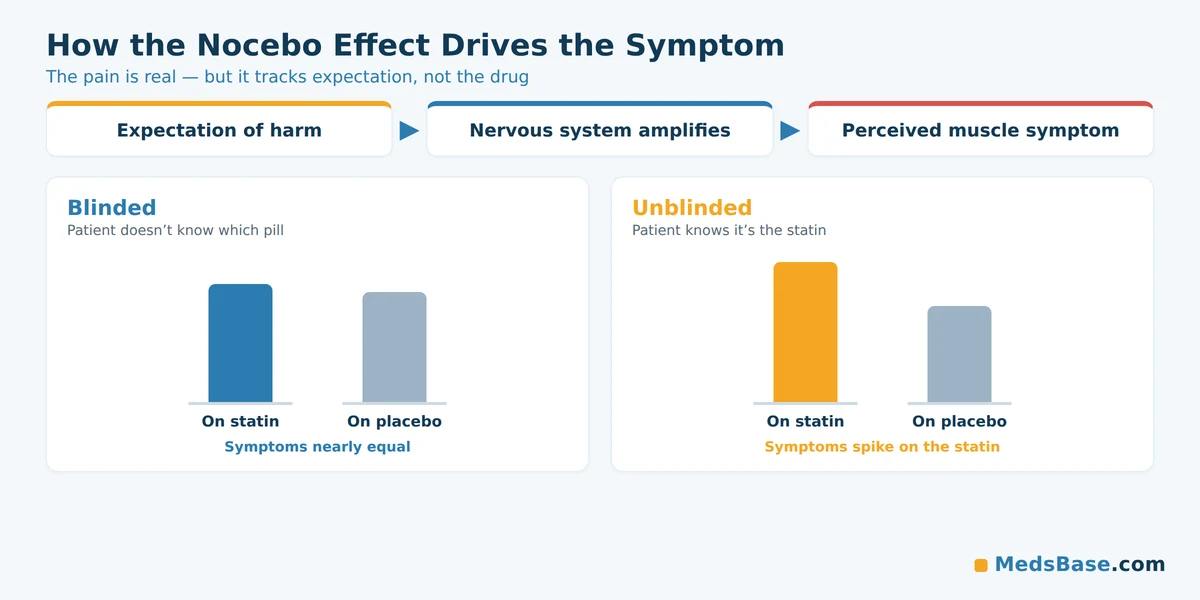
You already know the placebo effect: believe a sugar pill will help, and sometimes you genuinely feel better. The nocebo effect is its mirror image. Believe a real pill will hurt you, and your body can genuinely produce the symptom — even when the drug itself is doing nothing to your muscles.
Here’s the analogy worth remembering: it’s like the itch you feel the second someone mentions head lice. Your scalp starts prickling. The itch is completely real — your nervous system is generating it — but there are no lice. The cause is the expectation, not an infestation. Nocebo works the same way. When you read a leaflet warning of muscle pain, or you know you’ve just started a drug famous for it, your brain becomes primed to notice and amplify every ordinary twinge your body was already producing.
So let’s be blunt about what nocebo does and doesn’t mean for statin intolerance. Nocebo does not mean the pain is fake, imagined, or a sign of weakness. It means the pain is real but the statin isn’t the thing generating it. That distinction is the difference between “your symptoms are invalid” (wrong, and insulting) and “your symptoms may have a cause we can actually fix” (right, and hopeful).
Researchers have even coined a sharper term for the statin version: the “drucebo” effect — symptoms that show up when you know you’re taking the drug, but fade or never appear when you don’t. An International Lipid Expert Panel position paper lays out how to diagnose and manage exactly this pattern, and puts genuinely complete statin intolerance at only around 3–5% of users. The other side of that number is the hopeful part: for most people, the door back is still open.
One line to hold onto: the muscle symptom you felt was real, but “real symptom” and “caused by the statin” are two different claims — and blinded trials let us tell them apart.
Who Statin Intolerance Really Affects
If nocebo explains so much, does anyone get true muscle problems from statins? Yes — and pretending otherwise would be its own kind of dismissal. The honest answer is that genuine statin-associated muscle symptoms exist; true statin intolerance is real, just far less common than the label rate suggests, and certain people are more prone to it.
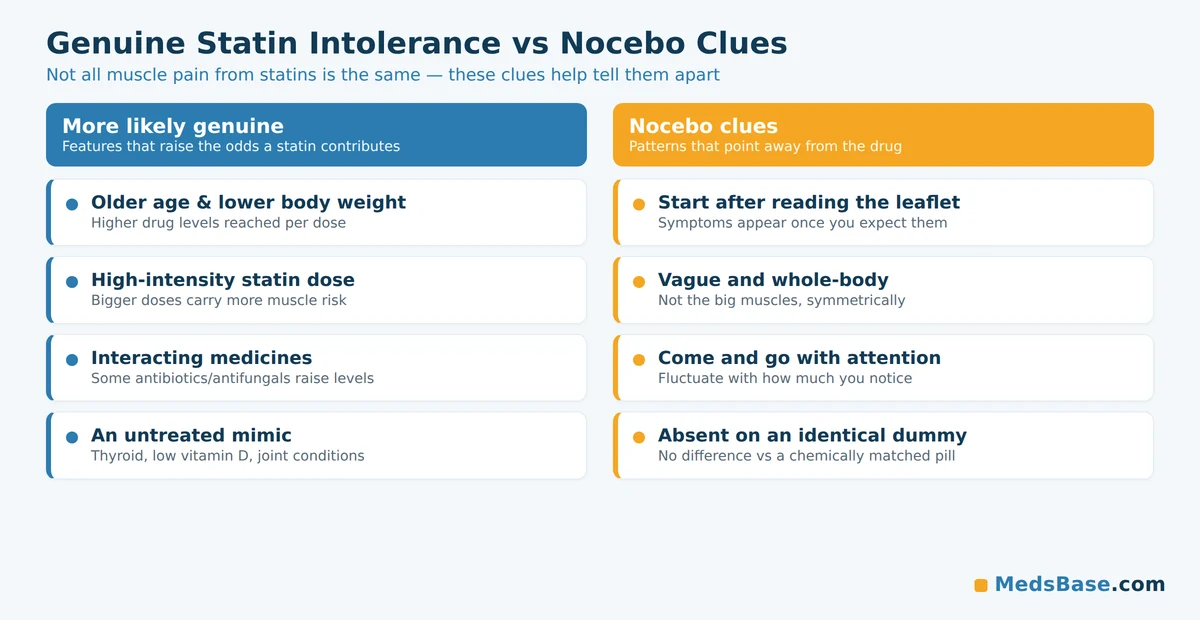
When muscle pain from statins is more likely genuine
Some features raise the odds that a statin really is contributing:
- Older age and lower body weight — thinner, older adults reach higher drug levels per dose.
- High-intensity dosing — bigger doses of the more potent statins carry a somewhat higher muscle-symptom rate.
- Interacting medicines — certain antibiotics, antifungals, some heart-rhythm drugs, and grapefruit juice can push statin levels up (this matters enormously for the re-challenge plan later).
- An untreated mimic — an underactive thyroid, low vitamin D, or a separate muscle or joint condition can cause aches that get blamed on the statin.
Nocebo clues, on the other hand
Symptoms are more likely to be nocebo-driven when they start almost immediately after reading about side effects, affect the whole body vaguely rather than the big muscles symmetrically, come and go with your attention to them, or appear with a statin but not with a chemically identical dummy.
The reassuring reality is that most readers land in the first group, not the second. Statin intolerance, understood properly, is usually a puzzle to solve rather than a permanent verdict.
Side Effects, Red Flags & True Muscle Damage
Now the safety signal we promised. The vast majority of the muscle symptoms behind a label of statin intolerance are aches and stiffness with no muscle damage at all. Rarely, a statin can cause genuine muscle injury — and there’s one blood test that tells the two apart: creatine kinase, or CK, an enzyme that leaks into the blood when muscle tissue is breaking down. Normal or mildly raised CK levels with tolerable aches usually mean no real damage. Markedly high creatine kinase with weakness is a different animal.
| Side effect | Frequency | Severity | What to do |
|---|---|---|---|
| Mild muscle aches / stiffness (SAMS) | Common as reported; mostly not drug-caused | Mild | Note timing/pattern; discuss a structured re-challenge — don’t just quit |
| New muscle weakness (trouble on stairs, rising from a chair) | Uncommon | Potentially serious | Contact your doctor; a CK test is warranted |
| Dark / cola-coloured urine with muscle pain | Rare | Urgent | Seek prompt medical care — possible rhabdomyolysis |
| Statin myopathy (marked CK rise, weakness) | Rare (~1 in 10,000) | Serious | Stop under medical guidance; investigate cause |
| Rhabdomyolysis (severe muscle breakdown) | Very rare | Medical emergency | Emergency care immediately |
| Deranged liver blood tests | Uncommon, usually mild | Mild–moderate | Routine monitoring; rarely needs stopping |
Let’s put the scary end of statin intolerance in proportion. Severe statin myopathy occurs in roughly 1 in 10,000 people, and rhabdomyolysis — the dangerous, kidney-threatening extreme — is rarer still. That’s not a reason to be cavalier; it’s a reason to know the specific warning signs rather than living in vague dread of every ache.
So how do you tell true muscle damage from the common look-alike? Genuine statin myopathy tends to bring symmetrical weakness in the large muscles (thighs, shoulders), not just soreness; it’s more likely with the drug interactions listed earlier; and it shows up on the CK test. The red flags that mean stop and get seen the same day are muscle pain with dark urine, muscle pain with fever, or weakness severe enough to affect daily movement. If you have those, this is the one time “push through it” is the wrong instinct — get checked.
That resolves the loop from the intro: the signal that sorts serious from routine is your creatine kinase level read alongside your symptoms, and dark urine plus weakness is the pattern you never ignore. A pharmacist’s practical note — the people who run into genuine trouble are very often the ones who started an interacting antibiotic or antifungal on top of a high statin dose, which is exactly why the medicines you take alongside your statin matter as much as the statin itself.
What the Blinded Trials Actually Showed
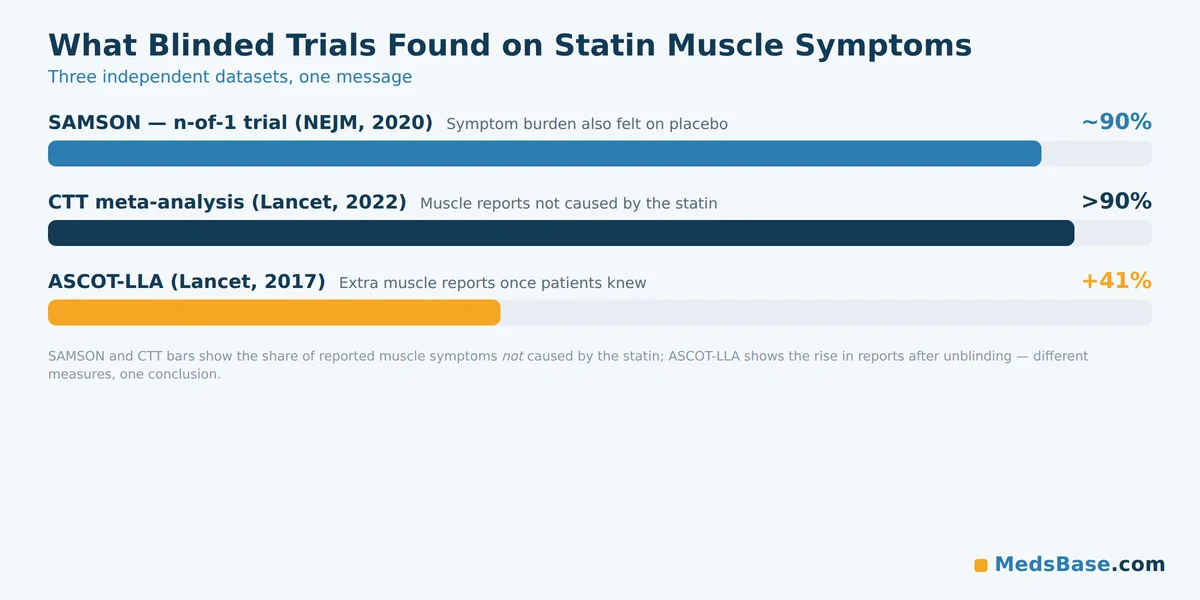
This is the evidence competitor pages skip. When researchers remove expectation from the equation — by blinding people to whether they’re on the statin or a placebo — statin intolerance looks dramatically different.
Start with SAMSON, a beautifully designed n-of-1 trial. Sixty people who had all stopped statins because of side effects took twelve bottles over a year: four with a statin, four with placebo, four empty. Neither they nor the researchers knew which was which until the end. The result: the symptom burden felt during statin months was almost identical to the burden felt during placebo months. The SAMSON trial found roughly 90% of the symptoms attributed to the statin also occurred on placebo — and, tellingly, half the participants were able to restart statins afterward.
StatinWISE, a larger series of n-of-1 trials, reached the same place from a different angle. Across participants who had reported severe muscle symptoms on statins, StatinWISE found no overall difference in muscle symptom scores between statin and placebo periods — and two-thirds of those who finished the trial planned to keep taking statins long-term.
Then there’s ASCOT-LLA, which caught the nocebo effect in the act. During its blinded phase, muscle complaints occurred at nearly identical rates on the statin and on placebo. Once the trial went open-label and everyone knew what they were taking, muscle-related reports rose by roughly 41% among statin users — the drug unchanged, only the knowledge different.
| Study | Year | Key finding | Source |
|---|---|---|---|
| SAMSON (n-of-1) | 2020 | ~90% of statin-attributed symptoms also occurred on placebo; half restarted statins | NEJM / peer-reviewed |
| StatinWISE (n-of-1 series) | 2021 | No difference in muscle symptom scores between statin and placebo periods | BMJ / peer-reviewed |
| ASCOT-LLA | 2017 | Muscle complaints equal when blinded; ~41% higher only after unblinding | Lancet / peer-reviewed |
| CTT Collaboration meta-analysis | 2022 | >90% of reported muscle symptoms on statins were not attributable to the statin | Lancet / peer-reviewed |
The capstone is the biggest of all. The Cholesterol Treatment Trialists’ Collaboration pooled individual data from large double-blind trials and found that more than 90% of muscle symptom reports on statins were not actually caused by the statin — with any genuine excess being small (about a 7% relative rise, mostly in the first year) and rarely severe.
What this means for you: if you stopped a statin for muscle pain, the odds are real that the pain and the drug weren’t as linked as they felt — which is genuinely good news, because it means a careful retry is very likely to succeed. It does not mean your pain was fake, and it does not mean everyone tolerates statins. It means the honest base rate for statin intolerance favours getting you back on treatment, not writing you off.
Take Michael, 62 — a purely illustrative example. He’d stopped two statins over aching thighs — a textbook picture of presumed statin intolerance — and felt brushed aside when his GP suggested trying again. This time his doctor checked his thyroid and vitamin D (both low-ish), treated those, waited a few weeks, then restarted a low dose of a different statin. The aches he braced for never really arrived. Michael’s story isn’t a promise — some people genuinely can’t tolerate a given statin — but it’s the pattern the blinded evidence predicts far more often than not.
Statin Intolerance vs the Alternatives: What Actually Helps
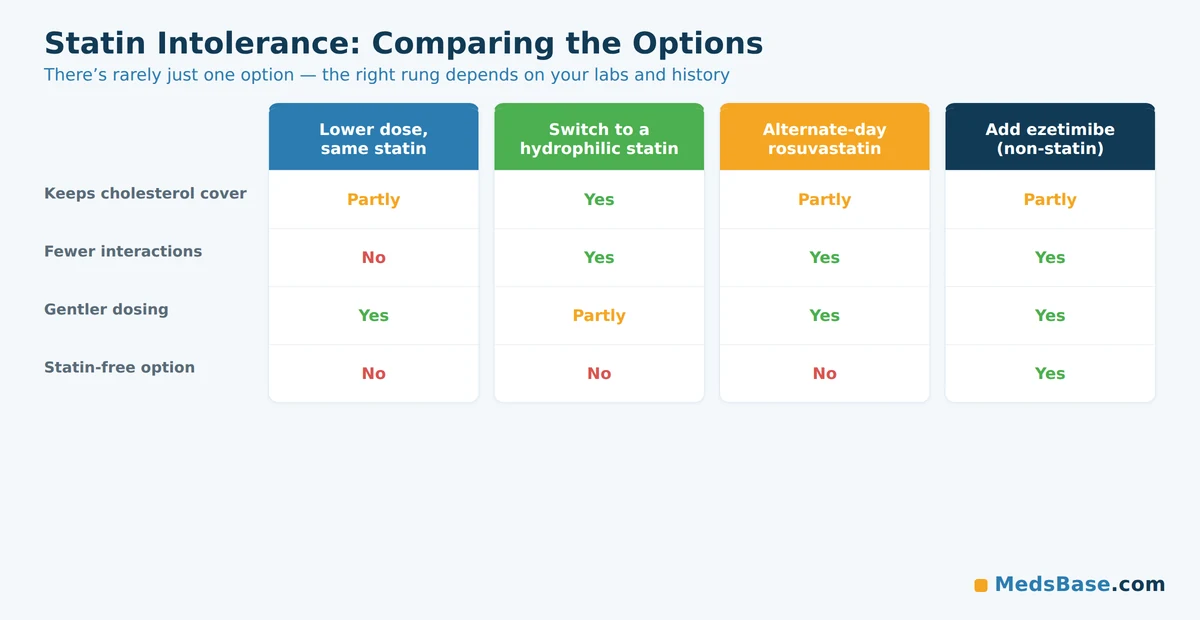
Suppose you’ve had the honest conversation and you still can’t settle on your original statin. You are not out of options — and this is where a good plan for statin intolerance beats a blunt “you’ll just have to live with high cholesterol.”
There are four broad moves, and the right one depends on your labs, your other medicines, and how strongly you reacted:
| Approach | What it changes | Keeps cholesterol cover? | Best when |
|---|---|---|---|
| Lower dose, same statin | Less drug, gentler exposure | Partly (still meaningful) | Symptoms were dose-related |
| Switch to a hydrophilic statin (rosuvastatin, pitavastatin) | Different chemistry, fewer interactions | Yes | Interactions or a bad reaction to one statin |
| Alternate-day / twice-weekly rosuvastatin | Same drug, far less often | Partly to mostly | Even low daily doses aren’t tolerated |
| Add or switch to ezetimibe (non-statin) | Blocks cholesterol absorption in the gut | Partly; stronger combined with a statin | You truly can’t take any statin dose |
Which fits which situation? If your aches seemed tied to a high dose, simply going lower often keeps most of the benefit. If you take interacting drugs — or reacted badly to a fat-soluble statin like simvastatin — switching to a water-soluble (hydrophilic) statin such as rosuvastatin or pitavastatin is the classic next move, because they’re processed differently and interact with fewer medicines. For a side-by-side on the two most common choices, our guide to which statin to switch to — atorvastatin vs rosuvastatin breaks down potency, interactions, and tolerability.
And if statins are genuinely off the table? Ezetimibe is the best-established non-statin add-on: it lowers LDL by blocking cholesterol absorption in the intestine, works with or without a statin, and rarely causes muscle symptoms. It’s less powerful than a statin alone, but it’s a real option for people with genuine statin intolerance who need one — see how the two stack up in our ezetimibe vs statins comparison. The goal is never “statin or nothing.” It’s “the most heart protection you can comfortably sustain.”
The Step-by-Step Path Back Onto Treatment
Here’s the practical ladder competitor pages leave out — the structured rechallenge that turns statin intolerance from a dead end into a plan. Every rung is a conversation to have with your doctor or pharmacist, not a DIY project. Never restart or change a statin on your own.
- Rule out the red flags and the mimics. Before anything, your clinician checks for genuine danger and for look-alikes: a CK / creatine kinase test if weakness is present, plus thyroid function, vitamin D, kidney function, and a review of every interacting drug and supplement you take. Untreated hypothyroidism or low vitamin D can cause the very aches being blamed on the statin.
- Take a proper washout. If symptoms are ongoing, a short statin-free break confirms whether they actually settle off the drug. If they don’t fully resolve, the statin probably wasn’t the main cause — useful information in itself.
- Re-challenge the same statin at a lower dose. Many people who couldn’t tolerate a high dose do fine on a smaller one. A lower dose still delivers meaningful LDL lowering, and tolerating it rebuilds confidence.
- Switch to a different, gentler statin. If a lower dose still bothers you, moving to a hydrophilic statin — rosuvastatin or pitavastatin — changes the drug’s chemistry and interaction profile. This single switch rescues a large share of people labelled with statin intolerance.
- Try alternate-day or twice-weekly rosuvastatin. Because rosuvastatin stays active in the body for a long time, taking it just two or three times a week still lowers cholesterol usefully while slashing total drug exposure — often the tipping point for someone who couldn’t manage a daily tablet. MedsBase stocks generic rosuvastatin as Rosuline, one accessible option to raise with your clinician when an intermittent-dosing plan is on the table — no prescription hurdle to arrange the conversation.
- Add a non-statin where needed. If even intermittent dosing isn’t enough or isn’t tolerated, ezetimibe (alone or combined with whatever statin dose you can take) closes part of the gap. Combination therapy often beats chasing a single high-dose statin you dread.
Mistakes to avoid on the way back: quitting for good after one bad experience without ever trying a different statin; restarting on your own without checking for drug interactions first; ignoring dark urine or true weakness because you assumed all statin aches are harmless; and treating “I read about the side effect” as proof the drug caused it. Pharmacists see all four constantly in people labelled with statin intolerance — and all four are avoidable.
Frequently Asked Questions
Q: Is statin intolerance real, or is it in my head?
A: It’s real — but “real” and “caused by the statin” aren’t the same thing. Blinded trials show most muscle symptoms attributed to statins also appear on placebo, which points to the nocebo effect: a genuine, measurable brain-body response, not imagination. Your pain is valid. The good news is that a cause you can often treat — rather than the drug itself — is frequently behind statin intolerance.
Q: How do I know if my muscle pain is really from my statin?
A: Clues that point to the drug include symmetrical weakness in large muscles, symptoms that clearly settle during a statin-free washout, and a raised CK / creatine kinase blood test. Clues that point away include vague whole-body aches that started right after reading about side effects. A structured washout and re-challenge, guided by your doctor, is the only reliable way to tell.
Q: What is the nocebo effect with statins?
A: The nocebo effect is when expecting a side effect helps produce it. With statins it’s sometimes called the “drucebo” effect — muscle symptoms that appear when you know you’re on the drug but fade when you don’t. It’s real physiology, not weakness or pretending, and it’s the core reason statin side effects are so easily over-attributed — muscle complaints jump in unblinded studies while staying flat in blinded ones.
Q: Can I retry statins after stopping because of side effects?
A: Very often, yes — and you shouldn’t attempt it alone. In the SAMSON trial, half the participants who had quit statins restarted successfully afterward. The usual path for statin intolerance is to rule out red flags, take a washout, then re-challenge at a lower dose or with a different statin. Ask your doctor about a structured rechallenge rather than writing statins off permanently.
Q: Which statin is best if I can’t tolerate the others?
A: There’s no single “best,” but if interactions or a bad reaction were the problem, a hydrophilic statin — rosuvastatin or pitavastatin — is a common next choice because it’s processed differently and interacts with fewer medicines. Alternate-day rosuvastatin is another gentle option. The right pick depends on your labs and other drugs, so decide it with your clinician.
Q: What is a safe cholesterol option if I truly can’t take a statin?
A: Ezetimibe is the best-established non-statin option. It lowers LDL cholesterol by blocking absorption in the gut, rarely causes muscle symptoms, and can be used alone or added to whatever statin dose you tolerate. It’s less powerful than a statin by itself, but for someone with genuine statin intolerance it provides real, guideline-recognised protection.
Q: What blood test checks for statin muscle damage?
A: The key test is creatine kinase (CK), an enzyme that rises when muscle breaks down. Mild aches with normal or slightly raised CK usually mean no real damage. A markedly high CK with weakness suggests genuine myopathy and needs prompt attention — especially alongside dark urine, which can signal rhabdomyolysis and warrants urgent care.
Q: Does everyone with statin muscle pain have to stop the statin?
A: No. Many people can continue, lower the dose, or switch statins rather than stop entirely. Because most reported muscle symptoms aren’t caused by the drug, quitting outright over statin intolerance often trades a treatable ache for an untreated heart risk. The safer default is a doctor-guided re-challenge — stopping for good is a last resort, not a first response.
The Bottom Line
Statin intolerance is real, but it’s rarely the closed door it feels like. The most rigorous blinded trials ever run — SAMSON, StatinWISE, ASCOT-LLA and the CTT meta-analysis — converge on one message: your muscle pain was genuine, yet in the large majority of cases the statin wasn’t the thing causing it. That’s not a dismissal. It’s the most hopeful finding in this entire field, because a symptom that isn’t drug-caused is usually a symptom you can get past.
Your one immediate action: if you stopped a statin over aches, book a conversation — not a solo restart — and ask two questions. “Could a mimic like my thyroid, vitamin D, or another medicine be behind this?” and “Can we try a structured re-challenge — a lower dose, a different statin, or alternate-day rosuvastatin?” That single discussion resolves most cases of statin intolerance without leaving your heart unprotected.
Still weighing it up? These are the natural next questions:
- Wondering whether a different medication could be affecting your muscles? Our companion guide on muscle changes with GLP-1 medicines looks at how another popular drug class interacts with muscle.
- Not sure which statin to try next? Compare the two most common choices in atorvastatin vs rosuvastatin.

Written by
Sophie ChenPharmaceutical Content Researcher · 8 years experience
Sophie Chen is a pharmaceutical content researcher with 8 years covering generic medication access and clinical pharmacology. She specialises in international regulatory frameworks, bioequivalence standards, and patient-facing education on therapeutic drug classes. She is not a clinician.