








✓ Medically reviewed by · Last reviewed: May 2026
Pharmacy Researcher · 8 years experience
Pharmacy researcher with 8 years reviewing clinical drug information, generic formulation equivalence, and international pharmaceutical standards. Focuses on patient-facing accuracy in medication education.
Here’s the question you might be too polite to ask your doctor out loud: “Do I really need a statin — or is there something gentler that still protects my heart?”
It’s a fair question. Statins are the most-prescribed cholesterol drugs on earth, and they’re also the ones people worry most about, usually because of muscle aches. Ezetimibe often gets floated as the “gentler alternative.” So which is right for you — and is that even the correct way to frame the choice?
By the end of this guide you’ll know exactly how ezetimibe vs statins compare on power, on safety, and on heart-protection evidence — and you’ll understand the plot twist that changes the whole debate: for many people, the smartest answer isn’t “one or the other” at all. We’ll get to that in the combination-therapy section.
Let’s start with what each drug actually does, because the difference is the entire story.
- Statins and ezetimibe lower cholesterol by two completely different mechanisms — and that’s exactly why they pair so well.
- One is far more powerful at cutting LDL; the other is far gentler on your muscles.
- A landmark trial found a combination approach matched high-dose statins on outcomes — with fewer people dropping out.
- “Can ezetimibe replace my statin?” has a nuanced answer that depends on one thing about you.
- There’s a newer option beyond both — we’ll point you to it at the end.
What Is Ezetimibe?
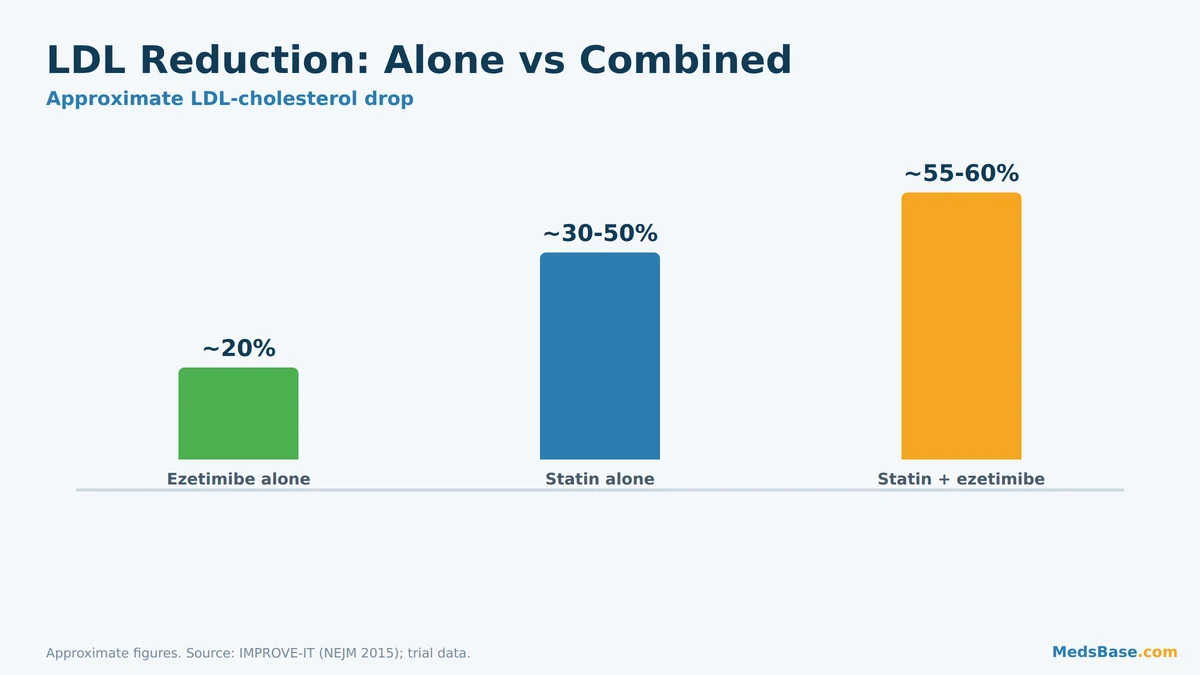
Ezetimibe is a cholesterol-absorption inhibitor — a non-statin cholesterol-lowering medication that blocks the NPC1L1 protein in your small intestine, reducing how much cholesterol your body absorbs from food and bile. On its own, it typically lowers LDL cholesterol by about 18–22%.
Statins work differently. As the NHS overview of statins explains, statins lower the amount of cholesterol your body makes in the liver. They’re the heavyweight of LDL reduction and carry decades of evidence for cutting heart attacks and strokes.
Per MedlinePlus ezetimibe drug information, ezetimibe is used for high cholesterol and specific inherited conditions, and it’s most often prescribed as an add-on when a statin alone doesn’t get LDL to target. That word — add-on — is the quiet key to this entire comparison.
Before we go further: LDL cholesterol is the “bad” cholesterol that builds up in artery walls. The NHLBI’s guide to blood cholesterol explains why lowering it reduces cardiovascular risk. Both drugs aim at the same enemy — they just attack from different directions.
How Each Drug Lowers Cholesterol
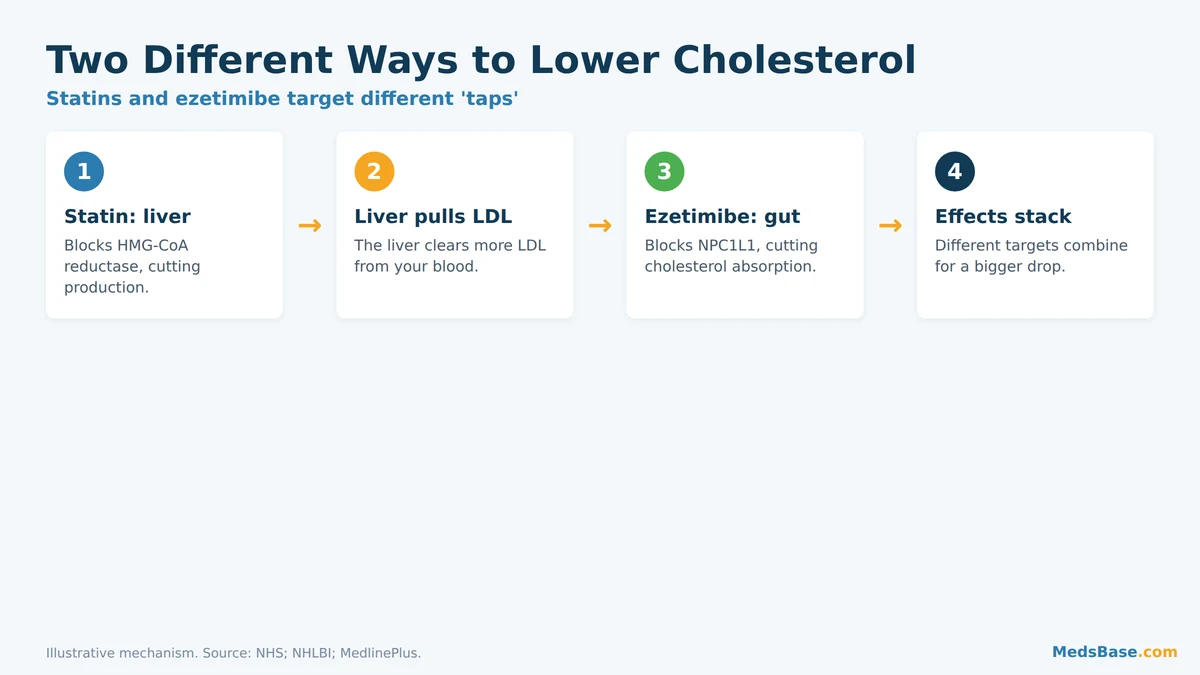
Picture your body’s cholesterol coming from two taps. One tap is production — your liver manufactures cholesterol. The other is absorption — your gut takes cholesterol in from food and bile.
- Statins turn down the production tap. They block HMG-CoA reductase, the liver enzyme that makes cholesterol. Turn down production, and your liver pulls more LDL out of your blood to compensate. This is the powerful mechanism — hence 30–50%+ LDL reductions with higher-intensity statins.
- Ezetimibe turns down the absorption tap. It blocks cholesterol uptake in the intestine, so less enters your bloodstream in the first place.
Here’s where it gets interesting: that stacking effect is why the smartest cholesterol strategy is often not a duel between the two drugs at all. Hold that thought — the trial evidence in a moment makes it concrete.
Ezetimibe vs Statins: The Core Comparison
Let’s lay the two side by side on the factors that actually matter to your decision.
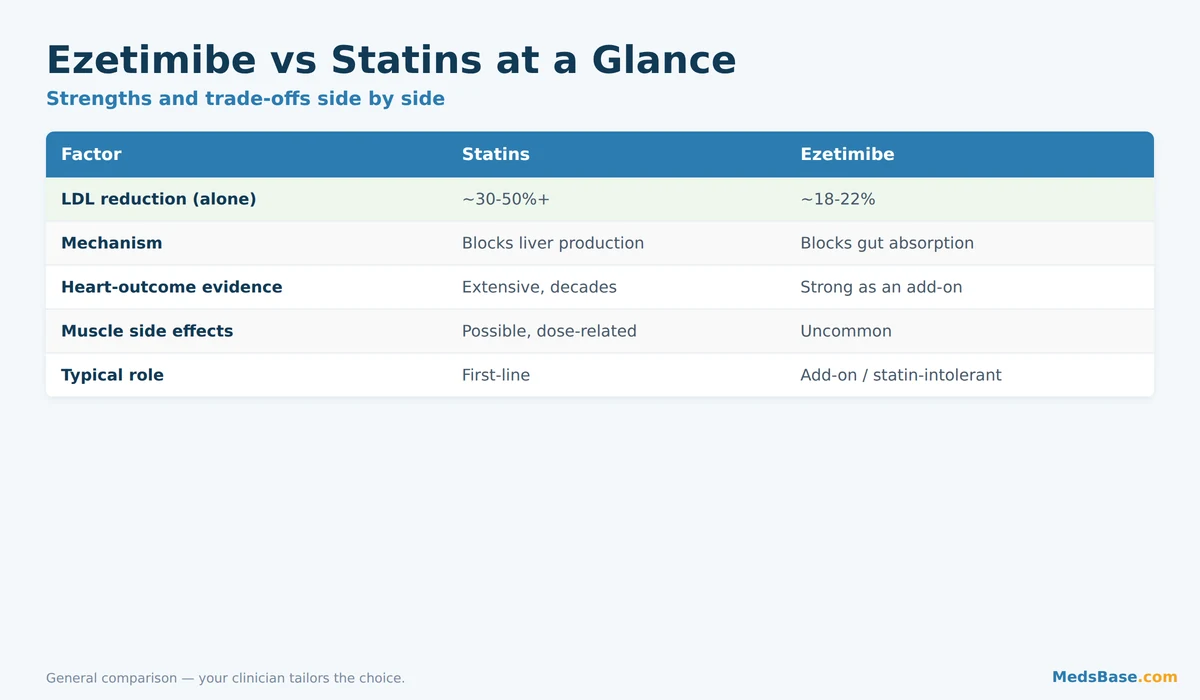
| Factor | Statins | Ezetimibe |
|---|---|---|
| LDL reduction (alone) | ~30–50%+ | ~18–22% |
| Mechanism | Blocks liver cholesterol production | Blocks gut cholesterol absorption |
| Heart-outcome evidence | Extensive, decades of trials | Strong as an add-on (IMPROVE-IT) |
| Muscle side effects | Possible, dose-related | Uncommon |
| Typical role | First-line | Add-on, or for statin-intolerant patients |
| Once-daily pill | Yes | Yes |
The headline: statins are more powerful and better-proven; ezetimibe is gentler and usually complementary. For most people at meaningful cardiovascular risk, a statin is the foundation. Ezetimibe earns its place when a statin alone isn’t enough, or when statins genuinely can’t be tolerated.
You can browse high-cholesterol treatments to see how these options are grouped — but the safety picture, especially around muscles, deserves an honest look first.
Side Effects & the Muscle-Pain Question
Let’s address the fear head-on, because it drives most “ezetimibe instead of a statin” searches: does ezetimibe cause muscle pain the way statins can?
Generally, no — not to the same degree. Because ezetimibe doesn’t touch the liver’s cholesterol-production pathway (the one linked to statin muscle symptoms), it largely sidesteps the dose-related muscle aches some people get on statins.
| Side effect | Statins | Ezetimibe | What to do |
|---|---|---|---|
| Muscle aches (myalgia) | Possible, dose-related | Uncommon | Report persistent/worsening pain; don’t just stop |
| Digestive upset (diarrhea) | Occasional | Occasional | Usually mild |
| Liver enzyme changes | Uncommon | Uncommon | Monitored with blood tests |
| Serious muscle breakdown (rhabdomyolysis) | Rare | Rare | Seek urgent care for severe pain + dark urine |
| Joint/back pain | Occasional | Occasional | Usually mild |
That said, two honest caveats. First, many people who think they can’t tolerate statins actually can tolerate a lower dose or a different statin — this is worth exploring before writing statins off. Second, the muscle-pain reputation of statins is real but often overstated; large studies find the difference from placebo is smaller than the internet suggests. Admitting that nuance is important: the goal is protecting your heart with a regimen you’ll actually keep taking.
One bolded takeaway: the “gentler” drug is only better if the trade-off in cholesterol lowering still protects your heart — which is exactly the question the trials answered.
What the Research Says: RACING and IMPROVE-IT
Two landmark trials turn this from opinion into evidence.
| Study | Year | What it compared | Key finding |
|---|---|---|---|
| IMPROVE-IT (NEJM) | 2015 | Simvastatin + ezetimibe vs simvastatin alone (18,144 patients) | Adding ezetimibe further lowered LDL and cut cardiovascular events — proof that lower LDL is better, even via a non-statin |
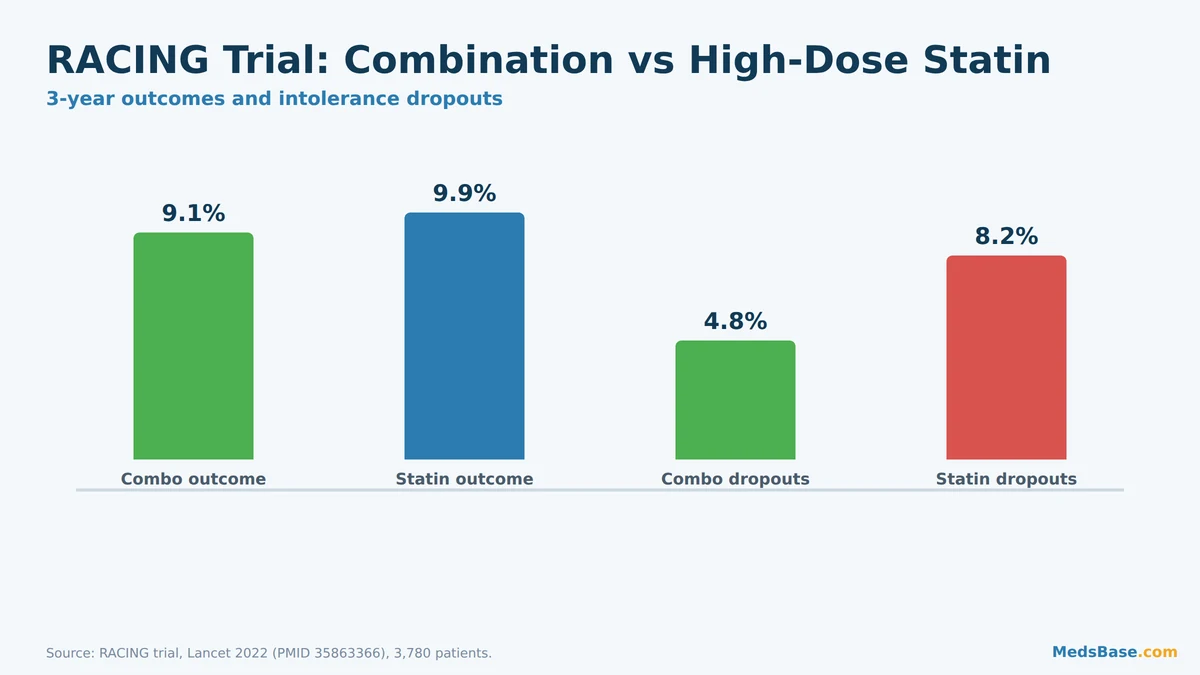
| RACING (Lancet) | 2022 | Moderate statin + ezetimibe vs high-intensity statin alone (patients with heart disease) | Combination was non-inferior for 3-year outcomes, hit LDL targets more often, and had fewer intolerance-related dropouts |
The details are striking. In the RACING trial, the primary composite outcome occurred in 9.1% of the combination group versus 9.9% of the high-intensity statin group (non-inferior), while discontinuation or dose reduction from intolerance was 4.8% with the combination versus 8.2% with high-dose statin alone — a meaningful tolerability win. Meanwhile, the IMPROVE-IT trial established that adding ezetimibe to a statin drove LDL down to about 54 mg/dL and reduced events versus the statin alone.
What this means for you: the evidence doesn’t crown ezetimibe or statins the winner — it shows that pairing a moderate statin with ezetimibe can match a high-dose statin on heart protection while being easier to tolerate. Research suggests, in plain terms: if a high-dose statin is rough on you, a gentler combination may protect your heart just as well.
Working Up “Statin Intolerance” Properly
This deserves its own section, because “I can’t take statins” is often the reason people reach for ezetimibe first — and it’s frequently more solvable than it seems.
True, complete statin intolerance is real but less common than the label suggests. Muscle symptoms can come from many sources — activity, other medications, low vitamin D, or simply the expectation of side effects (a well-documented “nocebo” effect confirmed in blinded studies, where people report aches even on placebo). That doesn’t mean your symptoms aren’t real; it means the cause is worth pinning down before you close the door on the most protective class of cholesterol drugs.
A sensible workup with your clinician often looks like this:
- Pause and rechallenge. Stop the statin briefly to see if symptoms truly resolve, then restart to see if they return — this separates statin-caused aches from coincidental ones.
- Lower the dose or switch the statin. Intolerance is often dose- and drug-specific. A gentler statin can succeed where a high-intensity one failed.
- Try intermittent dosing. Some people tolerate a statin every other day, still gaining meaningful LDL reduction.
- Check for contributors. Thyroid function, vitamin D, and interacting drugs can all amplify muscle symptoms.
One bolded takeaway: before concluding you need ezetimibe instead of a statin, it’s worth confirming you truly can’t tolerate any statin — because a combination often gives you the best of both.
Ezetimibe vs Statins vs Newer Options
The cholesterol toolbox has grown, and it helps to see where each option sits.
| Option | Power | Role | Notes |
|---|---|---|---|
| Statin (e.g. rosuvastatin, atorvastatin) | High | First-line foundation | Strongest evidence base |
| Ezetimibe | Moderate | Add-on / statin-intolerant | Gentle on muscles |
| Statin + ezetimibe | High (combined) | When statin alone falls short | Trial-backed |
| PCSK9 inhibitors | Very high | When LDL stays high despite the above | Newer, including an oral option |
Which one fits which situation? If you’re choosing between statins, our guide on how two statins compare head-to-head helps you pick — and MedsBase stocks a high-intensity statin like rosuvastatin if that’s your foundation. If you need ezetimibe as an add-on, our ezetimibe option sits alongside it. And if LDL stays stubborn despite both, the newest frontier is worth knowing — see the new oral PCSK9 inhibitor option in our Related Reading.
Cost, Adherence & the Real-World Choice
Here’s a truth the trials can’t measure but every patient feels: the best cholesterol drug is the one you’ll actually keep taking. LDL is silent, cardiovascular protection depends on years of consistency, and a regimen you abandon protects nobody.
That’s where cost and tolerability meet. Both statins and ezetimibe are available as affordable generics, which removes a common barrier to staying on treatment long-term. Ezetimibe is sold generically as ezetimibe 10 mg; statins like rosuvastatin and atorvastatin have long been off-patent. Because a moderate-statin-plus-ezetimibe combination can match a high-dose statin on outcomes with fewer dropouts, it can also be a more sustainable choice for someone who struggled with a high dose — better adherence, same protection.
A few real-world pointers:
- Once-daily simplicity helps. Both drugs are once-daily pills; some combination products even put a statin and ezetimibe in a single tablet, cutting pill burden.
- Consistency beats intensity you can’t sustain. A moderate regimen taken every day protects more than a high-intensity one you quit.
- Don’t self-adjust silently. If cost or side effects tempt you to skip doses, tell your prescriber — there’s almost always a workable alternative.
If you’re comparing what’s available, MedsBase lists our ezetimibe option and a high-intensity statin like rosuvastatin side by side within the wider category, so you can see the routes at a glance before your prescriber conversation.
How to Choose — a Practical Framework
You won’t make this call alone — your clinician weighs your LDL, your overall risk, and your history. But here’s the framework that will make that conversation sharper:
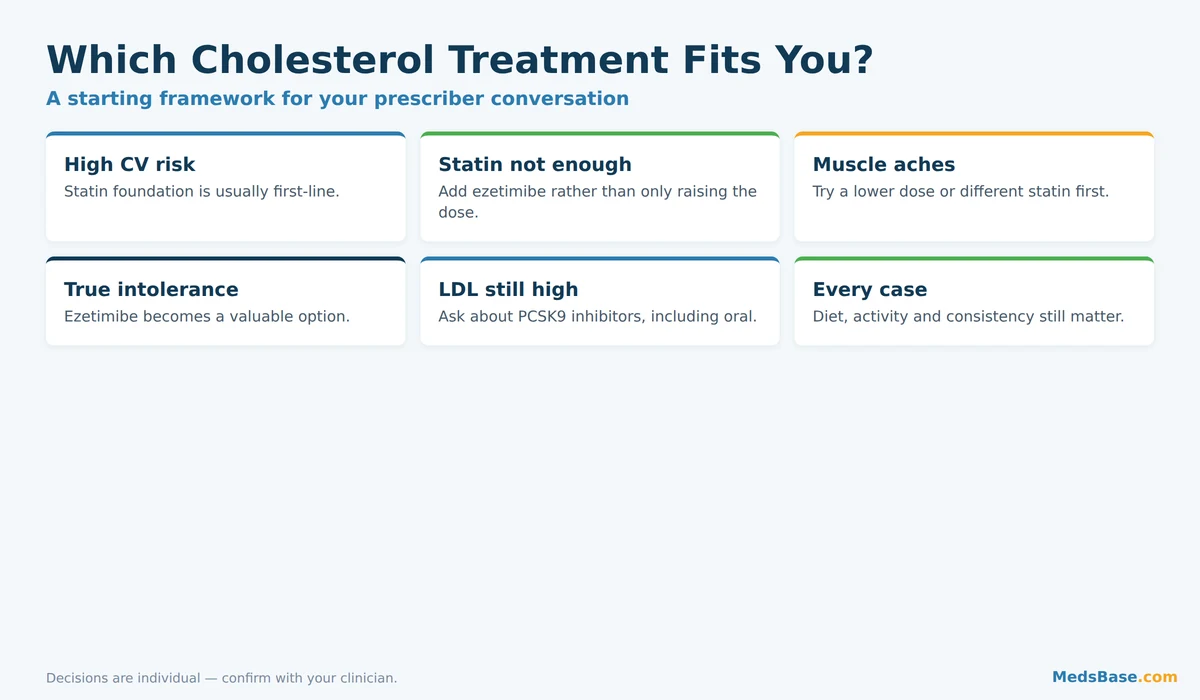
- Start with your cardiovascular risk. Higher risk (existing heart disease, diabetes, very high LDL) tilts strongly toward a statin foundation.
- Try to establish statin tolerance first. Before concluding “statins aren’t for me,” ask about a lower dose or a different statin — intolerance is often dose- or drug-specific.
- If a statin alone doesn’t hit target, add ezetimibe rather than only pushing the statin dose ever higher — the RACING approach.
- If statins are genuinely intolerable, ezetimibe becomes a valuable option, sometimes alongside other non-statin agents.
- If LDL stays high despite all this, ask about PCSK9 inhibitors.
- Abandoning statins over aches without trying a lower dose or a different one first.
- Treating ezetimibe as a full replacement for a statin when your risk warrants stronger LDL lowering.
- Stopping any cholesterol medication abruptly because you “feel fine” — high LDL is silent.
- Ignoring diet, activity, and other risk factors because a pill is doing “the work.”
Where diet and lifestyle fit in. Neither drug replaces the basics, and the basics genuinely move the needle. A diet lower in saturated fat, richer in soluble fibre (oats, legumes, fruit), regular physical activity, not smoking, and keeping weight and blood pressure in check all lower cardiovascular risk on top of any medication. Interestingly, diet and ezetimibe both work partly on the absorption side of cholesterol, so they complement each other well. None of this is a reason to skip a needed medication — high LDL usually can’t be managed by lifestyle alone in higher-risk people — but medication works best on a solid foundation. Think of the pill and the plate as teammates, not substitutes.
To see the full range of options in one place, browse high-cholesterol treatments — then bring your questions to your prescriber.
- How two statins compare: atorvastatin vs rosuvastatin
- Livalo (pitavastatin): a gentler statin option
- The new oral PCSK9 inhibitor explained
- Medication safety companion reads (publishing alongside): the prednisolone eye drops recall guide and settling Ozempic nausea — .
Frequently Asked Questions
Q: Is ezetimibe safer than statins?
A: Ezetimibe is generally gentler on muscles because it doesn’t affect the liver pathway linked to statin muscle aches. But “safer” isn’t the whole story — statins have far stronger evidence for preventing heart attacks and strokes. The best choice balances tolerability with the heart protection your risk level needs.
Q: Can ezetimibe replace a statin?
A: For most higher-risk people, no — ezetimibe alone lowers LDL less than a statin and has weaker standalone outcome evidence. It usually works best added to a statin. However, for people who genuinely can’t tolerate statins, ezetimibe becomes a valuable option, sometimes combined with other non-statin drugs.
Q: Does ezetimibe cause muscle pain?
A: Muscle pain is uncommon with ezetimibe, unlike the dose-related muscle aches some people get on statins. In fact, trials of moderate statin plus ezetimibe found fewer intolerance-related dropouts than high-intensity statin alone. Report any persistent muscle pain to your doctor rather than stopping on your own.
Q: Can you take ezetimibe and a statin together?
A: Yes — that combination is common and evidence-backed. Because they lower cholesterol by different mechanisms, taking them together produces a bigger LDL reduction than either alone, roughly equivalent to doubling the statin dose without the extra muscle-side-effect risk.
Q: Which lowers LDL more, ezetimibe or statins?
A: Statins lower LDL more — often 30–50% or more with higher-intensity doses, versus about 18–22% for ezetimibe alone. Combining them lowers LDL by around 55–60%, which is why the two are so often paired when a statin alone doesn’t reach the target.
Q: What can I take if I can’t tolerate statins?
A: Options include a lower statin dose, a different statin, ezetimibe, and (for stubborn LDL) PCSK9 inhibitors, including a newer oral one. Many “statin-intolerant” people tolerate an adjusted regimen, so it’s worth working through the choices with your doctor before giving up on cholesterol treatment entirely.
The Bottom Line
In the ezetimibe vs statins decision, there’s rarely a single winner. Statins deliver the most powerful, best-proven LDL reduction; ezetimibe offers a gentler, muscle-friendly effect that shines as an add-on — and the trial evidence shows a moderate-statin-plus-ezetimibe combination can match high-dose statins on heart protection with fewer dropouts.
Your one immediate action: book a conversation with your prescriber about your LDL target and your statin tolerance — and ask specifically whether adding ezetimibe beats simply pushing your statin dose higher. That’s the question the evidence rewards.
Wondering which statin to build on? Read how atorvastatin and rosuvastatin compare. Curious what comes after statins and ezetimibe? See the new oral PCSK9 inhibitor option.

Written by
Sophie ChenPharmaceutical Content Researcher · 8 years experience
Sophie Chen is a pharmaceutical content researcher with 8 years covering generic medication access and clinical pharmacology. She specialises in international regulatory frameworks, bioequivalence standards, and patient-facing education on therapeutic drug classes. She is not a clinician.