








✓ Medically reviewed by · Last reviewed: May 2026
Pharmacy Researcher · 8 years experience
Pharmacy researcher with 8 years reviewing clinical drug information, generic formulation equivalence, and international pharmaceutical standards. Focuses on patient-facing accuracy in medication education.
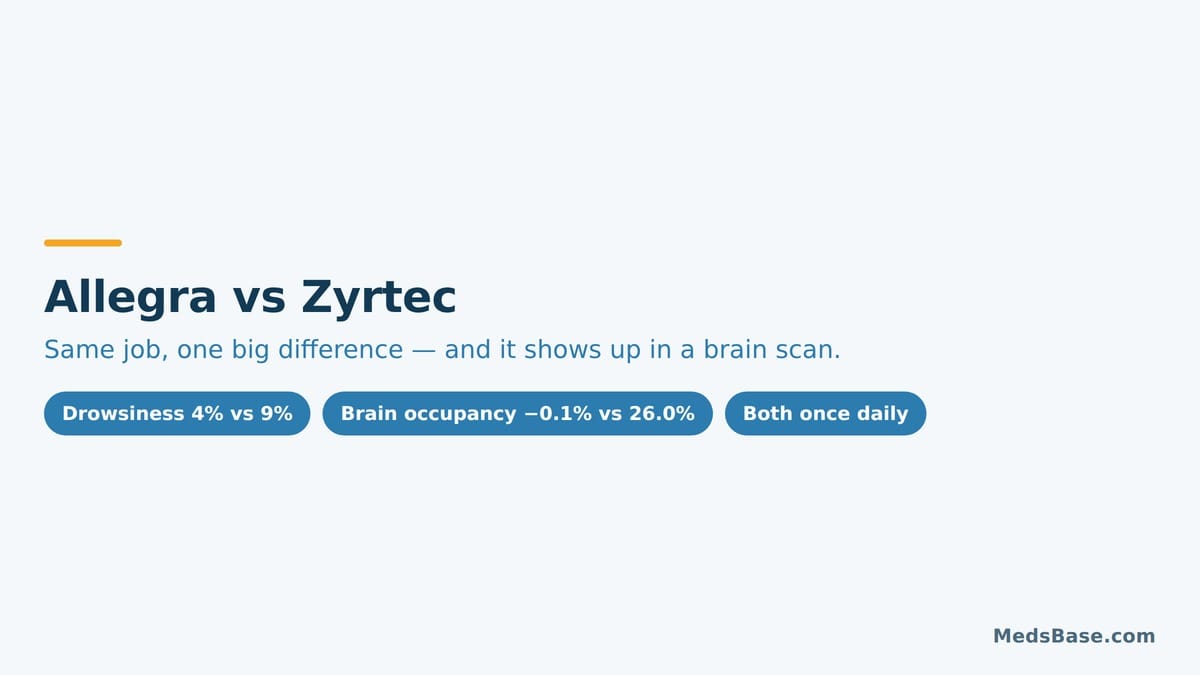
In a study that scanned people’s brains after they took an antihistamine, one drug occupied 26% of the histamine receptors in the brain. The other occupied −0.1% — statistically indistinguishable from taking nothing at all. That is the real story behind Allegra vs Zyrtec, and it explains a difference that most comparisons only assert.
By the end of this guide you will know which of these two suits your morning, what the actual drowsiness numbers are rather than the marketing claim, and the one dosing detail in the brain-scan study that changes how much weight you should put on it. There is also a small, annoying restriction on one of these two that nobody mentions until you have already bought it — we will get to that in the practical section.
- Both work. On symptom relief they were statistically comparable in a head-to-head trial — so “which is stronger” is the wrong question.
- The drowsiness gap is real and measurable, and one of these two is indistinguishable from placebo on it.
- A brain-imaging study explains why — but it used a dose that changes how you should read it.
- One of the two has a food restriction that quietly ruins a lot of people’s morning routine.
- Speed of onset differs enough to matter if you take your tablet after symptoms have already started.
What Are Allegra and Zyrtec?
Allegra is the brand name for fexofenadine. Zyrtec is the brand name for cetirizine. Both are second-generation antihistamines: they block H1 histamine receptors, which is what stops the sneezing, the runny nose, the itchy watering eyes and the hives that histamine causes when your immune system overreacts to something harmless like pollen.
“Second-generation” is the important phrase. The first generation — the older antihistamines still found in night-time cold remedies — knocked people out reliably. The whole point of the newer drugs was to keep the symptom relief and lose the sedation.
They did not all succeed equally, which is the entire subject of this article. The NHS groups antihistamines by whether they cause drowsiness and places both cetirizine and fexofenadine in the non-drowsy group, noting that “non-drowsy antihistamines are generally the best option, as they’re less likely to make you feel sleepy.” Note the careful wording: less likely, not unable to.
Here is where it gets interesting. Within that non-drowsy category there is a spread, and in the Allegra vs Zyrtec matchup the two drugs sitting at opposite ends of that spread happen to be the two most people are choosing between.
One more thing worth settling early, because it saves a lot of confusion later: the brand name and the molecule are not the same thing, and you will see both on shelves. Allegra is fexofenadine. Zyrtec is cetirizine. Generic versions of each contain the same active ingredient at the same strength and are held to the same standards — the brand name is packaging and marketing history, not chemistry. Nothing in this comparison changes if you buy either molecule under a different name.
Why Does Zyrtec Make You Sleepy When Allegra Doesn’t?
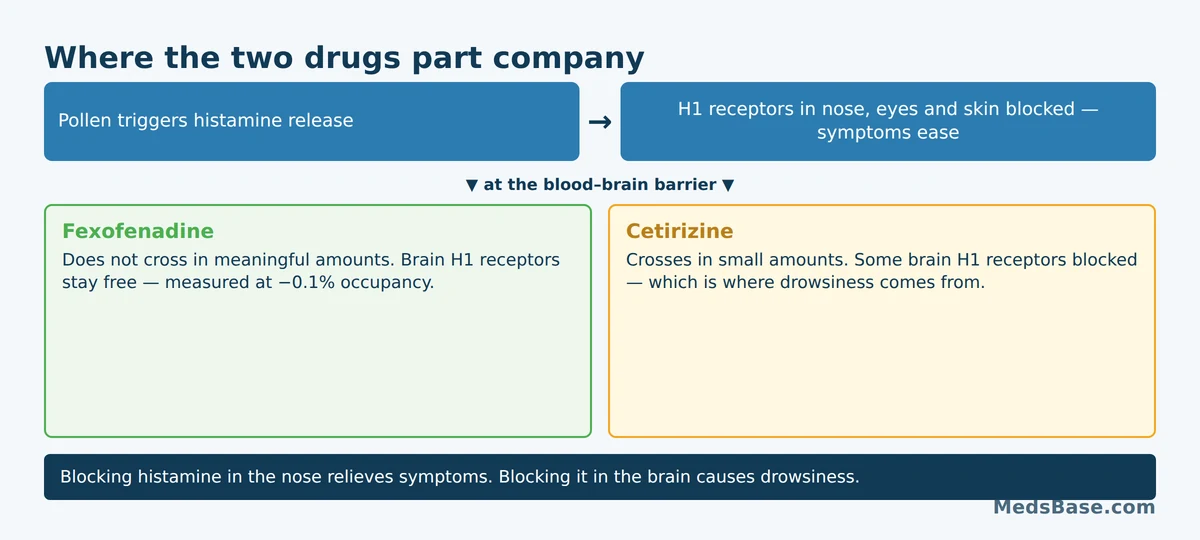
Your body has histamine receptors in two places that matter here: in the tissue of your nose, eyes and skin, where blocking them relieves symptoms, and in your brain, where blocking them causes drowsiness and slows your reactions.
Between your bloodstream and your brain sits the blood-brain barrier — a filter that decides which molecules get through. Think of it as a bouncer with a very specific list. Fexofenadine is not on the list. Cetirizine is, partially.
That is not a theory. Researchers measured it directly with brain imaging, using PET scanning with a radioactive tracer that binds to brain histamine receptors. In 20 healthy volunteers, fexofenadine 120 mg produced brain H1-receptor occupancy of −0.1% — effectively nothing, indistinguishable from placebo. Cetirizine 20 mg produced 26.0%. On psychomotor testing, fexofenadine was not significantly different from placebo and was significantly less impairing than cetirizine on some tasks.
So what does this mean for you in practical terms? If you take cetirizine and feel fine, you are not imagining it — most people do. Around nine in ten report no drowsiness at all. But if you have ever taken an allergy tablet and spent the afternoon feeling like you were operating one second behind everyone else, this mechanism is the likely reason, and switching molecules is a reasonable response.
Allegra vs Zyrtec: Which One Suits Your Day?
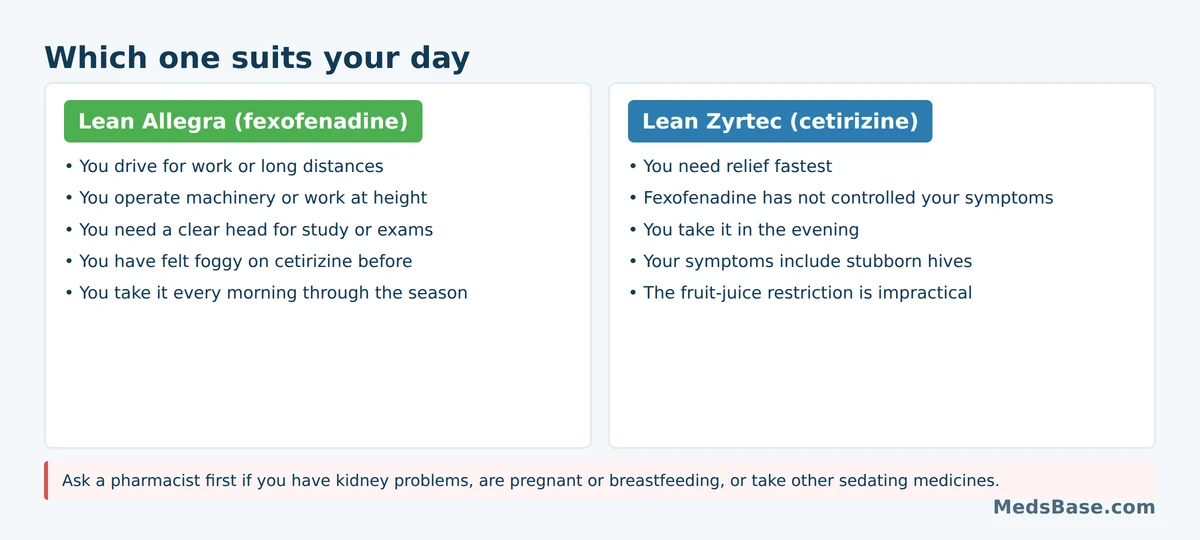
The honest framing for Allegra vs Zyrtec is not “which is better” but “which one loses you less.” They relieve symptoms comparably. What differs is what each costs you in alertness and convenience.
Choose fexofenadine if your day has no room for fog
Driving for work. Operating machinery or working at height. A shift where a slow reaction has consequences. An exam. Fexofenadine is the choice with the strongest evidence for leaving cognition alone — it performed at placebo level on both the drowsiness counts and the psychomotor testing.
Choose cetirizine if speed and symptom control matter more
Cetirizine reaches peak blood levels faster, which matters when you are taking a tablet in response to symptoms that have already started rather than pre-emptively. Some people also find it simply controls their symptoms better, and individual response to antihistamines varies more than any average suggests. If mild drowsiness is acceptable — or you take it in the evening, where it may even be welcome — that trade is perfectly reasonable.
Allegra vs Zyrtec for Hives, Not Just Hay Fever
Most people meet these two medicines through pollen. But both are also used for urticaria — hives — and the calculation shifts a little when that is why you are taking one.
MedlinePlus lists both drugs for hives as well as allergic rhinitis: fexofenadine for “itching and redness caused by hives,” cetirizine for urticaria alongside its allergy indications. So the choice is genuinely open in either condition.
Two practical differences show up here. First, hives are often worse in the evening and overnight, which changes how you weigh sedation — a small amount of drowsiness at 9pm is a feature rather than a bug for a lot of people, and that tilts the argument toward cetirizine in a way it does not for daytime hay fever. Second, chronic hives frequently need higher-than-standard antihistamine dosing under medical supervision, and that is a decision for a clinician rather than something to improvise from a box.
Bold takeaway: if your hives have run beyond six weeks, the medicine choice has stopped being the important question. Chronic urticaria that persists that long warrants assessment rather than a stronger tablet — MedlinePlus specifically advises calling a doctor if hives last more than six weeks. There are effective treatments beyond antihistamines, and finding out why the hives are there matters more than optimising which H1 blocker you take.
For seasonal allergy, the reverse is true: the medicine choice is most of the decision, and the timing of when you start it is the rest.
Allegra vs Zyrtec: Side Effects, Dosing and the Fine Print
Both are well tolerated. Neither is a drug most people need to think hard about. The differences are small but genuinely practical.
| Side effect | Fexofenadine (Allegra) | Cetirizine (Zyrtec) | What to do |
|---|---|---|---|
| Drowsiness or fatigue | ~4% — same as placebo in trial data | ~9% | If it affects you, switch molecules rather than pushing through |
| Headache | Occasional | Occasional | Usually settles; take with water and stay hydrated |
| Dry mouth | Uncommon | Occasional | Sip water; sugar-free gum helps |
| Reduced alertness while driving | Not detected above placebo | Possible | Do not drive until you know how it affects you |
| Serious allergic reaction (difficulty breathing or swallowing) | Rare | Rare | Seek medical help immediately |
Bold takeaway: the driving advice is not identical for these two, and the labels reflect that. MedlinePlus is explicit about driving on cetirizine: “Do not drive a car or operate machinery until you know how this medication affects you,” and it warns that “alcohol can add to the drowsiness caused by this medication.” That is standard, sensible labelling — but it exists because the effect exists.
Now the fine print promised in the introduction. MedlinePlus advises not taking fexofenadine with fruit juice — specifically “orange, grapefruit, or apple juice.” Fruit juices interfere with the transporters that absorb the drug from your gut, so you can end up with meaningfully less of it in your system. Take fexofenadine with water. If your morning routine is a tablet and a glass of orange juice, this is the detail that has quietly been undermining it.
Both drugs are once daily. Both are cleared partly by the kidneys, so reduced kidney function is a reason to check dosing with a pharmacist rather than assume the standard dose is right.
What Does the Research Say About Allegra vs Zyrtec?
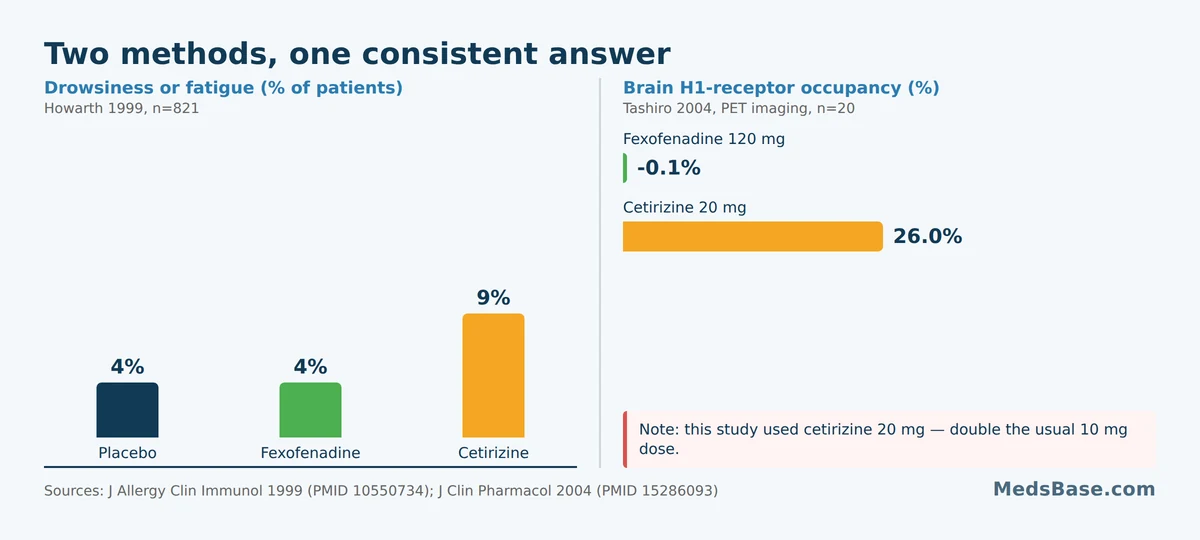
Two studies do most of the work here, and they approach the question from completely different angles.
| Study | Year | Design | Finding | Source |
|---|---|---|---|---|
| Howarth et al., J Allergy Clin Immunol | 1999 | Multicentre, double-blind, placebo-controlled; 821 patients with seasonal allergic rhinitis | Both fexofenadine doses superior to placebo on total symptom score. Drowsiness or fatigue: cetirizine 9%, placebo 4%, fexofenadine 4% (p = 0.02 vs fexofenadine) | PubMed |
| Tashiro et al., J Clin Pharmacol | 2004 | PET imaging with 11C-doxepin; 20 healthy volunteers plus 11 controls | Brain H1-receptor occupancy: fexofenadine 120 mg −0.1%, cetirizine 20 mg 26.0%. Fexofenadine not significantly different from placebo on psychomotor tests | PubMed |
The 1999 trial is the one that matters most for a real-world decision, because it counted what happened to actual allergy patients taking normal doses. An 821-patient trial measured the difference between the two and found the sedation gap while finding no meaningful efficacy gap.
What this means for you: the two questions people usually ask about Allegra vs Zyrtec — “which works better?” and “which is less drowsy?” — have different answers. On effectiveness, treat them as equivalent and let your own response decide. On drowsiness, the evidence consistently favours fexofenadine, from two independent methods twenty-five years apart.
It is worth noticing how those two methods agree, because that is what makes the conclusion durable. One counted symptoms reported by hundreds of allergy patients in ordinary use. The other took pictures of receptor binding inside the skulls of twenty healthy volunteers. Those studies share no assumptions, no design and no research group, and they were run twenty-five years apart. When two approaches that different land in the same place, the finding tends to survive.
Where the evidence is limited, say so plainly. The 1999 trial is old, and both drugs have been reformulated and moved over the counter since. The PET study is small, used a double dose of cetirizine, and measured healthy volunteers rather than people with active allergic rhinitis. Neither tells you how you will respond. Individual variation in antihistamine response is genuinely large, and a two-week personal trial of one molecule will tell you more than any average in this table.
Allegra vs Zyrtec vs the Other Options
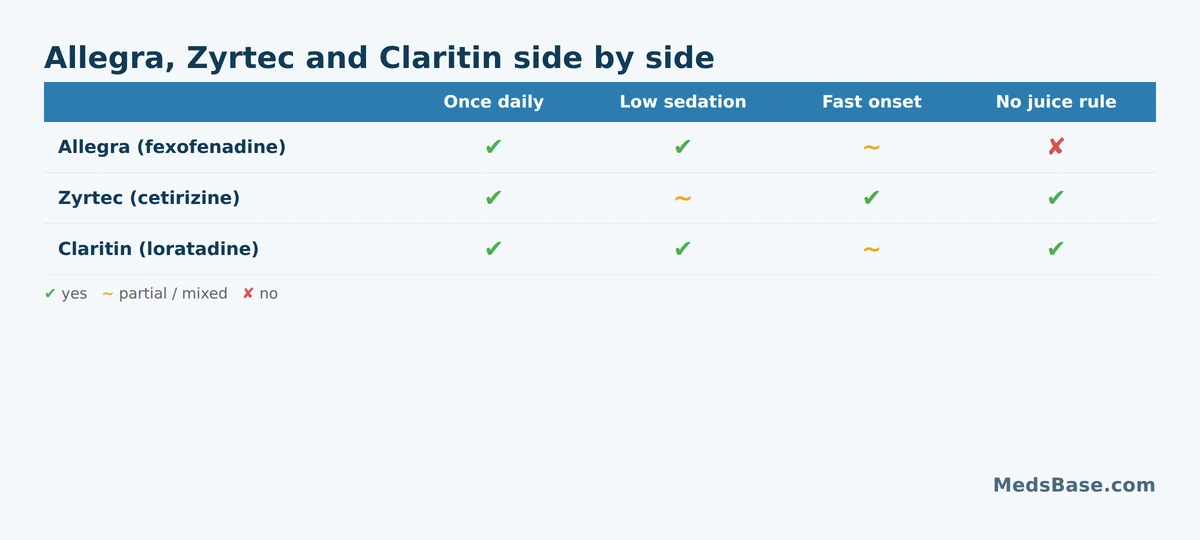
| Option | Onset | Sedation risk | Dosing | Notable restriction |
|---|---|---|---|---|
| Allegra (fexofenadine) | Slower — around 1–3 hours | Lowest — placebo-level in trials | Once daily | Avoid taking with fruit juice |
| Zyrtec (cetirizine) | Fastest of the three | Low but highest of the three (~9%) | Once daily | Caution with driving and alcohol |
| Claritin (loratadine) | Intermediate | Low | Once daily | Few |
| Nasal steroid spray | Days to full effect | None | Daily, consistently | Requires correct technique |
Which one fits which situation? If your symptoms are mainly nasal congestion rather than sneezing and itching, neither tablet is your best first move — a nasal steroid outperforms antihistamines for congestion, though it needs consistent daily use to work. If sneezing, itching and watery eyes dominate, an antihistamine is right, and the choice between these two comes down to whether your day tolerates any fog at all. If you happen to be comparing a different pair, we have covered how Zyrtec stacks up against Claritin instead.
How to Use Either One Properly
- Start before your season, not after it. Antihistamines work better preventing histamine effects than undoing them. If your trigger is predictable, begin a week or two ahead.
- Take it at the same time every day. Both are once-daily. Consistency matters more than which one you chose.
- Take fexofenadine with water only. Not orange, grapefruit or apple juice. Space juice a couple of hours away from the tablet if you cannot skip it.
- Test cetirizine’s effect on you before you drive on it. Take the first dose on a day where being slightly slow costs you nothing.
- Give one molecule a genuine two-week run before switching. Three days of partial relief is not a fair test.
- Skip alcohol while you are working out how it affects you — it compounds sedation, particularly with cetirizine.
- Escalate rather than double up. If a standard dose is not controlling your symptoms, the answer is usually adding a nasal steroid or getting assessed, not taking two tablets.
- Taking fexofenadine with your morning juice — a genuine absorption problem, not a technicality.
- Concluding “antihistamines don’t work for me” after three inconsistent days during peak season.
- Doubling the dose to get more relief. Higher cetirizine doses raise sedation faster than they raise benefit.
- Driving on a new antihistamine before you know how it affects you.
- Treating six-plus weeks of hives as a tablet problem. That needs assessment.
MedsBase stocks both molecules — Allegra (fexofenadine) and Okacet (cetirizine) — from WHO-GMP-certified manufacturers, and no prescription is needed to order. Which one to start with is genuinely a matter of what your day demands, and a pharmacist can settle it in a two-minute conversation if you are unsure.
- How Zyrtec stacks up against Claritin instead — if that is the pair you were actually comparing.
- The full seasonal allergy playbook — because a tablet alone rarely finishes the job.
- The medicines that quietly make you sun-sensitive — worth knowing before allergy season becomes beach season.
Frequently Asked Questions
Q: Which is better in the Allegra vs Zyrtec comparison?
A: Neither is universally better — they were statistically comparable on symptom relief in a head-to-head trial of 821 patients. The deciding factor is sedation. Drowsiness or fatigue affected about 9% of cetirizine (Zyrtec) users versus about 4% on fexofenadine (Allegra), the same rate as placebo. Choose Allegra if you drive, operate machinery or need sustained concentration. Choose Zyrtec if you want faster onset or if fexofenadine has not controlled your symptoms.
Q: Does Zyrtec make you sleepy?
A: For most people, no — roughly nine in ten report no drowsiness. But it is measurably more likely than with fexofenadine. In trial data, drowsiness or fatigue occurred in about 9% of cetirizine users against 4% for both placebo and fexofenadine. Brain imaging offers the explanation: cetirizine occupies a measurable share of brain histamine receptors while fexofenadine occupies essentially none. MedlinePlus advises not driving until you know how cetirizine affects you.
Q: Can you take Allegra and drive?
A: Fexofenadine has the strongest evidence of the second-generation antihistamines for not impairing driving-related performance. In PET-imaging research it produced brain histamine receptor occupancy of −0.1%, statistically no different from placebo, and it performed at placebo level on psychomotor testing. That said, individual responses vary, so take your first dose at a time when being slightly slower would not matter, and never combine any antihistamine with alcohol before driving.
Q: How long does fexofenadine take to work?
A: Fexofenadine typically takes longer to reach peak levels than cetirizine — roughly one to three hours versus under an hour. If you are taking a tablet in response to symptoms that have already started, that difference is noticeable. If you take it daily through a pollen season, which is how these medicines work best, onset speed stops mattering because you have steady levels in your system.
Q: Is it safe to switch from Zyrtec to Allegra?
A: Generally yes — both are second-generation antihistamines used for the same conditions, and switching between them is common when one causes drowsiness or does not control symptoms adequately. There is no tapering requirement. Simply take the new one at your usual time the next day. If you are on other medicines or have kidney problems, check with a pharmacist first, since both drugs are partly cleared by the kidneys.
Q: Why can’t you take Allegra with fruit juice?
A: Orange, grapefruit and apple juice interfere with the intestinal transporters that absorb fexofenadine, which can leave you with meaningfully less of the drug in your system and weaker symptom relief. MedlinePlus advises against taking fexofenadine with these juices. Take it with water, and if you cannot skip your morning juice, put a couple of hours between the two.
Q: Can you take Allegra and Zyrtec together?
A: This is not a standard approach and should not be done without professional advice. Both block the same receptors, so combining them mostly raises the side-effect risk rather than the benefit, and cetirizine’s sedation would be the effect most likely to increase. If one antihistamine at a standard dose is not controlling your symptoms, the more effective escalation is usually adding a different class — a nasal steroid — or getting your symptoms assessed.
Q: Do I need a prescription to order these from MedsBase?
A: No prescription is needed to order from MedsBase.com, and both fexofenadine and cetirizine come from WHO-GMP-certified manufacturers. If you have kidney problems, are pregnant or breastfeeding, or take other sedating medicines, a quick pharmacist conversation before you start is still worth the two minutes.
The Bottom Line on Allegra vs Zyrtec
Here is the balanced verdict. On symptom relief, Allegra vs Zyrtec is close to a coin toss — a head-to-head trial found no meaningful efficacy gap, and your individual response will decide more than any average. On everything else, the split is clean: fexofenadine is the choice if your day cannot afford fog, backed by placebo-level drowsiness rates and brain imaging showing essentially no central penetration. Cetirizine is the choice if you want speed, or if fexofenadine has not worked for you, and the roughly 9% drowsiness rate means most people never notice a thing.
Your one immediate action: pick the one that matches tomorrow, not the one that sounds stronger. If you drive to work, start with fexofenadine and take it with water rather than juice. If your symptoms hit hard and fast and you are home, start with cetirizine and see how the first dose sits before you plan around it. Give whichever you choose a fair two weeks.
Both are available at MedsBase from WHO-GMP-certified manufacturers, with no prescription needed.
Still not sure a tablet is the whole answer? Read the full seasonal allergy playbook for what to add when antihistamines only get you part of the way. And if you have ever wondered what to do when a medicine you rely on gets pulled from shelves, we wrote what to do if your medication is recalled.

Written by
Sophie ChenPharmaceutical Content Researcher · 8 years experience
Sophie Chen is a pharmaceutical content researcher with 8 years covering generic medication access and clinical pharmacology. She specialises in international regulatory frameworks, bioequivalence standards, and patient-facing education on therapeutic drug classes. She is not a clinician.