








✓ Medically reviewed by · Last reviewed: May 2026
Pharmacy Researcher · 8 years experience
Pharmacy researcher with 8 years reviewing clinical drug information, generic formulation equivalence, and international pharmaceutical standards. Focuses on patient-facing accuracy in medication education.
Between five and ten of every hundred people diagnosed with this pneumonia die from it — and the World Health Organization puts the death rate far higher, at 40–80%, in untreated patients with weakened immune systems. What makes those numbers so frustrating is that the bacterium responsible is entirely treatable. The catch is that Legionnaires disease treatment only works if you get the right class of antibiotic, and the antibiotic most people picture when they hear “chest infection” is one of the ones that does nothing at all here.
That single fact is missing from almost everything written about the current Manhattan outbreak. By the end of this article you will know exactly which drugs reach this organism and why, how long a course runs, how fast you need to start, and one thing about the standard test that surprises most people — including the reason a negative result does not always mean you are in the clear.
- Legionella hides inside your own immune cells — which silently rules out an entire family of common antibiotics, including the one in most people’s cupboards
- Effective Legionnaires disease treatment comes down to two drug classes, with a third as a reasonable fallback on thinner evidence
- Courses typically run 1–3 weeks, far longer than the 5-day course you may be used to
- The rapid urine test only reliably finds one subtype — we will cover what a negative result actually means
- A 2026 ICU study asked whether two antibiotics beat one in severe cases, and the answer was not what guidelines assumed
- The illness has a mild twin that needs no antibiotics whatsoever, and telling them apart changes everything
- What Legionnaires’ disease actually is
- Why the bacteria are so hard to reach
- Legionnaires disease treatment: which antibiotics work, and which fail
- The test that misses cases
- Side effects, dosing and how long treatment lasts
- What the research says about Legionnaires disease treatment
- Legionnaires’ vs Pontiac fever: the mild twin
- What to do if you think you have it
- Frequently asked questions
- The bottom line
What Is Legionnaires’ Disease?
The bacterium was first identified in 1977 and lives naturally in fresh water. Trouble starts when it colonises the warm, artificial water systems that modern buildings are full of — air-conditioning cooling towers above all, but also spa pools, humidifiers, and taps and showers that sit unused for long stretches.
You catch it by breathing in contaminated mist. That is a genuinely important detail, because it means the water you drink is not the risk, and the person coughing next to you is not either. The NHS is explicit that you cannot usually catch it from other people with the infection.
The current cluster in New York illustrates the pattern precisely. According to the city’s Health Department, an investigation that began on 2 July with two confirmed cases in the Carnegie Hill and Yorkville neighbourhoods had grown to 90 diagnosed cases and six deaths as of 28 July 2026. Of 183 cooling towers tested across 160 buildings, 77 tested positive by PCR and 59 grew live bacteria on culture; all have since been cleaned and disinfected. No infected person passed it to anyone else — the towers did all the work.
If you want the wider context of where this sits among infections generally, our guide to how bacterial infections are classified and treated covers the landscape. Here we are staying narrow, because this particular organism behaves unlike most of the bacteria that guide describes.
How Does Legionella Escape Most Antibiotics?
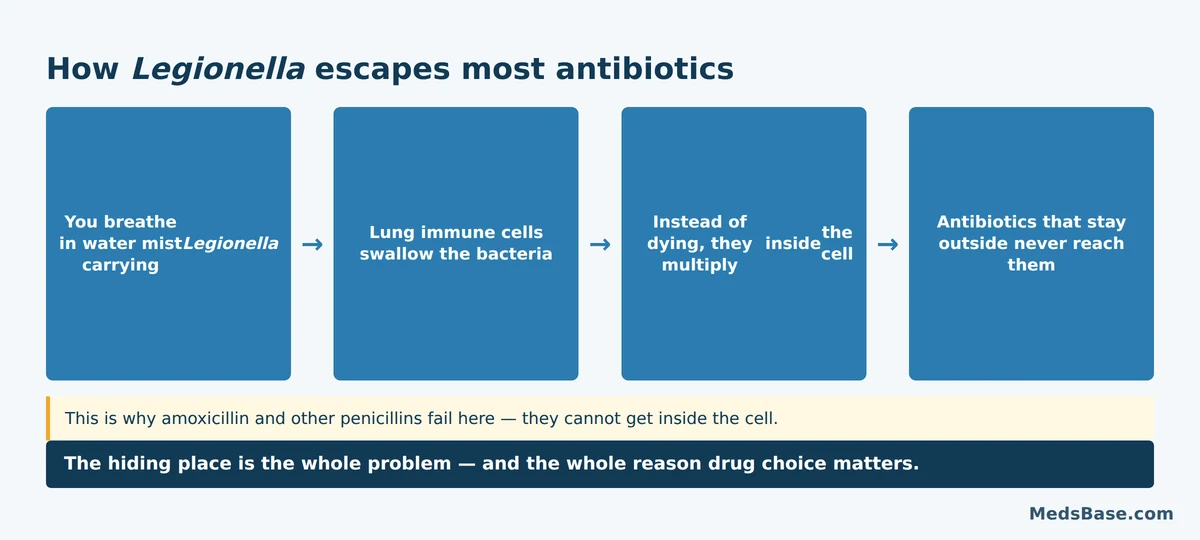
Here is where it gets interesting. Most bacteria that cause pneumonia sit in the spaces between your cells, floating in tissue fluid where a circulating antibiotic can reach them. Legionella does the opposite.
When you inhale the mist, your alveolar macrophages — the immune cells patrolling your lungs — do exactly what they are supposed to do and swallow the bacteria. Normally that is the end of the story. With Legionella, it is the beginning. The bacterium blocks the macrophage from digesting it, converts the compartment it is sitting in into a protected chamber, and multiplies inside the very cell sent to kill it.
Think of it as a burglar who gets caught by security, is escorted into the building’s safe room, and then changes the locks from the inside.
That hiding place is the entire reason drug choice matters so much here. An antibiotic can be superb against Legionella in a test tube and useless in a patient if it cannot cross the human cell membrane. Penicillins and related beta-lactams — amoxicillin, amoxicillin-clavulanate, most cephalosporins — concentrate poorly inside cells. They are excellent drugs against the usual causes of pneumonia and effectively spectators against this one.
This is not a subtle point buried in specialist literature. Microbiologists have stated it plainly for decades: many first-line antibiotics commonly used to treat typical bacterial pneumonias — beta-lactams specifically — are ineffective against Legionella species, and that is at least partly because these are intracellular pathogens. A 2026 review puts the same point from the other direction: because the bacteria live inside tissues and alveolar macrophages, an anti-Legionella drug has to accumulate and stay biologically active within your cells to do anything at all.
This also explains a pattern that frustrates patients and doctors alike. Someone develops pneumonia, is started on a standard antibiotic, and simply does not improve. Pharmacists see this often enough to have a reflex about it: a pneumonia that ignores a beta-lactam is a pneumonia worth re-examining, not just escalating blindly.
Which Antibiotics Reach It: The Legionnaires Disease Treatment Options
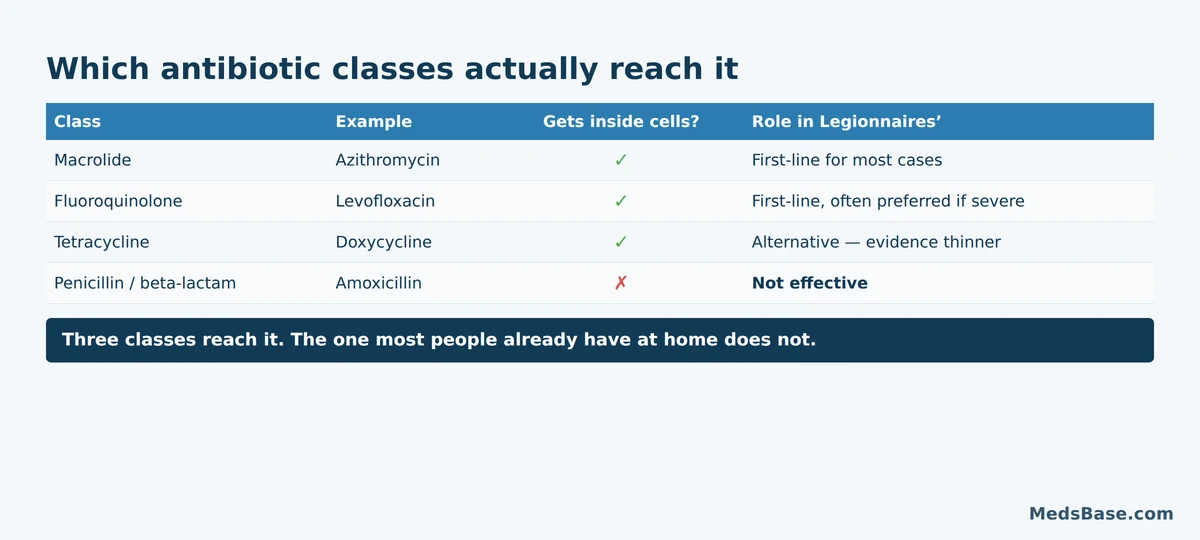
Legionnaires disease treatment rests on a single pharmacological requirement: the drug has to get inside your cells. Three classes manage it. One does not.
Macrolides — azithromycin. The default for most cases. Azithromycin concentrates strongly inside cells, including the macrophages where the bacteria are hiding, and it is convenient to take. MedlinePlus lists Legionnaires’ disease explicitly among the infections azithromycin is used to treat, alongside travellers’ diarrhoea and whooping cough. It is a macrolide antibiotic that works by stopping bacteria from growing.
Fluoroquinolones — levofloxacin. Also highly cell-penetrating, and often favoured in severe disease or in people who are immunosuppressed. It is a powerful drug with real costs, which we come to in the safety section.
Tetracyclines — doxycycline. A reasonable alternative, particularly where the other two are unsuitable, though the published evidence behind it is much thinner. A 2025 case series described three hospitalised patients treated with doxycycline monotherapy who all improved and were alive at 60 days, while noting honestly that laboratory data suggest doxycycline may be less bactericidal than fluoroquinolones and that clinical evidence overall remains sparse.
Beta-lactams — amoxicillin and relatives. Not effective. This is the one to remember.
| Class | Example | Gets inside cells? | Role in Legionnaires’ disease |
|---|---|---|---|
| Macrolide | Azithromycin | Yes | First-line for most cases |
| Fluoroquinolone | Levofloxacin | Yes | First-line, often preferred in severe illness |
| Tetracycline | Doxycycline | Yes | Alternative; evidence base thinner |
| Beta-lactam | Amoxicillin | Poorly | Not effective |
If you want a closer look at the first and third of those, we have a full breakdown of how these two antibiotics differ in mechanism, dosing and side effects.
MedsBase stocks azithromycin, levofloxacin and doxycycline, and you can see what we stock in the antibiotics category — no prescription needed to order. One honest caveat belongs right here, though: this is one of the few illnesses where buying an antibiotic and treating yourself is genuinely the wrong move. You cannot distinguish this pneumonia from the ordinary kind without a test, the course is unusually long, and severe cases need oxygen and monitoring that no medicine cabinet provides.
The Test That Misses Cases
Time to resolve the loop planted at the top. Most hospitals reach first for a urinary antigen test — fast, cheap, and results back within the hour. It is a genuinely good test with one significant limitation that patients are rarely told about.
It is mainly restricted to detecting Legionella pneumophila serogroup 1. That serogroup causes the large majority of cases, so the test earns its place. But other serogroups and other Legionella species exist, and if one of those is making you ill, your urine test can come back negative while you are thoroughly infected.
A 2026 review of global Legionella diagnosis and treatment states the position directly: culture remains the gold standard but is slow; urinary antigen testing “enables rapid screening, yet is mainly restricted to L. pneumophila serogroup 1″; and PCR-based molecular testing offers high sensitivity across multiple serogroups. That same review notes the test accounts for 70–80% of diagnoses in Europe and the United States, and can miss up to 40% of cases caused by non-serogroup-1 strains.
The pooled numbers put a figure on it. A 2022 meta-analysis of 21 studies and 5,772 patients found the urinary antigen test had a sensitivity of 79% and a specificity of 100% — rising to 86% sensitivity when the infection actually was serogroup 1 (Respiratory Investigation, PMID 34972680).
Read those two numbers together, because they pull in opposite directions. A positive result is close to conclusive: with a specificity of 100%, false alarms are vanishingly rare. A negative result is far weaker evidence, missing roughly one in five infections overall.
What this means for you is simple: a negative urine test in someone with a compatible illness and a plausible exposure is a reason to keep asking questions, not a reason to stop. If you were in an outbreak area and you have pneumonia, say so explicitly and keep saying it.
Legionnaires Disease Treatment: Side Effects, Dosing and Duration
Duration surprises people. The NHS notes that treatment usually runs one to three weeks — considerably longer than the three-to-five-day courses many people associate with antibiotics. Seriously ill patients typically start with antibiotics given straight into a vein in hospital, often alongside oxygen, then switch to tablets at home once they are improving. Most people make a full recovery, though feeling normal again can take several weeks.
| Side effect | Frequency | Severity | What to do |
|---|---|---|---|
| Nausea, stomach upset, diarrhoea (azithromycin) | Common | Mild | Take with food; keep fluids up; continue the course |
| Severe watery or bloody diarrhoea | Uncommon | Serious | Contact a doctor — do not treat it with an anti-diarrhoeal |
| Irregular or pounding heartbeat (azithromycin) | Uncommon | Serious | Seek medical advice promptly; mention any heart condition before starting |
| Tendon pain or swelling (levofloxacin) | Uncommon | Serious | Stop and seek advice — can occur months after finishing |
| Numbness, tingling, burning (levofloxacin) | Uncommon | Serious | Seek advice immediately; nerve damage may not fully resolve |
| Confusion, agitation, mood change (levofloxacin) | Uncommon | Serious | Seek advice — can occur after the very first dose |
| Sun sensitivity (doxycycline) | Common | Mild | Cover up and use sun protection |
The fluoroquinolone entries deserve emphasis rather than a footnote. Levofloxacin carries a boxed warning covering tendinitis and tendon rupture — which can develop during treatment or for several months afterwards — along with peripheral nerve damage that may not go away after stopping, effects on the brain and nervous system that can appear after the first dose, and worsening of muscle weakness in people with myasthenia gravis.
None of that makes levofloxacin the wrong drug for a severe Legionella pneumonia. It makes it a drug with a genuine trade-off, chosen deliberately for a serious infection rather than reached for casually. That distinction matters, and it is precisely why the same monograph notes the drug should not be used for simple bronchitis and certain urinary infections when other options exist.
What Does the Research Say About Legionnaires Disease Treatment?
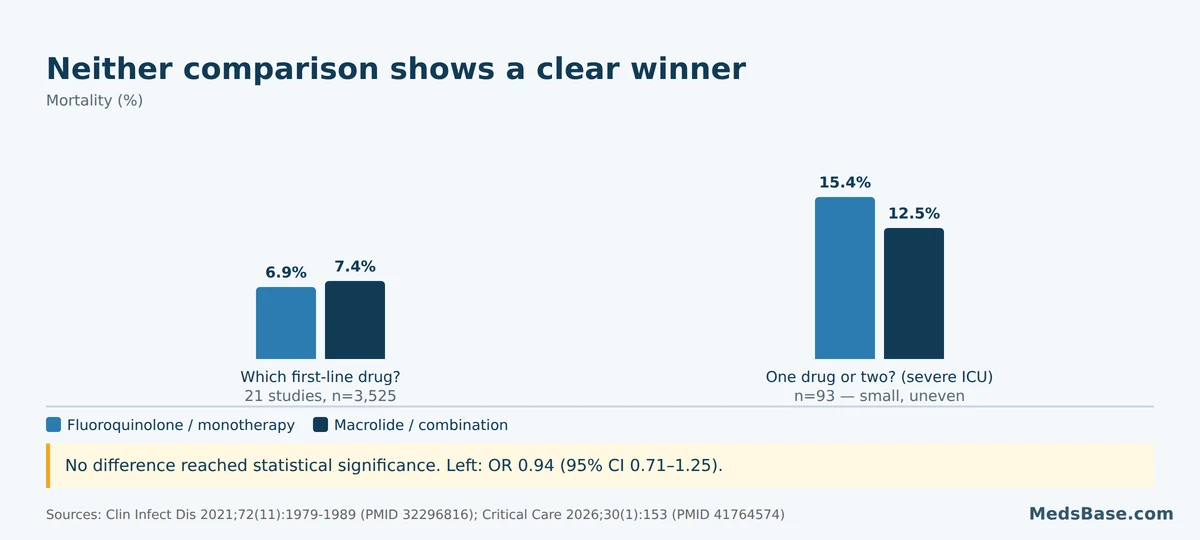
Two questions dominate the evidence on Legionnaires disease treatment: which of the two first-line drugs is better, and whether using both beats using one.
The first has a reasonably clear answer. A systematic review and meta-analysis of 21 studies covering 3,525 patients compared fluoroquinolones with macrolides and found mortality of 6.9% versus 7.4% — an odds ratio of 0.94, with a confidence interval spanning 0.71 to 1.25 and no heterogeneity between studies. Clinical cure, time for the fever to settle, length of stay and complications did not differ either.
What this means for you: if you are given azithromycin rather than levofloxacin, or the reverse, that is not a downgrade. On the evidence available, the two classes perform about equally, so the choice usually turns on your other conditions, your other medicines and local resistance patterns.
One caveat is worth stating plainly, because it is unusual: no randomised controlled trial has ever compared these two drug classes directly for this disease. Every figure above comes from pooling observational studies. An earlier 2014 meta-analysis of 879 patients did hint at a quinolone advantage, but the larger and more recent analysis found none — and where a bigger, later study contradicts a smaller, earlier one, the bigger one is usually the safer guide.
| Study | Year | Finding | Source |
|---|---|---|---|
| Meta-analysis of 21 studies, 3,525 patients | 2021 | Mortality 6.9% with fluoroquinolones vs 7.4% with macrolides — no significant difference (OR 0.94, 95% CI 0.71–1.25) | Clinical Infectious Diseases 72(11):1979–1989 (PMID 32296816) |
| Multicentre French ICU cohort, 93 patients | 2026 | 28-day mortality 15.4% with monotherapy vs 12.5% with combination — not statistically significant; 90-day mortality 23.1% vs 16.3%, also not significant | Critical Care 30(1):153 (PMID 41764574) |
| Meta-analysis of urinary antigen test accuracy, 5,772 patients | 2022 | Pooled sensitivity 79%, specificity 100%; sensitivity 86% for serogroup 1 | Respiratory Investigation 60(2):205–214 (PMID 34972680) |
| Global review of diagnosis and treatment | 2026 | Macrolides and fluoroquinolones are the mainstay; evidence supporting combination therapy “remains limited”; resistance reports increasing | Infection and Drug Resistance 19 (PMID 41983107) |
| Portuguese national surveillance isolates (n=107) | 2024 | 12 isolates showed azithromycin MICs above the EUCAST tentative wild-type threshold; 17 for levofloxacin, 7 for ciprofloxacin | Eur J Clin Microbiol Infect Dis 43(7):1297–1308 (PMID 38696083) |
| Doxycycline monotherapy case series (n=3) | 2025 | All three patients improved and survived to 60 days; authors note evidence overall remains sparse | J Pharm Technol (PMID 40901380) |
The second question — one drug or two — was tackled by a 2026 multicentre ICU study across five French hospitals, which followed 93 adults admitted to intensive care with Legionella pneumophila pneumonia. Thirteen received monotherapy, almost all a fluoroquinolone, and 80 received a combination. Neither 28-day nor 90-day mortality differed significantly, and nor did ventilation time or length of stay.
What this means for you: if you or a relative is on a single antibiotic for severe Legionella pneumonia, that is a defensible choice supported by current evidence, not a corner being cut. Read the caveats honestly, though — this was retrospective, the two groups were very unequal in size (13 versus 80), and the authors themselves call for randomised trials before anyone treats it as settled. Research suggests monotherapy may be sufficient; it has not proven it.
The resistance finding deserves the same measured reading. Elevated minimum inhibitory concentrations in surveillance isolates are an early warning signal about circulating strains, not evidence that your prescription will fail.
Legionnaires’ Disease vs Pontiac Fever: The Mild Twin
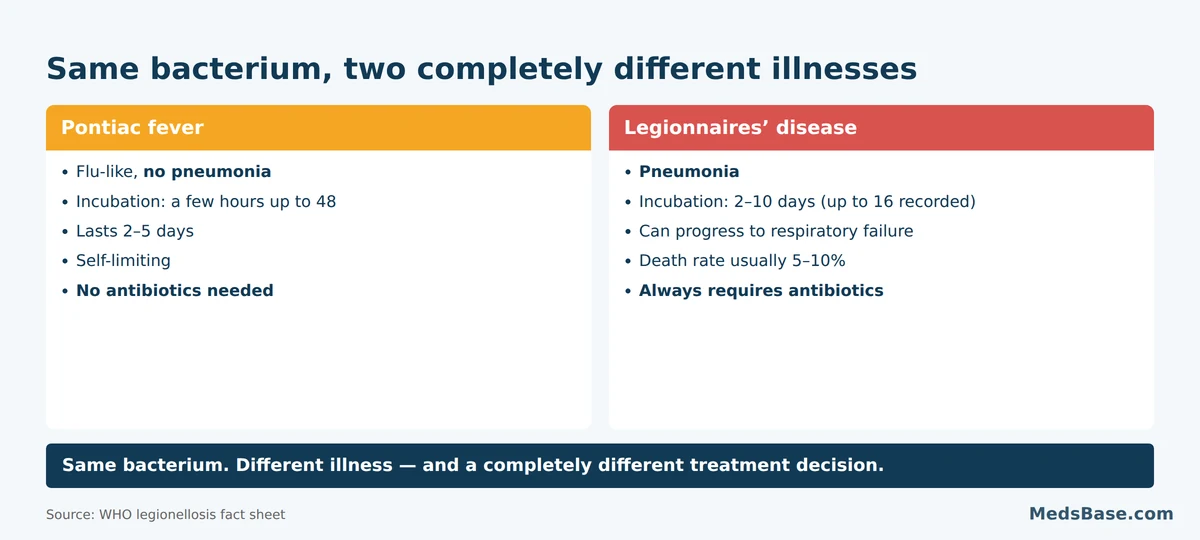
The same bacterium causes two very different illnesses, and confusing them is easy.
| Pontiac fever | Legionnaires’ disease | |
|---|---|---|
| Type of illness | Flu-like, no pneumonia | Pneumonia |
| Incubation | A few hours up to 48 | 2–10 days (up to 16 recorded in outbreaks) |
| Duration | 2–5 days | Weeks, with recovery beyond that |
| Antibiotics | Not required | Always required |
| Typical outcome | Self-limiting | Death rate usually 5–10% |
Which one fits which situation? If you were exposed to a suspect water source, felt flu-like and achy within a day, and were over it within a few days without a chest problem, that pattern fits Pontiac fever, and WHO notes it does not require medical intervention including antibiotics. If symptoms appeared several days after exposure and involve a cough, breathlessness or chest discomfort, that is the pneumonic form, and it always requires antibiotic treatment.
The practical trap is the incubation gap. Two to ten days — occasionally longer — means the exposure that made you ill may have happened before you were even aware there was an outbreak. Do not rule yourself out because you left the area last week.
What to Do If You Think You Have It
- Check the exposure question honestly. Have you spent time in a building or area with a known cluster in the last two weeks? Used a spa pool, or run a shower that had been sitting unused?
- Notice the pattern, not just the symptoms. Cough, fever, breathlessness and chest discomfort matter more in combination, and headache, muscle aches, confusion or diarrhoea alongside them raise the suspicion further.
- Seek care the same day if the picture fits. WHO names delay in diagnosis and in starting appropriate antibiotics, alongside older age and other illnesses, as predictors of death from this disease — and of those four, delay is the only one you can change. A retrospective cohort of 72 patients found that starting appropriate antibiotics within the first two days of admission was independently associated with lower mortality (odds ratio 0.16, 95% CI 0.03–0.90). It is a small study, so treat the size of the effect cautiously and the direction seriously.
- Say the word “Legionella” out loud. Tell the clinician about the exposure explicitly. It changes which test gets ordered and which antibiotic gets started.
- Ask about testing beyond the urine antigen if your exposure history is strong and the rapid test is negative.
- Finish the full course. One to three weeks is normal here. Stopping early because you feel better is the classic mistake.
- Starting leftover amoxicillin “just in case” — it does not work against this organism and delays proper care
- Treating a negative urine antigen test as an all-clear when your exposure history is strong
- Stopping antibiotics at day five because the fever broke
- Assuming you are safe because nobody you know is ill — it does not spread person to person, so clusters look scattered
- Waiting for symptoms to declare themselves over a weekend
Being prepared and being self-treating are different things. Knowing what your options are — and you can see what we stock if you want to understand the drugs involved — is useful. Deciding your own diagnosis is not.
- Our evidence-backed antibiotic guide — what actually treats what, drug by drug
- How these two antibiotics differ — azithromycin and doxycycline compared properly
- How bacterial infections are classified and treated — the wider map this disease sits inside
Frequently Asked Questions
Q: What antibiotic treats Legionnaires’ disease?
A: Macrolides such as azithromycin and fluoroquinolones such as levofloxacin are the mainstay of Legionnaires disease treatment, because both reach high concentrations inside human cells where the bacteria hide. Doxycycline is an alternative with a thinner evidence base. Penicillin-type antibiotics including amoxicillin are not effective, because they penetrate cells poorly and cannot reach the organism.
Q: Can amoxicillin treat Legionnaires’ disease?
A: No. Amoxicillin and related beta-lactams do not concentrate well inside human cells, and Legionella multiplies inside your own lung immune cells. Taking amoxicillin for this infection risks a dangerous delay while the illness progresses. If a pneumonia fails to improve on a beta-lactam, that is itself a reason to consider an atypical organism.
Q: How long does Legionnaires disease treatment last?
A: The NHS indicates Legionnaires disease treatment usually lasts one to three weeks — much longer than a typical short antibiotic course. Severe cases usually begin with intravenous antibiotics in hospital, often with oxygen support, then switch to tablets once improving. Full recovery can take several more weeks after the antibiotics finish.
Q: Is Legionnaires’ disease contagious?
A: It is not usually spread from person to person. You catch it by breathing in fine water droplets containing the bacteria — typically from cooling towers, spa pools, humidifiers or long-unused showers. This is why outbreaks cluster around buildings and water systems rather than around households, and why isolating patients is not the control measure.
Q: How quickly do you need antibiotics for Legionnaires’ disease?
A: As soon as the diagnosis is suspected. WHO notes the death rate is usually 5–10% but rises to 40–80% in untreated immunosuppressed patients, falling to 5–30% with appropriate case management — a gap that reflects how much timing matters. Do not wait for confirmatory testing before seeking care.
Q: Can you recover from Legionnaires’ disease at home?
A: Mild cases may be managed with oral antibiotics at home, but this is a decision for a clinician after testing, not a self-assessment. Many people need hospital care for intravenous antibiotics and oxygen. The milder Pontiac fever, caused by the same bacterium, does resolve on its own in two to five days without antibiotics.
Q: Does a negative urine test rule out Legionnaires’ disease?
A: Not entirely. The rapid urinary antigen test is mainly restricted to detecting Legionella pneumophila serogroup 1. That covers most cases, but infections caused by other serogroups or species can produce a negative result. With a strong exposure history and compatible pneumonia, culture or PCR testing may still be warranted.
Q: Who is most at risk of severe illness?
A: WHO lists smoking, heavy alcohol use, chronic lung disease, chronic kidney disease and immunosuppression among the factors that raise community-acquired risk, and age over 50 is consistently associated with more severe disease. Healthy younger adults do get infected, but they are more likely to recover fully with prompt treatment.
The Bottom Line
Legionnaires disease treatment comes down to one decision made correctly and quickly: the right antibiotic class, started early. Macrolides and fluoroquinolones reach the bacteria where they hide; the familiar penicillin-family drugs do not. Courses run one to three weeks, considerably longer than most people expect, and finishing them matters.
The evidence is genuinely reassuring in one respect and genuinely unsettled in another. A single antibiotic appears to do as well as two in severe disease, though the study behind that was retrospective and small. Resistance signals are appearing in surveillance data without yet changing what your doctor will prescribe. Where the picture is mixed, it is more useful to say so than to pretend otherwise.
Your one immediate action: if you have pneumonia symptoms and any plausible water-mist exposure in the past two weeks, contact a clinician today and say the word Legionella out loud. That single sentence changes which test gets ordered — and getting tested is what puts the right Legionnaires disease treatment in front of you while it still counts.
Wondering about the summer illness that looks urgent but usually needs the opposite approach — rehydration rather than antibiotics? Read our guide to the summer stomach bug that needs the opposite approach. And if you want to understand which antibiotic suits which infection more generally, our evidence-backed antibiotic guide is the natural next step.

Written by
Sophie ChenPharmaceutical Content Researcher · 8 years experience
Sophie Chen is a pharmaceutical content researcher with 8 years covering generic medication access and clinical pharmacology. She specialises in international regulatory frameworks, bioequivalence standards, and patient-facing education on therapeutic drug classes. She is not a clinician.