








✓ Medically reviewed by · Last reviewed: May 2026
Pharmacy Researcher · 8 years experience
Pharmacy researcher with 8 years reviewing clinical drug information, generic formulation equivalence, and international pharmaceutical standards. Focuses on patient-facing accuracy in medication education.
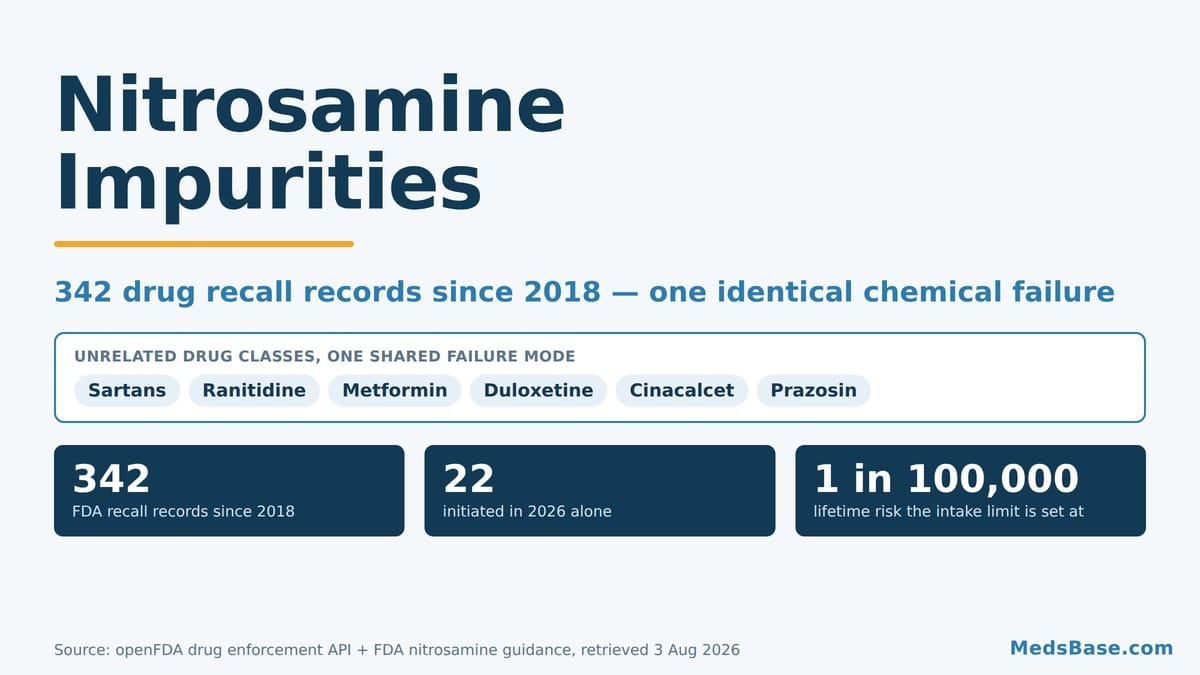
Here is a number almost nobody who takes a daily medicine has seen: the FDA’s own enforcement database holds 342 drug recall records tied to nitrosamine impurities since 2018 — and 22 of them were initiated in 2026 alone, across seven molecules that have nothing chemically in common. Duloxetine. Cinacalcet. Prazosin. Erythromycin. A blood-pressure combination. Tramadol. Furosemide.
If you have seen a headline calling one of your medicines “contaminated with a cancer-causing chemical” and quietly wondered whether to stop taking it tonight, this article is written for you. By the end you will know exactly what nitrosamine impurities are, why the same problem keeps resurfacing in unrelated drugs, and — most usefully — the two numbers that put the actual risk into proportion.
One of those numbers is genuinely reassuring, and it comes straight from the regulator. We will get to it in the safety section.
- Nitrosamine impurities are not added to medicines and not a sign of a bad manufacturer — they form from a reaction, which is why the problem reappears in drug classes that share nothing else.
- The 2019 wave of blood-pressure recalls got the headlines, but one later year in the chart below matched it almost exactly.
- The acceptable daily intake limit is set at a specific, published level of risk — and it is far smaller than the word “cancer-causing” suggests.
- Regulators give patients one clear instruction about prescription medicines affected by this, and it surprises most people.
- Not every recall means the same thing. One class of recall is genuinely urgent; the impurity recalls almost never are.
- What Are Nitrosamine Impurities?
- How Nitrosamine Impurities Get Into a Medicine
- The 2026 Recall Wave — In Real Numbers
- Which Medicines Have Been Affected
- The Cancer Risk, In Proportion
- What the Research Actually Shows
- Nitrosamine Impurities vs Other Recall Reasons
- What To Do If Your Medicine Is Affected
- Frequently Asked Questions
- The Bottom Line
What Are Nitrosamine Impurities?
Nitrosamines are not exotic. The FDA is blunt about this on its own patient page: they are common in water and in foods, including cured and grilled meats, dairy products and vegetables, and everyone is exposed to some level of them already. That single sentence reframes the whole subject. The question was never “is there any nitrosamine in my body” — the answer to that has always been yes. The question is how much, and from where.
What changed in 2018 was not the chemistry. It was the detection. Analytical methods became sensitive enough to find these compounds at the parts-per-billion level inside finished tablets, and once regulators started looking systematically, they started finding them.
The word “impurity” is doing a lot of quiet work here. An impurity is not an ingredient someone chose to add. It is a molecule that appeared where it was not wanted — and in the case of nitrosamine impurities, it usually appeared because two perfectly ordinary things met under the wrong conditions.
How Nitrosamine Impurities Get Into a Medicine
Think of it like rust. Nobody adds rust to a bridge. Rust appears whenever iron, oxygen and moisture occupy the same space for long enough. You do not prevent it by finding the person who added it — you prevent it by controlling the conditions.
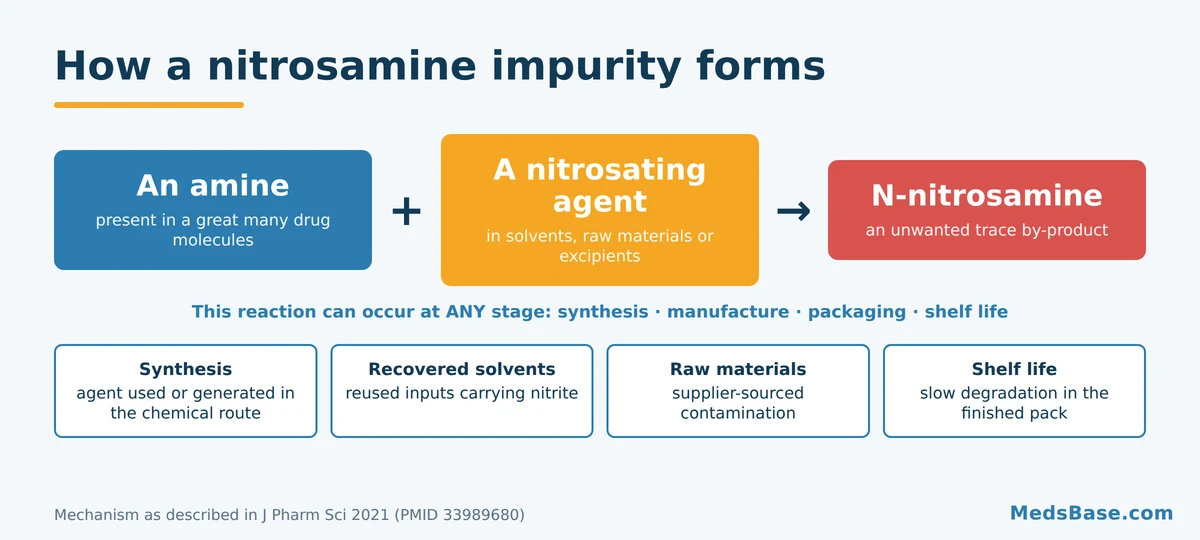
Nitrosamine impurities work the same way, and understanding that one point will do more to calm you than any reassurance. A 2021 review in the Journal of Pharmaceutical Sciences describes the mechanism in one line: these impurities may evolve if an amine reacts with a nitrosating agent coexisting under appropriate conditions — and, critically, this can happen at any stage, from the synthesis of the drug substance right through each product’s shelf life.
That last clause explains everything that follows. Because so many medicines contain an amine somewhere in their structure, and because nitrites turn up in raw materials, recovered solvents, processing aids and even some packaging, the ingredients for this reaction are scattered across the entire pharmaceutical supply chain. It is not one factory’s mistake. It is a chemical possibility that has to be actively designed out of thousands of separate manufacturing processes, one at a time.
Here is why that matters to you as a patient: it means a recall of your medicine is usually not evidence that your medicine is a poor one, or that its manufacturer is careless. It is far more often evidence that somebody tested a batch properly and reported what they found.
Four documented entry points
- Drug substance synthesis — a nitrosating agent used or generated during the chemical route.
- Recovered solvents and raw materials — reused or supplier-sourced inputs carrying nitrite contamination.
- The formulation itself — some excipients carry trace nitrites that react with the active ingredient.
- Degradation over shelf life — the impurity forms slowly in the finished pack, which is why long-dated stock is tested.
The 2026 Recall Wave — In Real Numbers
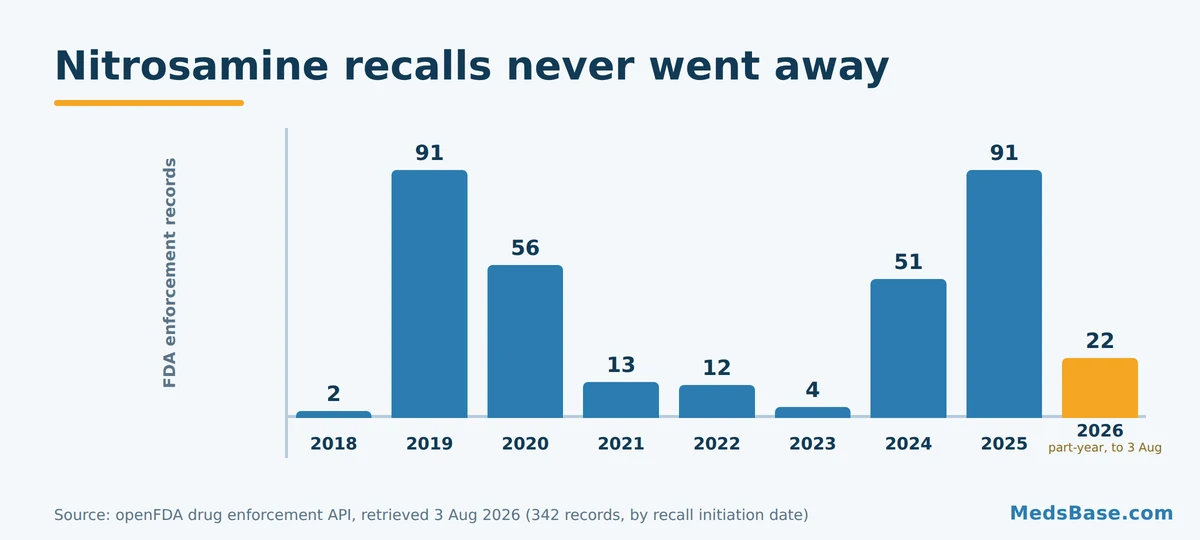
Rather than rely on how the story was reported, we queried the openFDA drug enforcement database directly on 3 August 2026 and counted every enforcement record whose stated reason involves a nitrosamine, an N-nitroso compound, NDMA or an NDSRI. Here is the full picture.
| Year recall initiated | Enforcement records | What drove it |
|---|---|---|
| 2018 | 2 | First valsartan findings |
| 2019 | 91 | The sartan wave — the year everyone remembers |
| 2020 | 56 | Ranitidine and metformin |
| 2021 | 13 | Tail of the sartan/ranitidine actions |
| 2022 | 12 | Scattered, multiple classes |
| 2023 | 4 | Quietest year on record |
| 2024 | 51 | New testing guidance takes effect |
| 2025 | 91 | Matches 2019 exactly |
| 2026 (to 3 Aug) | 22 | Duloxetine, cinacalcet, prazosin and others |
Look at 2025. It produced exactly as many recall records citing nitrosamine impurities as the famous 2019 sartan wave — 91 apiece — and almost nobody noticed, because they were spread across many molecules instead of concentrated in one headline-friendly drug class. That is the open loop from the introduction, closed: the recalls never stopped. They only stopped being a single story.
The 2023 dip to four records is worth reading correctly too. It does not mean the chemistry paused. It sits in the gap between the first round of manufacturer risk assessments and the revised FDA guidance that landed in 2023 and 2024, after which testing intensified again.
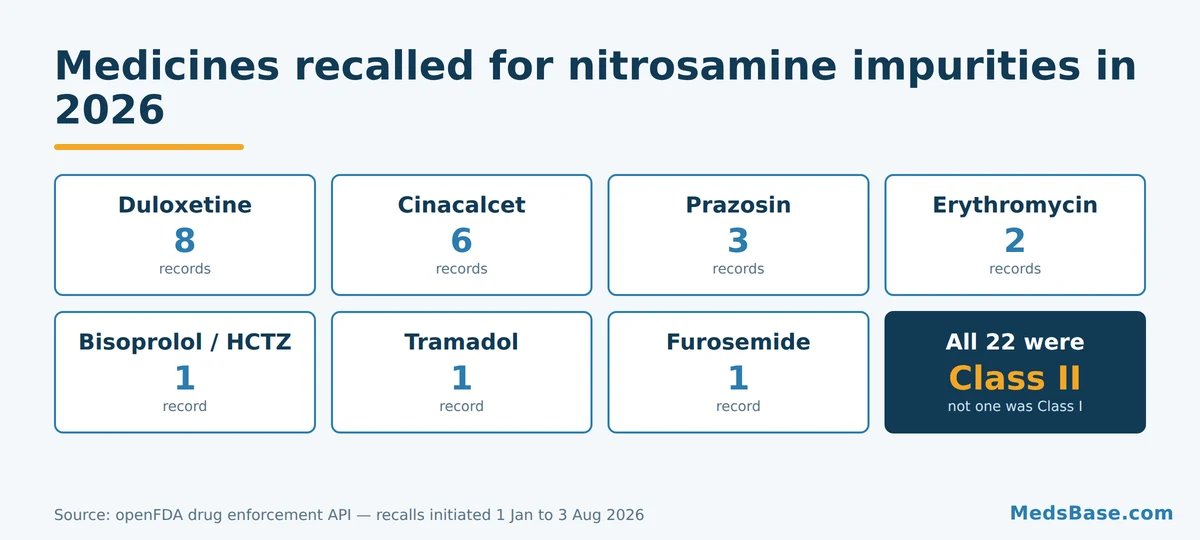
Here’s where it gets interesting. Every single one of the 22 records initiated in 2026 is a Class II recall. Not one is Class I. That distinction is not cosmetic, and we will come back to what it means for you.
Which Medicines Have Been Affected
Across the full 2018–2026 dataset, the molecules appearing most often in records citing nitrosamine impurities are duloxetine, ranitidine, metformin, cinacalcet, losartan, chlorpromazine, atomoxetine, carvedilol and prazosin. Notice the spread: an antidepressant, a heartburn drug, a diabetes drug, a calcium-regulating drug, a blood-pressure drug, an antipsychotic, an ADHD medicine, a beta-blocker and an alpha-blocker. No therapeutic pattern whatsoever.
The 2026 records break down like this:
| Molecule | 2026 records | Largest single recall in 2026 |
|---|---|---|
| Duloxetine | 8 | 359,676 bottles (60 mg, initiated 4 Jun 2026) |
| Cinacalcet | 6 | 113,336 bottles (30 mg, initiated 16 Mar 2026) |
| Prazosin | 3 | 88,008 bottles (1 mg, initiated 27 Mar 2026) |
| Erythromycin | 2 | 23,880 bottles (250 mg, initiated 29 Apr 2026) |
| Bisoprolol / hydrochlorothiazide | 1 | Quantity not stated in the record |
| Tramadol | 1 | 29,542 bottles (50 mg, initiated 19 Mar 2026) |
| Furosemide | 1 | 9,384 bottles (80 mg, initiated 20 Mar 2026) |
Two of these deserve a note.
Ranitidine is the cautionary tale everyone half-remembers. It was withdrawn from markets worldwide rather than recalled batch by batch, because the impurity appeared to increase over time and with storage temperature — a genuinely different situation from a single contaminated lot. If you were moved off it years ago and never quite understood why, that is the reason. The medicines that took over that job are a different chemical class entirely, and if you are choosing between them, our guide to the medicines that replaced ranitidine walks through how two of the most common ones differ.
Prazosin is an alpha-blocker, and its 2026 recall covered three strengths from one manufacturer — roughly 175,000 bottles combined. Alpha-blockers are widely used for blood pressure and for urinary symptoms, and if you are weighing options in that family, we compare how two alpha-blockers compare for an enlarged prostate in detail.
The Cancer Risk, In Proportion
This is the section you came for, so here is the number without preamble.
An acceptable intake limit, as regulators define it, is a level that approximates an increased cancer risk of one additional case in 100,000 people, based on a deliberately conservative assumption: daily exposure to that impurity, at that level, for a lifetime of 70 years.
Read that twice. The limit is not the point at which harm begins. It is the point at which a lifetime of daily exposure would be expected to produce one extra case per hundred thousand people — and batches are recalled when they exceed it, often by a modest margin, often after being on the market for a fraction of that 70 years.
The FDA’s patient guidance on nitrosamine impurities states the practical consequence directly: a person taking a drug containing nitrosamines at or below the acceptable daily intake limits, every day for 70 years, is not expected to have an increased risk of cancer.
That instruction is the single most important line in this article. Stopping an antidepressant abruptly, or a blood-pressure medicine, or a diabetes medicine, carries real and immediate consequences. The impurity risk is measured across 70 years. The withdrawal risk is measured in days.
Now, the honest counterweight, because this is not a subject that deserves false comfort. These limits rest on conservative modelling and animal carcinogenicity data, not on long-term human outcome trials in patients who took the affected batches. The models are designed to overestimate rather than underestimate. But “designed to be cautious” is not the same as “proven in humans,” and any source telling you otherwise is overselling.
What the Research Actually Shows
Only one of the medicines affected by nitrosamine impurities has been studied at scale for real-world cancer outcomes, and the finding is worth knowing.
| Study | Year | Design | Finding |
|---|---|---|---|
| Korean National Health Insurance cohort | 2022 | 25,360 propensity-matched patients, ranitidine vs other H2 blockers | No association with overall cancer risk: adjusted hazard ratio 0.98 (95% CI 0.81–1.20) |
| Same cohort, dose analysis | 2022 | Cumulative exposure gradient | Higher cumulative ranitidine exposure did not increase cancer risk |
| J Pharm Sci mechanistic review | 2021 | Narrative review of formation routes | Impurities can form at any stage from synthesis through shelf life |
| FDA guidance, revised | 2024 | Regulatory framework | Acceptable intake limits set at ~1 extra case per 100,000 over 70 years |
A Korean national cohort of 25,360 patients compared people who took ranitidine — the drug at the centre of the NDMA story — against people who took other H2 blockers, using national insurance data. Cancer incidence was 2.9 per 1,000 person-years in ranitidine users versus 3.0 in the comparison group. The adjusted hazard ratio for all cancers was 0.98, with a confidence interval spanning 0.81 to 1.20 — which is a statistician’s way of saying no signal was found.
What this means for you: the one large real-world dataset we have on the most heavily publicised nitrosamine impurities case found no measurable increase in cancer. The authors themselves flag the limitation honestly — the follow-up period may be too short for cancers that take decades to appear — and that caveat should travel with the finding. But it is meaningfully more reassuring than the headlines were.
Where the evidence is genuinely thin: nobody has run the equivalent study for duloxetine, cinacalcet or prazosin, and it is unlikely anybody will. The exposures are smaller, more recent and harder to isolate. For those medicines, the honest answer is that the risk is modelled rather than measured.
Nitrosamine Impurities vs Other Recall Reasons
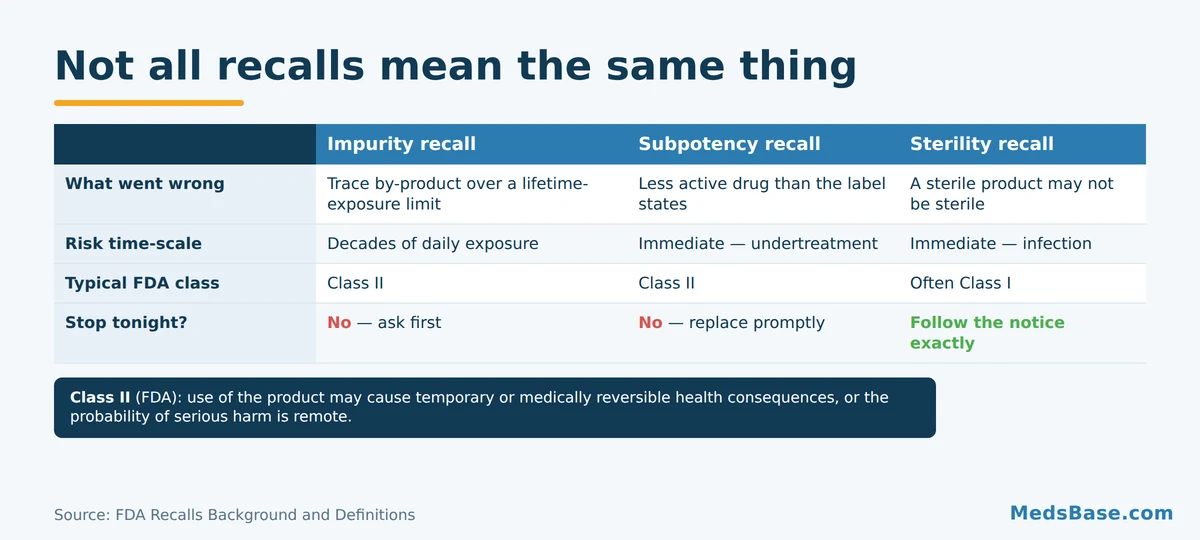
Not every recall carries the same urgency, and conflating them is the fastest route to unnecessary panic. How the FDA defines each recall class makes the distinction precise.
| Impurity recall (nitrosamines) | Subpotency recall | Sterility or contamination recall | |
|---|---|---|---|
| What went wrong | A trace by-product exceeded a lifetime-exposure limit | The product contains less active drug than labelled | A product that must be sterile may not be |
| Time-scale of the risk | Decades of daily exposure | Immediate — the condition goes undertreated | Immediate — infection risk |
| Typical FDA class | Class II | Class II | Often Class I |
| Should you stop tonight? | No — speak to a professional first | No, but get a replacement promptly | Follow the notice exactly, usually stop at once |
Nitrosamine impurities have, so far, landed almost exclusively in the middle tier. A Class II recall, in the FDA’s own words, is a situation in which use of the product may cause temporary or medically reversible adverse health consequences, or where the probability of serious harm is remote. A Class I recall is the serious one: a reasonable probability of serious harm or death.
Every one of the 22 nitrosamine recalls initiated in 2026 was Class II. Not one was Class I. When you next see one of these stories, that is the first thing worth checking — and it is usually stated in the notice itself.
Which one fits your situation? If your notice says Class II and mentions an impurity, you have time: finish the conversation with your pharmacist before you change anything. If it says Class I, or mentions sterility or a wrong-drug error, treat it as urgent and follow the notice to the letter. Recalls of the sterility type do happen in ordinary products — what happened with prednisolone eye drops is a clear worked example of that second kind.
What To Do If Your Medicine Is Affected
Four steps, in order. The detail behind each one lives in our dedicated guide, so this is deliberately brief.
- Find the lot number, printed on the bottle or the carton — not the drug name. Recalls are almost always lot-specific, and most people taking a “recalled” medicine are holding a lot that was never recalled.
- Check that lot against the actual notice, not against a news headline. Headlines name molecules; notices name lots.
- Call your pharmacy before you stop anything. A pharmacist can very often dispense the same medicine from an unaffected lot, which resolves the problem entirely without changing your treatment.
- If no unaffected lot is available, ask your prescriber about an alternative within the same class rather than going without.
The full procedural version — including what to do with the tablets you already have and how to check a lot number you cannot read — is in our guide to the seven steps to take when your medicine is recalled.
A note from the pharmacy side of the counter. Pharmacists see the same pattern every time one of these stories breaks: a queue of worried people, most of whom are holding stock that was never part of the recall, and a smaller number who have already stopped taking something they needed. The second group is the one that concerns clinicians. If you take only one thing from this article, make it the sequence — check, ask, then act.
If your medicine is one that no longer has a supply you can rely on, and you need to look at what else exists in the same class, you can browse blood-pressure medication options — the sartan family that started this whole story sits in that category, alongside several unrelated classes. MedsBase supplies from WHO-GMP-certified manufacturers and no prescription is needed to order, but the decision about which class suits you is a clinical one worth having with a professional first.
One last practical point: keep the recall notice itself, or a photo of it. If you later need to discuss your exposure to nitrosamine impurities with a clinician, the lot number and the dates you took that lot are the only two facts that matter, and they are almost impossible to reconstruct from memory a year later.
- The seven steps to take when your medicine is recalled — the procedural companion to this article.
- What happened with prednisolone eye drops — a worked example of the other kind of recall.
- The medicines that replaced ranitidine — where the acid-reflux story went after the withdrawal.
Frequently Asked Questions
Q: What are nitrosamine impurities in medications?
A: They are trace chemical by-products that can form inside a medicine when an amine group reacts with a nitrosating agent. They are not deliberate ingredients. Several nitrosamines are classified as probable human carcinogens at sustained high exposure, so regulators set acceptable daily intake limits and recall batches that exceed them. Nitrosamines also occur naturally in water and in foods such as cured meats, dairy and vegetables, so nobody has zero exposure.
Q: Should I stop taking a recalled medication?
A: No — not before speaking to a pharmacist or prescriber. Regulators state plainly that patients taking prescription medicines with potential nitrosamine impurities should not stop taking them. The impurity risk is modelled across 70 years of daily exposure, while the risk of an untreated condition or an abrupt withdrawal is immediate. Check your lot number first: most people holding a “recalled” medicine have a lot that was never recalled.
Q: How dangerous are nitrosamine impurities in drugs?
A: Less dangerous than the phrase “cancer-causing chemical” implies, though not zero. Acceptable intake limits are set at a level approximating one additional cancer case per 100,000 people after 70 years of daily exposure. Recalls happen when a batch exceeds that limit, not when harm has occurred. The largest real-world study to date, covering 25,360 patients who took ranitidine, found no increase in overall cancer risk.
Q: Why do nitrosamine recalls keep happening?
A: Because the impurity forms from a reaction rather than being added, and the ingredients for that reaction — an amine and a nitrosating agent — are common across the pharmaceutical supply chain. It can happen during synthesis, from recovered solvents, from raw materials, from the formulation itself, or by slow degradation on the shelf. Every manufacturing process has to be assessed separately, which is why the recalls arrive in waves rather than ending at once.
Q: Is my generic medication safe?
A: The recall data does not support a general “generics are riskier” conclusion. The molecules appearing most often in nitrosamine records include products from large, long-established manufacturers, and a recall is frequently evidence that a company tested rigorously and reported what it found. What matters more than generic-versus-brand is whether your specific lot appears on a notice, and whether your medicine comes from a manufacturer working to recognised standards such as WHO-GMP certification.
Q: What does a Class II recall mean?
A: A Class II recall is one where using the product may cause temporary or medically reversible health consequences, or where the probability of serious harm is remote. It is the middle tier. Class I is the serious one — a reasonable probability of serious harm or death — and Class III covers violations unlikely to cause harm at all. Every nitrosamine recall initiated in 2026 has been Class II.
Q: How do I know if my specific pills are affected?
A: By the lot number, which is printed on the bottle label or the outer carton, usually near the expiry date. Recall notices list specific lots, not every pack of the medicine ever made. If the lot on your bottle is not on the notice, your medicine is not part of that recall. If you cannot read or find the lot number, your pharmacy can identify it from the dispensing record.
Q: Does cooking or diet expose me to nitrosamines too?
A: Yes. Regulators note that nitrosamines are common in water and in foods including cured and grilled meats, dairy products and vegetables, and that everyone carries some level of exposure. That background exposure is precisely why intake limits for medicines are set so conservatively — the medicine is only one contributor, and the limit is calculated to keep its share very small over a lifetime.
The Bottom Line on Nitrosamine Impurities
Nitrosamine impurities are a real manufacturing problem that regulators are right to police, and they are also one of the most over-frightening stories in modern medicine. The chemistry means they will keep appearing — 342 recall records since 2018, 91 in 2019, 91 again in 2025, and 22 so far in 2026 — because a reaction that can happen at any stage of a medicine’s life cannot be solved once and closed. What can be solved, one process at a time, is the conditions that let it happen, which is exactly what the last eight years of testing have been doing.
Set against that, the risk framing is genuinely proportionate. A limit calibrated to one extra case per 100,000 people over 70 years of daily exposure is not a threshold of harm — it is a wide margin of caution. And the one large human study we have found no measurable increase in cancer.
Your immediate action: find the lot number on the medicine you are worried about and check it against the actual recall notice rather than the headline. That single step resolves the question for most people in under five minutes.
Wondering what to do once you have confirmed your lot is on the list? Read our step-by-step guide to the seven steps to take when your medicine is recalled. And if the recall has left you weighing a switch within the acid-reflux family, the medicines that replaced ranitidine covers the two options most people are choosing between.

Written by
Sophie ChenPharmaceutical Content Researcher · 8 years experience
Sophie Chen is a pharmaceutical content researcher with 8 years covering generic medication access and clinical pharmacology. She specialises in international regulatory frameworks, bioequivalence standards, and patient-facing education on therapeutic drug classes. She is not a clinician.