








✓ Medically reviewed by · Last reviewed: May 2026
Pharmacy Researcher · 8 years experience
Pharmacy researcher with 8 years reviewing clinical drug information, generic formulation equivalence, and international pharmaceutical standards. Focuses on patient-facing accuracy in medication education.
You reach for your eye drops, and a news alert stops you cold: millions of bottles recalled. Your first instinct is to throw yours in the bin. Hold on — that could be the wrong move.
Prednisolone eye drops do a specific, important job, and stopping a steroid drop abruptly can let the very inflammation it was controlling come roaring back. So before you do anything, you need three things: what these drops actually treat, what this particular recall means, and the exact steps that keep your eyes safe. By the end of this guide you’ll have all three — plus the one safety detail about steroid drops that surprises almost everyone (we’ll get to eye pressure in the safety section).
Here’s the reassuring headline first: as of the recall notices, no injuries had been reported in connection with the affected bottles. This is a precaution, not an emergency. Now let’s make sure you handle it calmly and correctly.
- Prednisolone eye drops treat inflammation — but the reason they’re prescribed changes how urgently you need a replacement.
- The 2026 recall is Class II — a specific classification that tells you exactly how worried to be (less than you’d think).
- Never stop a steroid eye drop cold-turkey — one common panic reaction can trigger a rebound flare.
- One side effect of longer courses catches patients off guard, and it has nothing to do with your vision blurring.
- There are non-recalled alternatives with the identical active ingredient — you’re not out of options.
What Are Prednisolone Eye Drops?
Prednisolone eye drops are a topical corticosteroid — most often prednisolone acetate 1% — that reduces irritation, redness, burning and swelling inside the eye. Doctors reach for them when inflammation is strong enough that a milder drop won’t cut it, such as after eye surgery or during a flare of uveitis.
Think of your eye as a sealed, pressurised chamber that reacts fiercely to injury or immune triggers. When it inflames, the tissue swells, blood vessels leak, and you feel pain and light sensitivity. Prednisolone is one of the most effective tools for switching that reaction off at the source.
Prednisolone acetate is a “high-potency” steroid, which is exactly why it works so well — and exactly why it needs respect. It comes as a suspension (the reason many bottles say shake well), a solution, and occasionally an ointment. According to MedlinePlus prednisolone ophthalmic guidance, it’s used for inflammation caused by chemicals, heat, radiation, infection, allergy, or a foreign object — and following eye surgery.
Here’s where it gets practical: because these are steroid eye drops, they are not a “use whenever your eye feels tired” product. They’re a targeted, time-limited treatment. That single fact shapes everything else in this guide.
How Do Steroid Eye Drops Work?
Imagine inflammation as a fire alarm that won’t stop ringing. Even after the smoke clears, the alarm keeps blaring, and the noise itself starts causing damage. Corticosteroid eye drops press the mute button on that alarm.
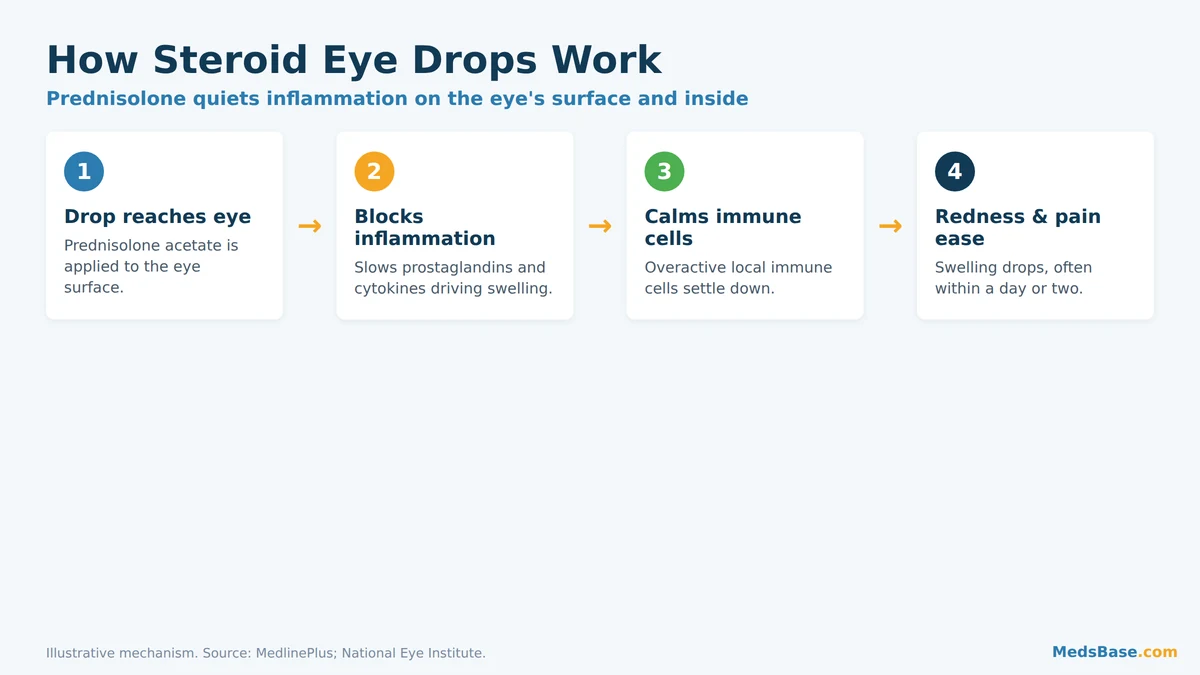
At a cellular level, prednisolone slows the production of inflammatory chemicals (prostaglandins and cytokines) and calms overactive immune cells in the eye tissue. The swelling drops, the redness fades, and the pain eases — often within a day or two of starting.
That potency is the whole point — and the whole caution. A drug powerful enough to shut down eye inflammation fast is also powerful enough to cause problems if it’s used too long or without monitoring. Which brings us to the interesting part: the same strength that heals your eye can quietly raise the pressure inside it. We’ll resolve that open loop in the safety section.
Key Uses & Applications of Prednisolone Eye Drops
Why you were prescribed these drops matters enormously right now — because it determines how quickly you need a replacement if your bottle is recalled.
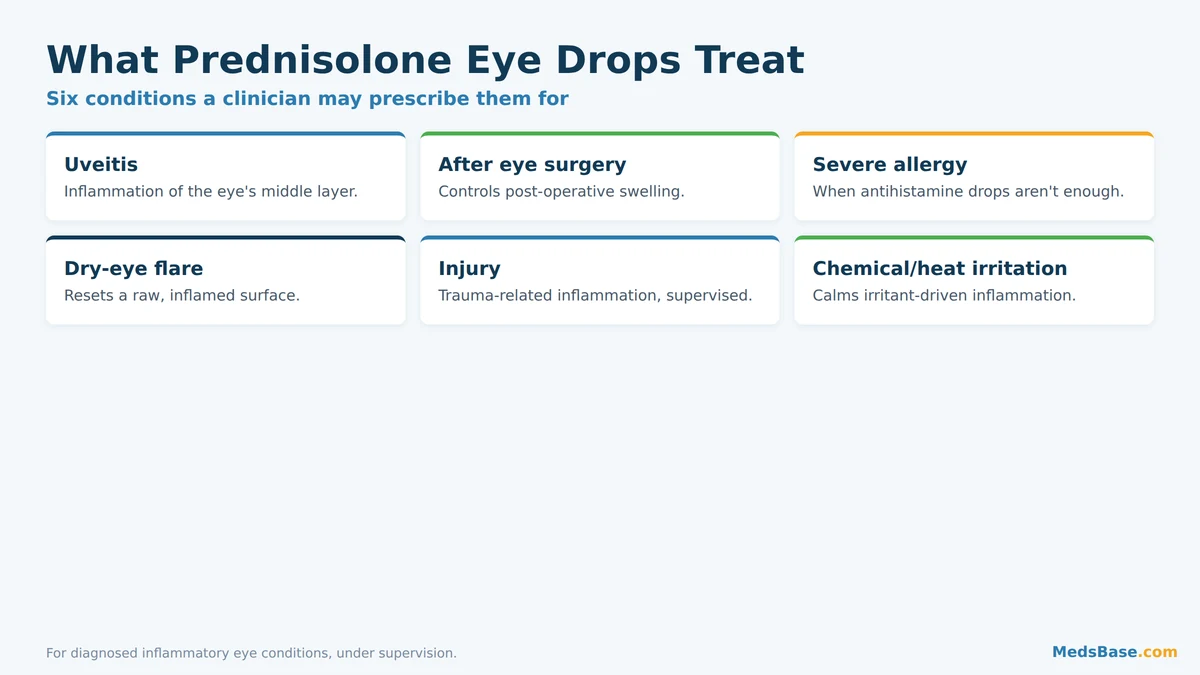
Uveitis and inner-eye inflammation
Uveitis is inflammation of the uvea, the eye’s middle layer, and it can threaten vision if untreated. Per the National Eye Institute’s overview of uveitis, steroid drops are a first-line treatment for the anterior (front) form. If prednisolone is controlling active uveitis, a missed few days is not trivial — call your prescriber promptly.
After eye surgery
Following cataract or other eye surgery, prednisolone controls the expected post-operative inflammation so the eye heals cleanly. Skipping doses here can slow recovery.
Severe allergic conjunctivitis and dry-eye flares
When ordinary antihistamine drops fail against a fierce seasonal allergy, or a dry-eye flare turns the surface raw, a short steroid course can reset the surface. (For flares specifically, some clinicians prefer a “soft” steroid — more on that in the comparison section.)
Injury, chemical or heat irritation
As MedlinePlus notes on uveitis and ocular inflammation, inflammation from trauma or irritants may also warrant steroid drops under supervision.
If you need a non-recalled bottle of the same medicine, MedsBase stocks a non-recalled prednisolone acetate 1% option — but read the safety and how-to sections below first, because a steroid drop is only as safe as the way you use it.
The Recall: What “Class II” Actually Means
Here’s where it gets reassuring once you understand the vocabulary. In mid-2026, the manufacturer Lupin voluntarily recalled more than 2.5 million bottles (2,530,182 in total) of prednisolone acetate ophthalmic suspension 1% after possible foreign material was found in certain lots. The recall was initiated on 4 June 2026, and the FDA designated it a Class II recall on 30 June 2026.
So what does that classification mean for you? The FDA sorts recalls into three tiers, explained on how the FDA classifies recalls:
| Recall class | What it means | How worried to be |
|---|---|---|
| Class I | Reasonable chance of serious harm or death | High — act immediately |
| Class II | May cause temporary or reversible harm; serious harm unlikely | Moderate — check and replace, don’t panic |
| Class III | Unlikely to cause harm; a labelling or quality issue | Low |
A Class II eye drop recall sits in the middle: worth acting on, but not an emergency. Critically, at the time of the notice there were no reported adverse events tied to the affected bottles. The recall is the system working before anyone got hurt.
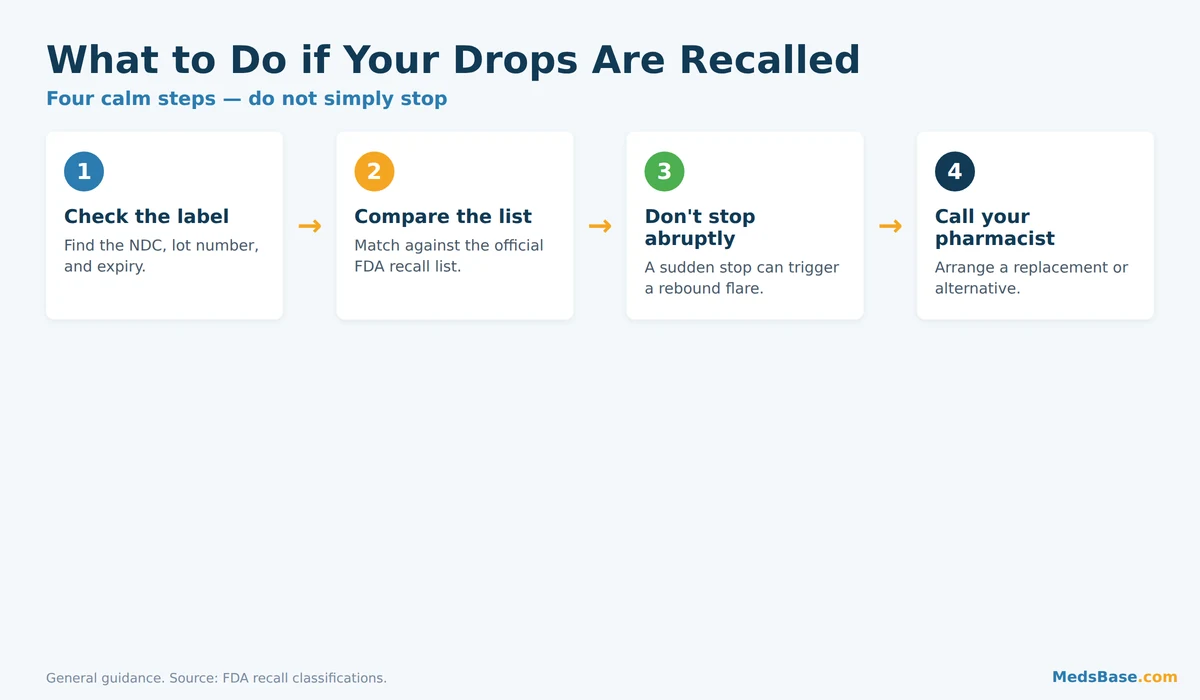
- Find your bottle’s details. Check the NDC number, lot number, and expiration date on the box and label.
- Compare them against the official list on FDA’s recalls and safety alerts page, or ask your pharmacist to check for you.
- Don’t stop abruptly. If your bottle is affected, do not simply quit — a sudden stop can trigger a rebound flare of the inflammation you were treating.
- Call your pharmacist or eye doctor to arrange a replacement or an alternative. This is the single most important step.
One bolded takeaway: a recall notice is a prompt to verify and replace — not a signal to abandon treatment your eye still needs.
If your bottle is affected, resist two temptations: don’t dig an old, expired bottle out of the cabinet to “bridge the gap,” and don’t borrow someone else’s steroid drops. Expired or shared eye drops carry their own contamination risk, which defeats the entire point of a safety recall.
Prednisolone Eye Drops: Safety Profile, Side Effects & the Eye-Pressure Detail
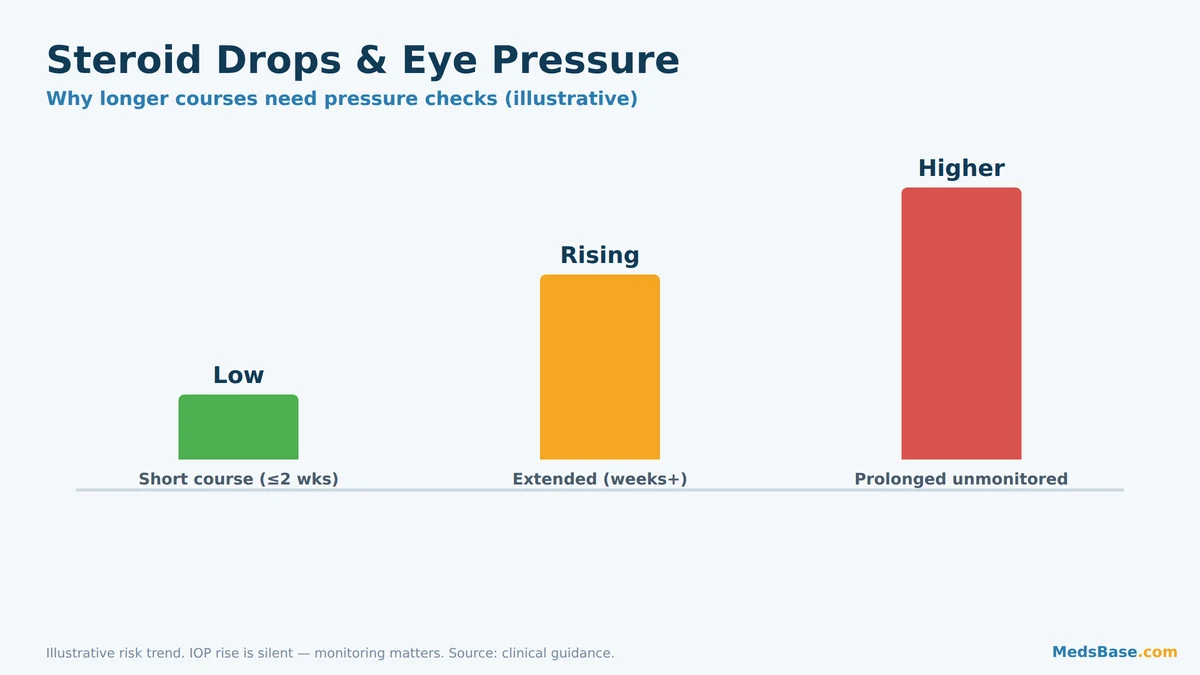
Now we resolve the open loop. The side effect that surprises people most isn’t blurry vision or stinging — it’s this: prednisolone and other steroid eye drops can raise the pressure inside your eye (IOP), and you usually can’t feel it happening.
That’s why clinicians monitor eye pressure when a steroid drop is used beyond about two weeks. In people prone to it (“steroid responders”), pressure can climb enough to risk the optic nerve — the same mechanism behind glaucoma. It’s silent, it’s reversible if caught early, and it’s the entire reason steroid drops are meant to be time-limited and supervised.
Here’s the honest side-effect picture:
| Side effect | Frequency | Severity | What to do |
|---|---|---|---|
| Temporary burning/stinging on instilling | Common | Mild | Usually settles in seconds; no action |
| Blurred vision right after a drop | Common | Mild | Wait a minute before driving/reading |
| Raised eye pressure (IOP) | Uncommon–occasional (higher with long use) | Potentially serious | Requires pressure checks; tell your doctor |
| Worsening/masked eye infection | Uncommon | Serious | Stop and seek care if pain/discharge worsens |
| Cataract formation (prolonged use) | With long-term use | Serious | Reserved for supervised long courses |
| Eye pain, halos, marked vision change | Rare | Serious | Seek medical attention promptly |
Per MedlinePlus prednisolone ophthalmic guidance, any eye pain while using these drops warrants prompt medical attention, and you should tell your doctor if you have glaucoma or diabetes before starting.
The takeaway isn’t fear — it’s respect. Used for the right reason, for the right length of time, with the right check-ups, steroid eye drops are safe and often vision-saving. The danger comes from open-ended, unsupervised use. If you want to understand the pressure side of the equation more deeply, our guide to the best glaucoma eye drops explains how eye pressure is lowered when it does climb.
What Does the Research Say?
The evidence base for topical corticosteroids in eye inflammation is decades deep and consistent. Here’s a snapshot of what reputable sources establish:
| Source | Focus | What it establishes |
|---|---|---|
| MedlinePlus (NIH) | Prednisolone ophthalmic | Effective for a broad range of ocular inflammation; requires monitoring for pressure and infection |
| National Eye Institute (NIH) | Uveitis | Steroid drops are first-line for anterior uveitis; treatment aims to prevent vision loss |
| MedlinePlus encyclopedia (NIH) | Uveitis / ocular inflammation | Steroid drops + pupil-dilating drops relieve anterior inflammation; posterior forms often need oral therapy |
| FDA | Recall classification | Class II = temporary/reversible harm possible, serious harm unlikely |
What this means for you: the medicine itself is well-established and trusted. The current story is about manufacturing quality control on one product line, not about whether prednisolone works. Research suggests the benefit-to-risk balance stays firmly positive when these drops are used as directed and monitored — the recall doesn’t change that.
Prednisolone Eye Drops vs Other Anti-Inflammatory Drops
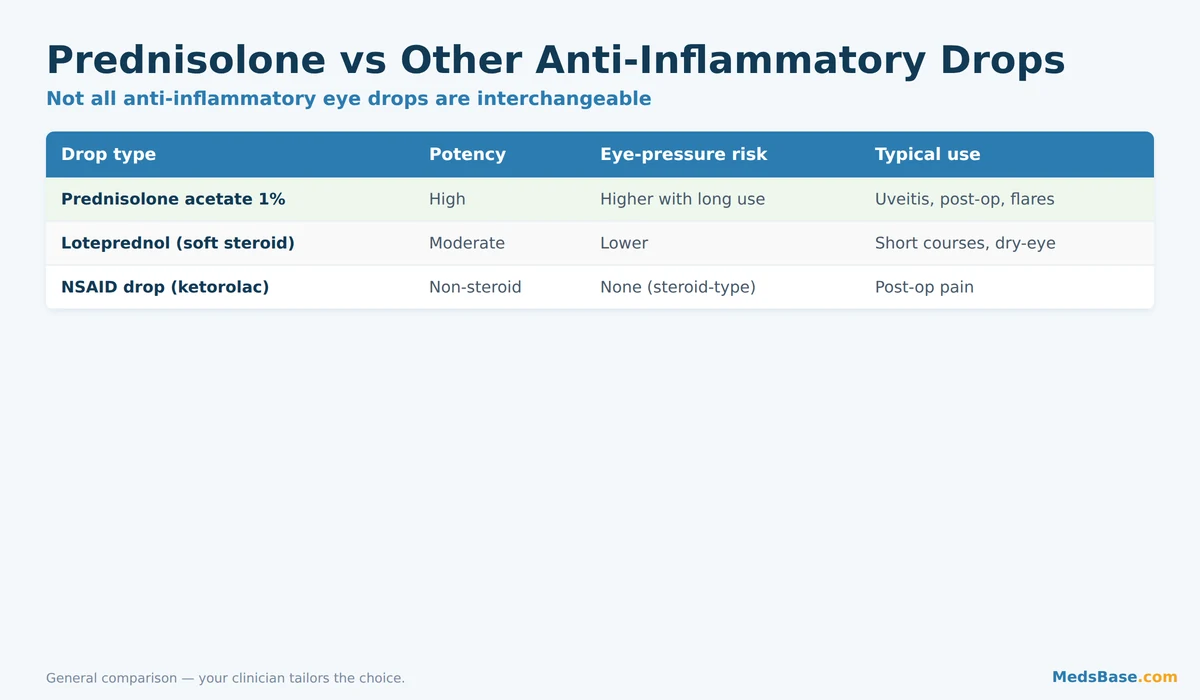
Not all anti-inflammatory eye drops are interchangeable, and knowing the differences helps you have a smarter conversation about a replacement.
| Drop type | Example | Potency | Eye-pressure risk | Typical use |
|---|---|---|---|---|
| Strong steroid | Prednisolone acetate 1% | High | Higher with long use | Uveitis, post-op, severe flares |
| “Soft” steroid | Loteprednol | Moderate | Lower | Short courses, dry-eye flares |
| NSAID drop | Ketorolac, bromfenac | Non-steroid | None (steroid-type) | Post-op pain, some inflammation |
Which one fits which situation? If you’re controlling active uveitis or healing after surgery, the strong steroid was likely chosen deliberately — a “softer” option may not be potent enough, so ask before switching. If your prescription was for a short dry-eye flare, a soft steroid such as the one covered in our how a short-term steroid drop like Eysuvis works guide is often designed for exactly that scenario, with a gentler pressure profile.
The point isn’t to self-substitute — it’s to arrive at your pharmacy knowing the right question to ask.
How to Use Prednisolone Eye Drops — Practical Guidance
Getting the technique right matters more than most people realise. Here’s the pharmacist-approved sequence:
- Wash your hands. A steroid slightly lowers the eye’s defences, so clean hands matter more than usual.
- Shake the bottle (for suspensions) so the dose is even.
- Tilt your head back, pull down the lower lid to make a pocket, and look up.
- Instill one drop without letting the tip touch your eye, lashes, or fingers.
- Close your eye gently for 2–3 minutes and press lightly on the inner corner (near your nose). This “punctal occlusion” keeps the drop on your eye and reduces how much drains into your body.
- Wait ~5 minutes before any other eye drop.
- Skipping the shake (weak early doses, over-strong late ones).
- Touching the dropper tip to your eye (contamination risk).
- Using the drops longer than prescribed “just in case” — this is where the eye-pressure risk grows.
- Stopping abruptly when you feel better; taper only as directed.
- Wearing soft contact lenses during treatment unless your clinician says it’s fine.
If you need to replace a recalled bottle or explore supervised options, you can browse our full eye-care range — but bring your prescriber into the loop so eye pressure stays monitored.
How to store and handle your drops safely
A recall over foreign material is a useful reminder that eye drops are sterile products, and how you store and handle them matters as much as how you instil them. A few habits protect you:
- Keep the cap on and the tip untouched. The dropper tip is the most common contamination point — never let it touch your eye, lashes, fingers, or any surface.
- Store as the label directs. Some suspensions prefer room temperature; others tolerate refrigeration (which can also make a cold drop easier to feel going in). Avoid hot places like a car dashboard.
- Mind the discard date. Many eye drops should be discarded a set number of weeks after opening, even if liquid remains — bacteria can grow in an opened bottle over time.
- One bottle, one person. Sharing eye medication spreads infection, full stop.
- Inspect before you dose. If a normally clear or uniformly milky drop looks off — visible particles, discolouration, clumping — don’t use it. That habit is exactly what a foreign-material recall is designed to reinforce.
- How the best glaucoma eye drops lower eye pressure
- How a short-term steroid drop for dry-eye flares works
- How prescription drops for eye pressure compare
- Medication-safety companion reads (publishing alongside this guide): managing Ozempic nausea and choosing between ezetimibe vs statins — .
Frequently Asked Questions
Q: Are prednisolone eye drops recalled?
A: One brand is. In 2026 the FDA classified a Class II recall of more than 2.5 million bottles of prednisolone acetate 1% ophthalmic suspension from Lupin over possible foreign material (initiated 4 June, classified Class II 30 June). Not every prednisolone product is affected — check your bottle’s NDC and lot number against the official recall list, or ask your pharmacist.
Q: What do prednisolone eye drops treat?
A: They treat inflammation in and on the eye — uveitis, post-surgical swelling, severe allergic conjunctivitis, dry-eye flares, and irritation from injury or chemicals. Because prednisolone acetate is a high-potency corticosteroid, it’s reserved for inflammation that milder drops can’t control.
Q: Can steroid eye drops raise eye pressure?
A: Yes. Raised intraocular pressure is the key reason clinicians monitor longer courses of steroid eye drops. It’s usually silent, more likely with prolonged use, and often reversible if caught early — which is why these drops are meant to be time-limited and supervised.
Q: What should I do if my eye drops are recalled?
A: Don’t stop abruptly. Check your bottle’s details against the recall list, keep using your current bottle only if it’s confirmed unaffected, and call your pharmacist or eye doctor to arrange a replacement or alternative. Stopping a steroid suddenly can trigger a rebound flare.
Q: How long can you use prednisolone eye drops?
A: Only as long as your clinician directs — often days to a couple of weeks, sometimes longer with monitoring. Prolonged use raises the risk of eye-pressure elevation and, rarely, cataract, so open-ended use is discouraged without check-ups.
Q: What does a Class II recall mean?
A: A Class II recall means the product may cause temporary or reversible health effects, and serious harm is unlikely. It’s a genuine reason to check and replace your product, but it is not the emergency-level Class I designation.
The Bottom Line
Prednisolone eye drops remain a trusted, effective treatment for eye inflammation — the 2026 recall is a manufacturing-quality precaution on one product line, classified as Class II with no reported injuries, not a verdict on the medicine itself.
Your one immediate action: check your bottle’s lot number against the recall list, and if it matches, call your pharmacist before your next dose — don’t just stop. That single step protects both your eyes and your treatment.
Still weighing your options? If eye pressure is your main worry, read how the best glaucoma eye drops lower it. If your drops were for a dry-eye flare, see how a short-term steroid alternative works so you can ask your pharmacist the right question next time.

Written by
Sophie ChenPharmaceutical Content Researcher · 8 years experience
Sophie Chen is a pharmaceutical content researcher with 8 years covering generic medication access and clinical pharmacology. She specialises in international regulatory frameworks, bioequivalence standards, and patient-facing education on therapeutic drug classes. She is not a clinician.