








✓ Medically reviewed by · Last reviewed: May 2026
Pharmacy Researcher · 8 years experience
Pharmacy researcher with 8 years reviewing clinical drug information, generic formulation equivalence, and international pharmaceutical standards. Focuses on patient-facing accuracy in medication education.
You’ve been taking ibuprofen for six months. Sometimes paracetamol as well. The burning along the sole of your foot, or the electric jolt down the back of your leg, has not shifted at all — and somewhere along the way you’ve started to wonder whether you’re imagining how bad it is. You are not. Effective neuropathic pain treatment looks almost nothing like treatment for ordinary pain, and the drugs you have been taking were never going to work.
That is not a figure of speech. A Cochrane review looked for evidence that oral anti-inflammatories help nerve pain and found essentially none — we’ll look at exactly what it found in a moment.
By the end of this article you’ll know why the usual painkillers fail on this kind of pain, which seven treatment classes actually have evidence behind them, how well each one works in real numbers rather than adjectives, and roughly what “working” should look like so you can tell progress from wishful thinking. There is also one class that performs better than almost anything else on paper and is still only a third-line recommendation. The reason why is worth understanding before you ask for it.
- Your nerve pain and ordinary pain travel by different routes — which is why one tablet helps one and not the other
- Seven neuropathic pain treatment classes have real evidence; the best helps roughly one in five people, and that is genuinely a good result here
- The 2025 guideline update reshuffled the rankings, and one long-assumed first-line drug pair moved
- The most effective-looking option on the chart is deliberately not recommended first, and the reason is not cost
- Expect weeks, not days — the most common reason you might abandon an effective drug is stopping it too early
- A Cochrane review of anti-inflammatories for nerve pain found no evidence to support their use at all
What Neuropathic Pain Actually Is
Most pain you have experienced is nociceptive. You damage tissue, the tissue becomes inflamed, your nerve endings report it, and your brain produces pain. The system is working correctly — it is telling you something true about your body.
Your neuropathic pain is different in kind. Here the nerve itself is damaged or misfiring, and it generates pain signals with no ongoing tissue injury behind them. Your alarm is sounding with nothing burning.
That distinction is not academic. It determines which drugs can possibly help, and it is the reason neuropathic pain treatment occupies its own set of guidelines separate from every other kind of pain management.
How common is it?
More common than most people assume. A systematic review of general-population studies estimated that between 6.9% and 10% of the general population has pain with neuropathic characteristics, drawing on 21 eligible studies. Individual studies in that review reported chronic pain with neuropathic characteristics anywhere from 3% to 17%, and the authors were explicit that the heterogeneity between studies was too great to pool.
Roughly one person in every ten or so has this — which means if you have been told your pain is unusual, that itself is the misunderstanding. You are not an outlier, and neuropathic pain treatment is not a niche corner of medicine; it has its own international guidelines precisely because so many people need it.
Why Ordinary Painkillers Fail — and What Neuropathic Pain Treatment Does Instead
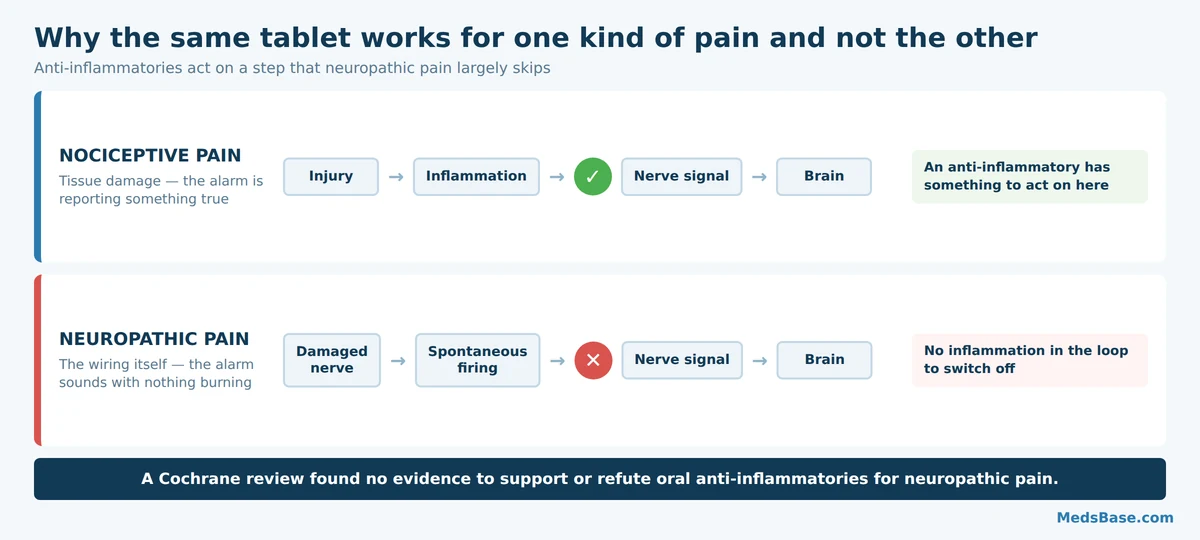
Here’s where it gets interesting. Anti-inflammatories like ibuprofen work by reducing inflammation, which reduces the signals nociceptors send. It is an elegant intervention and it is aimed at a step that neuropathic pain largely bypasses. There is no inflammation in the loop to switch off.
So what does work for you? Broadly, drugs that dampen the excitability of the nerve signalling itself, or that strengthen your body’s own descending pain-inhibition pathways coming down from the brain. Anticonvulsants like gabapentin and pregabalin do the first. Antidepressants — tricyclics and SNRIs — do the second, at doses well below those used for depression, which is why being offered one is not a comment on your mental health. Every drug class in modern neuropathic pain treatment sits in one of those two buckets.
Think of it like a faulty smoke alarm in your house. An anti-inflammatory puts out fires. If your alarm is going off because its wiring is damaged, putting out fires accomplishes nothing — you need something that acts on the alarm circuit.
Read that carefully, because it is more nuanced than “they don’t work”. The honest statement is that after decades of widespread use, the trials to answer the question were never properly done. What we can say is that no trial has demonstrated benefit, the mechanism gives no reason to expect one, and no neuropathic pain treatment guideline includes NSAIDs at any tier. If you have been taking them for months without effect, the evidence base is entirely consistent with your experience — your body was never the problem.
The Conditions Behind Nerve Pain — and Why Your Cause Matters
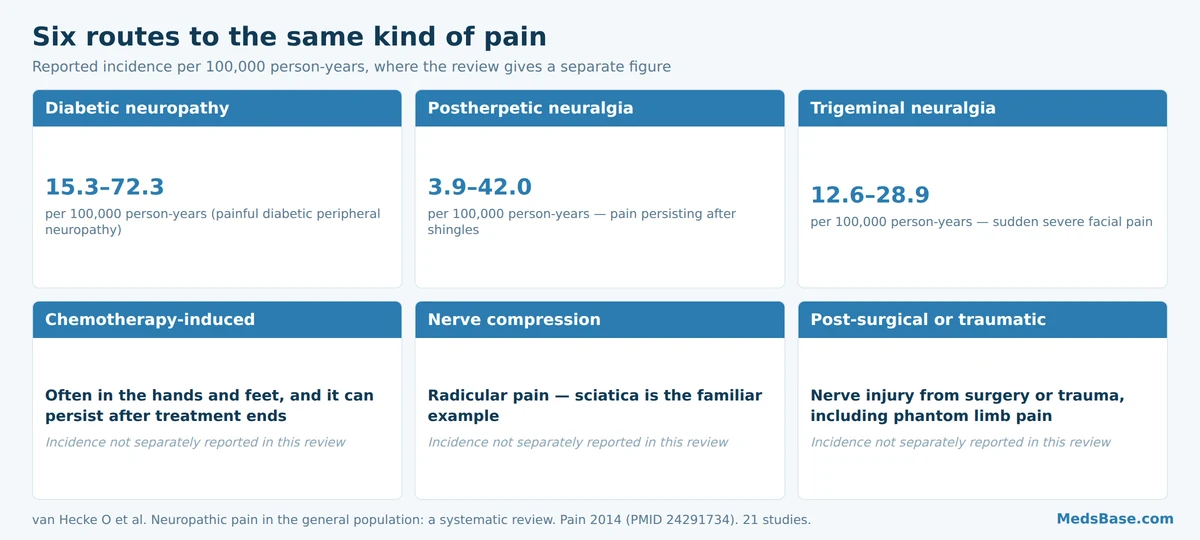
Neuropathic pain is a mechanism, not a diagnosis, and several routes lead you to it. Knowing which one applies to you changes your outlook considerably, even though it changes your neuropathic pain treatment options surprisingly little. Where the review reports separate incidence figures, they’re given here per 100,000 person-years.
- Diabetic neuropathy — the most common cause overall. Painful diabetic peripheral neuropathy: 15.3–72.3 per 100,000 person-years.
- Postherpetic neuralgia — pain persisting after shingles, sometimes for years. 3.9–42.0 per 100,000 person-years.
- Trigeminal neuralgia — sudden severe facial pain. 12.6–28.9 per 100,000 person-years.
- Chemotherapy-induced peripheral neuropathy — often in the hands and feet, sometimes lasting past treatment.
- Nerve compression and radicular pain — sciatica being the familiar example.
- Post-surgical and traumatic nerve injury — including phantom limb pain.
The Seven Neuropathic Pain Treatment Classes With Real Evidence
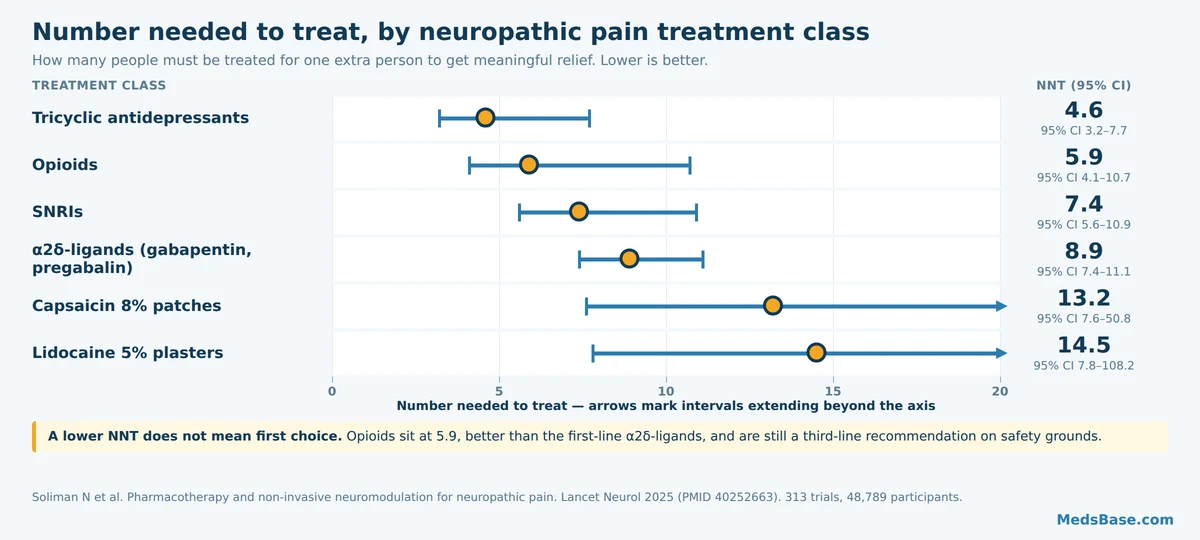
These are the classes that appear in the international guidelines. Efficacy is reported as number needed to treat (NNT) — how many people must take the drug for one additional person to get meaningful relief they would not have got from placebo. Lower is better. An NNT of 5 means roughly one person in five benefits because of the drug.
- Tricyclic antidepressants (TCAs) — amitriptyline and relatives, at low doses. The best NNT of any class in the current analysis. Limited mainly by anticholinergic side effects: dry mouth, constipation, drowsiness, and reduced sweating in hot weather.
- SNRI antidepressants — duloxetine principally. Better tolerated than TCAs for many people, with a modestly higher NNT.
- α2δ-ligands (gabapentin and pregabalin) — the anticonvulsant class most associated with nerve pain. The 2025 analysis pools them together rather than reporting them separately, which is itself informative if you’re trying to choose between them; how gabapentin and pregabalin actually differ is mostly a question of pharmacology and practicality rather than of measured efficacy.
- Topical capsaicin — both the high-concentration 8% patch and the cream. Localised action, minimal systemic effect, useful when the painful area is well defined.
- Topical lidocaine 5% plasters — the same logic, with a very favourable side-effect profile and the weakest efficacy evidence of the group.
- Botulinum toxin A — striking efficacy in the trials that exist, but they are small and it requires injection by a specialist.
- Opioids — genuinely effective on the numbers, and deliberately held back to third line. We’ll come to why.
The honest headline: even the best of these helps roughly one person in five more than placebo does — and in this field that is a good result, not a poor one. If you go into neuropathic pain treatment expecting a drug that reliably switches your pain off, you will conclude that every option has failed you. Calibrate first, and you will read your own results far more accurately.
What Does the Research Say About Neuropathic Pain Treatment?
Two systematic reviews from the same international group define current practice, and comparing them is the most useful thing on this page.
The 2015 NeuPSIG systematic review and meta-analysis pooled 229 studies. The 2025 update went considerably further.
| Study | Year | Finding | Source |
|---|---|---|---|
| NeuPSIG systematic review, 229 studies | 2015 | SNRIs NNT 6.4 (95% CI 5.2–8.4); pregabalin 7.7 (6.5–9.4); gabapentin 7.2 (5.9–9.21); capsaicin 8% patches 10.6 (7.4–19.0). Publication-bias analysis suggested a 10% overstatement of treatment effects | PMID 25575710 |
| NeuPSIG update, 313 trials, 48,789 participants | 2025 | TCAs NNT 4.6 (3.2–7.7); opioids 5.9 (4.1–10.7); SNRIs 7.4 (5.6–10.9); α2δ-ligands 8.9 (7.4–11.1); capsaicin 8% patches 13.2 (7.6–50.8); lidocaine 5% plasters 14.5 (7.8–108.2) | PMID 40252663 |
| Same update — harms | 2025 | Number needed to harm: SNRIs 13.9 (10.9–19.0); opioids 15.4 (10.8–24.0); TCAs 17.1 (11.4–33.6); α2δ-ligands 26.2 (20.4–36.5) | PMID 40252663 |
| Cochrane review, oral NSAIDs | 2015 | Two studies, 251 participants, only 16 with confirmed neuropathic pain. No evidence to support or refute use | PMID 26436601 |
| Systematic review of epidemiological studies, 21 articles | 2014 | Best estimate of population prevalence of pain with neuropathic characteristics: 6.9–10% | PMID 24291734 |
What changed in 2025
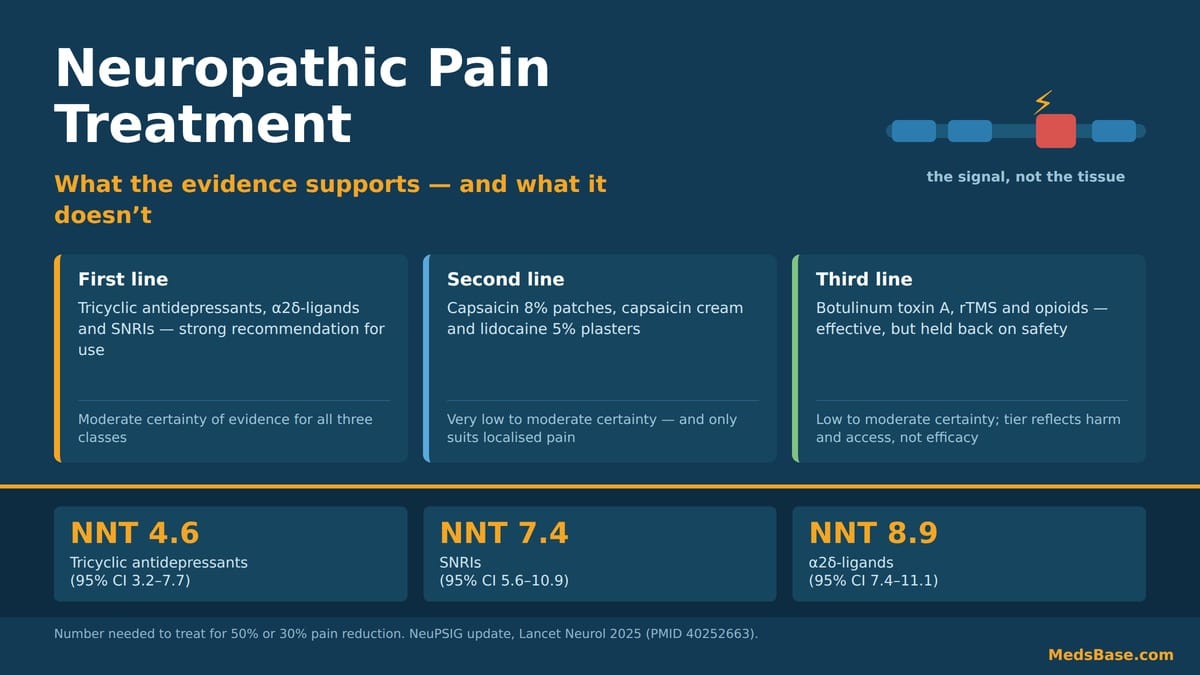
The group updated its recommendations in 2025 on the basis of 313 trials and 48,789 randomised participants. Three changes matter to you:
- Tricyclics moved clearly to the front. Their NNT of 4.6 is the best of the oral options, better than the 2015 analysis implied.
- Gabapentin and pregabalin are now pooled as one class rather than reported separately, with a combined NNT of 8.9 — a weaker showing than either drug’s separate 2015 figure. They remain first-line, but the case is now about tolerability and accessibility as much as raw efficacy.
- Topical options were re-tiered. Capsaicin patches, capsaicin cream and lidocaine plasters became the second-line group.
What this means for you. If your treatment started with gabapentin or pregabalin, that is still a guideline-consistent first-line choice — but if it hasn’t worked, a low-dose tricyclic is not a step down or a last resort. On the current numbers it is the strongest oral option available, and it is a reasonable next thing to ask about.
Two cautions on reading NNTs at all. First, the 2015 analysis found evidence of publication bias amounting to roughly a 10% overstatement of effects, so treat every figure here as a slight over-estimate. Second, an NNT is a population statistic and says nothing about you individually. Research suggests these are the best available bets; it cannot tell you which one is your bet.
First, Second and Third Line — and Why the Order Isn’t Efficacy
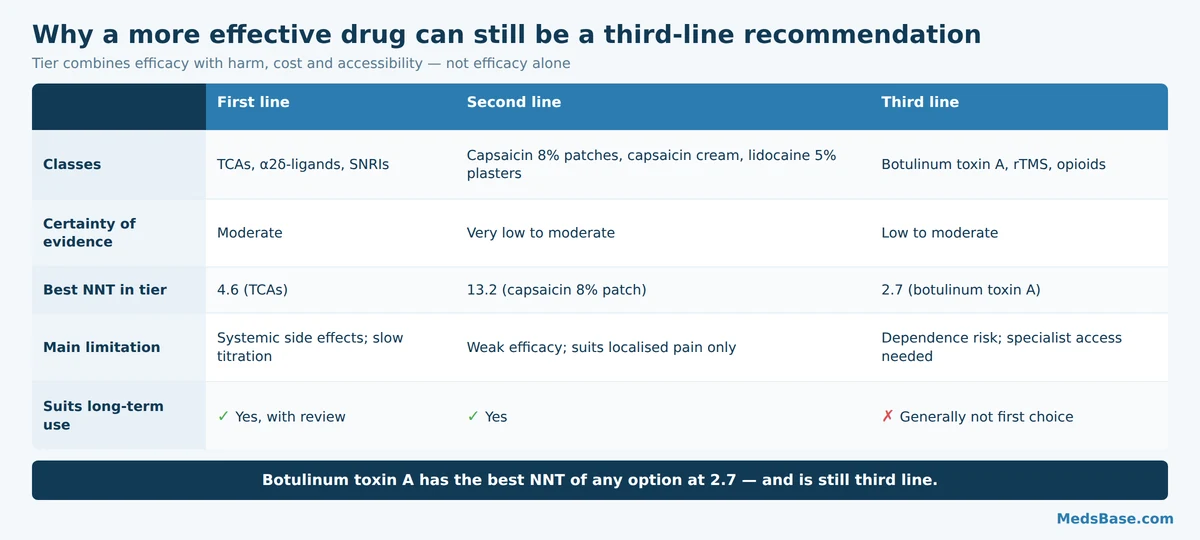
But there’s a catch, and it’s the open loop from the introduction. Look again at the 2025 numbers: opioids have an NNT of 5.9, better than SNRIs and considerably better than the gabapentinoids. Botulinum toxin A comes in at 2.7. Yet both sit at third line.
The tiers are not a ranking of efficacy. They combine efficacy with adverse events, accessibility, cost and — new in the 2025 update — feedback from people who live with the condition. So when your clinician starts you on a first-line drug rather than the one with the best number on the chart, that is the guideline working as designed, not you being fobbed off with something weaker.
| First line | Second line | Third line | |
|---|---|---|---|
| Classes | TCAs, α2δ-ligands, SNRIs | Capsaicin 8% patches, capsaicin cream, lidocaine 5% plasters | Botulinum toxin A, rTMS, opioids |
| Certainty of evidence | Moderate | Very low (cream, plasters) to moderate (8% patch) | Low to moderate |
| Main limitation | Systemic side effects; slow titration | Weak efficacy; only suits localised pain | Dependence and long-term harm (opioids); specialist access (BTX-A, rTMS) |
| Long-term use | Yes, with review | Yes | Generally not first choice for chronic use |
Which one fits your situation? If your pain is widespread — both your feet, a whole limb — the topical options are impractical for you regardless of their safety profile, and an oral first-line drug is your sensible start. If your pain is confined to one well-defined patch, a topical is worth requesting early precisely because it avoids systemic effects entirely. If you have a cardiac history, TCAs need more caution in your case than the alternatives do. And if you have already failed two first-line drugs at adequate doses for adequate durations, that is the point at which your neuropathic pain treatment conversation legitimately widens — not before.
If you want to see what’s available across these classes, you can browse pain relief medication — though which class to try is a decision worth taking with a clinician who knows your history.
Practical Guidance: Getting a Fair Trial of Neuropathic Pain Treatment
Pharmacists see the same failure pattern constantly, and it is not a failure of the drug. Someone is started on gabapentin, takes it for ten days at the starting dose, feels drowsy and no less sore, and stops. The drug never had a chance. Here is what a fair trial of neuropathic pain treatment looks like, so that whatever you conclude at the end of it, you can trust your own conclusion.
- Expect weeks, not days. These drugs are titrated upward gradually and judged over roughly four to eight weeks at an adequate dose. Judging at day ten is judging the starting dose, which was never meant to be the therapeutic one.
- Titrate slowly and deliberately. Starting low and building up is what makes the side effects tolerable. Most early drowsiness and unsteadiness settles as you adjust.
- Set a realistic target before you start. Complete relief is rarely achievable. A 30–50% reduction in pain, better sleep and more function is what these trials measure and what success usually looks like.
- Keep a simple record. Pain score, sleep quality and one daily activity, once a week. Memory is unreliable over eight weeks, and a slow improvement is genuinely hard to notice from the inside.
- Don’t stop abruptly. Gabapentinoids and tricyclics should be tapered rather than stopped suddenly. MedlinePlus drug information for gabapentin covers the patient-level detail.
- Report side effects rather than silently quitting. Drowsiness, swelling in the ankles and unsteadiness are all manageable with dose or timing changes.
- Ask what happens if this one fails. Having the next step named in advance makes an unsuccessful trial feel like a step forward rather than a dead end.
- Stopping at day 10. The single most common reason an effective drug gets written off.
- Adding more ibuprofen when the nerve drug seems slow. The evidence gives no reason to expect it to help this kind of pain.
- Assuming an antidepressant means the pain is thought to be psychological. The doses used for nerve pain are well below antidepressant doses and act on a different pathway.
- Stopping suddenly because of a side effect. Tapering avoids a rebound that can be worse than the original problem.
- Chasing complete relief. Aiming for zero pain often means abandoning a drug that was giving a genuine 40%.
MedsBase stocks gabapentin in several strengths — you can see the gabapentin options available if this is the class you’ve been prescribed or are discussing. No prescription is needed to order from MedsBase.com, which makes it more important, not less, that you get the titration and review right.
- How gabapentin and pregabalin actually differ — the two drugs pooled as one class here, compared properly
- Whether your medication is making hot weather harder — tricyclics appear on both lists, and this is why summer feels different on them
- What the evidence says about CBD oil for pain — the question most people ask next
Frequently Asked Questions
Q: What is the best treatment for neuropathic pain?
A: On current evidence, low-dose tricyclic antidepressants have the best number needed to treat of the oral options, at 4.6 in the 2025 NeuPSIG meta-analysis. But the best neuropathic pain treatment for you depends on your circumstances: SNRIs are often better tolerated, gabapentin and pregabalin carry fewer cardiac cautions, and topical options avoid systemic effects entirely when your pain is localised. All three of those oral classes are first-line, so your right first choice is genuinely individual rather than universal.
Q: Why don’t painkillers work for nerve pain?
A: Because they target a step that neuropathic pain largely skips. Anti-inflammatories reduce inflammation, which reduces the signals sent by nerve endings reporting tissue damage. In neuropathic pain the nerve itself is misfiring, with no ongoing tissue injury behind it, so there is little inflammation to reduce. A Cochrane review of oral NSAIDs for neuropathic pain found no evidence supporting their use — and only 16 participants across the whole review had confirmed neuropathic pain, which tells you how thinly this question has been studied.
Q: How long does it take for nerve pain medication to work?
A: Longer than most people expect. These medications are started at a low dose and increased gradually, and a fair assessment usually takes four to eight weeks at an adequate dose. Some people notice improved sleep within the first two weeks before any change in pain itself, which is a useful early signal. Judging the drug at day ten is judging a starting dose that was never intended to be therapeutic.
Q: Can neuropathic pain go away on its own?
A: Sometimes, depending on the cause. Postherpetic neuralgia after shingles often improves over months. Nerve pain from a compression that gets relieved can resolve. Pain from a progressive condition such as diabetic neuropathy is less likely to resolve spontaneously, though it can be substantially reduced with treatment and with better control of the underlying condition. Where evidence on individual outlook is limited, it genuinely is limited — this is a question no article can answer for a specific person.
Q: What is the strongest medication for nerve pain?
A: This is the wrong question, and asking it is how people end up on drugs that don’t suit them. On raw efficacy, botulinum toxin A has the lowest number needed to treat in the 2025 analysis at 2.7, and opioids come in at 5.9 — better than the first-line gabapentinoids. Both are third-line recommendations anyway, because tier reflects safety, dependence risk, accessibility and cost alongside efficacy. A better question is which drug gives you a worthwhile reduction with side effects you can live with long-term.
Q: Do antidepressants really work for nerve pain?
A: Yes, and by a different mechanism than the one that treats depression. Tricyclics and SNRIs strengthen the descending pathways from the brain that dampen incoming pain signals. The doses used for nerve pain are typically well below antidepressant doses, and the effect does not depend on whether you’re depressed. Being offered one is a statement about the pain pathway, not about your mental state.
Q: Does CBD oil help neuropathic pain?
A: The evidence is mixed and considerably weaker than for the classes covered here, and cannabis-based medicines are not part of the first-line guidance. We cover what the trials actually show in a separate article — the short version is that the effect sizes reported are small and the quality of evidence is low.
Q: Can I take gabapentin and a tricyclic together?
A: Combinations are used in practice, and they are a recognised strategy when one drug at an adequate dose gives partial benefit. Both are sedating, so the combined drowsiness is the main practical limit, and doses are usually adjusted to account for it. This is specifically a decision to take with a clinician rather than to assemble yourself, because the side effects compound in ways the individual leaflets don’t describe.
The Bottom Line on Neuropathic Pain Treatment
The balanced verdict: neuropathic pain treatment works, but modestly and slowly, and the honest framing is that even the best option helps roughly one person in five beyond what placebo achieves. That sounds discouraging until you notice the alternative you probably arrived with — months of anti-inflammatories with no evidence base behind them at all for this kind of pain.
Seven neuropathic pain treatment classes have real evidence. Three are first-line, and low-dose tricyclics currently lead on efficacy. Expect four to eight weeks at an adequate dose before you judge any of them, aim for a meaningful reduction rather than zero pain, and treat an unsuccessful trial as information rather than as your failure — there are two more first-line options behind the first one you try.
Your one immediate action: if you have been taking ordinary painkillers for nerve pain for more than a month with no benefit, stop treating that as a reason to take more of them and book a conversation about a first-line nerve-pain drug instead. Take a note of what you’ve tried, at what dose, and for how long — that single piece of information is what makes the conversation productive.
Wondering which of the two gabapentinoids to ask about? Read our full comparison of how gabapentin and pregabalin actually differ — the answer comes down to absorption, not effectiveness. And if you’re starting a tricyclic as summer arrives, it’s worth knowing whether your medication is making hot weather harder, because this class appears on that list too.

Written by
Sophie ChenPharmaceutical Content Researcher · 8 years experience
Sophie Chen is a pharmaceutical content researcher with 8 years covering generic medication access and clinical pharmacology. She specialises in international regulatory frameworks, bioequivalence standards, and patient-facing education on therapeutic drug classes. She is not a clinician.