








✓ Medically reviewed by · Last reviewed: May 2026
Pharmacy Researcher · 8 years experience
Pharmacy researcher with 8 years reviewing clinical drug information, generic formulation equivalence, and international pharmaceutical standards. Focuses on patient-facing accuracy in medication education.
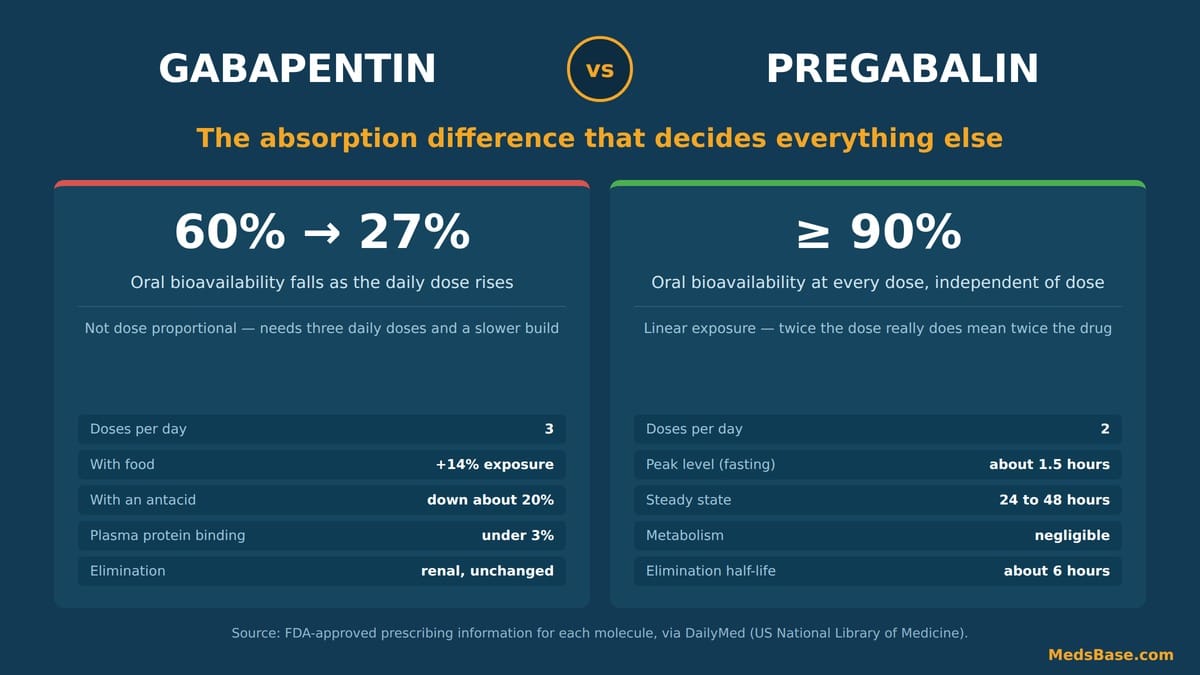
Most people are told these two drugs are basically the same — same family, same job, pick whichever is cheaper. The prescribing information says otherwise, and the difference is not subtle. In the gabapentin vs pregabalin comparison, one drug absorbs at a flat rate of 90% or more regardless of how much you take, while the other starts at about 60% and falls to 27% as the daily dose climbs. That is not a rounding difference. It is the reason their dosing schedules, titration speeds and dose ceilings look nothing alike.
Both belong to the same class and both are recommended for nerve pain, so the “same family” part is fair. What follows from the absorption gap is where the useful part of gabapentin vs pregabalin actually lives.
By the end you’ll know the seven differences that actually change your experience of taking these drugs, which one suits your circumstances, what the side-effect numbers really are, and — the part almost every comparison gets wrong — why you should be suspicious of anyone who tells you one of them is simply stronger. If you want the wider picture of what neuropathic pain treatment involves overall, that’s covered separately; this page assumes you’re already choosing between these two.
- One drug’s absorption collapses as the dose rises and the other’s doesn’t — and nearly every practical difference follows from that
- “Pregabalin is stronger” is the most common claim about these drugs and it doesn’t survive contact with the guideline
- The dosing schedules differ for a mechanical reason, not a traditional one
- One of the two carries a controlled-substance classification in the US; the other does not
- A common household product can cut one drug’s absorption by about a fifth, and the label gives a specific timing fix
- The 2025 international guideline stopped reporting them separately — which tells you something on its own
Gabapentin vs Pregabalin: The Short Answer
Both drugs bind the same target — the α2δ subunit of voltage-gated calcium channels — and dampen the release of excitatory neurotransmitters from over-firing nerves. Same mechanism, same class, same broad indication. If you were hoping gabapentin vs pregabalin would resolve into “this one works and that one doesn’t”, it does not, and you should treat any page that claims otherwise with suspicion.
The differences are pharmacokinetic. They concern how much drug gets into you, how fast, and how predictably. Those are not minor details when you’re the person titrating a dose over eight weeks.
Gabapentin vs Pregabalin: The One Number That Separates Them
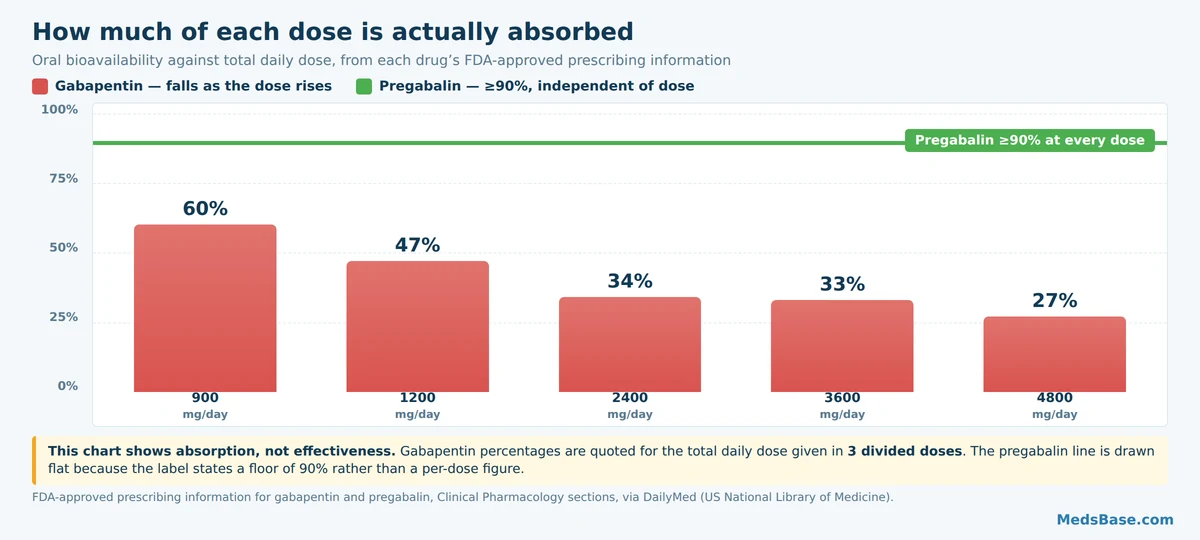
Here’s where it gets interesting. The FDA-approved prescribing information for each drug states its own oral bioavailability, and the two statements could hardly be more different.
The FDA-approved label for pregabalin says: oral bioavailability is greater than or equal to 90% and is independent of dose. Maximum plasma concentration and total exposure increase linearly with dose. Take twice as much, get twice as much in.
The FDA-approved label for gabapentin says the opposite: bioavailability is not dose proportional — as the dose increases, bioavailability decreases. It then prints the actual ladder:
| Daily gabapentin dose (3 divided doses) | Bioavailability |
|---|---|
| 900 mg | approximately 60% |
| 1200 mg | approximately 47% |
| 2400 mg | approximately 34% |
| 3600 mg | approximately 33% |
| 4800 mg | approximately 27% |
Read the bottom row against the top: at 4800 mg per day you are absorbing less than half the proportion you absorbed at 900 mg. That single table is the honest core of gabapentin vs pregabalin, and it is the thing you will not find on a comparison page that describes the two as interchangeable.
Why gabapentin behaves this way
Gabapentin resembles an amino acid closely enough that it is carried across the intestinal wall by an amino-acid transport system rather than simply diffusing across. Transporters have a finite capacity. Flood them and the surplus passes through unabsorbed.
This was demonstrated as far back as 1993 (PMID 8456077), in work that measured dose-dependent bioavailabilities falling from about 73.8% to 35.7% as a single dose rose from 100 mg to 1600 mg, and identified the saturable carrier-mediated transport responsible. Pregabalin, despite the family resemblance, does not run into the same ceiling at therapeutic doses.
Think of it like a doorway into a room. Pregabalin walks through a wide corridor — send twice as many people, twice as many arrive. Gabapentin goes through a turnstile. Send twice as many and the queue outside simply gets longer. Every practical difference in gabapentin vs pregabalin below is downstream of that turnstile.
Gabapentin vs Pregabalin: Seven Practical Differences
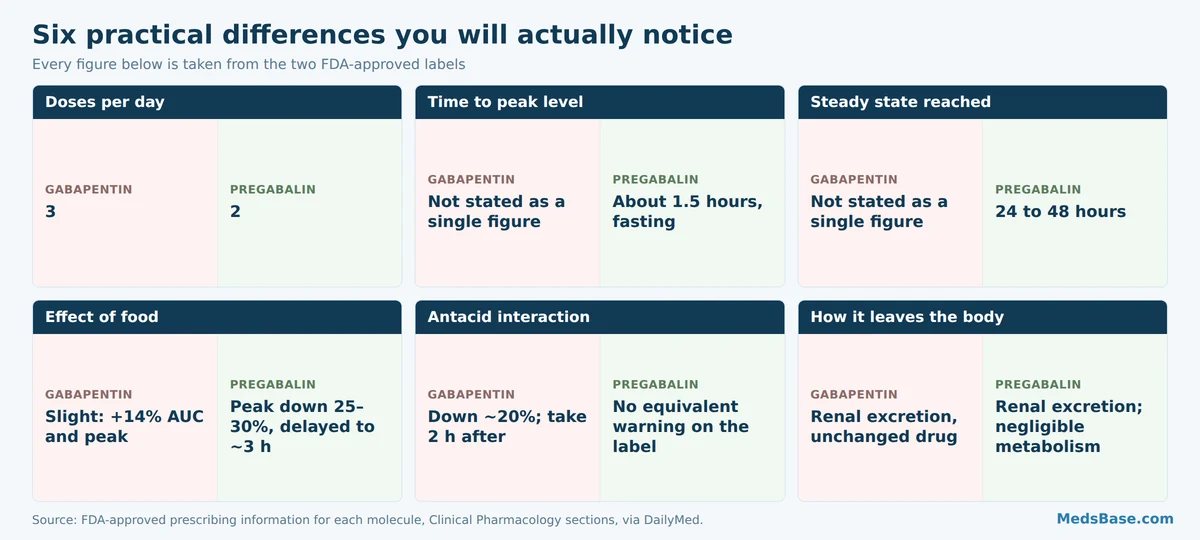
1. Doses per day. Pregabalin is typically taken twice daily, gabapentin three times. That follows directly from the saturation curve above and from gabapentin’s shorter practical dosing interval.
2. Speed to peak level. Pregabalin reaches peak plasma concentration within about 1.5 hours when taken fasting, and reaches steady state within 24 to 48 hours of repeated dosing. That predictability is why pregabalin titration can move faster.
3. Predictability of dose increases. With pregabalin, a dose increase produces a proportional increase in exposure. With gabapentin it does not — the higher you go, the less of each additional milligram arrives. This is the single most useful thing to understand if you have ever wondered why a big gabapentin increase felt like a small change.
4. Food effects, in opposite directions. Food has only a slight effect on gabapentin — about a 14% increase in exposure and peak level. With pregabalin, food slows absorption: peak concentration drops by roughly 25% to 30% and time to peak stretches to about 3 hours. Neither effect makes either drug unusable with meals; both are worth knowing if you’re chasing a consistent response.
5. The antacid interaction. This one catches people out. Taking gabapentin with a magnesium- and aluminium-hydroxide antacid reduces its bioavailability by about 20%. The label’s fix is specific: take gabapentin at least 2 hours after the antacid. If you take something for reflux and your gabapentin has felt underpowered, this is worth checking before concluding the dose is wrong.
6. Controlled-substance status. In the United States, pregabalin is a Schedule V controlled substance. Gabapentin is not federally scheduled, though some individual states control it. This affects paperwork more than pharmacology, but it also reflects a recognised difference in misuse potential that is worth discussing if you have a history of substance dependence.
7. Elimination. Both are cleared by the kidneys largely unchanged — pregabalin undergoes negligible metabolism in humans, and gabapentin is eliminated by renal excretion as unchanged drug. Neither is a significant liver concern, and both need dose adjustment if kidney function is reduced. This is the one place where the two are genuinely alike, and it matters: if your kidney function is impaired, switching between them does not solve the problem.
Side Effects and Safety: Gabapentin vs Pregabalin Compared
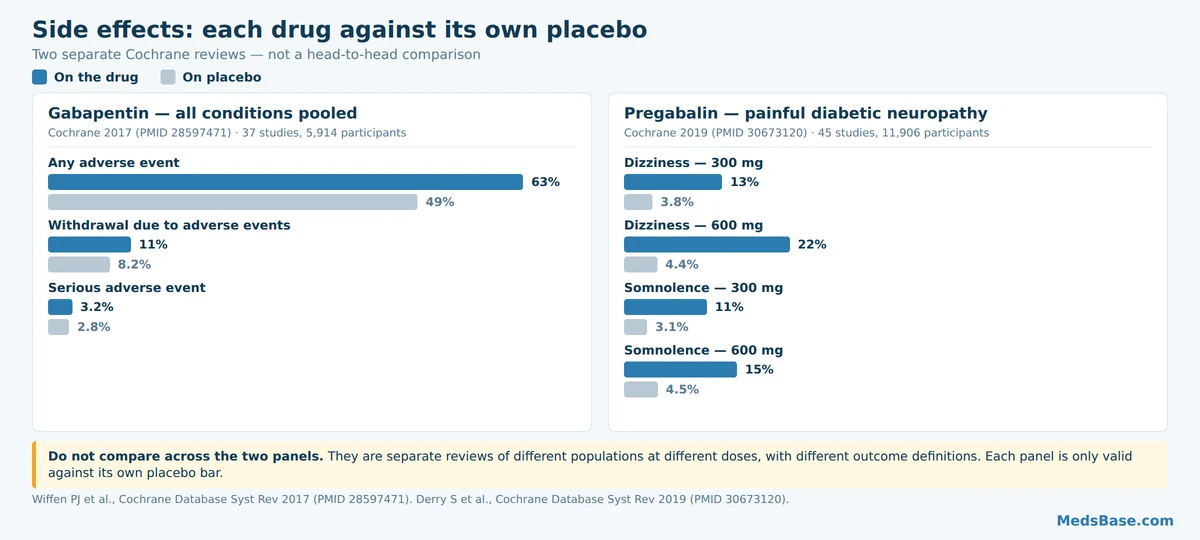
On safety, gabapentin vs pregabalin is much less of a contest than on absorption. Both drugs are sedating, both can cause dizziness and unsteadiness, and both can cause fluid retention with ankle swelling. Here’s what the trial data shows you — and the crucial caveat first.
These figures come from two separate Cochrane reviews of two different populations at different doses. They are each drug against its own placebo. They are not a head-to-head comparison and cannot be read as one.
| Finding | Drug | Placebo | Source |
|---|---|---|---|
| Any adverse event (gabapentin, all conditions) | 63% | 49% | Cochrane 2017 |
| Withdrawal due to adverse events (gabapentin) | 11% | 8.2% | Cochrane 2017 |
| Serious adverse events (gabapentin) | 3.2% | 2.8% | Cochrane 2017 |
| Dizziness (pregabalin 600 mg, diabetic neuropathy) | 22% | 4.4% | Cochrane 2019 |
| Somnolence (pregabalin 600 mg, diabetic neuropathy) | 15% | 4.5% | Cochrane 2019 |
In the gabapentin review, the individual effects reported were dizziness in 19%, somnolence in 14%, peripheral oedema in 7% and gait disturbance in 14% of participants taking the drug.
The safety point that applies equally to both, and matters most: both labels carry a warning about respiratory depression when these drugs are combined with other central nervous system depressants — including opioids — or taken by someone with existing respiratory impairment. If you are taking either drug alongside an opioid, a sedative or a strong antihistamine, that combination deserves an explicit conversation rather than an assumption.
What Does the Research Say About Gabapentin vs Pregabalin?
This is where the myth from the introduction gets resolved. The claim that pregabalin is simply the stronger drug is common, and the evidence does not support it.
The strongest signal comes from what the current international guideline chose to do. The 2025 NeuPSIG systematic review and meta-analysis in Lancet Neurology (PMID 40252663), covering 313 trials and 48,789 randomised participants, stopped reporting gabapentin and pregabalin separately and reported them as a single pooled class — α2δ-ligands — with a number needed to treat of 8.9 (95% CI 7.4–11.1) and a number needed to harm of 26.2 (20.4–36.5).
You do not pool two treatments into one estimate if you believe one is meaningfully better than the other. For your purposes, that editorial decision by the guideline group is stronger evidence on gabapentin vs pregabalin than any individual trial you will find quoted elsewhere.
| Study | Year | Finding | Source |
|---|---|---|---|
| Cochrane review, 37 studies, 5,914 participants | 2017 | Gabapentin ≥1200 mg/day, postherpetic neuralgia: substantial benefit in 32% vs 17% on placebo (NNT 6.7). Painful diabetic neuropathy: 38% vs 21% (NNT 5.9) | PMID 28597471 |
| Cochrane review, 45 studies, 11,906 participants | 2019 | Pregabalin 300 mg, postherpetic neuralgia: at least 30% pain reduction in 50% vs 25% on placebo (NNTB 3.9). No evidence of benefit at 600 mg in HIV neuropathy across 2 studies and 674 participants | PMID 30673120 |
| NeuPSIG update, 313 trials, 48,789 participants | 2025 | Both pooled as α2δ-ligands: NNT 8.9 (7.4–11.1), NNH 26.2 (20.4–36.5). Both remain first-line | PMID 40252663 |
What this means for you. The two Cochrane reviews look different, but they studied different conditions at different doses with different response thresholds, so the apparent gap between “NNT 6.7” and “NNTB 3.9” is largely an artefact of study design rather than a real difference in drug strength. Comparing across separate placebo-controlled reviews is exactly the error the pooled 2025 estimate exists to prevent.
Where the evidence is genuinely thin, it should be said plainly: direct head-to-head trials of these two drugs in neuropathic pain are sparse, and none of the major guidelines rests a recommendation on one. Anyone giving you a confident ranking is going beyond the published evidence.
There is one asymmetry worth knowing. The pregabalin review found no evidence of benefit at 600 mg in HIV-associated neuropathy across two studies and 674 participants, and limited evidence in neuropathic back pain, sciatica, cancer pain and polyneuropathy. Response varies more by condition than by which of the two drugs you take.
Gabapentin vs Pregabalin: Which One Fits Your Situation
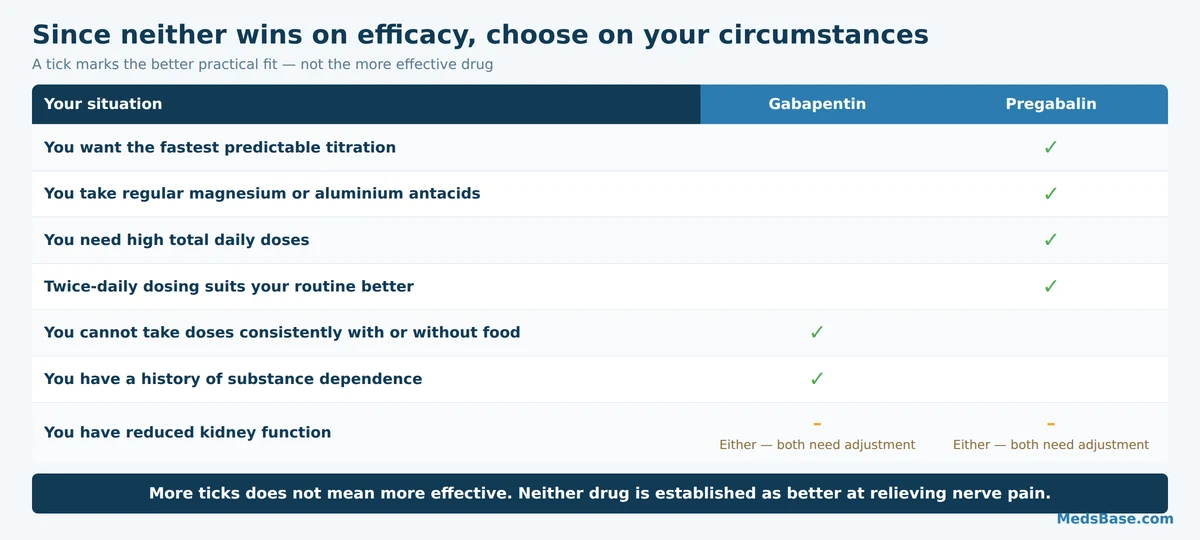
Since neither drug wins on efficacy, your gabapentin vs pregabalin decision is properly made on practicalities. Here is how the differences map onto your real circumstances.
| Your situation | Better fit | Why |
|---|---|---|
| You want the fastest predictable titration | Pregabalin | Linear kinetics, steady state in 24–48 hours |
| Cost is your deciding factor | Often gabapentin | Generally the less expensive of the two; check current pricing |
| You take regular antacids | Pregabalin, or gabapentin with 2-hour separation | The ~20% absorption hit is specific to gabapentin |
| You need high total daily doses | Pregabalin | Gabapentin’s absorption falls away above roughly 1800–2400 mg/day |
| Twice-daily dosing suits your routine | Pregabalin | Gabapentin generally needs three doses |
| You have a history of substance dependence | Discuss carefully; gabapentin may be preferred | Pregabalin is a Schedule V controlled substance in the US |
| You have reduced kidney function | Neither is exempt | Both need dose adjustment; this is not a reason to switch |
The verdict, stated plainly. For most people starting treatment, either is a reasonable first choice, and the sensible approach is to pick on practicality and cost rather than on a strength claim that the evidence does not support. If the first one you try fails at an adequate dose over an adequate period, switching to the other is a recognised step — the shared mechanism does not make it futile, because tolerability differs between individuals even when average efficacy does not.
Practical Guidance: Starting, Switching and Stopping
Pharmacists see the same two mistakes with these drugs, and neither is really about which molecule you chose. The first is judging them at day ten. The second is stopping either one abruptly. Get these seven things right and you will get a fair reading of whichever drug you start.
- Start low and build up. Both drugs are titrated upward over days to weeks. Most of the early drowsiness and unsteadiness settles as you adjust, and rushing is the main reason people abandon a drug that would have suited them.
- Split gabapentin doses as directed. Three doses is not arbitrary — the label’s absorption figures are all quoted for divided dosing, and consolidating them pushes you further up the saturation curve.
- Keep the antacid gap. At least 2 hours after any magnesium- or aluminium-hydroxide antacid, if you take gabapentin.
- Give it four to eight weeks at an adequate dose before deciding whether it works. Improved sleep often arrives before reduced pain.
- Never stop either drug abruptly. Both should be tapered. MedlinePlus drug information for pregabalin covers the patient-level detail on this.
- Switching is a supervised conversion, not a swap. The two are not milligram-for-milligram equivalent, and the changeover is usually staged rather than done overnight.
- Watch your ankles. Peripheral oedema is a recognised effect of both and appeared in 7% of gabapentin participants in the Cochrane review. Report it rather than living with it.
- Doubling a gabapentin dose and expecting double the effect. The absorption curve is the reason it doesn’t work that way.
- Taking gabapentin with your antacid at the same time. Two hours apart, minimum.
- Stopping abruptly because of drowsiness. Taper, and ask about shifting the larger dose to bedtime instead.
- Assuming a switch fixes a kidney-related problem. Both drugs are renally cleared; both need adjustment.
- Combining either with an opioid or strong sedative without flagging it. Both labels carry a respiratory-depression warning for exactly this combination.
MedsBase stocks both molecules — you can see the gabapentin strengths available or see the pregabalin option if you’re weighing them up. No prescription is needed to order from MedsBase.com, which makes getting the titration and the taper right your responsibility as much as anyone’s.
- What neuropathic pain treatment involves overall — the seven classes with evidence, and where these two sit among them
- Whether these drugs make hot weather harder — both are sedating, and the combination risks are covered there
- Browse pain relief medication — the wider range
Frequently Asked Questions
Q: Is pregabalin stronger than gabapentin?
A: Not in the sense most people mean, and this is the single most common misconception about gabapentin vs pregabalin. The 2025 NeuPSIG meta-analysis of 313 trials pooled both drugs into a single α2δ-ligand estimate with one number needed to treat of 8.9, which is not what you do if you believe one is clearly better. Pregabalin is more potent per milligram — the doses look very different on paper — but potency is not effectiveness. Direct head-to-head trials in neuropathic pain are sparse, and no major guideline ranks one above the other.
Q: Why is pregabalin taken twice a day and gabapentin three times?
A: Because of how each is absorbed. Gabapentin crosses the gut wall using a saturable transport system, so its bioavailability falls as the dose rises — approximately 60% at 900 mg/day down to 27% at 4800 mg/day, all measured in three divided doses. Splitting the total into more, smaller doses keeps each one lower on that saturation curve. Pregabalin absorbs at 90% or more independent of dose, so it does not need the same workaround.
Q: Can you switch from gabapentin to pregabalin?
A: Yes, and switching is a recognised step when the first drug is not tolerated or not effective at an adequate dose. It is not a milligram-for-milligram swap — the two have very different dose ranges — and it should be a staged, supervised conversion rather than an overnight change. Because tolerability varies between individuals even where average efficacy does not, a switch is genuinely worth trying rather than assuming the whole class has failed you.
Q: Which has fewer side effects, gabapentin or pregabalin?
A: The available data cannot settle this on tolerability, because the two are studied against placebo rather than against each other, in different populations at different doses. What can be said is that both cause dizziness, drowsiness and fluid retention, and that in its Cochrane review gabapentin produced at least one adverse event in 63% of participants against 49% on placebo. The 2025 pooled analysis gives the class a number needed to harm of 26.2, meaning roughly 1 in 26 people treated withdraws because of side effects attributable to the drug.
Q: Does doubling the gabapentin dose double the effect?
A: No, and this is the most practically useful thing on this page. Gabapentin’s bioavailability is explicitly not dose proportional — the FDA label states that as the dose increases, bioavailability decreases. Going from 1200 mg to 2400 mg daily takes absorption from about 47% to about 34%, so you absorb considerably less than twice as much. Pregabalin behaves differently: its exposure increases linearly with dose.
Q: Do you need to take gabapentin with food?
A: It is not required. Food has only a slight effect on gabapentin, increasing exposure and peak level by about 14%. Taking it consistently — either always with food or always without — is more useful than the choice itself, because consistency is what makes your response interpretable. Pregabalin taken with food has its peak concentration reduced by roughly 25% to 30%, with the peak arriving around 3 hours instead of 1.5.
Q: Are these drugs addictive?
A: Pregabalin is a Schedule V controlled substance in the US, which reflects a recognised potential for misuse at the lower end of the controlled scale. Gabapentin is not federally scheduled, though some states control it individually. Neither is in the same category as opioids, but both should be tapered rather than stopped abruptly, and anyone with a history of substance dependence should raise it before starting either.
Q: Can I take gabapentin and pregabalin together?
A: There is no good reason to, and it is not standard practice. They act on the same target, so combining them mostly stacks the side effects — sedation, dizziness and swelling — without a corresponding gain. If one is not working at an adequate dose, the recognised move is to switch or to add a drug from a different class, such as a tricyclic or an SNRI, rather than to double up within the class.
The Bottom Line on Gabapentin vs Pregabalin
The balanced verdict: gabapentin vs pregabalin is a choice about practicality, not potency. They share a target, they share a first-line recommendation, and the most current international analysis thought them similar enough to report as a single class. Nobody has shown that one relieves nerve pain better than the other.
What genuinely separates them is absorption. Pregabalin’s is flat and predictable at 90% or more, which buys faster titration, twice-daily dosing and dose increases that behave the way you’d expect. Gabapentin’s falls away as the dose climbs, which is why it needs three daily doses, a slower build, and why large increases can feel disappointingly small. Add the antacid interaction on one side and the controlled-substance classification on the other, and you have a real basis for choosing — just not the one most articles offer.
Your one immediate action: if you’re already on gabapentin and it has felt underpowered, check two things before concluding the dose is wrong — whether you’re splitting it into three doses as directed, and whether you’re taking an antacid within two hours of it. Both are fixable in a day and both meaningfully change how much drug you actually absorb.
Not sure nerve pain is what you’re treating in the first place? Start with what neuropathic pain treatment involves overall — the wrong mechanism is the most common reason these drugs disappoint. And if you’re starting either one as summer arrives, it’s worth knowing whether these drugs make hot weather harder, since both are sedating and the combination effects are real.

Written by
Sophie ChenPharmaceutical Content Researcher · 8 years experience
Sophie Chen is a pharmaceutical content researcher with 8 years covering generic medication access and clinical pharmacology. She specialises in international regulatory frameworks, bioequivalence standards, and patient-facing education on therapeutic drug classes. She is not a clinician.