








✓ Medically reviewed by · Last reviewed: May 2026
Pharmacy Researcher · 8 years experience
Pharmacy researcher with 8 years reviewing clinical drug information, generic formulation equivalence, and international pharmaceutical standards. Focuses on patient-facing accuracy in medication education.
candida auris — Candida Auris: The Drug-Resistant Fungal Superbug, Explained Without the Panic. Read on for an evidence-backed guide covering everything you need to know.
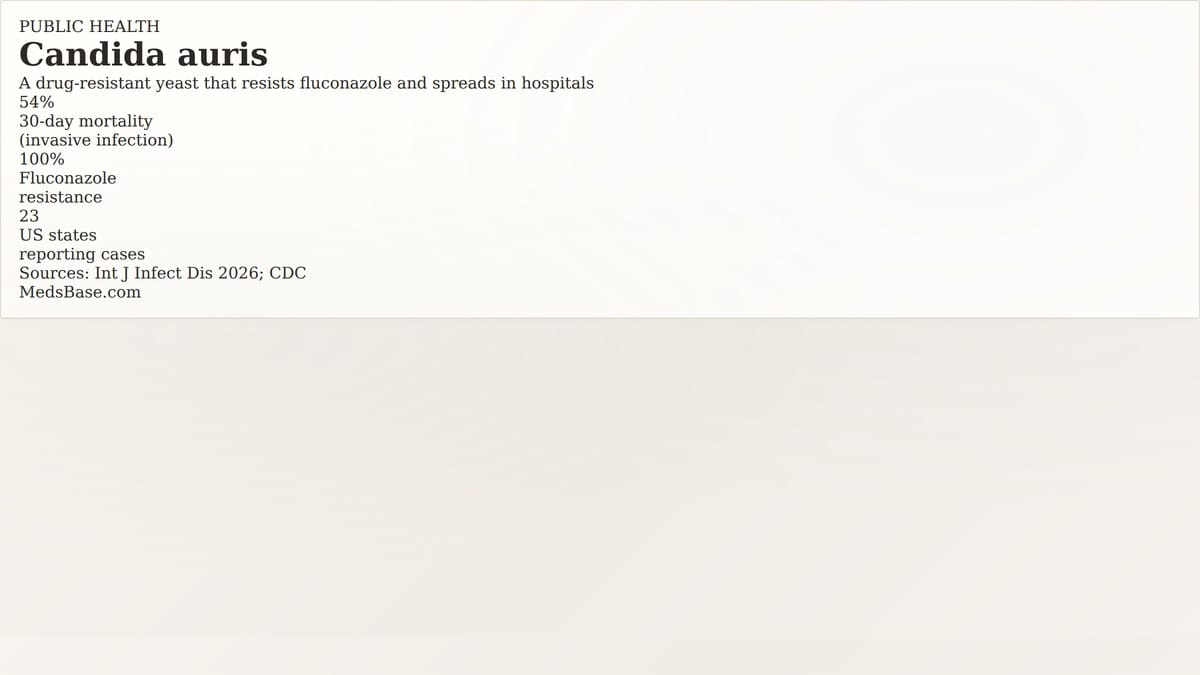
- Candida auris is a real, drug-resistant yeast — but it mainly threatens hospitalized, already-sick patients, not healthy people.
- It resists fluconazole, the most common antifungal — and a few strains now resist the last-line drugs too.
- It spreads on surfaces and equipment in hospitals, and it can survive for weeks.
- In one recent outbreak, the 30-day mortality rate reached 54% — and that number deserves context, not panic.
What Is Candida auris?
You’ve probably seen the headlines: a “superbug fungus” spreading through hospitals, resistant to nearly every drug we have. It sounds like a movie plot. Most people believe it’s coming for everyone — the research says otherwise. Candida auris is a serious, genuinely worrying public-health problem, but almost none of that worry should land on a healthy person going about their day.
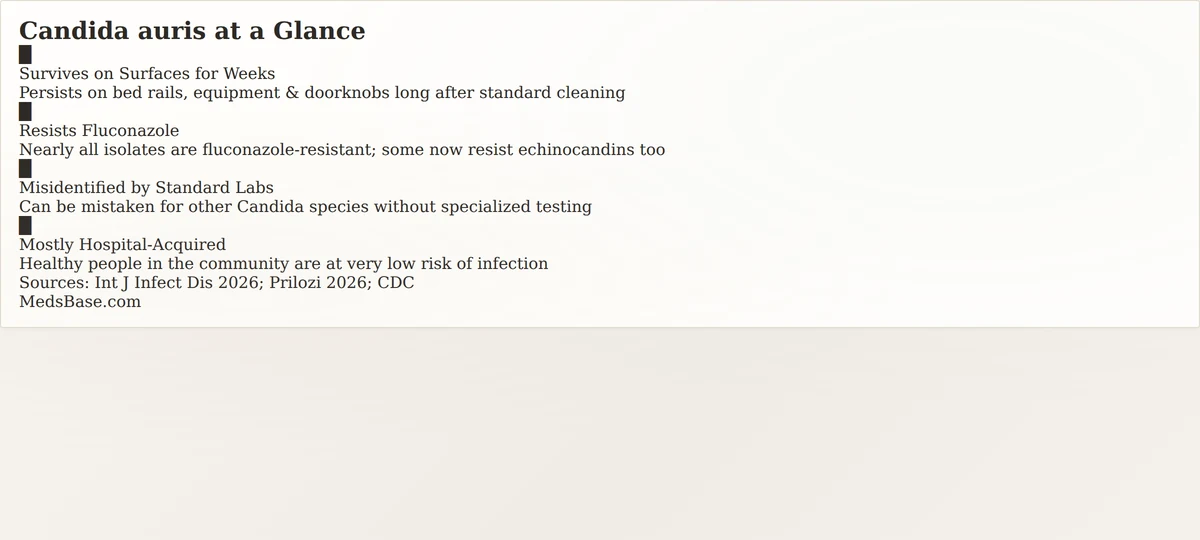
Fungi are everywhere: on your skin, in the soil, in the air. Most are harmless, and even the common Candida yeasts live quietly on healthy people without causing trouble. C. auris is different in three specific ways. It is unusually good at spreading between patients in a hospital. It is unusually good at clinging to surfaces and equipment. And it is unusually resistant to the drugs we normally reach for.
The name itself is a clue: it was isolated from a patient’s ear (hence “auris,” Latin for ear) in 2009, and within a decade it had been detected on nearly every continent. Its arrival is one of the more striking examples of a pathogen emerging almost from nowhere in the modern era.
How Does Candida auris Spread?
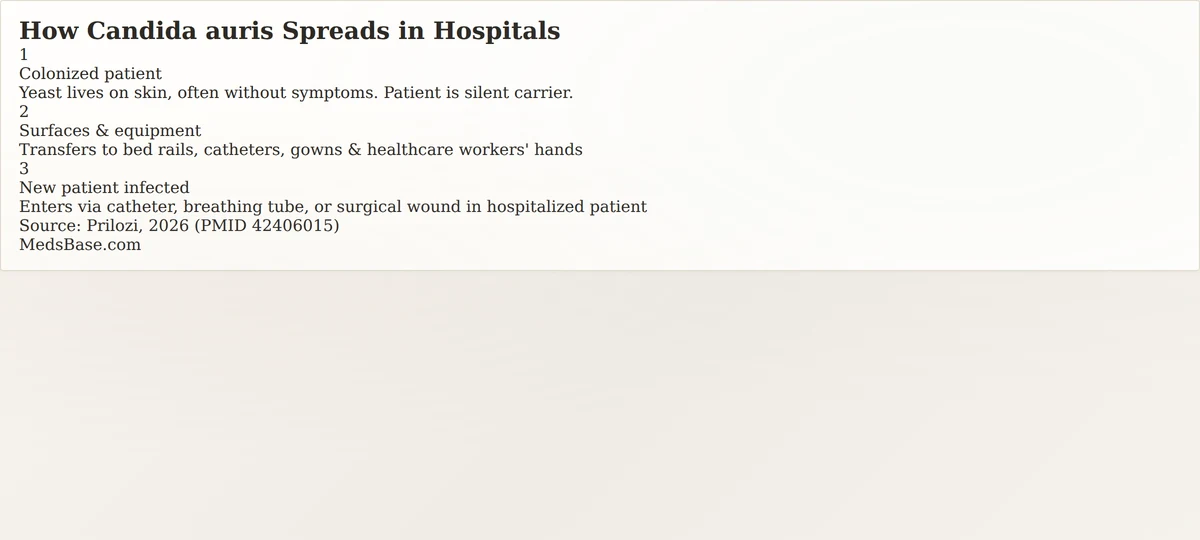
Unlike the flu or COVID-19, C. auris is not something you catch by breathing the same air as a stranger. It spreads in healthcare settings through a chain that looks like this:
- A patient becomes colonized — the yeast lives on their skin, often without making them sick.
- The yeast transfers to surfaces, bed rails, medical equipment, or a healthcare worker’s hands or gown.
- It finds its way to another patient — often through a catheter, breathing tube, or surgical site.
The U.S. Centers for Disease Control and Prevention (CDC) reports that more than 3,000 cases have been identified across at least 23 states, concentrated in long-term care facilities and hospitals — and those numbers have risen sharply since the pandemic-era pressures on infection control.
Here’s where it gets interesting: the hardest part of containing C. auris is that most of the people carrying it never feel sick. They’re colonized, not infected — but they’re still shedding the yeast onto everything they touch. That silent spread is why a single patient can seed a ward-wide outbreak without anyone realizing it at first.
Symptoms & Who Gets Sick
The symptoms of a C. auris infection depend entirely on where it invades — and that’s usually tied to a medical device:
| Infection Site | Common Setting | Typical Signs |
|---|---|---|
| Bloodstream (candidemia) | Central line, catheter | Fever, chills, low blood pressure |
| Wound/surgical site | Post-surgery | Redness, discharge, poor healing |
| Ear | Ear swabs | Discharge, discomfort |
| Urinary tract | Urinary catheter | Often no symptoms, or cloudy urine |
This is the single most important thing to take away: C. auris is a healthcare-associated organism. Its danger is concentrated in people whose defenses are already down and whose bodies are already being breached by tubes and lines.
Why labs sometimes miss it
One reason C. auris spread silently for years is that standard diagnostic methods — the kind most hospital labs use — can misidentify it as a different, more common Candida species. It takes specialized techniques like MALDI-TOF mass spectrometry or molecular sequencing to confirm the identification. During that delay, a patient may be treated with fluconazole for what looks like ordinary candidiasis, while the real culprit — fully fluconazole-resistant — continues multiplying.
A pathogen on five continents
C. auris emerged almost simultaneously across five distinct genetic clades — South Asian, East Asian, South African, South American, and the newer Middle Eastern clade — rather than spreading outward from a single point. That pattern, described in the 2026 Prilozi review, suggests environmental or agricultural factors may have driven its emergence independently, rather than person-to-person spread across borders.
Why It Resists Antifungals
Here’s the uncomfortable core of the problem. There are only three major classes of antifungal drugs for serious infections: the azoles (like fluconazole), the echinocandins, and amphotericin B. C. auris has shown the ability to resist all three.
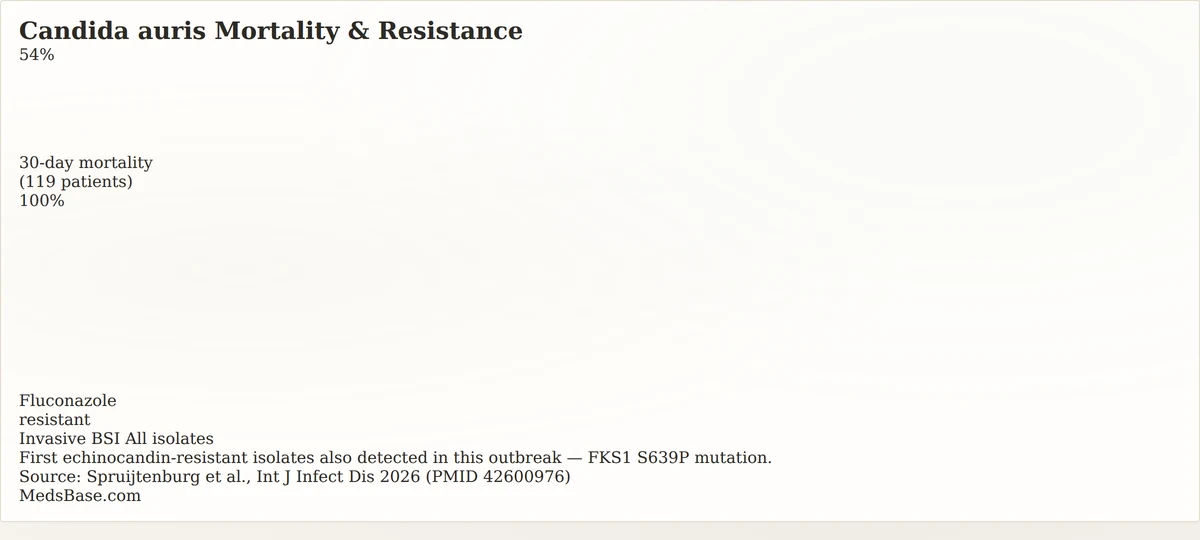
- Fluconazole resistance is the rule, not the exception. In a recent outbreak investigation in Türkiye, every single isolate was resistant to fluconazole.
- Echinocandin resistance has now emerged. That same investigation documented the first echinocandin-resistant isolates from patients who had previously been exposed to those drugs — a troubling milestone, because echinocandins are the usual last line.
- Some strains are genuinely multidrug-resistant, leaving clinicians with very few options.
What this means for you: the rise of antifungal resistance doesn’t change what you should do today. But it does mean the antifungals we use for ordinary infections need to be used thoughtfully — which is exactly why treating the right infection with the right drug matters.
What the Mortality Numbers Really Mean
Now the number everyone misreads. You may have seen “C. auris has a 30–60% mortality rate.” Here’s what that actually means — and it’s not what the headline implies.
The Türkiye outbreak study reported a 30-day mortality rate of 54% among 119 patients with bloodstream infection. That is a real and serious number. But those were critically ill, hospitalized patients whose infections were, by definition, invasive and severe. The high mortality reflects the vulnerability of the patients — not a lethal fungus stalking the general public.
Think of it this way: candidemia from any Candida species in an intensive-care patient is often deadly. C. auris adds the resistance problem on top. The mortality rate tells you that when this yeast gets into the bloodstream of an already-sick person, the outcome is often poor — which is precisely why hospitals take it so seriously.
So what does this mean for you? Unless you or a loved one is hospitalized with an invasive device and a weakened immune system, the 54% figure is not a number you need to lose sleep over.
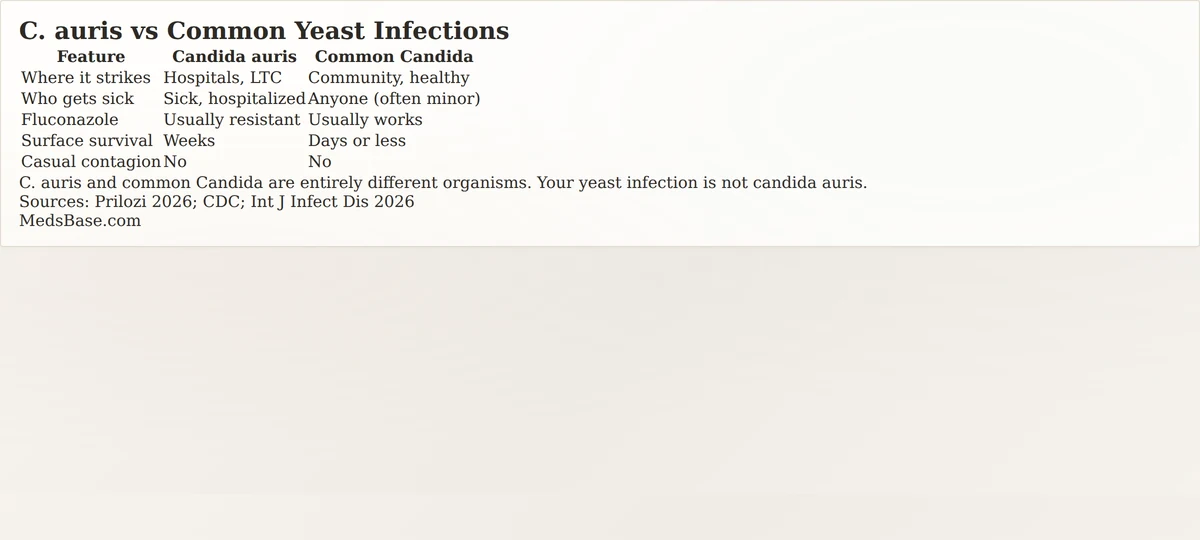
Candida auris vs Common Yeast Infections
| Feature | Candida auris | Common Candida (thrush, yeast infection) |
|---|---|---|
| Where it strikes | Hospitals, long-term care | Community, healthy people |
| Who gets sick | Sick, hospitalized patients | Anyone (often minor) |
| Fluconazole | Usually resistant | Usually works |
| Surface survival | Weeks | Days or less |
| Contagious to healthy contacts | No | No |
Which fits which situation? If you have a routine yeast infection, thrush, or athlete’s foot, you are dealing with the common, treatable end of the fungal spectrum — and standard antifungals like fluconazole or terbinafine are usually highly effective. C. auris is a different organism, in a different setting, and the two should not be conflated.
How Hospitals Contain It — a Look Behind the Scenes
Because C. auris is so good at lingering on surfaces and spreading silently, hospitals treat a single confirmed case as a potential outbreak. The control playbook is methodical:
- Colonization screening. When a case is found, facilities often swab roommates and nearby patients to find silent carriers — the colonized-but-not-sick patients who are still shedding yeast.
- Contact precautions. Colonized and infected patients are isolated or cohorted, and staff wear gowns and gloves for room entry.
- Aggressive environmental cleaning. C. auris requires disinfectants that are effective against fungi — ordinary cleaning isn’t enough, and the yeast can survive standard quaternary-ammonium wipes.
- Chlorhexidine bathing. Patients may be bathed with antiseptic solutions to reduce skin colonization and lower the odds of the yeast entering a device site.
This is why containment is so expensive and disruptive: it touches staffing, housekeeping, lab capacity, and the physical layout of a ward. That cost, more than the disease itself, is what keeps infection-control teams up at night — a single missed carrier can restart the whole cycle.
The takeaway for you: if you visit someone in a hospital or care facility, follow the posted precautions. If a sign says “gown and gloves required,” it isn’t bureaucracy — it’s the wall between a resistant yeast and the next patient.
The Global Picture — Why This Isn’t Just a U.S. Story
It would be a mistake to think of C. auris as an American problem. The fungus has been reported on nearly every continent, and the Türkiye outbreak described in the International Journal of Infectious Diseases study is a reminder that it thrives wherever healthcare systems are under pressure. That investigation traced 119 bloodstream infections back to a single source patient whose strain spread across 21 wards — a textbook illustration of how one unrecognized case can cascade.
The independent emergence of multiple genetic clades also means there’s no single “patient zero” to blame. Environmental and agricultural factors — including antifungal use in farming — are suspected contributors to the rise of resistant fungal species generally, though the evidence is still being assembled. What’s clear is that C. auris rewards vigilance and punishes complacency, everywhere.
Treatment & Prevention
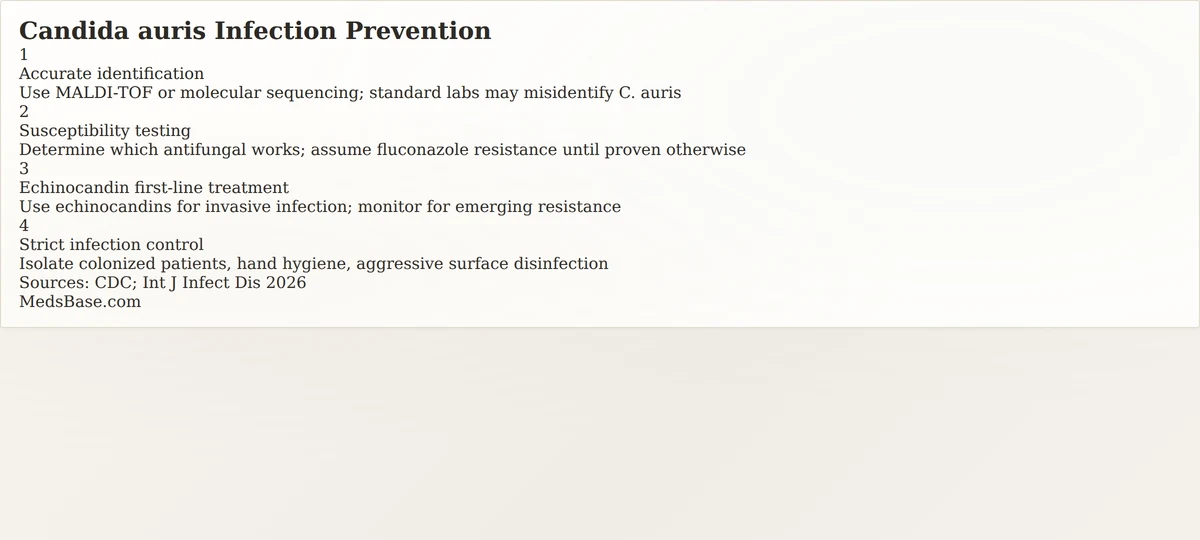
Because C. auris is often resistant to first-line drugs, treatment requires:
- Accurate identification. Standard lab methods can misidentify C. auris as another Candida species — a key reason it spread silently. Specialized testing is needed.
- Susceptibility testing to determine which antifungal will actually work.
- Echinocandins as the usual first choice for invasive infection, with careful monitoring now that resistance has appeared.
- Strict infection control — isolating colonized patients, rigorous hand hygiene, and thorough surface disinfection are the real weapons against spread.
For the far more common fungal infections that do affect everyday life — athlete’s foot, ringworm, thrush, nail fungus — effective topical and oral antifungals are widely available. If you’re looking to treat a routine fungal infection, MedsBase carries a range of antifungal treatments in its Fungal Infection category.
Here’s a practical example of how the risk divide works in real life. Take Mark, 52, who has diabetes and is recovering from abdominal surgery with a fresh incision and a urinary catheter in place. If C. auris is present on his ward, his infection risk is real — wound colonization can progress to candidemia. Now take Mark’s wife, who visits him and helps with meals. She can transfer the yeast on her hands if hygiene is skipped after touching surfaces in the room, but her chance of becoming sick from it is essentially zero. She should wash her hands thoroughly when leaving, but she does not need to avoid the hospital — and she definitely doesn’t need antifungal prophylaxis. The risk spectrum is that narrow.
Frequently Asked Questions
Q: What is candida auris?
A: Candida auris is a species of yeast that causes serious, often drug-resistant infections in hospitalized patients. First identified in 2009, it spreads in healthcare settings and resists the most common antifungal, fluconazole.
Q: Is candida auris contagious?
A: Candida auris is not contagious through casual contact. It spreads in hospitals and care facilities via contaminated surfaces, equipment, and the hands of healthcare workers — primarily to patients who are already sick or have invasive devices.
Q: How do you get candida auris?
A: You get candida auris by exposure in a healthcare setting, typically through a catheter, central line, breathing tube, or surgical wound — not from everyday activities. Healthy people in the community are at very low risk.
Q: Is candida auris deadly?
A: Invasive C. auris bloodstream infections carry a high mortality rate — around 54% in one recent outbreak — but this reflects how sick the affected hospitalized patients already are. The yeast rarely threatens otherwise healthy people.
Q: How is candida auris treated?
A: Because C. auris is often fluconazole-resistant, treatment relies on susceptibility testing and usually the echinocandin class of antifungals, sometimes combined with amphotericin B. Some strains are now resistant to echinocandins too.
Q: Can candida auris be cured?
A: Candida auris infections can be treated when the right antifungal is selected by susceptibility testing and the underlying condition improves. However, the yeast can persist in the environment, so prevention and infection control are just as important as treatment.
The Bottom Line
Candida auris is a genuine and growing challenge — for hospitals, for infection-control teams, and for the small number of seriously ill patients it affects. It deserves the attention it’s getting. But the honest verdict for most readers is reassuring: if you’re healthy, this is not your crisis. The one action worth taking is simple awareness — support good hygiene in any care setting and use antifungal medications appropriately.
If you’re caring for someone in a hospital or facility and have questions about infection-control precautions, ask the care team directly. Want to understand a related resistance story in a different germ? Read our guide on the once-weekly HIV pill and why combination therapy matters. And if a common fungal infection is what’s bothering you, MedsBase has antifungal options in its Fungal Infection category.

Written by
Sophie ChenPharmaceutical Content Researcher · 8 years experience
Sophie Chen is a pharmaceutical content researcher with 8 years covering generic medication access and clinical pharmacology. She specialises in international regulatory frameworks, bioequivalence standards, and patient-facing education on therapeutic drug classes. She is not a clinician.