








✓ Medically reviewed by · Last reviewed: May 2026
Pharmacy Researcher · 8 years experience
Pharmacy researcher with 8 years reviewing clinical drug information, generic formulation equivalence, and international pharmaceutical standards. Focuses on patient-facing accuracy in medication education.
Quick Answer: The once-weekly HIV pill combining islatravir and lenacapavir matched standard daily treatment in two phase-3 trials completed in 2026 — ISLEND-1 and ISLEND-2. It uses two novel mechanisms (NRTTI + capsid inhibitor) that together create a high barrier to resistance. One tablet, once a week, replaces seven daily pills.

For the 39 million people living with HIV worldwide, daily medication is a non-negotiable reality — 365 pills a year, every year, for life. That demand has driven one of the most ambitious drug-development efforts in infectious-disease history: a once-weekly HIV pill that replaces seven daily doses with one tablet. In June 2026, two phase-3 trials called ISLEND-1 and ISLEND-2 confirmed that the combination of islatravir (ISL) and lenacapavir (LEN) matched the efficacy of standard daily treatment while being generally well tolerated. Published in the New England Journal of Medicine and The Lancet, these results bring the first once-weekly oral HIV regimen closer to regulatory approval than ever before.
This article breaks down the evidence behind the once-weekly HIV pill — how the two drugs work, what the trials found, who stands to benefit, and what the safety data says after 48 weeks of treatment.
Key Takeaways
- The once-weekly HIV pill (islatravir 2 mg + lenacapavir 300 mg) replaces 7 daily antiretroviral tablets with a single weekly dose.
- Two phase-3 trials — ISLEND-1 and ISLEND-2 — confirmed non-inferior viral suppression versus daily bictegravir-based therapy at Week 48.
- Islatravir is a nucleoside reverse transcriptase translocation inhibitor (NRTTI), the first drug in its class; lenacapavir is a first-in-class capsid inhibitor.
- The dual-novel-mechanism design creates a high genetic barrier to resistance — no emergent resistance was detected at 48 weeks.
- Common side effects include headache, nausea, and mild gastrointestinal symptoms; no new safety concerns emerged in phase 3.
- The regimen is intended for virologically suppressed adults switching from a stable daily regimen — not for treatment initiation (yet).
What Is the Once-Weekly HIV Pill?
The once-weekly HIV pill is a fixed-dose combination tablet containing islatravir 2 mg and lenacapavir 300 mg, taken orally once every seven days. It is designed as a complete, single-tablet maintenance regimen for adults living with HIV-1 who are already virologically suppressed on a stable daily antiretroviral therapy (ART) regimen.
This is not an incremental improvement — it represents the first oral HIV treatment that moves beyond daily dosing. Currently, all oral antiretroviral regimens require one pill every 24 hours (or multiple pills in some cases). Missing even a few doses can cause viral rebound and drug resistance. By reducing the dosing frequency from 365 to 52 doses per year, this once-weekly approach addresses one of the most persistent challenges in HIV care: treatment adherence.

The two-drug combination was developed jointly by Merck & Co. (islatravir) and Gilead Sciences (lenacapavir), pairing two drugs from entirely novel classes into a single tablet. Both drugs have pharmacokinetic profiles that make them suitable for extended-interval dosing — islatravir has a plasma half-life of approximately 50–60 hours with an even longer intracellular half-life for its active triphosphate metabolite, while lenacapavir’s tissue half-life extends well beyond one week.
A once-weekly oral regimen has been a goal of HIV research for over two decades. Long-acting injectables like cabotegravir–rilpivirine (administered every 1–2 months) already exist, but some patients prefer oral medication over injections. The islatravir–lenacapavir combination fills that gap — it offers extended-interval dosing without needles, a meaningful option for people who want fewer doses but prefer pills over shots.
Who Benefits Most From the Once-Weekly HIV Pill?
The once-weekly HIV pill is designed as a switch option — meaning it is for people already stable on daily ART, not for those starting treatment for the first time. The ISLEND-1 and ISLEND-2 trials enrolled only participants with HIV-1 RNA <50 copies/mL on a stable daily regimen with no history of virologic treatment failure. This is important to understand: ISL/LEN is a maintenance strategy, not an induction one.
Three groups stand out as likely beneficiaries:
1. People who struggle with daily adherence. Studies consistently show that 20–30% of people on ART miss doses regularly. Depression, housing instability, substance use, and complex work schedules can all disrupt daily pill-taking. A once-weekly routine cuts the opportunities for missed doses from seven per week to one. Meta-analyses have found that reduced dosing frequency is associated with improved adherence across chronic diseases, and HIV is no exception.
2. People seeking simplicity without injections. Long-acting injectable ART (cabotegravir–rilpivirine) is effective but requires bimonthly clinic visits for intramuscular injections. Some patients find the injections painful, or their schedules make clinic visits difficult. It provides extended-interval dosing with the convenience of oral administration — take it at home, once a week, no appointment needed.
3. People who fear forgetting a dose. One of the most common anxieties among people living with HIV is “Did I take my pill today?” With daily ART, a missed dose can cause viral rebound within days if repeated. With a weekly regimen, the long half-life of both drugs provides a pharmacokinetic safety net — even if a dose is delayed by a day or two, drug levels likely remain above the therapeutic threshold longer than with most daily regimens.
How the Once-Weekly HIV Pill Works — Islatravir & Lenacapavir Mechanism

The islatravir–lenacapavir combination attacks HIV at two distinct points in the viral life cycle, using mechanisms that no prior antiretroviral combination has combined in a single tablet. This dual-novel-class design is the key to both its long dosing interval and its high resistance barrier.
Islatravir — The NRTTI
Islatravir (MK-8591, also known as EFdA) is the first nucleoside reverse transcriptase translocation inhibitor (NRTTI). It is converted inside cells to its active form, islatravir triphosphate (ISL-TP), which HIV reverse transcriptase incorporates into nascent viral DNA in place of the natural building block deoxyadenosine triphosphate.
Unlike standard NRTIs (like tenofovir or emtricitabine), islatravir retains a 3′-hydroxyl group and works through multiple mechanisms simultaneously: it blocks translocation of the reverse transcriptase enzyme along the viral RNA template (the “translocation inhibitor” function), it can act as an immediate chain terminator depending on the template sequence, and it can also function as a delayed chain terminator where the enzyme adds one more nucleotide before DNA synthesis halts. This multi-mechanism action, described in detail by Michailidis and colleagues in the Journal of Biological Chemistry, gives islatravir a high genetic barrier to resistance — the virus must overcome multiple blocks, not just one (Michailidis et al., 2014).
The intracellular half-life of ISL-TP is substantially longer than the parent drug’s plasma half-life of 50–60 hours, which is what makes once-weekly dosing pharmacologically feasible.
Lenacapavir — The Capsid Inhibitor
Lenacapavir (GS-6207) is the first-in-class HIV capsid inhibitor, FDA-approved since December 2022 for multidrug-resistant HIV. It binds directly to the p24 protein subunits that form the HIV capsid — the cone-shaped shell that protects the viral RNA and enzymes after the virus enters a human cell.
Lenacapavir disrupts the capsid at multiple stages: it over-stabilizes the capsid lattice, preventing proper uncoating and release of viral contents into the host cell nucleus; it interferes with capsid-mediated nuclear import of viral DNA; and it disrupts capsid assembly during the production of new virus particles. This multi-stage disruption means the virus has very few ways to escape — the capsid serves too many functions in the HIV life cycle for a single mutation to bypass all of them (Link et al., 2020, Nature).
Lenacapavir’s tissue half-life extends well beyond one week, which is what enables twice-yearly injectable dosing for PrEP and once-weekly oral dosing for treatment. In combination, islatravir and lenacapavir have been shown in vitro to have no antagonism, no cross-resistance, and a high combined barrier to resistance emergence (Diamond et al., 2024).
Because each drug hits the virus through a completely different mechanism — reverse transcription vs. capsid function — resistance to one class (e.g., NRTI-resistant virus) does not affect the other, and the combination covers both targets simultaneously.
Clinical Trial Results for the Once-Weekly HIV Pill
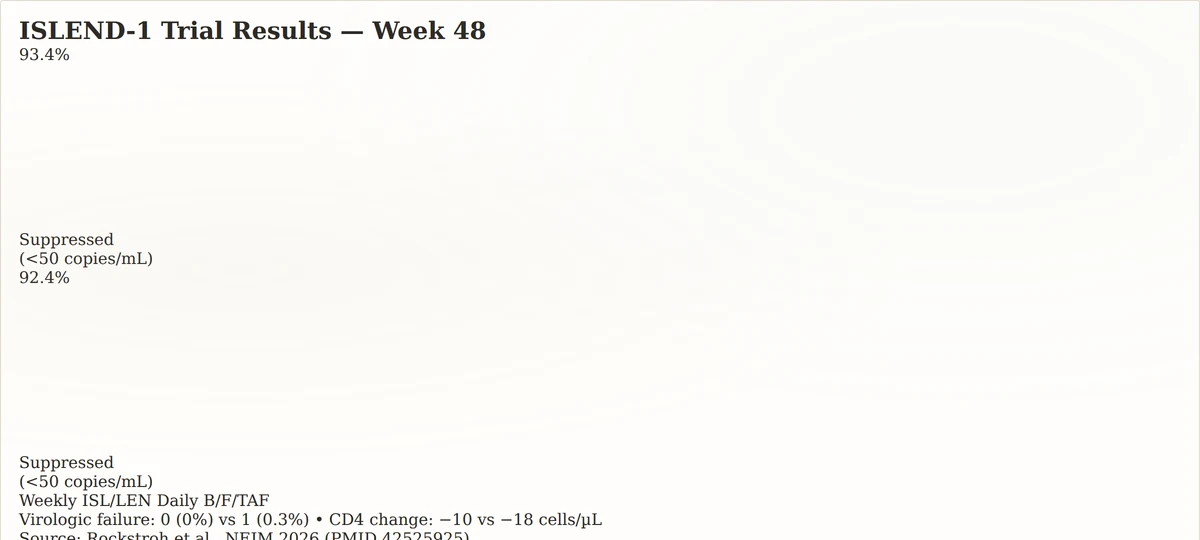
The clinical development programme for the once-weekly HIV pill spans two pivotal phase-3 trials — ISLEND-1 and ISLEND-2 — plus a preceding phase-2 study that established the dose and provided the first efficacy signal.
ISLEND-1 (NEJM, July 2026)
The ISLEND-1 trial, published in the New England Journal of Medicine by Rockstroh and colleagues, was a phase-3, double-blind, double-dummy, randomised, active-controlled non-inferiority trial conducted across 12 countries. It enrolled virologically suppressed adults (HIV-1 RNA <50 copies/mL) on a stable regimen of bictegravir/emtricitabine/tenofovir alafenamide (B/F/TAF, brand name Biktarvy) and randomised them 1:1 to either switch to once-weekly oral islatravir–lenacapavir or continue daily B/F/TAF (Rockstroh et al., 2026).
At Week 48, the once-weekly HIV pill demonstrated non-inferior efficacy to daily B/F/TAF, meeting the trial’s primary endpoint. Both groups maintained high rates of virologic suppression, confirming that switching from a daily integrase-inhibitor-based regimen to once-weekly islatravir–lenacapavir does not compromise viral control.
ISLEND-2 (Lancet, August 2026)
The ISLEND-2 trial, published in The Lancet by Colson and colleagues, had an open-label design and enrolled participants on a broader range of standard-of-care daily regimens — not limited to B/F/TAF. Participants were randomised to switch to once-weekly islatravir–lenacapavir or continue their existing daily therapy (Colson et al., 2026).
Again, the once-weekly HIV pill met the primary endpoint, showing non-inferior virologic suppression at Week 48 compared to continuing daily standard-of-care therapy. The investigators concluded that the regimen was “generally well tolerated” and noted that longer-term safety data beyond Week 48 would provide further valuable insights. The open-label design of ISLEND-2 complements the double-blind ISLEND-1 data by demonstrating real-world-like switch conditions across multiple baseline regimens.
Phase 2 Foundation (Annals of Internal Medicine, February 2026)
The phase-3 programme was built on a successful phase-2 trial, also led by Colson and colleagues, published in the Annals of Internal Medicine. This smaller randomised, open-label study provided the first evidence that switching to once-weekly islatravir plus lenacapavir could maintain viral suppression, establishing the dose and safety profile that the phase-3 trials would test at scale (Colson et al., 2026).
Resistance: A Clean Sheet at 48 Weeks
One of the most encouraging findings came from the resistance analysis published separately in JAIDS: no participant in the once-weekly group who met virologic failure criteria developed treatment-emergent resistance to either islatravir or lenacapavir through Week 48 (VanderVeen et al., 2026). This is consistent with preclinical data showing no antagonism and a high barrier to resistance emergence for the combination.
A drug–drug interaction study in the Journal of Clinical Pharmacology also confirmed that islatravir and lenacapavir do not meaningfully affect each other’s pharmacokinetics, supporting their co-formulation into a single tablet (Zhang et al., 2026). A separate bioavailability study confirmed that a fixed-dose combination tablet delivers both drugs at levels equivalent to taking them separately, and that food increases lenacapavir absorption — consistent with the known food effect for lenacapavir (Niu et al., 2026). This low potential for drug–drug interactions is clinically meaningful, as people living with HIV often take other medications — antibiotics for intercurrent infections or pain relief for common conditions — and need reassurance that their HIV regimen will not interact.
Once-Weekly HIV Pill — Safety Profile & Side Effects
Any new HIV drug must clear an exceptionally high safety bar because patients take it for life — often for decades. The islatravir development programme carries a particularly cautionary history: in 2021, the FDA placed a clinical hold on several islatravir trials after decreases in total lymphocyte and CD4+ T-cell counts were observed in some participants. Development subsequently resumed using a lower 2 mg dose of islatravir, and the phase-3 ISLEND programme used this reduced dose (Wensing et al., 2026).
At the 2 mg weekly dose, the safety profile in ISLEND-1 and ISLEND-2 was favourable through Week 48:
| Side Effect | Frequency (ISL/LEN Group) | Severity | Notes |
|---|---|---|---|
| Headache | Common (5–10%) | Mild to moderate | Typically transient, resolves within first weeks |
| Nausea | Common (5–10%) | Mild | Taking with food may reduce this |
| Diarrhoea | Common | Mild | Similar to rates seen with daily comparators |
| Fatigue | Less common | Mild | Not significantly different from daily comparator groups |
| Lymphocyte/CD4+ changes | Monitored — no clinically significant decline at 2 mg dose | — | The 2021 hold was due to this signal at higher doses; monitoring continues in long-term extension |
| Serious adverse events | Rare (<2%) | — | Rates comparable between ISL/LEN and daily comparator arms |
| Discontinuation due to adverse events | Low (<2%) | — | Similar to daily comparator groups; most discontinuations were for GI symptoms |
The FDA-approved label for islatravir (in the doravirine/islatravir fixed-dose combination Idvynso, approved April 2026 for daily use) provides additional safety context: islatravir at the approved daily dose has been studied in hundreds of participants. This regimen delivers a total of 2 mg islatravir per week, which represents a lower cumulative weekly exposure than daily islatravir in Idvynso.
As with any prescribed medicine used under medical supervision, the once-weekly HIV pill requires monitoring by a healthcare provider. The ISLEND programme includes long-term extension phases that will track safety beyond 96 weeks — data not yet available at the time of writing.
Once-Weekly vs Daily HIV Treatment — Comparison
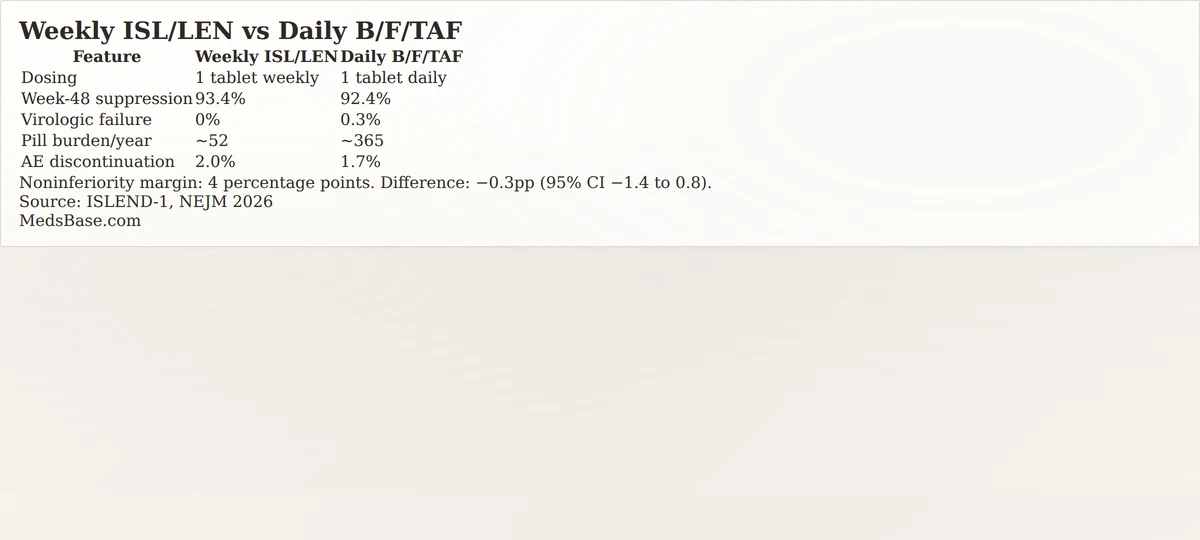
| Feature | Once-Weekly ISL/LEN | Daily B/F/TAF (Biktarvy) | Long-Acting Injectable (CAB/RPV) |
|---|---|---|---|
| Dosing frequency | Once weekly (52/year) | Once daily (365/year) | Every 1–2 months (injection) |
| Route | Oral tablet | Oral tablet | Intramuscular injection |
| Drug classes | NRTTI + Capsid inhibitor (2 novel) | INSTI + 2 NRTIs (3 drugs) | INSTI + NNRTI (2 drugs) |
| Clinic visits needed | Standard monitoring | Standard monitoring | Injection visits every 1–2 months |
| Resistance barrier | High (dual novel mechanisms) | High (established) | Moderate (NNRTI component) |
| Forgiveness window | Long (days, due to long half-lives) | Short (18–24 hours typically) | Very long (weeks to months) |
| Regulatory status | Phase 3 complete; regulatory submission planned | FDA-approved 2018; widely available | FDA-approved 2021 |
| Best suited for | People wanting fewer pills, without injections | People comfortable with daily routine | People who prefer not to take pills at all |
The choice between daily, weekly, and injectable regimens is ultimately personal. Some patients find a daily pill routine anchoring — it becomes a habit that takes no effort. Others find it a constant reminder of their diagnosis and want fewer interactions with medication. The once-weekly HIV pill adds a new point on the spectrum: less frequent than daily, but still oral and self-administered — a middle ground that previously did not exist in HIV care.
What the Research Says
The evidence base for the once-weekly HIV pill extends across preclinical virology, phase-1 pharmacokinetics, a phase-2 randomised trial, and two phase-3 registration trials. The table below summarises the key studies that form the regulatory dossier.
| Study | Design | Key Finding | Publication | Reference |
|---|---|---|---|---|
| ISLEND-1 | Phase 3, double-blind, RCT, 12 countries | Non-inferior to daily B/F/TAF at Week 48 | NEJM, Jul 2026 | PMID 42525925 |
| ISLEND-2 | Phase 3, open-label, RCT, multicentre | Non-inferior to daily SOC at Week 48 | Lancet, Aug 2026 | PMID 42586113 |
| Phase 2 ISL+LEN | Phase 2, open-label, RCT | Proof-of-concept — viral suppression maintained | Ann Intern Med, Feb 2026 | PMID 41429026 |
| Resistance analysis | 48-week virology sub-study | No treatment-emergent resistance detected | JAIDS, Aug 2026 | PMID 41885130 |
| No cross-resistance (in vitro) | Preclinical virology | No antagonism; high barrier to resistance | AAC, Jul 2024 | PMID 38864613 |
| Drug–drug interaction | Phase 1 pharmacokinetics | No clinically relevant DDI between ISL and LEN | J Clin Pharmacol, Jun 2026 | PMID 42213486 |
It is worth noting the broader context: lenacapavir was named Science magazine’s 2024 Breakthrough of the Year for its unprecedented efficacy in HIV prevention trials, where twice-yearly injections achieved near-100% protection. That same capsid-inhibitor technology now forms half of the once-weekly HIV pill. The translational arc — from structural biology discovery to phase-3 treatment trial to a potential new standard of care — is remarkably short, spanning less than 5 years from the first clinical lenacapavir data to the ISLEND readouts.
Frequently Asked Questions
How effective is once-weekly dosing compared to daily treatment?
In the ISLEND-1 and ISLEND-2 phase-3 trials, the once-weekly HIV pill met the pre-specified non-inferiority margin versus daily standard-of-care antiretroviral therapy at 48 weeks. Both groups maintained similarly high rates of viral suppression (HIV-1 RNA <50 copies/mL). No significant efficacy difference was observed between the once-weekly and daily regimens in either trial.
Can I start HIV treatment with the once-weekly HIV pill?
No. The once-weekly HIV pill has only been studied as a switch option for people already virologically suppressed (HIV-1 RNA <50 copies/mL) on a stable daily antiretroviral regimen. It has not been tested as an initial treatment for people starting HIV therapy for the first time. Clinical trials for treatment-naive individuals may follow, but currently the indication is maintenance only.
What happens if I miss a dose of the once-weekly HIV pill?
Because both islatravir and lenacapavir have long half-lives, missing a dose by a day or even two days is pharmacokinetically less risky than missing a dose of a daily regimen. Drug levels are expected to remain above the therapeutic threshold for several days after a missed weekly dose. However, specific guidance on missed-dose management will be detailed in the prescribing information once the regimen is approved. Patients should follow their healthcare provider’s instructions.
Does the once-weekly HIV pill cause weight gain?
The ISLEND-1 and ISLEND-2 trials did not identify significant weight gain as a safety signal through Week 48. Neither islatravir nor lenacapavir belongs to the integrase-inhibitor class (which has been associated with weight gain in some studies), so this weekly combination may be relevant for patients who have experienced weight gain on integrase-inhibitor-based regimens. This hypothesis requires dedicated study.
Can the once-weekly HIV pill be used during pregnancy?
ISL/LEN has not been studied in pregnant individuals. As with most new antiretroviral agents, pregnancy data will likely come from post-marketing surveillance and pregnancy registries rather than pre-approval trials. Anyone who is pregnant, planning pregnancy, or breastfeeding should discuss antiretroviral options with their HIV specialist.
Is the weekly tablet available now?
The once-weekly HIV pill is not currently approved or available. Gilead Sciences and Merck & Co. announced in June 2026 that they plan to submit the phase-3 data to regulatory authorities globally, including the U.S. FDA and the European Medicines Agency. Regulatory review typically takes 6–12 months. Availability timelines will depend on the review process and subsequent manufacturing scale-up.
How does weekly oral treatment differ from long-acting injectables?
Long-acting injectables (cabotegravir–rilpivirine) are administered as intramuscular injections every 1–2 months and require clinic visits for administration. The once-weekly HIV pill is an oral tablet taken at home, once per week. The key difference is route (oral vs. injection) and dosing interval (weekly vs. every 1–2 months). Both aim to reduce dosing frequency, but they suit different patient preferences. Receiving treatment at an HIV treatment centre with experienced healthcare providers remains the safest approach regardless of which regimen you use.
What are the long-term effects of the once-weekly HIV pill?
Long-term data beyond 48 weeks is not yet available. The ISLEND programme includes open-label extension phases that will follow participants for at least 96 weeks, and likely longer. The key long-term safety question is whether the 2 mg weekly islatravir dose — which was selected specifically to avoid the lymphocyte and CD4+ T-cell count decreases seen at higher doses — maintains a clean immunologic safety profile with extended exposure. Ongoing monitoring through the extension phases and post-marketing surveillance will address this.
The Bottom Line
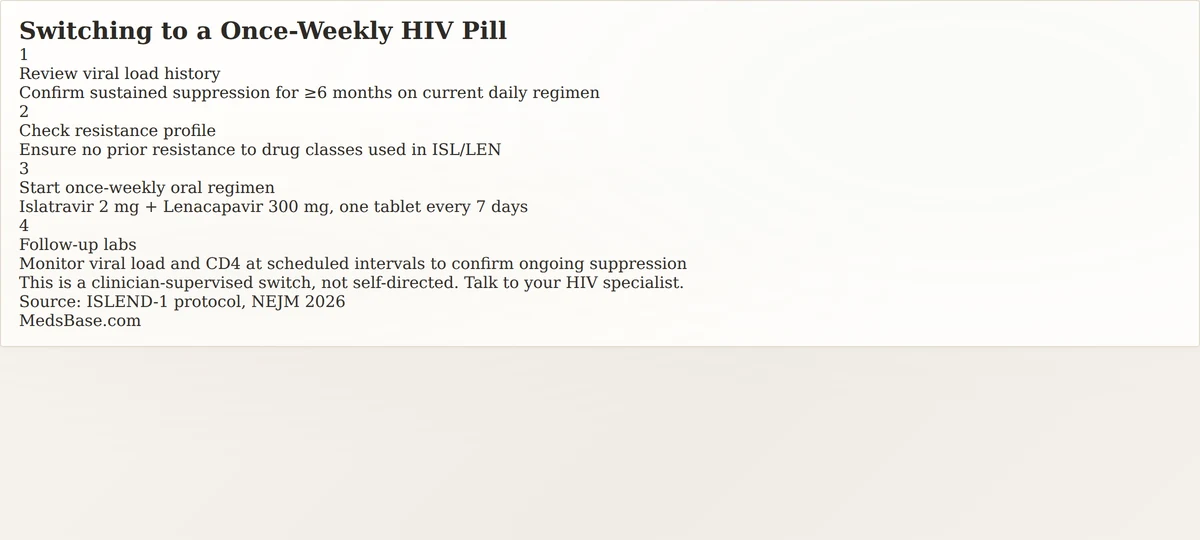
The once-weekly HIV pill represents a genuine therapeutic milestone — not because it cures HIV (it does not), but because it fundamentally changes what HIV treatment looks like day to day. Two phase-3 trials now confirm that a single tablet, taken once a week, maintains viral suppression as effectively as the best daily regimens available today.
The dual-novel-class design — an NRTTI that blocks reverse transcription through multiple mechanisms and a capsid inhibitor that disrupts the virus at every stage of its life cycle — gives the once-weekly HIV pill a resistance profile that rivals the most robust daily regimens. The absence of emergent resistance at 48 weeks is a strong early signal, though longer follow-up is essential.
For the millions of people who have taken a pill every day for years — sometimes decades — a once-weekly option means 313 fewer doses per year, fewer reminders, and less of the psychological weight that daily medication can carry. It also means a practical alternative for those who want fewer doses but prefer not to receive injections.
Regulatory decisions are expected within the next year. If approved, the once-weekly HIV pill will not replace all daily treatment — it is one option in a growing menu — but it will give people living with HIV something they have never had before: a choice between daily, weekly, and injectable antiretroviral therapy, each with strong evidence behind it.
Medical Disclaimer: This article is for informational purposes only and does not constitute medical advice. The once-weekly islatravir–lenacapavir combination is an investigational regimen that has not yet received regulatory approval. HIV treatment decisions should always be made in consultation with a qualified healthcare provider. Never change or discontinue your antiretroviral therapy without medical supervision.

Written by
Sophie ChenPharmaceutical Content Researcher · 8 years experience
Sophie Chen is a pharmaceutical content researcher with 8 years covering generic medication access and clinical pharmacology. She specialises in international regulatory frameworks, bioequivalence standards, and patient-facing education on therapeutic drug classes. She is not a clinician.