








✓ Medically reviewed by · Last reviewed: May 2026
Pharmacy Researcher · 8 years experience
Pharmacy researcher with 8 years reviewing clinical drug information, generic formulation equivalence, and international pharmaceutical standards. Focuses on patient-facing accuracy in medication education.
GLP-1 medications and anesthesia risks — GLP-1 Medications and Anesthesia Risks: What Patients Need to Know Before Surgery. Read on for an evidence-backed guide covering everything you need to know.
# GLP-1 Medications and Anesthesia Risks: 7 Precautions Every Patient Should Take
GLP-1 medications and anesthesia risks — nearly 1 in 30 patients undergoing anesthesia in the UK now reports using a GLP-1 medication like Ozempic, Wegovy, or Mounjaro — and most of them never thought to mention it to their anesthesiologist. That silence can carry a real risk. GLP-1 medications and anesthesia risks have become one of the most urgent perioperative safety topics of 2026, and if you or someone you know takes one of these medications, there are concrete steps you should take before any surgical procedure.
GLP-1 medications and anesthesia risks — by the end of this guide, you will know exactly why GLP-1 medications and anesthesia can be a dangerous combination, how long you need to stop your medication before surgery, which procedures carry the highest risk, and the 7 precautions that every GLP-1 patient should follow. One of those precautions — a simple gastric ultrasound — could be the difference between a routine procedure and a life-threatening complication.
Key Takeaways
GLP-1 medications and anesthesia risks — gLP-1 medications slow your stomach from emptying food, an effect that can last 6–12+ hours even on an empty stomach — a detail most surgical fasting guidelines do not account for.
The American Society of Anesthesiologists recommends stopping GLP-1 medications before elective surgery — but the exact timing depends on which specific drug you take.
Pulmonary aspiration — stomach contents entering the lungs during anesthesia — is the primary concern, and while the absolute risk is low, it can be fatal.
One simple conversation with your anesthesia team, ideally a week or more before surgery, can dramatically reduce your risk.
- What Are GLP-1 Medications, and Why Are Millions Taking Them?
- How GLP-1 Medications Delay Stomach Emptying
- The Aspiration Risk Explained: Why Anesthesia and GLP-1s Don’t Mix
- What Do Official Guidelines Say?
- How Common Is This Risk?
- GLP-1 Medications: Which Ones Carry This Risk?
- 7 Precautions Every GLP-1 Patient Should Take Before Surgery
- Frequently Asked Questions
- The Bottom Line
What Are GLP-1 Medications, and Why Are Millions Taking Them? — GLP-1 medications and anesthesia risks Explained
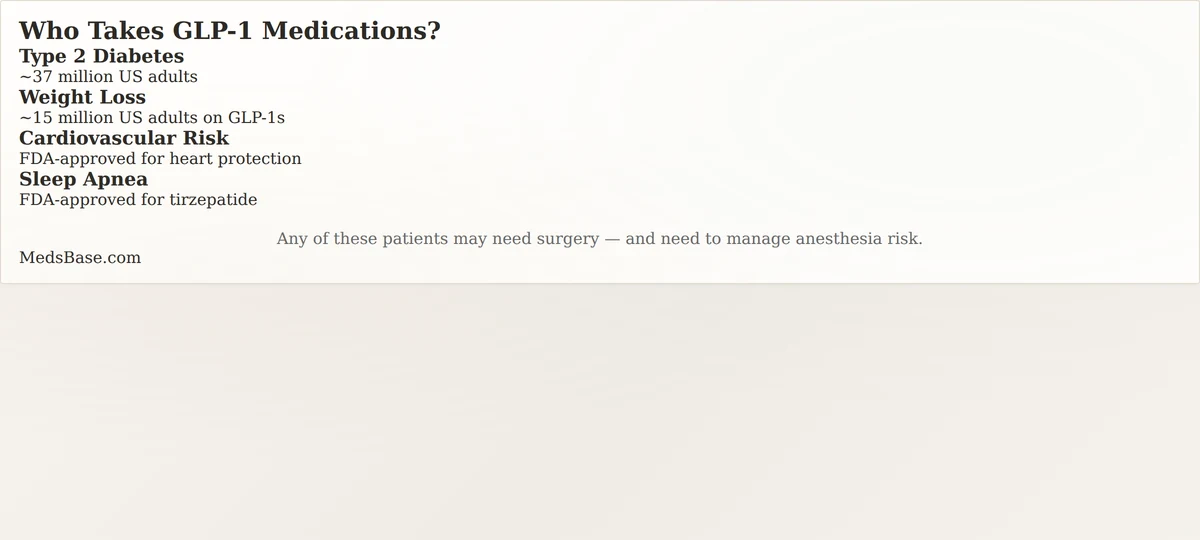
GLP-1 receptor agonists are a class of medications that mimic a natural hormone called glucagon-like peptide-1. Originally developed to treat type 2 diabetes, GLP-1 medications have exploded in popularity over the last five years because they also produce significant weight loss — in some cases, 15 to 20 percent of body weight. The most widely recognized names include semaglutide (Ozempic, Wegovy), tirzepatide (Mounjaro, Zepbound), liraglutide (Victoza, Saxenda), and dulaglutide (Trulicity).
As of early 2026, an estimated 15 million adults in the United States are taking a GLP-1 medication — and the number grows every month. These drugs have also earned FDA approvals for cardiovascular risk reduction and, most recently, for treating obstructive sleep apnea. That means GLP-1 users are not a narrow niche anymore; they are a substantial share of any hospital’s surgical patient population. With so many patients now on these medications, GLP-1 medications and anesthesia risks have moved from a niche concern to a mainstream perioperative safety issue that every surgical team needs protocols for.
Here is why that matters for anesthesia: GLP-1 medications do one thing particularly well — they slow down how quickly your stomach pushes food into your small intestine. This mechanism, called delayed gastric emptying, is part of why these drugs help with weight loss (you feel fuller for longer). But in the operating room, a stomach that has not fully emptied — even after 8 or 12 hours of fasting — creates a dangerous condition for general anesthesia. This is the core of why GLP-1 medications and anesthesia risks have drawn so much attention from professional societies — the conjunction of delayed gastric emptying and an unconscious patient is a setup for trouble if not actively managed.
How GLP-1 Medications Delay Stomach Emptying — GLP-1 medications and anesthesia risks Explained
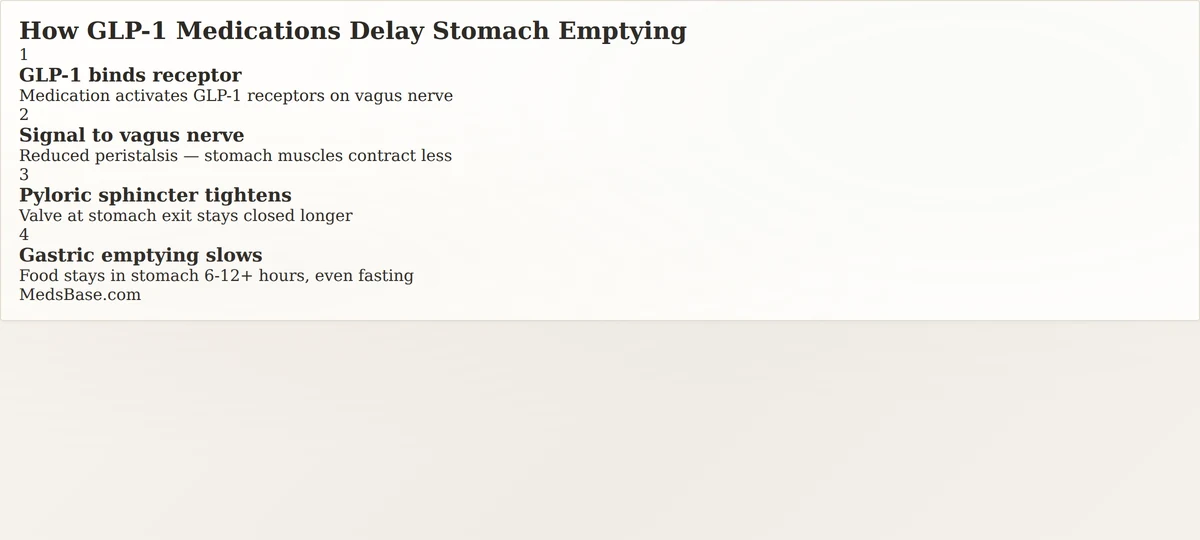
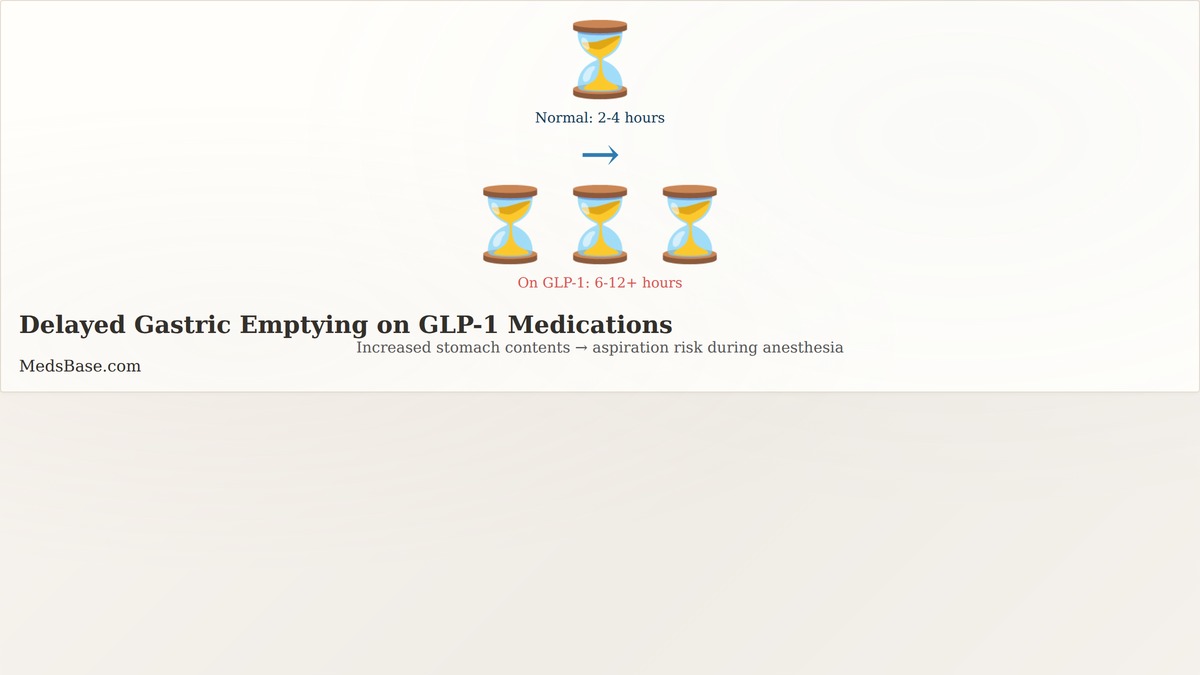
The stomach normally empties a solid meal in about 2 to 4 hours. On a GLP-1 medication, that window can stretch to 6 hours, 10 hours, or in some documented cases, longer — even if you have not eaten for half a day. A 2023 systematic review in a leading gastroenterology journal confirmed that GLP-1 receptor agonists significantly prolong gastric emptying time, an effect that persists for the duration of treatment and does not fully resolve on the day you skip a dose.
The mechanism works through three pathways. First, GLP-1 medications activate receptors on the vagus nerve, which sends signals from the brain to the stomach to reduce the muscular contractions (peristalsis) that push food forward. Second, they tighten the pyloric sphincter — the muscular valve at the bottom of your stomach that controls when food is released into the small intestine. Third, they act on the brain’s appetite centers to reduce hunger, which means you eat less and your stomach processes food more slowly even when you do eat. Understanding GLP-1 medications and anesthesia risks requires knowing all three pathways, because each contributes to why these drugs create a perioperative challenge.
Why standard fasting rules do not apply. Most surgical fasting guidelines tell you to stop eating solid food 6 to 8 hours before surgery and clear liquids 2 hours before. These rules were designed for people with normal gastric emptying. For someone on a GLP-1 medication, the stomach may still contain solid food residue 10 or 12 hours after their last meal — even though they feel empty and have followed the fasting instructions to the letter. You cannot rely on feeling hungry or full to gauge whether your stomach is actually empty, because GLP-1s make you feel full all the time. This is precisely why GLP-1 medications and anesthesia risks require a different set of rules than the standard pre-op fasting guidelines.
Research Spotlight — Gastric Emptying on Semaglutide
A 2022 study published in Diabetes, Obesity and Metabolism measured gastric emptying in people taking semaglutide. Using acetaminophen absorption testing (a validated method for measuring stomach emptying rate), researchers found that gastric emptying was delayed by approximately 38 percent in semaglutide users compared to placebo. The effect was measurable for the full duration of the 20-week study and showed no signs of tachyphylaxis (the body adapting to the drug’s effect over time).
What this means for you: The slowing effect of GLP-1 medications on your stomach is not something your body “gets used to” — it persists as long as you keep taking the drug. If you have surgery scheduled, simply skipping one dose the night before may not be enough to restore normal stomach emptying.
The Aspiration Risk Explained: Why Anesthesia and GLP-1s Don’t Mix — GLP-1 medications and anesthesia risks Explained
During general anesthesia, the protective reflexes that keep food and stomach acid from entering your airway and lungs are temporarily paralyzed. Your anesthesiologist places a breathing tube to protect your airway, but the most dangerous moment is during induction — the transition from awake to fully anesthetized — when stomach contents can silently flow up into the throat (regurgitation) and then into the lungs (aspiration).
Pulmonary aspiration of gastric contents is one of the most feared complications in anesthesiology. It can cause chemical pneumonitis — a severe inflammatory reaction in the lungs triggered by stomach acid — that can lead to respiratory failure, prolonged ICU stays, and in the most severe cases, death. Even a small volume of aspirated stomach contents can cause significant lung injury.
Why GLP-1 medications raise the stakes. In a patient with normal gastric emptying, 6 to 8 hours of fasting means the stomach is nearly empty — typically less than 25 milliliters of residual volume. In a patient on a GLP-1 medication, that same 6- to 8-hour fast may leave 100 milliliters or more of residual gastric contents, significantly increasing both the likelihood and the potential severity of an aspiration event. The risk is especially pronounced with semaglutide and tirzepatide, which have the longest half-lives in the GLP-1 class. When anesthesiologists discuss GLP-1 medications and anesthesia risks with their patients, this residual gastric volume differential is the single biggest factor they evaluate.
A comprehensive review of perioperative pulmonary aspiration published in a leading anesthesia journal found that delayed gastric emptying — whether from medications, diabetes, or other causes — is one of the most important modifiable risk factors for aspiration under anesthesia. The good news: it is highly modifiable. The right precautions, applied before surgery, can reduce your risk back toward baseline. Put differently: GLP-1 medications and anesthesia risks are a solvable problem, not an unavoidable one.
What Do Official Guidelines Say?
The American Society of Anesthesiologists (ASA) issued guidance in June 2023 specifically addressing GLP-1 medications and anesthesia risks. Their core recommendation: patients taking GLP-1 receptor agonists should hold the medication before elective surgery. The ASA did not issue a one-size-fits-all number of days, because the appropriate stop time depends on the specific drug’s dosing schedule and half-life, but their guidance provides a clear framework:
- Daily-dosed GLP-1s (oral semaglutide/Rybelsus, liraglutide/Victoza): Hold the morning dose on the day of surgery.
- Weekly-dosed GLP-1s (semaglutide/Ozempic/Wegovy, dulaglutide/Trulicity): Hold the dose for at least one week before surgery. If the last dose was taken within the past 7 days, the anesthesia team should consider a “full stomach” protocol regardless of fasting status.
- Tirzepatide (Mounjaro/Zepbound): Given its longer half-life (~5 days), hold for at least one week and ideally schedule surgery just before the next scheduled dose would be due — effectively a 2-week window in some cases.
The ASA guidance on GLP-1 medications and anesthesia risks represents the most authoritative clinical framework available for patients and providers navigating this issue.
Beyond just holding the medication, the ASA guidance also recommends that anesthesia teams consider performing a gastric ultrasound at the bedside for any GLP-1 patient who has not followed the recommended withholding period. Gastric ultrasound is a quick, non-invasive scan that can directly visualize whether the stomach still contains food or fluid — providing objective data that fasting history alone cannot. For patients seeking a complete understanding of GLP-1 medications and anesthesia risks, gastric ultrasound is one of the most concrete risk-mitigation tools available.
How Common Is This Risk?
In October 2026, a survey presented at the Anesthesia Association meeting in the United Kingdom revealed that 2.9 percent of patients undergoing anesthesia reported receiving GLP-1 receptor agonists — a much higher figure than most anesthesia providers expected. The same data indicated that pulmonary aspiration and regurgitation events were observed more frequently in GLP-1 users, though precise event rates were still being analyzed.
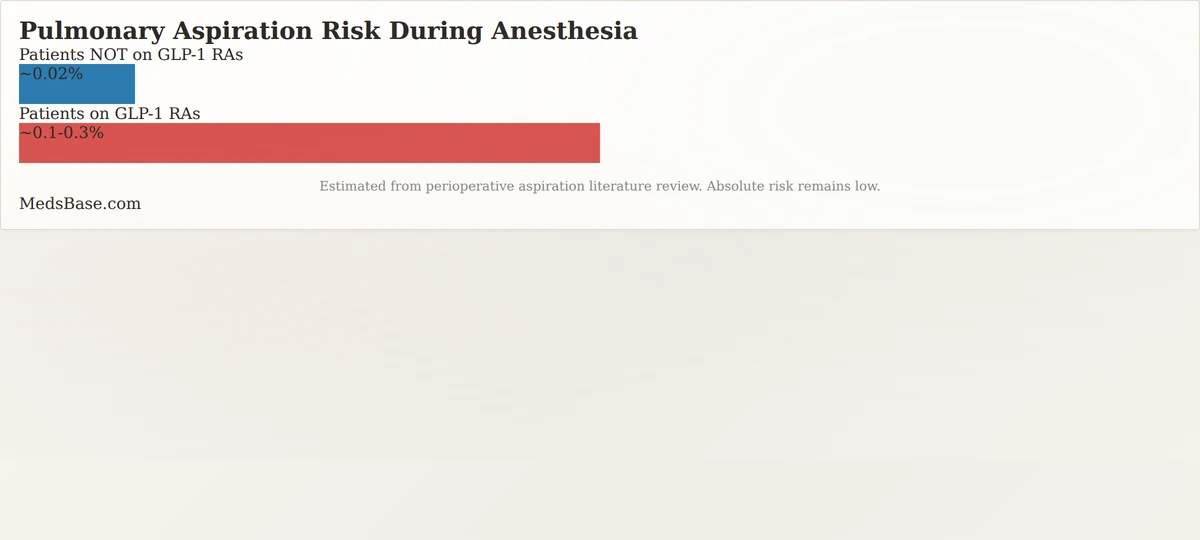
To put these numbers in perspective, the baseline risk of pulmonary aspiration during general anesthesia in the general population is approximately 1 in 4,000 to 1 in 10,000 procedures (0.01 to 0.025 percent). In patients with known risk factors — including delayed gastric emptying, diabetes with gastroparesis, emergency surgery, and obesity — the risk can be several times higher. GLP-1 medications add to this risk profile by pharmacologically inducing delayed gastric emptying in a population that already tends to have higher baseline surgical risk (people with diabetes and/or obesity).
What “increased risk” actually means for you. If 1 in 5,000 general-anesthesia patients aspirate at baseline, and GLP-1 use raises the relative risk by 3- to 5-fold, the absolute risk remains low — roughly 1 in 1,000 to 1 in 2,000. Low absolute risk does not mean zero risk. But it does mean you should take the precautions seriously without panicking. The risk is manageable when your anesthesia team knows what they are dealing with ahead of time. The body of evidence on GLP-1 medications and anesthesia risks is growing, and the consistent message from that evidence is that awareness and preparation close the risk gap almost entirely.
GLP-1 Medications: Which Ones Carry This Risk?
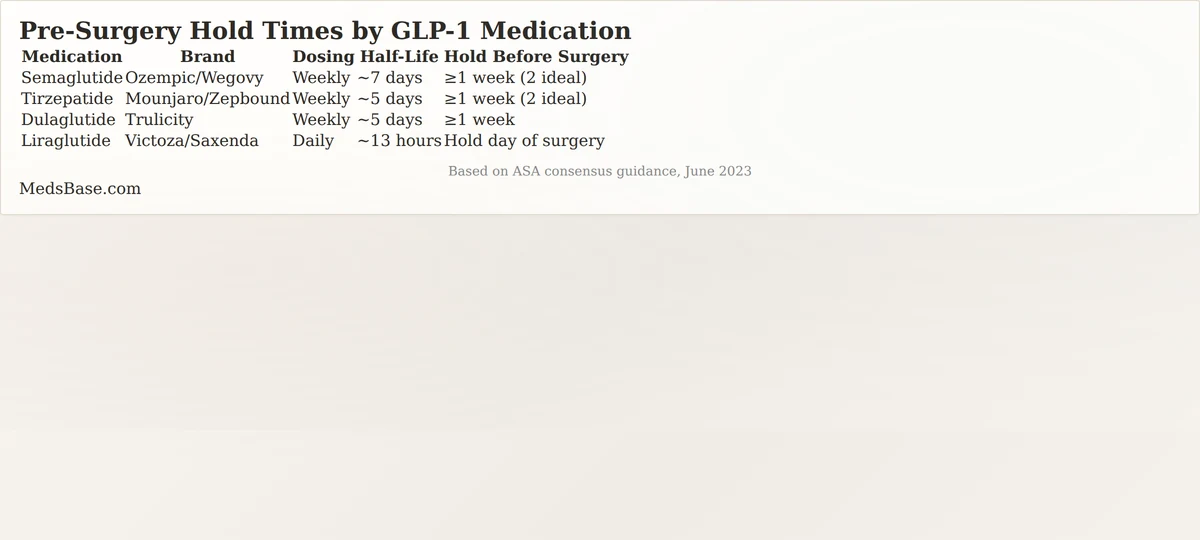
All GLP-1 receptor agonists slow gastric emptying — it is part of how the drug class works. However, the degree and duration of the effect varies.
| Medication | Brand Names | Dosing | Half-Life | Recommended Pre-Surgery Hold |
|---|---|---|---|---|
| Semaglutide | Ozempic, Wegovy, Rybelsus | Weekly (inj) / Daily (oral) | ~7 days | Hold ≥1 week; consider 2 weeks |
| Tirzepatide | Mounjaro, Zepbound | Weekly | ~5 days | Hold ≥1 week; consider 2 weeks |
| Dulaglutide | Trulicity | Weekly | ~5 days | Hold ≥1 week |
| Liraglutide | Victoza, Saxenda | Daily | ~13 hours | Hold day of surgery |
| Lixisenatide | Adlyxin | Daily | ~3 hours | Hold day of surgery |
| Exenatide | Byetta, Bydureon | Twice daily / Weekly | ~2.4 hours (IR) / prolonged (ER) | Hold day of surgery (IR); ≥1 week (ER) |
What this means for you: If you take a weekly GLP-1 medication such as Ozempic, Wegovy, Mounjaro, or Trulicity, a single missed dose 1–2 days before surgery is not enough to restore normal gastric emptying. The medication’s effect on your stomach persists for 5 to 7 days after your last injection, which is why guidelines recommend planning your surgery around your dosing schedule. This is the operational heart of GLP-1 medications and anesthesia risks — the pharmacology of these drugs means that the standard surgical fasting rules are insufficient.
7 Precautions Every GLP-1 Patient Should Take Before Surgery
Here is your practical checklist. GLP-1 medications and anesthesia risks can be managed — but only if you and your care team are deliberate about it. These seven precautions are drawn from the ASA guidance, published anesthesia literature, and clinical practice — and they reduce your risk back toward baseline when applied correctly.
1. Tell your anesthesiologist about your GLP-1 medication at the earliest possible moment. Do not wait until the day of surgery. At your pre-operative assessment visit — or at minimum, a phone call to the anesthesia department at least a week beforehand — disclose every medication you take, including GLP-1s. Many patients do not think of Ozempic or Wegovy as “medications I should mention for surgery” because they associate them with weight loss or diabetes management, not anesthesia. This is the single most important step. When researchers survey anesthesiologists about GLP-1 medications and anesthesia risks, the number-one complaint is that patients do not volunteer this information unless specifically asked.
2. Know your medication’s half-life and plan your dosing calendar backward from surgery. If you take a weekly GLP-1, count back from your surgery date. The ideal scenario is that your last dose was taken 10 to 14 days before the procedure. If your injection is due 3 days before surgery, talk to your prescriber about whether to delay that dose by a few days — do not make this decision on your own, but do raise the question.
3. Follow your fasting instructions with zero exceptions — and then add extra caution. Standard fasting means no solid food for 6–8 hours and no clear liquids for 2 hours before surgery. Because GLP-1 medications slow gastric emptying, some anesthesiologists now recommend extending the solid-food fast to 10 or even 12 hours for GLP-1 patients. Ask your anesthesia team what they recommend. And when they say “nothing by mouth,” they mean nothing — not even a sip of water to take other morning pills unless specifically cleared.
4. Ask whether a gastric ultrasound is appropriate. Bedside gastric ultrasound uses a small ultrasound probe placed on your upper abdomen to directly visualize whether your stomach contains food or fluid. It takes less than 5 minutes and provides objective reassurance that your stomach is truly empty — or, conversely, alerts the anesthesia team to use a “full stomach” rapid-sequence induction protocol to protect your airway. Many hospitals now offer this as standard for GLP-1 patients. The role of gastric ultrasound in managing GLP-1 medications and anesthesia risks has expanded rapidly as the evidence base has grown.
5. Discuss whether your other medications need adjustment too. GLP-1 medications are often taken alongside metformin, SGLT2 inhibitors, blood pressure medications, or other drugs that have their own perioperative considerations. Your anesthesia team will want a complete medication list to coordinate which drugs to hold and which to continue. SGLT2 inhibitors (empagliflozin, dapagliflozin), for example, also carry anesthesia-related risks and are typically held 3–4 days before surgery.
6. Have a post-surgery restart plan. Do not automatically resume your GLP-1 medication the day after surgery. Your gastrointestinal function may be sluggish from the combination of anesthesia, pain medications (especially opioids, which also slow gut motility), and post-surgical ileus. Wait until you are eating normally and passing gas or stool — signs that your GI tract is working again — before restarting. Your prescribing doctor should advise on exact timing.
7. Carry a written medication list with doses and timing. On the day of surgery, bring a printed list of every medication you take — name, dose, when you last took it, and when your next dose is due. Include supplements and over-the-counter drugs. Hand this to your preoperative nurse and anesthesiologist. In a busy pre-op area, verbal reporting gets lost; a printed list ensures the information reaches everyone who needs it.
Frequently Asked Questions
Q: Should I stop Ozempic before surgery?
A:
A: Yes, in most cases. The American Society of Anesthesiologists recommends holding weekly GLP-1 medications such as Ozempic (semaglutide) for at least one week before elective surgery. Because semaglutide has a half-life of approximately 7 days, its effects on gastric emptying persist for that duration. Ideally, your last dose should be 10 to 14 days before the procedure. Discuss the exact timing with both the doctor who prescribed your Ozempic and your anesthesia team.
Q: How long before surgery should I stop Wegovy?
A:
A: Wegovy contains the same active ingredient as Ozempic (semaglutide), so the same rules apply: hold for at least 7 days, and preferably 10 to 14 days, before surgery. Since Wegovy is dosed weekly, plan your surgery date so it falls right before your next scheduled dose would be due — that gives you the longest natural drug-free window without having to alter your dosing calendar.
Q: Can GLP-1 medications cause aspiration during anesthesia?
A:
A: GLP-1 medications increase the risk of aspiration indirectly by slowing gastric emptying. When the stomach still contains food or significant fluid after standard fasting periods, the risk of that material flowing backward into the throat and lungs during anesthesia induction rises. The direct cause is delayed gastric emptying from the medication; the complication is pulmonary aspiration. GLP-1 medications and anesthesia risks are closely linked through this mechanism, and the risk can be managed and substantially reduced with proper precautions.
Q: Why do GLP-1s delay stomach emptying?
A:
A: GLP-1 receptor agonists mimic the natural GLP-1 hormone, which signals the stomach to slow down its muscular contractions (peristalsis), tightens the pyloric sphincter that controls food release from the stomach, and reduces appetite through brain pathways. All three effects contribute to slower gastric emptying. This is an intended mechanism — it helps you feel full and reduces post-meal blood sugar spikes — but it becomes a concern in the context of anesthesia.
Q: Is it safe to have surgery while taking Mounjaro?
A:
A: With proper planning, surgery can be performed safely in patients who take Mounjaro (tirzepatide). The key is holding the medication for an appropriate period beforehand — at least 7 days — and informing your anesthesia team so they can take extra airway precautions if needed. Emergency surgery in a patient who has recently taken a GLP-1 requires a “full stomach” rapid-sequence induction protocol to minimize aspiration risk, but even emergency surgery is manageable when the anesthesia team knows about the medication.
Q: What if I need emergency surgery and I just took my GLP-1 medication?
A:
A: Tell the emergency and anesthesia teams immediately. They will treat you as having a “full stomach” regardless of how long you have fasted. This typically means a rapid-sequence induction with cricoid pressure — a technique designed to protect the airway during the highest-risk moments. Do not lie about or omit your medication history thinking it will simplify things; it will not. Full disclosure lets the team use the right safety protocol.
Q: Do non-injectable GLP-1s like Rybelsus carry the same risk?
A:
A: Oral semaglutide (Rybelsus) does cause delayed gastric emptying, but because it is taken daily and has a shorter duration of action than the weekly injectable forms, the perioperative management differs. The ASA suggests holding the morning dose on the day of surgery. If your surgery is early in the morning, skipping that morning’s dose is generally sufficient. Confirm the plan with your anesthesiologist.
Q: Can I restart my GLP-1 medication immediately after surgery?
A:
A: Not immediately. Wait until you are tolerating a regular diet, your bowel function has returned (you are passing gas or stool), and you are no longer taking opioid pain medications — opioids also slow gut motility, and stacking that effect with a GLP-1 can cause severe constipation or ileus. Most patients wait 2 to 5 days post-surgery before resuming their GLP-1, but confirm the exact timing with your prescribing doctor.
The Bottom Line
GLP-1 medications have transformed the treatment landscape for diabetes and obesity — and for millions of people, their benefits far outweigh their risks. But those risks do include a meaningful perioperative concern that not enough patients, and not enough surgeons, are discussing: delayed gastric emptying can make anesthesia more dangerous. GLP-1 medications and anesthesia risks are not a reason to avoid these medications, but they are a reason to plan ahead when surgery is on the calendar.
The good news is that this risk is almost entirely manageable with advance planning. A conversation with your anesthesia team a week or more before surgery, a temporary pause in your GLP-1 medication timed to your dosing schedule, and, in some cases, a quick gastric ultrasound are all it takes to bring your aspiration risk back down toward baseline. None of these steps is particularly difficult, but all of them require you — the patient — to initiate the conversation. GLP-1 medications and anesthesia risks are a topic every GLP-1 patient should proactively raise with their care team — do not wait for someone else to bring it up.
If you take a GLP-1 medication and have any surgical or endoscopic procedure on the horizon, pick up the phone today and tell your anesthesia provider. Then talk to the doctor who prescribes your GLP-1 about a temporary hold plan. The two conversations together are your safety net.
Wondering what else you should know about your GLP-1 medication? Read our full guide on GLP-1 medications beyond weight loss — covering the cardiovascular, brain, and liver benefits. Or explore the Diabetes and Weight Loss categories at MedsBase to see the full range of medications available.
Medical Disclaimer: This article is for informational purposes only and does not constitute medical advice. The information provided about GLP-1 medications and anesthesia risks should not replace consultation with your prescribing physician, surgeon, or anesthesia team. Every patient’s situation is unique, and perioperative medication decisions must be made on an individual basis. Never stop or adjust your medication without your doctor’s guidance. If you have a surgery scheduled and take a GLP-1 medication, contact your healthcare provider today.

Written by
Sophie ChenPharmaceutical Content Researcher · 8 years experience
Sophie Chen is a pharmaceutical content researcher with 8 years covering generic medication access and clinical pharmacology. She specialises in international regulatory frameworks, bioequivalence standards, and patient-facing education on therapeutic drug classes. She is not a clinician.