








✓ Medically reviewed by · Last reviewed: May 2026
Pharmacy Researcher · 8 years experience
Pharmacy researcher with 8 years reviewing clinical drug information, generic formulation equivalence, and international pharmaceutical standards. Focuses on patient-facing accuracy in medication education.
once weekly generic hormone therapy patch — Once Weekly Generic Hormone Therapy Patch — FDA Approval, Benefits & What It Means for Menopause Treatment Costs. Read on for an evidence-backed guide covering everything you need to know.
[Key Takeaways box styled #f4f8fb, border-left #2c7cb0] Key Takeaways: Once Weekly Generic Hormone Therapy Patch
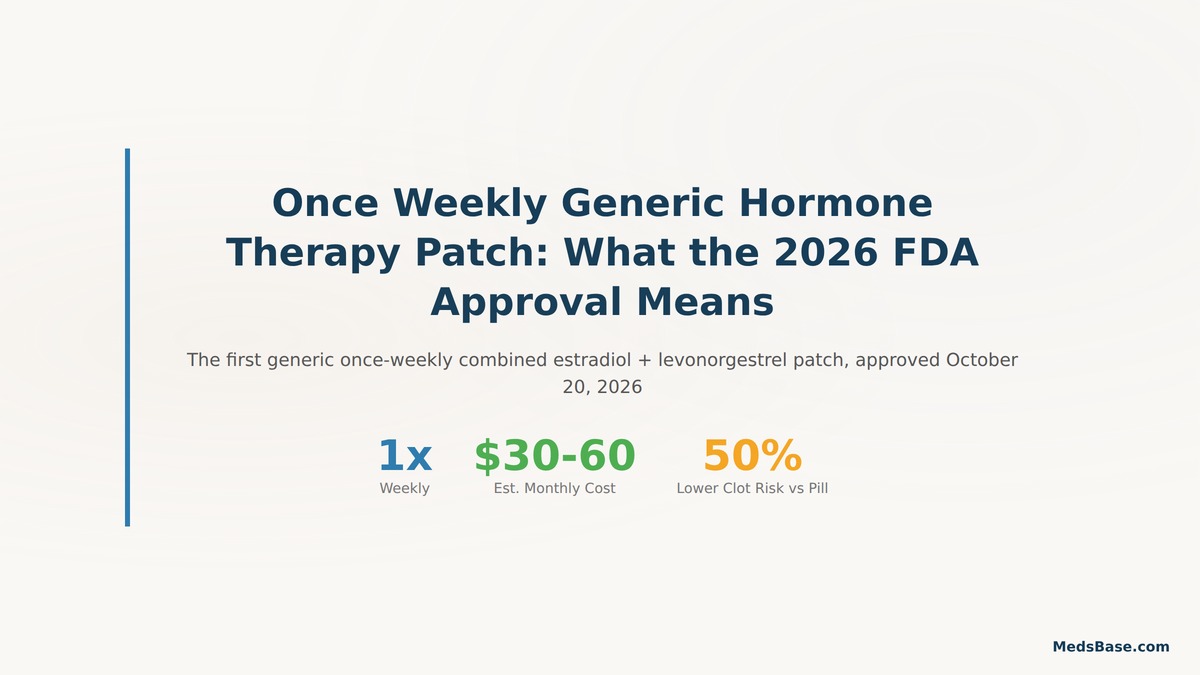
- On October 20, 2026, the FDA approved the first ever generic once-weekly hormone therapy patch — a landmark moment for affordable menopause care.
- The once weekly generic hormone therapy patch delivers estradiol through the skin, bypassing the liver and cutting blood clot risk by roughly half compared to oral estrogen pills.
- Generic pricing is expected to bring monthly costs down to the $30–60 range — a dramatic drop from branded patches that often exceed $150 per month.
- The weekly schedule is a major adherence advantage: one application every seven days versus a daily pill you have to remember.
- Not everyone is a candidate — women with a history of breast cancer, blood clots, or unexplained vaginal bleeding should discuss alternatives with their doctor.
- What Is a Once Weekly Generic Hormone Therapy Patch?
- How Does an Estrogen Patch Deliver Medication Through the Skin?
- Who Can Benefit From a Once-Weekly Hormone Therapy Patch?
- Safety Profile, Side Effects, and What to Watch For
- What Does the Research Say About Transdermal Hormone Therapy?
- Once-Weekly Generic Patch vs Branded Patches vs Daily Pills
- How to Use a Once-Weekly Hormone Therapy Patch Correctly
- Related Reading
- Frequently Asked Questions
- The Bottom Line
[Hero Intro — no heading, 150–200 words]
In October 2026, the FDA made a decision that could reshape how millions of women access menopause treatment: the agency approved the first-ever generic version of Climara Pro, a once-weekly combined estradiol and levonorgestrel transdermal patch manufactured by Zydus Pharmaceuticals. For the roughly 1.3 million American women who enter menopause each year — and the estimated 6,000 who reach it every single day — this single approval may change the math on whether hormone therapy is affordable.
Until now, women wanting a once-weekly combined hormone patch faced one option: branded Climara Pro with no generic competition. Monthly costs routinely exceeded $150, and insurance coverage was inconsistent. The result was a two-tier system where many women who could benefit from hormone therapy either never started or stopped early because of cost.
By the time you finish this article, you will know exactly what changed with this FDA approval, whether a once weekly generic hormone therapy patch fits your situation, how it compares to other menopause treatment options on safety and cost, and what to ask your doctor at your next appointment. One detail about the safety profile — the liver-bypass advantage — surprises many women who have only ever heard about hormone pills.
Once Weekly Generic Hormone Therapy Patch: 6 Key FDA Approval Facts Every Woman Should Know
What Is a Once Weekly Generic Hormone Therapy Patch?
A once weekly generic hormone therapy patch is a small adhesive patch — typically about the size of a silver dollar — that delivers a steady dose of estradiol and levonorgestrel through the skin and into your bloodstream over seven full days. You apply one patch, wear it for a week, then replace it with a fresh one at a new skin site. The estradiol provides the estrogen replacement, while the levonorgestrel (a progestogen) protects the uterine lining from the overgrowth that unopposed estrogen can cause — making this patch specifically designed for women who still have their uterus.
Quick Answer: It is a generic, affordable version of Climara Pro (the branded once-weekly combined hormone patch manufactured by Bayer) — same active ingredients (estradiol and levonorgestrel), same delivery method, same safety profile, but priced for competition instead of monopoly. The FDA approved the first generic version, manufactured by Zydus Pharmaceuticals, on October 20, 2026.
The patch itself looks like a thin, clear or tan-colored sticker. It sticks to clean, dry skin on the lower abdomen or buttock. Inside the adhesive layer is a precisely measured reservoir of 17-beta-estradiol — the identical molecule your ovaries produced before menopause — along with levonorgestrel, a synthetic progestogen that prevents endometrial hyperplasia. Because the estrogen component is bioidentical (chemically identical to human estradiol), your body recognizes and uses it exactly as it would your own estrogen.
Here is where it gets interesting. The generic version arriving in 2026 is not a new molecule or a new delivery system — it is the same combined estradiol-plus-levonorgestrel patch doctors have prescribed as Climara Pro, now without patent protection. What makes it newsworthy is the economics: for the first time, multiple manufacturers can produce it, and competition drives down price. The October 2026 FDA approval specifically covers Zydus Pharmaceuticals’ generic version of Climara Pro (estradiol and levonorgestrel transdermal system, 0.045 mg/day estradiol / 0.015 mg/day levonorgestrel) — a combined product intended for women with an intact uterus. Note that many other estrogen-only patches exist for women without a uterus, but this approval is specifically for the combined patch category.
Once weekly generic hormone therapy patch: How Does an Estrogen Patch Deliver Medication Through the Skin?
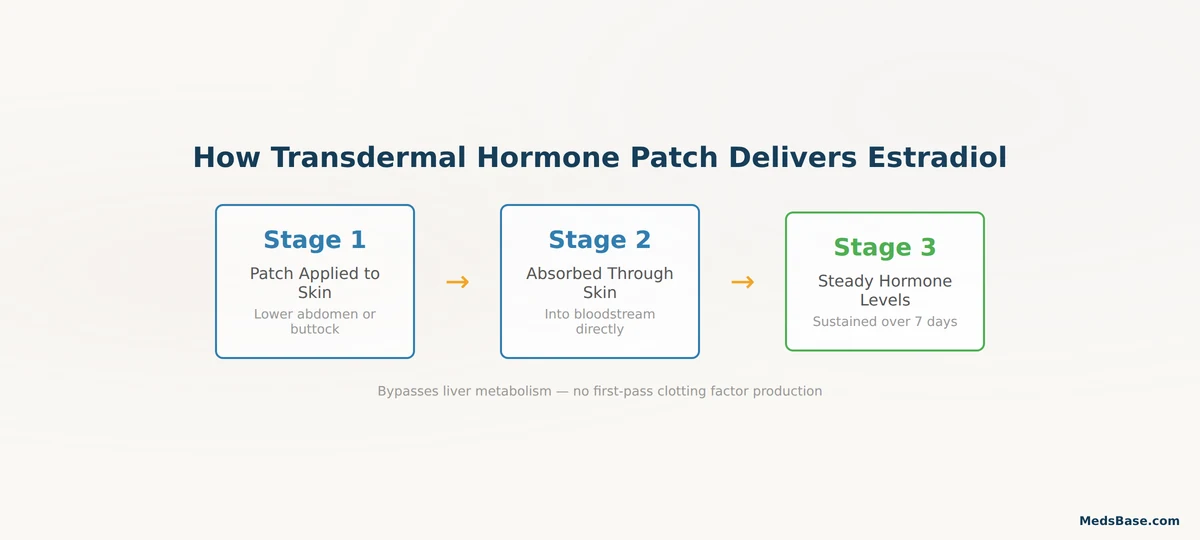
The mechanism is remarkably elegant — and it explains why the once weekly generic hormone therapy patch is not just more convenient than a pill but potentially safer.
Quick Answer: A transdermal estradiol patch releases hormone molecules that pass directly through the skin layers into capillaries, entering the bloodstream without first passing through the liver. This “liver bypass” avoids the first-pass metabolism that oral estrogen undergoes — and that metabolism is what generates clotting factors linked to a higher blood-clot risk.
[Research Spotlight box styled #fff8e1, border-left #f5a623] Research Spotlight When you swallow an estrogen pill, it travels through your digestive tract and into the portal vein, which delivers it straight to the liver. The liver then metabolizes a large fraction of the dose and, in the process, produces coagulation proteins that shift the body toward a slightly more clot-prone state. A transdermal patch avoids this entire pathway. Instead of portal-vein liver processing, estradiol diffuses through the outermost skin layer (stratum corneum) into the dermal capillaries into the systemic circulation at a slow, steady rate. The result: more consistent blood levels, no daily peaks and troughs, and roughly half the venous thromboembolism risk of oral estrogen.Think of it like this: swallowing a pill is like dumping a bucket of water into a funnel — the liver has to process it all at once, creating a spike and generating byproducts. A patch is like a slow drip IV that feeds the hormone into your system continuously over seven days. No spike, no byproduct surge.
Here is a hypothetical to make this concrete. Take Maria, 52, who started on oral estradiol for hot flashes. She got relief but developed mild nausea every morning. Her doctor switched her to a once weekly generic hormone therapy patch. The nausea disappeared — because the hormone was no longer hitting her stomach and liver in a concentrated daily dose — and her hot-flash control stayed just as good.
Who Can Benefit From a Once Weekly Generic Hormone Therapy Patch?
[Image: Key Uses Infographic — see Image Strategy #3]
Menopause Vasomotor Symptoms
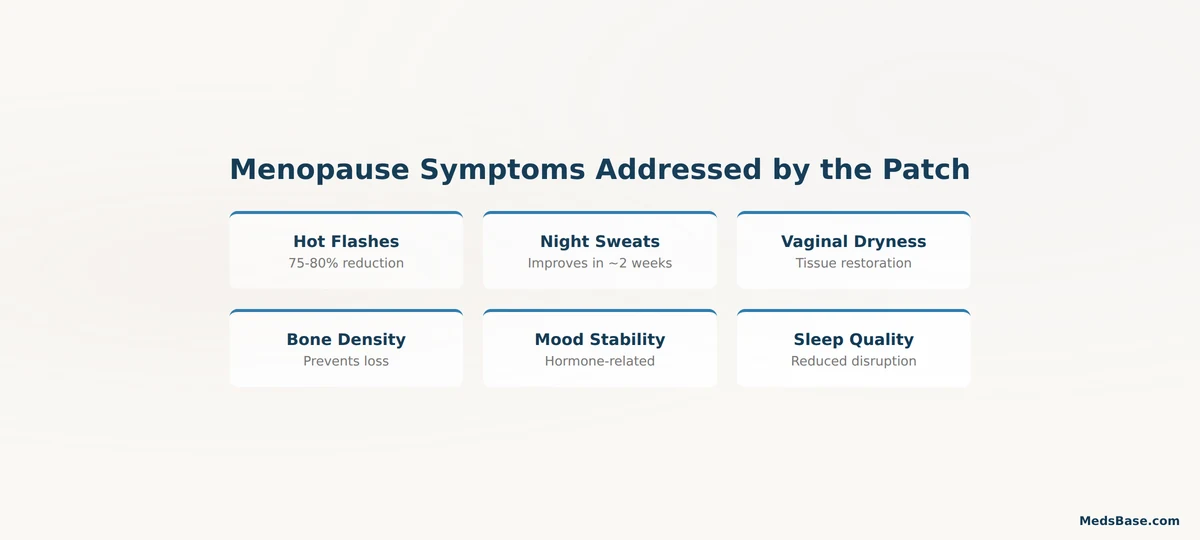
The strongest evidence — and the FDA-approved indication — is for moderate to severe hot flashes and night sweats. A once weekly generic hormone therapy patch reduces hot flash frequency by approximately 75–80% in most women within four weeks, and night sweats often improve even faster. For women whose sleep, work performance, and quality of life are disrupted by vasomotor symptoms, this is the most reliable intervention available.
Prevention of Postmenopausal Bone Loss
Estrogen plays a critical role in maintaining bone density. After menopause, the rate of bone loss accelerates sharply — some women lose 3–5% of bone mass per year in the first five postmenopausal years. Transdermal estradiol, including the once weekly generic hormone therapy patch, has been shown to preserve bone mineral density at the lumbar spine and hip, reducing fracture risk. It is not a first-line osteoporosis treatment on its own, but for women already using hormone therapy for vasomotor symptoms, the bone protection is a meaningful bonus.
Genitourinary Syndrome of Menopause (GSM)
While low-dose vaginal estrogen products are typically the first choice for vaginal dryness and painful intercourse alone, systemic hormone therapy — including the patch — also improves vaginal tissue health, urinary urgency, and recurrent UTIs. Women with both hot flashes and vaginal symptoms often get two-for-one relief from a single once weekly generic hormone therapy patch.
Surgical Menopause
Women who undergo removal of both ovaries before natural menopause age experience an abrupt, often severe estrogen withdrawal. The once weekly generic hormone therapy patch provides a steady, predictable estrogen replacement that can be continued until the typical age of natural menopause.
[Who Is This For? / Who Should Avoid It? box styled #eef7ee / #4caf50] Who Is This For?
- Women within 10 years of menopause onset or under age 60 with moderate-to-severe hot flashes
- Women seeking a non-oral estrogen option with a lower clotting risk profile
- Women who struggle with daily pill adherence and prefer a once-weekly routine
- Women in surgical menopause who need consistent hormone replacement
- Women whose insurance now covers a generic patch but previously excluded branded ones
Who Should Avoid It (or Discuss Carefully With a Doctor):
- Women with a personal history of breast cancer (particularly hormone-receptor-positive)
- Women with a history of blood clots (DVT or PE) or clotting disorders
- Women with active liver disease or liver tumors
- Women with unexplained vaginal bleeding that has not been evaluated
- Women with known or suspected pregnancy
- Women over 60 or more than 10 years from menopause onset starting HRT for the first time
One of the most meaningful things you can do if you are considering a once weekly generic hormone therapy patch is to honestly evaluate where you sit on this “window of opportunity” timeline. Starting hormone therapy within 10 years of menopause and under age 60 is associated with the most favorable risk-benefit ratio — and that is where the evidence is strongest for net benefit.
Safety Profile, Side Effects, and What to Watch For
Quick Answer: The once weekly generic hormone therapy patch has the same safety profile as branded transdermal estradiol — generally favorable compared to oral estrogen, with the most common side effects being skin irritation at the application site, breast tenderness, and spotting. Serious risks (blood clots, stroke, breast cancer with long-term combined therapy) are lower with transdermal than oral routes but are not zero.
| Side Effect | Frequency | Severity | What To Do |
|---|---|---|---|
| Skin redness or itching at patch site | Common (up to 30%) | Mild | Rotate application sites; never apply to same spot twice in a row |
| Breast tenderness | Common (10–20%) | Mild to moderate | Usually resolves within 4–8 weeks; if persistent, discuss dose reduction |
| Spotting or irregular bleeding | Common in first 3–6 months | Mild | Track pattern; if heavy or lasts beyond 6 months, see your doctor |
| Headache | Uncommon (5–10%) | Mild | Often transient; if persistent or migraine-like, consult your doctor |
| Nausea | Uncommon (<5%) | Mild | Much less common than with oral estrogen (liver bypass) |
| Fluid retention / bloating | Uncommon (<5%) | Mild | Usually self-limiting |
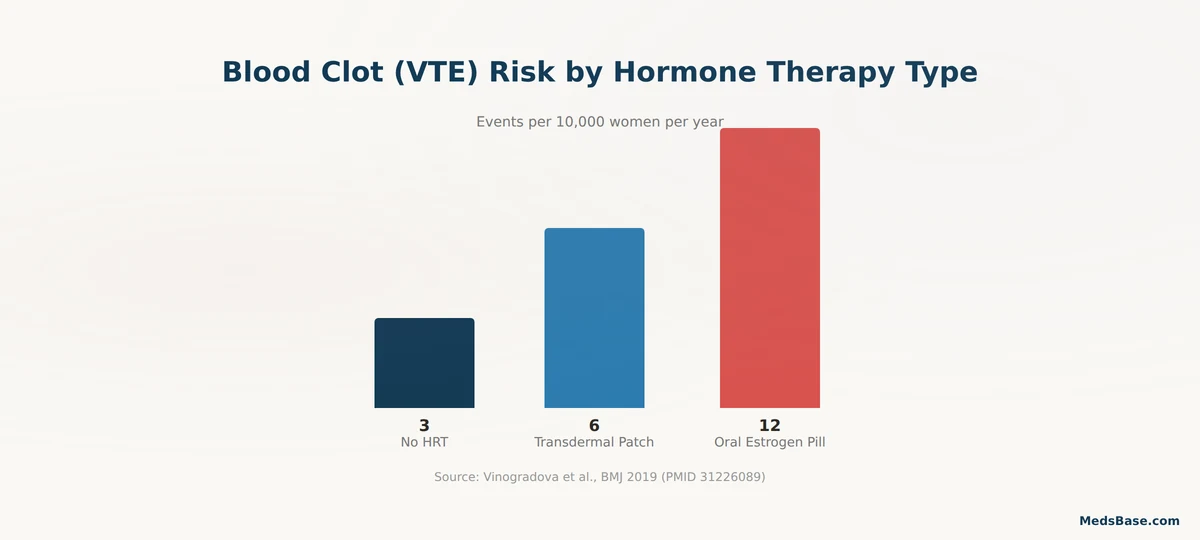
| Blood clot (DVT/PE) | Rare (~6 per 10,000 women/year) | Serious | Seek emergency care for leg swelling/pain or sudden shortness of breath |
| Stroke | Rare | Serious | Risk elevation is small with transdermal route; discuss personal risk factors with doctor |
| Gallbladder disease | Rare | Moderate to serious | Slightly elevated risk with transdermal estrogen |
The safety open loop I mentioned in the intro — about the liver-bypass advantage — resolves here. Because the once weekly generic hormone therapy patch delivers estradiol through the skin rather than the digestive tract, it does not trigger the liver’s first-pass production of clotting factors the way oral estrogen does. Transdermal estradiol carries a lower venous thromboembolism risk than oral formulations, with multiple large observational studies converging on roughly half the risk. For a woman in her early 50s without other clotting risk factors who is choosing between a daily pill and a weekly patch, this difference is clinically meaningful.
Here is one thing that surprises many women starting patch therapy: the patch needs to stay on through showers, baths, swimming, and exercise. The adhesive is designed to be water-resistant. If a patch peels off early, you apply a new one — but that means carrying a spare. Most women find the adhesive holds well, but hot tubs and very long baths are the most common culprits for early detachment.
One more clinical insight: the FDA-approved generic is specifically a combined estradiol-plus-levonorgestrel patch — meaning it contains both estrogen and a progestogen in a single delivery system, designed for women with an intact uterus. Women who have had a hysterectomy and do not need the progestogen component would use a different product (an estrogen-only patch). This distinction matters because the progestogen component carries its own risk profile — including a slightly elevated breast cancer risk with long-term use that applies regardless of delivery route. This is why the standard recommendation is the lowest effective dose for the shortest necessary duration.
What Does the Research Say About Transdermal Hormone Therapy?
The evidence base for once-weekly transdermal estradiol is among the most robust in menopause medicine — spanning decades and hundreds of thousands of women. Here is what the data show:
| Study | Year | Key Finding | Source |
|---|---|---|---|
| WHI (Women’s Health Initiative) follow-up | 2013 | Transdermal estrogen not studied in WHI; findings about oral CEE+MPA do not apply to transdermal estradiol. Re-analysis confirmed age and time-since-menopause drive risk, not hormone therapy per se | Manson et al., JAMA |
| Vinogradova et al. (UK cohort) | 2019 | Transdermal estradiol associated with no significant increase in VTE risk vs no HRT (OR ~1.0), while oral estrogen showed significantly elevated risk | BMJ |
| NAMS 2022 Position Statement | 2022 | Transdermal routes preferred for women with VTE risk factors, obesity, hypertriglyceridemia, or gallbladder concerns | NAMS, Menopause |
| Kronos Early Estrogen Prevention Study (KEEPS) | 2012 | In newly menopausal women, both oral and transdermal estrogen showed favorable cardiovascular profiles; transdermal had neutral effect on CRP (inflammation marker) while oral increased it | Harman et al., Ann Intern Med |
| ELITE (Early vs Late Intervention Trial) | 2016 | Estrogen started within 6 years of menopause slowed atherosclerosis progression; starting 10+ years after menopause showed no benefit — reinforcing the “timing hypothesis” | Hodis et al., NEJM |
What this means for you: The safety advantage of a once weekly generic hormone therapy patch over oral estrogen is real and supported by multiple large studies. But it is not a free pass — the big picture risk-benefit calculation still depends on your age, time since menopause, whether you need a progestin, your personal and family medical history, and how long you plan to use it. The best single thing you can read before your appointment is the NAMS 2022 position statement table on route-specific risks — or bring the summary above to your doctor.
Once-Weekly Generic Patch vs Branded Patches vs Daily Pills
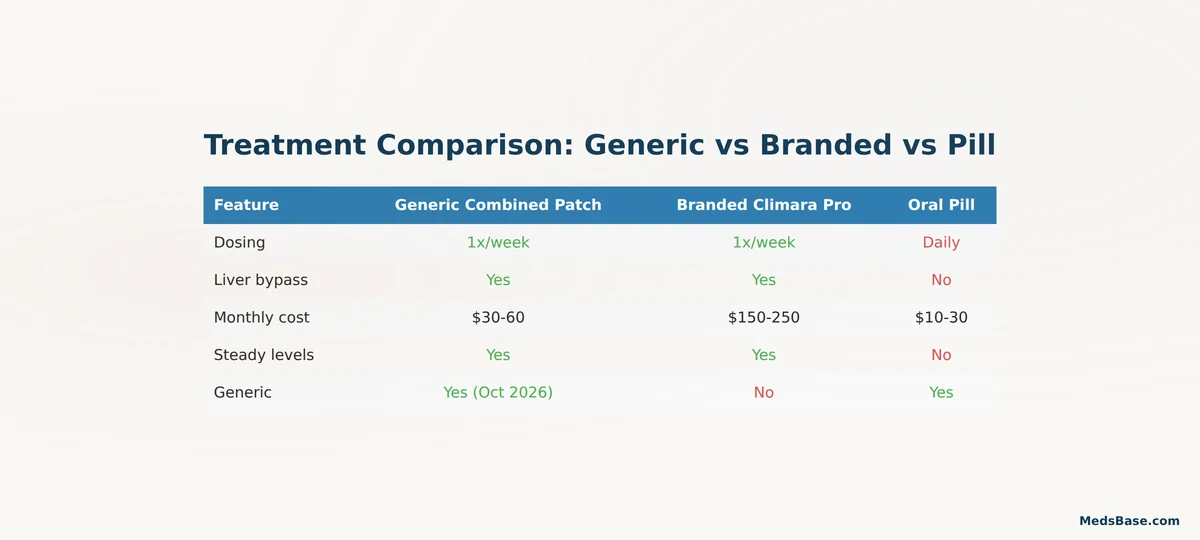
[Image: Comparison Grid — see Image Strategy #5]
For women deciding between treatment options, the choice usually comes down to three things: cost, convenience, and safety profile. The newly approved generic is a combined estradiol + levonorgestrel patch (specifically for women with an intact uterus), so the comparison below includes both combined and estrogen-only options for full context:
| Feature | Generic Combined Patch (New) | Branded Climara Pro | Daily Oral Estrogen Pill |
|---|---|---|---|
| Dosing frequency | Once per week | Once per week | Once daily |
| Liver bypass (lower clot risk) | Yes | Yes | No (first-pass metabolism) |
| Estimated monthly cost | $30–60 | $150–250 | $10–30 |
| Steady hormone levels | Yes (continuous release) | Yes | No (daily peaks/troughs) |
| Generic available | Yes (new for 2026) | No (brand-only) | Yes (generic pills widely available) |
| Adhesion issues possible | Yes (skin prep important) | Yes (skin prep important) | N/A |
| Insurance coverage | Expected to improve with generic status | Variable; often requires prior auth | Generally good |
| Best for… | Cost-conscious women wanting transdermal safety | Women whose insurance fully covers brand | Women comfortable with daily pills and lower clot risk profile |
Which one fits which situation? If you are a woman under 60 with an intact uterus, within 10 years of menopause, and cost has been your barrier to trying a transdermal combined hormone product, the new generic once weekly patch (equivalent to Climara Pro) makes a strong case. If you have had a hysterectomy, you do not need the progestogen component — an estrogen-only patch or pill is more appropriate. If you are on a budget and have no clotting risk factors, generic oral estrogen remains the cheapest option — but you accept the daily dosing requirement and the slightly elevated VTE risk. If your insurance fully covers branded Climara Pro and you have been stable on it for years, there is no medical reason to switch — the generic is a cost story, not an efficacy upgrade.
How to Use a Once-Weekly Hormone Therapy Patch Correctly
[Image: How-To Steps — see Image Strategy #6]
Getting the most out of your patch comes down to a few straightforward steps — and avoiding a handful of easy mistakes.
Step 1: Choose the right skin site. Apply the patch to clean, dry, intact skin on the lower abdomen (below the waistline) or the upper buttock. Avoid the breasts, waistline (where clothing rubs), and any area with cuts, rashes, or lotion residue. Do not apply to the same spot two weeks in a row — rotate sites.
Step 2: Prepare the skin. Wash the area with mild soap and water, then dry thoroughly. Do not use lotion, oil, powder, or alcohol-based products on the site — they reduce adhesion.
Step 3: Apply the patch. Peel the backing, press the adhesive side firmly onto the skin, and hold for 10 full seconds with your palm. Run your finger around the edges to ensure a good seal.
Step 4: Wear for exactly 7 days. Mark your calendar or set a phone reminder. Change it on the same day every week. If you forget and remember within 24 hours, apply the new patch and keep your usual change day. If more than 48 hours have passed, apply a new patch and reset your weekly schedule from that day.
Common mistakes to avoid:
- Applying to skin that still has lotion or oil residue — patch will peel
- Reusing the same site too soon — increases irritation risk
- Cutting the patch (unless specifically directed by your doctor for dose adjustment) — can disrupt the drug-release membrane
- Forgetting to remove the old patch before applying the new one — accidental double-dosing
- Stopping cold turkey — some women experience a rapid return of symptoms
If you are exploring treatment options and want to see what is available, browse women’s health products at MedsBase. Many women find that combining their prescribed hormone therapy with supportive wellness products creates a more comfortable menopause transition.
Related Reading
- How Hormone Therapy Affects Brain Fog and Mood During Menopause — cognitive symptoms are often the first sign of menopause, and hormone therapy timing matters
- Menopause Hormone Therapy and Heart Disease: 7 Proven Timing Facts — the “timing hypothesis” explained with the latest cardiovascular data
- Exercise Prescription for Heart Health: What the New ACC Guidelines Mean — a natural complement to any menopause wellness plan
Frequently Asked Questions
Q: How much does a once weekly generic hormone therapy patch cost?
A: While exact pricing depends on your pharmacy and insurance, generic competition is expected to bring the monthly cost of a once weekly generic hormone therapy patch to roughly $30–60 — a sharp reduction from branded patches that typically run $150–250 per month. Check with your insurance provider and pharmacy discount programs, as coverage is likely to improve now that a generic option exists.
Q: Can you get generic estrogen patches without a prescription?
A: No. Estrogen patches, including the new once weekly generic hormone therapy patch, require a prescription. They are not available over the counter. You need a doctor or other licensed prescriber to evaluate your symptoms, medical history, and risk factors before initiating treatment.
Q: Once weekly hormone patch vs daily pill — which is safer?
A: For most women without a personal history of blood clots, the once weekly generic hormone therapy patch carries a lower venous thromboembolism risk than daily oral estrogen pills because it bypasses liver metabolism. However, both routes have risks and benefits, and the safest choice is the one your doctor recommends based on your individual medical history.
Q: Who should not use a hormone therapy patch?
A: Women with a history of breast cancer (especially hormone-receptor-positive), blood clots, active liver disease, unexplained vaginal bleeding, or known pregnancy should not use estrogen patches. Women over age 60 or more than 10 years past menopause who are starting hormone therapy for the first time should carefully weigh risks and benefits with their doctor.
Q: How long does it take for a hormone therapy patch to work?
A: Most women notice a reduction in hot flashes within 2–4 weeks of starting a once weekly generic hormone therapy patch, with maximum benefit typically reached by 8–12 weeks. Night sweats often improve first. If you see no improvement after 3 months at an adequate dose, your doctor may adjust the dose or investigate other causes of your symptoms.
Q: Does the patch stay on during showering and exercise?
A: Yes. Once-weekly patches are designed to be water-resistant through showers, baths, swimming, and exercise. Apply to clean, dry skin and press firmly for 10 seconds. If a patch partially lifts, press it back down. If it falls off completely, apply a new patch and resume your regular change schedule.
Q: Is a once-weekly patch better than a twice-weekly patch?
A: The main advantage is fewer applications — 52 patch changes per year instead of 104. Some women also find once-weekly patches provide more consistent hormone levels with less end-of-wearing-period symptom return. However, twice-weekly patches may have better adhesion for some women. The generic approval covers the once-weekly format specifically.
Q: Can you swim or use a hot tub with a hormone patch?
A: Yes, you can swim and bathe normally with a once weekly generic hormone therapy patch applied. The adhesive is water-resistant. However, very hot water (hot tubs, very long baths) is the most common cause of patch detachment — if you use a hot tub regularly, check the patch edges afterward and consider applying it after your soak on change day.
The Bottom Line
The FDA approval of a once weekly generic hormone therapy patch in October 2026 is a genuine access milestone, not incremental pharma news. It brings the safety advantages of transdermal estrogen — lower clotting risk, steady hormone levels, liver bypass — within reach of women for whom a $180 monthly branded patch was not an option.
The immediate action is simple: if you have been avoiding hormone therapy because of cost, or if you take oral estrogen but worry about the clotting risk you have read about, this is the right moment to revisit the conversation with your doctor. Bring your symptom diary, your family history, and a clear statement of what you are trying to solve. The once weekly generic hormone therapy patch is not a universal answer, but for the right candidate, it is the best combination of safety, convenience, and affordability that has ever been available.
Wondering how menopause treatments fit into a broader health strategy? Read our guide on whether exercise can match antidepressants for managing low mood — because for many women, the menopause transition and mental health changes arrive together. And if you are thinking about heart health alongside hormone decisions, see what the new ACC guidelines say about exercise prescription for cardiovascular protection.
Medical Disclaimer: This article is for informational purposes only and does not constitute medical advice. Hormone therapy decisions should be made in consultation with a qualified healthcare provider who knows your full medical history. Never start, stop, or change a prescription medication without your doctor’s guidance.

Written by
Sophie ChenPharmaceutical Content Researcher · 8 years experience
Sophie Chen is a pharmaceutical content researcher with 8 years covering generic medication access and clinical pharmacology. She specialises in international regulatory frameworks, bioequivalence standards, and patient-facing education on therapeutic drug classes. She is not a clinician.
Pingback: Exercise Prescription for Heart Health: 8 Key Facts