







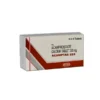
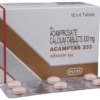
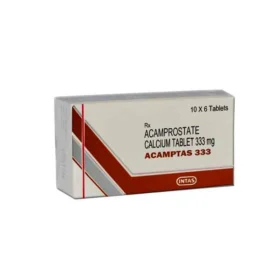
Acamptas 333 Mg
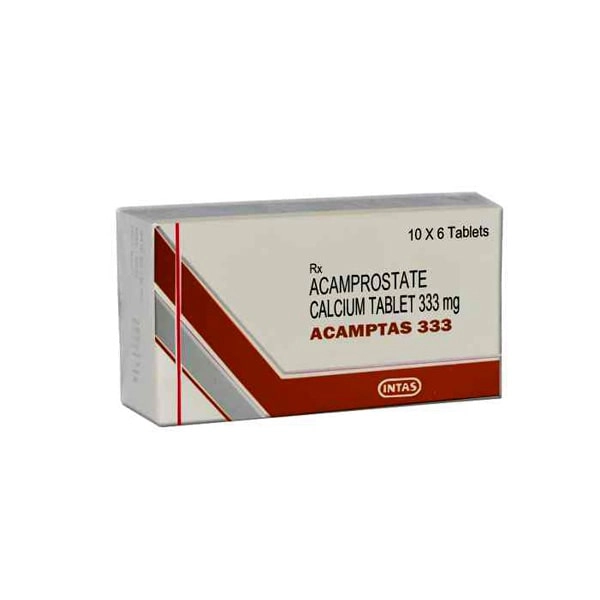
✅ Reduces alcohol dependency
✅ Prevents relapse in alcoholism
✅ Enhances brain neurotransmission
✅ Improves mental health
✅ Supports sobriety maintenance
✓ Medically reviewed by Morgan Ellis — Pharmacy Researcher · 8 years experience · Last reviewed: May 2026
⚡ Quick Answer — Acamptas 333 Mg — acamprosate 333 mg (delayed-release) for maintaining alcohol abstinence
Acamptas 333 Mg is acamprosate calcium 333 mg (delayed-release), an NMDA / glutamate modulator that helps maintain alcohol abstinence after the patient has already stopped drinking. Standard dose is two 333 mg tablets three times daily (1,998 mg/day) with food. It does not treat acute withdrawal and produces no aversive reaction; benefit emerges over 4–12 weeks. Best paired with counselling. Renal-dose adjusted; contraindicated in severe renal impairment.
📦 Every order is covered by our Reshipment Assurance Policy — if your parcel does not arrive within 20 business days, we reship it.
Why order from MedsBase
Our generic medications are sourced from WHO-GMP certified manufacturers and shipped worldwide in discreet, plain packaging — no medication name on the parcel exterior. Card payments are routed through a regulated processor (statement descriptors include a regulated card-payment processor — never “MedsBase” or any medication name). Crypto and SEPA bank transfer are also accepted. Every order is backed by our Reshipment Assurance Policy.
What is Acamptas 333 Mg?
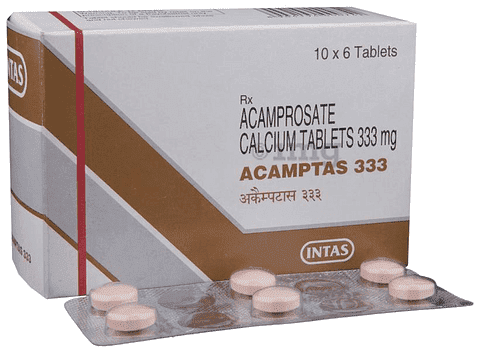
Acamptas 333 Mg is a maintenance medication for alcohol use disorder containing acamprosate calcium 333 mg (delayed-release) (enteric-coated tablets), supplied by Intas Pharmaceuticals. It is one of the two first-line oral pharmacotherapies for alcohol use disorder (alongside naltrexone) in modern guidelines including FDA, EMA, NICE, and APA. It is structurally similar to the amino-acid neurotransmitter taurine and does not have abuse, sedative, or anxiolytic effects.
How acamprosate works
Chronic heavy drinking induces a long-term up-regulation of NMDA glutamate receptors and down-regulation of GABA-A receptors as the brain adapts to alcohol’s GABAergic and anti-glutamatergic effect. When the patient stops drinking, this leaves a relative glutamate hyperactivity state that drives several months of post-cessation symptoms — insomnia, anxiety, irritability, sleep fragmentation, anhedonia, dysphoria — collectively the protracted withdrawal syndrome. These symptoms are the strongest pharmacological driver of late relapse.
Acamprosate is thought to modulate NMDA-receptor function (probably as a partial agonist at the glycine-binding site, with secondary effects on type-1 metabotropic glutamate receptors and voltage-dependent calcium channels), reducing the post-cessation glutamate hyperactivity and helping the brain re-equilibrate. Crucially, it does not affect acute alcohol intoxication or withdrawal — it is purely a maintenance drug, started after withdrawal has been managed (typically by benzodiazepines).
How Acamptas 333 Mg is used
| Patient weight | Dose | Notes |
|---|---|---|
| ≥ 60 kg | 2 tablets (666 mg) three times daily (total 1,998 mg/day) | Take with breakfast, lunch, and dinner |
| < 60 kg | 4 tablets/day (1,332 mg) divided | Typically 2 tabs morning, 1 mid-day, 1 evening |
Take with food — acamprosate has poor (~11%) bioavailability and food markedly reduces inter-patient variability. Swallow tablets whole; the enteric coating protects against gastric breakdown, so do not crush or split.
Acamprosate is started after the patient has stopped drinking and has been through any necessary supervised withdrawal (typically 5–10 days post last drink). It has no effect on acute withdrawal symptoms, so starting too early offers no benefit. Treatment is usually continued for 12 months, often longer in patients with strong relapse risk.
Renal-dose adjustment (mandatory)
Acamprosate is excreted unchanged by the kidneys; renal function determines dose:
| eGFR (mL/min/1.73 m²) | Dose |
|---|---|
| > 50 | Standard 666 mg three times daily |
| 30–50 | 333 mg three times daily (one tablet TDS) |
| < 30 | Contraindicated |
Side effects
- Diarrhoea — the most common (~17%), usually mild and self-limiting in 2–4 weeks; bran or psyllium can help
- Flatulence, abdominal pain, nausea
- Pruritus, rash — uncommon
- Insomnia, anxiety, depression — usually attributable to underlying AUD recovery rather than the drug itself, but worth tracking
- Headache, asthenia
- Decreased libido (uncommon)
- Suicidal ideation — rare but reported, more often related to underlying mood disorder than to acamprosate; monitor in vulnerable patients
Drug interactions
Acamprosate has an exceptionally clean interaction profile: no hepatic metabolism, no plasma protein binding, no relevant CYP activity. It can be co-prescribed with disulfiram, naltrexone, antidepressants, antipsychotics, and benzodiazepines without significant interactions. The only practical points:
- Combination with naltrexone (CALM trial, COMBINE) is sometimes more effective than either alone in select patients.
- Combination with disulfiram is well tolerated.
- Concurrent diarrhoea-causing drugs may compound GI side effects.
Contraindications
- Severe renal impairment (eGFR < 30 mL/min/1.73 m²)
- Hypersensitivity to acamprosate
- Pregnancy — animal studies show no clear teratogenicity but human data are limited; avoid unless benefit clearly outweighs risk
- Breastfeeding — small molecular weight predicts excretion in milk; avoid
- Patients still drinking actively — acamprosate offers no benefit during ongoing alcohol use
Realistic expectations
Acamprosate’s effect is modest but real: meta-analyses (Rosner 2010, Jonas 2014) show roughly a 9–14 percentage-point increase in continuous abstinence at 6–12 months versus placebo, with a number-needed-to-treat of about 9. It works best in patients whose primary relapse driver is the protracted post-cessation glutamate hyperactivity (insomnia, anxiety, dysphoria) rather than craving or reward; for those, naltrexone is often more effective. Some patients respond better to one drug than the other — switching after a 12-week non-response is reasonable, and combination is supported by the COMBINE study in selected cases.
Storage
Store at room temperature (15–30 °C / 59–86 °F), in the original blister, away from direct light and moisture. Keep out of reach of children.
Frequently Asked Questions
Will acamprosate stop me drinking?
No — you have to stop drinking first. Acamprosate maintains abstinence after cessation; it does not reduce craving in the way naltrexone does, and it does not cause an aversive reaction the way disulfiram does. Its job is to make the protracted post-cessation period (insomnia, anxiety, irritability) less unpleasant so you do not relapse out of misery.
When does it start working?
Subjective benefit usually emerges in 4–12 weeks. The pharmacological effect on NMDA receptors is gradual because the brain’s glutamate adaptation took months to develop and re-equilibration is on the same time scale.
Why three doses a day?
Acamprosate has a short elimination half-life (~20 hours) but tissue levels matter more than plasma levels for the NMDA effect. Three-times-daily dosing was the schedule used in the registration trials and produces stable receptor occupancy. Two-times-daily schedules have weaker evidence.
Can I drink wine while on it?
It will not produce a reaction (no DER) but it defeats the purpose — the medication is not active during ongoing drinking and the body needs cessation for the NMDA-receptor adaptation to reverse. Continued drinking on acamprosate is essentially uncovered.
Why does it cause diarrhoea?
Acamprosate is a poorly absorbed drug; most of an oral dose stays in the gut, and the calcium-acamprosate salt has a mild osmotic effect on the bowel. Diarrhoea is usually self-limiting in 2–4 weeks; psyllium or a small dose of loperamide can bridge.
Can I take it with naltrexone?
Yes — the COMBINE study and several smaller trials support combination use. The two drugs target different relapse drivers (acamprosate = protracted withdrawal, naltrexone = reward and craving) so the rationale is sound. Combination is usually reserved for patients who have not responded to either alone.
Is it safe with antidepressants?
Yes — no significant interactions with SSRIs, SNRIs, mirtazapine, bupropion, tricyclics. Many AUD patients have comorbid depression and routinely take both. Anti-craving medications work better when underlying mood and anxiety are also treated.
What if I miss a dose?
Take it as soon as you remember unless it is nearly time for the next dose. Do not double up. Missing one dose has no major consequence; consistently missing the lunchtime dose is the most common adherence problem and can be solved by setting a phone alarm or a workplace reminder.
How long do I take it for?
12 months is typical, longer in patients with high relapse risk. Stopping is a planned discussion with the prescriber, ideally during a stable life period rather than during a stressor.
Will it affect my liver?
No — this is one of acamprosate’s major advantages. There is no hepatic metabolism and no hepatotoxicity signal. It is the preferred first-line choice in AUD patients with established liver disease where naltrexone is contraindicated.
Other Alcohol & Drug Treatment Medications
- Acamprol 333 mg (acamprosate) — alternative acamprosate brand at the same dose; choice usually driven by manufacturer preference and supply.
- Naltima (naltrexone 50 mg) — first-line alternative or combination partner; targets reward rather than glutamate hyperactivity.
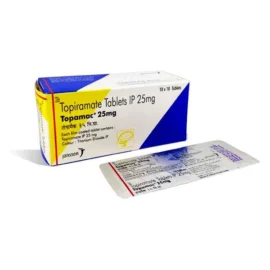
- Topamac (topiramate 25/50 mg) — off-label maintenance option; useful in patients with comorbid migraine or for those who fail acamprosate and naltrexone.
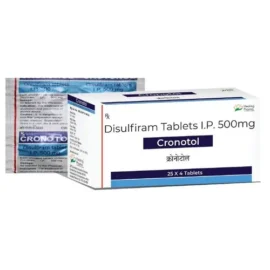
- Esperal (disulfiram 250 mg) — aversive therapy for highly motivated patients with structured supervision.
- Champix (varenicline 1 mg) — smoking-cessation aid — high tobacco use overlap means addressing both improves overall outcomes.
More options in Alcohol and Drug Treatment
Ranked by recent MedsBase order volume — what other customers in this category are picking.
| Strength | 333 mg |
|---|---|
| Quantity | 30 Tablet/s, 60 Tablet/s, 90 Tablet/s |
| Pharma Form | Tablet/s |
| Manufacturer | Intas Pharma |
| Treatment | Alcohol Dependence |
| Generic Brand | Acamprosate |
 Acamptas 333 Mg
Q & A
Acamptas 333 Mg
Related products



Reviews
There are no reviews yet