







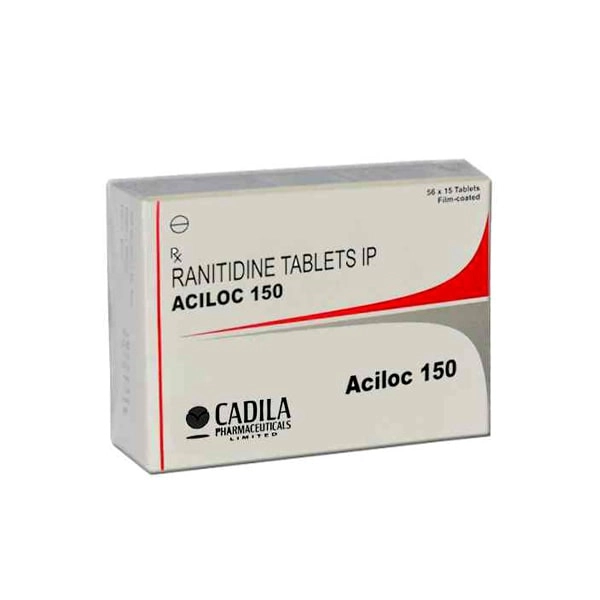
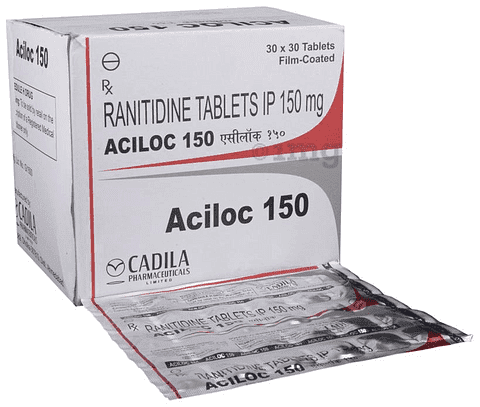
Aciloc
✅ Reduces Excess Stomach Acid
✅ Alleviates Acid-Related Symptoms
✅ Treats Stomach Ulcers Effectively
✅ Manages GERD Effectively
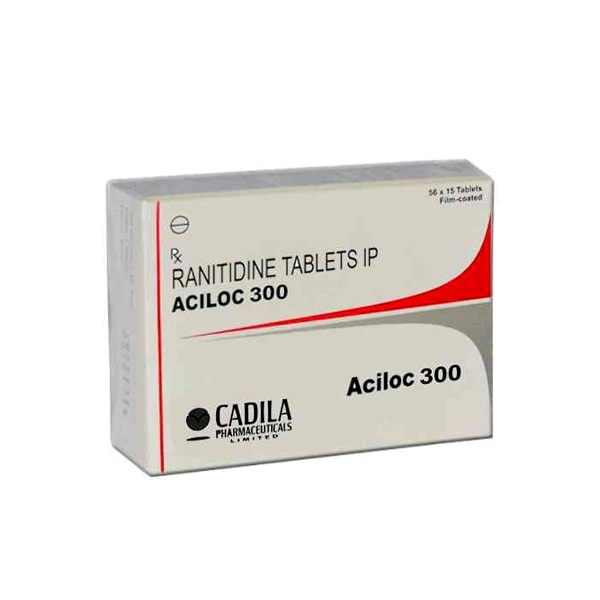
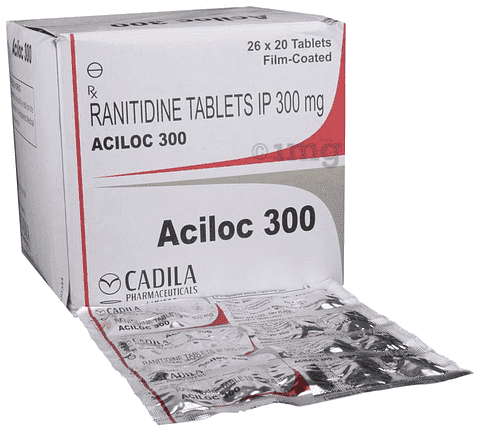
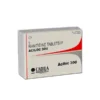
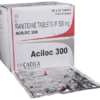
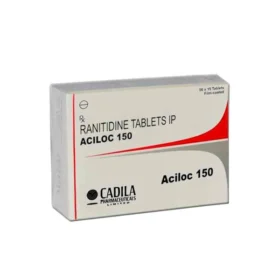
Aciloc contains Ranitidine
✓ Medically reviewed by Morgan Ellis — Pharmacy Researcher · 8 years experience · Last reviewed: May 2026
⚡ Quick Answer — What is Aciloc?
Aciloc contains ranitidine 150 mg / 300 mg (made by Cadila Pharmaceuticals) — a histamine H2 receptor antagonist that reduces stomach acid. Important regulatory note: ranitidine was withdrawn from the United States, European Union, United Kingdom, and Canadian markets in 2020 after the discovery of N-nitrosodimethylamine (NDMA, a probable human carcinogen) contamination in finished ranitidine products. The Indian regulator (CDSCO) has not formally withdrawn ranitidine, so it remains available in the Indian market. Most major regulators now recommend famotidine (Famocid) as the preferred H2-antagonist substitute. If you live in a country where ranitidine has been withdrawn by your local regulator, please review the warning below before ordering, and consider switching to famotidine. Standard adult dose where ranitidine is still used: 150 mg twice daily, or 300 mg at bedtime, for up to 8 weeks.
📦 Every order is covered by our Reshipment Assurance Policy — if your parcel does not arrive within 20 business days, we reship it.
Why order from MedsBase
Our generic medications are sourced from WHO-GMP certified manufacturers and shipped worldwide in discreet, plain packaging — no medication name on the parcel exterior. Card payments are routed through a regulated processor (statement descriptors include a regulated card-payment processor — never “MedsBase” or any medication name). Crypto and SEPA bank transfer are also accepted. Every order is backed by our Reshipment Assurance Policy.
What Aciloc Is
Aciloc is the Cadila Pharmaceuticals brand of ranitidine, an H2-receptor antagonist that was widely used worldwide between the 1980s and 2020 for acid-related disease. Each tablet contains 150 mg / 300 mg of ranitidine. Ranitidine is the second H2 antagonist developed (after cimetidine) and was for decades the world’s most widely prescribed prescription medicine. The 2020 NDMA-contamination withdrawal in major markets has shifted clinical practice almost entirely to famotidine.
How Ranitidine Works (Mechanism)
Ranitidine is a competitive, reversible antagonist at the histamine H2 receptor on the parietal-cell basolateral membrane. Histamine release from gastric enterochromaffin-like cells is the dominant signal driving acid secretion; blocking this signal reduces acid output by 60–80% at standard doses. Onset within 30 minutes, peak 1–3 hours, duration 8–12 hours. The mechanism is identical to famotidine; the difference between the two molecules is purely chemical — ranitidine’s aminonitrile group makes it prone to forming NDMA in storage, while famotidine’s thiazole structure does not.
Why Was Ranitidine Withdrawn? (NDMA Story)
In June 2019, an independent online pharmacy submitted ranitidine samples for routine NDMA screening (NDMA is a known contaminant of certain blood-pressure medicines and tobacco products) and reported levels far above the FDA’s acceptable daily intake of 96 ng. Subsequent FDA testing confirmed the finding and showed that NDMA levels increased with storage at higher temperatures. By April 2020, the FDA requested removal of all ranitidine products from the US market (this is a stronger action than a recall). The EMA, MHRA, and Health Canada followed within months. The mechanism is now understood: ranitidine’s dimethylamine group can break down to NDMA in the molecule itself or react with nitrites in the stomach to form NDMA in vivo. The risk to any individual patient from past ranitidine use is small in absolute terms, but unnecessary exposure to a probable carcinogen when an effective alternative (famotidine) exists is no longer considered acceptable.
The Indian regulator CDSCO reviewed the data in 2020 and concluded that local ranitidine products met national quality standards, declining to issue a formal withdrawal. Ranitidine therefore remains legally available in the Indian market and from manufacturers serving that market. Customers in countries where ranitidine has been withdrawn by their national regulator should consider switching to famotidine.
Indications Where Ranitidine Was Used
Where ranitidine is still used, the indication list mirrors famotidine:
- Mild-to-moderate GERD — on-demand or short-term
- Peptic ulcer disease (duodenal and gastric)
- NSAID ulcer prophylaxis (lower-risk patients)
- Stress-ulcer prophylaxis (where PPI is not preferred)
- Aspiration prophylaxis before surgery
- Zollinger-Ellison syndrome — high-dose adjunct
For each of these indications, famotidine is now the recommended H2 antagonist of choice; PPIs are first-line for chronic moderate-to-severe disease.
Dosing
| Indication / patient | Adult dose | Duration / notes |
|---|---|---|
| GERD — mild-to-moderate | 150 mg twice daily, or 300 mg at bedtime | 6–12 weeks; review |
| Duodenal ulcer healing | 300 mg at bedtime, or 150 mg twice daily | 4–6 weeks |
| Gastric ulcer healing | 300 mg at bedtime | 6–8 weeks |
| Maintenance therapy | 150 mg at bedtime | as needed |
| Renal impairment (CrCl < 50) | 150 mg once daily | reduce dose |
Side Effects
Ranitidine has a comparable side-effect profile to famotidine: headache, dizziness, constipation or diarrhoea, fatigue (1–3%). Uncommon: confusion (especially in elderly or renally impaired), reversible thrombocytopenia, hepatitis, severe hypersensitivity. Unlike cimetidine, ranitidine does not cause significant anti-androgen effects.
Drug Interactions
Ranitidine is a much weaker CYP enzyme inhibitor than cimetidine. Main interactions are absorption-related: HIV antiretrovirals that need acid (atazanavir, rilpivirine), antifungals (ketoconazole, itraconazole), iron supplements, and calcium carbonate.
Contraindications and Cautions
- Known hypersensitivity to ranitidine
- Acute porphyria (relative)
- Severe renal impairment — reduce dose
- Caution in elderly — CNS effects
- Alarm symptoms (weight loss, dysphagia, GI bleeding, anaemia, age > 55 with new symptoms) — require investigation, not empirical therapy
Pregnancy, Breastfeeding, Children
Ranitidine has historical pregnancy safety data, but the NDMA contamination signal makes its use in pregnancy and breastfeeding more difficult to justify when famotidine is available. Discuss with your obstetrician/paediatrician.
Storage
Store at 15–30 °C in the original blister, protected from light, heat and moisture. Heat and humidity accelerate NDMA formation in ranitidine; do not store in bathrooms or near a kettle. Discard at expiry — do not use beyond date.
Frequently Asked Questions
Why is ranitidine still available in India?
The Indian regulator CDSCO reviewed the NDMA data in 2020 and concluded that local ranitidine products met national quality standards, declining to issue a formal withdrawal. Major manufacturers serving the Indian market (including the makers of Aciloc and Rantac) continue to supply local demand. Whether to use ranitidine in this regulatory context, where famotidine is widely available with no NDMA signal, is a clinical and personal decision — many physicians have switched their practice to famotidine even where ranitidine remains legally on sale.
Is the cancer risk from ranitidine large?
The absolute risk to any one patient from past ranitidine use is small. The reason regulators acted was that the cumulative NDMA exposure over years of daily ranitidine use exceeded acceptable thresholds, when an effective alternative (famotidine) was available with no comparable contamination. The argument was not that ranitidine caused obvious cancer in users; it was that there is no good reason to continue exposing patients to a probable carcinogen when a safer alternative exists.
Should I switch to famotidine?
Yes — if you live in a country where your national regulator has withdrawn ranitidine, switching to famotidine 20–40 mg is a straightforward substitution. The mechanism is identical. There is also a strong argument for switching even where ranitidine remains legal, because the cost is similar and the safety profile is better. Talk to your prescriber.
Is Aciloc / Rantac contaminated with NDMA?
The contamination signal applies to the ranitidine molecule itself and is influenced by storage conditions (heat, humidity, time on shelf). Indian regulators have stated that local products met Indian quality standards. We cannot independently certify any individual batch. The honest answer is: you should assume that any ranitidine product carries some NDMA exposure risk, and that risk is reduced (but not eliminated) by short shelf time and cool storage. Famotidine carries no analogous risk.
How does ranitidine compare to famotidine in efficacy?
Mechanism is identical (H2 receptor antagonism); efficacy at standard doses is similar — ranitidine 150 mg twice daily and famotidine 20 mg twice daily produce comparable acid suppression and ulcer-healing rates. Famotidine is more potent on a milligram basis (about 8-fold), which is why the typical doses look different.
What is the difference between H2 antagonists and PPIs?
H2 antagonists (ranitidine, famotidine, cimetidine) block the histamine signal that drives acid secretion. PPIs (omeprazole, esomeprazole, pantoprazole, lansoprazole, rabeprazole, ilaprazole) block the H+/K+-ATPase pump itself, the final step. PPIs give deeper, longer acid suppression and are first-line for chronic GERD, ulcer disease, and H. pylori eradication. H2 antagonists are useful for on-demand mild reflux, breakthrough symptoms on a PPI, and short-term use.
Does ranitidine interact with other medicines?
Ranitidine has a much smaller interaction footprint than cimetidine. The clinically relevant interactions are absorption-related: HIV antiretrovirals (atazanavir, rilpivirine), antifungals (ketoconazole, itraconazole), iron, and calcium carbonate. It does not have the anti-androgen effects of cimetidine.
Is ranitidine safe in pregnancy?
Pre-2020 pregnancy safety data on ranitidine were reassuring. The NDMA contamination signal complicates this picture, and famotidine is now the preferred H2 antagonist of choice in pregnancy. Discuss with your obstetrician.
Will Aciloc / Rantac help my heartburn?
Yes — ranitidine reduces stomach acid and gives symptom relief in mild-to-moderate reflux, peptic ulcer disease, and NSAID gastritis. The clinical question is not whether it works but whether the regulatory and safety context favours using it over famotidine. Most international physicians now answer that question by switching the patient to famotidine.
How should ranitidine be stored?
Cool, dry, dark place — 15–30 °C. Heat, humidity, and time on shelf all increase NDMA formation. Do not store in bathrooms or warm cars; do not use beyond expiry. Use the shortest reasonable course of treatment.
Other Acid Reflux Medications at MedsBase
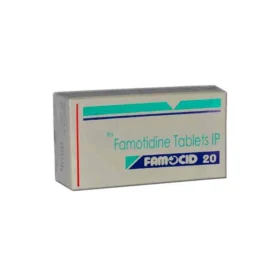
- Famocid — famotidine 20/40 mg — H2 antagonist; the safe modern substitute for ranitidine; useful for nocturnal acid breakthrough
- Omez — omeprazole 10/40 mg — broad strength range; lower 10 mg dose useful for step-down
- Esoprol — esomeprazole 20/40 mg — S-isomer of omeprazole; ~30% AUC advantage with less inter-individual variability
- Pantodac — pantoprazole 40 mg — standard once-daily PPI; minimal CYP impact
- Macralfate Suspension — sucralfate 1 g per 10 mL suspension — topical mucosal-coating ulcer healer; pairs with PPI for refractory disease
More options in Acid Reflux Treatment
Ranked by recent MedsBase order volume — what other customers in this category are picking.

| Strength | 150 mg, 300 mg |
|---|---|
| Quantity | 30 Tablet/s, 60 Tablet/s, 90 Tablet/s |
| Pharma Form | Tablet/s |
| Manufacturer | Cadila Pharmaceuticals |
| Treatment | Gastro Health |
| Generic Brand | Mesalamine |
 Aciloc
Q & A
Aciloc
Related products

Reviews
There are no reviews yet