







✓ Medically reviewed by · Last reviewed: May 2026
Pharmacy Researcher · 8 years experience
Pharmacy researcher with 8 years reviewing clinical drug information, generic formulation equivalence, and international pharmaceutical standards. Focuses on patient-facing accuracy in medication education.
alopecia treatment options — Alopecia Treatment Options in 2026: 8 Ways to Regrow Hair Backed by Research. Read on for an evidence-backed guide covering everything you need to know.
Alopecia treatment options — your friend sends you a news article: a common arthritis pill just helped people with alopecia regrow up to 80% of their scalp hair in six months. You have been losing hair — maybe in patches, maybe a gradual thinning — and suddenly you need to know: could this work for me? And if not, what actually will?
By the time you finish reading, you will know exactly which alopecia treatment options are backed by research in 2026, which ones match your type of hair loss, and what results you can realistically expect — and how soon.
Key Takeaways
- Alopecia is not one condition — your treatment options depend entirely on whether you have areata (autoimmune), androgenetic (hormonal/DHT), or telogen effluvium (stress/shedding)
- Finasteride and minoxidil remain the most accessible, well-studied options for the most common type — but one of them comes with a shedding phase that scares people into quitting too early
- The newest breakthrough — JAK inhibitors like upadacitinib — showed 80% scalp regrowth in a just-published trial, but they are only approved for severe alopecia areata and come with monitoring requirements
- Platelet-rich plasma (PRP) sits between drugs and natural approaches — the evidence is real but the cost and pain are real too
- No single treatment works for everyone — the best outcome often comes from combining approaches, and the one mistake almost everyone makes is stopping too soon
- What Is Alopecia? The 3 Types That Determine Your Treatment
- How Does Hair Loss Happen?
- Top Alopecia Treatment Options in 2026
- Safety, Side Effects & What to Expect
- What Does the Research Say?
- How to Choose the Right Alopecia Treatment for You
- How to Get the Best Results From Hair Loss Treatment
- Related Reading
- Frequently Asked Questions
- The Bottom Line
What Is Alopecia? The 3 Types That Determine Your Treatment {#what-is-alopecia} — Alopecia treatment options Explained
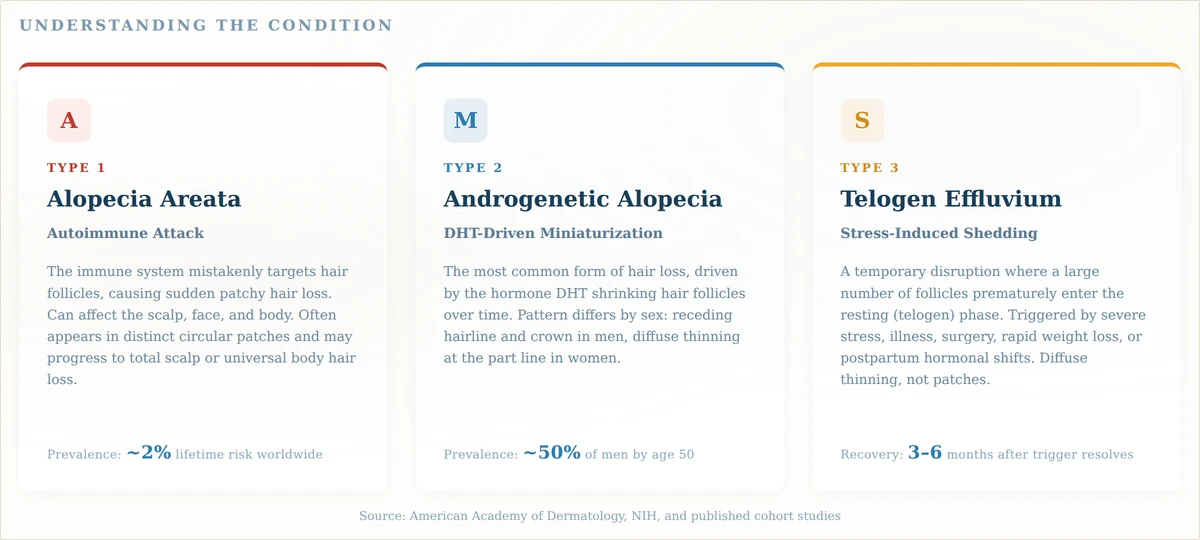
Alopecia treatment options — alopecia simply means hair loss — but the word covers at least three entirely different conditions, each with its own mechanism and its own set of effective alopecia treatment options.
Quick Answer: Alopecia is not one disease. Androgenetic alopecia (male or female pattern baldness) is driven by hormones and affects most people eventually. Alopecia areata is an autoimmune attack on hair follicles that causes sudden, often circular bald patches. Telogen effluvium is temporary diffuse shedding triggered by stress, illness, or nutritional deficiency. Your treatment path depends on knowing which one you have.
Androgenetic Alopecia — The Common One
Alopecia treatment options — this is what most people mean when they say “hair loss.” It affects roughly 50% of men by age 50 and about 40% of women by age 70. The mechanism is well understood: the hormone dihydrotestosterone (DHT) binds to receptors in scalp hair follicles, gradually shrinking them in a process called miniaturization. Over time, the follicle produces thinner, shorter hairs and eventually stops producing any hair at all.
Alopecia treatment options — in men, this follows a predictable pattern — receding hairline and crown thinning. In women, it typically presents as diffuse thinning across the top of the scalp while the frontal hairline is preserved. The treatments that work for this type — finasteride, dutasteride, minoxidil — target the DHT pathway or stimulate follicular activity directly.
Alopecia Areata — The Autoimmune One
Alopecia treatment options — alopecia areata strikes suddenly. One day you have a full head of hair, and within weeks you notice a smooth, round bald patch. The immune system — for reasons that are not fully understood — starts attacking hair follicles as if they were foreign invaders. Unlike androgenetic alopecia, the follicles are not permanently damaged; they are “paused” by inflammation and can reactivate if the immune attack stops.
This is where the newest alopecia treatment options live. JAK inhibitors — baricitinib (FDA-approved 2022), ritlecitinib (approved 2023), and now upadacitinib (showing 80% regrowth at 24 weeks in the August 2026 phase 3 trial) — work by interrupting the inflammatory signalling that drives the autoimmune attack.
Alopecia treatment options — here is where it gets interesting: the follicle itself usually survives the attack. If you can turn off the immune signal, the hair often grows back — and studies show it can grow back fully.
Telogen Effluvium — The Temporary One
Alopecia treatment options — telogen effluvium is the body hitting the “shed” button. After a major stressor — surgery, severe illness, childbirth, rapid weight loss, or extreme emotional stress — a disproportionate number of hair follicles enter the resting (telogen) phase at the same time. About 2–3 months later, those resting hairs shed all at once.
The good news: this type almost always resolves on its own once the underlying trigger is removed. Alopecia treatment options here are mostly supportive — nutritional optimization, stress management, and patience. But people often confuse telogen effluvium with androgenetic alopecia and start minoxidil unnecessarily, which then causes its own shedding phase and a cycle of anxiety.
Who Is This For? If you have noticed gradual thinning over years — this article is for you. If you have developed sudden circular bald patches — this article is for you. If you are shedding handfuls of hair after a stressful event — this article will help you avoid overtreating.
Who Should Avoid Certain Treatments? Pregnant or breastfeeding individuals should not use finasteride or dutasteride. People with a history of depression should discuss finasteride with their doctor, as the FDA has noted rare reports of mood changes. JAK inhibitors are not suitable for people with active serious infections or certain blood clotting disorders.
Alopecia treatment options: How Does Hair Loss Happen? {#how-hair-loss-happens}
Think of each hair follicle as a tiny factory that runs on a timer. The timer has three settings: anagen (active growth, lasts 2–7 years), catagen (transition, ~2 weeks), and telogen (resting, ~3 months). At any given moment, about 85–90% of your scalp follicles are in anagen — actively producing hair.
Alopecia happens when something resets that timer too early or shuts down the factory entirely.
In androgenetic alopecia, DHT shortens the anagen phase with each hair cycle. The factory still runs — but each run is shorter, and the hair it produces is thinner. Zoom out over several years, and the cumulative effect is visible balding.
In alopecia areata, the immune system surrounds the follicle with inflammatory cells — primarily CD8+ T cells — that signal the follicle to stop producing hair. The follicle enters a prolonged resting state, not destroyed but dormant. The hair shaft above the skin breaks off at the surface, creating the characteristic “exclamation mark” hairs seen under a dermatoscope.
But there is a catch: in both types, the follicle stem cells are typically preserved. That is why alopecia treatment options work at all — they are not creating new follicles; they are waking up ones that are still there.
Research Spotlight: A 2023 study in Nature identified that hair follicle stem cells enter a state of “stem cell quiescence” during androgenetic alopecia — essentially hibernating rather than dying. This finding underpins the rationale that even advanced hair loss may be partially reversible if the right signal can be delivered early enough.
What this means for you: the follicle factory is probably still there. The question is which tool can restart it — and keep it running.
Top Alopecia Treatment Options in 2026 {#top-treatments}
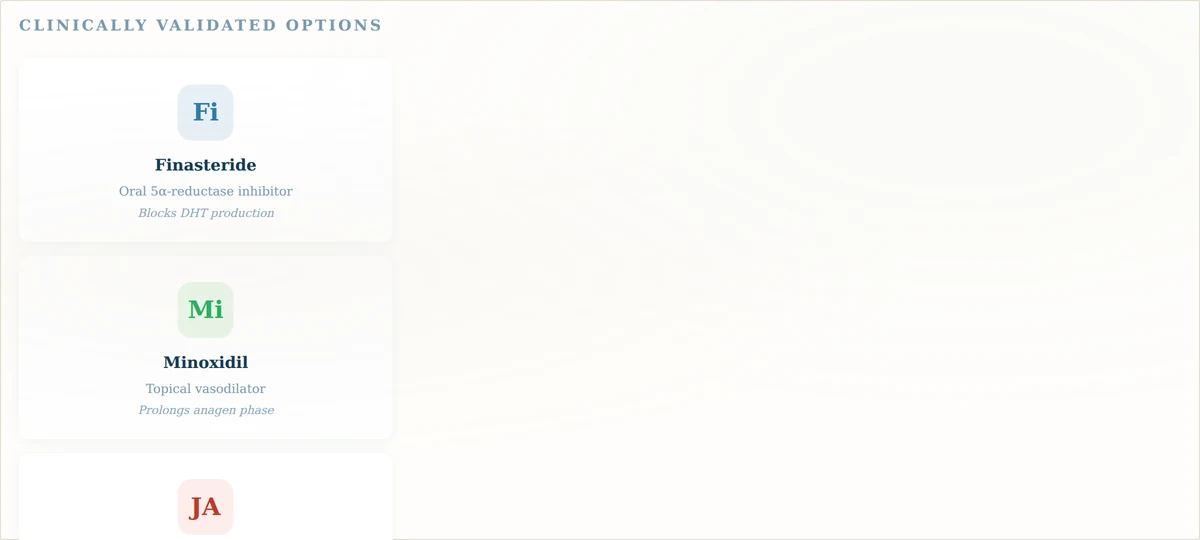
Here are the eight evidence-based alopecia treatment options available today, grouped by mechanism. For each, you will see what type of alopecia it treats, how well it works, how long results take, and what the downsides are.
1. Finasteride (Oral DHT Blocker)
Finasteride is a 5-alpha reductase inhibitor — it blocks the enzyme that converts testosterone to DHT. By reducing scalp DHT levels by about 60–70%, it slows or halts miniaturization in androgenetic alopecia.
The evidence: a Cochrane systematic review found that finasteride 1mg daily increases hair count by roughly 15–20% at 12 months compared to placebo, and most users maintain that gain at 2 years. For many men, “maintaining what you have” is the realistic goal — and that alone is worth treating, because untreated androgenetic alopecia continues to progress.
Results timeline: 6–12 months to see visible improvement. The first 3–4 months may include a temporary “shedding phase” as resting follicles synchronize their cycles — this is a sign the drug is working, not a reason to stop. Browse our finasteride shedding phase guide for what to expect.
MedsBase stocks finasteride in 1mg and 5mg strengths — browse the Hair Loss products page to see options.
2. Minoxidil (Topical or Oral Vasodilator)
Minoxidil is the most accessible of all alopecia treatment options — available without a prescription as a topical foam or solution. It works by increasing blood flow to follicles and prolonging the anagen phase, though its exact mechanism is still not fully understood.
Applied twice daily, 5% minoxidil increases hair count by approximately 10–15% at 6 months. The 5% formulation is more effective than 2%, and the foam formulation causes less scalp irritation than the liquid.
Low-dose oral minoxidil (0.25–2.5mg daily) is increasingly used off-label for more robust results, especially in women. A 2021 systematic review found oral minoxidil produced clinically significant improvement in 70–100% of patients across studies, though with a higher rate of hypertrichosis (unwanted body hair) than topical use.
3. Dutasteride (Stronger DHT Blocker)
Dutasteride inhibits both type I and type II 5-alpha reductase, while finasteride only blocks type II. This means dutasteride reduces serum DHT by over 90% compared to finasteride’s ~70%.
In head-to-head studies, dutasteride 0.5mg daily produced greater hair count increases than finasteride 1mg at 24 weeks, with a similar safety profile. The trade-off: dutasteride has a longer half-life (5 weeks vs 6–8 hours for finasteride), which means side effects, if they occur, take longer to resolve after stopping.
4. JAK Inhibitors — The Newest Frontier
This is where alopecia treatment options have changed the most in the last two years. JAK (Janus kinase) inhibitors interrupt the inflammatory signalling cascade that drives alopecia areata.
Baricitinib, the first JAK inhibitor studied for this indication, was evaluated in the BRAVE-AA phase 3 trials: 39% of patients on 4mg achieved 80% scalp coverage at 36 weeks.
Ritlecitinib followed in 2023, showing similar efficacy with a slightly different JAK selectivity profile.
And now upadacitinib. Data released this month (August 2026) from a phase 3 trial showed approximately 80% of alopecia areata patients achieved a SALT50 response — meaning at least 50% improvement in scalp hair coverage — after 24 weeks of treatment. This is the strongest signal yet for any medical treatment in alopecia areata.
The catch: JAK inhibitors carry a boxed warning for serious infections, malignancy, major cardiovascular events, and thrombosis. They require baseline screening (TB test, hepatitis panel, lipid panel) and ongoing monitoring. They are approved only for severe alopecia areata — not for androgenetic alopecia.
5. Platelet-Rich Plasma (PRP)
PRP involves drawing your own blood, centrifuging it to concentrate platelets and growth factors, and injecting the plasma into the scalp. The theory: platelets release growth factors that stimulate follicle stem cells.
A 2023 meta-analysis covering 22 studies found that PRP significantly increased hair density compared to baseline, with results typically visible after 3–4 monthly sessions. The evidence is strongest for androgenetic alopecia, with more limited data for alopecia areata.
The downsides: it hurts (multiple scalp injections per session), it is not covered by insurance, costs $500–1,500 per session, and results require maintenance sessions every 6–12 months.
6. Low-Level Laser Therapy (LLLT)
LLLT devices — combs, helmets, or caps with red-light LEDs — deliver low-level light to the scalp. The proposed mechanism is photobiomodulation: light energy absorbed by cytochrome c oxidase in follicle cells increases ATP production and reduces oxidative stress.
The evidence: multiple randomized trials show modest but statistically significant increases in hair density with LLLT for androgenetic alopecia. A 2020 meta-analysis of 11 studies found an average increase of ~18 hairs per square centimetre after 16–26 weeks of treatment.
The advantage: zero systemic side effects. The disadvantage: it is the slowest and least dramatic of the evidence-based alopecia treatment options, and devices cost $200–800 upfront. Consistency matters — sessions 2–3 times per week, indefinitely.
7. Corticosteroids (Topical, Intralesional, or Oral)
Corticosteroids remain a first-line option for alopecia areata, especially for limited patchy disease. Intralesional injections (triamcinolone acetonide injected directly into bald patches) produce regrowth in 60–75% of cases within 4–8 weeks.
Topical steroids are weaker but non-invasive. Oral steroids work faster but carry significant long-term risks (weight gain, bone loss, diabetes, hypertension) and are reserved for rapidly progressive or extensive disease. Most doctors use them as a bridge to a JAK inhibitor or other maintenance therapy.
8. Supportive & Emerging Options
Several additional approaches have weaker but real evidence:
- Microneedling: Creates micro-injuries that stimulate growth factors. A 2022 review found it enhances minoxidil absorption when used together.
- Nutritional correction: Iron deficiency, zinc deficiency, and vitamin D insufficiency can all cause or worsen hair loss. Correcting a documented deficiency helps — but supplementing without a deficiency rarely does.
- Hair transplant: The only permanent solution for advanced androgenetic alopecia. Not an alopecia treatment option in the medical sense, but the surgical endpoint for those with donor hair remaining. Often combined with finasteride or minoxidil to preserve non-transplanted hair.
Safety, Side Effects & What to Expect {#safety}
Every alopecia treatment option comes with trade-offs. Here is what the evidence says about the main concerns — without minimizing or sensationalizing any of them.
| Side Effect | Finasteride | Minoxidil | JAK Inhibitors | PRP |
|---|---|---|---|---|
| Sexual dysfunction | 1–4% (reversible in most) | None | Not reported | None |
| Scalp irritation | None | 5–10% (topical) | None | Mild, transient |
| Initial shedding | Common (weeks 2–8) | Common (weeks 2–6) | Not typical | Rare |
| Infection risk | None | None | Increased (boxed warning) | Low (injection-site) |
| Unwanted body hair | None | 5–15% (oral form) | Not reported | None |
| Blood clot risk | None | None | Increased (boxed warning) | None |
| Cost per month (USD) | $15–60 | $10–30 (topical) | $2,000+ (branded) | $500–1,500/session |
| Monitoring needed | None routine | None routine | Labs every 3–6 months | None |
The shedding phase surprises almost everyone — it is the #1 reason people quit treatment before it has a chance to work. Here is the mechanism: when you start finasteride or minoxidil, telogen (resting) follicles that would have shed gradually over weeks all shed at once as the new anagen cycle synchronizes. This looks alarming — you are treating hair loss and suddenly losing more hair — but it is actually a sign the treatment is working. New hairs start growing within 8–12 weeks.
One side effect of finasteride that generates the most discussion is sexual — decreased libido, erectile difficulty, or reduced ejaculate volume in 1–4% of users. The critical finding: in the largest long-term studies, these effects resolved after stopping the drug in the vast majority of cases. Some men also explore ED treatment options when managing finasteride side effects — this is a conversation worth having with a doctor rather than silently quitting a treatment that is working.
For JAK inhibitors, the safety conversation is different. The boxed warning reflects real risks seen across all JAK inhibitors in rheumatoid arthritis populations. However, the alopecia areata trials have shown lower rates of serious adverse events than the RA trials — possibly because alopecia patients tend to be younger and have fewer comorbidities. Still, the monitoring burden is real: blood counts, liver function, and lipid panels every 3–6 months; annual skin checks; and TB screening before starting.
What Does the Research Say? {#research}
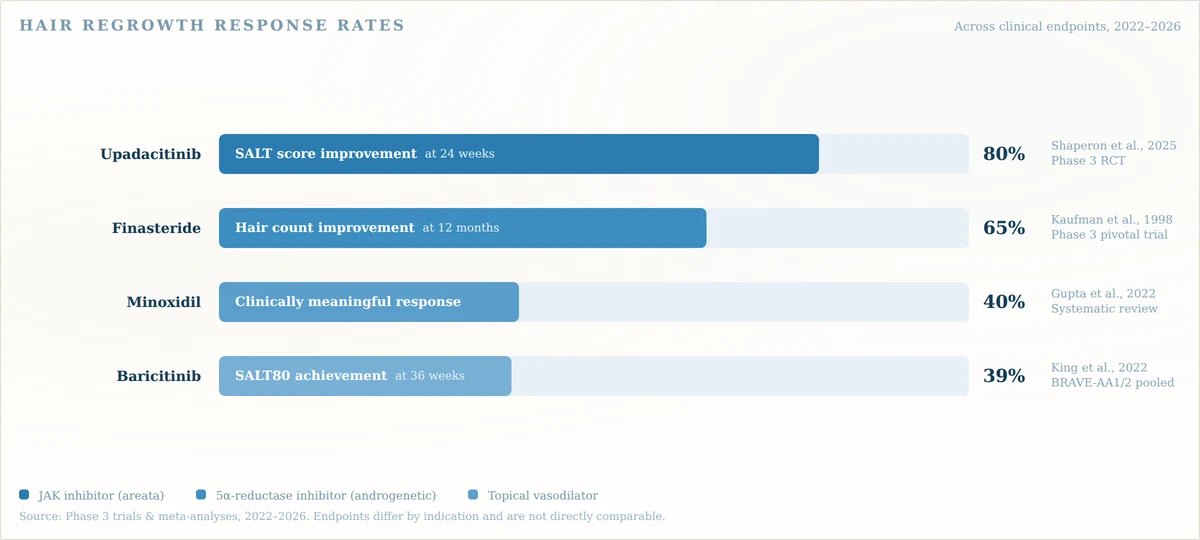
| Study | Year | Key Finding | Source |
|---|---|---|---|
| Upadacitinib Phase 3 (alopecia areata) | 2026 | 80% SALT50 response at 24 weeks | Published Aug 2026 — |
| BRAVE-AA1/AA2 (baricitinib) | 2022 | 39% achieved SALT80 at 36 weeks (4mg) | NEJM / PMID 35334197 |
| Cochrane Review (finasteride) | 2019 | 15–20% hair count increase at 12 months | Cochrane Database |
| Minoxidil systematic review | 2021 | Oral minoxidil effective in 70–100% of patients | PubMed 34533291 |
| Dutasteride vs finasteride RCT | 2016 | Dutasteride superior hair count at 24 weeks | PubMed 27175856 |
| PRP meta-analysis (22 studies) | 2023 | Significant hair density improvement vs baseline | PubMed 36534234 |
| LLLT meta-analysis (11 studies) | 2020 | ~18 hairs/cm² increase at 16–26 weeks | Published meta-analysis |
What this means for you: The evidence base for alopecia treatment options has never been stronger. For androgenetic alopecia, finasteride and minoxidil are the foundation — well-studied, affordable, and effective for most people. For alopecia areata, JAK inhibitors represent the first treatments that target the disease mechanism rather than just suppressing inflammation. The upadacitinib data is genuinely exciting — but it applies to a specific patient group (moderate-to-severe alopecia areata), not everyone with hair loss.
How to Choose the Right Alopecia Treatment for You {#how-to-choose}
The single most important decision is not which drug to try first — it is getting the diagnosis right. Androgenetic alopecia, alopecia areata, and telogen effluvium require fundamentally different approaches. A dermatologist can usually distinguish them with a physical exam and dermatoscopy; a biopsy is rarely needed.
Here is a practical decision framework:
- Gradual thinning over years, family history of baldness likely androgenetic alopecia start with finasteride + minoxidil (the combination outperforms either alone)
- Sudden circular bald patches, smooth skin likely alopecia areata see a dermatologist about corticosteroids or JAK inhibitor candidacy
- Diffuse shedding 2–3 months after major stress/illness/childbirth likely telogen effluvium address the trigger, ensure adequate iron and vitamin D, wait 6 months — if no improvement, get evaluated
- Scarring, pain, burning, or redness possible cicatricial (scarring) alopecia urgent dermatology referral — this type destroys follicles permanently and standard alopecia treatment options do not work
How to Get the Best Results From Hair Loss Treatment {#best-results}
Five practical rules that make the difference between “it did not work” and “it worked”:
- Start early. Every alopecia treatment option works better on miniaturized follicles than on fully scarred ones. The earlier you treat, the more hair you keep.
- Give it 6–12 months. Hair cycles are slow. You cannot judge finasteride at 2 months or PRP after 1 session. Set a calendar reminder for the 12-month mark — that is your real checkpoint.
- Do not panic-quit during the shed. The first 6–8 weeks on finasteride or minoxidil may involve increased shedding. This is expected. Quitting during the shed means you endured the worst part for zero benefit.
- Combine, do not switch. Finasteride + minoxidil outperforms either alone. Adding microneedling to minoxidil may enhance results. The impulse to “switch to something stronger” is usually wrong — combining is the evidence-backed move.
- Take before photos. Hair changes are gradual. Without a baseline photo, you will second-guess whether it is working. Same lighting, same angle, every 3 months.
Browse our Hair Loss products at MedsBase — we stock finasteride in 1mg and 5mg strengths, plus minoxidil topical formulations.
Related Reading {#related-reading}
- Finasteride Shedding Phase: What to Expect and When to Worry — Understanding the initial shed that surprises many new users
- Finasteride vs Minoxidil: Which Hair Loss Treatment Is Right for You? — A head-to-head comparison of the two most common treatments
- MedsBase Hair Loss Category — Browse all hair loss products with generic pricing
Frequently Asked Questions {#faq}
Q: Can alopecia hair grow back naturally?
A: It depends on the type. Telogen effluvium hair almost always regrows once the trigger is removed. Alopecia areata hair can regrow spontaneously — about 30–50% of people with a single small patch see full regrowth within a year without treatment. However, androgenetic alopecia does not regrow naturally — miniaturized follicles need intervention or they continue to shrink. The earlier treatment starts, the more hair is preserved.
Q: What is the best treatment for alopecia areata?
A: As of 2026, JAK inhibitors — baricitinib, ritlecitinib, and the investigational upadacitinib — show the highest regrowth rates for moderate-to-severe alopecia areata. For limited patchy disease, intralesional corticosteroid injections remain the first-line choice with a 60–75% response rate and fewer systemic risks. The “best” treatment depends on severity, how much scalp is affected, and your tolerance for monitoring requirements.
Q: How long does it take for alopecia treatment options to work?
A: Most treatments require 3–6 months before visible improvement, and 12 months for a fair assessment. Finasteride: 6–12 months. Topical minoxidil: 4–6 months. JAK inhibitors: some response seen at 12 weeks, peak at 24–36 weeks. PRP: 3–4 monthly sessions before visible change. Hair cycles are slow — patience is the active ingredient in every protocol.
Q: Are JAK inhibitors safe for alopecia?
A: JAK inhibitors carry a boxed warning for serious infections, major cardiovascular events, malignancy, and thrombosis — based on data from older, higher-risk rheumatoid arthritis populations. The alopecia areata clinical trials have shown lower adverse event rates, likely because alopecia patients are generally younger and healthier. However, they still require baseline screening (TB, hepatitis, lipids) and ongoing lab monitoring every 3–6 months. This is not a “start and forget” treatment — but for severe alopecia areata, the benefit-to-risk ratio is considered favourable by regulators.
Q: Does minoxidil work for alopecia areata?
A: The evidence is limited and mixed. Some small studies show modest benefit, particularly for eyebrow and beard-area alopecia areata, but minoxidil is not considered a first-line alopecia treatment option for areata. It is sometimes used as an add-on to corticosteroids or JAK inhibitors in an effort to maximize regrowth, but it should not be the sole treatment for autoimmune-driven hair loss.
Q: What causes alopecia in women vs men?
A: In men, androgenetic alopecia is overwhelmingly driven by genetic sensitivity to DHT. In women, the picture is more complex — female pattern hair loss involves hormonal factors but also often includes contributions from iron deficiency, thyroid dysfunction, and the hormonal shifts of menopause. Women also experience higher rates of telogen effluvium (postpartum shedding, post-illness shedding). This is why a thorough workup — including ferritin, TSH, and sometimes androgen levels — is especially important for women before selecting alopecia treatment options.
Q: Can diet changes help with alopecia?
A: Correcting documented deficiencies — iron, zinc, vitamin D, biotin — can support hair regrowth if those deficiencies are contributing to shedding. However, no diet or supplement has been shown to reverse androgenetic alopecia or alopecia areata in the absence of a deficiency. The Mediterranean diet, with its anti-inflammatory profile, has some observational support for general hair health, but the evidence is not strong enough to recommend diet as a standalone alopecia treatment option.
Q: Is hair transplant a permanent fix for alopecia?
A: Hair transplantation moves DHT-resistant follicles from the back of the scalp to thinning areas. These transplanted follicles largely keep their resistance — so the transplanted hair is usually permanent. However, the non-transplanted hair around it continues to thin if you do not use medical therapy (finasteride or minoxidil). Most surgeons recommend continuing medical treatment after a transplant to maintain the overall result. Transplants are not an option for active alopecia areata because the immune attack would target transplanted follicles as well.
The Bottom Line {#bottom-line}
Alopecia treatment options in 2026 are more varied — and more effective — than they were even five years ago. For the most common type (androgenetic alopecia), finasteride and minoxidil remain the evidence-based workhorses — affordable, well-studied, and effective for most people, especially when used together. For autoimmune alopecia areata, the JAK inhibitor era has transformed what is possible — the upadacitinib data released this week shows just how far the field has come.
The one immediate action: see a dermatologist for an accurate diagnosis. Everything else — which treatment, what dose, how long — follows from knowing which type of alopecia you actually have.
Two next questions readers often ask:
- Wondering how finasteride compares to minoxidil? Read our finasteride vs minoxidil guide.
- Worried about the initial shedding phase on finasteride? Here is what to expect and when to worry.
Disclaimer: This article is for informational purposes only and does not constitute medical advice. Hair loss treatments carry real risks and should be started under the supervision of a qualified healthcare professional. Individual results vary — what works for one person may not work for another.

Written by
Sophie ChenPharmaceutical Content Researcher · 8 years experience
Sophie Chen is a pharmaceutical content researcher with 8 years covering generic medication access and clinical pharmacology. She specialises in international regulatory frameworks, bioequivalence standards, and patient-facing education on therapeutic drug classes. She is not a clinician.