








✓ Medically reviewed by · Last reviewed: May 2026
Pharmacy Researcher · 8 years experience
Pharmacy researcher with 8 years reviewing clinical drug information, generic formulation equivalence, and international pharmaceutical standards. Focuses on patient-facing accuracy in medication education.
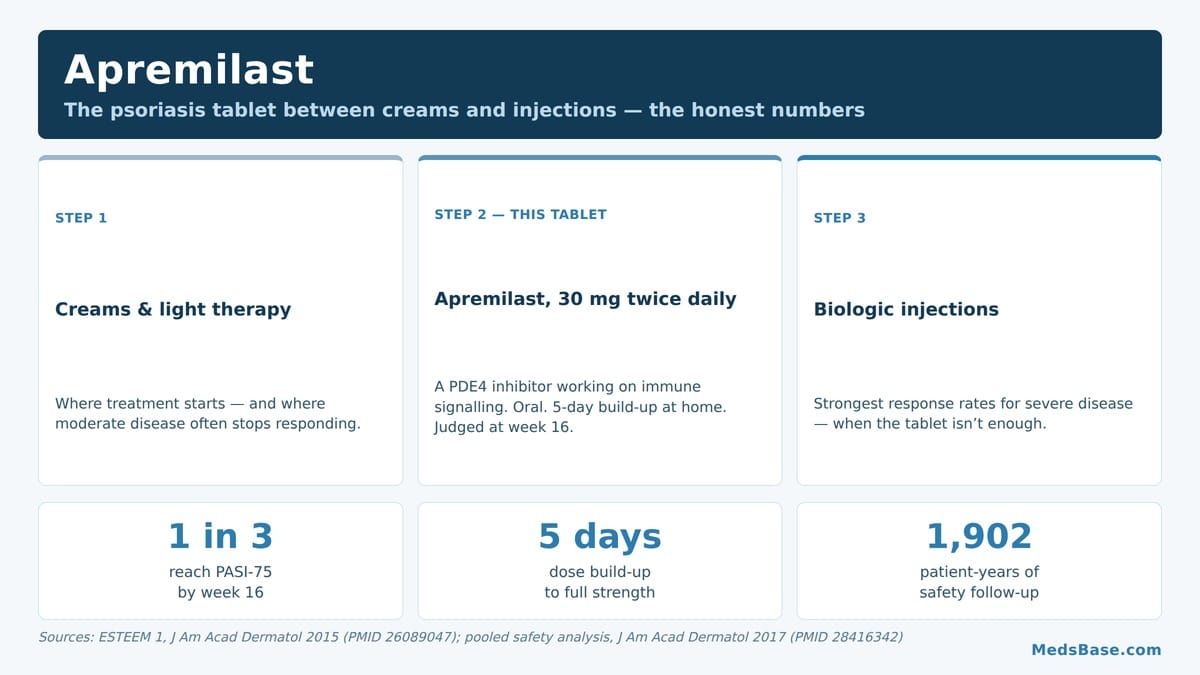
Most people with worsening psoriasis believe the next step after creams is an injection. The research says otherwise: since 2014 there has been a middle rung on that ladder — apremilast, a twice-daily tablet that works on the immune signalling behind plaques rather than on the skin surface. No needles, no clinic visits to receive it.
Here is what this article will give you that the marketing never does: the real response numbers from the pivotal trial (spoiler: genuinely useful, decidedly not miraculous), the three-year safety data in actual rates, the exact 5-day starting schedule from the FDA label, and a clear-eyed answer to who should — and should not — consider this drug.
Two details to hold onto as you read. First, the most common reason people quit apremilast in the early weeks is entirely predictable and usually manageable — we’ll cover it in the side-effects section. Second, there is one number on the label about weight that surprises almost everyone.
- Apremilast is a tablet, not a biologic injection — it blocks an enzyme called PDE4 inside immune cells
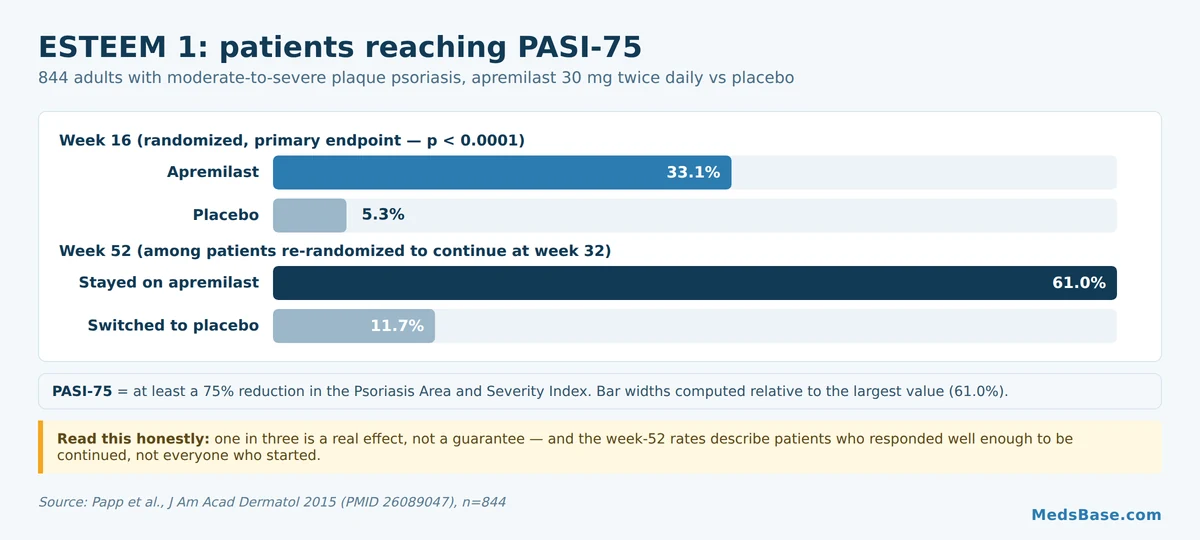
- In the pivotal trial, 33.1% reached a 75% skin improvement by week 16, versus 5.3% on placebo — real, but a minority; we show who tends to benefit
- Diarrhea and nausea lead the side-effect list — and the label’s 5-day dose ladder exists specifically to soften them
- Three-year pooled safety follow-up (1,902 patient-years) found no new safety signals emerging over time
- About 1 in 8 psoriasis-trial patients lost 5–10% of body weight — the label number nobody quotes
- One rule about other medicines can quietly cancel apremilast’s effect — it’s in the how-to section
What Is Apremilast?
Apremilast is an oral tablet for moderate-to-severe plaque psoriasis, active psoriatic arthritis and mouth ulcers of Behçet’s disease. It is a small-molecule PDE4 inhibitor — not a biologic — taken twice daily at 30 mg after a 5-day dose build-up, and it calms the immune signalling that drives plaque formation.
Psoriasis is an immune-driven condition in which skin cells are pushed to renew far too fast, stacking into the raised, scaled plaques you can see and feel — the NIH’s psoriasis overview covers the condition itself well. For years the treatment story had two chapters: creams and light therapy on one side, and powerful systemic drugs — methotrexate, cyclosporine, then injectable biologics — on the other, with a large group of people stranded between them.
Apremilast was built for that gap. Originally sold under the brand name Otezla, it is now also available as generic apremilast — same molecule, same 30 mg twice-daily maintenance dose. MedlinePlus explains apremilast at consumer level; what MedlinePlus won’t tell you is how well it actually works in numbers. That is this article’s job.
But first — what does “PDE4 inhibitor” even mean, and why should you care that it isn’t a biologic?
How Does Apremilast Work?
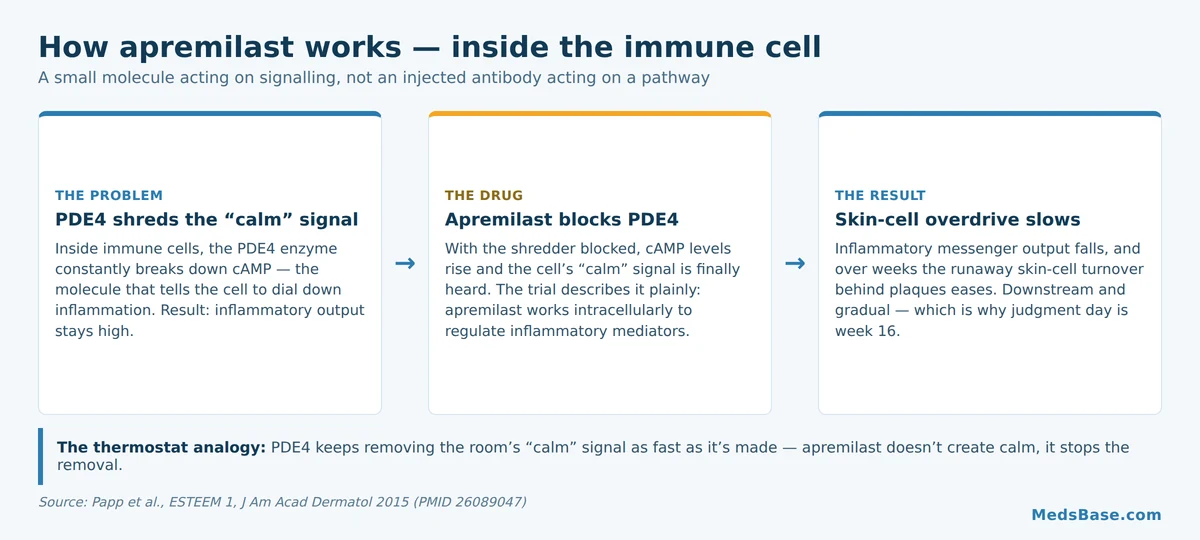
Picture the inflammation in your immune cells as a room with a thermostat. The “calm” signal in that room is a molecule called cyclic AMP (cAMP) — while its level is high, the cell dials down its output of inflammatory messengers. The problem: an enzyme called phosphodiesterase 4 (PDE4) sits in the corner shredding cAMP as fast as the cell makes it.
Apremilast blocks the shredder. cAMP levels rise, the cell’s inflammatory output falls, and — downstream, over weeks — the skin’s cell-production frenzy slows. As the ESTEEM 1 phase III trial puts it, apremilast “works intracellularly to regulate inflammatory mediators”: inside the cell, at the signalling level.
That location matters for two practical reasons. Because it is a small molecule rather than an engineered antibody, it can be a tablet — biologics are proteins and must be injected. And because it modulates a signalling enzyme rather than deleting an immune pathway, its safety conversation differs from the biologic one — the trial programme reported no serious opportunistic infections or tuberculosis reactivation over three years of pooled follow-up. “Differs” is not “disappears”: it has its own list, and we will get to it honestly.
So what does one-in-three mean for you? It means apremilast is a genuine option, not a guarantee: most patients get some improvement, a third get a transformative one, and there is no blood test that predicts in advance which group you’ll join. The practical consequence: apremilast is usually a 16-week experiment with a clear go/no-go review at the end — and knowing that upfront changes how you experience week 6.
Key Uses — and Who It Actually Suits
Moderate-to-severe plaque psoriasis
The core use. The FDA label covers adults with plaque psoriasis who are candidates for phototherapy or systemic therapy — in plain terms: your psoriasis is beyond what creams alone can manage, whether by area, by location (scalp, palms, soles), or by impact on your life. The pivotal trials enrolled moderate-to-severe disease, which is where the tablet’s evidence lives.
Active psoriatic arthritis
Up to a third of people with psoriasis develop joint involvement — stiffness, swelling, pain, often in fingers and toes. Apremilast is approved for active psoriatic arthritis in adults, which makes it a rational single-tablet option when skin and joints flare together.
Mouth ulcers of Behçet’s disease
The third approved use: recurrent oral ulcers in Behçet’s disease, a rarer inflammatory condition. Included here for completeness — if that is your diagnosis, your specialist is already steering.
For readers who match the first column, MedsBase stocks oral apremilast 30 mg (Aprezo), sourced from a WHO-GMP-certified manufacturer, with no prescription needed to order — while the decision that apremilast is the right next step, and the mood/kidney checks above, belong in a conversation with your doctor or dermatologist.
Apremilast Side Effects, Dosage and the 5-Day Ladder
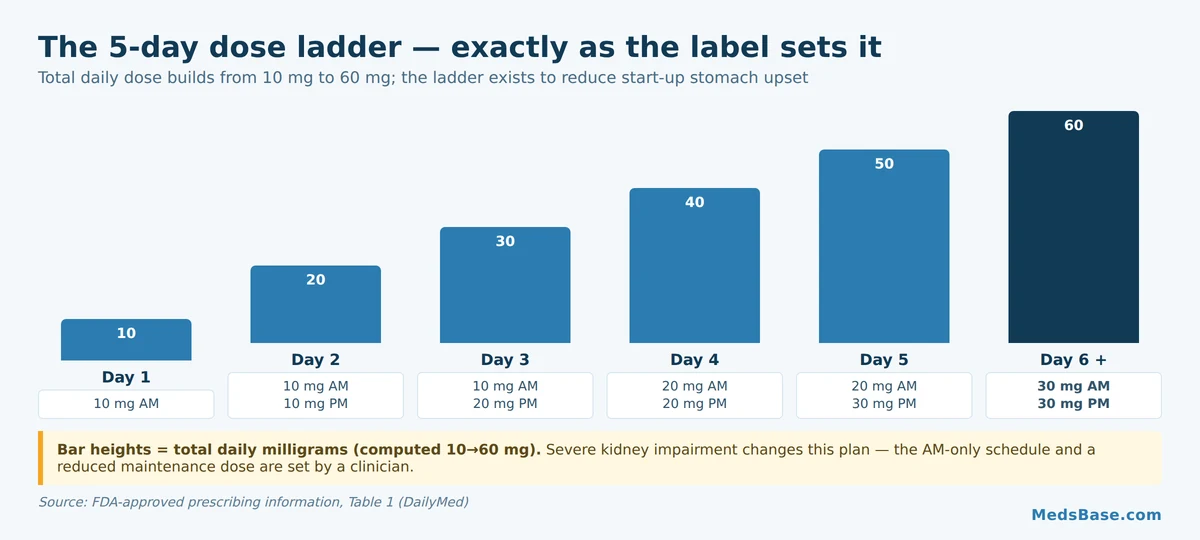
Here’s the early-weeks reality promised in the introduction: apremilast’s most common side effects are digestive, they front-load into the first days and weeks, and the label’s entire starting design exists to soften them.
| Side effect | Frequency (trials) | Severity | What to do |
|---|---|---|---|
| Diarrhea | Most common (≥5% of patients) | Usually mild–moderate, early | Hydrate; if severe or persistent, contact your prescriber — the label allows dose reduction or suspension |
| Nausea | Common (≥5%) | Usually mild–moderate, early | Take with food if it helps (label allows either); usually settles over weeks |
| Upper respiratory tract infection / nasopharyngitis | Common (≥5%) | Mild | Routine care; mention recurrent infections to your prescriber |
| Headache (incl. tension headache) | Common (≥5%) | Mild–moderate | Usually transient; persistent headache review |
| Weight decrease | 12% of psoriasis-trial patients lost 5–10% of body weight (vs 5% on placebo); 2% lost ≥10% | Gradual | Weigh regularly; report unexplained or continuing loss — the label advises considering discontinuation for significant loss |
| Depression / mood change | Uncommon but label-flagged | Potentially serious | Agree a monitoring plan upfront; report mood changes or suicidal thoughts immediately |
That weight row is the number nobody quotes: roughly one patient in eight lost 5–10% of body weight in the psoriasis trials — for some readers unwelcome, and for a clinician a reason to keep a scale in the plan either way. It resolves the takeaway teased at the top: monitor it, don’t discover it.
The 5-day ladder. The FDA-approved prescribing information sets the start-up precisely — Day 1: 10 mg in the morning; Day 2: 10 mg twice; Day 3: 10 mg morning, 20 mg evening; Day 4: 20 mg twice; Day 5: 20 mg morning, 30 mg evening; Day 6 onward: 30 mg twice daily. The label states the purpose plainly: to reduce the gastrointestinal symptoms of starting. Skipping the ladder because you feel fine is the classic self-inflicted rough first week.
One more label rule, quietly critical: in severe kidney impairment the maintenance dose halves to 30 mg once daily, using a morning-only titration. That is a prescriber decision made from your kidney function — one of the few blood-test moments in the apremilast story.
What Does the Research Say?
| Study | Year | Finding | Source |
|---|---|---|---|
| ESTEEM 1 (phase III RCT, n=844) | 2015 | PASI-75 at week 16: 33.1% vs 5.3% placebo (P < .0001); week 52 among continued users: 61.0%; adverse events 69.3% vs 55.7%, mostly mild–moderate | Papp et al., J Am Acad Dermatol (PMID 26089047) |
| Pooled long-term safety, ESTEEM 1+2 (n=1,184; 1,902.2 patient-years) | 2017 | No new adverse events emerged through ≥156 weeks; rates per 100 patient-years: major cardiac events 0.5, malignancies 1.2, depression 1.8, suicide attempts 0.1; no serious opportunistic infections, no TB reactivation, no meaningful lab changes | Crowley et al., J Am Acad Dermatol (PMID 28416342) |
The efficacy story you know from the spotlight box. The second row deserves equal attention, because “is this safe to take for years?” is the question that actually decides whether people stay on a daily tablet. A pooled safety analysis covering three or more years followed 1,184 patients on apremilast 30 mg twice daily for a combined 1,902 patient-years and found the safety profile at year three looked like the safety profile at week 52 — no new event types, no rising rates of cardiac events, cancers, depression or suicide attempts, and — notably for an immune-signalling drug — no serious opportunistic infections and no clinically meaningful laboratory drift. Its honest limitation: a high dropout rate over three years, which is common in long extension studies but does soften certainty.
What this means for you: the drug’s rough edges show early (stomach, weight, mood-watch) rather than accumulating late. That shapes the practical bargain — get through the first month, review honestly at week 16, and long-term maintenance has a reassuring, well-measured record.
Apremilast vs Alternatives
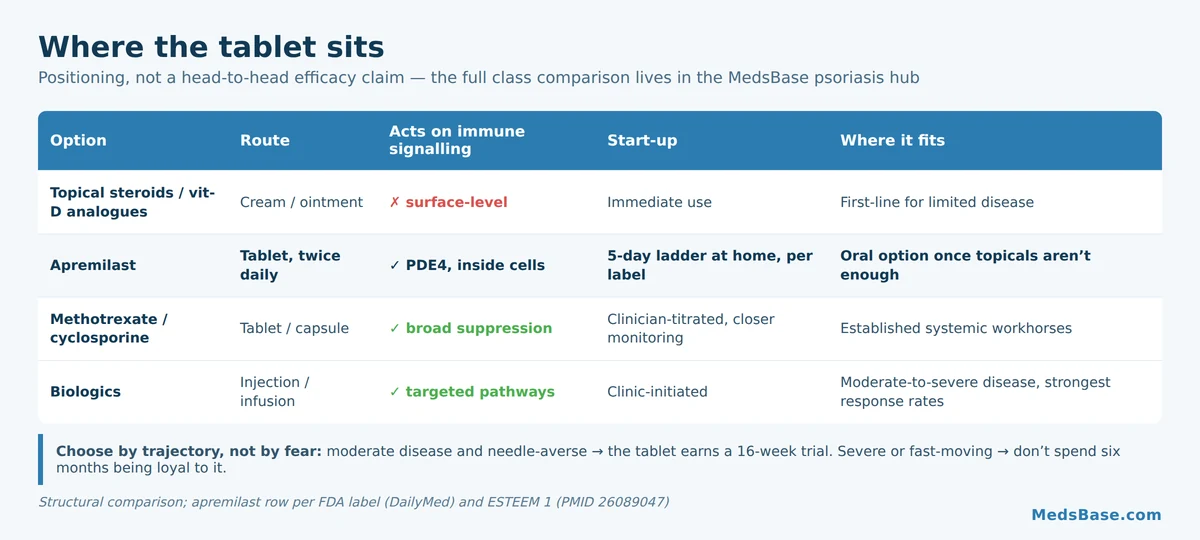
| Option | Route | Where it acts | Start-up | Typical position |
|---|---|---|---|---|
| Topical steroids / vitamin-D analogues | Cream/ointment | Skin surface & local inflammation | Immediate use | First-line for limited disease |
| Apremilast | Tablet, twice daily | Immune signalling (PDE4, intracellular) | 5-day label-defined ladder at home | Oral option once topicals aren’t enough |
| Methotrexate / cyclosporine (older systemics) | Tablet/capsule (weekly or daily) | Broad immune suppression | Clinician-titrated, closer monitoring | Established systemic workhorses |
| Biologics (injectables) | Injection/infusion | Targeted immune pathways (TNF, IL-17, IL-23) | Clinic-initiated | Moderate-to-severe disease, strongest response rates |
The verdict paragraph the table can’t give you: choose by trajectory, not by fear. If your disease is moderate, your veins are nobody’s business and you want a defined oral trial — apremilast earns its slot, with the one-in-three transformative-response rate priced in. If your disease is severe, moving fast, or joint-heavy despite treatment, don’t spend six months being loyal to a tablet: the stronger systemic options exist for a reason. Many readers weighing the older tablets will want our guide to oral cyclosporine for that side of the scale — and for the full map of every class, how apremilast compares with every other psoriasis treatment class is the hub this article plugs into.
Illustrative scenario (not a real patient): Tomas, 41, has plaques across his elbows, shins and scalp that two years of potent creams keep merely acceptable. He is offered a biologic but hesitates at self-injection. His dermatologist frames apremilast as a 16-week experiment: dose ladder in week one, expect stomach grumbles, weigh weekly, review with photos at week 16. By week 12 his scalp is clear and his elbows faded; he stays on. His neighbour with near-identical psoriasis tried the same experiment, saw modest change by week 16, and moved to a biologic without regret. Both outcomes are the system working.
How to Take Apremilast — Practical Guidance
- Follow the 5-day ladder exactly — it is printed on the starter pack and in the label table above. The ladder is the anti-nausea plan.
- Take it with or without food, but whole — the label is explicit: swallow tablets whole; do not crush, split or chew.
- Anchor the two daily doses to fixed habits — breakfast and evening routine. A missed-dose pattern is the quiet killer of a drug whose effect builds over weeks.
- Weigh yourself weekly for the first months — you now know the 1-in-8 statistic; make it data, not a surprise.
- Review at week 16 with evidence — photos from day 0 and a symptom note beat memory. One in three reach PASI-75; be honest about which curve you’re on.
- Check your other medicines — this is the loop from the top of the article: strong enzyme inducers — rifampin, phenobarbital, carbamazepine, phenytoin — can cut apremilast’s blood levels enough to cause loss of efficacy, and the label says the combination is not recommended. Your pharmacist can screen your list in two minutes.
Mistakes to avoid:
- Skipping the titration ladder (“I’ll be fine”) — the predictable rough week
- Quitting at week 3 because skin hasn’t changed — the trial’s primary readout was week 16
- Ignoring gradual weight loss until it’s significant — track it from day one
- Not telling your prescriber about a depression history — the label’s mood warning exists for a reason
- Adding a new anticonvulsant or antibiotic without mentioning apremilast to the prescriber
- Psoriasis treatment: the full comparison of options — every class, one map
- Oral cyclosporine: uses, dosage and side effects — the older systemic tablet compared above
- What to do if your medication is recalled — the practical safety companion for anyone on a long-term medicine
Frequently Asked Questions
Q: How long does apremilast take to work?
A: Judge it at 16 weeks — that was the primary endpoint of the pivotal trial, where 33.1% of patients reached a 75% skin improvement versus 5.3% on placebo. Some people notice change within 4–8 weeks, and itch often improves before plaques visibly shrink. Quitting at week 3 for lack of effect is premature; staying past week 16 without clear benefit deserves an honest review with your clinician.
Q: Is apremilast a biologic?
A: No. Apremilast is a small-molecule tablet that blocks the PDE4 enzyme inside immune cells; biologics are engineered proteins, given by injection or infusion, that target specific immune pathways from outside the cell. The practical differences: apremilast is oral and, in three years of pooled trial follow-up, showed no serious opportunistic infections or TB reactivation — while biologics generally deliver higher response rates in moderate-to-severe disease.
Q: Does apremilast cause weight loss?
A: It can. In the placebo-controlled psoriasis trials, 12% of apremilast patients lost 5–10% of body weight (versus 5% on placebo), and 2% lost 10% or more. The label advises monitoring weight regularly and considering stopping the drug for significant unexplained loss. For most people the loss is modest and plateaus — but it should be tracked deliberately, not discovered at an annual check-up.
Q: What are the most common side effects of apremilast?
A: Diarrhea, nausea, upper respiratory tract infections, nasopharyngitis and headache (including tension headache) — each affecting at least 5% of trial patients, concentrated in the early weeks. The 5-day dose ladder exists specifically to soften the digestive start. Serious but less common label warnings: worsening depression or suicidal thoughts, significant weight loss, and severe diarrhea/nausea/vomiting warranting dose reduction or suspension.
Q: Do you need blood tests on apremilast?
A: Far fewer than with the older systemic tablets. The label sets no routine laboratory monitoring schedule during treatment; the key blood-test moment is at the start, where kidney function decides whether you need the reduced 30 mg once-daily dose (severe renal impairment). Three-year pooled trial data reported no clinically meaningful laboratory changes. Your own clinician may still order checks — follow their plan.
Q: Is apremilast the same as Otezla?
A: Yes — Otezla is the original brand name; apremilast is the molecule, now also available as generic tablets such as Aprezo at the same 30 mg twice-daily maintenance dose with the same label. The titration ladder, side-effect profile and trial evidence all belong to the molecule, not the box. Generic availability is largely why the tablet has become a realistic option for people paying out of pocket.
Q: Do I need a prescription to buy apremilast?
A: MedsBase supplies oral apremilast 30 mg (Aprezo) with no prescription needed to order. Use that access wisely: the decision that apremilast fits your psoriasis — and the mood-history and kidney checks the label calls for — deserve a doctor’s or dermatologist’s input, and the week-16 review is genuinely better done with a clinician looking at your skin alongside you.
The Bottom Line
Apremilast occupies a spot the psoriasis treatment ladder genuinely needed: a tablet that works on immune signalling, starts with a self-explanatory 5-day ladder at home, and carries a three-year safety record with no late surprises in the pooled data. The honest counterweight: a one-in-three chance of the headline PASI-75 response by week 16, digestive side effects early, and a weight number worth tracking.
The verdict: a rational, evidence-backed middle step for moderate disease when creams aren’t enough and injections aren’t wanted — run as a deliberate 16-week experiment, never as an open-ended hope.
One thing to do today: if you’re considering apremilast, photograph your skin in daylight and book the conversation with your doctor — the week-16 review only works if day 0 is on record.
Wondering how the tablet stacks against every other option before you commit? Our full psoriasis treatment comparison maps all the classes side by side. Weighing the older systemic tablets instead? Oral cyclosporine: uses, dosage and side effects covers the other candidate honestly.

Written by
Sophie ChenPharmaceutical Content Researcher · 8 years experience
Sophie Chen is a pharmaceutical content researcher with 8 years covering generic medication access and clinical pharmacology. She specialises in international regulatory frameworks, bioequivalence standards, and patient-facing education on therapeutic drug classes. She is not a clinician.