








✓ Medically reviewed by · Last reviewed: May 2026
Pharmacy Researcher · 8 years experience
Pharmacy researcher with 8 years reviewing clinical drug information, generic formulation equivalence, and international pharmaceutical standards. Focuses on patient-facing accuracy in medication education.
best laxative for constipation — Best Laxative for Constipation: 4 Safe Types to Try First. Read on for an evidence-backed guide covering everything you need to know.
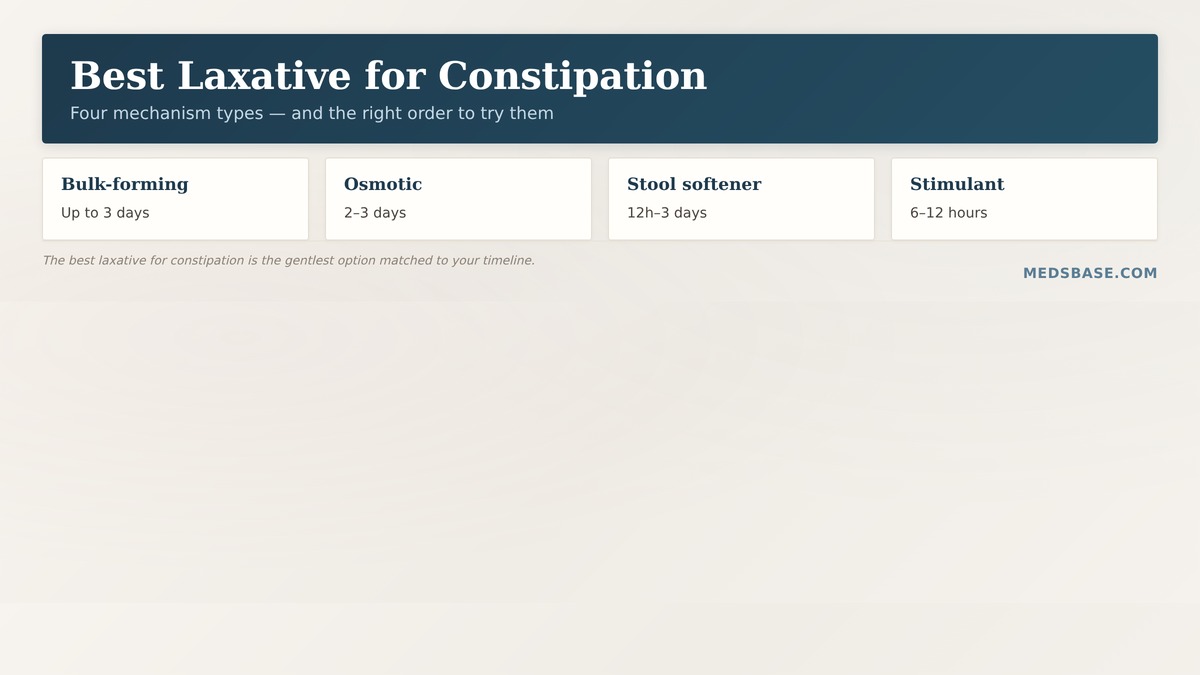
You have not been in three days, you feel bloated, and you are standing in the pharmacy aisle staring at a wall of bottles — each promising relief and each doing something slightly different. Choosing the best laxative for constipation is harder than it should be, because “laxative” is not one thing; it is four families of medicines that work on completely different timelines. Pick the wrong one and you may wait three days for a result, or trigger cramping when gentler options would have done the job. This guide walks you through the four laxative types, how fast each one actually works, and the sensible fibre-first order you should follow so you choose the best laxative for constipation for your specific situation.
- The best laxative for constipation is usually not the strongest one — it is the gentlest one that works for your cause, applied in the right order.
- Laxatives come in four types — bulk-forming, osmotic, stool softener and stimulant — and they act on very different timelines, from 6 hours to 3 days.
- For most adults, the best laxative for constipation to try first is a bulk-forming fibre product, after diet and fluids alone have been ruled out.
- Stimulant laxatives work fastest but should be short-term only; long-term daily use can mask an underlying problem and may actually worsen things.
- One habit that surprises people: taking an osmotic or bulk-forming laxative without enough water can make constipation feel worse, not better.
Best laxative for constipation: On this page:
- What Is a Laxative?
- How Does Each Laxative Type Work?
- Key Uses & Who Is This For
- Safety, Side Effects & Risk
- What Does the Research Say?
- Best Laxative for Constipation: Types Compared
- How to Choose the Best Laxative for Constipation
- Frequently Asked Questions
- The Bottom Line
What Is a Laxative?
A laxative is a medicine that helps you pass a stool — by softening it, bulking it up, lubricating it, or prompting the bowel muscles to squeeze. The best laxative for constipation depends on which of those levers your bowels actually need pulled. NHS guidance describes four main types of laxative: bulk-forming, osmotic, stool-softening and stimulant — each with a different mechanism and a different time to work.
Crucially, a laxative treats the symptom, not the cause. Constipation itself is usually a lifestyle problem first — not enough fibre, not enough fluid, too little movement, or habitually “holding on” — and the first-line fix is almost always those basics, not a pill. The best laxative for constipation is therefore often a temporary bridge back to regularity, not a permanent solution.
It helps to know what “constipated” actually means before you treat it. NHS guidance describes constipation as passing stool fewer than three times a week, or finding stools unusually hard, dry, lumpy or difficult to pass, often with straining or a feeling you have not fully emptied. Occasional constipation — a few uncomfortable days after travel or a change in routine — is extremely common and usually self-corrects. The kind that keeps returning, or that comes with red-flag symptoms, is a different matter and needs a different response than simply reaching for the strongest bottle on the shelf.
How Does Each Laxative Type Work?
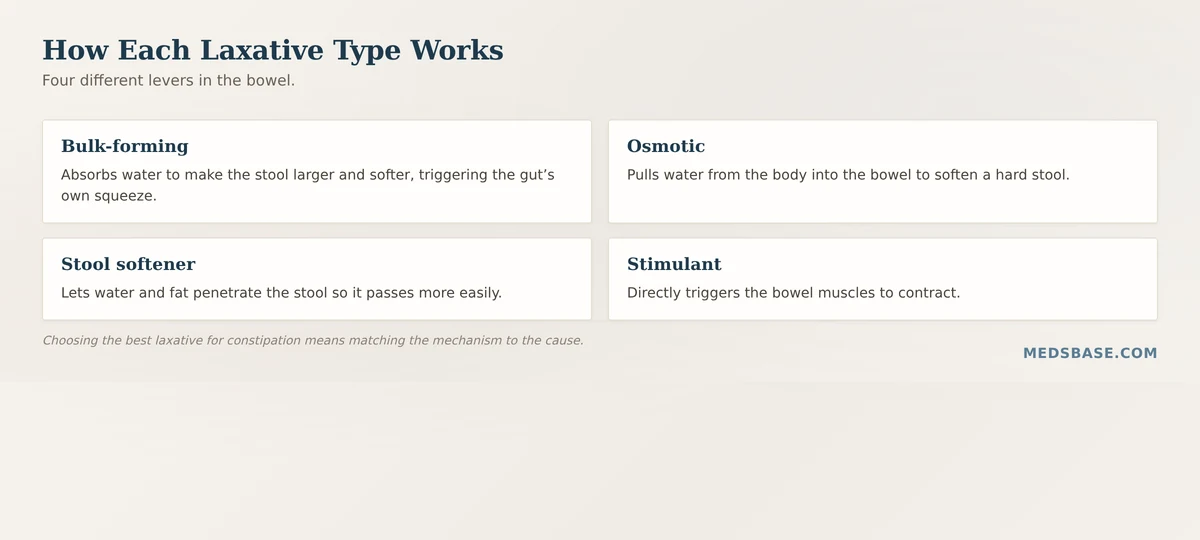
Here is where the choice gets practical, because the four types pull the bowel in four different directions.
- Bulk-forming laxatives (ispaghula husk, methylcellulose) absorb water to make the stool larger and softer, which triggers the gut’s own natural squeeze. They are the gentlest, closest to how fibre itself works, but they take up to three days.
- Osmotic laxatives (macrogol, lactulose) draw water from the body into the bowel to soften the stool. They typically work in two to three days and are the usual next step when a bulk-former is not enough.
- Stool softeners (docusate, arachis oil) help water and fat penetrate the stool so it is easier to pass — a gentler assist, acting over 12 hours to three days.
- Stimulant laxatives (bisacodyl, senna) directly trigger the bowel muscles to contract. They work fastest — six to twelve hours — but are meant for short-term use only.
Key Uses & Who Is This For
Occasional, lifestyle-related constipation
The common case: a short stretch of hard, infrequent stools after travel, a change in routine, or a low-fibre week. Here the best laxative for constipation is often a bulk-former plus more water, used for a few days.
Painful or straining stools
When stools are hard and passing them hurts, an osmotic (or a stool softener) that draws water into the stool is often better tolerated than a stimulant, which can cause cramping.
Opioid-induced constipation
Some medicines — especially opioid painkillers — slow the gut down. This often needs a different, planned approach (usually an osmotic like macrogol, taken regularly) rather than sporadic stimulant use.
Occasional rescue
When you need a result by the next morning — before a procedure, or after several uncomfortable days — a stimulant works fastest, but it should be the short-term exception, not the daily norm.
When constipation keeps returning
If constipation is a regular companion — most weeks, not just occasionally — the answer is rarely “a stronger laxative.” Recurring constipation points to fibre, fluid, activity, medication side effects or a medical cause, and it is worth a conversation with a pharmacist or doctor rather than a nightly stimulant. In these cases, the best laxative for constipation is usually a regular, gentle osmotic under guidance, combined with lifestyle work.
Constipation caused by other medicines
A long list of common medicines slow the bowel — opioid painkillers, some antidepressants, iron supplements, certain blood-pressure drugs and more. If your constipation started after a new medicine, the fix may be adjusting that medicine with your prescriber, plus a planned laxative rather than ad-hoc use.
Safety, Side Effects & Risk
The best laxative for constipation is the one you can use safely. All four types can cause mild griping, bloating or flatulence, but the risks differ.
| Side Effect / Risk | Which types | Severity | What To Do |
|---|---|---|---|
| Bloating, wind, cramps | All (common) | Mild | Reduce dose; drink more water |
| Dehydration | Osmotic & bulk-forming (if under-hydrated) | Moderate | Always take with enough fluid |
| Diarrhoea | Any, if overdosed | Mild-moderate | Drop back to a lower dose |
| Low potassium / electrolyte shift | Stimulant (long-term) | Moderate | Keep stimulants short-term only |
| Dependence / “lazy bowel” | Stimulant (long-term) | Moderate | Never use stimulants indefinitely |
The NHS advice is blunt about the biggest trap: do not take a laxative without prescription for more than seven days, and if you have used one for three days without help, speak to a doctor or pharmacist. Long-term stimulant use in particular can reduce the bowel’s own ability to work, which is the opposite of what you want from the best laxative for constipation.
There is also a hydration rule that trips people up more than any other. Bulk-forming and osmotic laxatives rely on water to work — a bulk-former absorbs water into the stool, and an osmotic pulls water from your tissues into the bowel. If you take either while dehydrated, or without drinking extra fluid, the stool can become harder and more uncomfortable to pass, and you may end up feeling more bloated than before. This is why the instruction to “drink plenty of water” on every laxative label is not just filler — it is the difference between the product working and working against you.
What Does the Research Say?
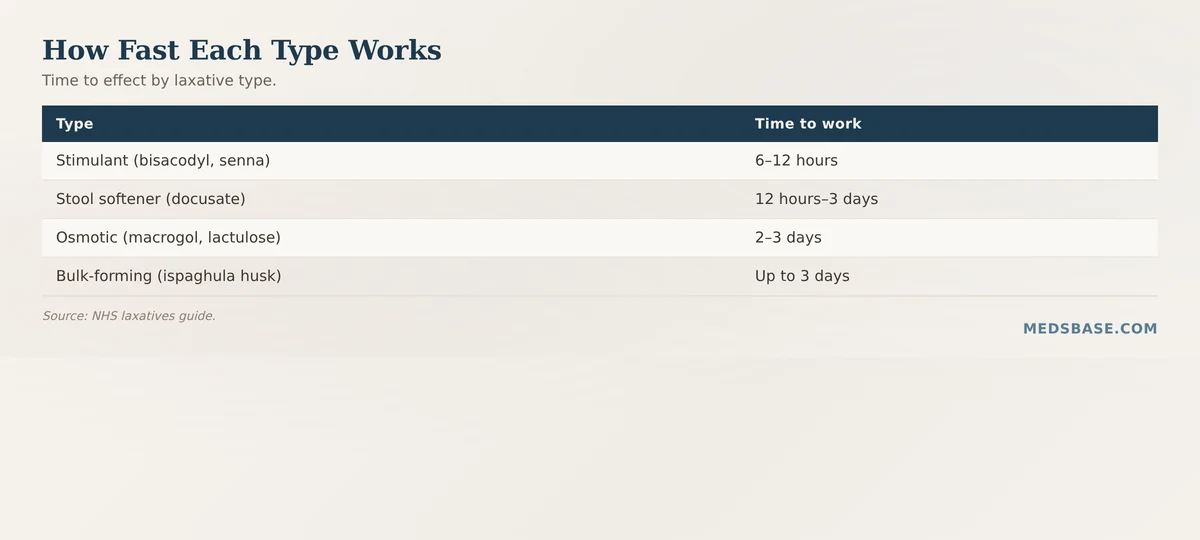
The evidence steering the “best laxative for constipation” decision is less about one product beating another and more about a consistent, uncontroversial principle: gentle, fibre-based approaches first, stronger agents reserved for when they fail.
| Guidance | Source | Takeaway |
|---|---|---|
| Four laxative types, each with a distinct timeline | NHS laxatives guide | Bulk-forming up to 3d · osmotic 2–3d · softener 12h–3d · stimulant 6–12h |
| Lifestyle change is the first step | NHS constipation | Fibre, fluids, movement and toilet routine before medication |
| Bulk-forming first when self-treating | NHS laxatives guide | “It’s usually best to try a bulk-forming laxative first” |
| Increase fibre gradually | NHS fibre guidance | Fruits, veg, oats, bran, linseed |
What this means for you: the “best” laxative is a sequence, not a single champion product. For most occasional constipation, that sequence is diet and fluid first, then a bulk-former, then an osmotic, with a stimulant as a short-term last resort — and a visit to the pharmacist or doctor if things are not moving after a few attempts.
Best Laxative for Constipation: Types Compared
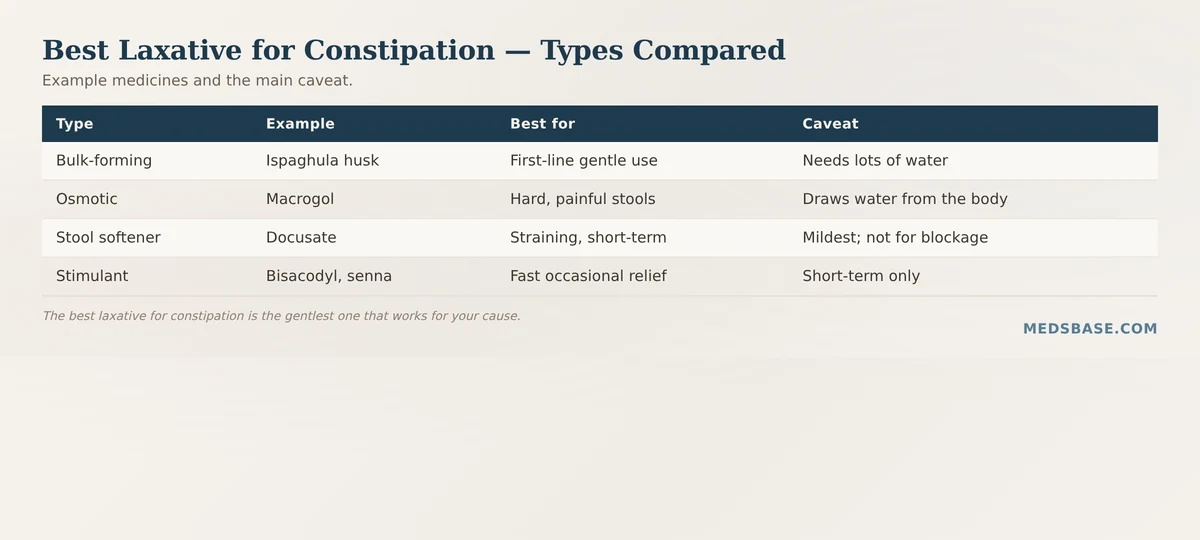
| Type | Example medicines | How fast | Best for | Caveat |
|---|---|---|---|---|
| Bulk-forming | Ispaghula husk (Fybogel), methylcellulose | Up to 3 days | First-line, gentle daily use | Needs lots of water |
| Osmotic | Macrogol, lactulose | 2–3 days | Hard stools; opioid-related | Draws water from the body |
| Stool softener | Docusate, arachis oil | 12h–3 days | Straining, short-term comfort | Mildest; not for blockage |
| Stimulant | Bisacodyl, senna | 6–12 hours | Fast occasional relief | Short-term only; can cramp |
Which one fits which situation? If your constipation is mild and lifestyle-linked, start gentle with a bulk-former and plenty of water. If stools are hard and painful, an osmotic softens from within and is the workhorse most doctors reach for next. If you need a predictable result by morning, a stimulant delivers — just do not make it a habit. The genuinely best laxative for constipation is the one matched to the timeline you actually need and the gentlest option that gets you there.
It is worth saying plainly: there is no single product that is the best laxative for constipation for everyone, because the four types solve different problems. A bulk-former makes the stool easier for the gut to push; an osmotic softens a hard stool from inside; a stimulant forces a contraction when the gut will not move on its own. Treating them as interchangeable is how people end up with three different laxatives in the cupboard and still no relief. The best laxative for constipation is the one that addresses the specific reason you are backed up — which is why the cause, and the timeline, matter more than the brand name.
How to Choose the Best Laxative for Constipation
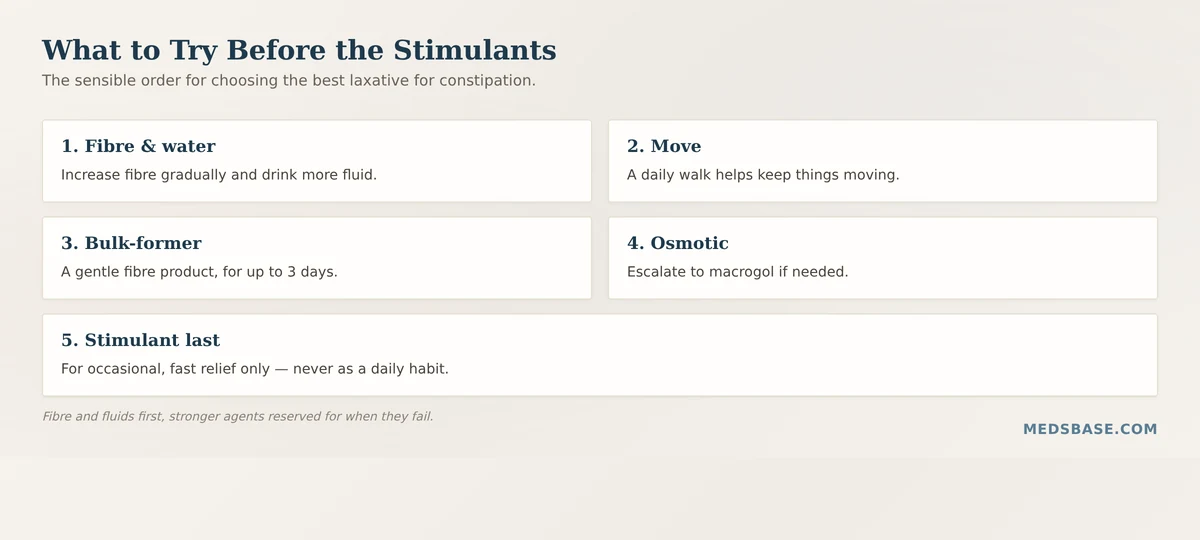
- Try lifestyle first — more fibre, more water, and a daily walk.
- If still stuck, try a bulk-forming laxative for up to three days, with plenty of fluid.
- Not enough? Escalate to an osmotic laxative such as macrogol.
- Reserve a stimulant for occasional, fast relief — and do not use it daily.
- If nothing has worked after three days of laxatives, or it keeps returning, see a pharmacist or doctor.
Mistakes to avoid: taking an osmotic or bulk-former without enough water (you make the problem worse); using stimulants as a nightly crutch (you can train the bowel to need them); and ignoring the “blood in stool / weight loss / new persistent change” red flags, which mean stop self-treating and get checked.
If you are looking at your options, you can browse constipation treatment options or look at a laxative product such as Cremalax at MedsBase.
- Myopia Control Treatment — 7 proven ways to slow nearsightedness (today’s related post on evidence-led treatment choice)
- Betahistine for Vertigo — does it actually work? (another “how to choose a medication” guide)
- Browse constipation treatment options at MedsBase
Frequently Asked Questions
Q: What is the best laxative to take for constipation?
A: For most people with occasional constipation, the best laxative to try first is a bulk-forming fibre product such as ispaghula husk. If that does not work, an osmotic laxative like macrogol is the usual next step, with stimulants reserved for short-term, occasional relief.
Q: How long do laxatives take to work?
A: It depends on the type. Stimulant laxatives work fastest, in 6 to 12 hours; stool softeners in 12 hours to 3 days; osmotic laxatives in 2 to 3 days; and bulk-forming laxatives in up to 3 days.
Q: Is it safe to take laxatives every day?
A: Generally not without advice. Bulk-forming laxatives are the safest for longer-term use, but even they should be reviewed. Taking any non-prescription laxative for more than seven days, or using stimulant laxatives daily, is discouraged because it can mask an underlying problem or reduce the bowel’s own function.
Q: What should I try before laxatives?
A: Lifestyle first: gradually increase fibre from fruit, vegetables, oats and bran; drink plenty of fluid; move more; and establish a regular, unhurried toilet routine. These basics resolve most occasional constipation within days without any medicine.
Q: Which laxative works the fastest?
A: Stimulant laxatives such as bisacodyl or senna work the fastest, usually within 6 to 12 hours. Because they directly trigger bowel contractions and can cause cramping, they are best saved for occasional use rather than taken every day.
Q: Can laxatives make constipation worse?
A: Yes, in the long run. Overusing stimulant laxatives can leave the bowel dependent on them, and taking osmotic or bulk-forming laxatives without enough fluid can worsen the problem. Persistent or recurring constipation that ignores lifestyle fixes deserves a doctor’s input, not a stronger laxative.
Q: Is it better to try diet first or go straight to a laxative?
A: For occasional constipation, diet and fluids first is the evidence-backed approach — increase fibre gradually, drink more water, and move more, giving it a few days. The best laxative for constipation is usually the one you reach for only after those basics have not been enough, rather than the first resort.
Q: How do I know if my constipation is something serious?
A: See a doctor rather than self-treating if you notice blood in your stool, have lost weight without trying, are persistently bloated or tired, or have a new and lasting change in your bowel habit. These can be signs that constipation is a symptom of something that needs investigation, not just a fibre shortfall.
The Bottom Line
The best laxative for constipation is not a single magic product — it is a sensible sequence: fibre, fluid and movement first, then a gentle bulk-former, then an osmotic, with a fast-acting stimulant kept as a short-term exception, and a visit to a professional if things do not settle. Matching the type to your timeline and using the gentlest option that works is both safer and more effective than reaching for the strongest bottle on the shelf.
Your next step is concrete: drink a large glass of water, add some fibre to your next meal, and only reach for the pharmacy if you are still uncomfortable after a day or two of the basics.
Wondering whether an osmotic or a stimulant is right for your situation? That single decision — timeline versus gentleness — is the whole game, and it is worth getting right before you buy. Remember that the best laxative for constipation is a strategy matched to your cause, not a brand name. For other evidence-led medication guides, see our myopia control treatment and betahistine for vertigo articles.

Written by
Sophie ChenPharmaceutical Content Researcher · 8 years experience
Sophie Chen is a pharmaceutical content researcher with 8 years covering generic medication access and clinical pharmacology. She specialises in international regulatory frameworks, bioequivalence standards, and patient-facing education on therapeutic drug classes. She is not a clinician.