








✓ Medically reviewed by · Last reviewed: May 2026
Pharmacy Researcher · 8 years experience
Pharmacy researcher with 8 years reviewing clinical drug information, generic formulation equivalence, and international pharmaceutical standards. Focuses on patient-facing accuracy in medication education.
Welcome to our doxycycline guide — every question you have about this antibiotic and a few you haven’t thought to ask yet, all in one place. Doxycycline sits among the most-prescribed antibiotics worldwide, and for good reason: it does more than kill bacteria. It calms inflammation, blocks malaria parasites, and even tightens your gums. But it also comes with rules — swallow it sitting up, stay out of the sun, and time your calcium. Miss those details and a safe medicine turns uncomfortable fast.
This doxycycline guide walks you through the mechanism, the clinical evidence, the real-world dosing rituals, and the comparison tables that make sense of your options. Whether your doctor just handed you a script for a chest infection, you are weighing it for your skin, or you are planning travel to a malaria zone — you will find what you need here, backed by research and written in plain English.
Key Takeaways
- Doxycycline is a broad-spectrum bacteriostatic antibiotic in the tetracycline class with a unique dual action — it fights bacteria and suppresses inflammation.
- It treats respiratory infections, acne, rosacea, Lyme disease, malaria prophylaxis, STIs, and periodontal disease — often at different doses for different conditions.
- Sun sensitivity is real and common — wear high-SPF sunscreen and cover up, because doxycycline-induced phototoxicity can burn skin within minutes of UV exposure.
- Take it with a full glass of water while sitting or standing — never lie down for at least 30 minutes afterwards to avoid oesophageal ulceration.
- Calcium, iron, magnesium, and zinc block absorption — separate dairy, antacids, and mineral supplements by at least 2 hours.
- This doxycycline guide is not a substitute for medical advice — always follow your prescribing doctor’s instructions.
What Is Doxycycline?
Doxycycline is a second-generation tetracycline antibiotic first synthesised in 1967 and approved by the FDA that same year. It belongs to a class of medicines that disrupt bacterial protein synthesis — in plain terms, it stops bacteria from making the proteins they need to grow and multiply. Unlike some antibiotics that outright kill bacteria (bactericidal), doxycycline is bacteriostatic: it halts reproduction so your own immune system can clear the infection. That distinction matters clinically because it means doxycycline works best when your immune defences are intact.
The drug comes in several oral forms — capsules, tablets, and a liquid suspension — plus an intravenous formulation for hospital use. Brand names include Vibramycin, Doryx, Acticlate, and Oracea, though generic doxycycline hyclate and doxycycline monohydrate are widely available. The hyclate salt is more common and costs less; the monohydrate form may cause less stomach upset in some people. Both deliver the same active molecule once absorbed.
What makes doxycycline unusual among antibiotics is its breadth. It covers gram-positive bacteria, gram-negative bacteria, atypical intracellular organisms (Chlamydia, Mycoplasma, Rickettsia), spirochetes (Borrelia burgdorferi, the Lyme bacterium), and even protozoan parasites like the malaria-causing Plasmodium species. Few oral antibiotics match that range, which is partly why this doxycycline guide covers so many different indications.
In the WHO Model List of Essential Medicines, doxycycline appears in multiple categories — antibacterial, antimalarial, and anti-infective — reflecting its versatility. It is off-patent, inexpensive, and temperature-stable, making it a cornerstone of antibiotic formularies from high-income hospitals to rural clinics in low-resource settings.
How Does Doxycycline Work?
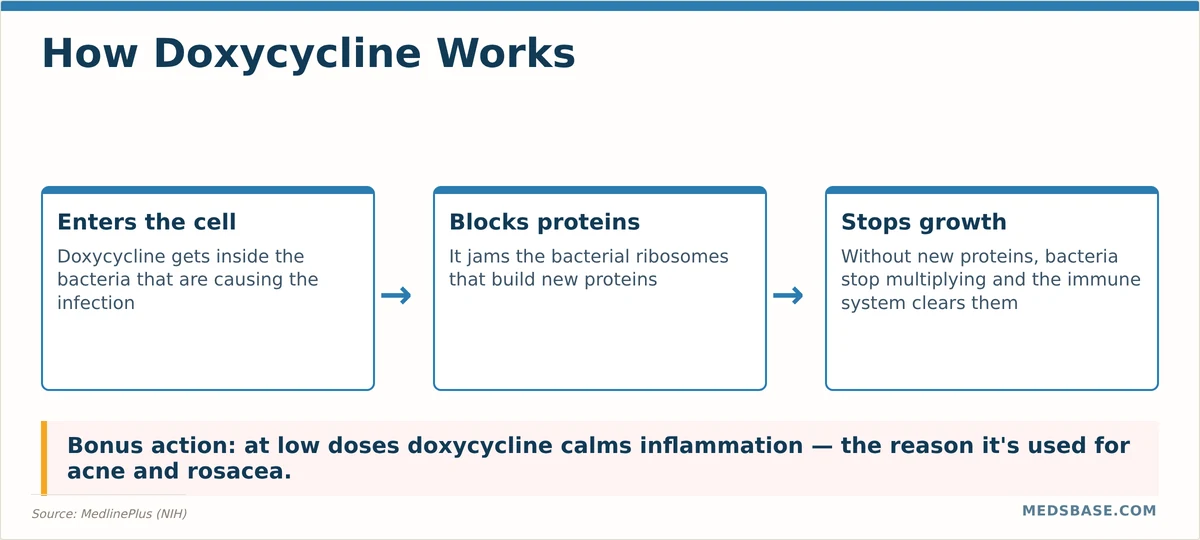
Doxycycline works at the molecular level by binding to the 30S ribosomal subunit of bacteria — essentially jamming their protein-assembly machinery. Bacteria need proteins to build cell walls, replicate DNA, and run their metabolism. Without new proteins, they stall. The host’s immune system then eliminates the static population. This mechanism underpins every clinical application covered in this doxycycline guide.
The Dual Mechanism: Antibacterial Plus Anti-Inflammatory
Beyond the ribosomal binding, doxycycline possesses a second, pharmacologically distinct action that separates it from most other antibiotics: it directly suppresses multiple inflammatory pathways. It inhibits matrix metalloproteinases (MMPs) — enzymes that break down collagen and connective tissue — and reduces the production of pro-inflammatory cytokines like TNF-alpha, IL-1 beta, and IL-6. This is not a side effect; it is a documented, dose-dependent mechanism operating at sub-antimicrobial concentrations.
Research Spotlight: A 2016 review in Dermatologic Therapy examined how doxycycline’s anti-inflammatory effects operate independently of its antibiotic activity. At the 40 mg modified-release dose used for rosacea (Oracea), plasma levels stay below the minimum inhibitory concentration — meaning zero antibacterial effect — yet inflammatory papules and pustules still decline by 60-80%. The review confirmed dose-dependent inhibition of neutrophil chemotaxis, reactive oxygen species, and MMP-9, all of which drive the redness and tissue damage seen in rosacea and acne.
Why the Dual Action Matters Clinically
As this doxycycline guide has detailed, the dual mechanism means doxycycline treats conditions that are not primarily infectious. Acne and rosacea involve bacteria (Cutibacterium acnes and Demodex-associated microbes respectively), but inflammation causes most of the visible damage — the papules, pustules, and eventual scarring. Doxycycline hits both the bacterial trigger and the inflammatory cascade simultaneously, which is why dermatologists reach for it before stronger options like isotretinoin.
Periodontal disease offers another example. Sub-antimicrobial-dose doxycycline (20 mg twice daily, brand name Periostat) is FDA-approved purely for its MMP-inhibiting effect — it reduces collagen breakdown in gum tissue without any antibacterial activity. The same principle may explain why doxycycline shows promise in early-stage osteoarthritis trials, where MMP-mediated cartilage degradation is the central pathology.
Key Uses — Doxycycline Guide to What It Treats
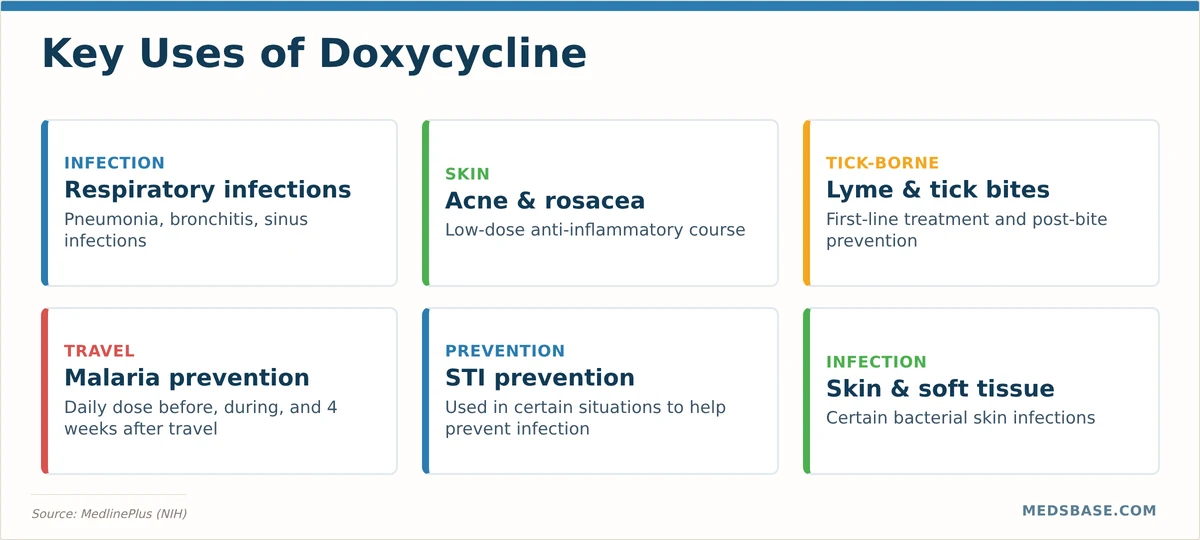
This section of our doxycycline guide covers the drug’s major clinical applications — the infections and conditions where doxycycline is a first-line or guideline-recommended choice. Dosing varies substantially by indication, so pay attention to the numbers.
Respiratory Tract Infections
Doxycycline covers the usual suspects in community-acquired pneumonia and acute bronchitis — Streptococcus pneumoniae, Haemophilus influenzae, Moraxella catarrhalis — plus the “atypical” organisms (Mycoplasma pneumoniae, Chlamydia pneumoniae, Legionella) that beta-lactams like penicillin miss entirely. For adults with mild-to-moderate community-acquired pneumonia who can take oral therapy, doxycycline 100 mg twice daily for 5-7 days is a guideline-supported option, particularly when atypical coverage is wanted up front.
It also handles acute bacterial sinusitis when first-line watchful waiting fails, though amoxicillin-clavulanate remains the preferred choice for severe or recurrent cases. The key advantage doxycycline brings to respiratory prescribing is single-drug coverage of typical plus atypical pathogens, avoiding the need for a macrolide add-on. For more on the respiratory antibiotic landscape, see our comparison of amoxicillin vs doxycycline.
Acne and Rosacea
Doxycycline is arguably the most-prescribed oral antibiotic for moderate-to-severe acne worldwide. At 50-100 mg once or twice daily, it reduces Cutibacterium acnes populations on the skin surface and suppresses the inflammatory response to those bacteria inside the follicle. Most dermatologists limit courses to 3-4 months to reduce resistance risk, then transition to topical maintenance (retinoids, benzoyl peroxide).
For rosacea, the approach differs. Low-dose doxycycline 40 mg modified-release (Oracea) once daily provides anti-inflammatory activity without reaching antibacterial plasma concentrations. This avoids disrupting the gut and skin microbiome — a meaningful concern when treatment may continue for months or years. The 40 mg dose reduces inflammatory lesions by roughly 60-80% compared to placebo in clinical trials, with a side-effect profile close to placebo because the sub-antimicrobial dose avoids typical antibiotic adverse events.
For more on acne treatment options beyond antibiotics, browse our acne treatment category.
Lyme Disease
Doxycycline is the first-line treatment for early localised and early disseminated Lyme disease in adults and children aged 8 and older. The standard regimen — 100 mg twice daily for 10-14 days (early localised) or 14-21 days (early disseminated) — eradicates Borrelia burgdorferi in the vast majority of cases when started promptly after the characteristic erythema migrans rash appears.
Beyond treatment, doxycycline has a unique role in Lyme post-exposure prophylaxis. A single 200 mg dose taken within 72 hours of a recognised tick bite in a high-incidence area reduces the risk of developing Lyme disease. A key 2026 paper cited in this doxycycline guide — from Infectious Disease Reports (PMID 41718073) — reviewed modern PEP data and affirmed that single-dose doxycycline prophylaxis remains effective, with a number-needed-to-treat of approximately 50 in endemic regions.
Malaria Prophylaxis
Travellers to malaria-endemic regions have relied on doxycycline for decades. At 100 mg daily, started 1-2 days before travel, continued throughout the stay, and maintained for 4 weeks after leaving the malarious area, it provides robust protection against chloroquine-resistant Plasmodium falciparum. The CDC lists doxycycline as one of three first-line chemoprophylaxis options alongside atovaquone-proguanil and mefloquine.
Doxycycline’s advantages for malaria prophylaxis include its low cost, wide availability, and the bonus antibacterial coverage it provides against travellers’ diarrhoea caused by enterotoxigenic E. coli. The main downsides are the 4-week post-travel tail (longer than atovaquone-proguanil’s 7 days) and the sun-sensitivity risk in tropical destinations — exactly where most travellers taking it are heading.
Sexually Transmitted Infections
Doxycycline 100 mg twice daily for 7 days is a first-line treatment for uncomplicated chlamydia and non-gonococcal urethritis. It also covers lymphogranuloma venereum (21-day course), granuloma inguinale, and — in combination with other agents — pelvic inflammatory disease. In recent years, a new indication has emerged: doxycycline post-exposure prophylaxis (Doxy-PEP), where a single 200 mg dose taken within 72 hours of condomless sex reduces the risk of bacterial STIs (chlamydia, syphilis, and to a lesser extent gonorrhoea) by roughly 60-70% in high-risk populations.
Doxycycline Guide — Side Effects & Safety
Every medication carries risk, and this doxycycline guide would be incomplete without an honest look at what can go wrong. Most people tolerate doxycycline well, but the common side effects are predictable and largely preventable — once you know what to watch for:
| Side Effect | How Common | What to Do |
|---|---|---|
| Photosensitivity (sunburn-like rash on UV-exposed skin) | 7-21% of users | Broad-spectrum SPF 50+ sunscreen, protective clothing, avoid prolonged sun exposure; stop the drug if severe |
| Oesophageal irritation/ulceration | ~4% without proper technique | Take with full glass of water, remain upright ≥30 min afterwards; never take just before bed |
| Gastrointestinal (nausea, diarrhoea, epigastric pain) | 10-25% | Take with food (small non-dairy meal); switch to monohydrate salt if hyclate is poorly tolerated |
| Vaginal yeast infection | 5-10% in women | Probiotic supplementation may help; antifungal treatment if needed; see our guide on antibiotics and yeast infections |
| Tooth discolouration | Risk in children <8 years and in-utero exposure | Avoid in pregnancy (Category D) and children under 8 unless benefits clearly outweigh risks (e.g. severe RMSF) |
| Intracranial hypertension (pseudotumor cerebri) | Rare; risk increases with concomitant retinoids or vitamin A | Stop immediately if headache, blurred vision, or double vision develop; seek urgent medical review |
Sun Sensitivity: The Most Underestimated Risk
Doxycycline phototoxicity deserves special attention because it catches people off guard — a short walk to the car or 20 minutes gardening can produce a blistering sunburn on skin that normally tans easily. The mechanism involves doxycycline accumulating in the skin and absorbing UVA radiation, generating free radicals that damage cell membranes and DNA. Unlike ordinary sunburn, phototoxic reactions can appear within minutes of exposure rather than hours later.
Protection requires broad-spectrum sunscreen that specifically covers UVA (look for the PA++++ rating or ingredients like avobenzone, zinc oxide, or titanium dioxide). Sunscreen alone is not always enough — long sleeves, wide-brimmed hats, and shade-seeking behaviour are just as important. Phototoxicity risk persists for several days after the last dose because doxycycline has a long terminal half-life of 16-22 hours and tissue concentrations decline gradually.
What the Research Says — Evidence Behind This Doxycycline Guide
Doxycycline has been studied for over five decades. The evidence base is deep, and recent research continues to expand its reach beyond classical antibiotic indications. Here are key findings that inform the clinical recommendations in this doxycycline guide:
| Study / Source | Key Finding | Clinical Implication |
|---|---|---|
| Dermatol Ther 2016 (PMID 27306750) — review of anti-inflammatory mechanisms | Sub-antimicrobial-dose doxycycline inhibits MMPs, neutrophil chemotaxis, and reactive oxygen species independent of antibiotic activity | Justifies 40 mg modified-release dosing for rosacea — effective anti-inflammatory action without antibiotic resistance or microbiome disruption |
| Infect Dis Rep 2026 (PMID 41718073) — Lyme PEP review | Single 200 mg dose within 72 hours of tick bite reduces Lyme incidence; NNT ~50 in endemic areas | Prophylaxis is appropriate for recognised Ixodes bites in high-incidence regions when the tick was attached ≥36 hours |
| MedlinePlus — doxycycline drug monograph | Comprehensive safety data: photosensitivity in 7-21%, oesophageal ulceration risk with improper administration, pregnancy Category D | Patient counselling on sun protection and upright administration is essential at dispensing; pregnancy must be excluded before prescribing |
| CDC — Lyme disease treatment guidelines | Doxycycline 100 mg BID × 10-14 days is first-line for early Lyme; equally effective as amoxicillin and cefuroxime for erythema migrans | Doxycycline is preferred when co-infection with Anaplasma or Ehrlichia is possible, as it covers both — amoxicillin does not |
| WHO — International Travel and Health, malaria chapter | Doxycycline 100 mg daily is one of three first-line chemoprophylaxis options; effective against chloroquine-resistant P. falciparum | Start 1-2 days pre-travel, daily during stay, continue 4 weeks post-travel; cost-effective and widely available compared to alternatives |
| Multiple RCTs — Doxy-PEP for STI prevention | 200 mg post-exposure dose reduces chlamydia by ~70%, syphilis by ~70%, gonorrhoea by ~55% in MSM and transgender women | Doxy-PEP is now CDC-recommended for high-risk populations; concerns about resistance (especially gonorrhoea) warrant ongoing monitoring |
Doxycycline vs Alternative Antibiotics
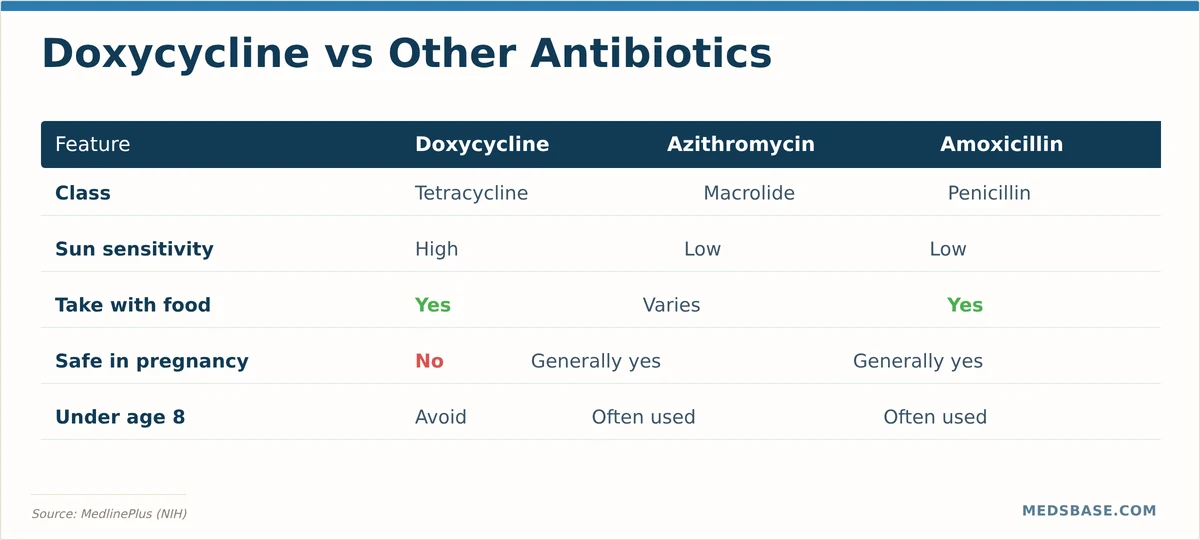
No doxycycline guide is complete without comparing it to the other antibiotics a doctor might prescribe for the same condition. Here is how doxycycline stacks up against the two most common alternatives:
| Feature | Doxycycline | Azithromycin | Amoxicillin |
|---|---|---|---|
| Class | Tetracycline | Macrolide | Beta-lactam (penicillin) |
| Mechanism | Bacteriostatic — 30S ribosomal subunit | Bacteriostatic — 50S ribosomal subunit | Bactericidal — cell wall synthesis |
| Atypical coverage | Yes (Mycoplasma, Chlamydia, Legionella, Rickettsia) | Yes (Mycoplasma, Chlamydia, Legionella) | No — requires add-on for atypicals |
| Lyme disease | First-line; covers co-infections (Anaplasma, Ehrlichia) | Not recommended — resistance in Europe, inferior efficacy | Second-line alternative; effective but does not cover Anaplasma/Ehrlichia |
| Acne | First-line oral; anti-inflammatory benefit | Used occasionally; less evidence base for acne specifically | Rarely used for acne; poor follicular penetration |
| Key limitation | Photosensitivity; cannot use in pregnancy or children <8 years | QTc prolongation risk; growing resistance in respiratory pathogens | Penicillin allergy (~10% of population); no atypical cover; C. difficile risk |
| Dosing frequency | Once or twice daily | Once daily; short 3-5 day courses common | Two to three times daily |
For a deeper look at the clinical differences, read our full comparison of doxycycline vs azithromycin. If you are weighing it against a penicillin-class option, our amoxicillin vs doxycycline breakdown covers every angle.
How to Take Doxycycline Correctly
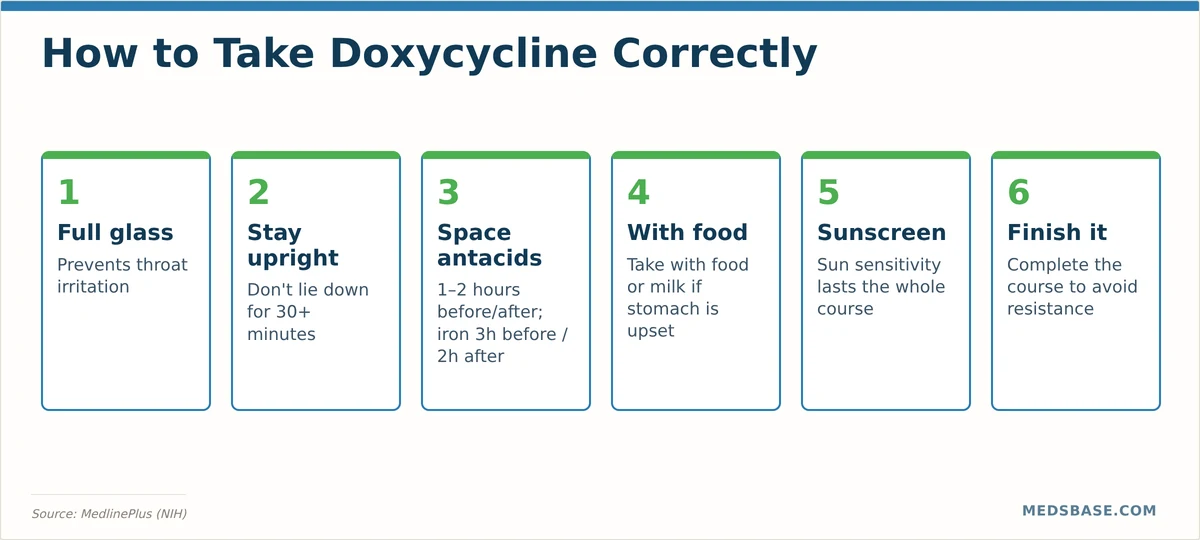
Getting the dosing right matters more with doxycycline than with most oral antibiotics. Follow these steps as outlined in this doxycycline guide to maximise effectiveness and minimise side effects:
- Take it with a full glass of water (240 mL / 8 oz minimum). The capsule or tablet must wash all the way into the stomach. A partial swallow lets it stick in the oesophagus, where it can dissolve and cause chemical burns — a painful, preventable injury.
- Stay upright for at least 30 minutes after swallowing. Do not lie down, recline, or go to bed. Gravity keeps the medicine in the stomach, away from the oesophagus. This single habit prevents nearly all cases of doxycycline-induced oesophagitis.
- Separate from dairy, antacids, calcium, iron, magnesium, and zinc by at least 2 hours. Divalent and trivalent cations (Ca²⁺, Mg²⁺, Fe²⁺/Fe³⁺, Zn²⁺, Al³⁺) chelate doxycycline in the gut, forming insoluble complexes that pass through unabsorbed. A glass of milk with your dose can reduce absorption by 30% or more. This includes calcium-fortified orange juice, yoghurt, iron supplements, and many multivitamins.
- Take with food if your stomach objects, but keep it non-dairy. Unlike older tetracyclines, doxycycline absorption is not significantly reduced by food. A small meal — toast, crackers, rice — can blunt nausea without compromising efficacy.
- Take at the same time each day. Consistent timing maintains steady-state plasma concentrations. If you miss a dose, take it as soon as you remember unless it is nearly time for the next one. Never double-dose to catch up.
- Complete the full prescribed course. Stopping early because you feel better is the single biggest driver of antibiotic resistance. Even if symptoms resolve on day 3, finish the 7-day course unless your doctor says otherwise.
- Apply sunscreen every morning — even on cloudy days. UVA penetrates cloud cover and window glass. Make SPF 50+ broad-spectrum sunscreen part of your morning routine for the entire course plus several days afterwards.
Key Drug Interactions
Beyond the mineral-absorption issue, doxycycline interacts with several important drug classes:
- Oral retinoids (isotretinoin, acitretin): Combined use increases the risk of benign intracranial hypertension (pseudotumor cerebri). Avoid concomitant use unless the benefit clearly justifies the risk and the patient is monitored for headache and visual changes.
- Warfarin and other anticoagulants: Doxycycline may enhance anticoagulant effect by reducing vitamin K production by gut flora. Monitor INR more frequently during the course.
- Barbiturates, carbamazepine, phenytoin, and rifampicin: These hepatic enzyme inducers accelerate doxycycline metabolism, reducing its half-life and potentially its efficacy. Higher doses or alternative antibiotics may be needed.
- Oral contraceptives: While the evidence for contraceptive failure is weaker than historically taught, the British National Formulary still advises additional barrier contraception during and for 7 days after a doxycycline course as a precaution.
- Alcohol: Chronic heavy alcohol use induces hepatic enzymes and may reduce doxycycline levels. Moderate occasional drinking does not appear to interact significantly, though alcohol can worsen GI side effects.
For a broader look at antibiotic options, see our antibiotics category page.
Frequently Asked Questions
Can I drink alcohol while taking doxycycline?
Moderate alcohol consumption does not directly reduce doxycycline’s effectiveness the way it does with metronidazole. However, chronic heavy drinking induces liver enzymes that can accelerate doxycycline clearance and potentially lower blood levels below the therapeutic range. Alcohol also irritates the stomach lining — combining it with doxycycline, which can already cause nausea in 10-25% of users, may compound GI discomfort. The safest approach is to limit alcohol or abstain during the short course.
How long does doxycycline stay in your system?
Doxycycline has a terminal elimination half-life of approximately 16-22 hours in adults with normal renal function. It takes roughly 4-5 half-lives for a drug to be fully cleared, so doxycycline is eliminated from the body within about 4-5 days after the last dose. However, tissue concentrations — particularly in the skin — may decline more slowly, which is why photosensitivity can persist for several days after completing the course.
Is doxycycline safe in pregnancy?
No. Doxycycline is FDA Pregnancy Category D, meaning there is positive evidence of human fetal risk. Tetracyclines cross the placenta and can cause permanent discolouration of the developing baby’s teeth (yellow-grey-brown staining) and inhibit bone growth. The risk is highest during the second and third trimesters when tooth calcification occurs. Doxycycline should be avoided throughout pregnancy unless no alternative exists for a life-threatening infection such as severe Rocky Mountain spotted fever.
Does doxycycline treat sinus infections?
Yes, doxycycline can treat acute bacterial sinusitis when antibiotics are indicated — usually after 7-10 days of persistent symptoms without improvement. It covers Streptococcus pneumoniae, Haemophilus influenzae, and Moraxella catarrhalis, the three most common bacterial causes. However, amoxicillin-clavulanate remains the first-line guideline recommendation for most cases. Doxycycline is a reasonable alternative in penicillin-allergic patients or where atypical coverage is desired.
Can I take doxycycline for a UTI?
Doxycycline is not a first-line treatment for urinary tract infections. While it achieves adequate urine concentrations, most common UTI pathogens (E. coli, Klebsiella, Proteus) show variable susceptibility, and resistance rates are higher than with first-line agents like nitrofurantoin, fosfomycin, or trimethoprim-sulfamethoxazole. Doxycycline may be used for UTIs caused by susceptible organisms when first-line options are contraindicated, but it should be guided by culture and sensitivity results.
Why does doxycycline cause sun sensitivity?
Doxycycline accumulates in the skin and absorbs ultraviolet A (UVA) radiation. When UVA photons hit doxycycline molecules in skin cells, the excited drug transfers energy to molecular oxygen, generating reactive oxygen species — essentially free radicals. These free radicals attack cell membranes, proteins, and DNA in skin cells, producing the clinical picture of an exaggerated sunburn. Unlike ordinary sunburn, which is primarily UVB-mediated, doxycycline phototoxicity is UVA-driven, meaning it can occur through window glass and on cloudy days.
Does doxycycline make you gain weight?
Doxycycline is not associated with weight gain as a side effect. Unlike some medications — corticosteroids, certain antidepressants, some antipsychotics — doxycycline does not affect appetite-regulating hormones, metabolic rate, or fat storage. If you experience weight changes during a doxycycline course, it is more likely related to the underlying infection (illness often suppresses appetite) or gastrointestinal side effects (nausea may reduce food intake temporarily) rather than a direct drug effect.
Can I stop doxycycline early if I feel better?
No. Stopping antibiotics early because symptoms have resolved is a well-established driver of antimicrobial resistance. The bacteria most susceptible to the drug die first, which is why you start feeling better — but the more resilient subpopulation survives. Stopping treatment prematurely allows these partially resistant survivors to repopulate, potentially causing a relapse that is harder to treat. Always complete the full prescribed course unless your doctor instructs you otherwise due to an adverse reaction.
The Bottom Line
Doxycycline earns its place on the WHO Essential Medicines List. Few oral antibiotics match its breadth — respiratory pathogens, atypical bacteria, spirochetes, malaria parasites, and the dual antibacterial-plus-anti-inflammatory punch that makes it uniquely useful in dermatology. This doxycycline guide has covered the full picture: how it works, what it treats, what the research says, how it compares to alternatives, and — crucially — how to take it without ending up with a burnt face or a burned oesophagus.
The rules are not complicated, but they are non-negotiable. Full glass of water. Stay upright. Ditch the dairy. Wear sunscreen. Follow those four habits and you sidestep the vast majority of doxycycline’s problems. Skip them and a safe, effective, inexpensive antibiotic becomes an uncomfortable experience that might land you back in the doctor’s office for a different reason than the one that got you the prescription.
For anyone weighing doxycycline against another option, the comparison tables above give you the data. For anyone already taking it, the administration checklist keeps you safe. And for anyone who wants to go deeper — our linked comparisons on azithromycin, amoxicillin, and the broader antibiotics category are there when you need them. Medication works best when you understand it — that is the whole point of this doxycycline guide.
Medical Disclaimer: This doxycycline guide is for informational and educational purposes only and does not constitute medical advice. Always consult a qualified healthcare professional before starting, stopping, or changing any medication. Doxycycline is a prescription medicine and should only be used under the supervision of a licensed prescriber. Individual circumstances — including allergies, comorbidities, concurrent medications, pregnancy status, and age — affect suitability. The information in this guide is based on published research and clinical guidelines available as of August 2026.

Written by
Sophie ChenPharmaceutical Content Researcher · 8 years experience
Sophie Chen is a pharmaceutical content researcher with 8 years covering generic medication access and clinical pharmacology. She specialises in international regulatory frameworks, bioequivalence standards, and patient-facing education on therapeutic drug classes. She is not a clinician.