








✓ Medically reviewed by · Last reviewed: May 2026
Pharmacy Researcher · 8 years experience
Pharmacy researcher with 8 years reviewing clinical drug information, generic formulation equivalence, and international pharmaceutical standards. Focuses on patient-facing accuracy in medication education.
The evidence is association, not proof. A 2026 Neurology study found that women who used estrogen-only hormone therapy had 35% lower odds of Alzheimer’s hallmark brain changes on autopsy, plus better memory-test performance compared to non-users. But this does not establish causation, does not apply to women with an intact uterus (who need combined therapy), and does not justify starting HRT specifically for brain protection. No clinical guideline currently recommends hormone therapy for dementia prevention.
Estrogen HRT and Alzheimer’s risk has become one of the most talked-about questions in menopause research this year — and for good reason. One number in a major 2026 study stopped a lot of clinicians mid-scroll: 35%.
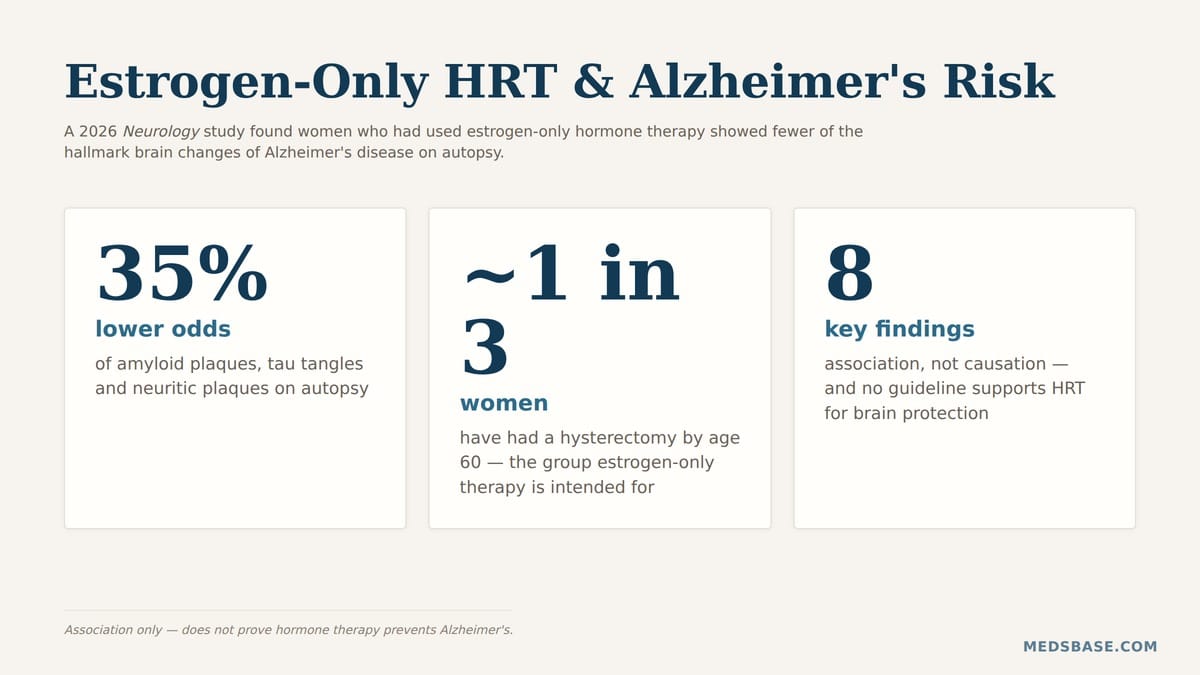
That’s how much lower the odds were of showing amyloid plaques, tau tangles, and neuritic plaques — the three signature brain changes of Alzheimer’s disease — in women who had used estrogen-only hormone therapy, according to a study published in Neurology, the journal of the American Academy of Neurology.
Here’s why the estrogen HRT and Alzheimer’s risk question suddenly matters, and why you should care even if you’ve never taken hormones. For decades, the relationship between menopause hormone therapy and the brain has been genuinely confusing. One landmark trial suggested that combined hormones might raise dementia risk in older women. Now a newer, autopsy-backed study suggests the opposite for estrogen alone. Same organ, different hormone mix, completely different signal.
By the time you finish reading, you’ll understand what the study actually found, why it does not mean you should start HRT to protect your brain, the specific group of women for whom the findings matter most, and the one detail in the study that surprised even the researchers.
- The headline: 35%. Autopsy data linked estrogen-only HRT to 35% lower odds of amyloid plaques, tau tangles, and neuritic plaques — the three hallmark brain changes of Alzheimer’s.
- Association, not causation. The study was observational. It couldn’t prove hormones caused the better brain outcomes — the HRT group may have been healthier to begin with, though researchers adjusted for key confounders.
- Hormone mix matters enormously. The older WHIMS trial found combined estrogen-plus-progestin raised dementia risk in women 65+. The 2026 study looked at estrogen alone. Different hormone, different population, different result.
- Not every estrogen behaved the same. Conjugated estrogen showed a clear benefit signal; estradiol users looked similar to non-users in one subgroup analysis. This surprised the researchers and needs replication.
- APOE-e4 carriers didn’t show the same brain benefit. The protective neuropathology association appeared mainly in women without the APOE-e4 gene — the strongest known genetic risk factor for late-onset Alzheimer’s.
- No one should start HRT for brain protection. Every expert quoted in the study stressed this. Current evidence does not support prescribing hormone therapy specifically to prevent dementia.
- Estrogen-only therapy is only for women without a uterus. Taking unopposed estrogen with an intact uterus raises endometrial cancer risk. This study’s findings do not apply to women on combined therapy.
What Is Estrogen-Only Hormone Therapy?
Estrogen-only hormone therapy is exactly what it sounds like: a form of menopause treatment that delivers estrogen without any progestin (a synthetic form of progesterone). Women use it to relieve menopause symptoms such as hot flushes, night sweats, vaginal dryness, and bone-density loss.
But here’s the critical detail most headlines about estrogen HRT and Alzheimer’s risk skip: estrogen-only therapy is only appropriate for women who have had a hysterectomy. Taking unopposed estrogen when you still have a uterus raises the risk of endometrial (uterine) cancer — a well-established medical fact that hasn’t changed.
Women with an intact uterus are prescribed combined estrogen-plus-progestin therapy instead, because adding progestin protects the uterine lining. This distinction is the single most important thing to understand about the new study, because it determines exactly who the findings apply to.
The NHS describes hormone replacement therapy as medication that replaces the hormones dropping around menopause, noting the two main forms — estrogen-only and combined — are prescribed to different people for different safety reasons. Roughly one in three women in the United States has had a hysterectomy by age 60, according to research the study’s lead author cited. That’s the group estrogen-only therapy is intended for, and that’s the group this study is about.
So when you read headlines about “estrogen HRT and Alzheimer’s risk,” the first question to ask is always: which estrogen, with or without progestin, and in whom? The answer changes everything.
How Estrogen HRT and Alzheimer’s Risk Are Connected
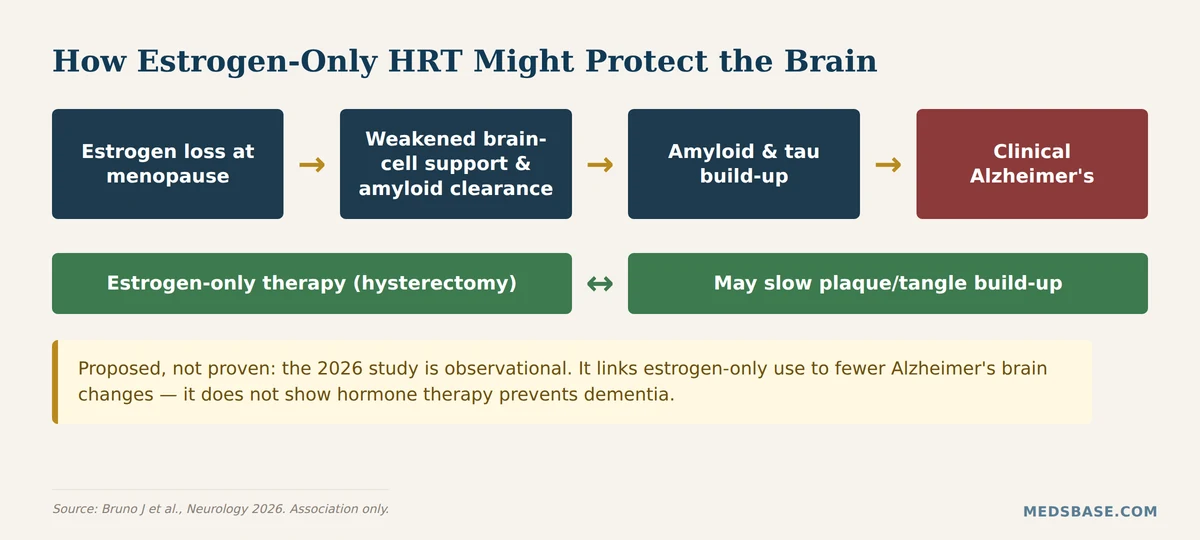
Estrogen does far more in the body than manage reproduction. Receptors for estrogen sit throughout the brain, including in regions critical for memory, learning, and the regulation of brain blood flow — the hippocampus, prefrontal cortex, and hypothalamus.
Estrogen levels drop sharply at menopause — not gradually, but precipitously, often over just a few years. Researchers have long suspected that this sudden withdrawal may accelerate some of the processes that lead to Alzheimer’s. Women make up roughly two-thirds of Alzheimer’s cases — a fact that cannot be explained by longer life expectancy alone. The 2026 study is one of the first to connect autopsy-confirmed brain changes directly to estrogen-only therapy use.
The proposed mechanism, in plain terms, runs something like this. Estrogen helps keep brain cells healthy and supports the clearance of amyloid-beta — the sticky protein that clumps into the plaques that define Alzheimer’s. When estrogen drops at menopause, that support system weakens. In some women, the result may be a faster build-up of amyloid and tau — the two proteins that accumulate over decades before any symptoms appear.
If that model is right, then restoring estrogen — for women who lack a uterus and can safely take estrogen alone — might slow that build-up. The study’s finding that estrogen-only users also had fewer brain infarcts (areas of tissue death from reduced blood flow) points to a second, vascular pathway: estrogen’s known effects on blood vessels and circulation. Estrogen receptors in the endothelium (the lining of blood vessels) help regulate blood flow and inflammation — both relevant to dementia risk.
A third mechanism involves glucose metabolism in the brain. Estrogen enhances the brain’s ability to use glucose as fuel. When estrogen drops, brain cells in memory regions partially lose that metabolic support — a phenomenon sometimes called “brain insulin resistance” — which may make neurons more vulnerable to the toxic effects of amyloid over time.
The honest scientific position: the theory is biologically plausible, it now has autopsy-level support, and it aligns with what we know about estrogen receptors in the brain — but it remains a theory about association, not a proven cause-and-effect chain. No randomised trial has demonstrated that giving estrogen prevents Alzheimer’s.
The Type of Estrogen Also Mattered
When the researchers split the data by the type of estrogen, the results diverged in a way that surprised even them. Only conjugated estrogen (a blend of estrogen hormones derived from natural sources, such as Premarin) showed a clear association with lower Alzheimer’s neuropathology. Women using estradiol — the most common form used in many modern preparations — looked similar to non-users in that particular analysis.
This detail is a reminder that “estrogen” is not one molecule. Conjugated estrogens contain a mix of estrone, equilin, and other estrogens; estradiol is a single, bioidentical molecule. Different formulations have different receptor affinities, different metabolic pathways, and — potentially — different effects in the brain. The researchers themselves flagged their subgroup analyses as preliminary, given the smaller sample sizes once they split by estrogen type.
Timing showed a similar pattern. Starting estrogen HRT before age 60 trended toward lower Alzheimer’s neuropathology, but the result did not reach statistical significance — echoing the broader “timing hypothesis” in menopause research: the idea that there may be a critical window around menopause when hormone therapy is beneficial, and starting too late may lose the benefit or even cause harm.
The 2026 Neurology Study — Estrogen HRT and Alzheimer’s Risk Findings
The study, led by Dr. Jennifer Bruno at Stanford University School of Medicine, drew on two large, well-regarded datasets: the National Alzheimer’s Coordinating Center (NACC) and the Alzheimer’s Disease Neuroimaging Initiative (ADNI). From NACC, researchers analysed 258 women who had used estrogen-only hormone therapy and 2,701 who had not; from ADNI, 110 users and 1,948 non-users. The average age was 71–72, and the therapy had typically been started years earlier — often around the time of menopause.
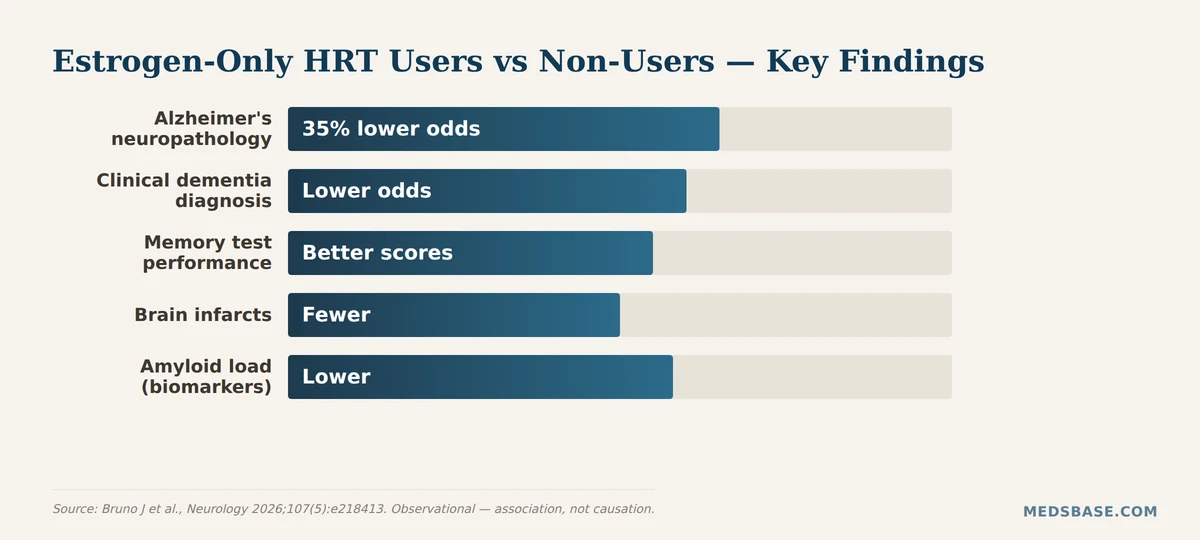
The headline result came from brain autopsies on a subgroup of participants — the gold standard for confirming Alzheimer’s pathology, because you can actually see the plaques and tangles under a microscope. Women who had used estrogen-only therapy had 35% lower odds of showing the three hallmark brain changes of Alzheimer’s disease:
- Amyloid plaques — clumps of beta-amyloid protein that build up between neurons
- Tau tangles — twisted strands of tau protein that accumulate inside neurons
- Neuritic plaques — dense deposits of amyloid surrounded by damaged nerve-cell branches
That autopsy finding was reinforced by living biomarkers. Blood and spinal-fluid samples collected while the women were still alive also pointed toward lower amyloid accumulation in the brains of estrogen-only users. This convergence — autopsy findings plus fluid biomarkers — is what makes the study stronger than a single-measure finding would be.
The pattern held across several other measures, too. Estrogen-only users were:
- Less likely to receive a clinical dementia diagnosis
- Less likely to show cognitive decline over time on standardised assessments
- More likely to perform better on immediate memory and learning tests (in the ADNI group)
- In a subgroup without dementia, estrogen-only therapy was linked to better verbal memory
Crucially, Dr. Bruno noted the associations “held after we accounted for key risk factors including age, genetics, education, race, and hypertension.” That adjustment is meaningful — it reduces (though doesn’t eliminate) the possibility that the 35% figure simply reflects the HRT group being younger, better educated, or healthier in other ways.
But here’s the open loop. When the researchers examined the data by the type of estrogen, only conjugated estrogen showed a clear benefit signal; estradiol users looked similar to non-users. And when they looked by APOE-e4 carrier status — the strongest genetic risk factor for late-onset Alzheimer’s — the protective neuropathology association appeared mainly in non-carriers. More on both findings in the next section.
Who Benefits Most — Estrogen HRT and Alzheimer’s Risk Reduction
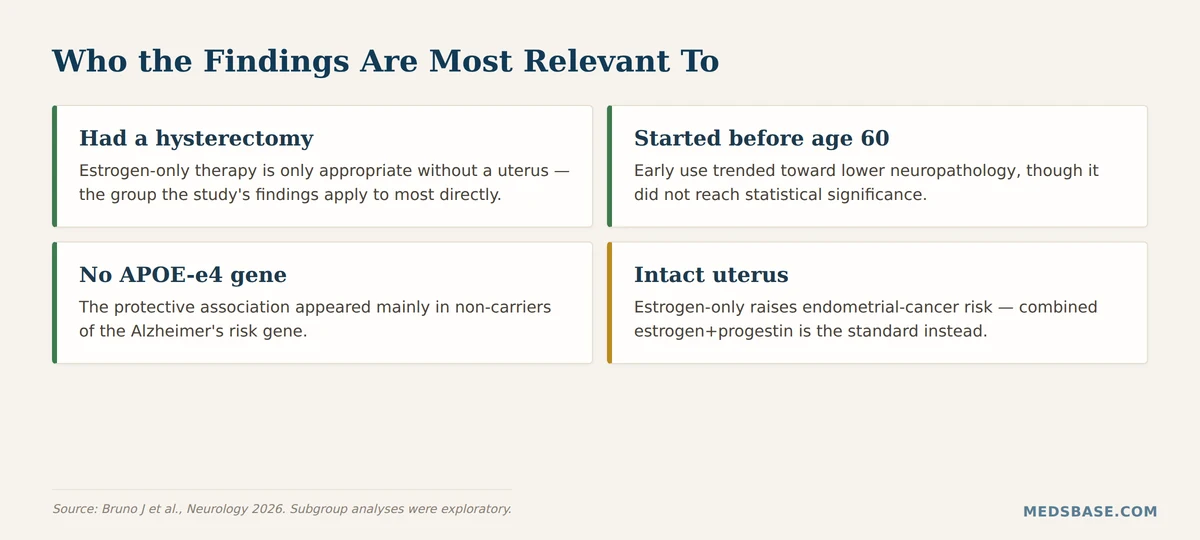
The study’s findings on the estrogen HRT and Alzheimer’s risk connection are most directly relevant to a specific profile of woman — and there’s one subgroup where the brain benefit largely didn’t show up. Both matter for how you interpret the headlines.
Most relevant to: women who have had a hysterectomy (estrogen-only therapy is only appropriate without a uterus); women who started therapy around or before age 60; women who do not carry the APOE-e4 gene variant; women using conjugated estrogen formulations specifically.
Caution applies to: women with an intact uterus (estrogen-only raises endometrial-cancer risk — combined therapy is the standard here); women who carry the APOE-e4 gene (the neuropathology benefit was not observed in carriers); and anyone considering HRT specifically to prevent dementia (no guideline supports that use).
The APOE-e4 finding deserves a careful read, because it’s genuinely important. APOE-e4 is the best-known genetic risk factor for late-onset Alzheimer’s. Carrying one copy roughly triples your risk; carrying two copies raises it even more. In the study, the protective association with estrogen HRT and Alzheimer’s risk appeared mainly in non-carriers of APOE-e4. Carriers did not show the same reduction in Alzheimer’s neuropathology.
Interestingly, both carriers and non-carriers on estrogen-only therapy had less severe clinical diagnoses and better global dementia ratings — suggesting that even when hormones don’t stop the physical brain changes in every woman, they might still be associated with milder symptoms in some. But the honest read is that we do not yet understand why carriers and non-carriers differ, and more research is needed before drawing any clinical conclusion.
The timing dimension also matters. Starting estrogen HRT before age 60 — roughly around the menopause transition — trended toward lower Alzheimer’s neuropathology, though the result did not reach statistical significance. This aligns with the broader “critical window” or “timing hypothesis”: the idea that there may be a period around menopause when estrogen therapy is beneficial for the brain, and that starting too late may lose the benefit or even cause harm. The WHIMS trial — which found higher dementia risk with combined hormones — studied women who started therapy at 65 or older, well past the likely critical window.
If you’re wondering where you fit, the practical step is a conversation with your prescriber, not a self-diagnosis. Your doctor can help you weigh your personal risk factors — hysterectomy status, family history, APOE status if known, your menopause symptoms, and your age — against the known risks and benefits of hormone therapy. If you’re exploring estrogen options, you can browse the available formulations to understand what’s out there, but the decision to start or change therapy should always be made with a clinician who knows your full history.
Safety Profile & Side Effects of Estrogen HRT
Before considering any hormone therapy — and certainly before interpreting the estrogen HRT and Alzheimer’s risk findings as a reason to start — you need a clear picture of the known risks and side effects. These have been established through decades of research, including large randomised trials, and they vary by formulation and by who’s taking the therapy.
Estrogen-only therapy carries a different safety profile than combined estrogen-plus-progestin therapy. Below is a summary of the most important risks, based on the Women’s Health Initiative trials and subsequent follow-up studies:
| Risk or Side Effect | Estrogen-Only Therapy | Combined E+P Therapy | Notes |
|---|---|---|---|
| Endometrial cancer | Increased risk — contraindicated with intact uterus | Not increased (progestin protects the lining) | Estrogen-only only for women post-hysterectomy |
| Breast cancer | Neutral to slightly decreased in WHI | Modestly increased with long-term use (>5 years) | Risk rises with duration; returns to baseline after stopping |
| Venous thromboembolism | Increased (~30% higher) | Increased (~2x higher) | Risk highest in first year; lower with transdermal route |
| Stroke | Modestly increased | Modestly increased | Absolute risk low in women under 60 |
| Coronary heart disease | Neutral or reduced if started <60 | Neutral overall; possible harm if started at 65+ | Timing hypothesis applies |
| Dementia / cognitive decline | New 2026 data: possibly reduced risk (observational) | WHIMS: increased risk in women 65+ | Observational vs RCT; different populations |
| Breast tenderness | Common, usually transient | Common, usually transient | Typically resolves within weeks to months |
| Nausea, headache | Common initially | Common initially | Often improves with continued use or dose adjustment |
| Gallbladder disease | Modestly increased with oral route | Modestly increased with oral route | Transdermal route may reduce this risk |
The table makes one thing clear: the risk-benefit equation for estrogen HRT depends heavily on who is taking it, which formulation, by what route, and at what age. A 52-year-old woman who had a hysterectomy last year and started transdermal estradiol for hot flushes is in a very different situation from a 68-year-old who started oral conjugated estrogens two decades ago and never stopped. Generalising from “HRT and the brain” headlines is a mistake — the details are everything.
If you’re on estrogen therapy for menopause symptoms, the new study’s brain findings are reassuring rather than alarming. If you’re considering starting therapy specifically for brain protection, that use is not supported by any current guideline. Talk to your prescriber about the full picture — symptoms, risks, and the evidence we actually have.
What the Research Says — Estrogen HRT and Alzheimer’s Risk Evidence
The relationship between hormone therapy and the brain has been studied for decades — sometimes with contradictory findings. The table below summarises the key studies that shape our current understanding of estrogen HRT and Alzheimer’s risk:
| Study | Year | Design | Key Finding | Source |
|---|---|---|---|---|
| Bruno et al. — Neurology | 2026 | Observational (autopsy + biomarkers) | Estrogen-only HRT linked to 35% lower odds of Alzheimer’s neuropathology; conjugated estrogen showed strongest signal; APOE-e4 carriers did not benefit | PubMed |
| Manson et al. — JAMA (WHI 20-year review) | 2024 | RCT + long-term follow-up | Comprehensive review: estrogen-only and combined E+P carry different risk/benefit profiles; age at initiation modifies outcomes | PubMed |
| Shumaker et al. — WHIMS | 2003 | RCT (randomised controlled trial) | Combined E+P in women 65+ was associated with doubled dementia risk vs placebo; landmark finding that shaped two decades of prescribing caution | PubMed |
| Coker et al. — WHIMS follow-up | 2010 | RCT + post-intervention follow-up | Confirmed elevated dementia risk with combined E+P in older women; risk persisted after stopping therapy | PubMed |
| Yaffe et al. — Cache County Study | 2000 | Observational (prospective cohort) | Earlier observational work suggesting longer HRT use was associated with lower Alzheimer’s risk — pre-WHI data that drove the timing hypothesis | PubMed |
| Mosconi et al. — Neurology (brain imaging) | 2018 | Cross-sectional imaging study | HRT users showed preserved brain glucose metabolism in Alzheimer’s-vulnerable regions; effect strongest in women who started early | PubMed |
The single most important pattern in this table: the contrast between the WHIMS trial result (combined hormones, older women, higher dementia risk — a randomised trial) and the 2026 Bruno study (estrogen alone, younger start age, lower neuropathology — an observational study). The hormone mix, the age at starting, the population, and the study design all appear to matter enormously. Anyone who tells you “HRT is good for the brain” or “HRT is bad for the brain” is oversimplifying — the honest answer is it depends.
Estrogen HRT vs Alternatives — Comparison Table
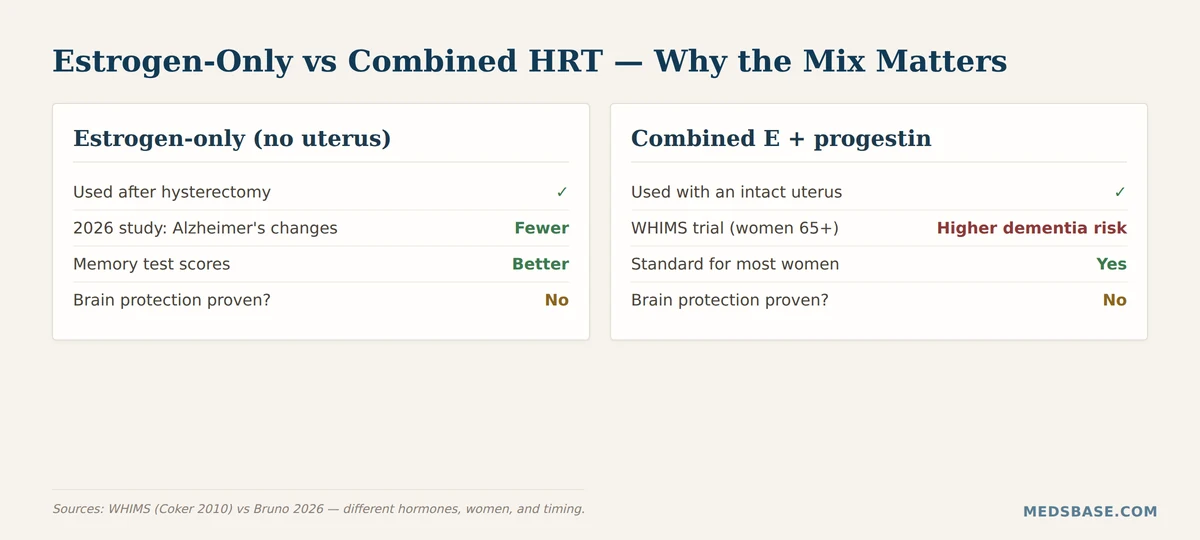
If you’re weighing options — or simply trying to understand what the estrogen HRT and Alzheimer’s risk evidence means for you personally — the table below compares the main approaches to menopause symptom management, including their relevance to brain health:
| Option | Who It’s For | Brain Health Evidence (2026) | Key Caveats |
|---|---|---|---|
| Estrogen-only HRT | Women post-hysterectomy | Observational link to 35% lower Alzheimer’s neuropathology (Bruno 2026) | Not for brain protection; association only; not for women with uterus |
| Combined E+P HRT | Women with intact uterus | WHIMS: elevated dementia risk in women 65+; timing may be critical | Different risk profile from estrogen-only; start <60 if at all |
| Vaginal estrogen (local) | Genitourinary symptoms only | No dementia data; minimal systemic absorption | Does not treat hot flushes or provide systemic benefits |
| Non-hormonal medications | Women who cannot take estrogen | SSRIs/SNRIs, gabapentin: no established effect on Alzheimer’s risk | Effective for hot flushes; different side-effect profile |
| Lifestyle interventions | All women | Exercise, Mediterranean diet, cognitive engagement all have stronger evidence for dementia risk reduction | No prescription needed; cumulative benefit across decades |
| No treatment | Women with mild or no symptoms | Baseline risk; no intervention effect | Valid choice; menopause is a life stage, not a disease |
If the brain-health angle is what drew you to this article, the most honest advice is this: the strongest evidence for reducing dementia risk doesn’t involve any pill. Regular physical exercise, a Mediterranean-style diet, treating hearing loss, controlling blood pressure in midlife, maintaining social connections, and keeping cognitively engaged all have stronger (and more consistently replicated) evidence for lowering Alzheimer’s risk than hormone therapy does. HRT should be a symptom-management decision first — any brain benefit is a potential bonus, not the reason to start.
For women specifically weighing different estrogen options, the distinction between systemic therapy and local therapy matters. Progynova (estradiol) provides systemic relief for hot flushes, night sweats, and bone protection; Evalon Cream (estriol) is a gentler topical form used primarily for vaginal and urinary symptoms. If you’re weighing one against the other, our estriol vs estradiol comparison breaks down the differences in plain language. For non-estrogen menopause symptom management, Veozah (fezolinetant) is a newer non-hormonal option worth discussing with your doctor.
Frequently Asked Questions
Does estrogen HRT prevent Alzheimer’s disease?
No — not in a proven, guideline-supported sense. The 2026 Neurology study found an association between estrogen-only HRT and 35% lower odds of Alzheimer’s brain changes on autopsy, but the study was observational and could not establish cause and effect. No randomised trial has shown that HRT prevents dementia, and no clinical guideline currently recommends starting hormone therapy specifically for brain protection. The finding is a promising new line of evidence, not a reason to change your medication.
Is HRT safe for the brain?
It depends on the type of HRT, the age at which it’s started, and who takes it. The WHIMS randomised trial found that combined estrogen-plus-progestin in women aged 65 and older was associated with a higher risk of dementia. The newer 2026 observational study linked estrogen-only therapy — in a different population, started at a younger age — to lower Alzheimer’s neuropathology. The differences come down to hormone mix, timing, and population characteristics. Discuss your specific formulation and personal risk factors with your doctor rather than generalising from headlines.
Who should not take estrogen-only HRT?
Women with an intact uterus should generally avoid estrogen-only therapy, because unopposed estrogen raises the risk of endometrial (uterine) cancer. These women are usually prescribed combined estrogen-plus-progestin therapy instead, which protects the uterine lining. Estrogen-only therapy is primarily intended for women who have had a hysterectomy. Women with a history of breast cancer, blood clots, stroke, or liver disease should also generally avoid systemic hormone therapy. Always let your prescriber determine whether HRT is appropriate for you.
Can hormone therapy lower dementia risk?
Possibly for a specific group, but the evidence is not yet strong enough to change clinical practice. The 2026 study suggests estrogen-only therapy may be associated with better Alzheimer’s-related brain outcomes in women who have had a hysterectomy, particularly those who do not carry the APOE-e4 gene and those using conjugated estrogen formulations. However, experts caution that these findings do not support prescribing HRT specifically to lower dementia risk. Randomised trials are still needed before any such recommendation could be made.
What exactly did the 2026 Neurology study find about estrogen HRT and Alzheimer’s risk?
The study by Bruno and colleagues (published in Neurology, the journal of the American Academy of Neurology) analysed data from two large cohorts — NACC and ADNI — comparing women who had used estrogen-only hormone therapy with those who had never used any hormone therapy. The key findings: 35% lower odds of amyloid plaques, tau tangles, and neuritic plaques on autopsy; lower amyloid levels in blood and spinal-fluid biomarkers; lower odds of a clinical dementia diagnosis; and better performance on memory and learning tests. The associations held after adjusting for age, genetics, education, race, and hypertension. However, the benefit was most evident in non-APOE-e4 carriers and conjugated-estrogen users, and the study could not establish causation.
Does the type of estrogen matter for brain health?
In the study’s exploratory subgroup analyses, yes — and this was one of the findings that surprised the researchers. Conjugated estrogen users showed a lower chance of increased Alzheimer’s neuropathology, while estradiol users looked similar to non-users in that particular analysis. The researchers flagged these subgroup analyses as preliminary and in need of replication, so no one should switch formulations based on this signal alone. It does, however, highlight that different estrogen formulations have different molecular effects, and future research will need to examine specific types rather than lumping all “estrogen” together.
How does the APOE-e4 gene affect the estrogen HRT and Alzheimer’s risk relationship?
Significantly. APOE-e4 is the strongest known genetic risk factor for late-onset Alzheimer’s disease. In the 2026 study, the protective association between estrogen-only HRT and lower Alzheimer’s neuropathology appeared mainly in women who did not carry the APOE-e4 gene variant. Carriers did not show the same reduction in brain pathology. Interestingly, both carriers and non-carriers on estrogen-only therapy had less severe clinical diagnoses — suggesting that even when hormones don’t stop the physical brain changes, they might still be associated with milder symptoms in some women. If you know or suspect you carry APOE-e4, discuss this with your clinician when weighing HRT decisions.
Is the 2026 study relevant to me if I haven’t had a hysterectomy?
Mostly as background knowledge. The estrogen HRT and Alzheimer’s risk findings from the 2026 Neurology study apply specifically to estrogen-only therapy, which is only appropriate for women without a uterus. If you still have your uterus and take HRT, you are almost certainly on combined estrogen-plus-progestin therapy — for which the brain-health evidence points in a different direction. The WHIMS trial, which studied combined therapy in women 65+, suggested higher dementia risk (not lower). Your situation is governed by the combined-therapy evidence, not this estrogen-only study. Bring any concerns to your prescriber, but don’t apply the 35% figure to your own situation — it came from a different population using a different regimen.
The Bottom Line
The estrogen HRT and Alzheimer’s risk story is genuinely interesting — and genuinely easy to over-read. Here is the honest, balanced verdict in three layers.
What we know: A well-designed observational study published in Neurology in 2026 found that women who had used estrogen-only hormone therapy showed 35% lower odds of Alzheimer’s hallmark brain changes on autopsy, supported by lower amyloid in fluid biomarkers and better memory-test scores. The association persisted after adjusting for age, genetics, education, race, and blood pressure. The findings are biologically plausible — estrogen receptors sit throughout memory-critical brain regions, and estrogen’s sudden drop at menopause may accelerate the amyloid and tau build-up that underlies Alzheimer’s.
What we cannot conclude: This study is not proof that estrogen HRT prevents Alzheimer’s. It was observational, not randomised — meaning the women who chose to use hormone therapy may have differed from non-users in ways the researchers could not fully measure (healthier lifestyle, better access to healthcare, higher health literacy). It does not apply to women with an intact uterus, who require combined therapy with a different brain-risk profile. And it does not change any clinical guideline: no major medical body currently recommends starting HRT for dementia prevention.
What to do with this: If you have had a hysterectomy and are already on estrogen-only therapy for menopause symptoms, this study is reassuring — it suggests your therapy is not harming your brain and may even be associated with better long-term brain health. If you are considering starting estrogen-only therapy, let the decision be driven by your symptoms (hot flushes, night sweats, bone protection) rather than by a brain-protection promise the evidence doesn’t yet support. And if you carry the APOE-e4 gene, the brain-benefit signal was weaker — another reason to discuss your individual risk profile with your prescriber.
For most readers, the more useful next steps are to understand menopause hormones in general and to understand the specific differences between the estrogen options available. Start with our estriol vs estradiol comparison, then read the full menopause guide for a broader picture. If you’re exploring non-hormonal treatment options, our Veozah guide covers the newest FDA-approved non-hormonal menopause medication.
One conversation with your prescriber, armed with the right questions about your formulation, your risk factors, and what the evidence actually says — that’s the most productive thing you can do with this information.

Written by
Sophie ChenPharmaceutical Content Researcher · 8 years experience
Sophie Chen is a pharmaceutical content researcher with 8 years covering generic medication access and clinical pharmacology. She specialises in international regulatory frameworks, bioequivalence standards, and patient-facing education on therapeutic drug classes. She is not a clinician.