








✓ Medically reviewed by · Last reviewed: May 2026
Pharmacy Researcher · 8 years experience
Pharmacy researcher with 8 years reviewing clinical drug information, generic formulation equivalence, and international pharmaceutical standards. Focuses on patient-facing accuracy in medication education.
estriol vs estradiol — Estriol vs Estradiol: Which Menopause Estrogen Is Right for You?. Read on for an evidence-backed guide covering everything you need to know.
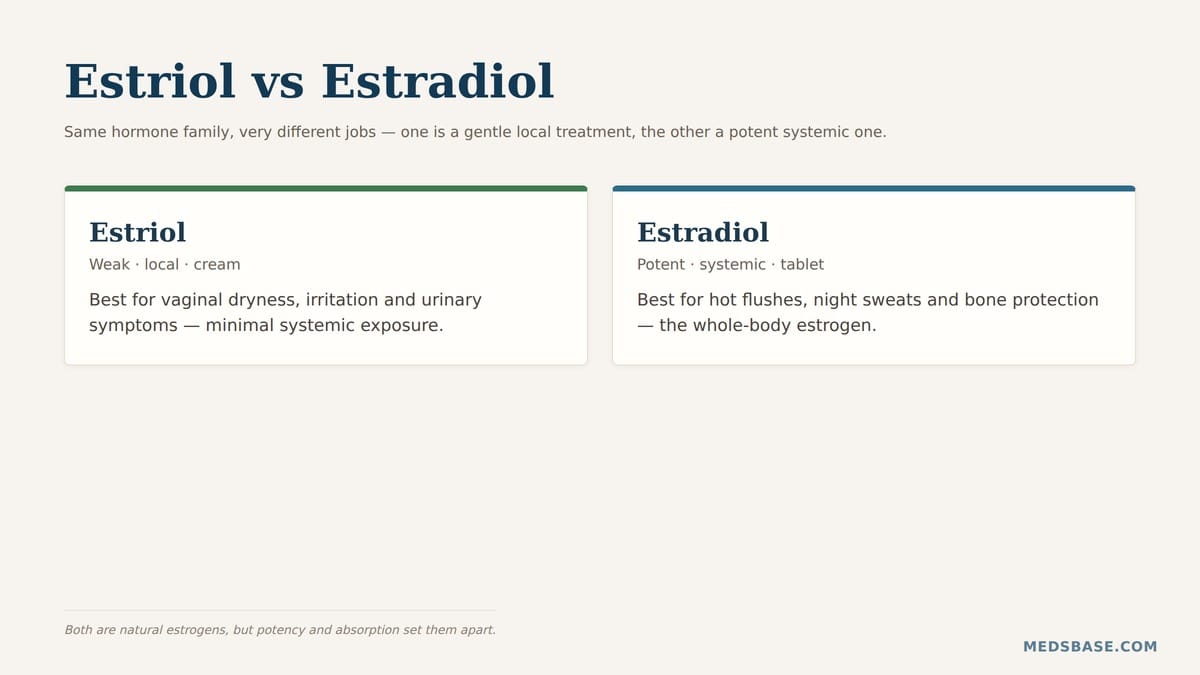
Most people assume “estrogen” is one thing. It isn’t. The two forms you’ll most often see in menopause treatment — estriol and estradiol — are different molecules with different strengths, different jobs, and different risk profiles. Choose the wrong framing and you’ll confuse a gentle local cream with a potent systemic hormone.
If you’ve been staring at a list of menopause products wondering whether you need estriol or estradiol, this is the comparison that clears it up. By the end, you’ll know exactly which one is used for vaginal dryness, which one is used for hot flushes, and why the “safest” choice depends entirely on what you’re actually trying to treat.
There’s one common mistake people make when choosing between the two — it’s the reason some women get little relief while others get more than they need. We’ll cover it in the dosage section.
Estradiol is the most potent natural estrogen and is used systemically (pills, patches) for whole-body menopause symptoms like hot flushes. Estriol is a much weaker estrogen used mainly topically, in vaginal creams and pessaries, for local symptoms like vaginal dryness. For vaginal symptoms, both can work — estriol is often preferred for its lower systemic exposure.
- Estradiol = strong and systemic. The go-to for hot flushes, night sweats, and osteoporosis prevention.
- Estriol = gentle and local. Primarily for vaginal dryness, irritation, and recurrent urinary symptoms.
- For vaginal symptoms, both work. Clinical guidance lists vaginal estrogen (in any form) as first-line treatment.
- Potency is the real difference. Estriol is estimated to be far weaker than estradiol, which is why it’s considered lower-risk for systemic effects.
- One common mistake: using a local estriol cream expecting it to fix hot flushes — it won’t. We’ll explain the dosage why.
- What Are Estriol and Estradiol?
- How They Work — Potency and Absorption
- Key Uses of Estriol vs Estradiol
- Safety, Side Effects & Dosage
- What Does the Research Say — Summary
- Estriol vs Estradiol — Head-to-Head
- How to Choose
- Frequently Asked Questions
- The Bottom Line
What Are Estriol and Estradiol?
Both estriol and estradiol are natural forms of estrogen — the hormone family that drops sharply at menopause. The difference is potency and role.
Estradiol is the strongest and most abundant estrogen in a woman’s reproductive years. When people talk about “estrogen levels,” they’re usually talking about estradiol. It’s the workhorse hormone that regulates the menstrual cycle, maintains bone density, and supports the tissues of the vagina, bladder, and skin. In menopause treatment, estradiol is used both systemically — as oral tablets (like Progynova) or patches — and topically.
Estriol is a much weaker estrogen, produced in higher amounts during pregnancy and otherwise present at lower levels. Its main therapeutic use is local: in vaginal creams and pessaries, where it treats the vaginal and urinary symptoms of menopause without producing the systemic effects that a potent estrogen would.
The NHS hormone replacement therapy overview describes HRT as replacing the hormones that drop at menopause, and it distinguishes between systemic therapy (for whole-body symptoms) and local vaginal estrogen (for vaginal symptoms). Estriol and estradiol sit at different points on that spectrum.
So the short version: estradiol is the strong, system-wide estrogen; estriol is the gentle, local one. Both have legitimate roles — but they are not interchangeable.
How They Work — Potency and Absorption
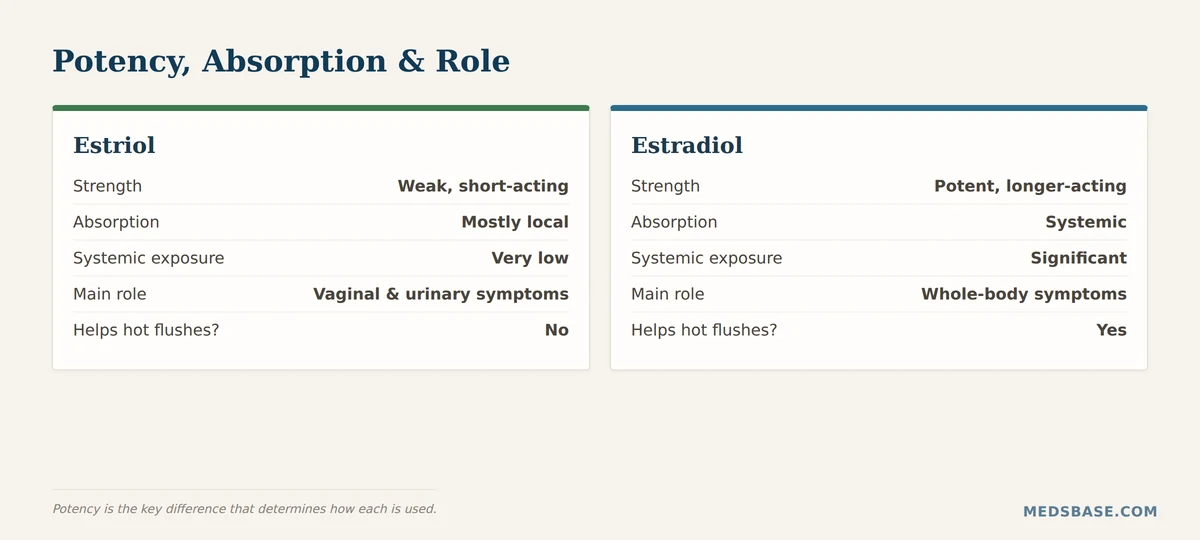
Here’s the single most important concept for understanding the estriol vs estradiol choice: potency and absorption.
Estradiol binds strongly to estrogen receptors throughout the body. Taken orally or via a patch, it circulates systemically and relieves the classic menopause symptoms — hot flushes, night sweats, mood changes, and the bone loss that follows menopause. That systemic action is exactly what you want for whole-body symptoms, but it also means systemic side effects and contraindications have to be weighed.
Estriol is a much weaker agonist at the estrogen receptor — it binds more briefly and is quickly cleared. When applied vaginally, most of it stays local, treating the tissues of the vagina and lower urinary tract directly. Very little reaches the bloodstream, which is why estriol is considered a low-risk option for local symptoms — and why it’s generally not effective for hot flushes: it simply isn’t strong enough, or systemic enough, to act on the brain’s temperature centre.
That distinction — local versus systemic — is the whole game. If your problem is “down there,” a local estriol or low-dose estradiol product is usually the right tool. If your problem is whole-body symptoms, you likely need systemic estradiol.
The Common Mistake, Explained
Here’s that mistake I promised. It’s natural to assume that because estriol and estradiol are both “estrogen,” a gentle estriol cream will also ease your hot flushes. It generally won’t — at least not reliably — because the dose and absorption aren’t designed for systemic effect.
The reverse mistake is also common: taking a potent systemic estradiol when the only symptom is mild vaginal dryness, when a low-dose local option would do the job with less systemic exposure. Matching the form and strength to the symptom is what separates a treatment that works well from one that disappoints.
Key Uses of Estriol vs Estradiol
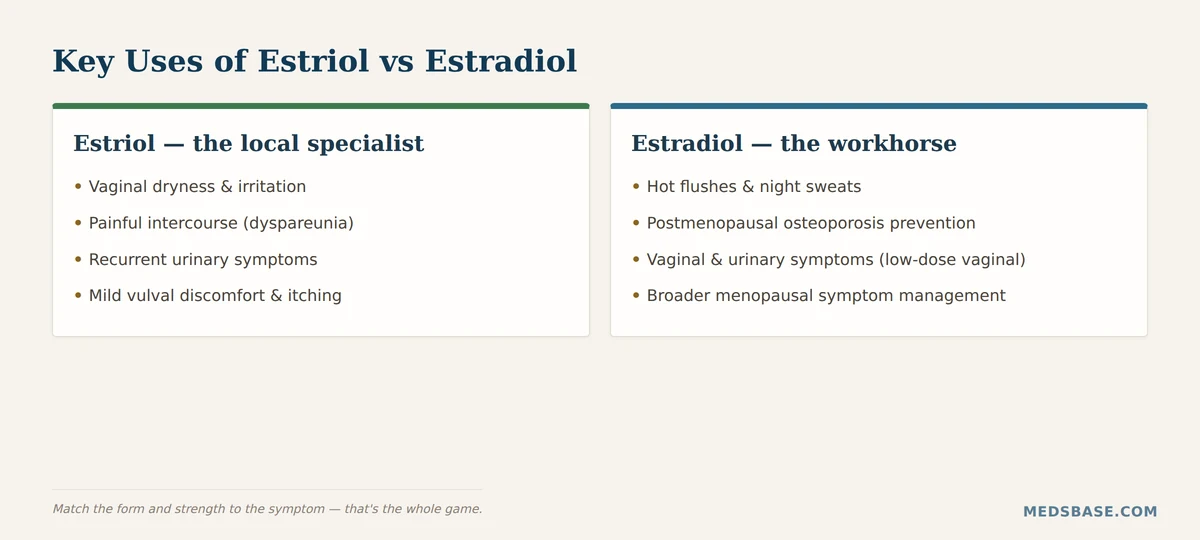
Estriol — the local specialist
- Vaginal dryness and irritation — the classic symptom of genitourinary syndrome of menopause.
- Painful intercourse (dyspareunia) caused by vaginal atrophy.
- Recurrent urinary symptoms, including some urinary tract infections linked to thinning vaginal tissues.
- Mild vulval discomfort and itching at menopause.
Estradiol — the whole-body workhorse
- Hot flushes and night sweats — the hallmark vasomotor symptoms of menopause.
- Prevention of postmenopausal osteoporosis when systemic therapy is indicated.
- Vaginal and urinary symptoms, via dedicated low-dose vaginal estradiol products.
- Broader menopausal symptom management (mood, sleep disturbance linked to flushes) in appropriate candidates.
For an evidence-backed rundown of how local estrogen helps with recurrent urinary infections specifically, our vaginal estrogen for recurrent UTIs guide covers it in detail.
Safety, Side Effects & Dosage
Safety is where the potency difference really matters, and it’s the reason estriol has a reputation for being the “gentler” option.
| Aspect | Estriol (topical/cream) | Estradiol (systemic) |
|---|---|---|
| Potency | Weak, short-acting | Strong, longer-acting |
| Typical route | Vaginal cream or pessary | Oral tablet or patch (also vaginal, low-dose) |
| Systemic exposure | Very low | Significant (by design) |
| Main side effects | Mild local irritation, discharge | Breast tenderness, bloating, nausea, headache |
| Serious-risk profile | Low (local therapy) | Higher (needs individual risk assessment) |
| Main use | Vaginal/urinary symptoms | Hot flushes, night sweats, bone protection |
For local vaginal symptoms, the side-effect profile is reassuring. A systematic review in Obstetrics & Gynecology concluded that vaginal estrogen is effective for genitourinary syndrome of menopause and well tolerated, with the main drawbacks being minor local effects. Estriol specifically has been studied for vaginal atrophy — one 2018 review examined estriol in combination with lactobacilli and found it effective for restoring vaginal tissue with a low safety concern.
The dosage logic follows the same local-vs-systemic split. Low-dose vaginal estriol is used frequently (often daily for a short “loading” phase, then two or three times a week for maintenance) precisely because each dose is small and locally absorbed. Systemic estradiol is dosed to achieve a steady circulating level, and it’s adjusted to the lowest effective dose for the shortest needed duration.
- Don’t expect a local estriol cream to stop hot flushes — it’s not designed for systemic effect.
- Don’t assume “natural estrogen” means risk-free; estradiol is a potent hormone and needs proper monitoring.
- Don’t use vaginal estrogen indefinitely without a review — reassess the need and dose with your prescriber.
- Don’t self-prescribe: whether you need estrogen with or without progestin depends on whether you still have a uterus.
What Does the Research Say — Summary
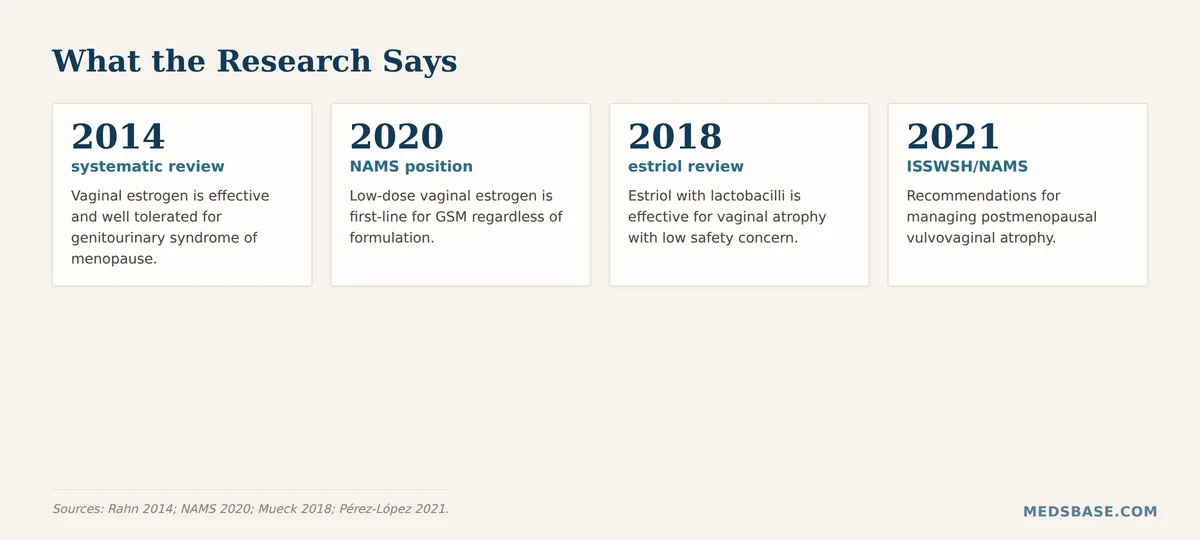
| Study | Year | Finding | Source |
|---|---|---|---|
| Rahn et al., Obstet Gynecol | 2014 | Systematic review: vaginal estrogen is effective and well tolerated for genitourinary syndrome of menopause | PubMed |
| NAMS GSM Position Statement, Menopause | 2020 | Low-dose vaginal estrogen is first-line for GSM regardless of formulation | PubMed |
| Pérez-López et al., Gynecol Endocrinol | 2021 | ISSWSH/NAMS recommendations for managing postmenopausal vulvovaginal atrophy | PubMed |
| Mueck et al., Climacteric | 2018 | Estriol (with lactobacilli) is effective for vaginal atrophy with low safety concern | PubMed |
| NHS — HRT overview | Ongoing | Distinguishes systemic HRT from local vaginal estrogen | NHS |
What this means for you: the evidence base is unusually consistent. For vaginal symptoms, local estrogen — estriol or low-dose estradiol — works well and carries a low risk. For systemic symptoms, you need systemic estradiol, which is more effective but comes with a more careful risk conversation.
Estriol vs Estradiol — Head-to-Head
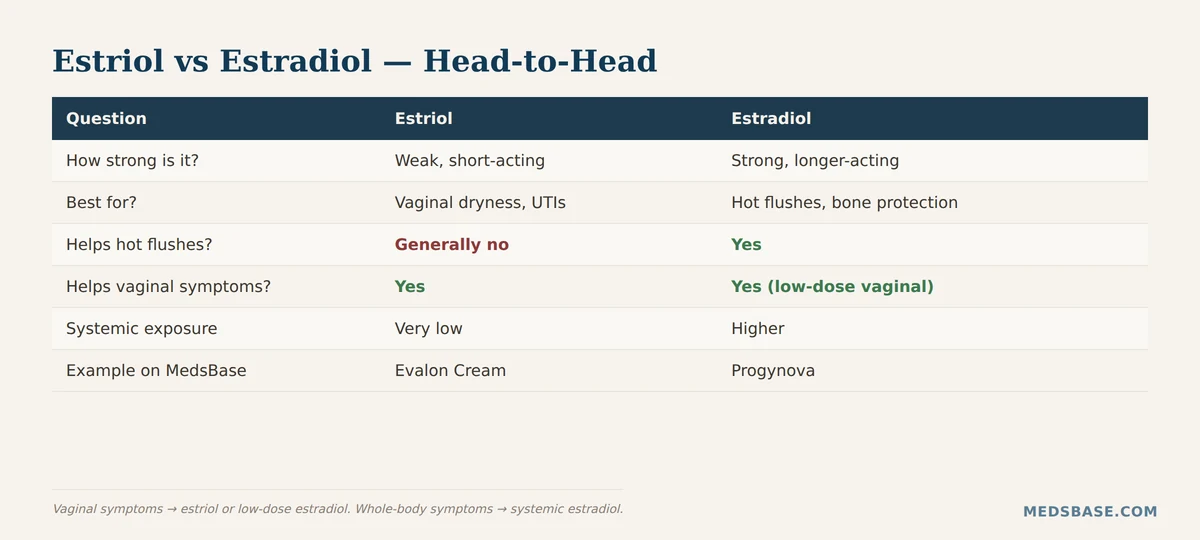
Let’s put the two side by side in plain terms, so the choice is obvious.
| Question | Estriol | Estradiol |
|---|---|---|
| How strong is it? | Weak, short-acting | Strong, longer-acting |
| What’s it best for? | Vaginal dryness, irritation, recurrent UTIs | Hot flushes, night sweats, bone protection |
| Does it help hot flushes? | Generally no (local action) | Yes (systemic) |
| Does it help vaginal symptoms? | Yes | Yes (low-dose vaginal form) |
| Systemic exposure | Very low | Higher |
| Typical example on MedsBase | Evalon Cream (estriol) | Progynova (estradiol) |
The “which fits which situation” verdict: if your only symptom is vaginal or urinary, a local estriol cream is a smart, low-exposure first step. If you’re dealing with hot flushes, night sweats, or bone-loss concerns, you’re in systemic-estradiol territory — and your prescriber will weigh the full risk-benefit picture, including whether you also need a progestin if you still have a uterus.
How to Choose
Here’s a simple decision flow to take to your appointment.
Step 1 — Identify the symptom. Write down what’s actually bothering you: vaginal dryness and discomfort, or hot flushes and night sweats? This one distinction decides most of the choice for you.
Step 2 — Match the form to the symptom. Vaginal/urinary symptoms start the conversation about a local estrogen (estriol cream or low-dose vaginal estradiol). Whole-body symptoms discuss systemic estradiol.
Step 3 — Let your prescriber weigh the risk factors. Whether you’ve had a hysterectomy, your age, and your personal and family history all shape whether estrogen is appropriate and in what form. This isn’t a decision to make alone.
Step 4 — Reassess regularly. Estrogen therapy — local or systemic — is meant to be reviewed. The goal is the lowest effective dose for the shortest duration that manages your symptoms.
When you’re ready to compare actual products, MedsBase carries both ends of the spectrum: Evalon Cream for the gentle, local estriol route, and Progynova for systemic estradiol. Browse the Women’s Health range to see the options, then bring your specific situation to your prescriber.
Related Reading
- Estrogen-Only HRT and Alzheimer’s Risk — today’s companion explainer on estrogen and the brain.
- Vaginal Estrogen for Recurrent UTIs — the local-estrogen use case in depth.
- Progynova (Estradiol) HRT Guide — systemic estradiol in detail.
Frequently Asked Questions
Q: What is the difference between estriol and estradiol?
A: Both are natural estrogens, but they differ in potency and use. Estradiol is the strongest natural estrogen and is used systemically (pills or patches) for whole-body menopause symptoms like hot flushes. Estriol is a much weaker estrogen used mainly topically, in vaginal creams, for local symptoms like vaginal dryness. The key difference is that estradiol acts systemically while estriol stays mostly local.
Q: Which estrogen cream is best for vaginal dryness?
A: For vaginal dryness, either a low-dose estradiol vaginal product or an estriol cream can work — clinical guidance lists low-dose vaginal estrogen (in any formulation) as first-line treatment for genitourinary syndrome of menopause. Estriol is often preferred because it produces very little systemic absorption, giving it a lower side-effect profile for local use.
Q: Is estriol safer than estradiol?
A: In the context of local vaginal use, estriol is generally considered to carry less systemic risk than systemic estradiol, because it’s weaker and barely absorbed into the bloodstream. But “safer” depends on the comparison you’re making: a low-dose vaginal estradiol is also low-risk. The real question is whether you need local or systemic treatment — that, more than the specific estrogen, determines the risk profile.
Q: Does estriol help with hot flushes?
A: Generally no. Estriol is weak and, when used vaginally, acts locally rather than systemically, so it isn’t effective for vasomotor symptoms like hot flushes and night sweats. Those require systemic estrogen — typically estradiol — to act on the brain’s temperature regulation. Using estriol for hot flushes is the most common mismatch people make.
Q: Estriol or estradiol for menopause — which should I choose?
A: It depends on your symptoms. If your symptoms are vaginal or urinary only, estriol cream (or low-dose vaginal estradiol) is a sensible, low-exposure choice. If you have hot flushes, night sweats, or bone concerns, you need systemic estradiol. Your prescriber should make the final call based on your full history.
Q: Can I use estriol and estradiol together?
A: It’s possible to use a local vaginal estrogen alongside systemic estrogen therapy if a prescriber recommends it — for example, if vaginal symptoms persist despite systemic treatment. But this should only be done under medical guidance, because the combined estrogen exposure needs to be considered.
Q: Do I need progestin with estriol or estradiol?
A: For systemic estrogen (estradiol), women with an intact uterus generally need a progestin to protect the uterine lining from endometrial-cancer risk. Low-dose vaginal estrogen (including estriol) usually does not require a progestin, but this is a decision for your prescriber based on dose and formulation.
Q: How long does it take for vaginal estrogen to work?
A: Most women notice improvement in vaginal dryness and discomfort within a few weeks of starting low-dose vaginal estrogen, though full tissue restoration can take two to three months. Products are often used daily for an initial loading phase, then reduced to a maintenance schedule. If you see no improvement after a few months, return to your prescriber.
The Bottom Line
Here’s the balanced verdict: estriol and estradiol aren’t competing answers to the same question — they’re different tools for different symptoms.
If your problem is vaginal dryness or urinary discomfort, a gentle, local estriol cream is a smart place to start. If your problem is hot flushes and the wider impact of menopause, you need systemic estradiol — and a proper conversation about the full risk-benefit picture.
Your immediate action: clarify, in one sentence, what you’re actually trying to treat. Write it down, then take it to your prescriber — because matching the estrogen to the symptom is the single biggest determinant of whether treatment works.
Wondering how this connects to the bigger hormone-and-health picture? Read our companion on estrogen-only HRT and Alzheimer’s risk, or go deeper on the local use case with vaginal estrogen for recurrent UTIs.

Written by
Sophie ChenPharmaceutical Content Researcher · 8 years experience
Sophie Chen is a pharmaceutical content researcher with 8 years covering generic medication access and clinical pharmacology. She specialises in international regulatory frameworks, bioequivalence standards, and patient-facing education on therapeutic drug classes. She is not a clinician.