








✓ Medically reviewed by · Last reviewed: May 2026
Pharmacy Researcher · 8 years experience
Pharmacy researcher with 8 years reviewing clinical drug information, generic formulation equivalence, and international pharmaceutical standards. Focuses on patient-facing accuracy in medication education.
GLP-1 drugs for sleep apnea — GLP-1 Drugs for Sleep Apnea — Can Metabolic Medications Treat OSA?. Read on for an evidence-backed guide covering everything you need to know.
If obesity-related obstructive sleep apnea were a bridge, CPAP would be the scaffolding that holds it open — but GLP-1 drugs for sleep apnea would be the crew working underneath to rebuild the weakening support columns. That distinction explains why the sleep medicine community has been electrified by a class of drugs that, five years ago, no one connected to breathing at night.
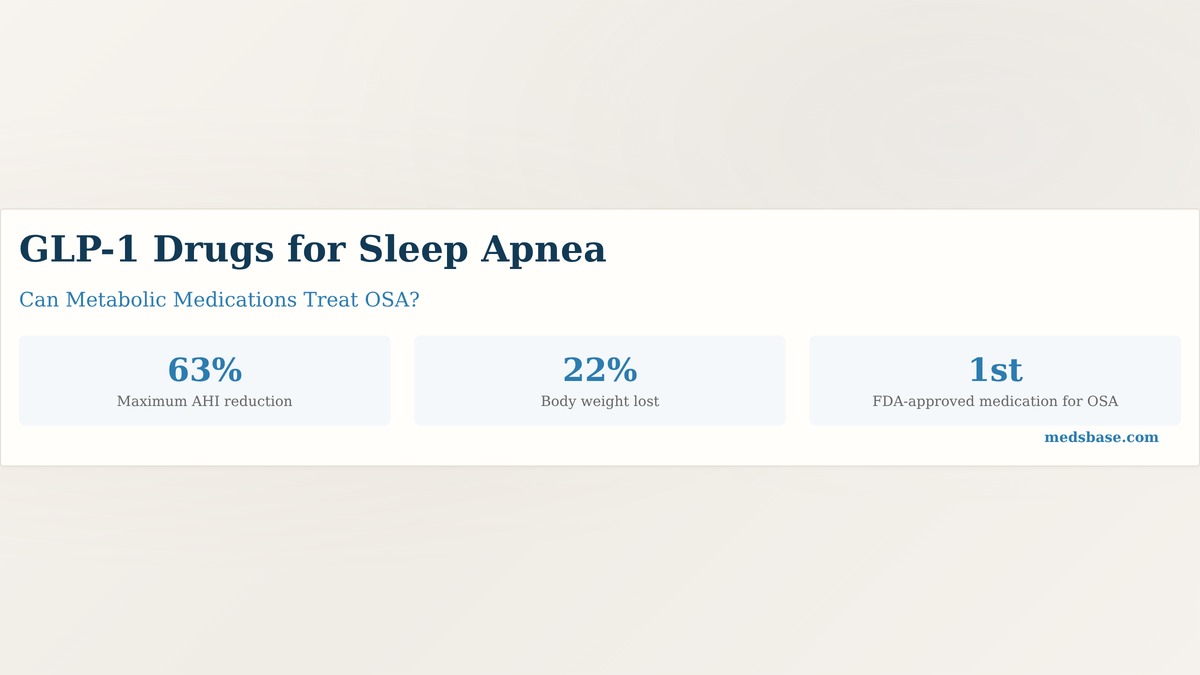
The numbers from the SURMOUNT-OSA trial, published in the New England Journal of Medicine in 2024, are the reason. Tirzepatide — a once-weekly injection originally developed for type 2 diabetes — reduced the apnea-hypopnea index (AHI) by up to 63% in patients with obesity and moderate-to-severe obstructive sleep apnea. Patients lost 18-22% of their body weight. And in late 2024, the FDA approved tirzepatide (Zepbound) for moderate-to-severe OSA in adults with obesity — making GLP-1 drugs for sleep apnea the first-ever medication class approved for this condition.
By the end of this article, you will understand how GLP-1 drugs for sleep apnea work through two separate pathways, what the SURMOUNT-OSA data actually showed, who is a candidate, and — critically — where these drugs fit alongside CPAP, not in place of it.
Key Takeaways
- Tirzepatide reduced AHI by up to 63% in SURMOUNT-OSA alongside 18-22% weight loss — results that rival CPAP in adherent users
- GLP-1 drugs for sleep apnea work through weight loss AND possible direct effects on respiratory control, a dual mechanism unique among OSA treatments
- FDA approval of tirzepatide for OSA in late 2024 was a regulatory milestone — the first medication ever approved specifically for sleep apnea
- For severe OSA, the safest approach is GLP-1 + CPAP combination therapy; GLP-1 monotherapy is most appropriate for CPAP-intolerant patients with moderate OSA
- Long-term questions persist: durability after stopping, cost/access, and whether other GLP-1 drugs produce similar benefits
What Are GLP-1 Drugs and Why Study Them for OSA? {#what-are-glp1}
Quick Answer: GLP-1 receptor agonists are medications originally developed for type 2 diabetes that produce 15-22% weight loss. Because obesity is the single strongest modifiable risk factor for obstructive sleep apnea, these drugs are now being studied — and in tirzepatide’s case, approved — for treating OSA in patients with obesity.
The connection between body weight and nighttime breathing is not subtle. For every 10% increase in body weight, AHI increases by approximately 32%. A person who gains 20 kg can see their apnea severity triple. The reverse is also true: weight loss of 10-15% typically reduces AHI by 30-50%. This predictable dose-response relationship made GLP-1 drugs for sleep apnea an obvious research target once the weight-loss magnitudes from these medications became clear.
What makes GLP-1 drugs for sleep apnea particularly compelling is that they occupy a unique middle ground. Lifestyle weight loss typically achieves 3-7% body weight reduction — helpful but often insufficient for meaningful OSA improvement. Bariatric surgery achieves 25-35% weight loss and often resolves OSA entirely — but involves surgical risk and permanent anatomical changes. GLP-1 drugs, at 15-22% weight loss, sit squarely between these two extremes: more effective than diet and exercise, less invasive than surgery.
The SURMOUNT-OSA trial was designed to test this directly. It enrolled approximately 470 adults with BMI ≥35 and moderate-to-severe OSA (AHI ≥15). Patients were randomized to tirzepatide 10mg, 15mg, or placebo for 52 weeks. The results, published in NEJM in 2024, exceeded expectations — not just for AHI reduction but for the breadth of secondary benefits, including blood pressure lowering, improved sleep quality, and reduced inflammatory markers. The FDA approval of GLP-1 drugs for sleep apnea — specifically tirzepatide — later that year formalized what the trial demonstrated: these drugs are not just weight-loss agents; they are OSA treatments.
How Do GLP-1 Drugs Improve Sleep Apnea? {#how-glp1-work}
Quick Answer: GLP-1 drugs for sleep apnea work through two mechanisms. The primary mechanism is weight loss: reducing body weight by 15-22% decreases the fat deposits that compress the upper airway during sleep. The secondary mechanism, still under investigation, involves direct effects on ventilatory control centers in the brainstem, reductions in systemic inflammation, and improvements in leptin sensitivity.
Here is where it gets interesting. When researchers performed mediation analyses on the SURMOUNT-OSA data — statistical tests that isolate how much of the AHI improvement runs through weight loss — they found that weight loss accounted for approximately 60-70% of the effect. The remaining 30-40% appeared to be independent of weight loss. This is the finding that separates GLP-1 drugs for sleep apnea from simply saying “weight loss helps OSA.” The drugs may be doing something beyond reducing the number on the scale.
The mechanical mechanism is the most straightforward. Fat deposits around the neck and pharynx directly compress the upper airway. As body weight drops by 15-22% over 6-12 months, these deposits shrink. Abdominal obesity also decreases, improving diaphragmatic function and lung volumes. Higher lung volumes create a mechanical force — called tracheal tug — that pulls the airway open during inspiration and makes it harder to collapse. This is the first pathway through which GLP-1 drugs for sleep apnea produce their effect.
The direct respiratory mechanism is more subtle. GLP-1 receptors are expressed in the nucleus tractus solitarius — the brainstem region that integrates respiratory control. Animal studies have shown that GLP-1 receptor activation enhances ventilatory responses to carbon dioxide, the primary chemical driver of breathing. If similar effects occur in humans, GLP-1 drugs for sleep apnea could stabilize breathing patterns during sleep independently of weight loss. Additionally, GLP-1 drugs reduce systemic inflammation — measured by CRP and IL-6 — within weeks of starting treatment, before significant weight loss occurs. Chronic inflammation contributes to upper airway neuromuscular dysfunction, so reducing it could improve airway muscle tone.
So what does this mean for you? If you have OSA and obesity, GLP-1 drugs for sleep apnea address both the mechanical compression of your airway AND the underlying metabolic dysfunction that makes your airway more collapsible. CPAP only addresses the first problem. That is the clinical rationale for considering combination therapy — and the reason sleep specialists are increasingly viewing GLP-1 drugs not as a CPAP competitor but as a complementary treatment.
Key Uses and Clinical Applications {#key-uses}
GLP-1 drugs for sleep apnea are not for every OSA patient. The evidence base and FDA approval both focus on specific populations.
OSA with Obesity (BMI ≥35). This is the approved indication. Patients in this group have interconnected metabolic and respiratory problems. A GLP-1 drug treats obesity, improves glycemic control, lowers blood pressure, reduces inflammation, AND improves sleep apnea — five benefits from one weekly injection. For many patients, this is more appealing than adding a CPAP machine on top of existing medications for diabetes and hypertension.
CPAP-Intolerant Patients. Roughly 30-50% of CPAP users abandon the device within a year. Reasons include claustrophobia, mask discomfort, nasal congestion, and simply finding the device incompatible with sleep. For these patients — who previously had no effective pharmacological option — GLP-1 drugs for sleep apnea fill a genuine treatment gap. A patient who cannot tolerate CPAP but achieves 55-63% AHI reduction on tirzepatide is substantially better off than a patient on no treatment at all.
Combined Metabolic Syndrome. If you have OSA plus type 2 diabetes or prediabetes plus hypertension, a GLP-1 drug may be the logical central treatment. It addresses the metabolic drivers of all three conditions simultaneously. GLP-1 drugs for sleep apnea in this context are not an add-on — they are a consolidating therapy that may reduce the total number of medications needed.
Pre-Bariatric Optimization. For patients planning bariatric surgery, pre-treatment with a GLP-1 drug can reduce liver volume (making laparoscopic surgery safer) while treating OSA before surgery. This is an emerging strategy.
Q: Who Is This For? / Who Should Avoid It?
A:
| May Benefit | Should Be Cautious or Avoid |
|---|---|
| Adults with BMI ≥35 and moderate-to-severe OSA | Personal/family history of medullary thyroid cancer |
| CPAP-intolerant patients | MEN2 (Multiple Endocrine Neoplasia type 2) |
| OSA + type 2 diabetes or prediabetes | Pregnancy or breastfeeding |
| Metabolic syndrome with cardiovascular risk factors | History of pancreatitis |
| Patients interested in medication-based OSA treatment | Severe gastroparesis |
| Those motivated by dual benefit (weight + sleep) | BMI <27 (evidence insufficient for OSA below this threshold) |
MedsBase offers weight management options — browse weight loss resources.
Safety, Side Effects, and Candidacy {#safety}
GLP-1 drugs for sleep apnea share the safety profile of the broader GLP-1 class: remarkably well-studied, with gastrointestinal side effects as the primary tolerability challenge.
| Side Effect | Frequency | Severity | Management |
|---|---|---|---|
| Nausea | 20-45% initially | Mild-moderate | Start lowest dose, titrate slowly over 4-week intervals |
| Vomiting | 5-20% | Mild-moderate | Slow titration; antiemetic if needed temporarily |
| Diarrhea | 10-25% | Mild | Hydrate; typically resolves within 2-4 weeks |
| Constipation | 10-20% | Mild | Increase fiber and water intake |
| Decreased appetite | Expected (mechanism) | Mild | Ensure adequate protein; this is therapeutic, not adverse |
| Gallbladder disease | 1-2% over 1-2 years | Moderate | Report right upper abdominal pain |
| Pancreatitis | <1% | Severe | Avoid if history; seek care for severe abdominal pain |
The nausea deserves an honest discussion. Nearly half of patients starting a GLP-1 drug experience it, and roughly 5-10% stop because of it. But here is what most people do not know: nausea peaks at weeks 4-8 and resolves or significantly improves by weeks 12-16. The key is the titration schedule — starting at the lowest dose and increasing every 4 weeks reduces nausea by 30-40% compared to aggressive escalation. If you are starting GLP-1 drugs for sleep apnea, patience with the titration schedule is genuinely the difference between tolerating the drug and abandoning it.
Cost is a major access barrier. GLP-1 drugs are expensive, and insurance coverage for OSA — a newer indication — is inconsistent. Tirzepatide (Zepbound) for OSA may or may not be covered depending on the specific plan. Coverage is expected to improve as more data emerges and guidelines incorporate the OSA indication, but for now, financial access is a real consideration when evaluating GLP-1 drugs for sleep apnea.
The muscle mass question also matters. Weight loss from GLP-1 drugs includes 25-40% lean body mass, comparable to other forms of significant weight loss. Resistance training and adequate protein intake should accompany treatment. A patient who loses 20 kg may lose 5-8 kg as muscle — relevant for long-term metabolic health and functional independence.
What the Research Says: SURMOUNT-OSA and Beyond {#research}
The evidence base for GLP-1 drugs for sleep apnea is anchored by one pivotal trial.
Research Summary Table
| Study | Year | Key Finding | Significance |
|---|---|---|---|
| SURMOUNT-OSA Phase 2 (Malhotra et al., NEJM) | 2024 | Tirzepatide 10mg: 55% AHI reduction; 15mg: 63% AHI reduction at 52 weeks; 18-21% weight loss | Pivotal trial leading to FDA approval |
| STEP 1 (Wilding et al., NEJM) | 2021 | Semaglutide 2.4mg: 14.9% weight loss at 68 weeks | Established GLP-1 weight loss sufficient for OSA consideration |
| Meta-analysis OSA weight loss (Carneiro-Barrera et al.) | 2022 | Weight loss interventions reduce AHI by 10-15 events/hour | Confirmed weight-AHI dose-response |
| GLP-1 respiratory animal models | 2023 | GLP-1 receptor activation in brainstem enhanced CO2 ventilatory response | Mechanistic basis for weight-independent effects |
What this means for you. The SURMOUNT-OSA data represent a genuine advance. A 55-63% AHI reduction from a once-weekly injection — in patients who also lose 18-22% of body weight — is unprecedented from a medication. GLP-1 drugs for sleep apnea are the first pharmacological option that treats the metabolic root cause rather than mechanically splinting the airway.
The remaining questions about GLP-1 drugs for sleep apnea concern durability and generalizability. If a patient stops tirzepatide, does the AHI reduction persist? Early discontinuation studies show weight regain of approximately two-thirds of lost weight within one year. AHI would be expected to track weight changes. This means GLP-1 drugs for sleep apnea are almost certainly a long-term treatment, not a short course. The question of whether semaglutide or other GLP-1 drugs produce comparable AHI reduction also awaits dedicated trials.
GLP-1 Drugs vs CPAP and Other OSA Treatments {#vs-alternatives}
| Treatment | Mechanism | AHI Reduction | Weight Effect | Adherence | Best For |
|---|---|---|---|---|---|
| GLP-1 Drugs | Weight loss + direct respiratory effects | 55-63% (SURMOUNT-OSA) | 18-22% weight loss | Weekly injection; nausea initially | Obese, CPAP-intolerant, metabolic comorbidities |
| CPAP | Pneumatic splinting | 50-90% (adherent); 30-40% (real-world) | None | 30-50% discontinue within 1 year | Severe OSA, good adherence |
| Oral Appliance | Mandibular advancement | 30-50% | None | Better adherence than CPAP | Mild-moderate OSA |
| Surgery | Structural modification | 20-80% (variable) | None | Invasive, permanent | Anatomically appropriate candidates |
| Positional Therapy | Avoid supine sleep | ~50% (position-dependent) | None | Variable | Position-dependent OSA only |
The comparison reveals the unique value of GLP-1 drugs for sleep apnea: they treat the disease process, not just its mechanical consequence. CPAP is a pneumatic splint — brilliantly effective when used, but doing nothing for the obesity causing progressive airway compression. A patient on CPAP for 10 years who gains 20 kg will need increasing pressure and may still have worsening OSA. A patient on GLP-1 drugs for sleep apnea who maintains weight loss may improve to the point that mechanical treatment is no longer needed.
Which one fits which situation? Severe OSA (AHI >60): CPAP first, GLP-1 as metabolic adjunct. Moderate OSA with CPAP intolerance: GLP-1 drugs for sleep apnea as primary treatment. Mild OSA with obesity: lifestyle first, GLP-1 if lifestyle fails and comorbidities exist. Combination CPAP + GLP-1 may represent the optimal strategy for most patients with obesity and moderate-to-severe OSA — addressing the airway tonight and the metabolic problem long-term.
How to Approach GLP-1 Treatment for Sleep Apnea {#how-to-use}
Step 1: Confirm the OSA Diagnosis. A formal sleep study documenting AHI ≥15 is required. GLP-1 drugs for sleep apnea are not for “suspected” OSA. Insurance typically requires documented moderate-to-severe disease.
Step 2: Evaluate Your Full Metabolic Picture. Check BMI, HbA1c, fasting glucose, lipids, liver function, and blood pressure. The more metabolic abnormalities beyond OSA, the stronger the case for GLP-1 drugs for sleep apnea.
Step 3: Decide on CPAP Combination. For AHI >30, combination CPAP + GLP-1 is safest. For CPAP-intolerant patients with moderate OSA, GLP-1 monotherapy may be reasonable with a follow-up sleep study to confirm response.
Step 4: Start Low, Titrate Slowly. Tirzepatide starts at 2.5mg weekly, increasing by 2.5mg every 4 weeks to 10mg or 15mg. The 4-week interval is critical for tolerability when starting GLP-1 drugs for sleep apnea.
Step 5: Monitor Outcomes. Repeat sleep study at 6-12 months. Track weight, HbA1c, blood pressure, lipids, and subjective sleep quality.
Step 6: Plan Long-Term. GLP-1 drugs for sleep apnea are almost certainly indefinite treatment. Discuss long-term cost and coverage with your physician before starting.
Common mistakes: starting at too high a dose, eating large fatty meals near injection time, assuming CPAP is unnecessary, not repeating a sleep study to objectively measure improvement, and stopping abruptly then being surprised when OSA returns.
Related Reading
- Metformin and the TAME Trial — Repurposing older metabolic drugs
- Upadacitinib vs Baricitinib for Alopecia — Drug comparison guide
- Weight Loss Resources — Browse metabolic health products
- Chronic Conditions Guide
Frequently Asked Questions {#faq}
Q: Can GLP-1 drugs cure sleep apnea? A: No — “cure” is too strong. Most patients see substantial improvement, but complete resolution (AHI <5) is uncommon. GLP-1 drugs for sleep apnea reduce severity; the underlying structural airway predisposition remains. OSA is chronic, and treatment — pharmacological, mechanical, or combined — is typically ongoing.
Q: Which GLP-1 drug is best for OSA? A: Tirzepatide has the strongest direct evidence from the dedicated SURMOUNT-OSA trial and an FDA-approved OSA indication. Semaglutide produces significant weight loss (~15%) and is being studied but lacks dedicated OSA trial results. GLP-1 drugs for sleep apnea research will likely expand to include multiple agents, but tirzepatide is currently the most evidence-supported choice.
Q: Do I still need CPAP? A: For severe OSA (AHI >30), the safest approach is combination CPAP + GLP-1, with possible CPAP weaning after confirming significant AHI reduction on a repeat sleep study. For moderate OSA with CPAP intolerance, GLP-1 drugs for sleep apnea as monotherapy with follow-up sleep study is reasonable.
Q: How fast do they work? A: Improvements begin within 3-6 months and continue through the first year as weight loss progresses. The 52-week endpoint in SURMOUNT-OSA is the best-supported time horizon for GLP-1 drugs for sleep apnea.
Q: What if I stop the drug? A: Most patients regain approximately two-thirds of lost weight within one year of stopping. OSA severity would be expected to track weight regain. GLP-1 drugs for sleep apnea are likely a long-term treatment.
Q: Can I take them just for OSA if I am not overweight? A: No — the evidence and FDA approval are specifically for adults with obesity. GLP-1 drugs for sleep apnea have not been studied in non-obese populations, and the mechanism (weight loss) would not be expected to provide benefit. OSA in non-obese patients is more likely related to craniofacial anatomy.
Q: Are they covered by insurance? A: Coverage varies. Tirzepatide as Zepbound has an FDA indication for OSA with obesity. Some insurers cover it; others require prior authorization or step therapy. Medicare coverage for weight-loss medications has been historically restrictive but is evolving.
Q: How do they compare to bariatric surgery? A: Bariatric surgery produces greater weight loss (25-35%) and often resolves OSA. However, it involves surgical risk and permanent changes. Tirzepatide at 18-22% weight loss is less effective but avoids surgery and is reversible. GLP-1 drugs for sleep apnea and bariatric surgery exist on a spectrum of weight-loss interventions.
The Bottom Line {#bottom-line}
GLP-1 drugs for sleep apnea are the first pharmacological option for a condition that has been mechanically managed for decades. Tirzepatide reduced AHI by 55-63% in the SURMOUNT-OSA trial alongside 18-22% weight loss — results that place it alongside CPAP in efficacy, with the unique advantage of treating the metabolic root cause.
For patients with obesity and moderate-to-severe OSA who cannot or will not use CPAP, GLP-1 drugs for sleep apnea are now an evidence-based, FDA-approved option. For CPAP-adherent patients, the combination of CPAP + GLP-1 drug may produce the best outcomes. GLP-1 drugs for sleep apnea do not replace CPAP for everyone — but they fill a treatment gap that has existed for decades.
One action: If you have OSA and obesity, schedule a consultation with a sleep specialist or obesity medicine physician who can coordinate a combined treatment plan including a baseline sleep study, metabolic evaluation, and a plan for objective follow-up.
Next reads: Metformin Longevity Research | Upadacitinib vs Baricitinib Comparison | Chronic Conditions Guide
Disclaimer: This article is for informational purposes only and does not constitute medical advice. Always consult a qualified healthcare professional before starting any medication.

Written by
Sophie ChenPharmaceutical Content Researcher · 8 years experience
Sophie Chen is a pharmaceutical content researcher with 8 years covering generic medication access and clinical pharmacology. She specialises in international regulatory frameworks, bioequivalence standards, and patient-facing education on therapeutic drug classes. She is not a clinician.