








✓ Medically reviewed by · Last reviewed: May 2026
Pharmacy Researcher · 8 years experience
Pharmacy researcher with 8 years reviewing clinical drug information, generic formulation equivalence, and international pharmaceutical standards. Focuses on patient-facing accuracy in medication education.
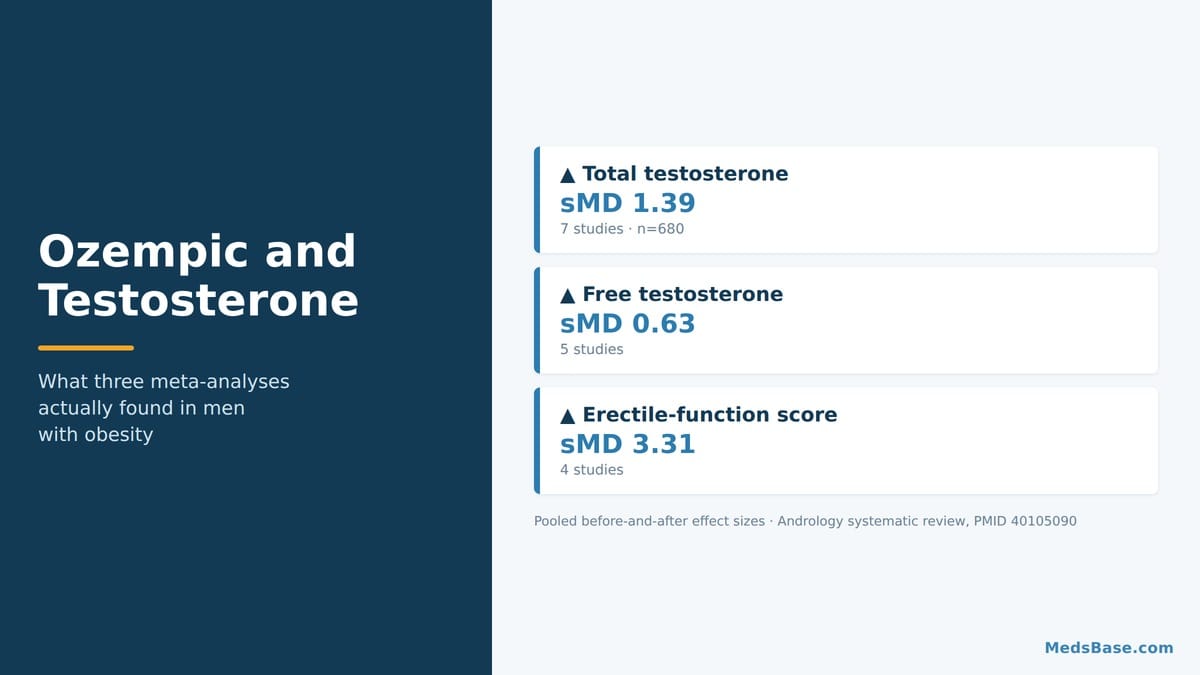
Across seven studies and 680 men, treatment with a GLP-1 receptor agonist raised total testosterone with a standardised mean difference of 1.39 — and the newest analysis found that rise happened largely independently of how much weight the men lost. That last detail is the one the July headlines skipped, and it changes what the finding means. If the testosterone rise were purely a consequence of losing fat, it would be a footnote to weight loss. If it isn’t, something is happening further upstream.
So here is what you’ll know by the end of this article: exactly what the pooled numbers on Ozempic and testosterone say, how confident anyone is entitled to be in them, whether any of it applies to a man whose testosterone is already normal, and how this compares with simply taking testosterone. One of the findings in the safety section surprises almost everyone who has assumed these drugs are hormonally neutral — we’ll get there.
- Pooled data on Ozempic and testosterone show your total testosterone rising on GLP-1s — but the studies disagreed with each other far more than the tidy headline suggests, and we’ll show you exactly how much.
- The 2026 analysis found the hormone change was not explained by weight loss alone, which points somewhere unexpected.
- Erectile-function scores improved substantially in trials — yet testosterone replacement still beat GLP-1s on two specific outcomes.
- Every single study was done in men with obesity or type 2 diabetes. If that isn’t you, the honest answer is that nobody has tested it.
- The fertility signal is real but thin — five small trials, and the researchers themselves are asking for better ones.
What Is the Ozempic and Testosterone Connection?
The link between Ozempic and testosterone describes a consistent finding in recent research: men with obesity or type 2 diabetes who take a GLP-1 receptor agonist tend to show higher measured testosterone afterwards than before, along with higher luteinising hormone and improved erectile-function scores. The effect appears within months rather than years, and it shows up whether the drug used was semaglutide, liraglutide or another agent in the class.
That is the forty-second version. Now the part that matters.
If you carry significant excess weight and your testosterone is low, that combination is common enough to have its own name — functional hypogonadism. “Functional” is doing real work in that phrase. It means your testicles and your pituitary are not damaged; they are being suppressed by something reversible. Remove the suppression and your system tends to recover. That is genuinely different from primary testicular failure, where no amount of weight loss will restore anything for you.
That distinction determines whether any of this research applies to you. If your testosterone is low after years of metabolic strain, you have a reversible problem. If your testosterone is low because of testicular injury, a pituitary tumour or a genetic condition, you do not — and no GLP-1 study has ever included anyone like you.
Here’s where it gets interesting: for most of the last two decades, the assumed fix for functional hypogonadism was weight loss by any means. GLP-1 drugs happen to produce weight loss reliably, so the expectation was that testosterone would follow along behind, nothing more. The recent data complicate that story.
How Does Ozempic Affect Testosterone? The Mechanism in Plain English
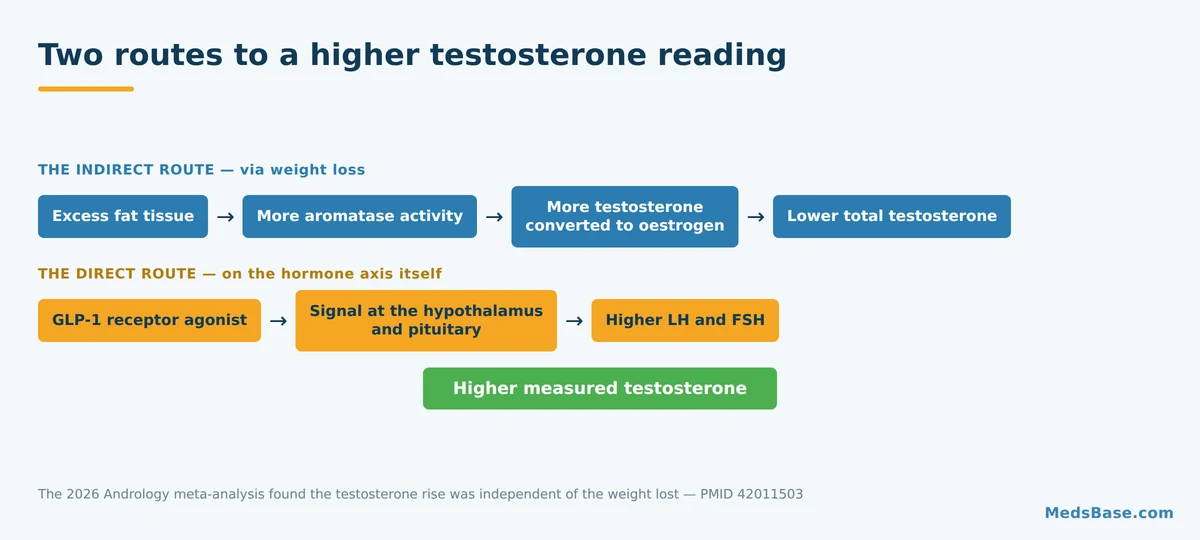
Picture your fat tissue as an unauthorised second endocrine gland. It isn’t inert storage — it is metabolically busy, and one of the things it does inside you is run an enzyme called aromatase, which converts your testosterone into oestrogen. The more fat tissue you carry, the more conversion happens, and the more the resulting oestrogen signals back to your brain that hormone levels are adequate. Your pituitary responds by easing off on luteinising hormone, the signal that tells your testicles to make testosterone in the first place — so the more you carry, the quieter that instruction gets.
That is the indirect route, and it is a genuine loop: excess fat lowers testosterone, and low testosterone makes fat easier to gain. If you want the fuller picture of how this loop plays into sexual function, we cover why losing weight changes erections at all separately.
If the indirect route were the whole story, then any method you used to lose the same amount of weight should raise your testosterone by the same amount. And this is exactly where the newest evidence gets interesting.
a 2026 meta-analysis of GLP-1s and male sexual hormones pooled eight studies covering 375 men and reported something specific: the testosterone increase on GLP-1 receptor agonists was independent of the observed weight loss. The authors concluded that this points to a direct action on the hypothalamic–pituitary–testis axis rather than an indirect consequence of getting lighter. In the same analysis, sodium-glucose cotransporter 2 inhibitors — a different diabetes drug class that also produces weight loss — did not produce the same significant testosterone effect, though only three small studies covered them.
Two drug classes, similar weight loss, different hormonal result. That is the observation the direct-mechanism argument rests on.
There is a tidy piece of internal evidence for the direct route. Across the pooled studies, luteinising hormone and FSH both went up. If testosterone were rising purely because less of it was being converted to oestrogen, you would expect the pituitary signal to stay flat or fall, not climb. Rising LH suggests the instruction from above got louder — which is an upstream change, not a downstream one.
Honest caveat, because it matters to how much weight you give this: it is a pattern across pooled before-and-after data, not a mechanism proven in a controlled experiment. Nobody has yet run the study that would settle it for you.
Who the Ozempic and Testosterone Research Actually Applies To
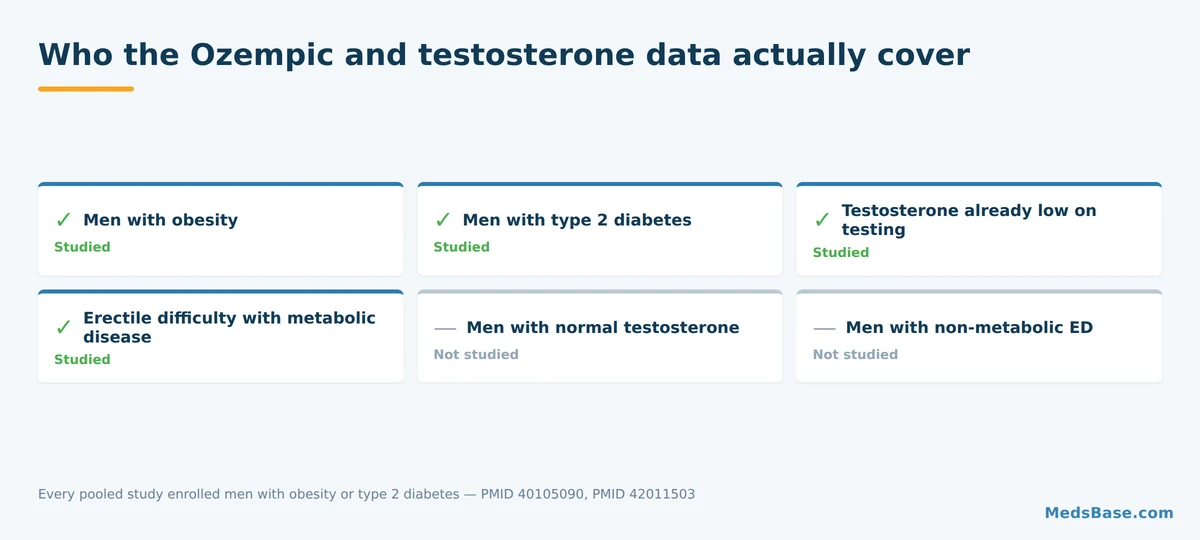
This is the section most coverage skips, and it is the one that decides whether any of the headline means anything for you personally. That research was carried out in one specific group of men, and your first question should be whether you are one of them.
Men with obesity and measured low testosterone
This is the studied population. Across the pooled analyses, participants were overweight or obese men, frequently with type 2 diabetes, and often with testosterone already below the reference range. If that describes you, the research is directly relevant to you — with the caveat that “relevant” means “worth discussing with your clinician,” not “predictive of your individual result.” Pooled averages describe groups. They do not promise you anything.
Men with type 2 diabetes and sexual difficulty
If you have had diabetes for years, your erectile difficulty is usually vascular and neurological before it is hormonal. The pooled improvement in erectile-function scores is encouraging here, but a GLP-1 is not an erection treatment, and if you read it as one you are setting yourself up for disappointment.
Men with normal testosterone
Nobody has studied you. Not “the results were negative” — the studies were not designed to include men with normal baseline hormones, so your situation was never tested. Anyone telling you a GLP-1 will raise your testosterone when you are metabolically healthy and your levels are already normal is extrapolating well past the data.
MedsBase stocks semaglutide and no prescription is needed to order — but the decision about whether a GLP-1 belongs in your treatment at all is a clinical one, and the hormonal findings here are a reason to have that conversation, not a reason to skip it.
Ozempic and Testosterone: Safety Profile, Side Effects and What Changes
Time to resolve the loop from the introduction. The finding about Ozempic and testosterone that surprises people: a rise in your testosterone is not automatically good news, and it can be a fertility problem in disguise — but not for the reason most men assume.
Here is the distinction that matters to you. Your testosterone rising because your own axis started working again is a restoration. Your testosterone rising because you injected it is a replacement — and replacement suppresses the signal from your pituitary, which is what shuts down your sperm production. The pooled GLP-1 data show LH and FSH going up, which is the opposite pattern. That is genuinely reassuring on this specific point, and if you want children it is the practical reason the two approaches are not interchangeable for you.
Now the ordinary side effects, which are the ones you will actually meet.
| Side effect | Frequency | Severity | What to do |
|---|---|---|---|
| Nausea, especially in the first weeks and after each dose increase | Very common | Mild to moderate | Smaller meals, slower dose escalation. Usually settles as your body adapts |
| Vomiting or diarrhoea | Common | Mild to moderate | Keep fluids up. Persistent vomiting needs medical review, not persistence |
| Loss of appetite and reduced food intake | Very common | Mild — but consequential | Protein intake often falls without anyone noticing. This is the one to actively manage |
| Constipation | Common | Mild | Fluids, fibre, movement |
| Muscle loss alongside fat loss | Common with rapid weight loss | Moderate | Resistance training and adequate protein. Covered in depth below |
| Gallbladder problems | Uncommon | Potentially serious | Persistent upper-right abdominal pain needs same-day assessment |
| Pancreatitis | Rare | Serious | Severe persistent abdominal pain radiating to the back — stop and seek urgent care |
The side effect that quietly undermines the hormonal benefit is the appetite loss. If you eat far too little protein while your weight drops quickly, you lose muscle along with fat — and your muscle mass is itself tied to your metabolic health. You can improve one number on your lab report while going backwards on the thing that number is supposed to represent.
Pharmacists see a version of this constantly: someone doing everything right on paper, losing weight steadily, and unknowingly eating at a level that guarantees they lose lean tissue too. The fix isn’t complicated, but you do have to make it deliberate.
What Does the Research Say About Ozempic and Testosterone?
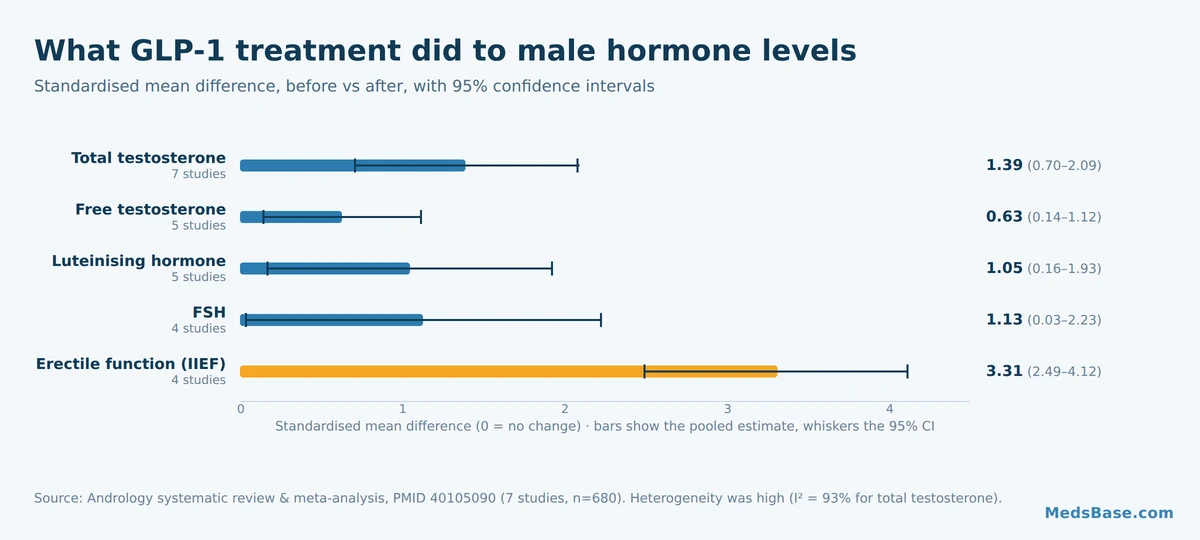
Three independent analyses, published between November 2025 and April 2026, now cover Ozempic and testosterone. Here is what each of them found — and, just as usefully for you, what each one refused to claim.
| Study | Year | Finding | Source |
|---|---|---|---|
| Systematic review & meta-analysis, Andrology (7 studies, n=680) | 2025 | Total testosterone increased, sMD 1.39 (95% CI 0.70–2.09, p < 0.0001). Free testosterone sMD 0.63 (0.14–1.12, p=0.01). LH sMD 1.05 (0.16–1.93). FSH sMD 1.13 (0.03–2.23). Erectile-function (IIEF) score sMD 3.31 (2.49–4.12, p < 0.00001) | PMID 40105090 |
| Systematic review & meta-analysis, Andrology (8 GLP-1 studies, 375 subjects) | 2026 | Only GLP-1 agonists significantly raised total and calculated free testosterone plus gonadotropins; the effect was independent of weight loss. Testosterone replacement performed better on orgasm and satisfaction domains | PMID 42011503 |
| Systematic review & meta-analysis, BMC Urology (4 studies, 219 pre / 216 post) | 2025 | Bioavailable testosterone rose significantly and HbA1c fell significantly; changes in free testosterone (p=0.051) and SHBG (p=0.120) were not statistically significant | PMID 41291666 |
Read that third row again, because it is the counterweight you will not find in the headlines. Two analyses found free testosterone up; a third found the free-testosterone change fell just short of significance. That is what a genuinely emerging evidence base looks like — directionally consistent, not unanimous.
And there is a bigger caveat sitting underneath all of it. In a systematic review and meta-analysis in Andrology, heterogeneity for the total-testosterone result was I² = 93% — meaning the individual studies disagreed with one another enormously. The authors also graded study quality on the Newcastle–Ottawa scale and rated several of the included studies “Poor.” A pooled estimate built on studies that disagree that much is a signal worth investigating, not a number to plan your treatment around.
The same is true in a 2025 meta-analysis in BMC Urology, where heterogeneity for the bioavailable-testosterone result was similarly high. Where the evidence is uncertain, saying so is the useful thing to do.
What about sperm and fertility?
Thinner ground again. The 2025 Andrology review found only two of its seven included studies measured semen parameters at all — too few to pool, so they didn’t try. Separately, the Endocrine Society reported at ENDO 2026 on a review of five clinical trials — semaglutide over 24 weeks, liraglutide over 16 weeks — noting improvements including sperm shape in men with obesity. The researchers’ own conclusion was that the number of studies is small with varying results, and that larger, better-designed trials are still needed.
What this means for you: if fertility is your reason for reading, this is a promising signal and nothing more. It is not a basis for choosing a treatment, and it is certainly not a substitute for a semen analysis.
Ozempic and Testosterone vs Testosterone Replacement Therapy
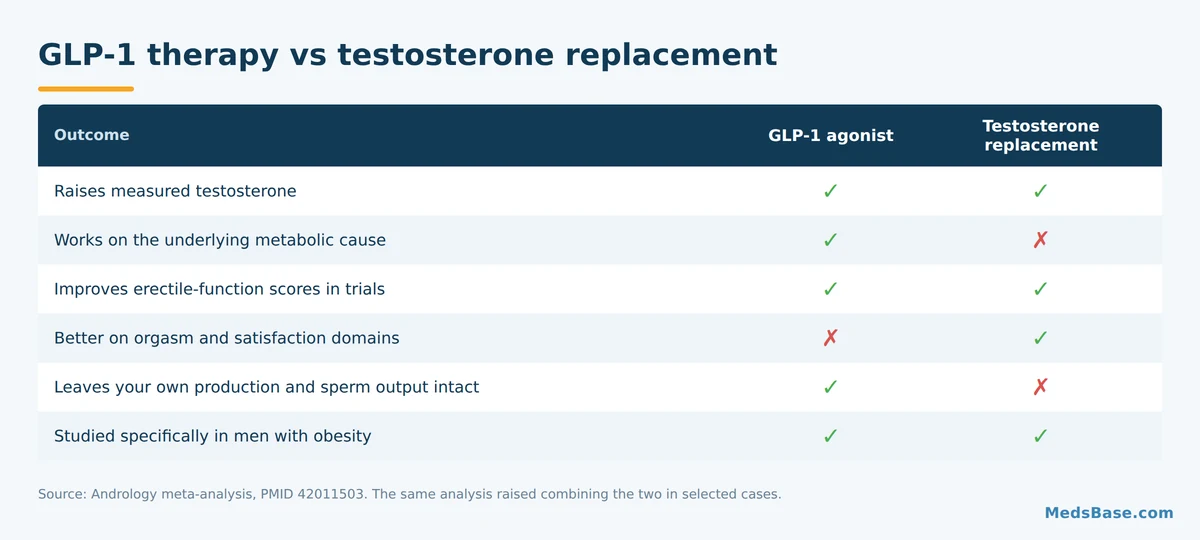
This is the comparison the headlines never make, and it is the one that gives you a practical answer. Ozempic and testosterone replacement are not rivals doing the same job badly — they do different jobs, and which one suits you depends on why your level is low in the first place.
| GLP-1 receptor agonist | Testosterone replacement therapy | |
|---|---|---|
| How testosterone rises | Your own production, via the pituitary signal | Supplied from outside |
| Effect on LH and FSH | Rises in pooled data | Suppressed |
| Effect on sperm production | Not suppressed; early signals mildly positive | Commonly suppressed |
| Treats the metabolic cause | Yes — that is its primary job | No |
| Erectile-function scores in trials | Improved substantially (IIEF sMD 3.31) | Improved |
| Orgasm and sexual satisfaction domains | Weaker | Better, per the 2026 analysis |
| Speed of hormonal change | Months | Weeks |
| Requires ongoing monitoring | Yes | Yes, more intensively |
Which one fits your situation? If your testosterone is low and you carry significant excess weight with metabolic disease, the GLP-1 route addresses your cause rather than your readout, and it does not switch off your own production — which matters enormously if fertility is on your table now or later. If your testosterone is low from a primary testicular or pituitary cause, no amount of metabolic improvement will fix it for you and replacement is the relevant treatment. If your main complaint is specifically about orgasm and sexual satisfaction rather than about your energy and metabolic health, the 2026 analysis found replacement performed better on exactly those domains.
And the two are not mutually exclusive. The 2026 authors explicitly raised combining them in selected cases, and there is older support for the idea: an earlier controlled study of liraglutide added to testosterone therapy in diabetic obese men with overt hypogonadism reported improved erectile function on the combination. That is a clinician-supervised decision — combining two hormonally active treatments without monitoring is how people get into trouble — but it is a real option rather than a fringe one.
If you’re weighing that route, what testosterone replacement actually involves sets out the practical commitment honestly, including the parts people underestimate.
How to Approach Ozempic and Testosterone — Practical Guidance
None of the evidence on Ozempic and testosterone helps you unless you turn it into something you can actually do. Here is the sequence that makes the difference between knowing a fact and knowing your own numbers.
- Get a baseline before you start, not after. Your testosterone should be measured on a morning sample, ideally twice on separate days, because your levels swing across the day and a single low reading proves very little. Without a baseline you will never know whether anything changed for you.
- Re-test at three to six months, not at three weeks. The studies followed men for months. Hormonal systems move slowly, and an early re-test mostly measures noise.
- Protect muscle while the fat comes off. Resistance training plus adequate protein, deliberately, because appetite suppression makes under-eating protein almost the default. We cover protecting muscle while you lose fat on a GLP-1 in full.
- Treat erections as a separate question. Improved scores in a trial population are not the same as a treatment for your erectile difficulty. If that is the actual problem, it deserves its own assessment.
- Don’t stack treatments unsupervised. Adding testosterone on top of a GLP-1 because an article mentioned combination therapy is exactly the decision that needs a clinician who can see your bloods.
- Reading “GLP-1s raise testosterone” as “GLP-1s are a testosterone treatment.” No regulator anywhere has approved them for that.
- Testing testosterone in the afternoon and drawing conclusions from it.
- Assuming a normal-weight man gets the same effect. That population was never studied.
- Stopping an existing testosterone treatment abruptly because of something you read here. Abrupt discontinuation has its own consequences.
- Losing weight fast without resistance training and then wondering why you feel worse despite better numbers.
Frequently Asked Questions
Q: Does Ozempic lower testosterone?
A: The pooled evidence on Ozempic and testosterone points the other way. Across seven studies and 680 men, total testosterone rose after GLP-1 treatment rather than falling, and luteinising hormone rose alongside it. That said, every study was conducted in men with obesity or type 2 diabetes, so the finding describes that population specifically. If your testosterone dropped after you started a GLP-1, your result needs individual investigation rather than reassurance from a pooled average.
Q: Can GLP-1 drugs increase testosterone naturally?
A: “Naturally” is the right word for the mechanism, if not for the drug. In this data the rise appears to come from your own testicles responding to a stronger pituitary signal — luteinising hormone and FSH both increased — rather than from hormone supplied to you externally. The 2026 Andrology analysis found the effect was independent of weight loss, suggesting direct action on the hormone axis. That mechanism remains a hypothesis supported by pooled observational data.
Q: Does Ozempic cause erectile dysfunction?
A: The trial data show the opposite direction. Four studies pooling erectile-function scores found a substantial improvement (IIEF standardised mean difference 3.31, 95% CI 2.49–4.12). Improvement in a trial population does not guarantee improvement for you, and rapid weight loss can bring you fatigue and low mood that affect your sexual function through entirely separate routes. If you develop new erectile difficulty after starting any medication, raise it with your clinician rather than waiting it out.
Q: How long does testosterone take to rise on a GLP-1?
A: The studies behind these findings generally ran over months rather than weeks — the ENDO 2026 review covered semaglutide trials of 24 weeks and liraglutide trials of 16 weeks. Testing yourself at three to six months on a morning sample is more informative than testing early. Nobody has established a reliable individual timeline for you, and there is no evidence that a faster testosterone rise indicates a better outcome.
Q: Should you take testosterone replacement therapy with Ozempic?
A: Possibly, and it is your clinician’s call rather than a self-service one. The 2026 meta-analysis found testosterone replacement outperformed GLP-1s on orgasm and sexual-satisfaction domains and explicitly raised combining the two in selected cases, and an earlier controlled study of liraglutide added to existing testosterone therapy reported improved erectile function. The catch is that replacement suppresses your own production and your sperm output, which matters if fertility is a current or future consideration for you.
Q: Does semaglutide affect sperm quality?
A: The signal is early and thin. Only two of the seven studies in the 2025 Andrology review measured semen parameters — too few to pool. The ENDO 2026 review of five trials noted improvements including sperm shape in men with obesity, while the researchers stressed that the studies are small with varying results and that better trials are needed. If fertility is your reason for asking, a semen analysis answers your question and this literature does not.
Q: Is this a reason to start a GLP-1?
A: On its own, no. These drugs are approved for type 2 diabetes and weight management, and these hormonal findings are an observed effect within those populations rather than an indication you can act on. If you already meet the criteria for GLP-1 treatment and you also have functional hypogonadism, the hormonal data are a genuinely useful part of your conversation with your doctor.
Q: Do the results apply to all GLP-1 drugs equally?
A: The pooled analyses combined several agents, most commonly semaglutide and liraglutide, and did not establish that one outperforms another for hormonal outcomes. The 2026 analysis did find a class difference at a higher level — SGLT2 inhibitors, which also produce weight loss, did not show the same significant testosterone effect — but only three small studies covered that comparison.
The Bottom Line on Ozempic and Testosterone
The link between Ozempic and testosterone is real, reasonably consistent in direction, and considerably less certain in size than the coverage suggests. Total testosterone, free testosterone, luteinising hormone, FSH and erectile-function scores all moved in a favourable direction across pooled studies of men with obesity and type 2 diabetes. The most interesting finding is that the hormonal change did not track weight loss, which points at something happening in the hormone axis directly. The most important limitation is that the studies disagreed with each other severely — 93% heterogeneity on the headline result — and several were rated poor quality by the reviewers themselves.
The balanced verdict: if you have obesity or type 2 diabetes and low testosterone, this is a genuine and welcome reason to discuss GLP-1 treatment with a clinician. If you have normal testosterone and no metabolic indication, nothing here applies to you, because nothing here studied you.
One thing you can do today: if you are already on a GLP-1 and have never had your testosterone measured, ask for a morning total testosterone test. It costs you little, it takes one appointment, and without it you are guessing about a system you could simply measure.
Wondering whether your erections are the metabolic problem or a separate one? Compare ED treatment options — a GLP-1 is not an erection treatment, and treating them as one question tends to leave both unanswered. And if the pattern here feels familiar — treated, numbers technically fine, still not feeling right — the same argument is playing out in thyroid medicine, where we look at which thyroid hormone people switch to when they still feel unwell.

Written by
Sophie ChenPharmaceutical Content Researcher · 8 years experience
Sophie Chen is a pharmaceutical content researcher with 8 years covering generic medication access and clinical pharmacology. She specialises in international regulatory frameworks, bioequivalence standards, and patient-facing education on therapeutic drug classes. She is not a clinician.