








✓ Medically reviewed by · Last reviewed: May 2026
Pharmacy Researcher · 8 years experience
Pharmacy researcher with 8 years reviewing clinical drug information, generic formulation equivalence, and international pharmaceutical standards. Focuses on patient-facing accuracy in medication education.
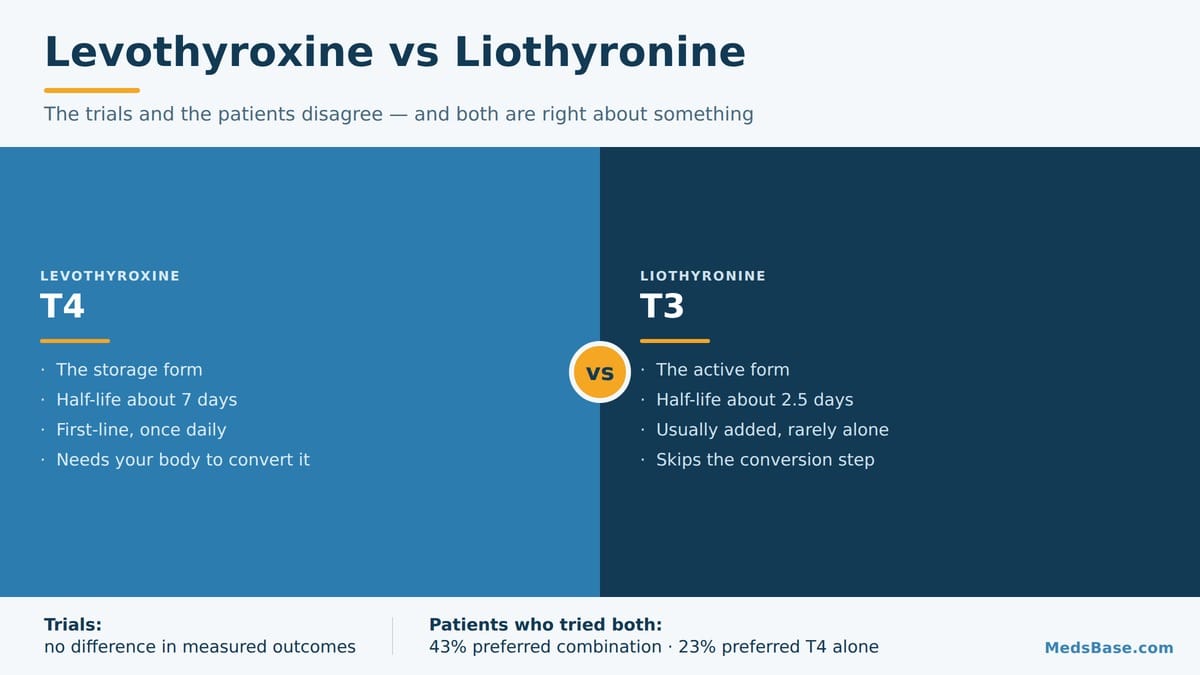
Most people are told that once the TSH number lands in range, thyroid treatment is working and any remaining symptoms must be something else. The research is less comfortable than that. In pooled trial data, patients who had tried both levothyroxine vs liothyronine combination therapy and levothyroxine alone preferred the combination by 43% to 23% — while the same analyses found no measurable difference between them in clinical status, quality of life, fatigue or mood.
Both of those results are real. Neither one cancels the other, and the reason they can both be true is the genuinely useful part of this whole debate.
Here’s what you’ll have by the end: what each hormone actually is, why one requires a conversion step your body performs and the other doesn’t, what three meta-analyses published between 2021 and 2026 found, whether the old heart-safety worry about liothyronine held up, and — importantly — the far more boring explanation that accounts for a good share of “my treatment isn’t working” cases before anyone needs to change drugs at all. That last one is where a surprising number of these stories actually end.
- In levothyroxine vs liothyronine, one is the storage hormone and one is the active one. Your body normally does the conversion itself — and where that step happens matters more than most explanations admit.
- Randomised trials found no clinical difference between the two approaches. Patients who had tried both disagreed with the trials, by nearly two to one.
- The historical safety objection to liothyronine has weakened considerably — a 2025 analysis of over 630,000 people found something genuinely unexpected in the mortality data.
- A 2026 network meta-analysis produced a scary-looking safety number whose credible interval is so wide it tells you almost nothing. We’ll show you why that matters.
- One extremely common, entirely fixable problem mimics “my medication isn’t working” — and it has nothing to do with which hormone you take.
Levothyroxine vs Liothyronine: What Each One Actually Is
Levothyroxine is synthetic T4 — thyroxine, the storage form of thyroid hormone. Liothyronine is synthetic T3 — triiodothyronine, the active form that binds receptors and does the work. Your thyroid normally makes mostly T4, and your tissues convert it to T3 as needed. Levothyroxine works with that system; liothyronine bypasses it.
That is the forty-second version, and it explains the whole levothyroxine vs liothyronine debate in one sentence. Now the detail that makes the difference practical for you rather than academic.
Levothyroxine is the first-line treatment for an underactive thyroid essentially everywhere. It has a long half-life, which means the level in your blood stays remarkably steady between your doses — take it once a day and you get a flat, predictable line. Miss a day and very little happens to you. That stability is the main reason it became standard, and it is a genuine clinical advantage rather than an accident of history.
Liothyronine behaves differently. It reaches your receptors without waiting for your body to convert anything, but its biological half-life is about two and a half days according to the FDA-approved label, against roughly a week for T4. A shorter half-life means peaks and troughs rather than a flat line — you feel each dose more, in both directions.
If the symptoms that brought you here still feel vague, what an underactive thyroid actually does to the body covers the full picture for you. The short version: fatigue, cold intolerance, weight change, low mood, brain fog and dry skin are all in scope, and none of them is specific to thyroid disease — which is exactly why your question gets complicated so quickly.
How Levothyroxine and Liothyronine Work — The Conversion Step
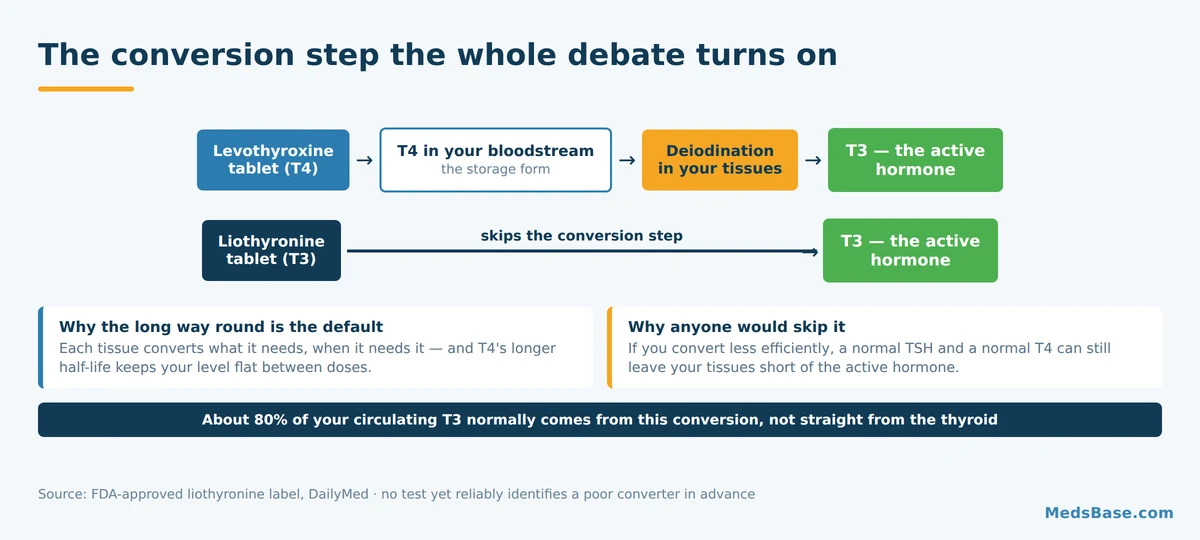
The whole levothyroxine vs liothyronine argument turns on one step, so here is a picture for it. Think of T4 as a sealed delivery van and T3 as the parcel inside it. The van is stable, easy to store, and useless to you until something opens it. Enzymes in your tissues — the deiodinases — perform that opening, converting T4 into T3 exactly where and when your tissue needs it.
That design is elegant for a reason. Each of your tissues regulates its own conversion, so your brain, liver and muscles can each dial their local T3 supply independently. Take levothyroxine and you are topping up your van supply and letting each tissue decide. Take liothyronine and you are delivering opened parcels straight into your bloodstream, at whatever rate the tablet dissolves.
The FDA-approved liothyronine label puts a number on how much of your normal T3 arrives by the conversion route: approximately 80% of circulating T3 is derived from peripheral conversion rather than direct thyroid secretion. Four fifths of your active hormone normally comes from the step that levothyroxine relies on and liothyronine skips.
So the theory behind combination therapy is straightforward: if you convert T4 to T3 less efficiently than average, you might sit at a normal TSH with a normal T4 while your tissues stay short of the active hormone. Give you a little T3 directly and your gap closes.
Here’s where it gets interesting. Because the theory has never been confirmed, and because the trials found no average difference, the standard conclusion was for years that combination therapy simply doesn’t work. But an average of zero across a mixed group can hide two opposite subgroups perfectly. If a minority genuinely benefit and a similar minority do slightly worse, the average is flat and the trial reports no difference — accurately.
That is not proof that responders exist. It is a reason the question stayed open long after the trials were supposed to have closed it — and a reason your doctor may take your persistent symptoms more seriously than a flat trial average suggests.
Levothyroxine vs Liothyronine: Who Each One Is For
Levothyroxine alone
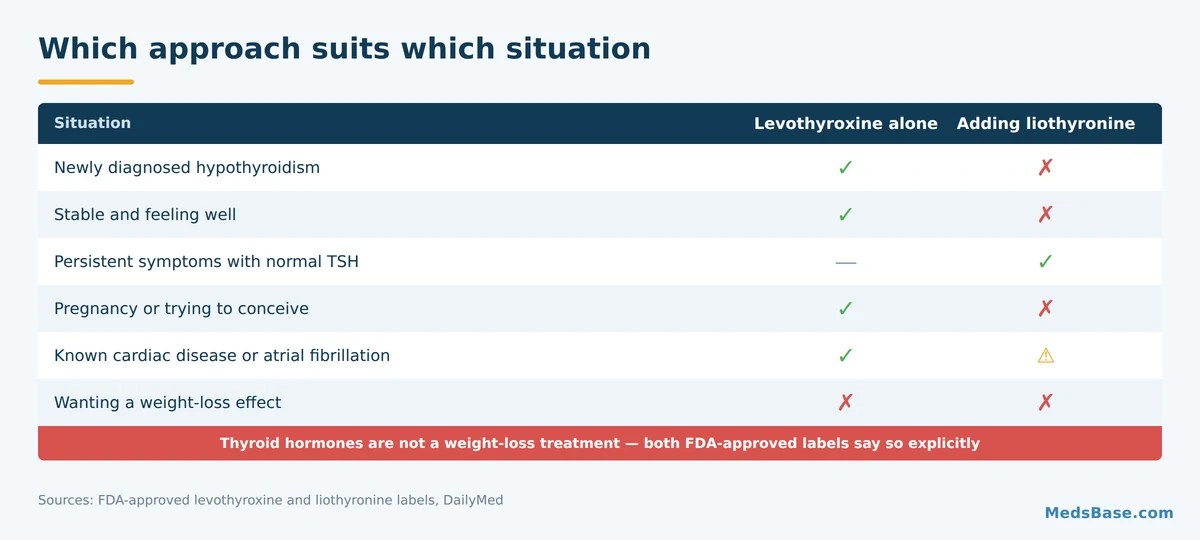
The default, and correctly so, if you are one of the large majority of people with hypothyroidism. If you were recently diagnosed, this is where your treatment starts. If you are stable on it and feeling well, there is no argument in the literature for you to change anything — this whole debate simply does not concern you yet.
It is also the clearly preferred option if you are pregnant or trying to conceive, because your thyroid hormone requirements change and the evidence base for anything else is thin.
Adding liothyronine
The realistic candidate group is narrow: you are already on an adequate levothyroxine dose, your TSH is genuinely in range on repeat testing, and you still have persistent symptoms after other causes have been looked for. Note the order — for you this is a consideration after a proper workup, not instead of one.
Liothyronine alone
Rarely the right answer for you as long-term hypothyroidism replacement. The short half-life makes your levels hard to keep stable, and the FDA-approved label reflects that context by listing thyroid cancer TSH suppression and the thyroid suppression test among its indications alongside hypothyroidism replacement.
Safety Profile, Side Effects and Dosing
Both drugs share one characteristic: almost every side effect you can get is a symptom of getting too much. Thyroid hormone replacement doesn’t have a separate toxicity profile so much as an overdose profile that makes you look and feel exactly like someone with an overactive thyroid.
| Side effect | Frequency | Severity | What to do |
|---|---|---|---|
| Palpitations, racing or irregular heartbeat | Common if over-replaced | Moderate to serious | Report promptly. Needs a dose review and often a TSH check |
| Anxiety, tremor, irritability | Common if over-replaced | Moderate | Usually resolves on dose reduction |
| Insomnia | Common if over-replaced, or with late-day T3 dosing | Mild to moderate | Review both dose and timing |
| Heat intolerance and sweating | Common if over-replaced | Mild | Dose review |
| Unintended weight loss with increased appetite | Common if over-replaced | Moderate | Dose review — not a desirable effect |
| Atrial fibrillation | Uncommon overall, higher risk in older adults and cardiac disease | Serious | Urgent assessment. Both labels flag this as the reason for cautious dosing in these groups |
| Bone density loss with long-term over-replacement | Long-term concern | Moderate | Periodic monitoring; another reason not to run TSH suppressed without cause |
The practical translation: if you feel wired, hot and sleepless on your thyroid treatment, you are probably on too much rather than finally on enough. That distinction is easy for you to get backwards when you have spent years feeling under-treated.
Dosing, and why levothyroxine takes so long to judge
The FDA-approved levothyroxine label sets a full replacement dose at 1.6 micrograms per kilogram per day, titrated in 12.5 to 25 microgram increments every four to six weeks. Adults at risk of atrial fibrillation or with cardiac disease start lower and titrate every six to eight weeks. Crucially, the label states that the peak therapeutic effect of a given dose may not be attained for four to six weeks — and that TSH should be rechecked six to eight weeks after any dose change.
Liothyronine dosing runs on a different clock, which is one of the more practical differences between them. Its label gives an adult starting dose of 25 micrograms once daily, increased by 25 micrograms every one or two weeks, with a usual maintenance dose of 25 to 75 micrograms daily. If you are older or have underlying cardiac disease, the label directs starting you at 5 micrograms daily and increasing in 5 microgram steps.
For the practical detail on levothyroxine strengths, levothyroxine strengths and how dosing is set covers the titration range in full.
Six weeks to judge a change is the single most-broken rule in thyroid treatment. You change dose, feel no different after ten days, and conclude the drug has failed you — when the label says the effect had not arrived yet.
What Does the Research Say About Levothyroxine vs Liothyronine?
Three substantial analyses, published between 2021 and 2026, define where levothyroxine vs liothyronine currently stands. Read them together rather than singly — any one of them on its own will give you a misleading impression.
| Study | Year | Finding | Source |
|---|---|---|---|
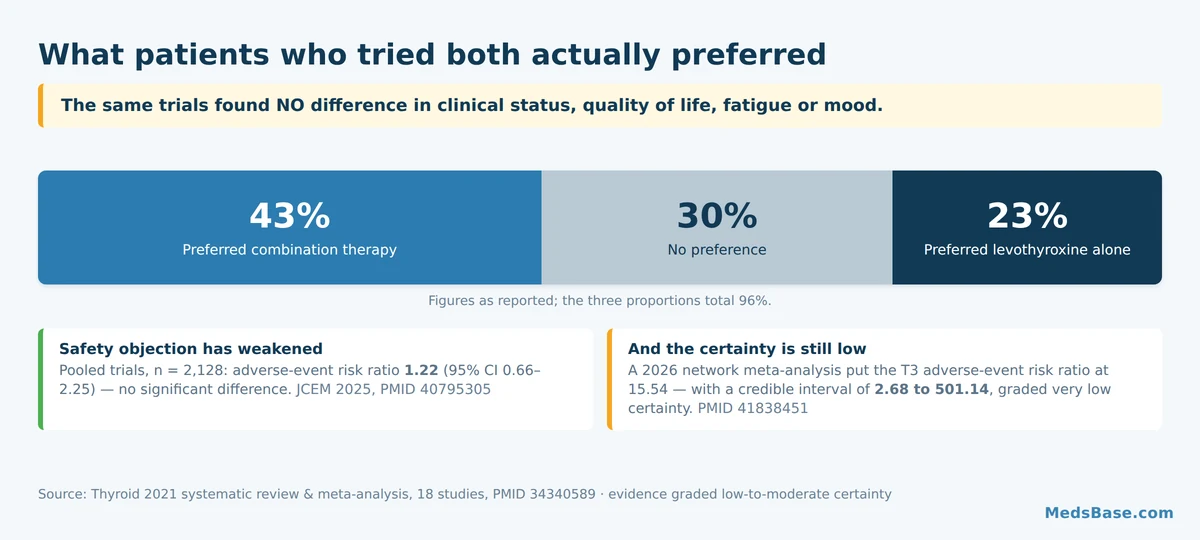
| Systematic review & meta-analysis, Thyroid (18 studies) | 2021 | No difference between combination therapy and levothyroxine monotherapy in clinical status, quality of life, psychological distress, depressive symptoms or fatigue, at low-to-moderate certainty. But patient preference split 43% combination / 23% monotherapy / 30% no preference. Adverse events appeared similar between groups | PMID 34340589 |
| Multisource systematic review & meta-analysis, JCEM (52 studies) | 2025 | Pooled RCTs (n=2,128): adverse-event risk for combination vs monotherapy RR 1.22 (95% CI 0.66–2.25) — no significant difference. Pooled cohorts (n=630,254): atrial fibrillation RR 1.10 (0.74–1.63), heart failure RR 1.54 (0.95–2.47), stroke RR 0.86 (0.11–6.75) — none significant. Mortality RR 0.70 (0.62–0.78) — lower in liothyronine users | PMID 40795305 |
| Bayesian network meta-analysis, Endocrine Connections (35 RCTs, 3,508 patients) | 2026 | Liothyronine increased adverse events versus placebo, RR 15.54 (95% CrI 2.68–501.14) — but graded very low certainty by CINeMA. Separately, levothyroxine plus aerobic and resistance training reduced TSH (SMD −3.97, 95% CrI −5.76 to −2.18) at high certainty and improved quality-of-life scores | PMID 41838451 |
Three things deserve unpacking, because on levothyroxine vs liothyronine the table alone will mislead you.
First, the preference finding is not a measurement error. A 2021 systematic review and meta-analysis in Thyroid pooled 18 studies and found no difference on any measured clinical outcome — and found that when patients who had experienced both were asked which they preferred, nearly twice as many chose combination therapy. The authors’ own framing was that these results should inform shared decision-making conversations rather than settle the question. Preference is data too; it is just data about something the questionnaires weren’t measuring.
Second, the mortality finding needs care. A 2025 safety meta-analysis in the Journal of Clinical Endocrinology & Metabolism drew on trials, cohorts, the UK Yellow Card scheme and the US FDA adverse-event database, and found no increased risk of atrial fibrillation, heart failure or stroke among liothyronine users — with reduced mortality (RR 0.70). That is a striking result, and the sober reading is that it comes from observational cohort data where people prescribed liothyronine may differ systematically from those who aren’t: often younger, often healthier, often more engaged with their care. It is strong evidence against the old harm hypothesis. It is not evidence that liothyronine extends life. The authors’ own conclusion was the measured one — that findings are reassuring that regulated use is not associated with death or serious adverse events, and that more studies are needed.
Third, that alarming 2026 number is mostly noise. A 2026 network meta-analysis in Endocrine Connections reported liothyronine increasing adverse events with a risk ratio of 15.54 — and a credible interval running from 2.68 to 501.14. An interval spanning more than two orders of magnitude means the data are compatible with a small effect and with an absurd one; the analysts graded the certainty “very low” themselves. A number with a credible interval that wide is a signal to collect better data, not a basis for a decision. Reporting the point estimate without the interval, as some coverage does, is how a non-finding becomes a scare.
The same 2026 analysis contained something more immediately useful. Levothyroxine combined with aerobic and resistance training reduced TSH at high certainty and improved quality-of-life and mental-health scores. That was the highest-certainty finding in the entire network — and it involved no change of medication at all.
Levothyroxine vs Liothyronine vs Combination Therapy and Desiccated Thyroid
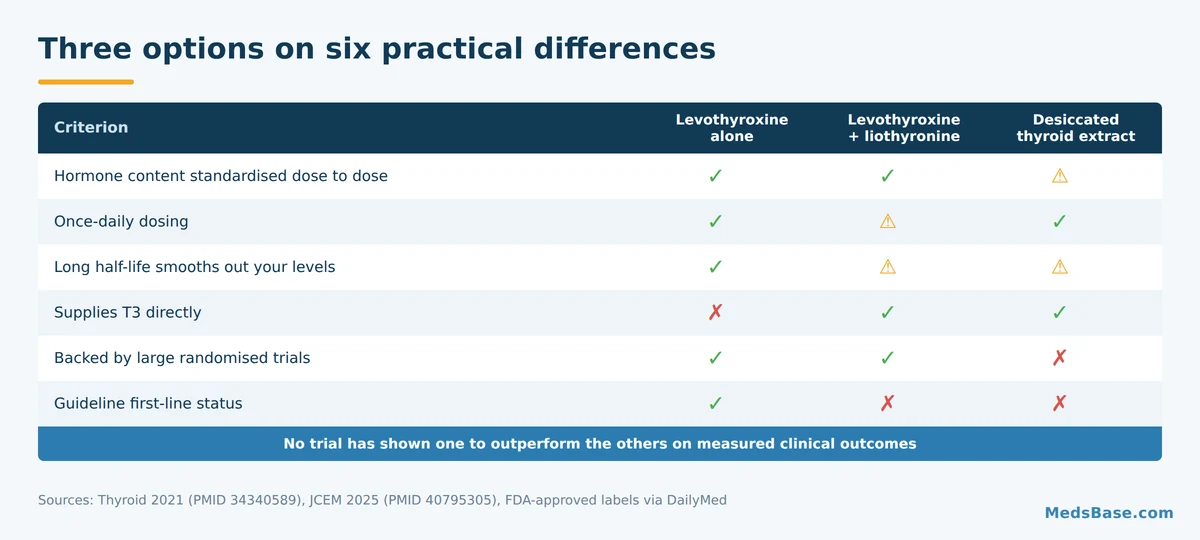
| Levothyroxine alone | Levothyroxine + liothyronine | Desiccated thyroid extract | |
|---|---|---|---|
| What it supplies | T4 only | T4 plus a small amount of T3 | T4 and T3 from animal thyroid |
| Dose-to-dose consistency | High | High for each component | More variable between products |
| Dosing frequency | Once daily | Usually once daily plus split T3 doses | Usually once or twice daily |
| Half-life profile | Long and flat | Flat base with T3 peaks | Mixed |
| Guideline first-line status | Yes | No — considered case by case | No |
| Randomised trial evidence | Extensive | Substantial, consistently showing no average difference | Limited |
| Best suited to | Almost everyone starting treatment | Persistent symptoms despite adequate levothyroxine and a proper workup | Rarely a first choice on current evidence |
So where does levothyroxine vs liothyronine leave you? If you have just been diagnosed, levothyroxine alone, without hesitation — the evidence is deepest, the dosing is simplest, and most people in your position do well. If you have been on levothyroxine for a year or more, your TSH is genuinely in range on repeat testing, your other causes have been ruled out, and you still feel unwell, then a supervised trial of adding liothyronine is a reasonable conversation for you to have with your doctor. The 2021 analysis makes the case for that conversation explicitly. If you are pregnant, trying to conceive, over 65 or living with cardiac disease, the balance shifts firmly back toward levothyroxine alone for you.
Desiccated thyroid extract sits outside the well-studied levothyroxine vs liothyronine comparison. It supplies you both hormones, which is its appeal, but with less consistent standardisation and a thinner trial base than either synthetic option you have been weighing.
If you want to see what the T3 option looks like in practice, you can see liothyronine options — no prescription is needed to order from MedsBase, which makes it more important, not less, that a change like this is made with a clinician who can monitor your bloods and your heart rhythm.
Getting the Most From Either — Practical Guidance
Time to resolve the loop from the introduction: the boring explanation that accounts for a large share of “my medication isn’t working.”
It is absorption — and it has nothing to do with levothyroxine vs liothyronine at all. The levothyroxine label states that absorption of oral T4 from the gastrointestinal tract ranges from 40% to 80% — a range so wide that you and someone on an identical dose can end up with substantially different blood levels based on nothing but your timing and what else is in your stomach. Get your timing wrong and you can be taking a correct dose while absorbing a fraction of it.
- Take it on an empty stomach, half an hour to an hour before breakfast. This is the label’s own instruction, and fasting increases absorption.
- Leave at least four hours around the big blockers. The label names calcium carbonate, ferrous sulfate and other phosphate binders, bile acid sequestrants such as cholestyramine and colesevelam, and orlistat — all of which bind levothyroxine and prevent it being absorbed. Four hours’ separation, not one.
- Know that acid-suppressing drugs matter too. The label notes that gastric acidity is essential for adequate levothyroxine absorption, and that proton pump inhibitors, sucralfate and antacids can reduce it. This one is missed constantly because the interaction is invisible.
- Stop biotin supplements at least two days before any thyroid blood test. Biotin interferes with the assay itself, so it distorts the result rather than your hormone level — the label calls this out specifically. High-dose biotin is common in hair and nail supplements.
- Be consistent rather than perfect. A steady routine that is slightly imperfect beats an ideal routine you follow half the time, because dose adjustments are made against your average.
- Wait the full six weeks before judging a change. The label says peak effect may take four to six weeks and TSH should be rechecked at six to eight.
- Add the exercise. The 2026 network meta-analysis found levothyroxine plus aerobic and resistance training reduced TSH at high certainty and improved quality-of-life scores — the strongest-certainty finding in the whole analysis, and it requires no prescription change.
- Taking levothyroxine with coffee or breakfast because it’s easier to remember. It measurably reduces absorption.
- Taking a calcium or iron supplement in the same part of the morning. Four hours.
- Judging a dose change at two weeks.
- Assuming a normal TSH means every other cause has been excluded. Iron deficiency, B12 deficiency, coeliac disease, sleep apnoea and perimenopause all mimic this.
- Adjusting your own dose upward because you still feel tired. Over-replacement carries real cardiac and bone risks.
- Reading the 2026 risk ratio of 15.54 without its credible interval.
Frequently Asked Questions
Q: Is liothyronine better than levothyroxine?
A: On measured outcomes, no. In levothyroxine vs liothyronine, a 2021 meta-analysis of 18 studies found no difference between combination therapy and levothyroxine alone on clinical status, quality of life, psychological distress, depressive symptoms or fatigue, at low-to-moderate certainty. What the same analysis did find was that patients who had tried both preferred combination therapy 43% to 23%. So the accurate answer for you is that it is not better on the outcomes trials measure, and a meaningful minority of people who have used both say they prefer it anyway.
Q: Why do I still feel tired on levothyroxine when my TSH is normal?
A: Often for reasons that sit outside the levothyroxine vs liothyronine question entirely. Your absorption is the first thing to check, because oral levothyroxine absorption ranges from 40% to 80% and is reduced by your coffee, calcium, iron, antacids and acid-suppressing drugs. After that come the conditions that mimic hypothyroidism: iron deficiency, B12 deficiency, coeliac disease, sleep apnoea, depression and perimenopause. If your symptoms persist with a normal TSH, you deserve a proper workup before anyone changes your medication.
Q: Can you take levothyroxine and liothyronine together?
A: Yes — that is precisely what combination therapy means, and it is the arrangement the levothyroxine vs liothyronine trials actually studied. It is a supervised change rather than a self-directed one, because your liothyronine dose has to be balanced against a reduction in your levothyroxine, and because your monitoring needs to cover heart rhythm as well as thyroid levels. The liothyronine label also notes that when switching, residual effects of the previous thyroid preparation may persist for the first several weeks.
Q: Is liothyronine safe for your heart?
A: The recent evidence is more reassuring than the drug’s reputation. A 2025 multisource meta-analysis pooling cohort data on 630,254 people found no increased risk of atrial fibrillation (RR 1.10), heart failure (RR 1.54) or stroke (RR 0.86) among liothyronine users, and pooled randomised trials showed no significant difference in adverse events. That said, both labels direct cautious low-dose starts in older adults and anyone with existing cardiac disease, because over-replacement with any thyroid hormone raises the risk of atrial fibrillation.
Q: How long does it take to feel a difference after switching thyroid medication?
A: Longer than you will want to allow. The levothyroxine label states peak therapeutic effect of a given dose may not be attained for four to six weeks, and directs rechecking your TSH six to eight weeks after any change. Liothyronine acts faster for you because it skips the conversion step, but your stable overall picture still takes weeks. Judging a change at ten days is the most common way people conclude a treatment has failed when it simply hasn’t arrived.
Q: What stops levothyroxine from being absorbed?
A: A surprising amount. The label names calcium carbonate, ferrous sulfate and other phosphate binders, bile acid sequestrants such as cholestyramine and colesevelam, and orlistat — all needing at least four hours’ separation. Proton pump inhibitors, sucralfate and antacids reduce absorption by changing stomach acidity, which levothyroxine needs. Food generally reduces it, which is why the label specifies an empty stomach half an hour to an hour before breakfast. Separately, biotin supplements distort the blood test rather than the hormone, so stop them at least two days before testing.
Q: Does liothyronine help with weight loss?
A: No, and this is one of the few places both labels are unambiguous rather than cautious. Thyroid hormones should not be used for the treatment of obesity or for weight loss, and doses beyond normal hormonal requirements may produce serious or even life-threatening toxicity. Weight gain from an underactive thyroid usually improves once replacement is adequate; pushing past adequate does not produce further weight loss, it produces the effects of an overactive thyroid.
Q: Should I ask my doctor about combination therapy?
A: If you are on an adequate levothyroxine dose, your TSH is confirmed in range on repeat testing, your other causes have genuinely been looked for, and you still feel unwell — yes, levothyroxine vs liothyronine is a reasonable conversation for you to open, and the 2021 meta-analysis authors framed their results as material for exactly that discussion. If you are newly diagnosed, still titrating, or have not yet had your absorption and mimicking-condition questions worked through, those come first.
The Bottom Line on Levothyroxine vs Liothyronine
The honest summary of levothyroxine vs liothyronine is that the trials and the patients disagree, and both are telling the truth about different things. Randomised evidence shows no average difference in the outcomes researchers chose to measure — which may not be the outcomes you care about. Patient preference data show a near two-to-one lean toward combination therapy among people who tried both. The old cardiovascular objection to liothyronine has substantially weakened under a 2025 analysis of over 630,000 people, and the scariest recent safety number carries a credible interval so wide that it functions as an admission of uncertainty rather than a finding.
The balanced verdict: levothyroxine alone remains the right starting point for almost everyone, and if you are well on it you have no reason to change. Adding liothyronine is a legitimate, supervised option for a narrow group — adequately dosed, TSH in range, other causes excluded, still symptomatic — and it is neither a fringe request nor a guaranteed answer.
One thing you can do today: before considering any change of drug, fix the timing. Take your levothyroxine on an empty stomach, keep calcium and iron four hours away, move any acid-suppressing medication well clear of it, and hold that routine for six weeks. Given that absorption ranges from 40% to 80%, this alone resolves a meaningful share of “my treatment isn’t working” — and it costs nothing.
Continuing on treatment either way? Browse underactive thyroid treatments to see the strengths and options available. And if the shape of this argument feels familiar — treated, results technically normal, still not right — it is playing out in male hormone medicine too, where we look at the same argument playing out in men’s hormone treatment and what the newest evidence found there.

Written by
Sophie ChenPharmaceutical Content Researcher · 8 years experience
Sophie Chen is a pharmaceutical content researcher with 8 years covering generic medication access and clinical pharmacology. She specialises in international regulatory frameworks, bioequivalence standards, and patient-facing education on therapeutic drug classes. She is not a clinician.